


Uncategorized
House defeats Iran war powers resolution as Democrats wrestle with Israel
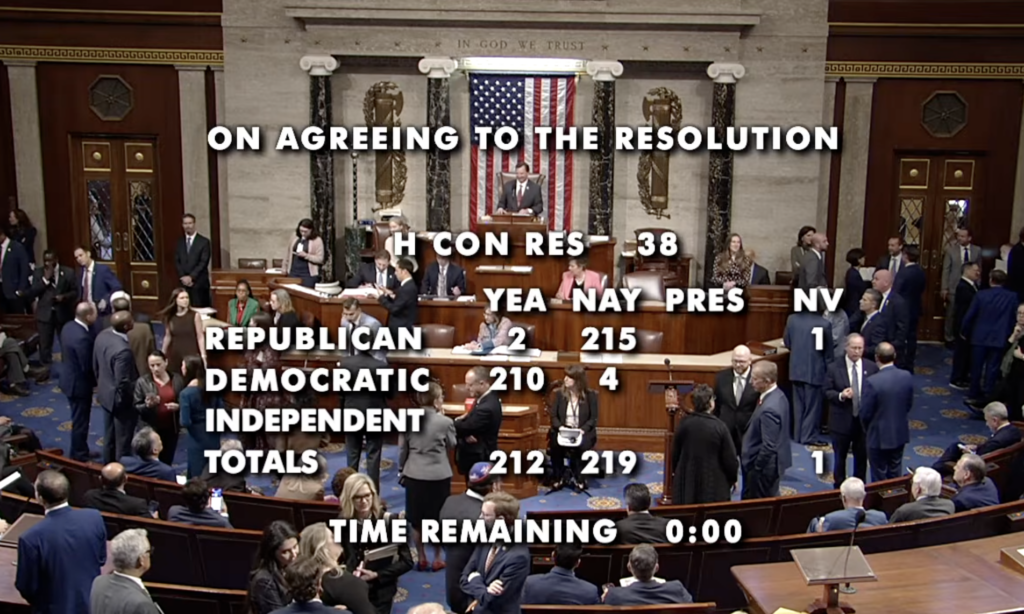
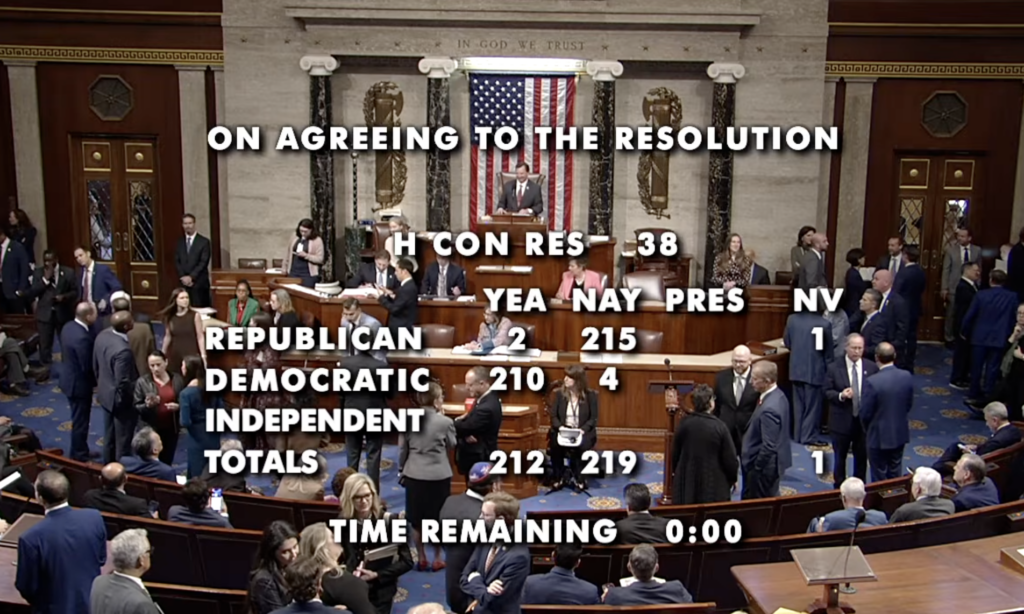
The House of Representatives on Thursday rejected a Democratic-led effort to limit President Donald Trump’s authority to expand U.S. military operations against Iran, voting largely along party lines with some defections on both sides.
The 212-to–219 vote exposed deep divisions within the Democratic Party, including among Jewish members who support confronting Tehran but say it should be up to Congress to authorize any broader war, as the constitution requires. Four Democrats joined Republicans, giving the GOP’s slim and fractured majority enough votes to defeat the measure.
The War Powers Act resolution, which would have required the administration to halt U.S. strikes against Iran, was introduced by Republican Rep. Thomas Massie of Kentucky, a libertarian and open critic of Israel, and co-sponsored by 94 Democrats.
The Senate rejected a similar effort to curb the president’s authority, largely along party lines.
Some members of the House offered a more moderate alternative that would order Trump to end the military campaign within 30 days unless Congress authorizes a formal declaration of war. That measure did not come up for a vote.
Rep. Greg Landsman of Ohio was the only Jewish Democrat to oppose the resolution. Reps. Josh Gottheimer of New Jersey and Jared Moskowitz of Florida, two Democrats who have at times crossed party lines in support of Israel and offered forceful support for U.S. military action against the Iranian regime, ultimately voted with most of their party to invoke the War Powers Act after initially opposing the measure.
Even if a resolution restraining Trump did clear Congress, Trump could veto it, necessitating a two-thirds vote in both chambers to override it — a threshold unlikely to be reached.
Trump said on Wednesday that the joint U.S.-Israeli air campaign against Iranian military and nuclear infrastructure, which he said was intended to create the conditions for regime change, was proceeding beyond expectations. He added that he rated Operation Epic Fury “about a 15” on “a scale of 10.” U.S. officials signaled strikes will intensify in the coming days.
At least six U.S. servicemembers have been killed in Iranian missile strikes. Operations in the region include at least 200 fighter jets, two aircraft carriers and about 50,000 troops stationed there.
The House also approved a separate resolution introduced by Rep. Brian Mast, a Republican from Florida, reaffirming the U.S. position that Iran remains the world’s largest state sponsor of terrorism. The measure passed with bipartisan support, 372 voting in favor and 53 — all Democrats — voting against.
Growing criticism of Israel and opposition to the war
The debate over the war exposed a growing divide between mainstream Democrats, who are largely supportive of Israel and back efforts to weaken Iran’s military and nuclear capabilities, and a party base that remains strongly opposed to U.S. military action. Those lawmakers say they support Israel’s right to defend itself and believe U.S. action against Iran’s missile and nuclear infrastructure may be justified, but they criticized the lack of congressional approval and the absence of a clear endgame that could lead to an endless and deadly conflict.
The position puts the centrist Democrats between progressives in their party who are demanding the strikes stop immediately and Republicans who overwhelmingly back Trump’s strategy — efforts by some on the far right to turn the party against the war notwithstanding. Some Democrats pointed to remarks by Secretary of State Marco Rubio that suggested that an Israeli decision to strike Iran forced Trump to act first.
The vote sends signals ahead of midterm primary elections for House seats. A CNN poll since the war began found that 82% of Democrats overwhelmingly disapprove of the U.S. action against Iran. Almost the same share of Israelis support the war.
Politicians are mindful that they can pay a price for supporting Israel in many districts: In an internal review of the 2024 presidential election, Democratic leaders acknowledged that the Biden administration’s support for Israel during the war in Gaza was a “net negative” politically and cost then-Vice President Kamala Harris crucial support among younger and progressive voters. Several progressive organizations have threatened to back primary challengers to Democrats who vote against limiting the war.
House Democratic Leader Hakeem Jeffries of Brooklyn, who has cultivated close ties with Jewish leaders since his election in 2012 and has visited Israel nine times, said in a House floor speech ahead of the vote that Trump has failed to make the case “to justify plunging America into another war that will cost more American lives and billions, if not trillions, in taxpayer resources.”
Speaking to reporters before that, Jeffries refused to say whether he’d back the alternative measure to give Congress a say on the war. “We will cross that bridge when we get to it,” he said.
The post House defeats Iran war powers resolution as Democrats wrestle with Israel appeared first on The Forward.
Uncategorized
Sally Rooney’s publisher stops selling her books in Britain, citing ban on pro-Palestinian group she backs
(JTA) — Sally Rooney’s publisher says it will stop supplying her books in the United Kingdom because current legislation prevents it from passing her earnings on to her.
The best-selling Irish writer, whose work includes the novel “Normal People,” which was adapted into a hit BBC drama, has long been a vocal supporter of the Palestinian cause.
Faber said it would no longer supply her books in the United Kingdom because of her backing for Palestine Action, a group that the British government last year proscribed as a terrorist organization, saying it had “orchestrated a nationwide campaign of direct criminal action against businesses and institutions.”
“Current legislation in the UK has led to circumstances where Faber cannot pass on UK earnings to Sally Rooney for her work,” the publisher said.
“To sell a writer’s work and not be able to pass on earnings is an unconscionable situation for a publisher,” it said. “As such, and in full agreement with Sally, we have taken the decision that we can no longer supply her works in the UK in any format. We remain the proud publisher of her remarkable body of work, which we will continue to sell in other territories.”
Faber had no further comment, the statement said.
Yvette Cooper, then the Home Secretary, banned Palestine Action last year following an attack by the group on the Royal Air Force base at Brize Norton which caused millions of pounds of damage. It had previously targeted businesses and premises which it said were linked to Israeli defence companies.
Soon after the announcement, Rooney wrote an opinion piece in the Irish Times in which she doubled down on her support for Palestine Action, adding that she would give the proceeds of her books to back the group. “If this makes me a ‘supporter of terror’ under British law, so be it,” she wrote.
In a statement following the action announced by Faber, Rooney cited her Irish Times opinion piece as she explained that the publication of her books “could now constitute a serious criminal offence.”
The ban of Palestine Action has proven to be highly contentious in Britain. Back in February, the group’s co-founder Huda Ammori challenged the move in the High Court, with Rooney providing a supportive witness statement. She said at the time that she was “almost certain” her work would be dropped in Britain if the ban persisted.
The court ruled in Ammori’s favor, but that decision was overturned by the Court of Appeal in June. The Supreme Court is due to hear an appeal next month.
Rooney said on Wednesday: “After a process of consultation and deliberation, and with my full agreement, my publisher Faber has therefore determined that it can no longer supply my work within the UK.
“I have made every effort to be honest with the public about my beliefs and intentions, and I am wholly prepared to accept the consequences.”
Rooney’s support for the Palestinian cause predates the attack by Hamas on Oct. 7, 2023, and the subsequent war in Gaza. In 2021 she declined to sell Hebrew translation rights for her novel “Beautiful World, Where Are You?” to the Israeli publisher that had previously released her books in Hebrew.
At the time, she said she supported the BDS movement and would not work with an Israeli publisher unless it is willing to “publicly distance itself from apartheid and support the U.N.-stipulated rights of the Palestinian people.”
That move prompted backlash in Israel and beyond, including calls to boycott Rooney’s work. Israeli bookstore chains reportedly removed some of her books from shelves.
However, earlier this year she agreed to have her latest novel, “Intermezzo,” published by an Israeli publisher approved by boycott activists.
This article originally appeared on JTA.org.
The post Sally Rooney’s publisher stops selling her books in Britain, citing ban on pro-Palestinian group she backs appeared first on The Forward.
Uncategorized
Trump cheered in video address to Michigan synagogue
(JTA) — SOUTHFIELD, Mich. – President Donald Trump addressed a Michigan synagogue by video Wednesday evening as part of an event orchestrated by Leo Terrell, chair of the administration’s task force for combating antisemitism, and the Zionist Organization of America.
Trump’s greeting, which was prerecorded, was met with applause from the estimated 500 Jews who had come to Congregation Shaarey Zedek in the Detroit suburbs amid a pivotal Senate election in the state that has prompted deep anxieties among its Jewish population.
The president told the crowd that Terrell “speaks for our country” and “speaks for a lot of people, a lot of people that love Israel but really, more than anything else, they don’t want to see false and inaccurate statements made about this horrible subject of antisemitism.”
The event was billed as the first stop on Terrell’s “American Tour Against Hate” and was staged by the U.S. Justice Department, while also serving as a fundraiser and booster for ZOA. Attendees were handed donation forms for ZOA’s Michigan chapter. The organization’s national director, Mort Klein, is close with Terrell and said he intends to participate in all future stops on the tour.
Several other Trump officials, including Terrell and U.S. Attorney General Todd Blanche, would address the crowd over the course of the night to emphasize the administration’s efforts to combat antisemitism.
(L-r) Leo Terrell, chair of the Trump administration’s Task Force to Combat Antisemitism, with U.S. Department of Labor official Kenneth Wolfe at an event to combat antisemitism at Congregation Shaarey Zedek in Southfield, Michigan, on Oct. 14, 2026. (Andrew Lapin/JTA)
Kobi Erez, director of ZOA’s Michigan chapter, told the Jewish Telegraphic Agency after the event that the evening was designed to be “nonpartisan.”
“It’s a tour against hate, and we can’t choose one side,” Erez said. “We have to fight antisemitism and hate for all.”
He argued that the event was not a ZOA fundraiser in his view, saying that it was free to attend and that the organization was asking for donations mainly to cover security costs.
He also said that the organization had been in touch with the head rabbi of Shaarey Zedek, Aaron Star, to address any concerns about the nature of the event so close to Election Day. “We had to promise Rabbi Starr that we were going to make a disclaimer that Shaarey Zedek doesn’t necessarily represent all the views of the speakers.”
Terrell did make that disclaimer, midway through the two-hour event.
Starr told JTA that there had been a back-and-forth with ZOA over the Trump video due to “a string of miscommunications and some last minute changes over the course of the day.”
Polls have shown that a majority of Jews nationwide have opposed Trump and his policies since his entry on the political scene. Yet recent fears about growing antisemitism and anti-Israel sentiment on the left have also alienated many Jews from the Democratic Party.
Some Michigan Jews are preparing to vote for a Republican for the first time over their objections to the Democratic Senate candidate, Abdul El-Sayed, a harsh critic of Israel whose prior remarks on Jewish safety have also upset many in the community.
El-Sayed’s name was not uttered from the stage Wednesday, but the Trump officials on hand took many opportunities to praise their boss’s work on Jewish issues.
“This administration, unlike any other administration, is committed 24/7 to fighting antisemitism,” Terrell told the crowd.
An estimated 500 Michigan Jews applaud Trump administration officials during an event held to address antisemitism at Congregation Shaarey Zedek in Southfield, Michigan, Oct. 14, 2026. (Andrew Lapin/JTA)
The Conservative synagogue was billed online as a “co-sponsor” of the event along with Frankel Jewish Academy, a local Jewish day school. But Starr told JTA, “It wasn’t our event.”
Midway through the program, Terrell stated that Shaarey Zedek “is not sponsoring this event,” adding, “The words of the speakers, mine and others, are theirs alone and are not a representation of this great religious institution.”
Terrell stated that DOJ and ZOA were the sponsors — itself an unusual arrangement between a federal agency and an activist group. Klein told JTA following the event that Terrell had contacted his organization to help organize the tour, and that ZOA “really did all the work.”
U.S. Attorney General Todd Blanche, who has been criticized for appearing at campaign events and who recently penned a memo loosening restrictions on political activism for senior federal officials, also addressed the crowd in a prerecorded video.
“In recent years, we have seen a disturbing rise in antisemitic rhetoric and acts of hatred against fellow citizens,” Blanche said. “Hate has no place in America, and this Department of Justice remains committed to confronting it wherever it appears.”
Initially billed as a conversation between Terrell and Klein, the event functioned more as an informational session for Jews to learn how their government is responding to antisemitism.
Flyers from the FBI instructed attendees on how to respond to various categories of threat. A roundtable of local and federal law enforcement officials, led by the FBI Detroit office field director who had responded to the terror attack on Temple Israel in the state in March, sought to assure the Jews in attendance that they had their backs.
Terrell also unveiled a just-launched “American Tour Against Hate” app that, he said, would enable its users to take a pledge to fight antisemitism and “report” antisemitic incidents. It wasn’t immediately clear where the reports would be filed to. The Combat Antisemitism Movement, another activist group, was credited for the app on its download page.
Trump administration official Leo Terrell addresses Congregation Shaarey Zedek in Southfield, Michigan, on the first stop of his “American Tour Against Hate,” Oct. 14, 2026. (Andrew Lapin/JTA)
Still, politics seeped in, and much of the crowd seemed happy about it. Klein attacked another anti-Zionist politician, New York City mayor Zohran Mamdani, by name in his remarks. He also drew enthusiastic cheers for calling to “fight the open-border policies that we had in the past, which allows unvetted people from countries whose governments and populations overwhelmingly hate Jews.”
Other Jewish speakers alluded to El-Sayed — particularly his initial reaction to the Temple Israel attack, which many Jews believed was equating the attack with Israel’s war in Lebanon. The candidate has since apologized for his initial remarks.
“No conflict overseas can ever justify trying to murder innocent people here at home, and no political candidate should ever excuse terror and hate,” Erez told the crowd.
Later, during an interfaith roundtable, Rabbi Shneur Silberberg of the Bais Chabad Torah Center in West Bloomfield leveled a more direct accusation.
“If you respond differently to a terror attack against a group of Jewish schoolchildren, and your response is any different than it would be to any other group of children, then that’s antisemitism,” Silberberg told the crowd.
During the program, Terrell inveighed against antisemitism with a showman’s flair, often to the delight of the audience, some of whom shouted his name. “News flash: I’m not Jewish. Who cares?” Terrell asked the crowd early on, to laughter and applause. He donned a red hat in the style of Trump’s “Make America Great Again” merchandise, with the lettering instead spelling, “American Tour Against Hate.”
He went after college campuses and K-12 teachers he said were “indoctrinated,” and repeatedly denounced what he called “the Jewish tax,” which he defined as the high security costs the community bears in order to safeguard its houses of worship and other institutions.
Flyers from the Federal Bureau of Investigation laid out on a table during the “American Tour Against Hate,” an event staged by the Trump administration at Congregation Shaarey Zedek in Southfield, Michigan, Oct. 14, 2026. (Andrew Lapin/JTA)
“For you to enjoy your right to walk down the street, to enjoy your synagogue, to go to a Jewish community center, to have your kids walk through their school, you have to pay extra security, millions of dollars,” Terrell said. “That’s going to stop.”
Terrell and Klein plan to meet with the head of Detroit’s Jewish federation as well as with rabbis at Temple Israel during their stay in town, Klein told JTA.
Erez said that Terrell’s visit to Michigan also included meetings with the mother of a Temple Israel preschooler who had been in the building during the March attack, as well as with Jewish college students who had experienced antisemitism. Terrell also met with leaders of Frankel Jewish Academy, one of the event’s co-sponsors, as well as the local Jewish Community Center, he said.
A longtime supporter of Trump, Klein said he believed the event demonstrated that more Jews were warming to the president as concerns about antisemitism have grown.
“I think more Jews certainly are more supportive of Trump than they were before, because they see what he’s done,” he said.
Sharon Matlen, a resident of nearby Farmington Hills who grew up in Skokie, Illinois, during the infamous neo-Nazi march of the 1970s, told JTA she had come to the event because “I’m very interested in antisemitism.”
“I really got a lot out of it,” Matlen said, of the talk. She spoke highly of Terrell: “I think he has our back. I’m glad that he’s there for us.”
Of El-Sayed, she said, “I pray he does not get in.”
The post Trump cheered in video address to Michigan synagogue appeared first on The Forward.
Uncategorized
I’m an empathetic Zionist. But it’s time for all of us to stop counting our dead.
There are, and always have been, several types of Zionism, as Rabbi Angela Buchdahl’s Yom Kippur sermon reminded me. I first had to declare the type of Zionist I am in 1994 at a meeting at the Leo Baeck Temple in Los Angeles that brought together Arabs and Jews to create a speakers’ bureau that would advocate for Middle East peace at synagogues, churches and mosques in southern California.
Approximately 20 people gathered in a small room and a moderator asked each of us to speak briefly about what brought us to the meeting. One by one as the people in the room spoke, they listed the atrocities both Jews and Palestinian Arabs had suffered, including the Holocaust, the Nakhba, the mutual massacres that had taken place in British Palestine before 1948, the suicide bombings and the destruction of Palestinian homes. When it was my turn to speak, I began, “I am a Zionist.”
My Zionism was anchored in 20 years of conducting archaeological excavations in Israel, and a 1986 trip to the Soviet Union to help Jews emigrate to Israel, during which I was arrested three times by the KGB. I was an American, but an active Zionist.
I continued, “But it is time for all of us to stop counting our dead. Jews and Arabs both have enough suffering to go around. We don’t need to justify ourselves to each other by enumerating the terrible losses we have experienced. Let’s focus our attention on understanding and making peace with one another.”
My words had an impact. We moved forward to plan the bureau. I was paired with a leader of the Palestinian community in LA who looked like he could be my older brother. We spoke at universities, synagogues and churches for two years, at a time when the promise of peace was bolstered by the Oslo Accords. But when Benjamin Netanyahu was elected Prime Minister in 1996, I felt I was no longer speaking about an Israeli government that shared my aspirations, and that phase of my life ended.
Today, in the post Oct. 7 world, I feel like I am sitting in that same meeting room, only it encompasses way more than 20 people. Often, when I hear or read about the present Palestinian-Israeli conflict, I hear about the 1,200 people killed on Oct. 7, and the tens of thousands killed thereafter. The death of every child is tallied and the sufferings of every hostage recalled. We can do better.
I am an empathetic Zionist. I support the Jewish state of Israel, and I also feel empathy for its victims. My definition of empathy bridges radical differences between individuals and forces a person to look through another person’s eyes. Sympathy allows one to feel the pain of someone closely related; empathy allows one to understand a thoroughly different person. As a Jew, I sympathize with the Oct. 7 victims, the hostages and their families; but I also empathize with the Palestinians who have suffered and died in the aftermath of the Oct. 7 Hamas attack.
I believe today, as I did in 1994, that the first step toward empathy is a cease fire, not only on the battlefield, but on the frontlines of the constant bickering about who has suffered more. After almost 100 years, the time has come to empathize with the victims instead of counting them.
And we should begin with the children. A child’s suffering can change minds, whether the trauma is witnessed firsthand or through a photograph or a written description. Who in my generation can forget the 1972 picture of the Vietnamese “napalm girl,” nine-year-old Phan Thi Kim Phuc running naked and screaming after a South Vietnamese napalm attack on her village severely burned her back? The Pulitzer Prize-winning photo influenced public opinion and the anti-war movement. As Anne Frank had triggered worldwide empathy for Holocaust victims, Kim Phuc made the Vietnam war seem insupportable.
Who today are the children who can teach us about Gaza? I would choose three: Ariel and Kfir Bibas, four years old and nine months old respectively, and five-year-old Hind Rajab.
Kfir and Ariel Bibas were kidnapped along with their mother Shiri from Kibbutz Nir Oz on Oct. 7 and murdered in captivity; their bodies were returned to Israel on February 20, 2025.
Hind Rajab was five years old when she and her uncle, aunt and three cousins left Gaza City by car. Israeli shelling killed all in the car except Hind and her cousin, 15-year-old Layan Hamadeh. Layan telephoned the Palestine Red Crescent Society and was heard pleading for help and screaming as she was shot. Hind, still alive, stayed on the telephone for three hours. She died from IDF gunfire, and when the Red Crescent workers finally arrived, they too were killed.
Who are the adults today who can teach us to empathize with those children? I would choose two: Noam Chayut and Aziz Abu Sarah.
Noam Chayut was an Israeli soldier patrolling the West Bank. In his memoir, The Girl Who Stole my Holocaust: A Memoir, written in 2007, he describes an encounter with a 10-year-old “scrawny” Palestinian girl wearing “light colored clothes.” On the outskirts of a village there were children playing, she among them. With no particular intent, Noam approached and smiled at her, but she did not smile back. She was terrified, frozen for a second, which allowed Noam to look into her eyes. Then she ran away. But what he saw in her eyes was himself. He saw the soldier, the occupier and he saw someone else, someone evil. He did not see himself as evil, but she did. He empathized with her terror, and it changed his life.
As a young Palestinian man, in 1998, Aziz Abu Sarah visited Yad VaShem with trepidation. He felt if he “empathized with the enemy it would be a betrayal of his own pain,” he wrote in The Future is Peace. But he went anyway, and after he arrived at the underground chamber memorializing the death of one and a half million Jewish children he “walked out of the museum a different person.”
Both Noam and Aziz looked at children they were taught to regard as enemies. And the adversaries who populated their world became human. It is imperative that the deaths of Hind Rajab, Ariel and Kfir Bibas teach us about the trauma of our perceived foes. If we cannot empathize with them and their families, I doubt that Israelis and Palestinians can come to any understanding.
I recognize the very problematic long term political and structural problems inherent in the Israeli-Palestinian conflict. But how will we ever learn how the other side thinks and feels if we do not try to understand each other’s pain? Seeking mutual empathy can be the beginning of a path to a new and peaceful community.
The post I’m an empathetic Zionist. But it’s time for all of us to stop counting our dead. appeared first on The Forward.
