


Uncategorized
How a complete unknown created one of the most iconic music events of the 1970’s

“I’ve always been a stranger,” Ido Fluk told me when I met him in a near-empty conference room in a sleek, Nordic-designed hotel in Berlin this past February. It was the afternoon after the Berlin Film Festival’s world premiere of the Israeli director’s German-language film, Köln 75, a kinetic behind-the-scenes look at Keith Jarrett’s famous live album, The Köln Concert. Jarrett improvised the hour-long set at the Cologne Opera House on Jan. 24, 1975, on a substandard piano — a beat-up baby grand rehearsal piano instead of the 10-foot-long Bösendorfer Imperial he’d been promised.
The film has grossed over a million dollars at the German box office — no mean feat for a domestic production — and was nominated for four Lola awards (Germany’s version of the Oscars) including Best Picture.
Fluk, 40ish, with tousled hair and a thick mustache, stubble and round, dark-framed glasses, had a peripatetic upbringing. Born in Tel Aviv, he was raised both there and in Paris, where his family relocated for five years during his childhood. Just shy of 20, he moved to New York City to study at N.Y.U.’s Tisch School of the Arts.

He returned to Israel to shoot his first feature film, Never Too Late (2011) about a young Israeli man who comes home after eight years in South America and takes a road trip in his 1985 Volvo through the country he left behind. It holds the unusual distinction of being the first crowd-funded Israeli film and won the main prize at the Fribourg Film Festival. Fluk shot his next film, The Ticket (2016), about a blind man who regains his vision, in Kingston, New York. Köln 75 was filmed largely on location in Cologne.
“I’ve always been, like, moving around. So for me, it’s very natural to go to a new country to make a film,” said Fluk. “I also think it’s the story of cinema a little bit these days where art house cinema in the States is kind of a dying breed. You see more and more filmmakers from the U.S. traveling to Europe.”
“And, you know,” he added, “it’s also kind of the story of Keith Jarrett in the 70s, which is that jazz musicians were losing their audiences in the States, and they started coming to Europe, because in Europe they still found an eager audience for their work. So I could identify with that, in a way.”
Fluk was wearing a black T-shirt for the British punk rock band Idles that showed a man in a balaclava posing with a birthday cake. The image was captioned, “JOY STILL AN ACT OF RESISTANCE.” Fluk has a musical background. When he moved to New York, he played bass for “all these punk bands that never made it.” One band that sort of did was Elephant Parade, a lo-fi indie outfit that he formed with his now-partner, Estelle Baruch. They played legendary venues and festivals like CBGB and South by Southwest and even opened for Beirut.
“I’m not a good musician by any means,” he said, “but it helps you understand just how difficult what Jarrett is doing. It’s such a feat, what this man was doing in the 70s, which means driving in this tiny car, and every night showing up at a new city and playing a new thing that nobody’s ever heard before. He doesn’t think about it. He just starts playing.”
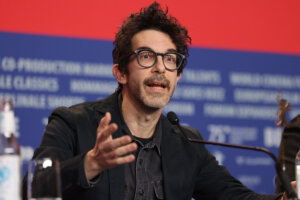
Despite, or perhaps because of, the respect that Fluk has for Jarrett (a reclusive artist, now 80, who had nothing to do with the film), the director did not set out to make a conventional biopic. Instead, the narrative and emotional center of the film, which Fluk also wrote, is Vera Brandes, the 18-year-old self-made concert promoter who, 50 years ago, signed Jarrett for the gig, sold out the venue, and convinced the reluctant pianist to perform on a subpar keyboard for the 1400-strong crowd that packed into the Cologne Opera House for the 11:30 pm concert. (The late hour was due to a performance of Alban Berg’s Lulu earlier that evening, a wonderfully strange detail that makes it into the film).
“There are a lot of movies about music that tell you the same story. It’s about the artist. It’s about his rise. There’s some complication, then there’s a comeback, there’s a big show at the end. And here was a story about the woman behind the scenes. It wasn’t a story about the artist so much as about the promoter and the invisible people behind the artist. I thought that was really interesting and fresh,” Fluk said. At the start of the shoot, Fluk invited Brandes, now 69, to visit the set, an event that he recalled as inspiring for him and the film’s team.
“She’s like a punk rock goddess from the 70s who, like, changed the world and never got a proper thank you. This was an opportunity to shine a light on her, because however good Keith Jarrett is, no Vera Brandes, no ‘Cologne Concert.’ If Keith Jarrett had the perfect piano on stage that night, the album wouldn’t sound the way it sounds, and it wouldn’t be as special as it is,” he said.
Mala Emde, a 29-year-old German actress, plays Brandes as a spirited and determined young woman striking out on her own, using her charm, enthusiasm and tenacity to navigate (and often bluff her way through) an exciting adult world that she cannot wait to enter. Emde carries the film on her capable shoulders. Jarrett, performed with brittle world-weariness by the American actor John Magaro, is another standout.
Köln 75 was in pre-production for four years and Fluk used that time to learn German. “By the time we were shooting, I already understood German. Now I can read, I can understand – I don’t like speaking it because I sound like an idiot — but it was enough for me to hear actors improvise, which was really important for me in this film, because it’s a film about improvisation and it needed to feel free,” he said. He added that Michael Winterbottom’s 2002 film 24 Hour Party People, about the birth of rave culture in late 1970s Manchester, was a key inspiration in terms of tone and energy, calling it “the spirit animal of this film.”
Fluk didn’t reveal too much about his upcoming projects, which include an HBO series based on the bestselling non-fiction book Empty Mansions and a legal thriller about the trial of Julius and Ethel Rosenberg, which Fluk described as “a really beautiful script and really important story about American Jews and the way they were perceived in America.”
With so many stateside projects lined up, can we expect Fluk to film again in Europe or Israel in the future?
“If the story I want to tell is located there? Absolutely,” he said. “I am very agnostic about territory. I have a film, and the film says where it needs to be shot, then we go there and shoot it.”
Köln 75 begins its theatrical run at the IFC Center in New York on Oct. 17. (It opens a week later in Los Angeles).
The post How a complete unknown created one of the most iconic music events of the 1970’s appeared first on The Forward.
Uncategorized
Minnesota man charged with ISIS-inspired plot on Jewish-owned Mall of America
(JTA) — The FBI accused an 18-year-old man of buying an AK-47 assault rifle with plans to commit a mass shooting in support of ISIS at the Mall of America in Bloomington, Minnesota, the largest indoor shopping mall in North America.
Sheikhdoon Abdullahi Mohamud, of Richfield, Minnesota, was charged on Wednesday with one count of knowingly receiving a firearm and ammunition in order to commit a federal crime of terrorism, according to a federal complaint filed on Wednesday.
Mohamud’s attorney did not respond to JTA’s request for comment.
Mohamud wanted to attack the Mall of America because he believed its owners to be Jewish, the FBI said in a statement. He planned to kill between 30 and 60 people, according to messages he exchanged with a confidential source, according to the complaint.
Mall of America is owned and operated by Triple Five Group, controlled by the Ghermezian family, a Canadian family of Iranian Jewish origin.
Messages sent in September 2026 included a video in which Mohamud pledged allegiance to ISIS, the complaint said. He planned his attack for Oct. 24 because he expected a crowd at the Hmong Arts Celebration scheduled for that day.
The complaint said an undercover FBI agent sold an AK-47 rendered inoperable, four 30-round magazines and 200 rounds of ammunition to Mohamud for $600 on Oct. 6. During the sale, Mohamud confirmed his plans to commit a mass shooting. Mohamud was arrested shortly after the sale.
The complaint said Mohamud wanted to commit an attack similar to the 2016 Pulse nightclub shooting in which 49 victims were killed; the Bondi Beach mass-shooting in Sydney last December, during which 15 victims were killed during a Hanukkah celebration; and a New Orleans truck-ramming attack that killed 14 victims in New Orleans on Jan. 1, 2025.
The investigation into Mohamud began around December 2024, when he messaged the confidential source on multiple social media platforms, according to the complaint, detailing his desire to travel to Somalia to join a group that the U.S. has designated a foreign terrorist organization. If travel was not possible due to financial constraints, he said would move forward with an attack in Minnesota.
This article originally appeared on JTA.org.
The post Minnesota man charged with ISIS-inspired plot on Jewish-owned Mall of America appeared first on The Forward.
Uncategorized
Is Israel or Iran a bigger threat to the U.S.? Michigan’s Abdul El-Sayed won’t say
(JTA) — Michigan Democrat Abdul El-Sayed was asked multiple times by a debate moderator on Thursday which country he considers a bigger threat to the U.S.: Iran or Israel.
Each time, he parried.
“That’s a ridiculous hypothetical because here’s what’s happening right now: Our ostensible ally in Israel has lobbied us to go to war with Iran,” said El-Sayed, Michigan’s Democratic nominee for U.S. Senate.
“I don’t consider an ally a country that takes us to wars we don’t need to fight, and I don’t want to be fighting wars we don’t need to fight,” he added, describing both as “kind of dangerous.” Another attempt yielded a similar response, with El-Sayed denouncing “one at risk of attacking us, one getting us into wars we have no business fighting.”
El-Sayed, a former county health official, was responding to a question repeatedly posed by WOOD TV8 political reporter Rick Albin, in a debate against his Republican opponent, former U.S. Rep. Mike Rogers. The two candidates hurled insults at each other during the hourlong discussion, often returning to issues related to Israel and the Middle East.
After making criticism of Israel a top issue in his primary campaign, El-Sayed eked out a victory against U.S. Rep. Haley Stevens in that early August race. Although he has earned the support of many democratic socialists, including Vermont independent Sen. Bernie Sanders, El-Sayed has stated that he is not a member of the Democratic Socialists of America.
Rogers, on the other hand, has the official endorsement of President Donald Trump. However, the candidate has been distancing himself from the president, including by criticizing the trade war with Canada.
Results of a CBS News poll published earlier this week showed El-Sayed leading Rogers, by 45.6% to 41.4%, with a 3.8% margin of error. A Quantus Insights poll released on Wednesday, meanwhile, gave El-Sayed a slightly narrower lead, with 47.6% to Rogers’s 46.5%, and a 7.8% margin of error.
While El-Sayed has been meeting with Jewish voters and leaders, he has not budged on certain issues of concern to many Jewish voters. For example, he has indicated only a willingness to recognize Israel’s identity as a Jewish nation-state if Israelis and Palestinians jointly agree to it..
Liberal Michigan rabbis last month signed a petition from the Zioness Action Fund, a progressive Zionist group, calling upon the Democratic Party to agree to “nonnegotiable” principles related to Jewish safety and Israel. A separate cohort of Michigan Jewish leaders urged community members to reject El-Sayed entirely.
Rogers and his representatives in August indicated that they would like AIPAC to refrain from spending directly on him in the general election, according to media reports. Asked about this at the Thursday debate, he said he’d welcome “anybody that wants to help my campaign stop a guy who can’t condemn terrorism in our own country.”
El-Sayed condemned the March attack on Temple Israel in West Bloomfield Township, but added that “hurt people hurt people,” which critics interpreted as justifying the attacker’s actions. He later apologized for those remarks.
Rogers has repeatedly slammed his opponent for taking funds from donors affiliated with the Council on American-Islamic Relations, the Unity & Justice Fund super PAC and other groups and individuals.
El-Sayed, on the other hand, accused Rogers on Thursday of accepting corporate PAC money and labeled him the “guy who’s going to rubber stamp everything Donald Trump tells him to rubber stamp.”
The two candidates criticized each other’s policies and interrupted each other so often that Albin, the moderator, needed to step in.
“We’ve got dozens of questions we want to get to,” Albin said. “You can’t litigate all of these with 14 different rebuttals.”
Even prior to a pause for ads, Albin announced that the station is going “to take a break from this pleasant conversation.” When they returned, he declared that “in 30 years of doing debates, I’ve never seen it continue during the commercial, but it did.”
The candidates continued to clash over Iran, with El-Sayed accusing the U.S. government of teaching “the Iranian regime that they had a choke [hold] on the Strait of Hormuz.”
“That’s the kind of policy you’re going to get from a guy who wants to be a sock puppet for the Trump administration,” El-Sayed added.
Rogers, meanwhile, claimed that the U.S. had set back Iran’s nuclear program by at least 20 years, adding that “this would be the time to wrap it up.”
As for Israel, Rogers said he supports “the right to exist for the Jewish state, and the right to defend itself in a very difficult neighborhood.” The only way Israel could lose his support, Rogers stated, would be if the country talked about using nuclear weapons.
Israel is widely assessed to possess an arsenal of approximately 90 nuclear warheads, according to the Stockholm International Peace Research Institute. The country is not a party to the Nuclear Non-Proliferation Treaty. Israel has never acknowledged possessing nuclear weapons.
Albin then turned to El-Sayed, noting the politician’s opposition to direct U.S. military funding for Israel. He asked, however, whether that position could change “if Israel were attacked tomorrow by Iran or another state actor.”
“I want our tax dollars spent here,” El-Sayed responded. “Israel has pushed us to go to war in Iran, and of course, my colleague, who thinks there’s a war for everything, went right along with it.”
When Albin pushed again for a yes or no answer, El-Sayed replied that he doesn’t want the U.S. “buying weapons for other countries.”
Toward the end of the discussion related to the Middle East, Rogers recognized the third anniversary of the Oct. 7, 2023, Hamas attack on Israel. He blasted his opponent for failing “to even acknowledge the pain, the terrorism, the rape, the murders.”
To this accusation, El-Sayed responded, “I’ve condemned that. I didn’t turn it into theater like you did.”
This article originally appeared on JTA.org.
The post Is Israel or Iran a bigger threat to the U.S.? Michigan’s Abdul El-Sayed won’t say appeared first on The Forward.
Uncategorized
Ossoff says IDF violated law of armed conflict in Gaza, but genocide is an issue for international courts
(JTA) — Democratic Sen. Jon Ossoff and Republican challenger Rep. Mike Collins clashed over Israel’s conduct in Gaza, U.S. weapons sales to Israel and the war in Iran during Thursday’s debate in Georgia’s closely watched Senate race.
The race could help determine control of the Senate, with implications for U.S. policy toward Israel.
The incumbent Ossoff, who is Jewish, has long supported Israel’s security, but over the last two years he has criticized its conduct in the Gaza war and voted to block some U.S. arms sales to the country.
A day after the third anniversary of the Oct. 7 Hamas-led attack, Ossoff was asked whether Israel had committed genocide in Gaza, whether he was concerned about growing anti-Israel sentiment within the Democratic Party and whether he would support a proposed $2.8 billion U.S. weapons package for Israel.
“The question of genocide is a question of whether a government has the specific intent to destroy a national or ethnic group, and that is a question for the International Criminal Court,” Ossoff responded. “There is no doubt in my mind that Israeli forces prosecuting the war in Gaza violated the law of armed conflict and international humanitarian law, and I care deeply about the security of the Israeli people, among whom are members of my family.
“I also care about innocent Palestinian life,” Ossoff continued, “and make no apology for my votes.”
Collins accused Ossoff of having aligned himself with anti-Israel figures including Twitch streamer Hasan Piker and Michigan U.S. Senate candidate Abdul El-Sayed.
“Imagine being a U.S. senator, and out there recruiting, endorsing, and supporting these people that want to see Israel wiped off the map,” Collins said. “They would rather be for Iran than for Israel — now that’s who Jon Ossoff is supporting.”
Piker had previously called Ossoff a possible contender for the 2028 Democratic presidential nomination. He subsequently disavowed Ossoff after the senator condemned antisemitic comments, Jewish Insider reported in August.
During the hourlong debate, Ossoff repeatedly condemned the U.S. war in Iran while highlighting Collins’ support for it. At least three times Ossoff called the war in Iran a “disaster” or “disastrous,” and he blamed the war for rising gas prices in the state of Georgia.
Collins, on the other hand, said he supported the war as necessary to prevent Iran from obtaining nuclear weapons. “The president had every right to go in there and make sure that Iran does not get a nuclear weapon,” Collins said. “The IAEA [International Atomic Energy Agency], they had already sounded the bells, the alarms that Iran was close to getting a nuclear weapon. And the thing is, Iran doesn’t only want to decimate and kill Israel, they want us as well.”
The evening was not without its personal attacks. Collins described Ossoff as “a radical” and a “trust-fund kid who has never had a job in his life,” while Ossoff repeatedly spotlighted the alleged ties between Collins and white nationalists. A recent report alleged that Collins’ former aides were involved with antisemitic and white nationalist rhetoric.
Ossoff leads Collins by about nine percentage points in FiftyPlusOne’s polling average as of Oct. 9.
The candidates are scheduled for a second debate hosted by the Atlanta Press Club on Oct. 13.
This article originally appeared on JTA.org.
The post Ossoff says IDF violated law of armed conflict in Gaza, but genocide is an issue for international courts appeared first on The Forward.
