


Uncategorized
How Abe Kugielsky’s photos of Hasidic Brooklyn ended up on display in Grand Central Terminal
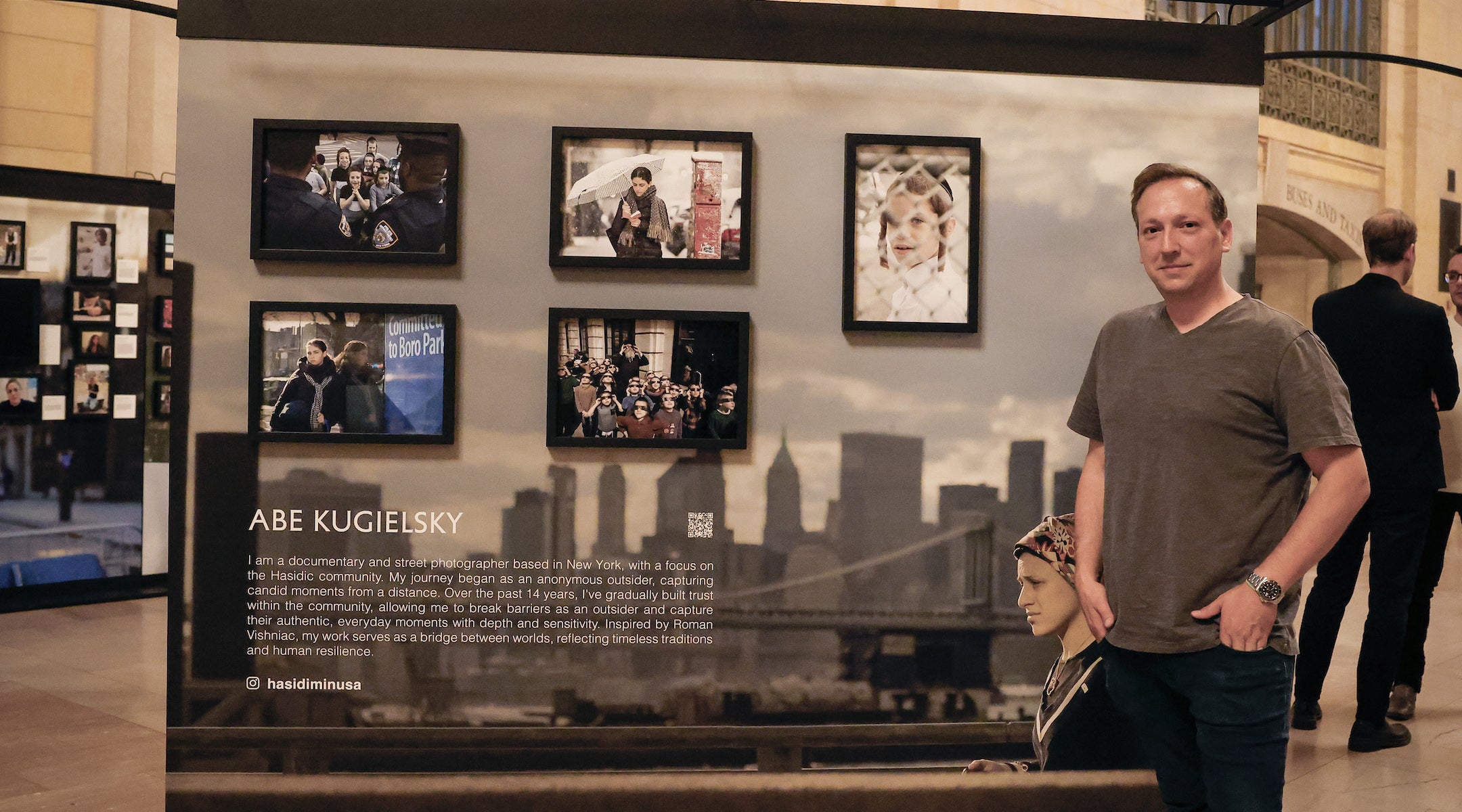
When Abe Kugielsky first began photographing the Hasidic Jewish community in Borough Park, Brooklyn, in 2010, he was an outsider with a camera, met with resistance from a community unaccustomed to being documented.
But by 2017, he had amassed a bank of roughly 50,000 photographs, and decided it was time to start posting his images to an Instagram account he called “Hasidim In USA.”
Today, his account has drawn 80,000 followers curious for a glimpse inside a traditionally private world. And this month, it has also landed him a place in Humans of New York’s “Dear New York” exhibition in Grand Central’s Vanderbilt Hall. The free exhibition, curated by Brandon Stanton of the online photo sensation Humans of New York and including dozens of local photographers, runs until Oct. 19.
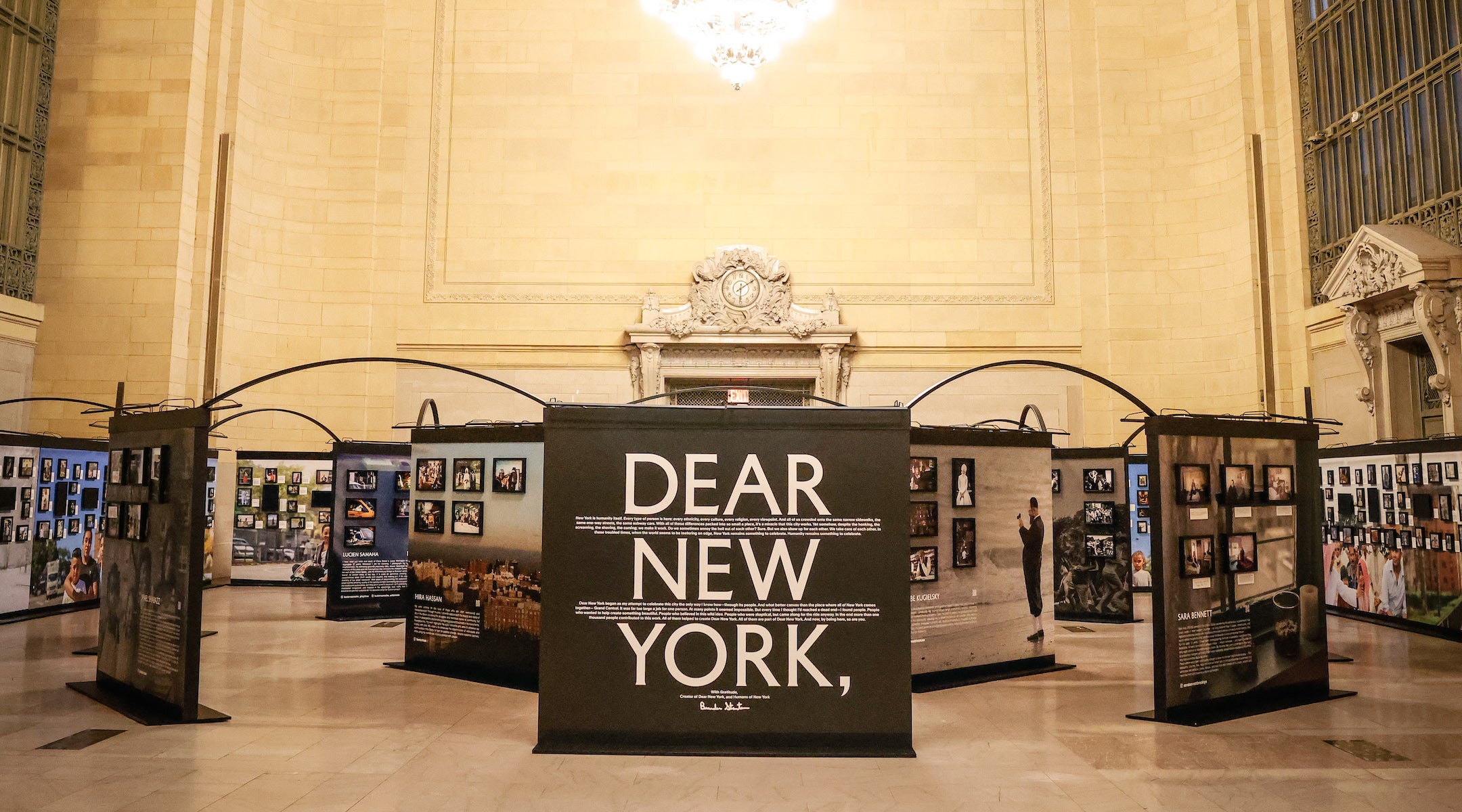
A view of Humans of New York’s “Dear New York” exhibition in Grand Central’s Vanderbilt Hall, running from Oct. 6 to Oct. 19. (Courtesy Abe Kugielsky)
By day, Kugielsky, who is 45 and identifies as Modern Orthodox, runs a Judaica antique auction house in Cedarhurst, Long Island. But his photography, and efforts to gain inroads in the Hasidic community, have become his true passion.
“Judaica is my full-time job, but I will close shop whenever I feel like I need a day off to go,” said Kugielsky. “It’s very therapeutic to me when I go out to shoot, I’m in my own little bubble, my own zone.”
This interview was condensed and lightly edited for clarity.
JTA: What first drew you to photographing the Hasidic communities in New York?
Kugielsky: When I moved to Brooklyn after we got married, my wife had a job in Borough Park. I would drive her to work every day. I had started street photography as a hobby back in Israel a little bit, and then got married and I let go of it. But when I started visiting Borough Park every morning, and I was getting that Roman Vishniac vibe by seeing the scenes, and I figured, I’ll pick up a camera and start documenting something that’s been untouched in New York.
It’s been very popular in Israel. There’s so many photography books on Orthodox life in Jerusalem, but there’s nothing about Hasidic life in America. There’s one book from like 1974, a small book with some photos, but that’s about it. It’s really very little. So I felt like it was an untouched niche, and I picked up a camera and I started photographing.
How do you build trust with your subjects in a community that is often described as insular?
To see someone walking on Borough Park with a camera taking pictures is not common. It’s not Mea Shearim [the Jerusalem neighborhood] where we have tourists and Americans and photographers. This is very uncommon, so there was a lot of fear of resistance, and of course, the resistance came. So it started off really more in hiding from distance, and over time, I built trust in the community to a point where they celebrate me.
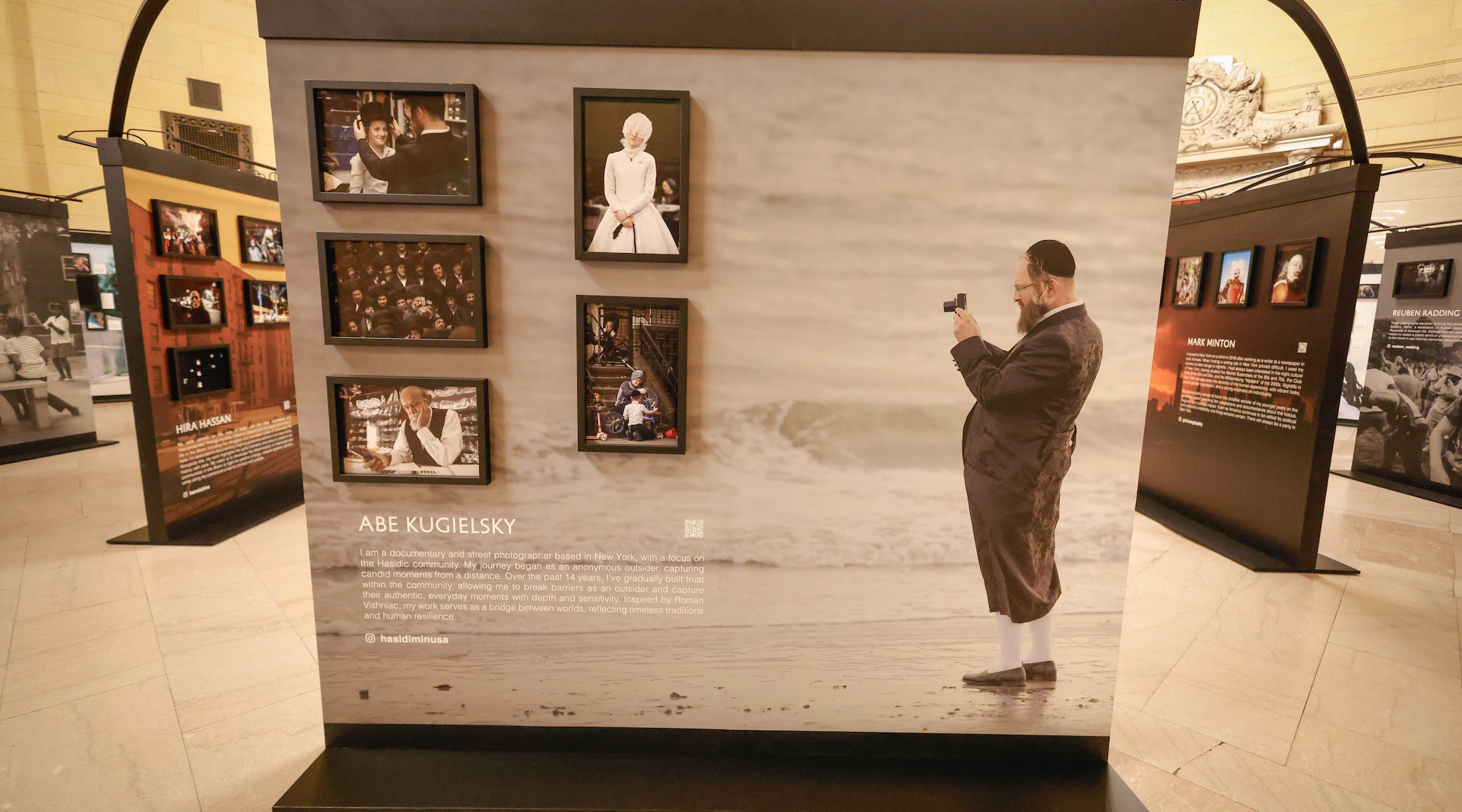
Abe Kugielsky’s installation at Humans of New York’s “Dear New York” exhibition in Grand Central’s Vanderbilt Hall, running from Oct. 6 to Oct. 19. (Courtesy Abe Kugielsky)
I made it my goal to post in a very positive light, either a positive caption or a positive scene or a positive story, to show them I’m not here to bring out what everyone else has been doing. I realized over the years that it’s really rooted a lot in generational trauma, where, whenever media came into Borough Park or Williamsburg, it was always for a negative story, and that’s where the resistance really came from. So over time, when they recognized that my work is not with that goal, they started to appreciate it more and more.
Can you tell me more about the response from the Hasidic community to your work?
I started off with an article in a local Yiddish magazine, and then a couple of months later, another article and I came out publicly with my name, my identity, so people started recognizing me more. And over time, I started getting more and more positive feedback.
I remember a woman in Williamsburg stopped me once, and she said, “I want to tell you that your photos made me fall in love again with my own culture.” So it really had a certain impact on the community, recognizing that these photos tell a positive story. It tells the story of the community that no one else does in a positive light.
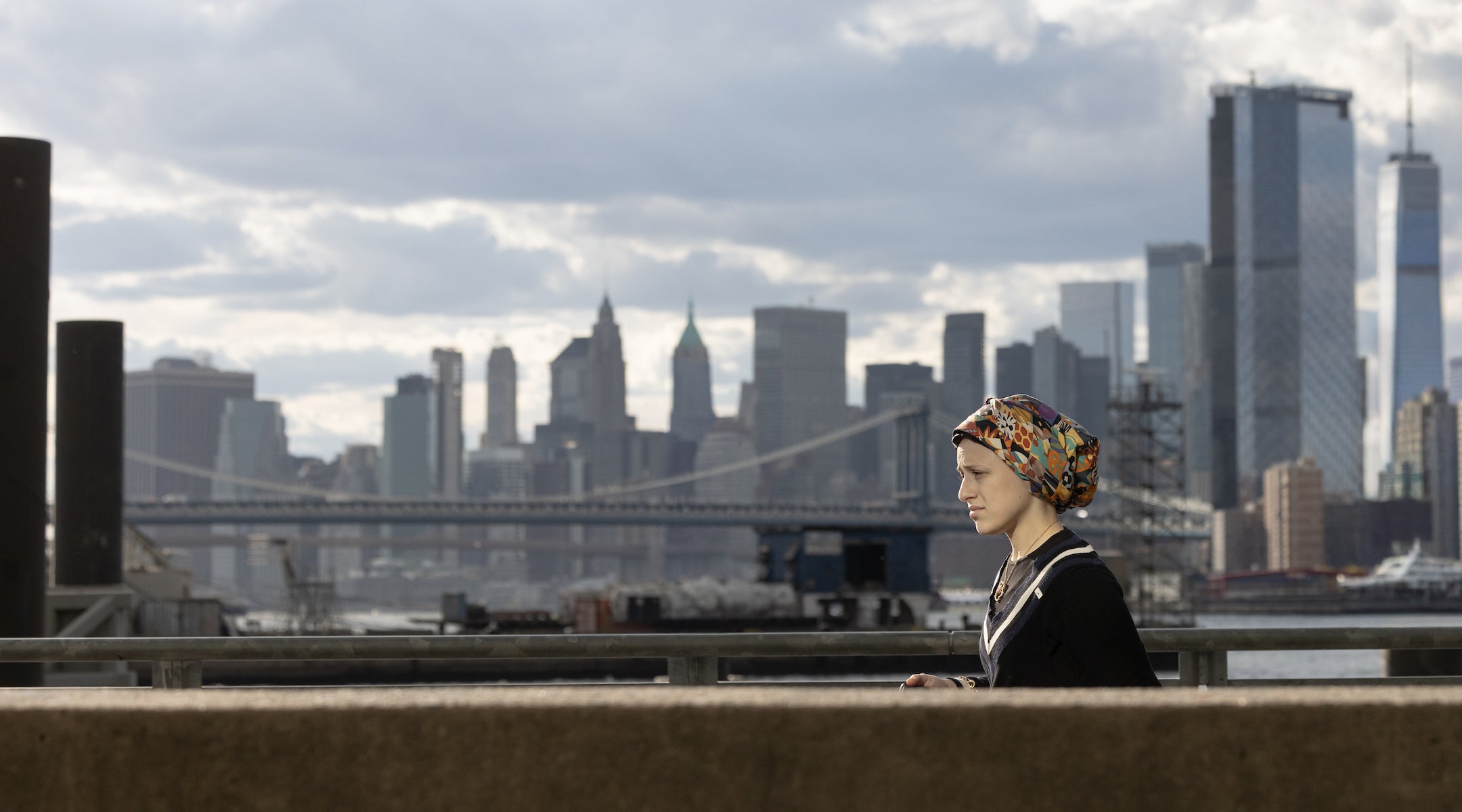
“A Bridge Apart” by Abe Kugielsky. (Courtesy Abe Kugielsky)
It really shifted to the point where, if I walk down Williamsburg, people stop me and ask me for a selfie, and people will DM me and say, ‘Hey, there’s an event going on here, please come down and photograph.” My goal was to go in deeper and deeper, more and more intimate, and I’ve gotten there. Especially this past summer, we had some invites into family life, which is a whole new level that I’ve been really trying to get to.
What kinds of reactions from the public to your work have surprised or challenged you?
Of course, I get a lot of antisemitic comments from time to time with DMs. Anyone who posts anything Jewish nowadays gets them, but I’ve had a lot of interesting positive feedback from non-Jews worldwide. I’ve had people in Iran reach out to me, and I’ve heard from people in Middle Eastern countries, in Germany, Poland. I think they love the concept where they can look into another culture, have a window into another culture, something they don’t get to see.
Do you have a favorite image from the exhibit, and what makes it stand out to you?
I have one great image that I really, really love. This was a silver shop in Borough Park I walked into and I asked the owner, an older Hasidic Jew, if I can photograph him, and his response is, “What do I need it for?”
I have an album on my phone with photos I downloaded from Brooklyn Public Library, old images from Williamsburg taken by a photographer in 1964, and I figured, let me show him what it looks like looking back at photos from 50 years ago. I started showing him on my phone. He was scrolling through the photos, and I said, look how beautiful it is to look at pictures from 50 years ago.
But then he froze on a certain picture, and his demeanor changes, and he goes, “This is my wife.” He found a picture of his wife and his first newborn son from 50 years ago in those photos, so I captured that moment where he’s really reminiscing about those years.
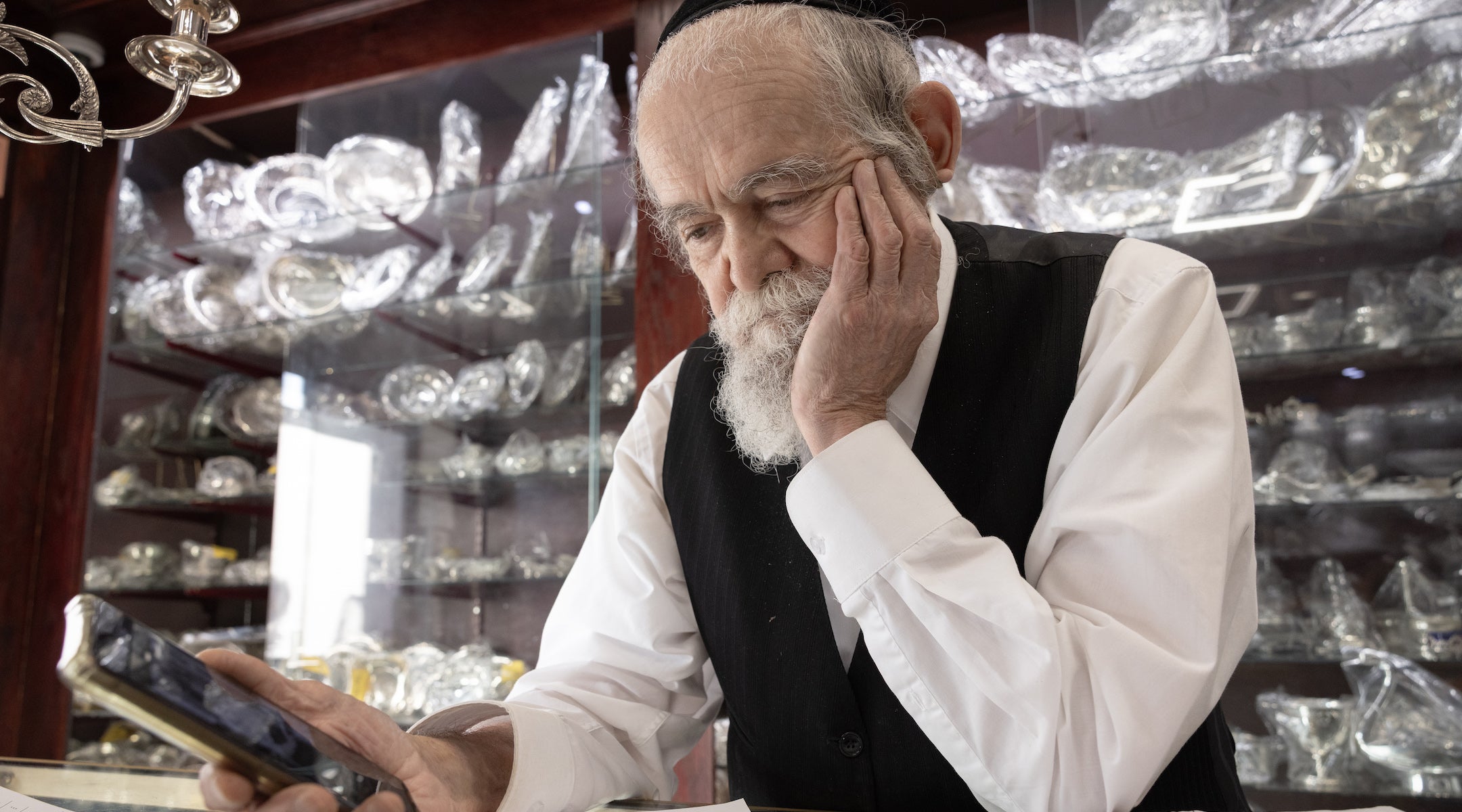
“Silver Memories” by Abe Kugielsky. (Courtesy Abe Kugielsky)
Humans of New York has drawn criticism for a series focused on aid workers in Gaza as well as for featuring a member of Neturei Karta, a small anti-Zionist sect of the Orthodox community. Was that something you thought about before deciding to participate?
I was tagged when he posted his request for people to submit. I didn’t follow him, it’s just not really my style of work, he’s more storytelling. I went into his page, and I saw all these posts, I wasn’t sure what to make of it.
The vibe that I got was I didn’t feel an antisemitism there. I felt like he was more going with the trend, showcasing Palestinians from Gaza or Neturei Karta, more from a place of ignorance.
I believe a lot of New Yorkers, a lot of Americans, a lot of people worldwide, don’t really know and understand the conflict. It’s just in style now to hate, and it’s in style now to side with one side or the other without really understanding.
I didn’t give it a lot of hope when I submitted my photos, and I was actually surprised that he chose my photos to be included, and throughout my conversations with him, I understood that he really doesn’t understand much of the conflict.
Have you received any critical feedback about your involvement in this project?
Very, very little. I think one or two people commented like, why would you do this? But for me, A, It’s an opportunity for me, for my work, to showcase my work out there more, and, B, I thought it was so important to have a representation of Jewish life, or Hasidic life, Orthodox life, in such an important exhibition.
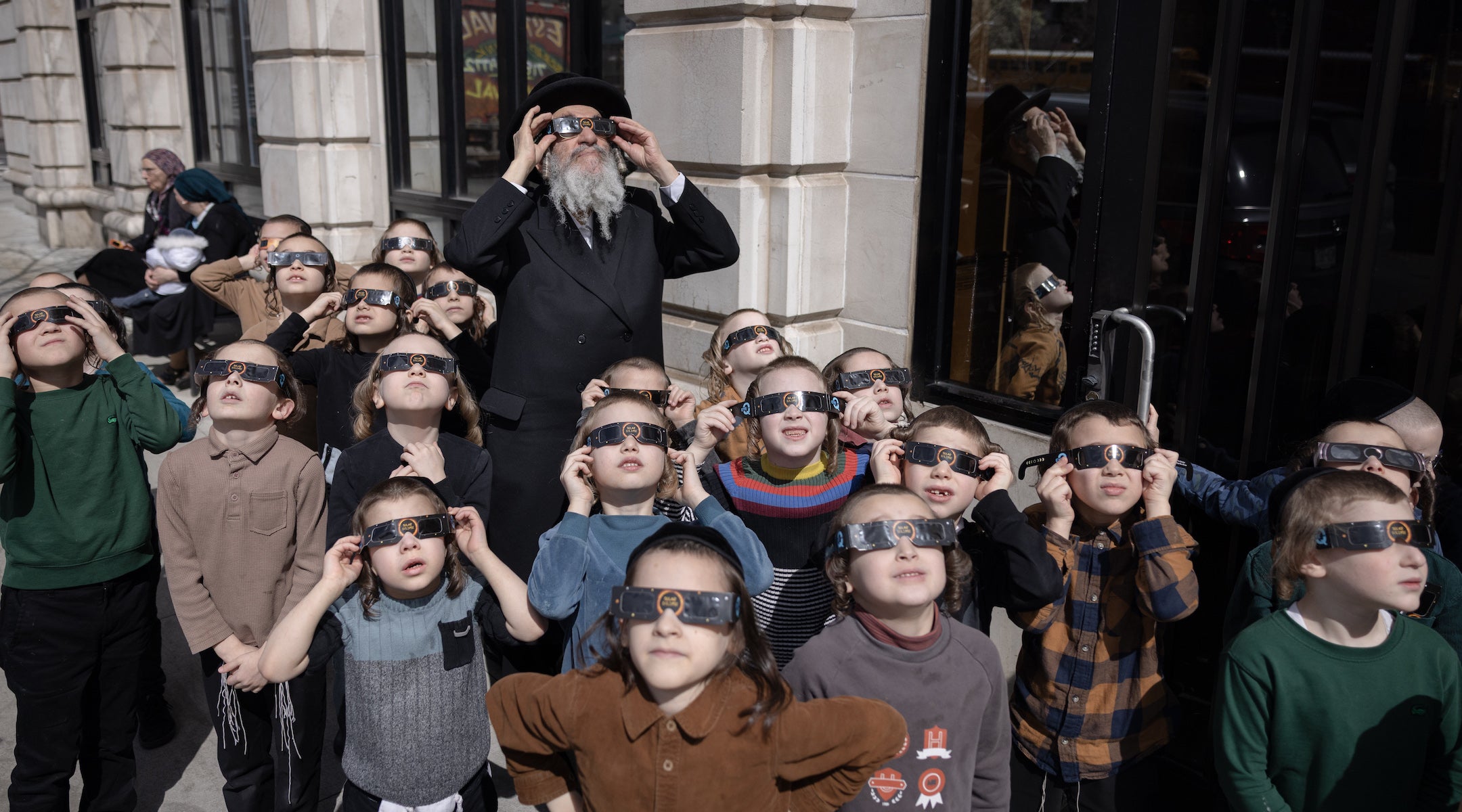
“Brooklyn Skies” by Abe Kugielsky. (Courtesy Abe Kugielsky)
What are you hoping people take away when they encounter your Grand Central exhibit?
What I’m expecting people to take away is really to see the humanistic side of this culture. People could be living literally a block away from the community, and not really know the community, and not understand them.
I’m hoping that this gives them a little bit more of a humanistic view of the Hasidic community, where they live, their life, their culture, their religion. After all, we’re all human, we all coexist in the same city.
—
The post How Abe Kugielsky’s photos of Hasidic Brooklyn ended up on display in Grand Central Terminal appeared first on Jewish Telegraphic Agency.
Uncategorized
Minnesota man charged with ISIS-inspired plot on Jewish-owned Mall of America
(JTA) — The FBI accused an 18-year-old man of buying an AK-47 assault rifle with plans to commit a mass shooting in support of ISIS at the Mall of America in Bloomington, Minnesota, the largest indoor shopping mall in North America.
Sheikhdoon Abdullahi Mohamud, of Richfield, Minnesota, was charged on Wednesday with one count of knowingly receiving a firearm and ammunition in order to commit a federal crime of terrorism, according to a federal complaint filed on Wednesday.
Mohamud’s attorney did not respond to JTA’s request for comment.
Mohamud wanted to attack the Mall of America because he believed its owners to be Jewish, the FBI said in a statement. He planned to kill between 30 and 60 people, according to messages he exchanged with a confidential source, according to the complaint.
Mall of America is owned and operated by Triple Five Group, controlled by the Ghermezian family, a Canadian family of Iranian Jewish origin.
Messages sent in September 2026 included a video in which Mohamud pledged allegiance to ISIS, the complaint said. He planned his attack for Oct. 24 because he expected a crowd at the Hmong Arts Celebration scheduled for that day.
The complaint said an undercover FBI agent sold an AK-47 rendered inoperable, four 30-round magazines and 200 rounds of ammunition to Mohamud for $600 on Oct. 6. During the sale, Mohamud confirmed his plans to commit a mass shooting. Mohamud was arrested shortly after the sale.
The complaint said Mohamud wanted to commit an attack similar to the 2016 Pulse nightclub shooting in which 49 victims were killed; the Bondi Beach mass-shooting in Sydney last December, during which 15 victims were killed during a Hanukkah celebration; and a New Orleans truck-ramming attack that killed 14 victims in New Orleans on Jan. 1, 2025.
The investigation into Mohamud began around December 2024, when he messaged the confidential source on multiple social media platforms, according to the complaint, detailing his desire to travel to Somalia to join a group that the U.S. has designated a foreign terrorist organization. If travel was not possible due to financial constraints, he said would move forward with an attack in Minnesota.
This article originally appeared on JTA.org.
The post Minnesota man charged with ISIS-inspired plot on Jewish-owned Mall of America appeared first on The Forward.
Uncategorized
Is Israel or Iran a bigger threat to the U.S.? Michigan’s Abdul El-Sayed won’t say
(JTA) — Michigan Democrat Abdul El-Sayed was asked multiple times by a debate moderator on Thursday which country he considers a bigger threat to the U.S.: Iran or Israel.
Each time, he parried.
“That’s a ridiculous hypothetical because here’s what’s happening right now: Our ostensible ally in Israel has lobbied us to go to war with Iran,” said El-Sayed, Michigan’s Democratic nominee for U.S. Senate.
“I don’t consider an ally a country that takes us to wars we don’t need to fight, and I don’t want to be fighting wars we don’t need to fight,” he added, describing both as “kind of dangerous.” Another attempt yielded a similar response, with El-Sayed denouncing “one at risk of attacking us, one getting us into wars we have no business fighting.”
El-Sayed, a former county health official, was responding to a question repeatedly posed by WOOD TV8 political reporter Rick Albin, in a debate against his Republican opponent, former U.S. Rep. Mike Rogers. The two candidates hurled insults at each other during the hourlong discussion, often returning to issues related to Israel and the Middle East.
After making criticism of Israel a top issue in his primary campaign, El-Sayed eked out a victory against U.S. Rep. Haley Stevens in that early August race. Although he has earned the support of many democratic socialists, including Vermont independent Sen. Bernie Sanders, El-Sayed has stated that he is not a member of the Democratic Socialists of America.
Rogers, on the other hand, has the official endorsement of President Donald Trump. However, the candidate has been distancing himself from the president, including by criticizing the trade war with Canada.
Results of a CBS News poll published earlier this week showed El-Sayed leading Rogers, by 45.6% to 41.4%, with a 3.8% margin of error. A Quantus Insights poll released on Wednesday, meanwhile, gave El-Sayed a slightly narrower lead, with 47.6% to Rogers’s 46.5%, and a 7.8% margin of error.
While El-Sayed has been meeting with Jewish voters and leaders, he has not budged on certain issues of concern to many Jewish voters. For example, he has indicated only a willingness to recognize Israel’s identity as a Jewish nation-state if Israelis and Palestinians jointly agree to it..
Liberal Michigan rabbis last month signed a petition from the Zioness Action Fund, a progressive Zionist group, calling upon the Democratic Party to agree to “nonnegotiable” principles related to Jewish safety and Israel. A separate cohort of Michigan Jewish leaders urged community members to reject El-Sayed entirely.
Rogers and his representatives in August indicated that they would like AIPAC to refrain from spending directly on him in the general election, according to media reports. Asked about this at the Thursday debate, he said he’d welcome “anybody that wants to help my campaign stop a guy who can’t condemn terrorism in our own country.”
El-Sayed condemned the March attack on Temple Israel in West Bloomfield Township, but added that “hurt people hurt people,” which critics interpreted as justifying the attacker’s actions. He later apologized for those remarks.
Rogers has repeatedly slammed his opponent for taking funds from donors affiliated with the Council on American-Islamic Relations, the Unity & Justice Fund super PAC and other groups and individuals.
El-Sayed, on the other hand, accused Rogers on Thursday of accepting corporate PAC money and labeled him the “guy who’s going to rubber stamp everything Donald Trump tells him to rubber stamp.”
The two candidates criticized each other’s policies and interrupted each other so often that Albin, the moderator, needed to step in.
“We’ve got dozens of questions we want to get to,” Albin said. “You can’t litigate all of these with 14 different rebuttals.”
Even prior to a pause for ads, Albin announced that the station is going “to take a break from this pleasant conversation.” When they returned, he declared that “in 30 years of doing debates, I’ve never seen it continue during the commercial, but it did.”
The candidates continued to clash over Iran, with El-Sayed accusing the U.S. government of teaching “the Iranian regime that they had a choke [hold] on the Strait of Hormuz.”
“That’s the kind of policy you’re going to get from a guy who wants to be a sock puppet for the Trump administration,” El-Sayed added.
Rogers, meanwhile, claimed that the U.S. had set back Iran’s nuclear program by at least 20 years, adding that “this would be the time to wrap it up.”
As for Israel, Rogers said he supports “the right to exist for the Jewish state, and the right to defend itself in a very difficult neighborhood.” The only way Israel could lose his support, Rogers stated, would be if the country talked about using nuclear weapons.
Israel is widely assessed to possess an arsenal of approximately 90 nuclear warheads, according to the Stockholm International Peace Research Institute. The country is not a party to the Nuclear Non-Proliferation Treaty. Israel has never acknowledged possessing nuclear weapons.
Albin then turned to El-Sayed, noting the politician’s opposition to direct U.S. military funding for Israel. He asked, however, whether that position could change “if Israel were attacked tomorrow by Iran or another state actor.”
“I want our tax dollars spent here,” El-Sayed responded. “Israel has pushed us to go to war in Iran, and of course, my colleague, who thinks there’s a war for everything, went right along with it.”
When Albin pushed again for a yes or no answer, El-Sayed replied that he doesn’t want the U.S. “buying weapons for other countries.”
Toward the end of the discussion related to the Middle East, Rogers recognized the third anniversary of the Oct. 7, 2023, Hamas attack on Israel. He blasted his opponent for failing “to even acknowledge the pain, the terrorism, the rape, the murders.”
To this accusation, El-Sayed responded, “I’ve condemned that. I didn’t turn it into theater like you did.”
This article originally appeared on JTA.org.
The post Is Israel or Iran a bigger threat to the U.S.? Michigan’s Abdul El-Sayed won’t say appeared first on The Forward.
Uncategorized
Ossoff says IDF violated law of armed conflict in Gaza, but genocide is an issue for international courts
(JTA) — Democratic Sen. Jon Ossoff and Republican challenger Rep. Mike Collins clashed over Israel’s conduct in Gaza, U.S. weapons sales to Israel and the war in Iran during Thursday’s debate in Georgia’s closely watched Senate race.
The race could help determine control of the Senate, with implications for U.S. policy toward Israel.
The incumbent Ossoff, who is Jewish, has long supported Israel’s security, but over the last two years he has criticized its conduct in the Gaza war and voted to block some U.S. arms sales to the country.
A day after the third anniversary of the Oct. 7 Hamas-led attack, Ossoff was asked whether Israel had committed genocide in Gaza, whether he was concerned about growing anti-Israel sentiment within the Democratic Party and whether he would support a proposed $2.8 billion U.S. weapons package for Israel.
“The question of genocide is a question of whether a government has the specific intent to destroy a national or ethnic group, and that is a question for the International Criminal Court,” Ossoff responded. “There is no doubt in my mind that Israeli forces prosecuting the war in Gaza violated the law of armed conflict and international humanitarian law, and I care deeply about the security of the Israeli people, among whom are members of my family.
“I also care about innocent Palestinian life,” Ossoff continued, “and make no apology for my votes.”
Collins accused Ossoff of having aligned himself with anti-Israel figures including Twitch streamer Hasan Piker and Michigan U.S. Senate candidate Abdul El-Sayed.
“Imagine being a U.S. senator, and out there recruiting, endorsing, and supporting these people that want to see Israel wiped off the map,” Collins said. “They would rather be for Iran than for Israel — now that’s who Jon Ossoff is supporting.”
Piker had previously called Ossoff a possible contender for the 2028 Democratic presidential nomination. He subsequently disavowed Ossoff after the senator condemned antisemitic comments, Jewish Insider reported in August.
During the hourlong debate, Ossoff repeatedly condemned the U.S. war in Iran while highlighting Collins’ support for it. At least three times Ossoff called the war in Iran a “disaster” or “disastrous,” and he blamed the war for rising gas prices in the state of Georgia.
Collins, on the other hand, said he supported the war as necessary to prevent Iran from obtaining nuclear weapons. “The president had every right to go in there and make sure that Iran does not get a nuclear weapon,” Collins said. “The IAEA [International Atomic Energy Agency], they had already sounded the bells, the alarms that Iran was close to getting a nuclear weapon. And the thing is, Iran doesn’t only want to decimate and kill Israel, they want us as well.”
The evening was not without its personal attacks. Collins described Ossoff as “a radical” and a “trust-fund kid who has never had a job in his life,” while Ossoff repeatedly spotlighted the alleged ties between Collins and white nationalists. A recent report alleged that Collins’ former aides were involved with antisemitic and white nationalist rhetoric.
Ossoff leads Collins by about nine percentage points in FiftyPlusOne’s polling average as of Oct. 9.
The candidates are scheduled for a second debate hosted by the Atlanta Press Club on Oct. 13.
This article originally appeared on JTA.org.
The post Ossoff says IDF violated law of armed conflict in Gaza, but genocide is an issue for international courts appeared first on The Forward.
