


Uncategorized
How Rachel Goldberg-Polin and Jon Polin find grace in their shattered world
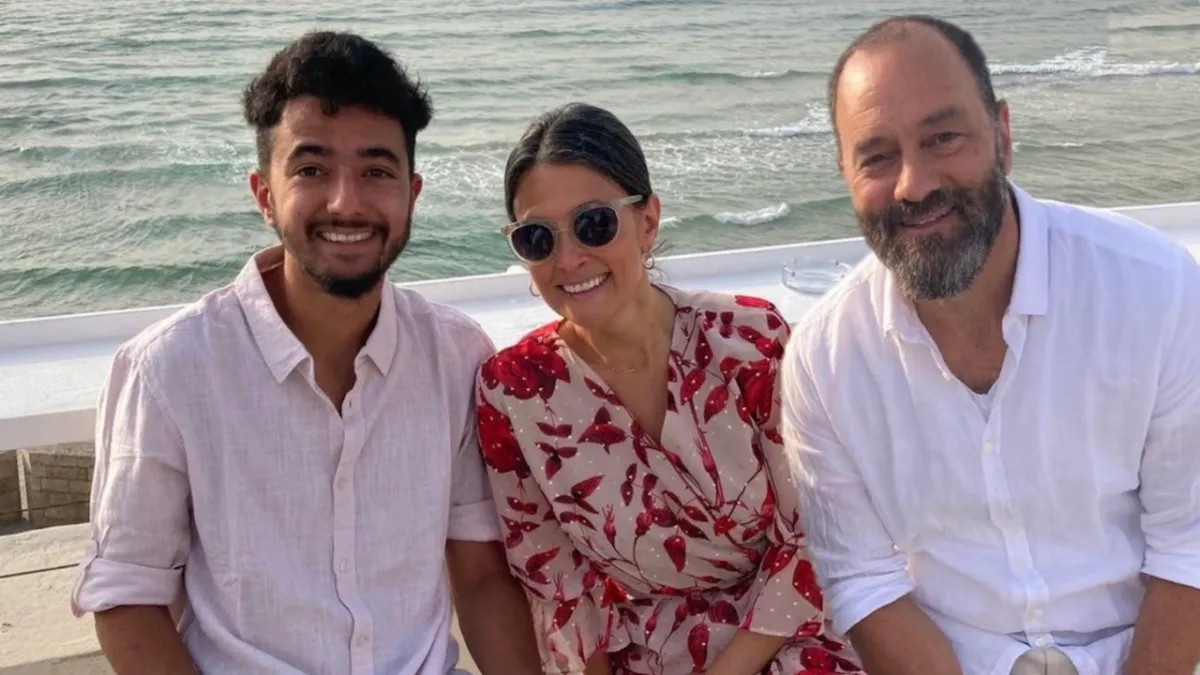
Rachel Goldberg-Polin and Jon Polin need no introduction. Since their son, Hersh, was kidnapped from the Nova music festival in southern Israel on Oct. 7, 2023, taken hostage in Gaza and, later, murdered by his captors, the American-Israeli couple have become, for many, the personification of an entire nation’s pain.
They didn’t want this. They surely didn’t ask for it. “We’re the manifestation of everybody’s worst nightmare,” Rachel said. And yet, it is precisely that fact, coupled with the almost supernatural grace they have brought to their international advocacy for Israel’s hostages, that helped make Hersh one of the most recognizable faces among the captives and why his death last year hit so hard.
It’s also why Jews have looked to them as exemplars of how to respond to one of the worst periods in Jewish history. Despite all they’ve gone through, and all they continue to endure, Hersh’s parents still see this as a moment of opportunity for cross-cultural connection.
“You’ve got your narrative, we’ve got our narrative,” Jon said. “You’ve suffered, we’ve suffered. You’ve got your Bible that says something. We’ve got our Bible that says something. You’ve got your claims. We’ve got our claims. And you know what? We’re never going to outshout each other. Let’s look forward and start right now and dedicate ourselves to something better for all of us. I still feel that way.”
The couple is speaking next week at the Z3 Conference in Palo Alto, California, near where they lived in Berkeley before moving to Israel in 2008. This interview, conducted by J. Jewish News of Northern California, has been edited for length and clarity.
A lot of people here in the United States, and also in Israel, felt as if they knew Hersh after Oct. 7. Some did, but most of us didn’t. I wonder if you could tell us about him as a person, and what it was like to be his parents.
Rachel Goldberg-Polin: Hersh, obviously, was a curious citizen of the world. “Obviously,” just because that’s really what I’ve come to realize is the most apt way of describing him. He was always hungry for knowledge, but very much outside of the confines of normative learning. So school was not really interesting to him. He did enough to get by, but was always an underachiever in school. And yet he was this voracious reader about whatever subject was floating his boat. As a young kid, he was obsessed with geography, obsessed with American presidents, obsessed with Native American history, obsessed with the Civil War.
And as he became a young man — I still think of him as a boy. He was a very young 23. He had just turned 23 on Oct. 3, three days before we said goodbye to him and he went down to the Nova festival. He was obsessed with his favorite soccer club, his Jerusalem Hapoel soccer club. He loved trance music and music festivals, and used them as an opportunity to get to know and meet different people from all over the world. He was very committed to traveling by himself when he went to those festivals, because he said when you travel in a clump, then you stay in a clump. And he wanted to meet people from everywhere.
He was also a real professional listener, which I’ve grown to understand is such a rare gift that is hard to learn. I’m trying to learn it in his memory and as part of his legacy. To train myself to really be with whoever’s speaking and not be thinking, what am I going to say next? What do I want to share? What do I want to say? What do I want to ask? And he was not afraid of having those pauses in between when someone was speaking. He would digest it, and then he would react.
We’ve had so many people come to us in these past two years to tell us about little moments that they had with him that were special, because they really felt heard. And in this time of such challenge in civil discourse everywhere around the world, when the new way of speaking is screaming, it is, I realize now, a unique blessing.
Jon, I saw you recently wearing a T-shirt that had an image of Hersh, and under it the Hebrew phrase “yehi zichrecha mahapeicha” — may your memory be a revolution. What kind of revolution did you have in mind?
Jon: It’s not the revolution of taking to the streets with fires burning. It’s a revolution for good. Hersh really, really — in some ways, naively — wasn’t jaded, and really it’s a revolution for bringing more good to the world. I was walking down the street this summer with my daughter, and a man who we didn’t know stopped me and said, “Hey, Hersh’s dad” — that’s how he referred to me — “can I show you something?” And he shows me that the screensaver on his phone is a picture of Hersh. And he said to me, “Every morning the first thing I do is turn on my phone and look at this picture and say to myself: What can I do today to be better? What can I do today to make the world better?” And right then I said, that’s the greatest legacy a person can have.
Rachel: Hersh still believed in goodness and possibility. But he also was a realist. When he was in high school in 2014, a young Israeli Ethiopian man named Avera Mengistu wandered into Gaza and Hamas took him hostage. Hersh was 15 years old and he came home and he was beside himself. He couldn’t believe that people were not on the streets advocating for Avera Mengistu. There were four or five people who would stand up on this square at the top of Ben Yehuda Street in Jerusalem a couple times a week, and they reminded me of the people on the UC Berkeley campus lawn who say “No nukes” — like, six people with gray hair and long braids. And then there was a short, dark boy with big, black-framed glasses standing with them. And it was 15-year-old Hersh. [Mengistu was released by Hamas in February.]
The resonance of him being out there as a kid, protesting in the street to bring someone home from Gaza, is quite extraordinary.
Rachel: We said before he was a hostage, he was a hostage advocate.
You’ve become the personification of an entire nation’s trauma. Obviously, you never wanted to be symbols like this, but you are now. Can you talk about what it’s like to have people look to you in this way?
Jon: We talk about this a fair amount, and sometimes wonder, can we just go and escape in privacy somewhere? And the answer is, maybe — but not in Israel. Part of us just wants to do that. But another part of us is saying, this has been thrust upon us, this horrific, terrible personal tragedy that’s part of a national tragedy that’s part of a global tragedy. And somehow, largely due to Rachel’s eloquence, there are people who are strangely looking to us. And we’re saying we might need to embrace this. Because part of the story is also the lack of clarity, leadership, morality, voices of sanity in the world today. And if somehow, in some small way, we can be a little bit those voices, it’s so important that we need to do it.
Rachel: We all experience loss. It makes us human. It’s a commonality that we all have. What’s different about our experience is that it was so completely public, and that is really scorching. And it is definitely hard, you know? When we go out, we are kind of the trigger for people — we’re the manifestation of everybody’s worst nightmare. That is a sad thing to be. A lot of people see us and they can’t help but cry. And I know that they are coming at it from a place of empathy and love. They’re feeling our pain. But it’s difficult to have that when you’re walking down the street just trying to go wherever your destination is, and to have people crying along the way, whenever they see you.
Jon: To the extent that we, in some way, are offering strength to anybody out there, it’s symbiotic. I’m not asking that people start coming up even more on the streets to say things and hug us, bring things to our apartment. But that stuff that we’ve been experiencing for 751 days has been remarkably strengthening. We buried Hersh 419 days ago, and we continue to be strengthened by the people who come anonymously and leave baked goods by our door every Friday. We take so much strength from so many people around the world who think they’re taking strength from us.
Rachel: Everybody is holding everybody, and I feel like that is where we as the Jewish people are, and have to be, now. And I don’t care if your hair looks that way, and you cover your knees down to here, and you pray with this book, and you don’t pray at all. It doesn’t matter.
It seems that many believe what you’ve endured must afford you special insight into what’s going on in the Middle East. That you’re singularly able to see through the confusion, right into the heart of what’s happening. I’m wondering if the terrible price you’ve paid has given you any particular understanding that’s different from what you understood before Oct. 7.
Jon: We have definitely been, against our wishes, thrust into the underworld of geopolitics and how it works. We watch the news like everybody else, and we read newspapers like everybody else, and we now understand that there’s the story that we all look at and hear and are told, and [then there are] the things we see out there every day of how the world [really] works. And I wish we could unsee it but, unfortunately, we’ve now learned that the world works on concepts like interests and equities. Every leader has them. And sometimes those interests and equities align with the will of the masses. And sometimes there are other things at play. I don’t know what to do with this information, other than it’s a hard burden to carry to know this reality.
With all that being said, I go back to something that I thought on Oct. 6, 2023, and I still think it today. There’s a better way. There’s a better path. And despite the pain, despite the suffering, despite all the agony that so many have felt, we can’t lose sight of that better path. I always say, let’s pick a day and say, “We’re moving on. We’re only looking forward. You’ve got your narrative. We’ve got our narrative. You’ve suffered, we’ve suffered. You got your Bible that says something. We’ve got our Bible that says something. You get your claims. We’ve got our claims. And you know what? We’re never going to outshout each other. Let’s look forward and start right now and dedicate ourselves to something better for all of us.”
You made aliyah in 2008. Can you tell me what it means for you to live in Israel? And I’m also curious if that meaning has changed over the course of the years you’ve lived there and specifically after Oct. 7.
Rachel: What really brought us here was very simple. Jon had said for years, we have an opportunity to be part of this giant Jewish experiment of living as a Jewish people in a Jewish homeland. We happen to be observant Jews who pray every day and we thought, how is it that every day we’re asking God to please allow us to return to Jerusalem? And Jon said, “We can go.” When you’re actually able to get on a plane and 12 hours later to be in this place, it started to feel inauthentic to be praying for that when we had the ability to do it.
So we came and we really did feel, and do feel, that we are privileged to live here. I certainly have had challenges all these years, because my Hebrew is not great, and I’ve felt like a fish out of water, and I’ve felt like a stranger in a strange land. And yet it’s my land. I feel privileged that I have lived here. I feel privileged that I raised children here. I feel privileged that my three children were and are bilingual, and that they had an opportunity and have the opportunity to still be part of this experiment.
We’ve had an enormous challenge thrust upon us. When I say us, I mean all of the nation of Israel and the people of Israel worldwide. But at the same time, with this great calamity comes extreme opportunity — extreme, extreme opportunity. And I pray that we will have the resilience, the recovery, the healing and the comfort that is needed to take this chance and make something really luminous.
Jon: You asked what we’ve learned or how things have changed. Something that’s become really clear to us, maybe to everybody in the world, is there is an intertwined sense between Israel and the Jewish people globally. We’re all connected, like it or not, and I would like to see us use this as an opportunity. How do we take this little country in the Middle East, this concept of an independent Jewish state with sovereignty and agency, and say, no matter who the government is, who the prime minister is, who’s in charge, this is a concept that’s bigger than us or any entity. How do we make this a source of pride and inspiration for all of us?
This is going to be your first time in the Bay Area since Oct. 7. What are you anticipating on coming here?
Rachel: Unfortunately, we won’t be there very long. But I know that it will be an embrace from the wonderful Bay Area Jewish community. We have felt the love and support and appreciate it. It sounds crazy to say that we feel it, but it’s like a visceral, tangible, tactile feeling of support and love. And we felt your confusion and we felt your pain and we felt your concern, and it helped us, and it touched us, and we will always feel a huge debt of gratitude to the Bay Area, because that’s where Hersh was born, and that’s where our older daughter, who’s younger than Hersh, that’s where she was born. They were both born at Alta Bates Hospital in Oakland. Jon and I had just gotten married, and we spent almost three years before Hersh was born in the Bay Area. It’s very much woven into the core of who we are. And I think in many ways, it was a foundation that made us strong as a unit in order to face this unbelievable mission that we are in now.
Jon: I just specifically want to bring it to Hersh for a minute and say, it’s amazing that we lived in the Bay Area for seven years. It left such an indelible, lasting mark on our identities. Hersh left the Bay Area when he was 3½ years old. He was blessed to grow up at Gan Shalom in Berkeley and to be part of Congregation Beth Israel in Berkeley and the Berkeley JCC. He lived 20 more years outside of Berkeley, yet Berkeley, California, and the Bay Area more broadly were such a prominent part of his personality, his thinking, who he was as a person. You could take the 3½-year-old out of Berkeley, but you can’t take the Bay Area out of the boy. It was the embodiment of so much about who Hersh was.
Rachel: I think it’s a lot of why he never liked to wear shoes.
I’m curious about the power of prayer. You talked about living in California and praying about returning to Jerusalem. Can you talk about your own approach to prayer now, and if that’s changed in any way — but also what it’s like to know that there are thousands of people you don’t even know praying for you every day?
Rachel: It absolutely works and is felt and is appreciated. And I am bottomlessly, endlessly grateful to the people who still have us in their prayers. Because I’m telling you, unfortunately, we need it. I think we might always need it.
I’m so thankful that I have prayer as a tool that I use daily. Every day, I open my eyes and immediately say the line that many Jewish people say upon waking, thanking God for giving me back my soul, and [saying] that God has tremendous faith in me, and that’s why I woke up this morning.
When I go to do my morning prayers, it’s such a relief. It’s the best therapy. You know, Rabbi Nachman, the famous mystical Kabbalist, said, “Life makes warriors out of all of us, and the most potent weapon is prayer.” And so I say to people, use it. Everyone has their pain, and we have this toolkit accessible to us. I pour my soul out in the morning, and then I can start my day. The question was, how has it changed since Oct. 7. I think I use it more. I lean on it more. I think that it’s more transformative. All of us have a different idea of God. What is God? Nobody knows what God is. It’s very confusing. But I have this idea of God, and I’ve been in a relationship with this idea of God. I’m so thankful, because when Oct. 7 happened, I wasn’t approaching a stranger. I’m thankful that I still have that and I’m grateful that people are shooting energy our way. I think it changes the sender and it changes the recipient.
This interview first appeared in J. Jewish News of Northern California. It is republished here with permission.
—
The post How Rachel Goldberg-Polin and Jon Polin find grace in their shattered world appeared first on Jewish Telegraphic Agency.
Uncategorized
Herzog calls for crackdown on violent West Bank settlers as olive harvest tensions mount
(JTA) — BUDAPEST, Hungary — Israeli President Isaac Herzog is backing senior Israel Defense Forces commanders in taking decisive action against violent settler attacks in the West Bank, he told the Jewish Telegraphic Agency.
His comments came a day before Israeli forces detained New York Democratic congressional candidate Brad Lander along with 90 rabbis and activists accompanying Palestinian farmers during the olive harvest.
At a press briefing in Budapest, JTA asked Herzog what action had been taken to curb settler violence following his previous calls for a stronger government response. Herzog pointed to a meeting he held earlier this month with the IDF’s West Bank division commander and other senior officers.
“I looked them in the eye and I gave them full backing to do whatever it takes to stop this terrible phenomenon,” he said.
The goal was to end the settler violence “at its roots,” Herzog said, adding that “major efforts” were underway.
Israeli police arrested 10 suspects following a series of settler attacks over the weekend, including a violent assault on Washington Post photojournalist Heidi Levine. Nine of those suspects were released from custody, Haaretz reported on Wednesday.
IDF Chief of Staff Lt. Gen. Eyal Zamir ordered the deployment of an additional Border Police company to the West Bank to combat extremist violence. The unit is expected to begin operations in late November.
Herzog had personally called Levine on Saturday to apologize for the attack, which left her with four broken vertebrae and other injuries. “I was morally tormented during Shabbat when I thought about it, and I express deep sorrow and apologize for what you went through,” he told her.
The attacks have drawn condemnation from the U.S. and European governments. On Sunday, the European Union called for Israel to take “full accountability” in preventing further violence against Palestinians, journalists and diplomats.
During his visit Tuesday, Herzog met with Hungarian President András Baka and Prime Minister Péter Magyar, whose government ended its predecessor’s opposition to EU sanctions against extremist Israeli settlers.
Herzog’s visit was the first by a senior Israeli leader since Magyar defeated longtime Prime Minister Viktor Orbán, a close ally of Israel and Prime Minister Benjamin Netanyahu, in April. At a joint appearance, Baka described relations with Israel as “cordial and stable,” while Herzog called Hungary a “friend and an ally.”
Asked later at the press briefing whether he had received a cooler reception than under Orbán, Herzog dismissed the suggestion, describing his meetings with both leaders as “fantastic.”
Pressed on Baka’s reference to the Palestinians, Herzog said the issue had been discussed “very politely” but had not dominated the talks, adding that it was “a perfectly legitimate subject to discuss.”
Herzog called the new prime minister “a brilliant person, a very impressive leader.”
The Hungarian leaders had “opened their hearts” to him, Herzog said, citing the attendance of several senior ministers at a lunch hosted by Magyar among other gestures that he said went beyond diplomatic protocol.
The visit also had personal significance for Herzog, whose father, former Israeli President Chaim Herzog, made the first state visit to Hungary by a sitting Israeli president in 1991, shortly after the restoration of diplomatic relations between the countries.
Herzog also addressed the closing gathering of Voice of the People, his initiative bringing together 150 Jews from Israel and the diaspora. He warned that combating antisemitism would be a “long-range battle” and stressed the need to engage millions of unaffiliated Jews.
“Ask the average Israeli – he has no clue about the diversity of Jewish life,” Herzog said, adding that many Jews in the Diaspora were similarly unfamiliar with Jewish life in Israel.
The post Herzog calls for crackdown on violent West Bank settlers as olive harvest tensions mount appeared first on The Forward.
Uncategorized
El-Sayed campaign hires Jewish liaison
(JTA) —
DETROIT – Abdul El-Sayed’s campaign for Michigan’s U.S. Senate seat has hired a Jewish liaison in the final weeks of the election season, part of a new push to swing undecided Jewish voters as the contentious race enters its homestretch.
Lenore Goldman is a veteran political consultant with Michigan ties whose work has included One Fair Wage, a national movement to raise the minimum wage that has prompted years of back-and-forth in the Michigan state legislature and courts.
She also consulted on Voters Not Politicians, a 2018 Michigan campaign that successfully passed a ballot measure to create a nonpartisan redistricting commission in the state. She has also consulted for Jewish groups, including the Jewish Community Federation of San Francisco.
Multiple figures close to the campaign confirmed her hire to the Jewish Telegraphic Agency on Wednesday. The El-Sayed campaign did not immediately make Goldman available for comment, but she has already been a presence at some local events staged by Jewish supporters.
News of her hire comes nearly two months after the Democratic candidate’s campaign first told JTA they were interviewing for a Jewish liaison position.
Goldman enters the campaign at a precarious moment for El-Sayed, who has struggled to win over skeptical Jewish voters in his tight race with his Republican opponent, former U.S. Rep. Mike Rogers.
Recent polls show a tight race, with El-Sayed holding a narrow advantage. A Marist poll released Wednesday put him ahead of Rogers, 50% to 48% among likely voters, within the survey’s margin of error.
Jews have bristled at the former county health director’s strong criticism of Israel, including when he stated earlier this week that the country is “not an ally.” They have also objected to his campaign’s prior association with left-wing streamer Hasan Piker, whose remarks about Jews have drawn accusations of antisemitism. El-Sayed has since distanced himself from Piker.
Some Jews have criticized El-Sayed’s initial remarks to this spring’s Temple Israel attack, which he has since apologized for. Rogers called his opponent “anti-Jew” in a JTA interview this week.
A new letter from El-Sayed to Jewish Michiganders is also being circulated as part of an effort to warm relations.
“I care deeply about the threat of antisemitism to our communities, and I am committed to protecting all Michigan Jews against hatred and injustice,” El-Sayed writes in the letter, which was shared on social media.
A spokesperson for the Michigan Democratic Party, which is named as a sponsor in the letter, did not respond to JTA requests for comment by press time. The El-Sayed campaign also did not respond to a request for comment about the letter.
Michigan Democratic U.S. Senate candidate Abdul El-Sayed meets with concerned Jewish voters during the state Jewish Democratic caucus’s “Summer Simcha” event, Birmingham, Mich., Aug. 30, 2026. (Andrew Lapin/JTA)
In the campaign’s final days, Jewish surrogates for El-Sayed are hitting the pavement hard. A new Jewish canvassing initiative led by the progressive voter-mobilization group Seed the Vote hopes to engage voters in an effort to boost support for El-Sayed. Seed The Vote is working with the Jewish advocacy groups Bend the Arc Action and IfNotNow.
Most of the Jewish canvassers have come from out of state. One Jewish Michigander who is canvassing, Ronit Wagman, said the activists have sometimes experienced hostility from Jewish households.
“People just don’t want to put themselves on a limb and open themselves up to name-calling,” Wagman, who lives in the Detroit suburb of Oak Park and has canvassed in the nearby, largely liberal town of Huntington Woods, told JTA. “So I’m not too surprised that local Jews don’t really want to door-knock.”
In her own family, Wagman said she has been an El-Sayed supporter for a while but that her parents “took some convincing” to vote for him.
The argument that worked on them, she said, was pulling back from the candidate’s remarks about Israel and the Temple Israel attack. Instead, she asked them to consider the prospect of how Jews would fare long-term under what she described as continued Republican attacks on “constitutional democracy and civil rights.”
“Ultimately, we talked about how Jews have been able to enjoy so much safety and security in America because of the protections offered to all people by our constitution,” she said. “And when you start to erode that, nobody is safe.”
Conversations like the Wagmans’ could prove the tipping point for a Jewish population that largely considers itself liberal but has often been troubled by El-Sayed. Jewish organizers for him have also staged a series of small-room meet-and-greets with progressive politicians who are either Jewish, or who have close ties to the Jewish community. These figures have made their own pitches for the senate candidate.
One of those surrogates, Jewish Illinois congressional candidate Daniel Biss, spoke at a Detroit private Jewish residence on Monday to about 50 people. Goldman was also present at the event.
Biss was targeted by far-left activists during his own primary this spring, some of whom accused the candidate of being AIPAC-aligned himself. In fact, he is backed by the liberal Zionist lobby J Street and he fended off millions in spending that the pro-Israel group dropped in favor of an opponent.
Yet Biss told JTA he had no qualms about supporting El-Sayed, some of whose followers have targeted Jewish Democrats in the state in similar fashion.
“I don’t think it is ever healthy to associate any leader with the ugliest thing that anyone who supports them does,” Biss told JTA. “I absolutely never saw anything like that from Abdul himself.”
He continued, “It is possible to fight for Jewish safety in America with a variety of different positions on foreign policy. I think if we don’t accept that, we make ourselves vulnerable unnecessarily.”
To the group, he also argued that some Jewish concerns regarding El-Sayed were misplaced, particularly concerns about his language around AIPAC, which spent heavily against El-Sayed in his primary.
The lobbyists also spent heavily against Biss in his own primary, and, according to Biss, are fair game for criticism because they employed pernicious tactics in hiding their ad spending and paying for ads that often obscure their pro-Israel motivations.
“To be a little bit cheeky, I would say you can’t perform an antisemitic trope and then accuse me of antisemitism when I describe the thing you just did,” Biss told the Jewish crowd.
AIPAC announced Wednesday that it would cease endorsing and soliciting donations for its preferred candidates, though its associated super PAC, United Democracy Project, would continue operations.
El-Sayed will campaign in Detroit this weekend with former President Barack Obama. He and Rogers face off in their final scheduled debate tonight.
The post El-Sayed campaign hires Jewish liaison appeared first on The Forward.
Uncategorized
Why many Israelis are silent on West Bank violence even as it escalates
In the last month, Jewish terrorists in the occupied West Bank boasted on Telegram and in Whatsapp groups that they burned 56 Palestinian vehicles, torched 13 buildings, injured 146 Palestinians, smashed numerous windshields, cut down thousands of olive trees and burned hundreds of dunams of fields and orchards. The tally was accompanied by a video with upbeat music showcasing the violence and injured Palestinians.
This escalation of Jewish terrorism in the West Bank is hardly invisible in Israel. Israeli security data show a sharp rise: Serious incidents of “nationalistic crime” increased 63% in the first half of 2026 compared with the same period a year earlier. Israeli newspapers report attacks, arson and assaults with depressing regularity. Prime Minister Benjamin Netanyahu himself reportedly described the phenomenon in a closed cabinet discussion as a “metastasizing cancer.”
And yet, as Israel heads toward elections, the scale and severity of this violence have not been matched by serious political attention. Why?
The easiest explanation would be that Israelis approve of it. Some do. There is an ideological minority for whom the answer is straightforward: the land belongs exclusively to the Jewish people, Palestinian claims to it have no legitimacy, and violence that drives Palestinians from contested areas can be understood as serving a national and religious purpose.
But that does not explain the broader silence or caution among the majority of Israelis who don’t share this ideology, including most mainstream political leaders and a growing number of rabbis and settlement figures who have explicitly condemned violence against and theft from Palestinians.
There are three primary reasons why mainstream Israelis who oppose the violence have nevertheless been cautious about making it a central political issue.
The first and perhaps most important reason is distrust. In mainstream Israeli discourse, there is widespread skepticism about the way settler violence is described by international organizations and parts of the media. That skepticism does not amount to denial of the phenomenon itself: a 2026 INSS poll found that 65% of Israelis viewed nationalist violence by Jews as either Jewish terrorism that must be stopped or serious violence requiring prevention. Still, many Israelis believe its scale is vastly inflated, stripped of context and folded into a larger campaign to portray Israel as uniquely monstrous. Palestinians, in this view, are perceived not as isolated civilians but as part of a hostile population, and the international institutions, NGOs and media documenting their victimization are themselves viewed with profound suspicion.
That reaction is not without cause. Israelis have spent three years hearing accusations they experience as grotesquely false, from sweeping charges of genocide to rhetoric questioning whether a Jewish state should exist at all, alongside repeated minimization or erasure of what Israelis endured on October 7. When many accusations really are distorted, it becomes instinctive for Israelis to dismiss all accusations. Suspicion of the accusers thus replaces the need to examine their claims, tragically removing any responsibility for self-reflection or the need to acknowledge wrong-doing.
The second reason is trauma and security. Palestinian terrorism in the West Bank has declined dramatically in recent years. According to IDF figures reported in the Israeli press, attacks fell from roughly 850 in 2023 to 260 in 2024 and about 60 in 2025. The security establishment attributes much of that decline to aggressive Israeli counterterrorism operations and unprecedented freedom of military action in Palestinian cities. But many Israelis draw a broader, less provable conclusion: Palestinian terror has declined because Jewish settlers became more aggressive and Palestinian communities more intimidated.
The implied logic is uncomfortable but powerful — lawlessness is ugly, but perhaps it is also keeping us alive. There is no good evidence that settler violence caused the decline. In fact, senior Israeli officials have argued the opposite: that Jewish rioters divert troops and damage counterterrorism efforts. But elections are shaped by perceptions, not causal studies. For a society still traumatized by Oct. 7, the possibility that confronting Jewish extremists might somehow weaken Jewish security is enough to make many voters reluctant to look too closely.
The third explanation is electoral politics. The Israeli left talks about Jewish terrorism frequently. The Democrats have sent lawmakers and activists to provide “protective presence” for Palestinians under threat. Different Israeli groups, including Rabbis for Human Rights, Bnei Avraham, Reservists Against Terrorism, and others, regularly accompany Palestinian farmers and shepherds; some of their activists have themselves been beaten by settlers. There are also, increasingly, leaders inside the settlement movement who have condemned the violence, issued halachic rulings against it, and demanded enforcement by the state.
But for much of the opposition bloc, making Palestinian victimization a central campaign issue carries a political risk. The opposition is trying to reach beyond its existing base, especially toward softer right-wing voters, while avoiding being cast as “the left.” In that political environment, condemning Jewish terrorism is one thing; centering Palestinian suffering is another. That does not mean opposition leaders are unaware of the problem of settler violence or unwilling to confront it. It means they are reluctant to make wrongdoing against Palestinians a defining campaign issue.
None of this should excuse the silence. Explaining why Israelis look away is not the same as justifying it. Violence against innocent Palestinians is a moral corruption before it is a diplomatic problem.
The attacks – and the lack of consequences that follow – corrode Israeli democracy and the rule of law, and undermine the conviction that Jewish power must remain bound by morality and the sanctity of human life. But the growing number of settlers, rabbis, reservists and activists who refuse to look away is also part of the Israeli story. After the election, those voices need to move from the margins toward the center.
The post Why many Israelis are silent on West Bank violence even as it escalates appeared first on The Forward.
