


Uncategorized
How the Global Religious Landscape Changed from 2010 to 2020

Muslims grew fastest; Christians lagged behind global population increase
• Christians are the world’s largest religious group, at 28.8% of the global population. They are a majority everywhere except the Asia-Pacific and Middle East-North Africa regions. Sub-Saharan Africa has surpassed Europe in having the largest number of Christians. But Christians are shrinking as a share of the global population, as millions of Christians “switch” out of religion to become religiously unaffiliated.
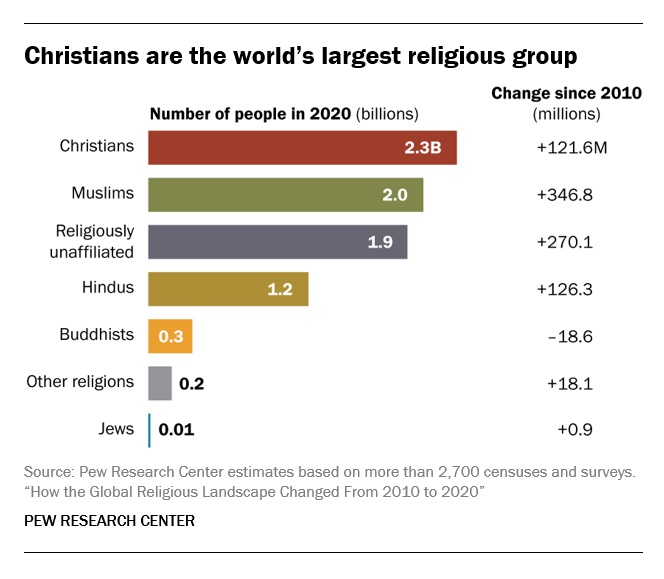
• Muslims are the world’s second-largest religious group (25.6% of the world’s population) and the fastest-growing major religion, largely due to Muslims’ relatively young age structure and high fertility rate. They make up the vast majority of the population in the Middle East-North Africa region. In all other regions, Muslims are a religious minority, including in the Asia-Pacific region (which is home to the greatest number of Muslims).
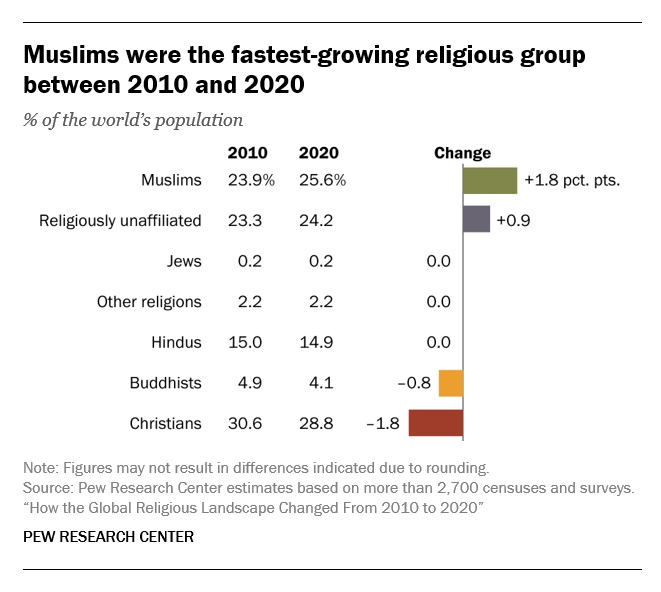
• The religiously unaffiliated population is the world’s third-largest religious category (24.2% of the global population), after Christians and Muslims. Between 2010 and 2020, religiously unaffiliated people grew more than any group except Muslims, despite their demographic disadvantages of an older age structure and relatively low fertility. The unaffiliated made up a majority of the population in 10 countries and territories in 2020, up from seven a decade earlier.
• Hindus are the fourth-largest religious category (14.9% of the world’s population), after Christians, Muslims and religiously unaffiliated people. Most (99%) live in the Asia-Pacific region; 95% of all Hindus live in India alone. Between 2010 and 2020, Hindus remained a stable share of the world’s population because their fertility resembles the global average, and surveys indicate that switching out of or into Hinduism is rare.
• Buddhists (4.1% of the world’s population) are the only group in this report whose number declined worldwide between 2010 and 2020. This was due both to religious disaffiliation among Buddhists in East Asia and to a relatively low birth rate among Buddhists, who tend to live in countries with older populations. Most of the world’s Buddhists (98%) reside in the Asia-Pacific region, the birthplace of Buddhism.
• Jews, the smallest religious group analyzed separately in this report (0.2% of the world’s population), lagged behind global population growth between 2010 and 2020 – despite having fertility rates on par with the global average – due to their older age structure. Most Jews live either in North America (primarily in the United States) or in the Middle East-North Africa region (almost exclusively in Israel).
These are among the key findings of a Pew Research Center analysis of more than 2,700 censuses and surveys, including census data releases that were delayed due to the coronavirus pandemic. This report is part of the Pew-Templeton Global Religious Futures project, which analyzes global religious change and its impact on societies around the world. Funding for the Global Religious Futures project comes from The Pew Charitable Trusts and the John Templeton Foundation.
Uncategorized
Hamas Tightens Grip on Gaza, New Analysis Shows, as Iran War Delays Second Phase of Ceasefire

Hamas fighters on Feb. 22, 2025. Photo: Majdi Fathi via Reuters Connect
As the international community struggles to advance the second phase of an already fragile ceasefire between Israel and Hamas, the Palestinian terrorist group is exploiting the war in Iran to tighten its civilian and security grip on the Gaza Strip and rebuild its military capabilities, according to a new report.
The Meir Amit Intelligence and Terrorism Information Center (ITIC) — an Israel-based research institute — released a new report this week warning that the US-Israel conflict with Iran and disputes over management of Gaza are delaying the implementation of the second phase of the US-backed ceasefire agreement, under which Hamas was expected to disarm as Israeli forces were set to withdraw from parts of the enclave.
The report also warned that such delays are giving Hamas a window of opportunity to rearm and further tighten its control over Gaza, complicating fragile efforts to move forward with the next stage of the truce.
ITIC’s new assessment shows Hamas has moved to reassert control over parts of the war-torn enclave and consolidate its weakened position by targeting Palestinians it labeled as “lawbreakers and collaborators with Israel.”
With its security control tightening, Hamas’s brutal crackdown has escalated, sparking widespread clashes and violence as the group seeks to seize weapons and eliminate any opposition.
The report further notes that Hamas’s confidence is on the rise across Gaza, visible in the increasingly public presence of armed operatives from both its military wing and security forces, underscoring the group’s tightening hold on the roughly 47 percent of the enclave it controls without an Israeli military presence.
Social media videos widely circulated online show Hamas members brutally beating Palestinians and carrying out public executions of alleged collaborators and rival militia members.
According to ITIC’s newly released report, Hamas is also rebuilding its military capabilities by smuggling arms from Egypt and producing weapons independently, while simultaneously consolidating civilian control through expanded police presence, regulation of markets, and the distribution of financial aid to residents in areas it governs.
Earlier this year, the US-backed plan to end the war in Gaza hit major roadblocks after proposals surfaced that would allow Hamas to retain some small arms — an idea strongly denounced by Israeli officials who insist the Islamist group must fully disarm.
Officials involved in the US-led Board of Peace drafted a plan that would allow Hamas to retain small arms while surrendering longer-range weapons as part of a “phased disarmament” process over several months, with heavy weapons to be “decommissioned immediately.”
However, key details about where the surrendered arms would go and how the process would be enforced remain unclear.
The initial framework also required “personal arms” to be “registered and decommissioned” as a new Palestinian administration takes charge of security in the enclave.
Israel has previously warned that Hamas must fully disarm for the second phase of the ceasefire to move forward, pointing to tens of thousands of rifles and an active network of underground tunnels still under the terrorist group’s control.
If the Palestinian Islamist group does not give up its weapons, Israel has vowed not to withdraw troops from Gaza further or approve any rebuilding efforts, effectively stalling the ceasefire agreement.
The Israel Defense Forces (IDF) currently occupies about 53 percent of the Strip, with most of the Palestinian population living in the remaining portion of the enclave under Hamas control.
Israeli Prime Minister Benjamin Netanyahu has insisted the country will not accept anything less than the full demilitarization of Gaza, warning that any reconstruction or political transition in the enclave depends on Hamas relinquishing its weapons.
Under US President Donald Trump’s 20-point Gaza peace plan, phase two would involve deploying an international stabilization force (ISF), beginning large-scale reconstruction, and establishing a Palestinian technocratic committee to oversee the territory’s administration.
According to media reports, the ISF could total around 20,000 troops, though it remains uncertain whether the multinational peacekeeping force will actually help disarm Hamas.
Over the past few weeks, Israel has resumed military operations in the Gaza Strip aimed at forcibly disarming Hamas. The IDF’s previous operations during the last two years of war had been partly limited by efforts to protect Israeli hostages kidnapped by Hamas, the last of whom were released last year as part of the ceasefire.
On Tuesday, Israeli forces announced that several Hamas Nukhba terrorists were eliminated during a strike in central Gaza after troops intercepted the operatives while they were conducting a military training exercise in the area.
IDF forces in the Southern Command remain deployed at key locations in the Gaza Strip, with the army warning it will employ all necessary force to neutralize threats and maintain control across the territory.
This week, the United Nations Security Council met to review progress on the Gaza peace plan and the implementation of phase two, originally adopted in November under the fragile truce between Israel and Hamas.
According to Nickolay Mladenov, the high representative for Gaza on Trump’s Board of Peace, a transitional Palestinian governing body has already been established in the enclave, and a framework agreed upon by the guarantor countries — the US, Egypt, Turkey, and Qatar — has been presented to armed groups, which he said establishes “the principle of one authority, one law, and one weapon.”
“The National Committee exercises authority solely on an interim basis,” Mladenov said during a speech, referring to the transitional Palestinian government that has been established.
“The end state is a reformed Palestinian Authority capable of governing Gaza and the West Bank, and ultimately a pathway to Palestinian self-determination and statehood,” he continued.
The proposed plan would require all armed groups in Gaza to transfer their arms to a transitional Palestinian governing authority, starting with their larger-scale weapons and monitoring compliance before reconstruction begins, while allowing fighters to gradually return to civilian life.
Mladenov also confirmed that Indonesia, Morocco, Kazakhstan, Kosovo, and Albania have committed troops to the ISF.
“The people of Gaza want reconstruction, and reconstruction requires the decommissioning of weapons,” he said, describing this link as the framework’s “driving force.”
So far, there is no timeline or clarity on discussions with relevant groups, nor on any potential Israeli military withdrawal.
As of February, Israel was planning to resume military operations in the Gaza Strip to forcibly disarm Hamas, with the IDF is drawing up plans for a renewed major offensive.
Israeli Defense Minister Israel Katz warned that Hamas will be disarmed by force if it continues to violate the ceasefire and pose a threat to Israel’s security.
“If Hamas does not disarm in accordance with the agreed framework, we will dismantle it and all of its capabilities,” the Israeli defense chief said this month.
However, with Israel focused on fighting Iran as well as its chief proxy Hezbollah in Lebanon, it appears a new offensive is unlikely to take place in Gaza in the immediate future.
Uncategorized
Sam Altman Shuts Down OpenAI’s Sora, Video Sharing App Notorious for Antisemitic Content

Three videos featured on Sora on March 24, 2026, promoted antisemitic stereotypes and violence against Jews. Photo: Screenshots
In a surprise move that has stunned industry watchers and killed a $1 billion licensing deal with Disney, OpenAI announced it would shutter Sora, the controversial video-generating app which drew condemnation last year for its unwillingness to stop the production and sharing of antisemitic content.
“We’re saying goodbye to the Sora app,” Sora’s X account posted on Tuesday. “To everyone who created with Sora, shared it, and built community around it: thank you. What you made with Sora mattered, and we know this news is disappointing. We’ll share more soon, including timelines for the app and API and details on preserving your work.”
Reflecting the seeming abrupt nature of the decision, OpenAI had published on Monday a “Creating with Sora safely” guide. The company claimed that its product “uses layered defenses to keep the feed safe while leaving room for creativity. At creation, guardrails seek to block unsafe content before it’s made — including sexual material, terrorist propaganda, and self-harm promotion — by checking both prompts and outputs across multiple video frames and audio transcripts.”
The guide stated, “We’ve red teamed to explore novel risks, and we’ve tightened policies relative to image generation given Sora’s greater realism and the addition of motion and audio.”
With the release of the standalone Sora 2 app in September 2025, The Algemeiner and other news organizations documented the antisemitic tropes emerging on the platform with one recurring visual depicting Jews chasing after coins.
Following the announcement of Sora’s shutdown on Tuesday, The Algemeiner reviewed the app’s feed and discovered multiple antisemitic videos within minutes.
The first from user @frankel944 depicts an elaborate 30-second narrative of an older Hassidic Jew with a long beard and traditional religious garb who demands a poor man’s $10,000 savings in exchange for moldy bread and soup. He complies, inspiring the Jewish man to then take the money, fly to Mexico, dance in a sombrero with a mariachi band, and then return to the US to say his prayers at the synagogue.
A second from @davidkline16 features a young man — apparently one of the user’s friends — walking in a synagogue proclaiming that he has been appointed the rabbi and inviting people to come and celebrate. A surreal, fleshy orb with a face floats in the background and starts to interrupt the warm greeting, menacingly yelling “Rapist! Rapist!” One of the recurring jokes that young people had used Sora to do was to transform their friends into Jewish converts.
The third is one of the most chilling as it depicts violence against Jews. User @orituviaabaselo felt compelled to create and share a video featuring a group of eight Hassidic Jewish men sitting at a table, speaking Hebrew, and eating challah in the middle of a dark road at night. Moments later a blue car comes barreling into the group sending them every which way. The clip ends with one of the Jews not concerned for his friends’ injuries, but asking where he can find his hat.
In October, the Anti-Defamation League (ADL) published research from its Center on Technology and Society which revealed that among the multiple AI-video generating apps tested, the programs would respond to antisemitic, racist, or other bigoted prompts at least 40 percent of the time. The ADL’s analysts found that, compared to its competitors, Sora “performed the best in terms of content moderation, refusing to generate 60% of the prompts.”
In January, the ADL analyzed multiple large language models and found that OpenAI’s ChatGPT lagged behind Anthropic’s Claude in its ability to detect antisemitism.
Some analysts suspect that this intra-industry rivalry may have played a role in OpenAI’s decision to shut down Sora as part of an effort to focus the company’s resources on core business capabilities. Anthropic was founded in 2021 by former OpenAI staffers dissatisfied with OpenAI CEO Sam Altman’s attitudes toward the dangers of AI. In recent years its Claude large language model has developed hegemony among computer programmers and other technical workers.
The Wall Street Journal reported on Tuesday that OpenAI sought to pivot to focus more on “so-called productivity tools,” a category currently dominated by Anthropic, rather than continuing with the cost-intensive videos.
Farida Khalaf, a business analyst and data engineer who focuses on cybersecurity, wrote Monday on Substack Notes predicting what would happen the next day. “Meta shutdown Metaverse, NEXT will be SORA from open AI,” she wrote.
On March 17, Meta announced its CEO Mark Zuckerberg had chosen to shut down Horizon World, the virtual reality platform which he had previously backed so heavily he chose to change the company’s name in October 2021 from Facebook to Meta.
Khalaf drew the comparison, asking, “Remember the hype surrounding the SORA app release? It seems to be following a similar trajectory, and with costs running higher than its revenue, the sustainability of this model is questionable.”
Forbes estimated in November that Sora was costing OpenAI $15 million a day. “We have been quite amazed by how much our power users want to use sora, and the economics are currently completely unsustainable. we thought 30 free gens/day would be more than enough, but clearly we were wrong!” Sora’s head Bill Peebles wrote on X on Oct. 30, 2025.
In December, Disney had signed a $1 billion agreement with OpenAI to license 200 characters for inclusion in Sora. “As the nascent AI field advances rapidly, we respect OpenAI’s decision to exit the video generation business and to shift its priorities elsewhere,” said a spokesperson for the film company.
On Tuesday, Altman announced his refocused priorities on X.
“AI will help discover new science, such as cures for diseases, which is perhaps the most important way to increase quality of life long-term,” Altman wrote. “AI will also present new threats to society that we have to address. No company can sufficiently mitigate these on their own; we will need a society-wide response to things like novel bio threats, a massive and fast change to the economy, extremely capable models causing complex emergent effects across society, and more.”
Uncategorized
Who is Hasan Piker, the left-wing streamer accused of being an antisemite?
(JTA) — Rep. Brad Schneider, an Illinois Democrat, delivered a forceful condemnation of the popular streamer Hasan Piker on Tuesday, warning his fellow Democrats against embracing figures he says traffic in hate.
“Hasan Piker is an unapologetic antisemite,” Schneider, who chairs the New Democratic Coalition, wrote in a post on X. “Democrats risk losing our credibility to condemn those on the right who traffic in bigotry, antisemitism, & hate when our own Members of Congress & candidates are celebrating or, worse yet, platforming those who espouse hate of any kind.”
While Schneider added in a separate post that he was “proud” that the party welcomes “a broad diversity of opinions and priorities,” he stipulated that the Democratic tent must “reject those who champion ideologies of exclusion and demonization.”
Schneider’s remarks come as the Republican coalition has faced deepening rifts over the vociferously anti-Israel, and increasingly antisemitic, rhetoric emanating from prominent online figures in its movement, including Tucker Carlson and Nick Fuentes.
But as top conservatives wrestle with the growing prominence of far-right voices within the party, an adjacent battle is emerging on the Democratic side, as support for Israel among its base has reached a record-low and political candidates increasingly engage with far-left, anti-Israel voices, including Piker.
Since starting his daily online broadcasts in 2018, Piker, 34, has amassed a devoted online fanbase, including three million followers on the streaming platform Twitch and 1.85 million on YouTube.
As one of the most prominent leftist commentators in the United States, Piker’s streams in recent years have often featured sharp critiques of the Democratic party, Israel and U.S. foreign policy in the Middle East, positions that have increasingly drawn scrutiny.
Piker has previously referred to Orthodox Jews as “inbred,” compared Israelis to the Ku Klux Klan and defended Hamas, writing in a post on X in January that the terror group is “a thousand times better than the fascist settler colonial apartheid state.”
On one of his shows aired days after Oct. 7, Piker told off a listener who condemned the massacre, saying “Bloodthirsty violent pig dog, suck my d–-k.” In a May 2024 stream, Piker also minimized reports of the prevalence of sexual assault during the Oct. 7 attacks, saying “It doesn’t matter if rape happened on October 7th. It doesn’t change the dynamic for me.”
While speaking at a conference in Qatar last month, Piker said that he had lost viewers in the wake of Oct. 7 for his commentary, explaining, “People were not ready, especially in Western audiences, for someone to say that Israel played a significant role in how Oct. 7 took place.”
In response to a CNN article last month that noted the joint U.S.-Israeli strikes on Iran coincided with Purim, Piker wrote, “This is jewish supremacy. it’s what netenyahu said after oct7” [sic].
Piker’s incendiary commentary has earned him a nomination for “Antisemite of the Year” in 2024 from a watchdog group and drawn the condemnation of Jonathan Greenblatt, the CEO of the Anti-Defamation League. Greenblatt charged the streamer with using his platform to “spread anti-Jewish tropes, amplify propaganda from a designated terrorist group, and promote toxic anti-Zionism.”
In October 2024, Rep. Ritchie Torres of New York, a pro-Israel stalwart in the Democratic party, wrote a letter to Twitch executives in which he called on the platform to “stop popularizing” Piker, who he called the “antisemitic poster child for a systematically antisemitic social media platform.”
Despite the volley of criticism, Piker has dismissed allegations that he is antisemitic.
“These last two years, I’ve been called antisemitic. I abhor antisemitism, and I’ve spent my entire professional media career combating it. I just happen to be anti-Israel, and that makes me a far greater threat than the likes of Nick Fuentes because they know he’s a Nazi,” Piker told Variety last November. “I don’t find kinship with the right because I think there are some on the right that just use Israel as a new opportunity to cut through the noise.”
Piker has also increasingly hosted left-wing politicians on his platform in recent years, drawing derision from critics, including Schneider, who argue that officials risk legitimizing his commentary by appearing alongside him.
Piker has previously interviewed Vermont Independent Sen. Bernie Sanders and New York Democratic Rep. Alexandria Ocasio-Cortez, California gubernatorial candidate Tom Steyer and New York City Mayor Zohran Mamdani. Next month, Piker is slated to appear on campuses alongside Michigan Senate candidate Abdul el-Sayed.
For many politicians, Piker is a conduit to the much-coveted younger voter. Twitch, originally designed for video games, is now widely used for music, creative content and political commentary from hosts like Piker.
The streamer also confirmed earlier this month that California Gov. Gavin Newsom, who is seen as a likely 2028 Democratic presidential candidate, had agreed to sit for an interview with him.
“Gavin newsom is a shrewd operator. while i do not trust him on israel, it is clear that this issue has shifted so much towards the side of truth and justice that even people w 2028 ambitions are leaning into anti israel sentiment,” Piker wrote in a post on X after Newsom appeared to agree with claims that Israel is an “apartheid state” earlier this month. (This week Newsom said he regrets those comments.)
Schnieder is not alone in his calls for fellow Democrats to distance themselves from Piker. Earlier this month, Jonathan Cowan, the president of the centrist Democratic think tank Third Way, wrote an op-ed in the Wall Street Journal calling on Democrats to “draw a line in the sand.”
“Mr. Piker is anti-American, antiwomen, anti-Western and antisemitic. No Democrat should engage with him. All should seek to push him to the fringe, where he belongs,” Cowan wrote.
Many in the party’s progressive wing have taken a sharply different view.
Cameron Kasky, a Jewish Gen-Z progressive who recently dropped his bid in New York’s 12th District race, pushed back on the calls to sideline Piker in post on X, arguing instead that more Democrats should sit down with him.
“Yeah, no sh–t big politicians are talking to Hasan Piker. More of them should be,” Kasky wrote. “God forbid a candidate actually work with new media, which the Right has used to dominate us.”
This article originally appeared on JTA.org.
The post Who is Hasan Piker, the left-wing streamer accused of being an antisemite? appeared first on The Forward.