


Uncategorized
How the Israeli scouts became a refuge for Jewish teens in a post-Oct. 7 world
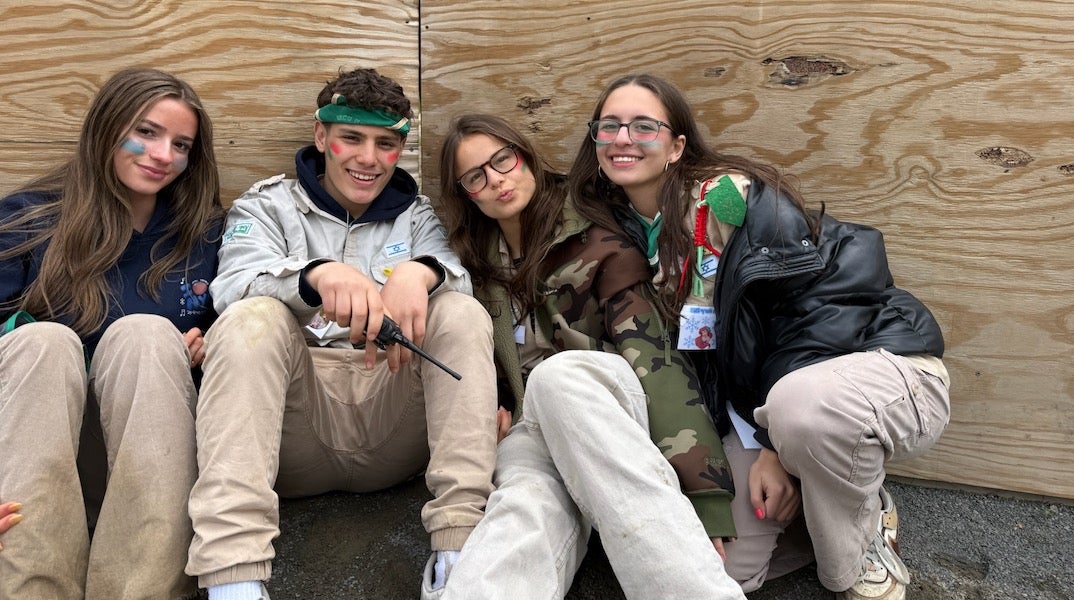
This article was produced as part of the New York Jewish Week’s Teen Journalism Fellowship, a program that works with Jewish teens around New York City to report on issues that affect their lives.
As a high school senior, the stress of college applications, homework and the looming end of childhood leaves me constantly waiting for Sundays. That’s the day I get to put on my khaki Tzofim, or Israeli Scouts, uniform — covered with pins, patches and signatures — and head to Manhattan’s East Side.
There, in a rented room in a Catholic school, is where I feel most grounded. There, I’m surrounded by people that understand the duality of being both American and Israeli, something that my born-and-raised American friends simply couldn’t understand. When I’m at a Tzofim meeting, surrounded by Israeli-American teens from across the city, the complexity of that dual identity doesn’t seem so complex.
Tzofim has been my refuge since shortly after the horrific events of Oct. 7, 2023. One bright November morning, just a few weeks after the attack, I was in my AP World History class, discussing nationalities and the role they play in history. My teacher decided to pick me as an example, pointing out to the class that my nationality is Israeli.
My classmates glared at me with newfound judgment. Suddenly, the labels I had always cherished — Israeli, Zionist, Jew — were no longer affirmations of pride. Instead, they felt like accusations, heavy with opinions and suspicion.
For the first time in my seven years of living in New York, I felt completely alone.
Two weeks later, I attended my first Tzofim activity. The meeting took place in a modest community space near Union Square, the room was filled with chatter, music and rows of teens in uniforms just like mine. Surrounded by peers who had similar fears about being judged for their Jewish and Israeli identities, I felt understood. I didn’t have to explain or defend who I was.
Founded in Israel in 1919 and brought to the United States more than 25 years ago, the Tzofim is a youth-led movement modeled loosely on the World Scouting Movement, but with a focus on Israeli culture and Jewish identity. It serves kids and teens ages 7 through 18 and emphasizes leadership, service and community.
Our New York chapter, Shevet Tapuach, meets weekly for programs that mix cultural education, team-building activities and discussions about Jewish identity and current events. Teens take on leadership roles: guiding younger scouts, organizing events and shaping the direction of the chapter.
After Oct. 7, participation in Shevet Tapuach surged — membership grew from 180 to more than 330 participants, according to our chapter head, Michal Poran. The teen division alone nearly doubled, from 54 to 95. What was once one of the smallest chapters in the U.S. became a thriving hub of Jewish teen life in New York.
This growth reflected a larger shift in post-Oct. 7 Jewish life: Many teens who had once felt only loosely connected to their Jewish or Israeli identity began seeking out safe spaces where they could feel seen and supported. In response, our chapter opened its doors more widely. What had previously been an Israeli-centered environment became a place where Jewish teens of all backgrounds could find belonging.
Poran called this shift a “rebranding,” sparked by the war in Israel. “We wanted to make this a community and a home for all Jews, a place to feel included, even if you’re not Israeli,” she told me.
Emma Navoth, an 18-year-old leader who has been in Tzofim since second grade, told me she’s watched the chapter transform. “So many teens who never thought about joining before are coming now,” she said. “People want a place where they feel safe and supported. For me, Tzofim has always been that, now it’s that for even more people.”
Another member, Liya Blinderman, explained that after Oct. 7, she realized that comfort couldn’t be found in the routines of school or casual hangouts with friends. What she needed was a community that understood what it felt like to wake up to news from Israel every morning, or to have family conversations constantly circle back to the war. “It became a meaningful outlet for me,” she told me. “A place where I could grow, connect, and give back. The support here isn’t just organizational, it’s deeply human.”
For these Jewish and Israeli teens in New York — myself included — the Scouts have become more than just an extracurricular activity. They’re an entry point into a longstanding tradition of leadership and resilience. Weekly meetings teach us not only about Israeli history and Jewish culture, but about standing strong in times of adversity.
As the new school year begins, I’m excited to see our group continue to grow — welcoming new members, planning community events, and finding new ways to speak up and support one another. For me, Tzofim isn’t just a reminder of who I am; it’s a way to shape who I want to become.
—
The post How the Israeli scouts became a refuge for Jewish teens in a post-Oct. 7 world appeared first on Jewish Telegraphic Agency.
Uncategorized
Trump Threatens to Hit Iran Infrastructure on Tuesday if Strait Remains Blocked

US President Donald Trump arrives to award the medal of honor to Master Sgt. Roderick ‘Roddie’ W. Edmonds, Staff Sgt. Michael H. Ollis, and retired Command Sgt. Maj. Terry P. Richardson during a ceremony in the East Room of the White House in Washington, DC, USA, 02 March 2026.
US President Donald Trump said in an expletive-laden social media post on Sunday that the United States will target Iran’s power plants and bridges on Tuesday if the Strait of Hormuz is not reopened.
“Tuesday will be Power Plant Day, and Bridge Day, all wrapped up in one, in Iran. There will be nothing like it!!!” Trump said in a Truth Social post, referencing the key shipping lane that Tehran has effectively closed since the US and Israel launched attacks on Iran more than a month ago.
“Open the Fuckin’ Strait, you crazy bastards, or you’ll be living in Hell – JUST WATCH!,” Trump said, ending his Easter morning post with: “Praise be to Allah.”
The president separately said he would hold a news conference on Monday in the Oval Office, after the US military rescued two US pilots whose aircraft were downed in Iran.
Uncategorized
Zelensky in Syria to Discuss Security Cooperation with Sharaa

FILE PHOTO: Ukraine’s President Volodymyr Zelenskiy looks on during an interview with Reuters, amid Russia’s attack on Ukraine, in Kyiv, Ukraine March 25, 2026. REUTERS/Valentyn Ogirenko/File Photo
Ukrainian President Volodymyr Zelensky pledged to work for enhanced security in talks on Sunday with his Syrian counterpart Ahmed al-Sharaa, as Kyiv seeks to promote its military expertise across the region following the outbreak of the Iran war.
Zelensky, continuing his tour of Middle East countries, also said Ukraine wants to contribute to food security in the region.
In recent weeks, Zelensky has visited several countries across the Middle East, offering Ukrainian expertise in countering drone and missile attacks, developed during its four-year war with Russia.
“We agreed to work together to provide more security and opportunities for development for our societies,” Zelensky wrote on Telegram. “There is a great interest in exchanging military and security experience.”
Zelensky told the Syrian leader that Ukraine, as a major grain producer, was a reliable supplier of food and said the two leaders “discussed joint opportunities to strengthen food security across the region.”
In Turkey on Saturday, Zelensky said he had agreed on “new steps” in security cooperation with Turkish President Tayyip Erdogan, and discussed opportunities in joint gas infrastructure projects and gas field development.
“Today in Damascus we continue our active Ukrainian diplomacy aimed at real security and economic cooperation,” Zelensky said on X after his arrival.
It was the Ukrainian leader’s first trip to Syria since diplomatic relations were re-established at the end of last year following the fall of Syria’s long-time strongman Bashar al-Assad.
Zelensky’s talks with Sharaa were linked to defense in light of the US-Israeli war in Iran, said one Syrian source, a government adviser. Syria is not known to have any air defenses capable of dealing with Iranian drones or missiles.
During Zelensky’s visits to Gulf states last weekend, Ukraine signed long-term military cooperation deals with Saudi Arabia and Qatar, and he said that a similar agreement was close to completion with UAE.
Syria is home to two major Russian military bases, used by its navy and air force. Sharaa said on Tuesday at an event in Chatham House in London that work was under way to transform these into “centers to train the Syrian army.”
Uncategorized
China Ready to Cooperate with Russia to Ease Middle East Tension, Foreign Minister Says

China’s Foreign Minister Wang Yi attends the 14th EAST Asia Summit Foreign Ministers’ Meeting in the 57th ASEAN Foreign Ministers’ Meeting at the National Convention Center, in Vientiane, Laos July 27, 2024. Photo: REUTERS/Chalinee Thirasupa/File Photo
China is willing to continue to cooperate with Russia at the UN Security Council and make efforts to cool down the Middle East situation, Foreign Minister Wang Yi told his Russian counterpart Sergei Lavrov in a phone call on Sunday.
Wang said the fundamental way to resolve navigation issues in the Strait of Hormuz is to achieve a ceasefire as soon as possible, adding that China has always advocated political settlement of hotspot issues through dialogue and negotiation.
The foreign ministers’ call came ahead of a U.N. Security Council vote next week on a Bahraini resolution to protect commercial shipping in and around the Strait of Hormuz.
As permanent UNSC members, China and Russia should “adopt an objective and balanced approach and seek to win greater understanding and support from the international community,” Wang told Lavrov, according to a statement from his ministry.
China has repeatedly called for a ceasefire in the Gulf region and Middle East, urging an end to the fighting that has run for more than a month and largely closed the Strait of Hormuz, a critical shipping artery for oil and gas.