



Uncategorized
How to Respond When Your Friends Cite Hamas’ Casualty Numbers

The head of an anti-Hamas faction, Hussam Alastal, fires a weapon in the air as he is surrounded by masked gunmen, in an Israeli-held area in Khan Younis, in the southern Gaza Strip, in this screenshot taken from a video released Nov. 21, 2025. Photo: Hussam Alastal/via REUTERS
Not long ago, a very intelligent friend asked me a sincere question.
He wanted to know whether, as a Zionist, I was disturbed by what he took to be a settled fact: that Israel had “killed 300 people in a tent while trying to get one terrorist.”
He wasn’t hostile. He wasn’t chanting slogans. He was genuinely troubled and trying to reconcile that number with my support for Israel.
What shocked me was not the question itself, but the assumption behind it. He works with numbers for a living, yet it had not occurred to him to ask the most basic question: “Is that figure actually true, and who produced it?” He had simply absorbed it as unquestionable reality.
When I explained that such numbers almost always trace back to Hamas-run institutions in Gaza, laundered through media outlets and NGOs that treat them as neutral sources, it was clearly a new way of looking at the war for him.
The conversation revealed something I see on a much larger scale: people who would never trust Hamas with their bank account are trusting it with their moral judgment.
When I describe Hamas’ listed death toll in Gaza, I describe it as the “casualty-number war.” It’s not just about how many people have died. It’s about who is doing the counting, what they are counting, and how those numbers are deployed to turn a complicated war into a morality play with ready-made villains and victims.
Hamas understands this perfectly. Its “Ministry of Health” in Gaza is not some independent public health office. It is part of a totalitarian structure that answers to the same regime that launched the October 7 massacre, embeds fighters and rocket launchers among civilians, and openly celebrates “martyrdom.”
Yet Western media outlets, NGOs, and politicians routinely preface their coverage with the same passive formulation: “According to the Gaza Health Ministry, more than X thousand people have been killed…”
Once that sentence is accepted as neutral, the argument is already half lost.
These headline numbers blur together every possible category of death: combatants and non-combatants, people killed by Hamas’ own rockets or internal violence, people who died of illness or old age, and people whose deaths are simply unverifiable.
There is rarely a breakdown by cause, location, or affiliation. The message is not “here is our best attempt at a complex casualty record.” The message is, “Israel killed this many people; now explain yourself.”
Western institutions, meanwhile, have powerful incentives to accept this framing. Journalists on deadline want a single, authoritative-sounding figure. NGOs need dramatic numbers to drive fundraising and campaigns. Politicians want an easy way to signal moral outrage without learning the underlying details. “According to Gaza’s Health Ministry…” gives them all exactly what they want.
The result is that Hamas’ tally becomes something close to sacred. To question it is treated as denial of suffering, rather than as basic due diligence.
To be clear, this does not mean that the real toll of the war is small, or that civilian deaths are imaginary. They are not. Wars in dense urban environments, against enemies who hide behind civilians, are always tragic. But tragedy does not excuse deception, and compassion does not require us to outsource moral judgment to a terrorist organization.
There is another trap we must avoid, however, and it lies on “our” side of the argument.
Recently, a claim circulated online that Hamas had “admitted” to losing 50,000 fighters and was preparing to pay stipends to their widows. It was an appealing narrative: if true, it would imply that the majority of Gaza’s war dead were Hamas’ own armed operatives, not civilians. Many people repeated it enthusiastically.
The problem is that the underlying evidence does not support such certainty. The 50,000 figure appears to come from extrapolations about an aid program for widows and vague statements in local media, not from a clear, formal admission of combatant deaths by Hamas itself. Israel’s own estimates of Hamas and Palestinian Islamic Jihad fighters killed are much lower — on the order of tens of thousands, but not double that.
In other words, some of Hamas’ critics were tempted to do what they rightly accuse Hamas of doing: leaping from suggestive data to definitive, emotionally satisfying numbers.
That may feel good in the moment, but it ultimately weakens our case. If we want the world to take casualty manipulation seriously, we have to hold ourselves to a higher standard than Hamas does.
So how should we think and talk about Gaza casualty numbers?
First, always ask who is counting. A figure produced by a Hamas-run bureaucracy and laundered through sympathetic NGOs is not equivalent to an independent forensic assessment. That does not mean every number is automatically false; it means we must treat it as a political artifact, not a neutral statistic.
Second, ask what is being counted. Are natural deaths and pre-existing illnesses being folded into “war fatalities”? Are internal killings, executions of “collaborators,” gang violence, and misfired rockets landing in Gaza all being quietly attributed to Israel?
Are combatants and non-combatants being distinguished, or are they all being described as “civilians,” “women,” and “children”? If those questions are not being asked, the headline number is not serious.
Third, examine the incentives. Hamas gains strategically every time the West believes that almost every death in Gaza is an innocent civilian killed by the Israel Defense Forces. That perception fuels accusations of “genocide,” drives diplomatic pressure, and legitimizes further violence under the banner of “resistance.”
Conversely, Hamas has every incentive to hide its own fighters among civilians, both physically and statistically.
Fourth, be honest about uncertainty. We will probably never know the exact distribution of deaths in Gaza by category. That is the nature of war, especially in closed, authoritarian environments. But we can say, with confidence, that the picture is far more complex than the nightly news suggests.
We know that a significant share of the dead are combatants. We know that some deaths are caused by Hamas’ own actions, whether through misfires or internal violence. We know that some reported “war casualties” would have occurred from natural causes even in peacetime. A morally serious discourse must reflect that complexity.
For ordinary readers and viewers, the question becomes: what can I actually do when confronted with someone like my friend, who has been told that Israel “killed 300 people in a tent to get one terrorist” and accepted it as unquestionable fact?
A few simple moves can help:
- Slow the conversation down. Instead of arguing about whether 300 is “too many,” start with “Who gave you that number?” That alone often changes the entire frame.
- Separate grief from propaganda. It is possible to say, “Every innocent life lost is a tragedy,” while also saying, “That does not mean Hamas’ numbers are accurate, or that Israel is committing the crimes you’ve been told about.”
- Insist on categories, not just totals. Ask whether the figure distinguishes between terrorists and non-terrorists, between people killed by Hamas and those killed by Israel, between battlefield fatalities and natural deaths. Most numbers in circulation do not.
- Refuse to play by Hamas’ rules. Do not feel compelled to accept a Hamas-run institution’s tally as the starting point for every moral conversation. We are not obligated to let Israel’s enemies define the terms of debate, whether in language or in arithmetic.
My friend and I ended our conversation on good terms. He did not walk away with a perfect spreadsheet of Gaza casualties — neither of us has one. But he did walk away with a new question lodged in his mind: “Why am I letting Hamas tell me what to think?”
That, ultimately, is the goal. If we care about truth, about Israel’s legitimacy, and about the real human beings — Jews and Arabs alike — whose lives are at stake, we cannot allow a terrorist organization to be the world’s official statistician. We do not have to accept a calculator held in the same hands that fired the rockets and sent the “martyrs.”
We can insist on something better: honest categories, transparent methods, and a refusal to surrender our moral judgment to those who openly seek our destruction.
David E. Firester, Ph.D., is the Founder and CEO of TRAC Intelligence, LLC, and the author of Failure to Adapt: How Strategic Blindness Undermines Intelligence, Warfare, and Perception (2025).
Uncategorized
A Jewish farmer broke ground on a synagogue in an Illinois cornfield. His neighbors showed up to help.
STERLING, ILLINOIS — On Wednesday, Nik Jakobs was planting corn. On Thursday, the 41-year-old Illinois cattle farmer stood in a two-acre cornfield preparing to plant something else: a synagogue.
Around 75 people gathered on the edge of the field this week in Sterling, Illinois, a two-hour drive west of Chicago, where Jakobs and his family broke ground on a new home for Temple Sholom, the small congregation that has anchored Jewish life here for more than a century, and where his family has prayed since the 1950s.
The planned 4,000-square-foot building will also house a Holocaust museum inspired by the story of Jakobs’ grandparents, Edith and Norbert, who survived the war after Christian families in the Netherlands hid them in their homes for years. Jakobs described the future museum as a place devoted not only to Jewish history, but to teaching the dangers of hatred and division. “If you have the choice to be right or kind,” he said, repeating advice from his grandmother, “choose kind.”
A 60-foot blue ribbon — chosen by Jakobs’ wife, Katie, to match the color of the Israeli flag — stretched across the future building site. His four daughters held it alongside his parents, brothers and friends. Then Jakobs lifted oversized gold scissors and cut the ribbon as pastors, farmers, city officials and members of neighboring churches applauded.
I’m writing a book about a young Jewish farmer who is building a synagogue in a two-acre cornfield in rural Illinois using sacred objects (ark, Torah, stained glass windows) donated by closing congregations across America. Today, they held the groundbreaking. 🧑🌾 🌽🕍 pic.twitter.com/90TynBMWHC
— Benyamin Cohen (@benyamincohen) May 8, 2026
The synagogue rising from this Illinois cornfield will house pieces of the past.
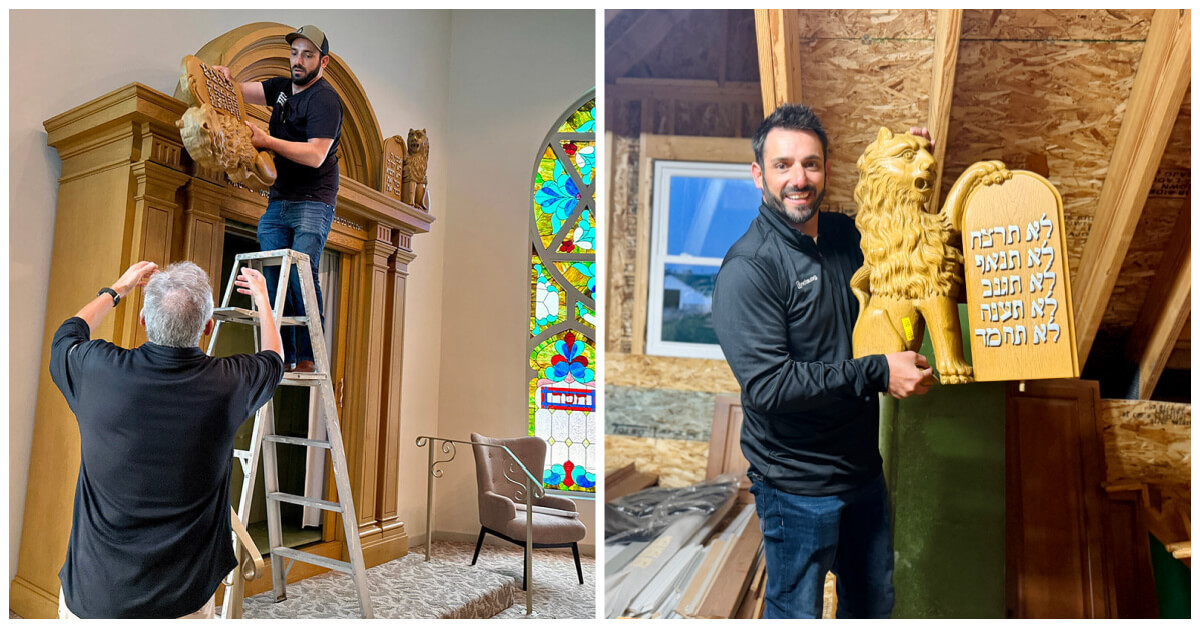
A nearby storage area holds Jewish objects Jakobs rescued from shuttered synagogues across the country: stained-glass windows, Torah arks, rabbi’s chairs, memorial plaques and wooden tablets engraved with the tribes of Israel. Many came from Temple B’nai Israel, a 113-year-old synagogue that closed down in 2025. It served generations of Jews in McKeesport, Pennsylvania, now a ghost town since the steel mills closed. Its remaining congregants donated sacred objects to Jakobs so their story could live on rather than disappear.
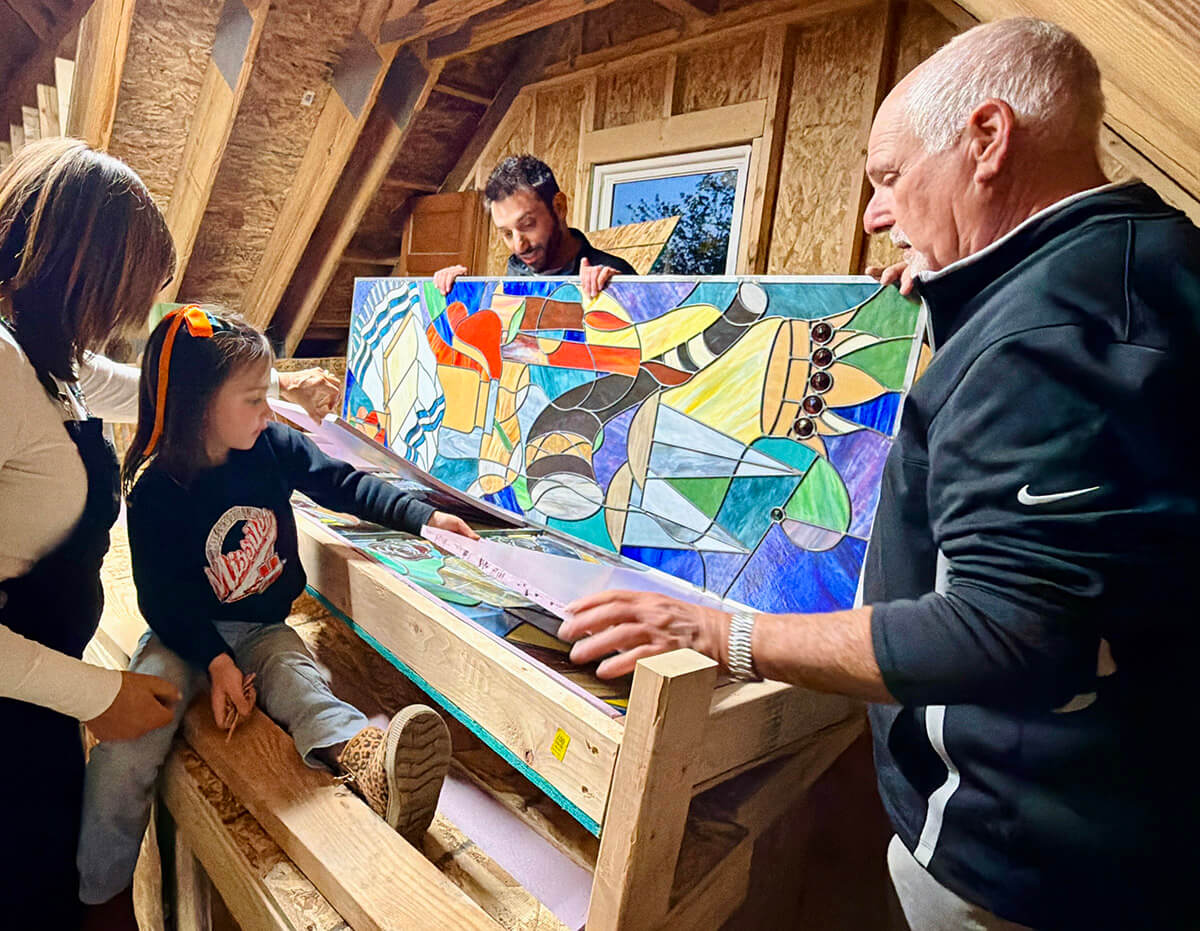
The day before the groundbreaking, the Jakobs family began opening some of the crates for the first time since they were packed away nearly a year ago. Nik’s father, Dave Jakobs, pried open one box with a hammer and crowbar while Nik loosened screws with an electric drill, the family gathered around like archaeologists opening a tomb.
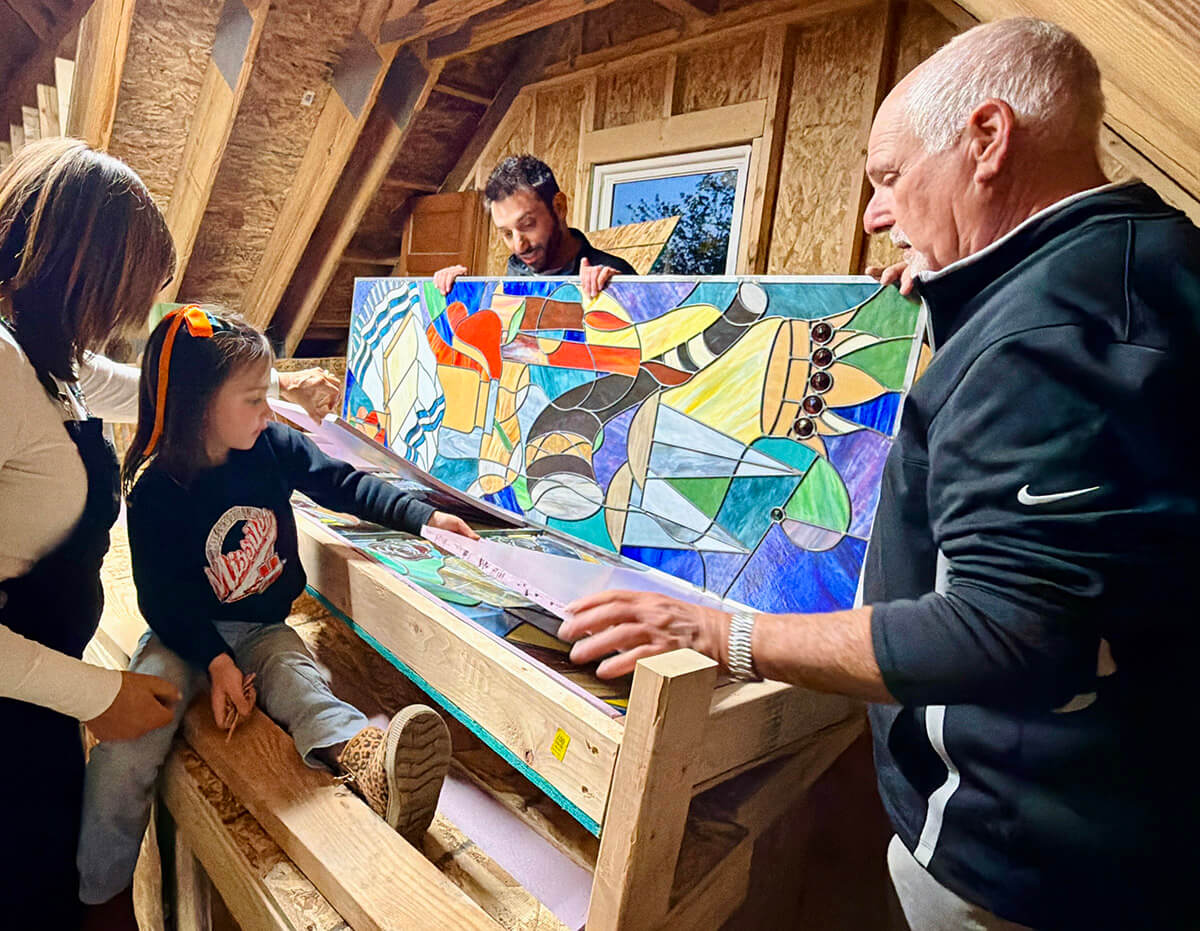
Inside was a stained-glass window with images of a tallit and shofar bursting in jewel tones of blue, yellow and red. Jakobs’ mother, Margo, lifted Annie, the youngest of Nik’s daughters, so the 4-year-old could peer inside. The bright red glass matched the bow in her hair.
Nearby sat the massive wooden ark salvaged from Pennsylvania, topped with twin Lions of Judah whose carved paws once overlooked generations of worshippers.
Faith on the farmland
Temple Sholom — founded in 1910 — was once the center of Jewish life in Sterling, a town of 14,500 surrounded by flat farmland and tall grain silos. Its Jewish community once included a pharmacist, the manager of Kline’s department store and the owner of a local McDonald’s franchise.
Over time, membership dwindled. The roof sagged. The pews emptied.
Last year, the congregation sold its aging building and relocated High Holiday services to a tent on the Jakobs’ farm, where prayers mingled with the smell of manure and cattle lowing nearby.
At a moment when many small-town synagogues are closing, Temple Sholom is doing something increasingly rare: building a bigger new sanctuary from scratch. The synagogue will sit prominently along one of Sterling’s main roads — a highly visible expression of Jewish life in a region where Jews are few.
Thursday’s groundbreaking took place on the National Day of Prayer, the annual observance formalized under President Ronald Reagan, who grew up a few miles away in Dixon, Illinois. Earlier that morning, attendees gathered inside New Life Lutheran Church for a breakfast sponsored by Temple Sholom.
“I was so happy to see bagels, lox and cream cheese,” said Rev. James Keenan, a Catholic priest originally from Brooklyn. “It reminded me of home.”
Inside the church sanctuary, a large wooden cross glowed amber and blue above the dais while two giant screens displayed the National Day of Prayer logo. Jakobs, wearing cowboy boots, jeans and a powder-blue blazer, addressed the crowd.
“Tolerance is not weakness,” he said. “It is strength.”
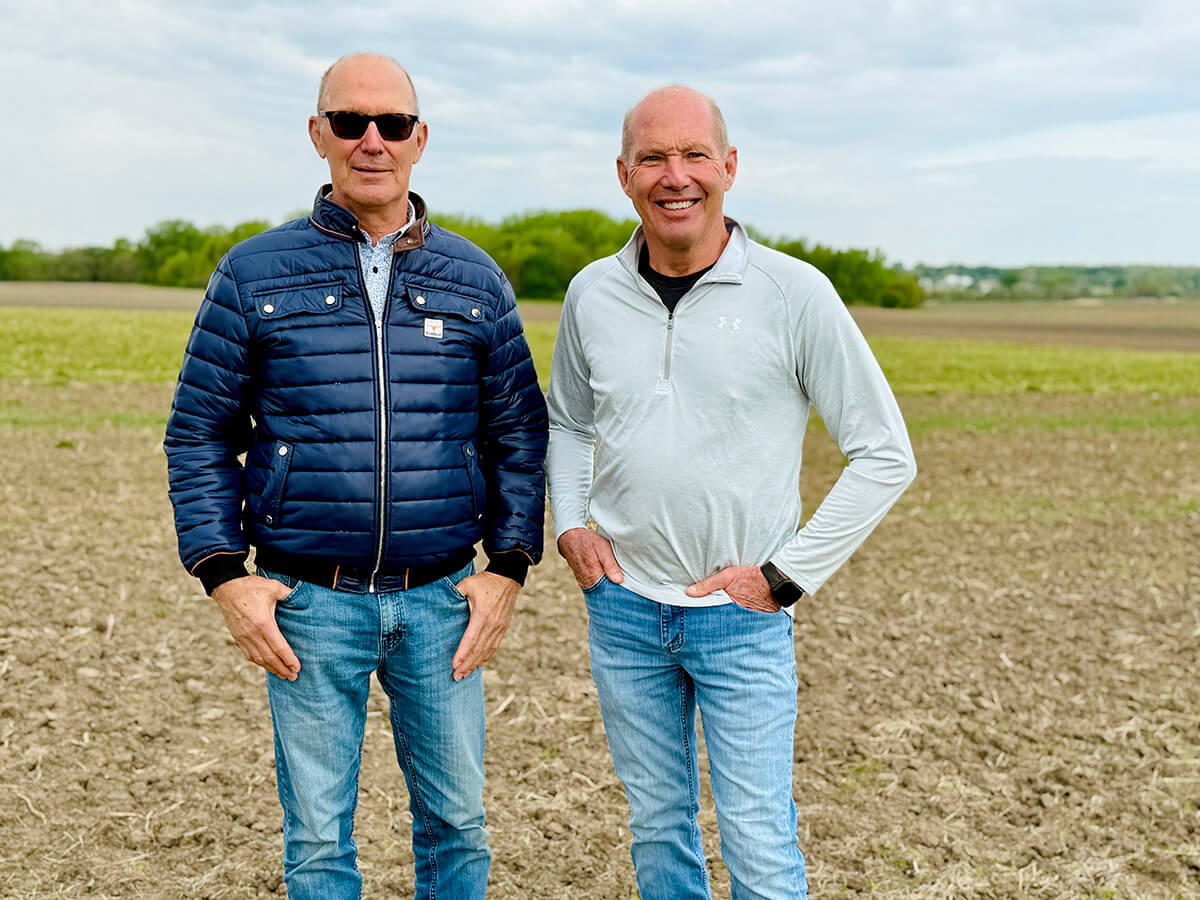
The new synagogue will sit beside New Life Lutheran Church on land sold to Temple Sholom by farmer Dan Koster, 71, who has known the Jakobs family for three generations.
“We need more religious presence in the community,” Koster said.
For Drew Williams, New Life’s 38-year-old lead pastor, the synagogue and museum represent more than neighboring buildings. His church already hosts food-packing drives, summer meal programs and community events. He imagines future partnerships with Temple Sholom.
“I don’t think there’s any community that is immune to hate,” Williams said. “That just means it’s on us” to be on the other side “spreading peace.”
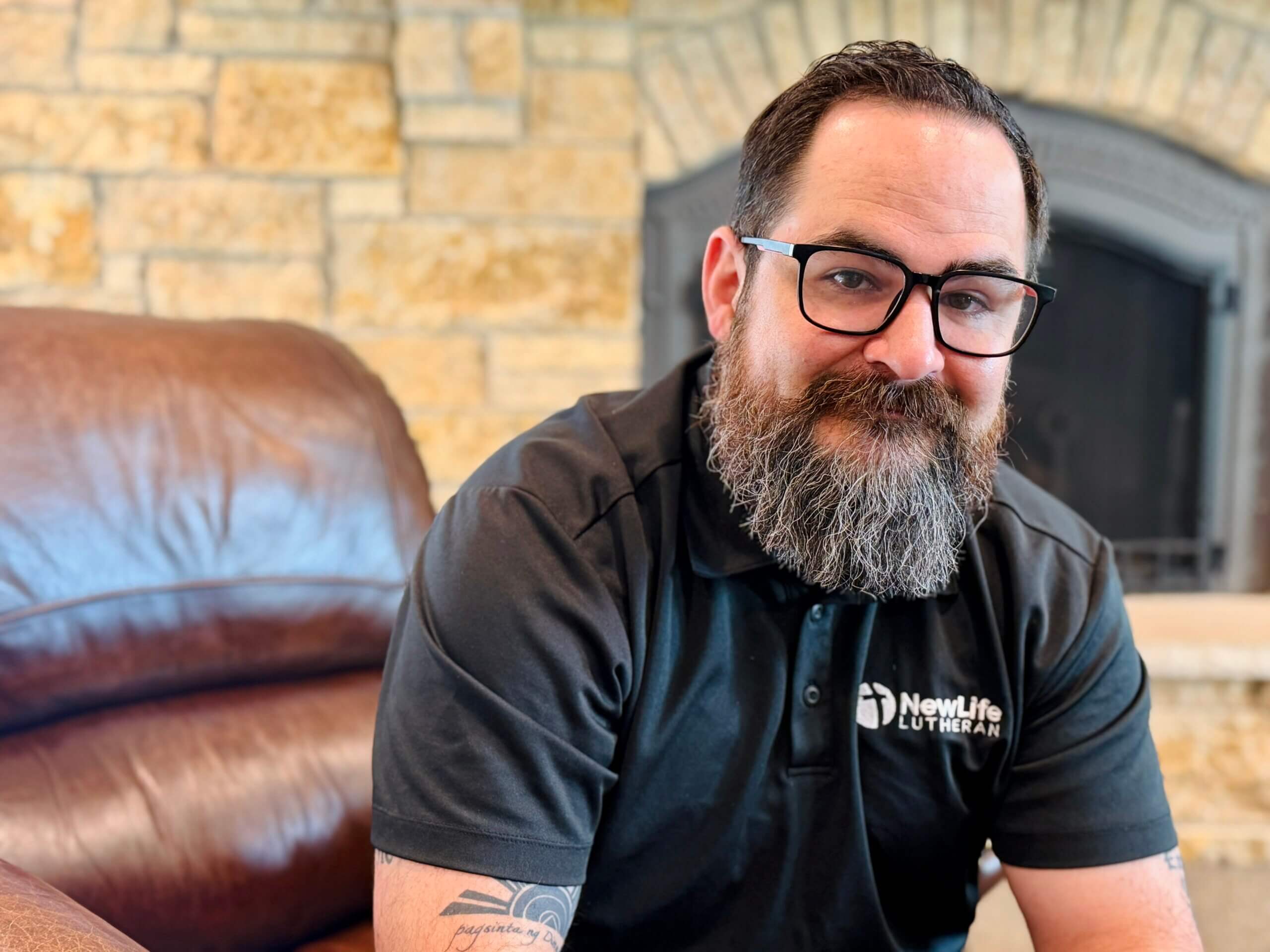
Sterling Mayor Diana Merdian, who is 41 and grew up in town with Jakobs, said the project reflects a broader desire among younger generations to preserve local history and identity. “If we don’t carry those stories, we lose them,” she said. “Once you lose that, you can’t get it back.”
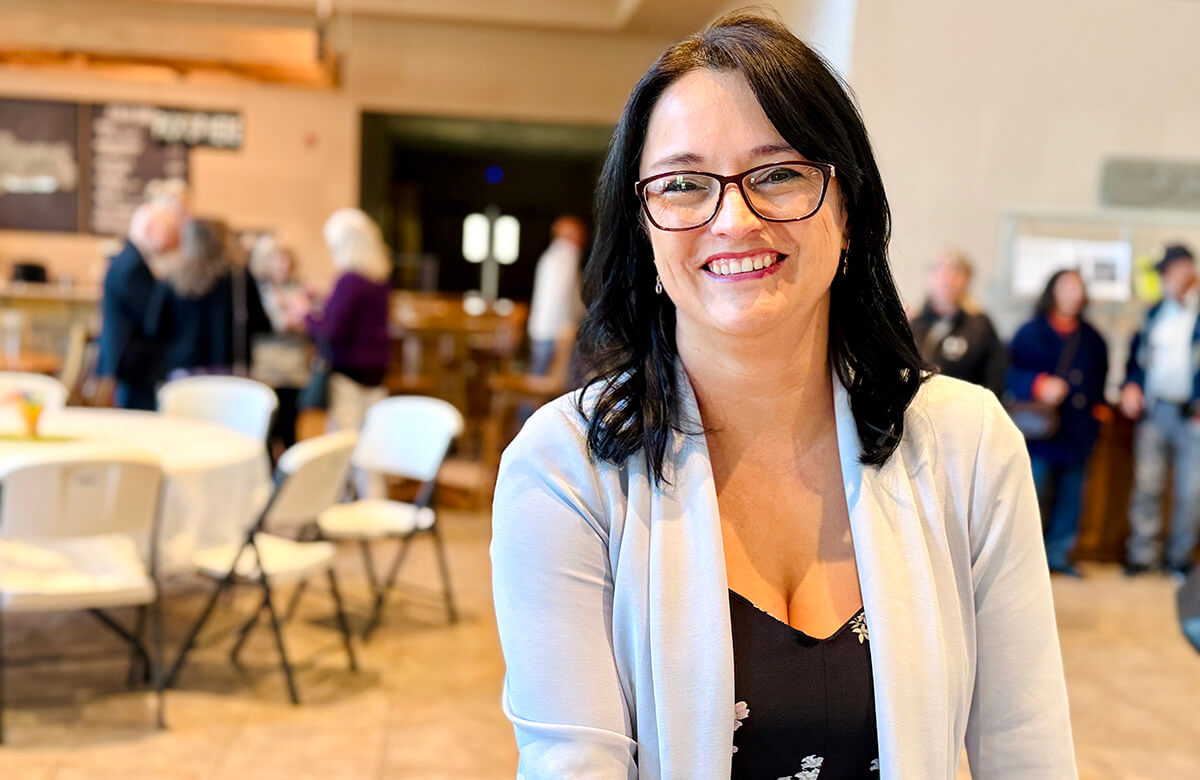
During the ceremony in the cornfield, Temple Sholom’s longtime cantor, Lori Schwaber, asked those gathered to remember the congregation’s founding members and recite the Mourner’s Kaddish together. Jews and Christians stood side by side in the prairie wind as Hebrew prayers drifted across the open farmland.
Lester Weinstine, a 90-year-old congregant who was the first bar mitzvah at Temple Sholom when the shul was still housed out of a Pepsi bottling plant, looked out across the field in disbelief. “I never thought I would see this,” he said.
For Jakobs, the synagogue project has become inseparable from the lessons his grandparents’ survival taught him. “You sometimes feel on an island as a Jew, especially in rural America,” he said. “But this community — that’s not what I’ve experienced here.”
If construction stays on schedule, the synagogue will open in fall 2027. Its first major service will not be a dedication ceremony, but the bat mitzvah of Jakobs’ oldest daughter, Taylor.
Members of the Pennsylvania congregation are planning a bus trip to Illinois for the occasion, after donating many of their sacred objects to help build Jakob’s synagogue. Their former rabbi has offered to officiate.
“If a farmer can build a synagogue in a cornfield,” Jakobs said, “anybody can do it anywhere.”
The post A Jewish farmer broke ground on a synagogue in an Illinois cornfield. His neighbors showed up to help. appeared first on The Forward.
Uncategorized
At this interfaith calligraphy class, the lines between Jew and Muslim blur
“So…are you Middle Eastern?”
I had just walked into the American Sephardi Federation office in lower Manhattan, where 20 Muslim and Jewish young people gather twice a month to learn Arabic and Hebrew calligraphy together. I was clearly the newbie, and one of the participants was sussing me out.
“I am,” I replied.
“Fully?” he asked.
I gave my usual spiel, explaining my Iraqi and Iranian background.
“Sick,” he said. “I’m only half.”
It struck me then that neither of us had any idea whether the other was Muslim or Jewish.
As I broke bread with the group, we chatted over an odd but familiar spread of kosher pizza and Gojeh Sabz, golf-ball-sized and very tart plums – a common Middle Eastern fruit many of us grew up eating. Somehow, religion didn’t really come up.
Eventually, felt-tipped multicolored calligraphy pens were passed around, and we began learning to write Hebrew letters — letters I had been perfecting since I embarked on my Hebrew School journey as a fourth grader. I was terrible. My reyshes weren’t swooping as they should, my khafs were somehow uneven and my yuds looked suspiciously like daleds.
Across the table, a young man who had introduced himself to me minutes before as Mohamad from Saudi Arabia had effortlessly filled the page with elegant Hebrew letters. He noticed my frustration. “Don’t worry,” he said. “I’ve done this like a million times. You’ll get it.” 
The person at the helm of this unusual form of interfaith exchange is Ruben Shimonov, a 39-year-old Sephardic polymath. I first discovered Ruben’s work when I saw an exhibit of his calligraphy blending Hebrew, Arabic and Farsi at the Museum of Jewish Heritage. I assumed he was a full-time artist, but soon learned that his main gig is serving as an educator and interfaith organizer. He mentors dozens of Sephardic college students, hosts LGBTQ+ Sephardic Shabbats. Now, he leads Sacred Scripts in NYC, a new six-month-long cohort-based interfaith calligraphy fellowship where Jewish and Muslim community leaders learn the intertwined history and etymology of Hebrew and Arabic.
Shimonov was born in Uzbekistan, a Muslim-majority country. For him, that background makes interfaith work feel like an extension of his upbringing.
“As a Jew from a community whose culture was shaped by Islamic cultures and histories, it is a natural expression of my Jewish identity to be in interfaith spaces,” he told me. “It’s not something I do because it’s cool or sexy or whatever. I just feel at home, because these are my people. This is my own background.”
From a young age, he was drawn to language, inspired in equal measure by the Hebrew letters he learned for his bar mitzvah and the Arabic script that adorned the mosques and architecture of his hometown.
Eventually, he taught himself calligraphy in three languages and came to see it as a powerful tool for the interfaith work he was already doing — organizing gatherings such as iftars in synagogues and seders in mosques through the Muslim Jewish Solidarity Committee. Over the past decade, Shimonov has led more than 100 interfaith calligraphy workshops around the world, highlighting the deep historical and linguistic connections between Hebrew and Arabic.
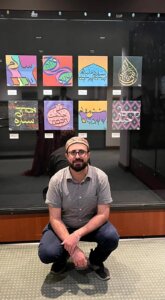
This year, Shimonov launched Sacred Scripts alongside his longtime partners at the Muslim American Leadership Alliance (MALA), drawing fellows from networks he and MALA have built over the years. The program brings together young artists and community leaders — many with Middle Eastern backgrounds — who they feel stand to benefit from sustained engagement. Over the course of six months, fellows study calligraphy and the histories of the languages, while connecting over shared meals and cultural outings. This month, they are attending a concert focused on Jewish and Muslim music from the Maghreb.
After Oct. 7, Shimonov said, he witnessed fractures between many Jewish and Muslim organizations that had been working together on interfaith initiatives. “That sense of betrayal and hurt was very real,” he said. “But if the only times you meet are when things are bad, what do you expect? I think the secret sauce to all this stuff is you’ve got to be in it for the long haul.”
The Sephardic connection
During each session, we practice writing while Shimonov lectures on the connections between the two languages. Shiminov gives each language its due, devoting several sessions to studying each before bringing them together.
Eventually, we learn the same words in Hebrew and Arabic — beit and bayt for home, Shabbat and al-sabt for Saturday — the list goes on. Before tackling day one of learning the Arabic alphabet, we practiced writing the phrase Bismillah ir-Rahman ir-Rahim, which appears at the beginning of every surah in the Quran, into Hebrew. Translated word-for-word, it sounds remarkably similar.
For Shimonov, that overlap is the point. He believes strongly that Sephardic and Mizrahi Jews occupy a unique place in interfaith work because of the seemingly endless cultural similarities they share with Muslims from the Middle East and North Africa.
That sensibility is reflected in the space itself. The fellowship is hosted at the American Sephardi Federation, a Jewish institution that looks more like a place to sip chai and do a close reading of Rumi’s greatest hits. The floors are covered with embroidered rugs, the walls are lined with ouds, a pear-shaped Middle Eastern instrument, and endless shelves are packed with rare books in Hebrew, Arabic and Farsi.
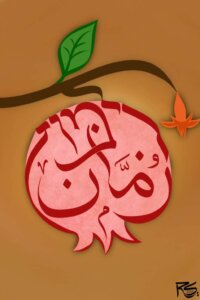
Because of these connections, the days focused on Arabic study are more Jew-y than one might expect. Shimonov takes care to highlight Jewish history in the Middle East, explaining how Iraq — not Europe — was the world’s foremost hub of Jewish life for centuries, where many Jews only spoke Arabic because Hebrew wasn’t widely taught, and presenting pivotal Jewish texts written in Judeo-Arabic.
In Shimonov’s Sephardic approach, the aim is less to “build bridges” — a phrase that has become a catch-all interfaith mantra — than to reveal how much was never separate to begin with.
Ali Saracoglu, a Muslim participant in the fellowship and an artist from Izmir, Turkey, said Sacred Scripts reshaped his understanding of Jewish identity.
When he moved to the United States, his primary exposure had been to Ashkenazi Jewish communities. “When you open the conversation to Sephardi and Mizrahi Jews, you encounter people from Uzbekistan to North Africa to descendants of communities from Spain,” he said. “You start to see a much more global form of Judaism.”
Saracoglu joked that within the group, it was often impossible to tell who was Jewish and who was Muslim unless it came up in conversation.
Nora Monasheri, a 23-year-old Iranian Jew, said that after Oct. 7, she had participated in countless interfaith dialogues at her alma mater, Binghamton University. “I felt like I’d been there, done that on campus,” she said, lamenting that such gatherers were “always very focused on Israel and Palestine, and it felt very forced.”
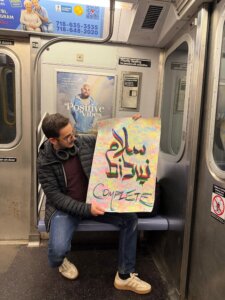
For her, creating calligraphy rather than debating peace agreements from the ’90s is a welcome change.
“I found that some of our most important words in Hebrew are the same in Arabic — faith, charity, blood — So instead of debating each other, we’re discovering this shared history, tradition, and spirituality together.”
For Saracoglu, the program’s artistic aspect is particularly powerful. He first met Shimonov at a one-off interfaith calligraphy workshop two years ago, an experience that stayed with him as an artist. He has been creating ebru, the traditional Turkish art of marbling, since the age of five, and now practices it in his New York City apartment. In a recent series he calls “One Word: Peace,” he layers his marbled designs with calligraphy by both Jewish and Muslim artists — often including Shimonov himself.
During one session, Shimonov read aloud from a Judeo-Arabic translation of the Torah, explaining that many Jews in the Arab world historically translated religious texts into Arabic because many did not understand Hebrew. The word for God was therefore transcribed as the Arabic word, Allah.
I chimed in that my own Jewish parents say “Inshallah” all the time when they simply mean “God willing.” My non-Sephardic friends always found this bizarre, but among this crowd, it barely required explanation.
As he read from the Torah, one Muslim fellow suddenly interrupted.
“It sounds like the Quran!”
The post At this interfaith calligraphy class, the lines between Jew and Muslim blur appeared first on The Forward.
Uncategorized
Netanyahu deploys AI videos as political weapon, aimed at voter fears of Arab power
As election season in Israel heats up, Israeli Prime Minister Benjamin Netanyahu and members of his government are deploying a charged weapon against their political opponents aiming to overthrow them: AI-generated viral videos.
In recent weeks, Netanyahu and key allies have taken to social media to post satirical content on their social media accounts, depicting their leading opponents, Yair Lapid and Naftali Bennett, as being controlled by Arab-Israeli puppetmasters.
One viral video posted by the prime minister last week, with over a million views, is captioned “taking off the masks.” It shows a smiling Bennett and Lapid embracing before peeling off their faces to reveal those of prominent Arab-Israeli political leaders Mansour Abbas and Ahmad Tibi.
מורידים את המסכות pic.twitter.com/IgFDWXp96N
— Benjamin Netanyahu – בנימין נתניהו (@netanyahu) April 29, 2026
After Bennett and Lapid announced in April that they would run jointly against Netanyahu in the upcoming fall elections, Israeli political Twitter flooded with AI-generated content on this theme, which goes for the jugular on a political vulnerability for Bennett: his past inclusion of Abbas’ Arab Ra’am party in his governing coalition.
One image posted by Likud, Netanyahu’s party, featured Bennett and Lapid depicted as children sitting obediently in the back seat of a car as Abbas drives. The photo is accompanied by the caption: “In any case, Bennett and Lapid will go again with the Muslim Brotherhood, the terrorism supporters.”
גם ביחד זה ברור – הנהג הוא מנסור.
לא משנה איך השמאל מחלק את הקולות שלו.
בכל מקרה בנט ולפיד ילכו שוב עם ברית האחים המוסלמים תומכי הטרור. pic.twitter.com/iYFIZQ8QhJ
— הליכוד (@Likud_Party) April 26, 2026
These AI videos reflect a growing post–Oct. 7 trend in Israeli politics: accusing one’s political opponents of being aligned with Arab parties as a way to delegitimize them.
Dr. Arik Rudnitzky, a researcher in the Arab Society in Israel program at the Israel Democracy Institute, said the trauma Israelis experienced after Oct. 7 has left a profound mark on the Jewish public. That fear, he said, is now being actively mobilized in political messaging.
“The post–Oct. 7 discourse is so influential in Israeli politics that it dictates everything,” Rudnitzky said. On Tuesday, Finance Minister Betzalel Smootrich went as far as to say that Naftali Bennett’s decision to include the Islamist Ra’am party in the 2021-2022 government was worse than the Netanyahu government’s failures tied to Hamas’s attacks on Oct. 7. This, despite the fact that Mansour Abbas has said that Netanyahu tried to court him into joining his coalition in 2021, though Netanyahu has denied this.
According to Rudnitzky, the implicit message is that Israel’s Arab parties are dangerous. The argument is that they are not Zionist (and some Arab parties are even explicitly anti-Zionist). In the aftermath of Oct. 7, while some Arab-Israeli political leaders condemned violence from both Hamas and the Israel Defense Forces on civilians, they stopped short of referring to Hamas as a terror organization. Some also failed to condemn the murder of Israeli soldiers on that day.
Now, Netanyahu’s government has taken to framing the choice for voters as existential. “Either you are with the most experienced prime minister in Israel’s history, or you are willing to gamble and put Israel at risk by electing Bennett and Lapid,” said Rudnitzky.
The use of AI by Israeli politicians, Rudnitzky added, makes that message more visceral. “It looks real, it goes straight to the back of your mind, and it hits a nerve.”
Bennett, for his part, has tried to distance himself from this narrative, stating after he announced that he would be running against Netanyahu, “The Arab parties are not Zionist, and therefore we will not rely on them.”
But the videos are taking their toll. Earlier this year, Bennett filed a police report after the Likud X account posted a doctored image that depicted Bennett celebrating with Arab leaders, with the men all raising their clasped hands in celebration. Bennett called the image “malicious forgery.”
Other politicians have deployed similar messaging tactics — against Netanyahu. In February, Avigdor Liberman, a right-wing critic of the prime minister, posted an AI-generated image of Netanyahu holding hands with Abbas in front of a bouquet of heart-shaped flowers, captioned: “Happy Valentine’s Day.”
יום אהבה שמח❤ pic.twitter.com/Sel1CkURFn
— אביגדור ליברמן (@AvigdorLiberman) February 14, 2026
In response, Netanyahu posted an actual photo of Lieberman meeting with Abbas with the caption: “Lieberman published a doctored AI photo of the PM holding hands with Mansour Abbas. So, Avigdor, here’s a real, unedited photo of you and Mansour Abbas.”
Lieberman then shared 10 posts of Netanyahu meeting with various Arab leaders since the 1990s, including former PLO Chairman Yasser Arafat and current Palestinian Authority President Mahmoud Abbas.
According to Rudnitzky, such wrestling-ring attacks have become normalized since Oct. 7, aimed at Jewish politicians and voters. “This is not about delegitimizing Arab voters,” he said. “The target is Naftali Bennett — not Mansour Abbas.”
A controversial pragmatist
Arab parties have long represented Israel’s Arab minority in the Knesset but historically remained outside governing coalitions. For decades, this arrangement — Arab parties supporting from the outside or remaining in opposition — was broadly acceptable to both sides. Arab politicians often avoided joining coalitions for ideological reasons, while Jewish parties largely viewed their inclusion as politically untenable.
That changed in 2021, when Abbas made history by joining the winning coalition led by Bennett and Lapid. That decision positioned him as a pragmatist, willing to work with Jewish parties to secure gains for Arab citizens.
In the aftermath of Oct. 7, Abbas issued the most explicit condemnations of Hamas among Arab Israeli political leaders. He has also said that “the state of Israel was born as a Jewish state, and it will remain one,” a rare acknowledgment of Israel’s identity in those terms. Still, no Arab-majority party in Israel defines itself as Zionist.
While it is considered to be the most moderate of the Arab parties in Israel, Abbas’ Ra’am is an Islamist party that emerged from the Islamic Movement in Israel and the Shura Council — organizations tied to the Muslim Brotherhood. Abbas has increasingly sought to distance the party from those groups and has denied any affiliation with the Brotherhood.
Forming a governing coalition in Israel requires at least 61 seats out of 120, and several polls have suggested that any viable opposition to Netanyahu would likely need Arab party support to reach that threshold. But reliance on Arab parties to form a coalition has become more contentious since Oct. 7.
According to the Democracy Index poll, 72% percent of the Jewish public in Israel opposes the inclusion of Arab parties in the governing coalition. Opposition extends beyond the right: 43% of centrist voters and 20% of left-wing voters also oppose such coalitions. Support has declined significantly since before Oct. 7, when roughly 36% of Jewish Israelis backed including Arab parties in government, compared to just 27% today.
Hence the opening for Bibi and his video blitz. “We’ve seen an escalating political discourse over the past several years. There are no more holy cows,” said Rudnitzky. “If you want to mobilize the entire Jewish public and you know that you are in an inferior position in the polls … this is the way to take the demons out of the bottle.”
The post Netanyahu deploys AI videos as political weapon, aimed at voter fears of Arab power appeared first on The Forward.