



Uncategorized
I’m an empathetic Zionist. But it’s time for all of us to stop counting our dead.
There are, and always have been, several types of Zionism, as Rabbi Angela Buchdahl’s Yom Kippur sermon reminded me. I first had to declare the type of Zionist I am in 1994 at a meeting at the Leo Baeck Temple in Los Angeles that brought together Arabs and Jews to create a speakers’ bureau that would advocate for Middle East peace at synagogues, churches and mosques in southern California.
Approximately 20 people gathered in a small room and a moderator asked each of us to speak briefly about what brought us to the meeting. One by one as the people in the room spoke, they listed the atrocities both Jews and Palestinian Arabs had suffered, including the Holocaust, the Nakhba, the mutual massacres that had taken place in British Palestine before 1948, the suicide bombings and the destruction of Palestinian homes. When it was my turn to speak, I began, “I am a Zionist.”
My Zionism was anchored in 20 years of conducting archaeological excavations in Israel, and a 1986 trip to the Soviet Union to help Jews emigrate to Israel, during which I was arrested three times by the KGB. I was an American, but an active Zionist.
I continued, “But it is time for all of us to stop counting our dead. Jews and Arabs both have enough suffering to go around. We don’t need to justify ourselves to each other by enumerating the terrible losses we have experienced. Let’s focus our attention on understanding and making peace with one another.”
My words had an impact. We moved forward to plan the bureau. I was paired with a leader of the Palestinian community in LA who looked like he could be my older brother. We spoke at universities, synagogues and churches for two years, at a time when the promise of peace was bolstered by the Oslo Accords. But when Benjamin Netanyahu was elected Prime Minister in 1996, I felt I was no longer speaking about an Israeli government that shared my aspirations, and that phase of my life ended.
Today, in the post Oct. 7 world, I feel like I am sitting in that same meeting room, only it encompasses way more than 20 people. Often, when I hear or read about the present Palestinian-Israeli conflict, I hear about the 1,200 people killed on Oct. 7, and the tens of thousands killed thereafter. The death of every child is tallied and the sufferings of every hostage recalled. We can do better.
I am an empathetic Zionist. I support the Jewish state of Israel, and I also feel empathy for its victims. My definition of empathy bridges radical differences between individuals and forces a person to look through another person’s eyes. Sympathy allows one to feel the pain of someone closely related; empathy allows one to understand a thoroughly different person. As a Jew, I sympathize with the Oct. 7 victims, the hostages and their families; but I also empathize with the Palestinians who have suffered and died in the aftermath of the Oct. 7 Hamas attack.
I believe today, as I did in 1994, that the first step toward empathy is a cease fire, not only on the battlefield, but on the frontlines of the constant bickering about who has suffered more. After almost 100 years, the time has come to empathize with the victims instead of counting them.
And we should begin with the children. A child’s suffering can change minds, whether the trauma is witnessed firsthand or through a photograph or a written description. Who in my generation can forget the 1972 picture of the Vietnamese “napalm girl,” nine-year-old Phan Thi Kim Phuc running naked and screaming after a South Vietnamese napalm attack on her village severely burned her back? The Pulitzer Prize-winning photo influenced public opinion and the anti-war movement. As Anne Frank had triggered worldwide empathy for Holocaust victims, Kim Phuc made the Vietnam war seem insupportable.
Who today are the children who can teach us about Gaza? I would choose three: Ariel and Kfir Bibas, four years old and nine months old respectively, and five-year-old Hind Rajab.
Kfir and Ariel Bibas were kidnapped along with their mother Shiri from Kibbutz Nir Oz on Oct. 7 and murdered in captivity; their bodies were returned to Israel on February 20, 2025.
Hind Rajab was five years old when she and her uncle, aunt and three cousins left Gaza City by car. Israeli shelling killed all in the car except Hind and her cousin, 15-year-old Layan Hamadeh. Layan telephoned the Palestine Red Crescent Society and was heard pleading for help and screaming as she was shot. Hind, still alive, stayed on the telephone for three hours. She died from IDF gunfire, and when the Red Crescent workers finally arrived, they too were killed.
Who are the adults today who can teach us to empathize with those children? I would choose two: Noam Chayut and Aziz Abu Sarah.
Noam Chayut was an Israeli soldier patrolling the West Bank. In his memoir, The Girl Who Stole my Holocaust: A Memoir, written in 2007, he describes an encounter with a 10-year-old “scrawny” Palestinian girl wearing “light colored clothes.” On the outskirts of a village there were children playing, she among them. With no particular intent, Noam approached and smiled at her, but she did not smile back. She was terrified, frozen for a second, which allowed Noam to look into her eyes. Then she ran away. But what he saw in her eyes was himself. He saw the soldier, the occupier and he saw someone else, someone evil. He did not see himself as evil, but she did. He empathized with her terror, and it changed his life.
As a young Palestinian man, in 1998, Aziz Abu Sarah visited Yad VaShem with trepidation. He felt if he “empathized with the enemy it would be a betrayal of his own pain,” he wrote in The Future is Peace. But he went anyway, and after he arrived at the underground chamber memorializing the death of one and a half million Jewish children he “walked out of the museum a different person.”
Both Noam and Aziz looked at children they were taught to regard as enemies. And the adversaries who populated their world became human. It is imperative that the deaths of Hind Rajab, Ariel and Kfir Bibas teach us about the trauma of our perceived foes. If we cannot empathize with them and their families, I doubt that Israelis and Palestinians can come to any understanding.
I recognize the very problematic long term political and structural problems inherent in the Israeli-Palestinian conflict. But how will we ever learn how the other side thinks and feels if we do not try to understand each other’s pain? Seeking mutual empathy can be the beginning of a path to a new and peaceful community.
The post I’m an empathetic Zionist. But it’s time for all of us to stop counting our dead. appeared first on The Forward.
Uncategorized
Why I go to shul on Shabbat — and church on Sunday
Violence at a house of worship is not an abstraction to me. Black churches have been bombed, burned, and attacked, from Birmingham to Charleston. So when 11 Jews were murdered at Pittsburgh’s Tree of Life synagogue eight years ago, I knew something about what it meant for a sacred place to become a place of terror.
I did the only thing I could think to do: I looked for a Shabbat service I could attend. I did not know of a nearby synagogue to go to, even though I’ve since discovered they are all around me in the Boston area. Where I grew up in Cassopolis, Michigan, a rural town of about 1,700, there were no synagogues within 45 minutes of my house. I grew up knowing nothing about Jews, went to my first Jewish service in college, and discovered that much of what I thought I knew was wrong.
When I first went to a Shabbat service following the Tree of Life shooting, I was not sure they would let me in. But they did. I was surprised to agree with everything I heard sung, prayed or preached. I thought Jews, like anyone else who died without Christ, were going to hell, or at least that is what I was taught. But I felt the presence of God there.
I enjoyed the service, went home and posted on my Facebook page, “I am a Jew,” in reference to John F. Kennedy’s “Ich bin ein Berliner.”
That explains why I went once. It does not explain why I went back and attended something like 52 Shabbat services in a year. People sometimes assumed that I was continuing an extended act of solidarity or that I was embedded like a news reporter.
The truth was much simpler: I liked it.
I liked the sermons, the worship, the music, the community and the spirit of tikkun olam. I liked hearing the Torah and hearing Scripture taught by clergy who knew Hebrew. I enjoyed growing in my knowledge of what Christians call the Old Testament. I also learned an entirely new hermeneutic, a Jewish one: the Living Torah, disagreement for the sake of heaven, presenting an opposing interpretation fairly, preserving minority opinions, and studying with a partner who challenges your reading.
Eventually, I became a member of Temple Beth Elohim in Wellesley.
At the same time, I kept going to church. I used to joke with friends that I got the Old Testament on Friday night and the New Testament on Sunday. I felt no urgency to choose between the two houses of worship. I was more than a member; I was part of a community. When I was asked to serve on committees, I served. When the synagogue asked me to participate in diversity, interfaith, or racial justice events, I said yes. Over time, that participation widened beyond my temple. I gave Shavuot talks over the last two years at Temple Emanuel in Newton. I participated more than once in the Boston Jewish Film Festival, serving as a moderator or panelist. I served on the advisory group for Intentional Beauty: Jewish Ritual Art from the Collection at the Museum of Fine Arts and currently serve on the Advisory Council for the Holocaust Museum Boston. The response of Jews to my involvement seemed appreciative, grateful for any help they could get.

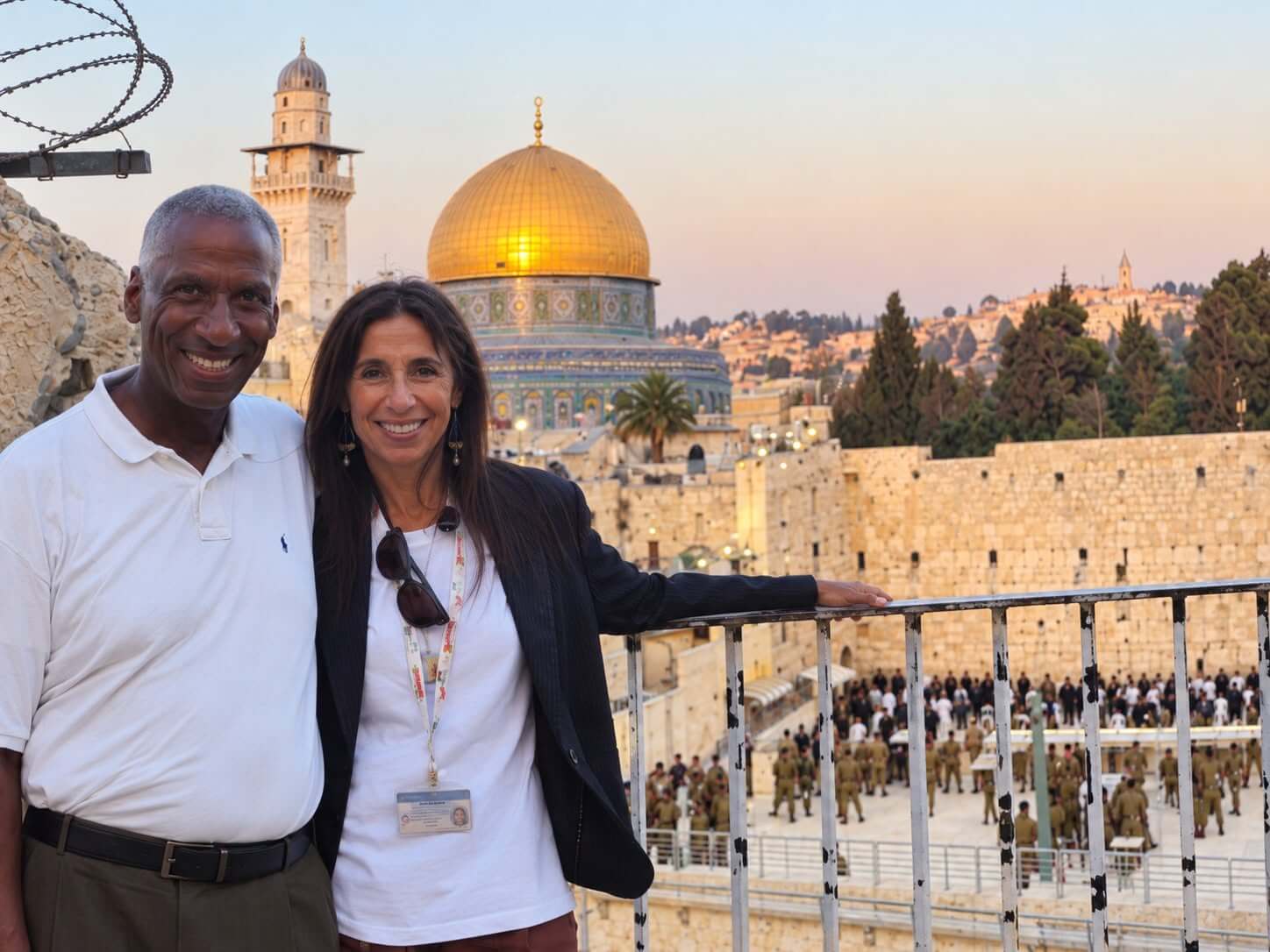
The first time I traveled to Israel was with members of Temple Beth Elohim, the second with the Consulate General of Israel to New England and just this month went with the Black Christian Leadership Council on Israel Relations as part of their Unfinished Business Holy Land Tour.
These parallel paths led me to examine Christian hostility toward Jews over centuries and across the world. As a Black American familiar with racism who had traveled in the West Bank, I felt compelled to explore the traumas of Jews and Palestinians from a civil rights perspective.
In addition, I am troubled by fractures in the relationship between Blacks and Jews, though I prefer to think of it as a quiet estrangement, an unspoken tension, and a mutual uneasiness. Both sides are often too polite to address it. Blacks do not want to raise certain issues for fear of being called antisemitic. Jews do not want to raise others for fear of being called racist. So we never deal with the tough, hard, and honest questions that exist between us.
My goal for all this? It’s to educate my fellow Christians and Black non-Jews about antisemitism — vital in stopping the harassment, discrimination, persecution and killing of Jews. I support the Jewish community because I simply feel it’s the right thing to do.
There is a joke that goes: If you want to hear God laugh, tell God your plan.
This was not my plan.
It was God’s.
The post Why I go to shul on Shabbat — and church on Sunday appeared first on The Forward.
Uncategorized
I wanted a Jewish future that didn’t force me to choose between Zionism and anti-Zionism. Here’s how I found it.
Like many people I know, I found myself after Oct. 7 observing my communities splintering before my eyes.
The Jewish institutions I once loved dug their heels deeper into Zionism, affirming it as the key to a unified Jewish future and castigating those who were less certain. The secular leftist spaces that had nurtured my political values demanded proof of anti-Zionism, rejecting Zionist Jews and insisting they had no future in their movements.
Suddenly, I was confronted with opposing visions of the future so narrow I would have to contort myself and cut myself off from one or the other to fit in. I began searching for places where leftist politics and Jewish tradition could coexist, rather than being seen as mutually exclusive categories. Three and a half years later, I found the Judeofuturism Project, which uses art as a creative launch pad to unite Jews across differences and explore how we can employ ancient wisdom to prepare for and respond to modern-day issues.
Drawing on her experience in democracy work and her formal liturgical training at the Harvard Divinity School, founder Becca Leviss also began exploring Jewish futures after Oct. 7.
“October 7 happened, and all the questions I was wrestling with … in my own studies became really proximate to my own life,” Leviss told the Forward.
She had previously worked for Democracy 2067, an organization that uses long-term thinking and strategy to protect democracy from authoritarianism and move people to action.
“I had learned about the ways that long-term thinking can bring people who are very disparate towards articulating some kind of shared vision, and also the ways that communities who have faced what seems like insurmountable amounts of violence and oppression have been able to envision different worlds,” Leviss told the Forward.
Seeing parallels between Democracy 2067’s goals and her own aspirations for her Jewish communities and institutions, Leviss mapped Democracy 2067’s work onto the Judeofuturism Project with hopes that she could move Jews to demand more than the Zionist or anti-Zionist futures being presented to them.
She quickly connected with Aimee Rubensteen, a curator and artist with an archivist background who had been grappling with many of the same questions.
The pair understood that art could provide the perfect entry point for the tough conversations that were yet to come.
“Art is a rare platform for people to learn something new without feeling threatened,” Rubensteen said.
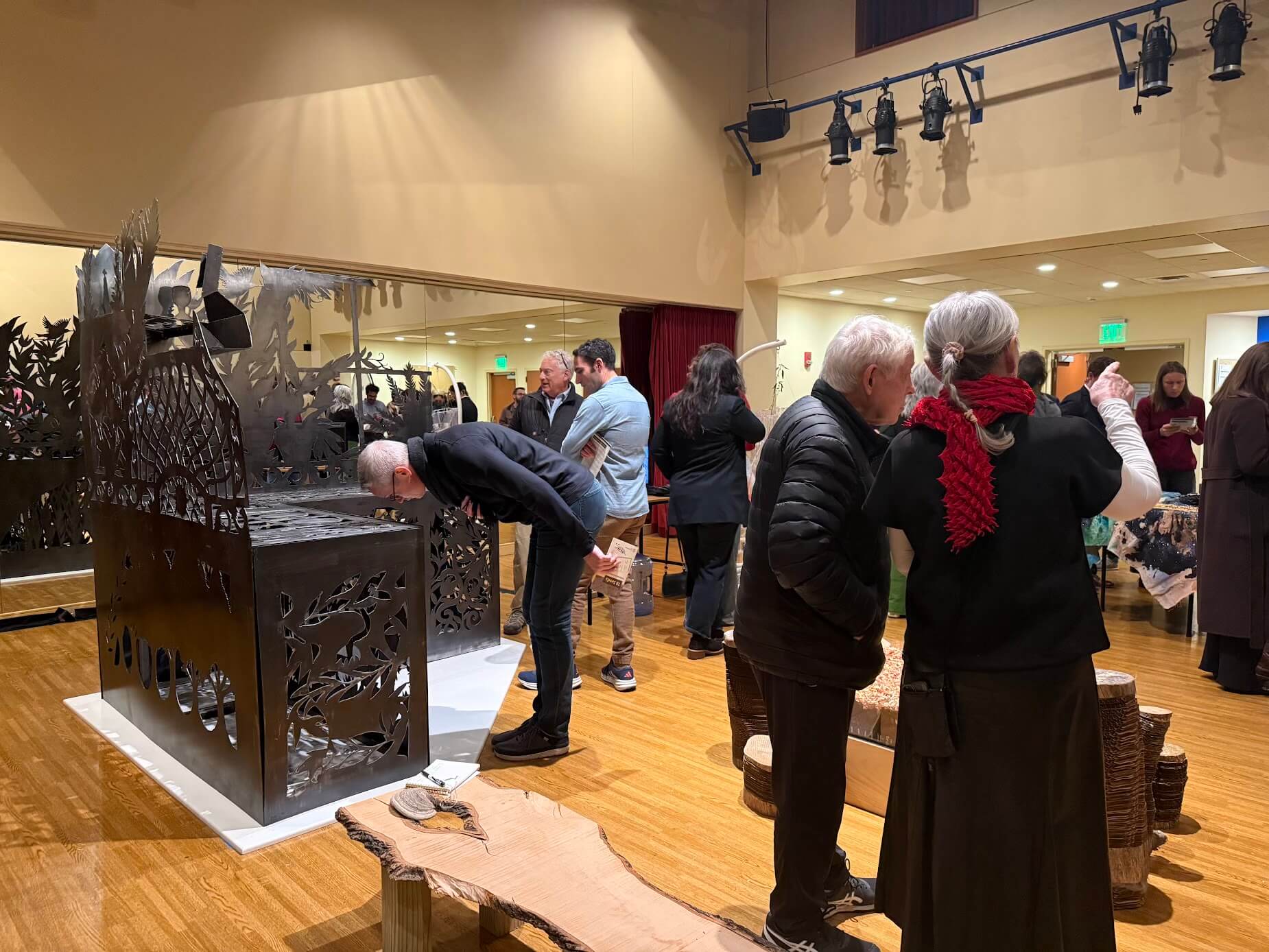
Leviss and Rubensteen launched the 70 Seeds exhibition in Boston’s South End. The exhibition ran from Oct. 27 to Nov. 8, and integrated panel discussions, immersive Shabbat rituals, theater performances, and artist workshops to engage community members and place them at the center of imagining a shared Jewish future beyond a Zionist/anti-Zionist binary.
The 70 Seeds opening was the first Judeofuturism event I attended, and it quickly became clear to me that this project was more than a typical Boston art opening: It was a newly emerging movement that encouraged collective visioning rather than the top-down compliance I’d seen controlling my communities since Oct. 7.
That night, I came upon Nicki Green’s soft-sided pickle fermentation jar, which offered a future where, regardless of belonging to a specific nation-state, Jews can continue to prepare the iconic diasporic food and transport it with them.

I sat on the wooden bench next to Beverly Sky’s reimagined genizah (sacred repository for old texts containing the word God), and was pushed to consider what traditions will continue to fuel Jewish culture and what no longer serve us.
As I moved from installation to installation, among about 100 attendees on opening night, the work created a balm for the festering wound of disconnection and division brought on by increased global turmoil.
These approaches to Jewish futures stood in stark contrast to the binary futures I had previously felt forced to choose between. Their grounding in Jewish ritual and history brought me closer to Jewish culture and to my own identity.
As the night drew on, Rubensteen and Leviss posed the same question to attendees as they had to the show’s artists: “What is your dreamed future of American Jewish life in 2070?”
The date marks two thousand years since the fall of the Second Temple, an event that prompted Jews to radically reimagine Jewish life.
At a moment today when our world is shifting dramatically, Rubensteen and Leviss’ question prompted me and my peers to consider how we might respond to growing pressures using Jewish knowledge. I parsed through the proposed futures laid before me by the exhibition’s artists, and, over the next week and a half, I participated with dozens of people in workshops and panels to see what other possible futures we had not yet considered.
The following night, at a workshop titled “Schism or Realignment? Emerging Identities in Jewish Life,” we negotiated our beliefs about Jewish life and spirituality by placing ourselves along a continuum, engaging with disagreement head-on.

Leviss posed questions to us, debating how open or closed Jewish practice should be to non-Jews, or what role Jewish institutions should play in attending to the needs of their communities. In hearing my peers’ perspectives, I found my own beliefs shifting and observed other participants experiencing the same changes. Rubensteen and her husband, Dr. Josh Eisenberg, even found themselves on opposite sides of the spectrum at times, demonstrating how, even in our most intimate relationships, we see the fractures of our increasingly polarized world emerging.
And yet, while disagreement occurred, our conversations seemed to bring us closer to one another, and closer to a shared vision of what Jewish life can look like outside of the narrow Zionist/anti-Zionist futures that are so well represented.
I realized that, at its core, the Judeofuturism Project was answering the call for a newly emerging Jewish identity, one defined by leftist politics and invested in reimagining ancient Jewish ritual to meet the present moment.
Isabel Mattia — whose work, “Amulet far der Kikh,” examines the kitchen as a site of solidarity, diversity, and potential intercultural connection — encapsulates this growing religious political moment. Drawing on ancient amulets that Jews used for protection and prayer, she examines how, when we turn our prayer towards our families and communities, we might recognize that the source of Jewish life is already within our own ovens and mixing bowls, rather than in a far-away place.
“In my conversations with others, I see a trend that we are sometimes made to feel that to oppose [Palestinian destruction] is somehow radical within Jewish culture. I don’t believe that it is radical at all. My opposition to this has brought me so much more deeply connected to my identity and values as a Jew and to my commitment to keeping Judaism alive and rich for my daughter,” Mattia told the Forward.
As I immersed myself in the Judeofuturism Project’s programs, I began to see Mattia’s sentiment reflected in my experience as well.
While the leftist spaces I previously frequented encouraged me to cut myself off from Judaism in order to access progressive theologies, and the Jewish institutions demanded that I couldn’t access Judaism without identifying as a Zionist, the Judeofuturism Project carved out a path for me and my peers where Jewish values could inform our politics and connect us more deeply to Jewish ritual and culture in the process.
And so, I returned, night after night, along with a handful of community members, to continue down this path.
“The Judeofuturism Project is really vital because it’s something that feels distinctly helpful right now,” Miriam Pellegrino, a design researcher and strategist, told the Forward. “It’s rooted in tradition, but also very imaginative … We’re in a kind of polycrisis, and I think people are hungry for community that helps them collectively parse out how to live a good life.”

And although the Judeofuturism Project’s November programming by no means provided a clear-cut answer to what a “good life” looks like, it placed the power to define a “good life” into the hands of community members, empowering them to build a dynamic, culturally responsive definition together. And, more than anything, it gave me and my fellow attendees the reassurance that we aren’t alone in wanting more than the two options currently on the table.
While the 70 Seeds exhibition concluded on Nov. 8, a digital version of the exhibition is now available for anyone to access and take the work of imagining new Jewish futures into their own hands.
Along with traditional installation photos of each artist’s work, Eisenberg has configured the site with additional resources and commentary, Talmudic-like, to welcome viewers into conversation with each artwork, rather than remaining passive onlookers.
Renderings of each artist’s workspace transport you into the artist’s shoes. Accompanying text offers each artist’s vision of American Jewish life in 2027. An attached workbook invites communities to utilize the exhibition as a tool and framework for their own future-visioning needs.
For Leviss’ part, she already has plans to present on the Judeofuturism Project at the upcoming annual Association for Jewish Studies conference, with the goal of bringing a multi-week exhibition with programming to other cities in the future.
And she’s sure to find more artists to imagine the futures that prompt these important conversations. Already the structures that Leviss and Rubensteen have provided are fueling future work.
“We’re navigating turbulent times, and I feel like we are all grasping for a way through it,” said artist Amalya Megerman, whose imaginative challah amulets draw on ancient Jewish challah rituals for contemporary use as protection against global crises. Finding the Judeofuturism Project was a turning point for Megerman and her creative process.
“The Judeofuturism Project gives me a guiding light to keep the work moving.”
The post I wanted a Jewish future that didn’t force me to choose between Zionism and anti-Zionism. Here’s how I found it. appeared first on The Forward.
Uncategorized
It shouldn’t be dangerous to wrap gifts at the mall for charity – but for Jews in North Carolina, it is
When news reports say antisemitism is rising, it can be hard to know what that means for each of us. As a Jewish American and North Carolinian active in my community, for a long time, nothing in my world seemed different. Now, it does.
Last December, I helped organize a gift-wrapping table at the Crabtree Valley Mall in Raleigh to raise funds for charity. The table was staffed by a group of Jewish women who wrap gifts to raise money for Hadassah, The Women’s Zionist Organization of America, a storied organization that brought modern healthcare to pre-state Israel and created one of the region’s leading hospital systems. Hadassah’s hospitals care for all, regardless of race, religion or nationality, treating more than one million patients a year – Jews and Arabs, Israelis and Palestinians, side by side. Staffed by physicians, nurses and researchers from diverse nationalities, they were once nominated for a Nobel Peace Prize for building bridges to peace through medicine.
Hadassah volunteers have been running the gift-wrapping table for 50 years. For me, this has always been a wonderful example of neighbors reaching out to neighbors during the holidays. But last year, this usually happy event became a dangerous one that put a target on the backs of our volunteers.
Just before Christmas, protesters stood outside the Hadassah booth, stopping customers to tell them, “You are giving money to kill babies in Gaza” and “You are paying for Israel to kill Gazans.” Mall security was called and asked the protesters to leave, but they came back, entered the booth yelling, and confronted our volunteers. At one point, a protester reached into their backpack to pull out something, which was a megaphone, not a weapon, but security escorted this individual out of the mall.
This year, we will not return to the gift-wrapping table. But we are not retreating. Hadassah volunteers have found another way to continue raising funds for healing, because antisemitism does not determine whether Jewish women participate openly in our community.
Amid a nationwide rise in antisemitic violence, including the murder of three people as the result of incidents last year in Washington, D.C., and Boulder, Colorado, we no longer feel it is safe to return to our gift-wrapping table. Being a Jew wrapping holiday gifts at a mall in North Carolina feels just too dangerous right now.
In January, a man who had traveled from South Carolina defaced Charlotte’s Shalom Park Jewish community center, a Jewish day school and a Holocaust memorial with flyers bearing a swastika and a noose. And two months ago, in our own Triangle community, someone identifying himself as the leader of the Goyim Defense League, whose stated goal is to remove Jews from the United States, broke into a Chapel Hill High School Zoom meeting and put up an antisemitic image before being removed. Worse, it happened during the Days of Awe between Rosh Hashanah and Yom Kippur, the holiest period on the Jewish calendar.
Since Oct. 7, 2023, antisemitism has surged across the U.S. and around the world to record levels, and it is not slowing down. This is not an abstract debate. A Hadassah report, From Fear to Resilience: Women Facing Antisemitism, found that nearly two-thirds of Jewish women surveyed said antisemitism affected their daily lives, and more than half of the respondents have taken steps to hide their Jewish identity in public.
Hadassah has not stayed silent in the face of these acts of hatred. We have advocated in Congress for legislation, including the Jewish American Security Act, which would allocate one billion dollars to secure houses of worship and nonprofit organizations, and hold social media platforms accountable for antisemitic content. We have also built local and national partnerships to advance interfaith dialogue and to fight antisemitic misinformation in schools and other community spaces.
These bills matter but are not enough. Laws alone will not change what happened at Crabtree Valley Mall and Shalom Park and on the Chapel Hill Zoom call. What is missing is leadership, and that starts at home.
Our experience highlights an important challenge for our communities: Our response to antisemitism cannot just be adding more security – though we certainly do need that. We checked to see what additional security would cost to keep our volunteers safe at the mall. It was over $20,000. That’s more than we raise with our annual event.
If we want to prevent antisemitism from becoming the new normal, we need a multi-pronged plan of action to push back against hate nationally and locally. Federal legislation isn’t enough. We stand ready to do this work. We also need North Carolina’s elected officials and community leaders to speak out against antisemitism and to back up their statements with action. Otherwise, we will see more incidents like those we’ve experienced – and perhaps worse.
The post It shouldn’t be dangerous to wrap gifts at the mall for charity – but for Jews in North Carolina, it is appeared first on The Forward.
