


Uncategorized
In a forgotten 20th century masterwork, a Holocaust story from the perpetrator’s perspective
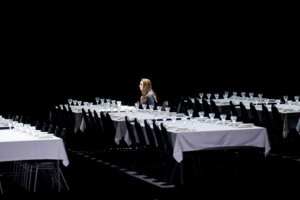
On stage at the Dutch National Opera, an elderly woman clutching a funeral urn containing her husband’s ashes stands on her balcony on a luxury cruise ship, gazing out at the imagined ocean.
She is dressed neatly in a blue dress with a red sash, and seems serene, until she catches a glimpse of a woman with long dark hair on a veranda below. Suddenly, she is catapulted into a memory, and a younger version of herself wearing the same dress appears on the balcony beside her.
The widow and her younger self are both Lisa, a German woman who holds a terrible secret. During World War II, she served as a Nazi camp guard in the women’s barracks at Auschwitz — a fact her husband, a German diplomat, did not know.
Seeing the dark-haired stranger triggers a flood of emotions, and Lisa is suddenly wracked with fear and guilt. She thinks she recognizes the woman as Marta, one of her former concentration camp prisoners. Could she possibly still be alive?
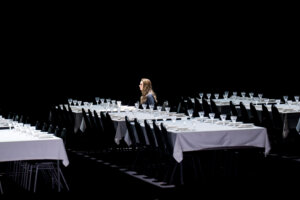
This is the beginning of Mieczysław Weinberg’s opera, Die Passagierin, (The Passenger), which opened Friday, April 17 at the Dutch National Opera and runs through May 2. The production, created in collaboration with the Bayerische Staatsoper (Bavarian State Opera) in Munich, where it premiered in 2024, is a modern adaptation of an opera that has been hailed as a forgotten 20th-century masterwork.
This extraordinarily powerful opera is by turns lyrical and overwhelmingly forceful, as it delves into the profound torment experienced both by the Holocaust’s helpless victims and their guilt-plagued tormentor. It presents Lisa with a surprising degree of compassion, but does not downplay her complicity, offering, instead, a twist at the end that reminds us who suffered most.
“You essentially hear mass killings, and later in the piece he shifts from such obvious descriptive writings and the music is much more a reflection of the internal world of the characters,” said Adam Hickox, the conductor of the Dutch National Opera production.
“It’s an illumination of Lisa’s internal world, then as we’re introduced to the prisoners in Auschwitz, an illumination of their experiences. You’ve got brutality and you’ve got sparseness and you’ve got lounge jazz, and all of this he puts together into one coherent whole.”
The Dutch production, directed by Tobias Kratzer, is only slightly changed from the Bavarian Opera’s version, with adaptations for the voices of the new cast of singers, said Hickox, including outstanding performances by soprano Sylvia D’Eramo (Marta), baritone Gyula Orendt (as her fiance, Tadeuz), and mezzo-soprano Jenny Carlstedt, as Lisa.
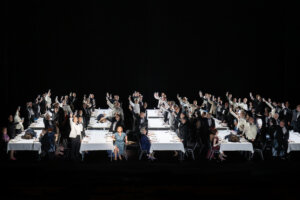
The first act takes place on a modern ocean liner, while the second act is set in a dining hall which serves as a set for the moments in the 1960s, and in flashbacks to a Nazi banquet hall in 1944, when Lisa is transported into her horrifying memories of the war.
The opera was based on a 1962 novel, Pasażerka, by the Polish author Zofia Posmysz, a Roman Catholic resistance worker during World War II who was arrested at age 19 by the Gestapo in 1942 and sent to Auschwitz. After the war, she became a journalist and award-winning writer and lived mostly in Poland, until she died in Oswiecim at age 98.
Posmysz came up with the idea for the story when she was a journalist on assignment in Paris in 1959, said Laura Roling, the production dramaturg at the Dutch National Opera. She heard someone calling something out in German, and she said she felt “nailed to the ground,” because it was the same tone and pitch as the voice of her captor in Auschwitz.
“What Posmysz did was to shift the perspective,” said Roling. “What if the guilty party were to recognize the people they have wronged, and what would that mean in terms of perpetratorship and guilt, and conscience?”
It was an unusual literary strategy — few novels had attempted to tell a Holocaust story from a perpetrator’s perspective; in the 1950s, the French novelist Robert Merle published La Mort Est Mon Métier (Death Is My Trade) based closely on the life and career of S.S. officer Rudolf Hoess, but such books were rare. Although Pasarzerka was very popular at the time, translated into more than a dozen languages and a Polish feature film, Posmysz received criticism for her approach.
“Trying to make a perpetrator into someone you can comprehend also makes them human,” said Roling. “It defies very clear black-and-white, good-and-evil boundaries. If you can say perpetrators were inhuman, they were monsters, that’s it. But we know that in reality they were human beings, who also did the most inhuman things. So it’s important to ask: How could they live with themselves afterwards?”
Weinberg, a Polish Jewish composer, who lost most of his family during the Holocaust, “experienced it as a duty as a survivor to somehow incorporate what happened into his work,” said Roling.
A musical prodigy, Weinberg (sometimes spelled Vainberg or Vaynberg as a transliteration from Cyrillic), was a musical prodigy who entered the Warsaw Conservatory at age 12 to study piano. When Germany invaded Poland in 1939, he fled on foot to Minsk; the rest of his family was murdered.
In the Soviet Union, Weinberg continued to face antisemitism; he was followed by the Secret Service and arrested in 1953 and accused on trumped-up charges, according to Roland, of a conspiracy to create a Jewish state in the Crimea. There was apparently no evidence that he was involved in any such conspiracy, and he was released after a couple of months, when Stalin died.
He completed his operatic adaptation of the novel in 1968 for a production that was planned to open at the Bolshoi Theater in Moscow. For reasons that are still not entirely known, said Roling, the performance didn’t take place. It was produced for the first time in 2006, ten years after the composer’s death.
Die Passagierin’s concert premiere took place in Moscow at the International House of Music. After its first full staging at the Bregenz Festival in Austria, in 2010, critics hailed it as the “rediscovery of the year.”
The Forward’s Benjamin Irvy described the satisfaction, in 2010, of seeing “a long-underrated composer finally receiving a deserved place in the sun.” The production subsequently moved on to London, Warsaw and Madrid, and later New York and Chicago.
During his career, Weinberg composed some 150 works, including several operas, 26 symphonies, and 17 string quartets, according to the Berlin Philharmonic. The composer Dmitri Shostakovich praised Die Passagierin for its “beauty and grandeur.”
Subsequent productions have varied in the way that they have approached Holocaust imagery. A 2024 version at the Teatro Real in Madrid had some singers in striped shirts with shaved heads, and others in SS uniforms.
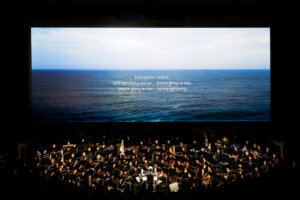
The Dutch National Opera’s version leaves more to the audience’s imagination, with all the players in both 60’s fashions and contemporary garb for the parts in the present; the concentration camp victims are in all black. Creating that distance from the facts of the Holocaust somehow makes the scenes even more poignant, as one calls to mind the real horrors without any prodding.
Conductor Adam Hickox said that Weinberg’s music has, until very recently, been under-appreciated. “The fact that he was a Jew meant that he was under increased Soviet censorship,” he explained. “He did have a certain amount of recognition in his life but it was short lived.” Only in the last several years, he said, has his enormous output been recognized, and his work been revived and championed.
A certain reluctance to produce Die Passagierin may also have something to do with a fear that any art about the Holocaust was somehow taboo in Europe, and among first and second-generation survivors. For the first two decades following World War II, there was a general feeling that creating art about the Holocaust would not be in good taste.
“In the 1960s, both survivors and perpetrators were still around and, of course, dealing with their own histories, responsibilities, or traumas,” said Roling. Today, she added, “There are still a lot of family secrets or even stories that have been lost because the people you could ask are no longer alive.”
This Dutch National Opera’s production of Die Passagierin may give some audience members a chance to open up conversations they haven’t had before, Roling said. “It’s a way into being able to discover what happened, what did my family do?” she said. “And also ask a question: What could a person do?”
Roling said the opera certainly does not let anyone off the hook for their behavior, but it might give some people pause when they consider their own actions today.
“I wouldn’t call it a cautionary tale, but it’s important to remember that nowadays we aren’t immune to this behavior, either,” Roling said. “It’s easy to think this was a specific time and place, and it couldn’t happen again, but I’m afraid that’s not true.”
The post In a forgotten 20th century masterwork, a Holocaust story from the perpetrator’s perspective appeared first on The Forward.
Uncategorized
Former Edmonton journalist admits to vandalizing monuments of Ukrainian Nazi collaborators
(JTA) —
EDMONTON, Canada – Duncan Kinney, a former journalist with the left-wing website Progress Report, pleaded guilty to criminal mischief on Monday, four years after he was arrested for vandalizing monuments to Ukrainian Nazi collaborators in Edmonton, Alberta.
Monday’s guilty plea was an anticlimactic not-quite-end to a case that appeared to be run-of-the-mill vandalism but was so culturally charged that it drew the attention of everyone from the Premier of Alberta to Friends of the Simon Wiesenthal Center in Toronto.
In 2021, Kinney broke the news story that someone had spray-painted “Actual Nazi” on a bust erected to honor WWII military commander and Nazi collaborator Roman Shukhevych and then painted “Nazi Monument” and “14th Waffen SS” on a memorial to the SS Galizien, a Ukrainian military unit that was part of the Nazi Party’s military wing.
According to court documents, Kinney was caught on a security camera spray-painting the Shukhevych monument shortly after midnight on Aug. 10, 2021, and caught again eight hours later photographing his handiwork. He then sent an email to the staff of the Ukrainian Youth Unity Complex, where the monument was located, explaining that Progress Report had received photos of the defaced monument. The brief email concluded with “Do you have any statement or information on this matter? Was Roman Shukhevych a Nazi or Nazi collaborator? Our deadline is 3:15 pm. Thank you.”
Kinney initially pleaded not guilty to one count each of criminal mischief and mischief relating to a war memorial. He suggested he’d been targeted because he was critical of the Edmonton Police Service and alleged that they were trying to silence him.
He is due to be sentenced Jan. 25, 2027, at which time the crown prosecutor is expected to drop the more serious charge of defacing a war memorial, which carries a sentence of up to 10 years in prison.
Neither Kinney nor his defense attorney, Tom Engel, would comment after the court appearance. However, the board of Progress Report issued a statement decrying its former employee’s actions, calling committing a crime and reporting that somebody else did it “a cardinal breach of journalistic ethics and not acceptable behavior within any media organization. Mr. Kinney has always maintained his innocence in this matter and we trusted him; today’s news was an unpleasant surprise for us.”
Ultimately, the case exposed deep divisions in the Ukrainian diaspora about the role that Ukraine played in the Holocaust.
Shukhevych was a leader in both the Organization of Ukrainian Nationalists (OUN) and its armed force, the Ukrainian Insurgent Army (UPA). He was also an officer in a Third Reich auxiliary battalion. During World War II, he commanded troops that murdered Jews, Polish civilians, other national minorities, communists and his countrymen from Ukraine. And he helped marshal the fight for Ukrainian independence from the Soviets.
The monument to the SS Galizien is located at St. Michael’s Cemetery, less than two miles from the complex housing the Shukhevych bust. Among the unit’s members was Yaroslav Hunka, who, at age 98, received two standing ovations for his service in WWII and fighting for Ukrainian independence when he appeared in the House of Commons alongside visiting Ukrainian President Volodymyr Zelensky in September 2023.
Nobody in Parliament, it seemed, was aware of Hunka’s Nazi past. When the news became public, the incident became a national embarrassment. At least temporarily, the country was forced to examine how it dealt with WWII war criminals.
In Edmonton, however, the blunder appeared to have no impact on Kinney’s case. For his alleged vandalism to the SS Galizien monument, he had been charged not with simple mischief, but with vandalizing a war monument.
“We do not consider a statue honoring a Nazi to be a war monument,” says Jaime Kirzner-Roberts, senior director of policy and advocacy at the Friends of Simon Wiesenthal Center in Toronto. “When we talk about veterans’ monuments, we are talking about Canada’s veterans. We are not talking about Nazi veterans.”
Kirzner-Roberts’ organization, B’nai Brith Canada and the Jewish Federation of Edmonton, as well as local politicians and academics, have been asking for years for the monuments to be removed.
“I think that in the case of the Shukhevych monument, you shouldn’t put up monuments to people responsible for mass murder,” says John-Paul Himka, a University of Alberta professor emeritus of history, whose 2021 book “Ukrainian Nationalists and the Holocaust” examines the role that the OUN and UPA had in destroying Ukraine’s Jewish population during WWII.
“As for the Waffen-SS memorial, Austria has also been trying to get rid of their Waffen-SS memorials and it’s an issue around the world, really, how much you want to put up memorials to SS men or to people who collaborated with the Nazi state.”
Less than six months after the Hunka debacle in Parliament, the monument to the SS Galizien at the St. Volodymyr Ukrainian Cemetery in Oakville, Ontario, was permanently removed. Himka doesn’t see anything like that happening in Edmonton, a city with the largest population of people with Ukrainian descent in a country with one of the largest populations of people with Ukrainian descent outside of Ukraine.
“The diaspora community doesn’t want to hear about this,” he says. “They don’t want to confront the history, and nobody is telling them otherwise really.”
The courtroom, though, did host one such confrontation. At the conclusion of Kinney’s appearance, two women who appeared to be in their 40s and who had spent the half-hour proceedings knitting, engaged in a conversation with two men who appeared to be at least twice their age and were sitting across the aisle.
The discussion started innocently enough, with inquiries as to what brought each of them to the courtroom. When the women said that Shukhevych was a Nazi who had killed thousands of innocent people, the temperature heated up.
When the women insisted, the men all but rolled their eyes. “That’s Russian propaganda,” they scoffed, then got up and marched together out of the courtroom.
The post Former Edmonton journalist admits to vandalizing monuments of Ukrainian Nazi collaborators appeared first on The Forward.
Uncategorized
Mike Rogers says his opponent is ‘anti-Jew.’ Do Michigan’s Jews believe him?
(JTA) —
WHITE LAKE, Mich. – Former U.S. Rep. Mike Rogers did not have to go very far back in time to find a new example of how, in his view, his opponent is a danger to the Jewish community. Twelve hours would do.
Rogers recalled an interview that had aired the previous night on ABC. “He basically said that Israel now is just not an ally — matter of fact may be the enemy — of the United States of America,” the Republican nominee for U.S. Senate in Michigan told the Jewish Telegraphic Agency on Tuesday morning.
The “he” in question was, of course, Abdul El-Sayed, the former county health director and polarizing Democratic nominee for the state’s open Senate seat. The night before, El-Sayed had told ABC that Israel was “not actually our friend.” He also recently told MS NOW that “the government of Israel has done nothing but use us.”
Rogers, by contrast, told JTA that Israel is “the best ally we have in the Middle East. They have Western values baked into their political system.” He proudly noted that far-right commentator Tucker Carlson has attacked him for his pro-Israel views.
Remarks like the ones El-Sayed recently made, Rogers continued, clarify his view of his opponent: “There’s so much evidence. It’s pretty hard to say that this guy is anything but anti-Jew.”
For Rogers and the Republican Party writ large, El-Sayed’s hardline criticism of Israel has thrown them an unexpected gift in a tough race that could help determine who controls the Senate after the November midterms.
That opportunity runs through Michigan’s Jewish community. At a recent rally in the state, Vice President JD Vance echoed that criticism, accusing El-Sayed of being “obsessed” with Israel.
“He’s 10 times more interested in what’s happening in Palestine than in Port Huron,” Vance, whose own views on Israel have concerned many conservative Jews, told the crowd. “He’s way more interested in what’s happening in Gaza than he is in what’s happening in Grand Rapids.”
Another recent Trump administration event, held at a Michigan synagogue, mostly discussed antisemitism. Neither Senate candidate’s name was mentioned from the stage. But Jews who attended the event told JTA they were scared of the prospect of a Senator El-Sayed. “I pray he does not get in,” one attendee, Sharon Matlen, said.
Rogers, a former congressman who lost the 2024 Senate race to Elissa Slotkin, a Jewish Democrat, by fewer than 20,000 votes, hopes to convince enough of the state’s estimated 100,000 Jewish adults and other traditionally Democratic blocs to vote for him in the election in two weeks’ time. He’s confident of his chances.
“I think the alternative is so bad, and they looked at us and said, ‘He’s not that bad,’” the candidate said. “And trust me, I think that’s a good place for us to be.”
Rogers positions himself as a common-sense Republican, one whose chief concerns are improving child literacy, rebuilding manufacturing jobs and lowering utility rates. Drawing on his military background, he insists he doesn’t have a problem with the fact that El-Sayed is Muslim: “I wore the uniform of the United States so you can pray any way you want.”
Local rabbi Asher Lopatin, who briefly went on leave from his role directing Jewish communal relations in Ann Arbor to stump for Rogers, has called him “a caring, sensitive man.”
Rogers is also trying to make inroads with Black communities, as well as other ethnic and faith-based groups. At a Tim Hortons in this tony Detroit suburb, an Iraqi Christian couple came out from behind the counter to take selfies and profess their support.
But among his potential new voters, it’s the Jewish community Rogers has made the most overt appeals to. His outreach has included meeting with various Jewish clergy and community leaders and hosting a meet-and-greet Sunday night in a heavily Orthodox Jewish neighborhood, catered by a kosher BBQ joint. And he and Texas Sen. Ted Cruz will be appearing together in Detroit next week for an event spearheaded by the Republican Jewish Coalition titled, “Who Will Keep Us Safe?”
Hundreds of Jews, including several prominent community leaders and lifelong Democrats, have already signed a pledge to vote for Rogers. El-Sayed’s association with left-wing streamer Hasan Piker and linking of the spring attack on Temple Israel to Israel’s war in Lebanon have troubled some Jewish voters.
(L-r) Michigan Jewish Democratic activist Alicia Chandler, Illinois congressional candidate Daniel Biss and former Michigan Rep. Andy Levin make a progressive Jewish case for Senate candidate Abdul El-Sayed to a small audience of conflicted Jews in Detroit, Michigan, Oct. 19, 2026. (Andrew Lapin/JTA)
But others, even those deeply worried about El-Sayed and his movement, still can’t bring themselves to support the current Republican platform. A new progressive canvassing campaign is targeting Jews in the Detroit suburbs to persuade them not to vote for the GOP candidate.
“We’ve been doing a lot of listening to people’s concerns and anxieties,” said Amanda Berger, a progressive Jewish activist from California who is leading Seed the Vote’s Jewish canvassing efforts for El-Sayed in Michigan.
But the volunteers’ goals, Berger told JTA, are then “to pivot to the question of, what will it mean to you, or what will it mean to the Jewish community, or what will it mean to your neighbors, if Mike Rogers is elected and Trump is unchecked for another two years.”
Elaine Driker, a prominent Detroit Jewish community leader, was no fan of El-Sayed. Yet after seeing so many of her peers sign the pro-Rogers letter, Driker signed a Jewish letter pledging to vote for El-Sayed.
She then went a step further, hosting Daniel Biss, a progressive Jewish congressional candidate from Illinois, and 50 Jews at her house Monday night for a dialogue about El-Sayed. One in attendance, Susan Ruttenberg, admitted that though she had already cast her vote for the Democrat, “I’m uncomfortable with him.”
Biss holds Israeli citizenship and told the group he believes “that the Jewish people have a legitimate claim to the land where the state of Israel has been established.” He conceded, “Some of the ways that Abdul has spoken about antisemitism have landed imperfectly with some people.”
Yet Biss insisted, “I think he’s shown a willingness to learn and grow.” He also warned the crowd against what he called “the political narrowness of the organized Jewish community.”
It was one of several such small-room Jewish conversations about the race that have taken place in recent weeks. Others have featured New York congressional candidate Brad Lander and Vermont U.S. Rep. Becca Balint. Michigan state Sen. Mallory McMorrow, who dropped out of the Senate primary that El-Sayed eventually won, will speak at another.
The events are intended “to breathe some air into the possibility that Abdul is not scary, that he is not antisemitic,” said Stacie Chaiken, an organizer with Michigan Jews for Democracy, which is also putting on the meet-and-greets. The coalition’s open letter of Jews pledging to vote for El-Sayed has topped 950 signatures to date.
To win over more Jews, Rogers will make his case by acknowledging what other Jews have told him is a deep fear for where the country is headed.
“They’re afraid for what kind of America their children will live in,” Rogers told JTA of the Jews he’s spoken to on the campaign trail. El-Sayed is building a “movement,” the Republican said, arguing that such a movement bodes poorly for Jews: “You have to remember, if elected to the Senate, this is just the beginning for them.”
Democrat US Senate candidate for Michigan Abdul El-Sayed speaks during a midterm campaign rally in Flint, Michigan on October 18, 2026. El-Sayed is competing against Republican candidate Mike Rodgers for Michigan’s US Senate seat in the upcoming midterm elections. (Jeff Kowalsky / AFP via Getty Images)
Rogers repeatedly brought up his opponent’s “ideology” and “extremism.” He sought to link El-Sayed to the Muslim Brotherhood, echoing a growing GOP line of attack. Republicans have cited resurfaced tweets by El-Sayed’s half-sister describing their mother’s activism in the movement in the early 1970s.
El-Sayed has disavowed the group and accused questioners of invoking Islamophobic tropes.
Rogers also said he doubted the sincerity of El-Sayed’s August apology to the Jewish community for his “hurt people hurt people” remarks regarding the March attack on Temple Israel — a similar sentiment other Michigan Jews have shared with JTA.
“That’s not an apology,” he said. “That says, ‘I’m sorry I said it then. Maybe I should have said it later.’ I don’t buy that.”
The Rogers campaign is additionally arguing that El-Sayed’s rhetoric has activated a deeper antisemitic contingent on the left. A Rogers campaign staffer, who is Jewish, posted to X Tuesday morning that El-Sayed is “a raging antisemite who is responsible for the hate and vitriol Michigan Jews face daily,” with a link to his ABC interview. That staffer, Abby Ronson, told JTA that she received death threats because of the tweet after progressive commentator Mehdi Hasan went after her.
El-Sayed has strongly rejected any allegation that he is antisemitic, saying he loves Judaism and that “AIPAC and Israel are not the same as Judaism and the Jewish people.” Some of the state’s top Jewish Democrats, including Slotkin and state Attorney General Dana Nessel, have endorsed him; others, including congressional candidate Jeremy Moss, have not.
But Rogers also hopes to tell more of Michigan’s Jews who he is — beyond simply not being El-Sayed. There’s someone else, he said, who he’s not: the deeply unpopular Republican president.
“I’m not Trump. And I don’t plan to be Trump when I get to Washington,” Rogers said. He listed issues he has broken with Trump on, including the joint U.S.-Israeli war in Iran, which Rogers formerly supported but now wants wrapped up: “I argue we met our objectives. Don’t hang out there very long.”
If such a view puts him at odds with Israeli leadership, he said, they will politely hash it out. “Every once in a while, we’re going to disagree with our allies. I don’t see this as a problem.”
Still, when it comes to issues of concern to Jewish voters, Rogers said he’s more aligned with Trump than not. He “absolutely” approves of the president’s campaign against campus antisemitism, which has drawn criticism and legal action for pulling billions of dollars in funding from various universities in order to pressure them to sign settlements.
If the government wanted to do the same to the University of Michigan, the state’s top research school that has been embroiled in a stream of antisemitism controversies of its own, Rogers — who donned Michigan gear for a TV ad running in the state — would support it.
“I wish there were a better way, but nothing else is working,” he told JTA. “Hell, their professors are talking in ways that would be shocking about an ally to the United States, and they’re buying into this ‘oppressor versus oppressed.’ It’s the craziest thing I’ve ever seen. The whole thing is anti-American. We’re going to get it fixed.”
Rogers dismissed as “a made-up story” reports that his allies had asked the pro-Israel lobbying group AIPAC not to advertise publicly on his behalf, reportedly because they fearedfearing its involvement could hurt his campaign.
“What I’ve always said is, if anybody wants to help defeat the most extreme candidate from his Democratic Socialists of America ties to his very, I think, hateful, angry, riddled contempt for Israel and Jews, welcome,” Rogers said. “I’ll take anybody that wants to help.” El-Sayed is not a DSA member, but he has spoken at the organization’s events and received campaign support from its members.
Recently, an AIPAC-linked super PAC, the United Democracy Project, spent about $95,000 against El-Sayed, according to federal elections filings. That expenditure took the form of mailers targeting the Jewish community.
Rogers insists his fight against El-Sayed is bigger than the candidates. Voters, he said, are concerned with what the Democratic Party’s treatment of Jews says about the coalition’s direction in general.
“I can’t tell you how many people tell me that they’re so disappointed in their party,” he said. “And if you can bring yourself to diminish one set of people or one ethnic group of people in Michigan, what stops you there? I argue, nothing.”
Yet many of the Michigan Jews trying to convince their neighbors to vote for El-Sayed are making the same argument — in a different order — about Republicans. The GOP’s demonizing of certain immigrant groups and LGBTQ people, progressive Jews argue, could lead back to antisemitism.
“A society that abandons pluralism in an effort to attack someone other than the Jews is surely going to be coming for the Jews pretty soon,” Biss told the assembled crowd on Monday.
Rogers rejected the premise that Republicans are doing the same thing. “I don’t equate them at all,” he said. “It may be a legitimate concern. But if you have somebody that wants to eliminate, you know, ‘from the river to the sea,’ last I checked, that’s just about every Jew that lives in Israel. There’s no more clear, brighter line than that.”
On his way out the door to speak at the Detroit Economic Club, Rogers was asked if he had any last message for American Jews.
“Keep the faith,” he said, before driving away.
The post Mike Rogers says his opponent is ‘anti-Jew.’ Do Michigan’s Jews believe him? appeared first on The Forward.
Uncategorized
Germany reprimands Iran over plot to kill Jewish leader and Israel advocate
(JTA) — Germany’s foreign ministry summoned Iran’s ambassador after a German court convicted two men of spying for Tehran and plotting attacks on a leader of the country’s Jewish community and a prominent non-Jewish supporter of Israel.
A slap on the wrist is not enough, said Volker Beck, president of the interfaith German-Israeli Society, who had been one of the spies’ targets.
Iranian Ambassador Majid Nili Ahmadabadi and most of the embassy’s personnel should be personae non grata in Germany, Beck said. He added he would be satisfied if the embassy was emptied except for a lone guard “to look after the building and this is it.”
Hamburg’s Higher Regional Court last week sentenced 54-year-old defendant S. to eight-and-a-half years in prison and 43-year-old defendant M. to four and a half years for plotting assassinations and an arson attack. The convicts’ full names have not been publicized.
The court found that the two men, living in Denmark, had in early 2025 carried out orders from Iranian intelligence oepratives to spy on Josef Schuster, head of the Central Council of Jews in Germany, and Beck, a Green Party politician and longtime Israel advocate, with the aim of planning an assassination.
In a statement issued Oct. 15, the court said that defendant S. was allegedly tasked “with conducting surveillance on Jewish or Israeli targets — including both locations and individuals — within Germany and preparing to carry out murders and arson attacks against them.”
S. was also convicted of conducting surveillance on a Jewish grocery store in Berlin. “To execute these orders, the defendant S. reportedly enlisted the assistance of the defendant M,” the court said.
The convicted men have until Oct. 22 to appeal the verdict. Further details about the case and the court’s reasoning will be released with the final report, in about three months, a spokesperson for the court told JTA in an email.
In a statement sent to JTA, Schuster praised the verdict but called the case “the tip of the iceberg.”
“With the now proven commissioning of these two spies, the regime in Tehran has once again shown its true face. The masterminds are in Iran, and the danger they pose to our open society remains great as long as the mullahs’ regime exists,” he said.
At the trial, Germany’s federal security agency, the Federal Office for the Protection of the Constitution, testified that it got wind of the plot in 2024, Beck told JTA. “Last year I had six weeks of the highest level of personal protection,” said Beck, who is not Jewish. He couldn’t take out the trash or walk his dog without police protection.
After German Foreign Minister Johann Wadephul’s summoned Iran’s ambassador, Iran called in Germany’s ambassador to the country, Axel Wilhelm Dittmann, for a meeting in Tehran to complain about accusations it considers “baseless.”
In a post Oct. 19 on X, the German Foreign Ministry said Germany “will not allow Iran to threaten our free society. We will not tolerate attacks on Jewish life and those who defend it—anywhere, least of all in Germany. The malicious attempted attacks against” Schuster and Beck “will have legal consequences.”
The post Germany reprimands Iran over plot to kill Jewish leader and Israel advocate appeared first on The Forward.
