


Uncategorized
In Max and Richard Fleischer, was father like son?

Spare a thought for Mr. Boop’s bald spot — or is it a yarmulke?
In Max Fleischer’s 1932 cartoon “Minnie the Moocher,” Betty Boop is shown at home, harangued by her heavily-accented immigrant parents. They want her to eat her hasenpfeffer. For a particular subset of cartoon neurotics, what exactly is going on with Betty’s dad’s pate is a point of obsession.
It’s not a kippah. A wisp of hair tells us it’s male pattern baldness, and, anyway, hasenpfeffer has rabbit, which is treyf. But if you watch enough Fleischer cartoons, you can be confident that the man’s lone follicle was meant to be challenged by landsmen.
The first cartoon the Betty Boop appears in — more properly a Boop prototype, a lounge-singing anthropomorphic dog — has similarly scrambled Yiddishkeit. And 1930’s “Dizzy Dishes” captures the shift of a psychopathic canine short order cook.
At one point, an animal with a hat and beard, and a distinctly Eastern European accent, pokes his head through the window. “I want ham,” he says, and his face is immediately smacked by a loin printed with the letters כּשר, or kosher. It makes no sense.
There’s no more logic when, in 1932’s “I’ll Be Glad When You’re Dead You Rascal You,” Koko the Clown, fleeing from the disembodied head of Louis Armstrong, sprouts a speedometer from his rear, first reading 70, then 90, 100, a question mark, an exclamation point and, finally, כּשר.
It’s an inside joke from one Majer (later Max) Fleischer, who was born to a tailor in Krakow, and came of age in Brownsville, Brooklyn, when it was the domain of poor Jewish factory workers. The question of Boop’s paternity — and whether it is any strict sense Jewish — may come to mind at Film Forum, where Fleischer père et fils, a retrospective of Max Fleischer’s cartoons and his son Richard’s live action work, is playing from May 8 to 28.

The elder Fleischer was a pioneer in animation. He patented the rotoscope, allowing artists to draw over filmed live action and create more realistic movement. He invented the bouncing ball used in sing-a-longs to indicate words. He pushed the boundaries of cartoons, bringing a manic, New York sensibility to the medium: Mickey Mouse drove a steamboat; Betty Boop went to hell.
It’s hard to explain the work of Fleischer and its sheer lunacy, but Jewish examples may suffice. Like a jumpscare, Semitic caricatures spring up from graveyards or along waterfalls with interjections like “ya needed ih” and “vat can we do?” Why? Why not?
At the same time Fleischer was capable of incredible, painterly refinement, as in his Superman cartoons. The curators at Film Forum have devoted programing to the Man of Steel, Betty Boop, Fleischer’s Popeye shorts, musical novelties and “head” cartoons, the kind favored by stoners in the 1960s and ‘70s.
They are all remarkably weird, but perhaps no less strange than the filmography of Max’s son Richard, who helmed the original Doctor Dolittle, Soylent Green and the 1959 adaptation of Meyer Levin’s novel Compulsion, a fictive account of the Leopold and Loeb case.
It’s difficult to say what Richard’s work has in common with his father’s, as so many of Richard’s projects have nothing in common with each other save his name in the credits.
What there is, from contained noirs like 1952’s The Narrow Margin to the spaghetti biblical epic Barabbas, is a brilliance for visuals and staging. (And a seeming affinity for lady pinnipeds.)
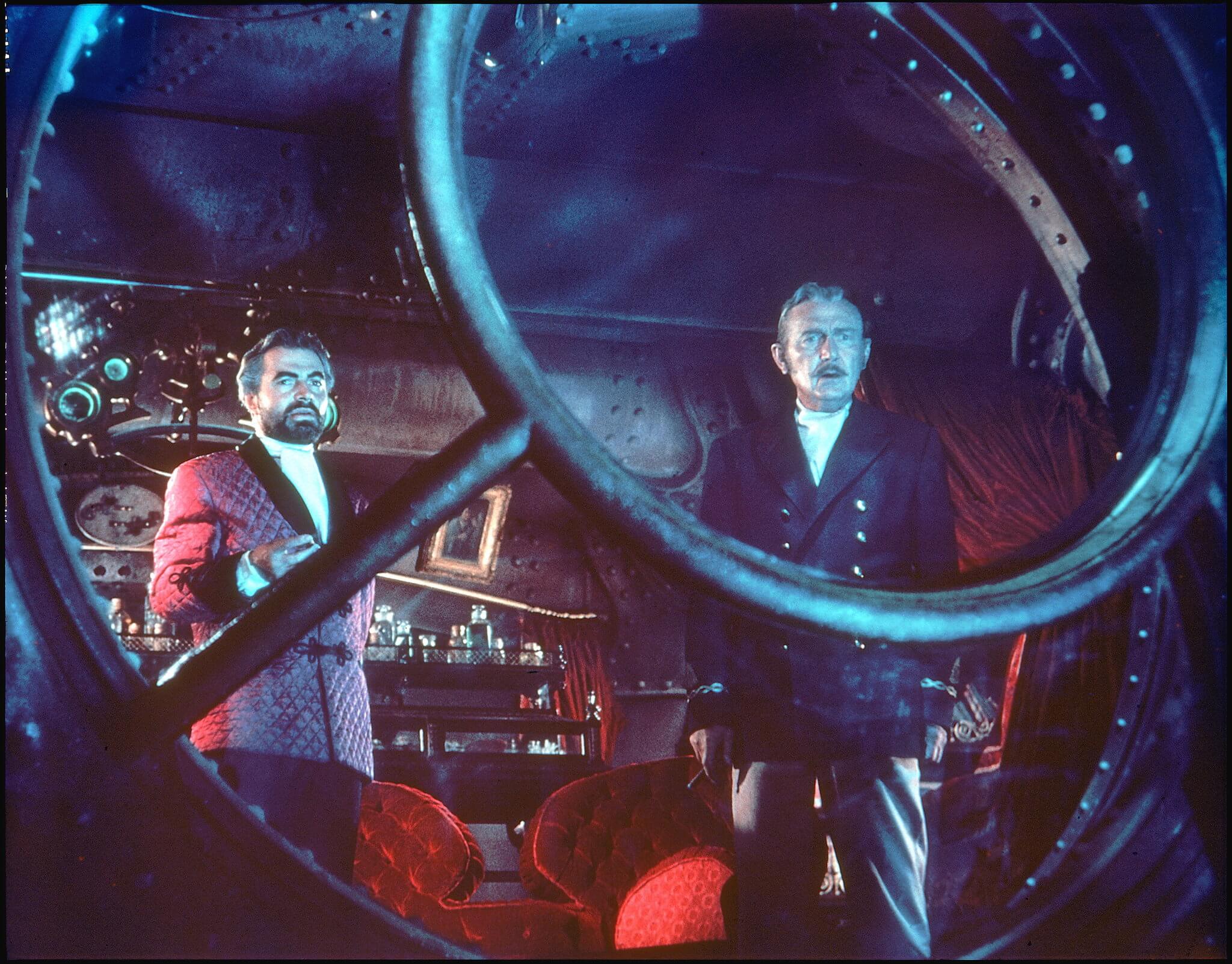
In the widescreen formats of VistaVision and CinemaScope, the younger Fleischer worked depth of field in ways that rivalled Orson Welles. (There may be no greater testament to Fleischer’s talent for wrangling tall personalities than Welles’ appearance in both Compulsion and 1960’s Crack in the Mirror.) He relished the chance to experiment with underwater cinematography in 20,000 Leagues Under the Sea. He once insisted on delaying production to film during a solar eclipse.
On the rare occasion that he tried comedy — 1948’s So This is New York — Fleischer made early use of freeze frames and, in a sequence that prefigures Airplane!, provided genteel subtitles to rough-spoken New York cabbie.
Notable in Fleischer the younger’s oeuvre is its detached engagement with Jewish themes. In the novel of Compulsion, Levin pays lip service to Jewish self-hatred motivating the murder at the center of the story. But Fleischer never makes much of his killers’ or their victim’s Jewishness, caring more for their nihilistic thoughts on Nietzsche and the Welles character’s atheism. (The character was based on Leopold and Loeb’s real attorney, Clarence Darrow, and often gives voice to his verbatim quotes.)
Barrabas, a film in the mold of Ben-Hur, follows Anthony Quinn as the titular reprieved bandit, the one Jesus replaced on the cross. The contours of his story resemble the Talmudic account of Reish Lakeish, a brigand turned gladiator turned believer, but it is a remarkably goyische production that doesn’t even bother to have matzo for the Passover week of the Passion.
Fleischer’s Jewishness perhaps feels akin to that of one of his collaborators, Kirk Douglas. It was never denied, but seldom a feature. But just as Douglas had The Juggler, where he went from Holocaust survivor to halutz, Fleischer had The Jazz Singer.
That remake, from 1980 and starring Neil Diamond, is wisely excluded from the Film Forum’s particular lineup, sparing filmgoers the Jewish Elvis’ blackface, and perhaps affording Fleischer the grace owed him as a replacement director who stepped in mid-production and couldn’t save the picture.
Per Jason A. Ney’s biography Richard Fleischer: Journeyman, Fleischer described the performance of Laurence Olivier in that movie thusly: “This very gentile gentleman had done his damnedest to portray a very Jewish cantor by using every broad cliche in the book. Rolling eyes, grimacing, gesturing, it was a performance worthy of the Yiddish Art Theater at its worst.”
Fleischer, it must be concluded, knew from Jews, and so surmised Sir Laurence wasn’t up to leading Kol Nidrei — not that Diamond did much better.
The yikhes in the Fleischer family is strong, with father and son producing countless hours of too often undersung entertainment. Perhaps the greatest tribute to their overlap and influence will not be screening at Film Forum, but it’s worth recalling.
In a season two episode of the Rugrats, Chuckie swallows a watermelon seed. Through the magic of animation, the babies, drawing inspiration from a sci-fi film, imagine themselves shrunken down and entering his body to retrieve it before it grows.
It’s a parody of 1966’s Fantastic Voyage, directed by Richard Fleischer. It’s safe to say, without the contributions of both father and son, the episode couldn’t exist.
Film Forum’s series Fleischer père et fils begins May 8.
The post In Max and Richard Fleischer, was father like son? appeared first on The Forward.
Uncategorized
A synagogue and Jewish-owned shops damaged in French riots
(JTA) — PARIS – Jewish-owned shops in Marseille were set ablaze and a synagogue in Paris was vandalized as part of widespread property damage caused by riots across France Saturday and Sunday, according to the Jewish Community Protection Service.
It is too early to assess the full extent of the riots protesting the rising cost of living and the damage they’ve caused, but various elements in the media have described them as civil unrest and chaos.
From Lille in the north to Marseille in the south and in the major cities in between, media estimate that nearly 800,000 people took to the streets and some 2,000 shops were vandalized or looted. Public buildings were set on fire, and hundreds of people or more were injured, including 150 police officers, with thousands arrested.
The riots followed a student uprising that blocked entrances to high schools across the country in recent weeks. Palestinian flags and keffiyas have been a recurring motif in most of the violent protests, acts of vandalism and looting.
But according to SPCJ, known as the Service de Protection de la Communaute Juive in French, there was no evidence that Jewish institutions or businesses were deliberately targeted.
Vandals broke into the Ohalei Yaakov synagogue in Paris’ 19th district overnight between Saturday and Sunday. On Sunday morning, members of the Jewish community discovered that their temporary place of worship had been broken into. The permanent synagogue building is currently undergoing renovations.
Inside the sanctuary, prayer books, tefillin, and various objects — taken from boxes and cupboards — were found scattered on the floor. The rabbi’s office was also searched. Despite the mess, the Torah scrolls appeared to be unharmed.
According to a member of the synagogue committee, the incident primarily points to an attempted theft. The suspects may have been looking for money, but nothing was believed to be missing.
This article originally appeared on JTA.org.
The post A synagogue and Jewish-owned shops damaged in French riots appeared first on The Forward.
Uncategorized
How much will Trump’s endorsement help Netanyahu?
(JTA) — JERUSALEM – Within minutes of President Donald Trump endorsing Prime Minister Benjamin Netanyahu in a post on Truth Social Sunday, Netanyahu’s campaign team had released a 30-second clip showing all the times Trump has lavished praise on the Israeli leader over the past few years.
With polls showing that Netanyahu and his governing coalition are slipping in their struggle to retain power in the upcoming Oct. 27 election and lag behind the opposition bloc, an endorsement from the president of the United States is a powerful statement.
But is it enough to tip the scales?
“I don’t think it will change anything,” said Ilana Shpaizman, a senior lecturer in the Department of Political Studies at Bar-Ilan University.
Of course, she said, “Netanyahu will say this is the proof that I’m a leader and all that, and I can speak to Trump … But so what? His followers already know that and they believe in him. They don’t need the endorsement.”
Those who oppose him, Shpaizman continued, “know that Trump forced him (Netanyahu) to accept the ceasefire in Gaza and accept the hostage deal, and that Trump runs the show around Iran. So they also don’t need the endorsement either,” Shpaizman said.
Some pundits speaking on Israeli news outlets criticized Trump for “interfering” in Israel’s election, while others put it down to the fact that Trump does not want America to return to fighting Iran alone if Netanyahu, who is hawkish on Iran, is replaced by someone less willing to act militarily. If Netanyahu loses, that is a scenario that could play out.
“This is the first time ever that the president, at least publicly, endorses a candidate in Israel’s election,” Bushinsky, a political commentator and former adviser to Netanyahu, told the Jewish Telegraphic Agency.
Bushinsky said he remembered Netanyahu complaining about U.S. intervention in previous elections in 1999 and 2001, when presidents less enamored of him were in office. He even pushed for an initiative that would block foreign funding for election campaigns.
Now, Bushinsky said, “I guess he is not complaining,” adding that the endorsement serves Netanyahu in two ways.
First, it signals that Trump thinks that Netanyahu is the most suitable guy for the job. Second, it puts Netanyahu’s election campaign back on track, refocusing attention on an issue where Netanyahu is strong – Iran.
“It lets him say ‘I can now finish a job, and I can finish a job with Trump,’ and ‘without Trump or without me, the job will not be finished,’” said Bushinsky.
He said that in the last few days, the political debate had pivoted to other issues such as Ashkenazim vs Sephardim, the draft law and the contentious efforts by the outgoing government to overhaul the judiciary.
“This [endorsement] is the ultimate campaign boost for Netanyahu,” Bushinsky said.
But that boost might not be enough.
Most of the polls taken in recent days show the opposition bloc led by former IDF chief Gadi Eisenkot pulling ahead of Netanyahu’s ruling coalition, but give neither bloc enough seats to gain the necessary 61 of 120 seats in Israel’s parliament, the Knesset, to form the next government.
“I think this might give Netanyahu one more seat, one more mandate, but not more than that,” said Bushinsky.
Prof. Tamar Hermann, director of the Israel Democracy Institute’s Viterbi Center for Public Opinion and Policy Research, said that the timing of Trump’s support for Netanyahu in this election race had come both “too late and too early.”
“It’s too late because people have already decided electoral preferences. They may shift within each bloc, but will not move between the blocs because of this,” she said. “And it’s too early because there are nine days to go to the elections, and we can already see other American leaders spilling some cold water over what he said, even on the Republican side of the aisle.”
This criticism, Hermann continued, will be transmitted to Israeli voters, and they will see that Trump is facing a huge battle in the upcoming midterm elections.
“The image of President Trump has deteriorated significantly since April 26, when he started the negotiations with Iran,” she said, pointing to one of the IDI’s recent public opinion surveys that found the president’s popularity had plummeted after he stopped the war with Iran without totally removing the threats against the State of Israel.
According to that poll, the Israeli public’s confidence in Trump as someone dedicated to Israel’s security fell from around 70% to just 42%.
“In my view, the endorsement will not make a big change,” Hermann added. “It will just strengthen Netanyahu’s political supporters, who will see it as a sign that he is still the internationally known figure that even the president of the United States is endorsing.”
She concluded, “The meaning of endorsement in Israel is totally different than in the United States … we are not that used to this kind of move, and it will not make people change their minds.”
This article originally appeared on JTA.org.
The post How much will Trump’s endorsement help Netanyahu? appeared first on The Forward.
Uncategorized
Trump endorses Netanyahu for reelection, warning Israelis against choosing another leader
President Donald Trump endorsed Israeli Prime Minister Benjamin Netanyahu for reelection, giving his longtime ally a major boost just nine days before Israel’s Oct. 27 election, which polls indicate could end without a clear winner.
“Please let this letter serve to represent my complete and total endorsement of Bibi Netanyahu in his upcoming race for re-election as Prime Minister of Israel,” Trump wrote Sunday in a lengthy post on Truth Social, praising Netanyahu as a strong leader and trusted partner in confronting Iran.
Netanyahu, Israel’s longest-serving prime minister, is seeking a seventh term after surviving political crises that repeatedly appeared likely to end his career — most significantly after the Oct. 7, 2023, Hamas attack. Recent polls suggest neither Netanyahu’s right-wing coalition nor the opposition is sure to win the 61 seats needed to form a government in the 120-member Knesset.
In his endorsement, echoing the sentiment of Netanyahu’s campaign, Trump warned Israeli voters that choosing anyone else as prime minister could put more pressure on the United States to deal with threats in the Middle East alone. “If Israel has the wrong leader, which would be anyone other than Bibi, America will have to do this work ourselves, and I am not inclined to do so,” Trump wrote. “Bibi Netanyahu has been strong, brave, and brilliant in the face of tremendous opposition, including that coming from even Israel, itself.”
Gadi Eisenkot, a former IDF chief of staff whose son was killed in the Gaza war, has emerged as Netanyahu’s chief rival. Eisenkot has floated a path to a government that does not require a majority in the Knesset. However, one of his partners in the anti-Netanyahu bloc, Avigdor Lieberman, has said in recent days he would oppose such a move. Recent polling puts Lieberman’s party at an average of eight or nine seats — enough to give Lieberman leverage in who leads the government.
Trump’s endorsement came hours after Netanyahu appeared on another program, the Fox News show Life, Liberty & Levin hosted by journalist and commentator Mark Levin. Netanyahu spoke glowingly of Trump and the importance of his battle to destroy the Iranian threat, as the American public prepares to head to the polls for midterm elections on Nov. 3. In that race, Republicans are fighting to maintain control of the House and Senate.
The U.S. war with Iran, which has slowed the flow of oil through the Strait of Hormuz causing gasoline prices to rise, has been unpopular with American voters and is often cited as one of the reasons Republican politicians could lose their races to Democrats.
Netanyahu made the case on Fox that the defeat of the Islamic Republic and the elimination of its nuclear program was critical to ensuring a safe American future. In the U.S., some lawmakers have insisted that the war was unnecessary.
If Iran can destroy Israel, it will conquer the Middle East, control world waterways and oil supplies and proceed to Europe and proceed “to the next target, which is you,” Netanyahu said, addressing a U.S. audience in his Fox News appearance.
A boost for Netanyahu in the final stretch
Trump has taken a personal interest in Israel’s election, but he held off on endorsing Netanyahu for months, raising questions about whether he was keeping his options open in case the longtime Israeli leader lost. “I’m not involved in [Israeli] politics anymore,” Trump told Time magazine in September. In an interview with Newsmax on Thursday, when asked whether he trusted Netanyahu, Trump said he did not trust anybody.
Sunday’s endorsement comes as Netanyahu steps up his campaign to rally his base and convince undecided voters that his close relationship with Trump is essential to Israel’s security. Trump remains popular in Israel, though his approval has declined in recent months following the ceasefire agreement with Iran. But the move could also complicate the president’s ability to influence what happens after the election, if neither political bloc wins a majority.
Trump has previously shown a willingness to pressure Israeli political leaders, including his public campaign last year for President Isaac Herzog to pardon Netanyahu of corruption charges.
Nonetheless, by declaring that Netanyahu is the only acceptable leader for the U.S. administration, Trump may have made it harder to persuade opposition parties to join a unity government led by Netanyahu if the election produces a political stalemate. It also gives Netanyahu another reason to resist stepping aside in post-election negotiations, knowing that the American president has publicly declared him the only alternative.
Netanyahu has already begun sharpening that message, arguing that he and Trump have unfinished business and only two more years to accomplish their shared goals before Trump’s term ends in January 2029. The messaging carries an implicit warning about Israel’s relationship with Washington after Trump leaves office. Whether the next president is Republican or Democrat, any Israeli leader may find it harder to maintain the same level of personal access and cooperation.
The election also carries broader consequences for American Jewry. Netanyahu has become increasingly unpopular among American Jews and Democrats, many of whom oppose his alliance with far-right and religious parties. A change in leadership could allow Israel to rebuild ties with Democrats and reconnect with parts of the American Jewish community — even without bringing nearly as much change in Israeli policy as some might hope.
Rep. Dan Goldman, a Jewish Democrat from New York who was defeated earlier this year in a primary that focused on his support for Israel, posted on X that the U.S.-Israel alliance “will suffer permanent damage if this Israeli government continues to hold power after the election on October 27.”
Polls point to another deadlock
The latest polls show that Netanyahu faces a difficult path to reelection.
Surveys published over the weekend show Eisenkot’s Yashar party ahead of Netanyahu’s Likud, with the opposition parties holding a combined 55 seats. The two Arab lists — the United List, a coalition of three Arab Israeli parties, and Ra’am led by Mansour Abbas — are generally counted outside either bloc.
Those numbers help explain why Trump’s endorsement matters.
A few additional seats could change the balance of power and determine who gets the first opportunity to form a government. And even if Netanyahu fails to secure a majority, he could still benefit from a political deadlock if his bloc wins enough seats to prevent the opposition from forming a government.
In that scenario, Netanyahu would remain prime minister until a new government is sworn in, potentially setting the stage for another election.
JTA contributed to this report.
The post Trump endorses Netanyahu for reelection, warning Israelis against choosing another leader appeared first on The Forward.
