


Uncategorized
In the work of 21 artists, 49 different ways to be Jewish
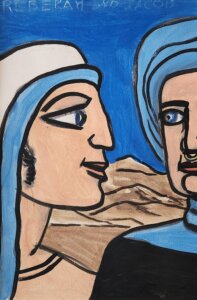
As I walked through the exhibit, Envisioning the Sacred: Modern Art from the Collection, at the Derfner Judaica Museum and Art Collection, I wondered aloud which was the more defining element in these 20th and 21st century paintings, drawings, prints and linoleum cuts. Was it the modernist sensibility, which encompassed figurative, abstract, symbolic and metaphorical approaches? Or was it the Jewish-themed content?
In the 49 pieces by 21 artists (including two etchings by Marc Chagall), there were illustrated Biblical characters and stories; depictions of traditions and rituals; and a fair number of the works employed the Hebrew alphabet to evoke emotion and inspire the composition.
“The exhibit shows how artists use a modern visual language to express their Jewish identities,” said Susan Chevlowe, chief curator and museum director who guided me through the light-filled gallery, which is part of the Hebrew Home at Riverdale and set on a shallow hill that slopes down to the Hudson River.
“It’s hard to separate the two elements or say which is more defining,” Chevlowe said. “The majority of these artists were artists early on in their lives, drawing and sketching as children. Some grew up steeped in a Jewish tradition and others came to their Jewish identity later in life, especially in the post-Holocaust years. Percival Goodman is an example. An agnostic, he was best known as a modernist architect. But in the post-Holocaust years he became interested in Biblical figures.”
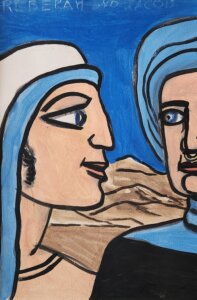
Chevlowe pointed to Goodman’s painting “Rebekah and Jacob,” presenting two large, sharply drawn flat heads. The bold colors outlined in stark black stripes summon forth figures that border on the cartoonish, yet are also strikingly beautiful. Here, the matriarch Rebekah beams at her younger son Jacob with whom she is scheming to steal her older son Esau’s birthright.
A number of the works reflect, in subtle and layered ways, Jewish traumas coupled with homage and pride and in some instances a touch of the elegiac.
Adam Muszka’s “Sabbath Meal,” painted in the 1960’s is a nostalgic look back at the lively Polish shtetl that he grew up in and that no longer exists. With its sentimental tone, the painting evinces distortion. Two figures in the foreground are over-sized, while the homes in the background are shrunken and lopsided — an indication, perhaps, that this is a falsely rosy memory.
In the seemingly more realistic 2003 painting, “Choral Synagogue, St. Petersburg, Russia,” one of the more recent works on display, Joyce Ellen Weinstein brings to life the massive temple entrance and the decorative gate in front of it, “which is slightly off kilter,” Chevlowe pointed out. “Notice the barbed wire on top of the gate. The painting suggests the dignity of the synagogue and its people and also the difficult position of Russian Jews throughout history.”
Chevlowe was hard pressed to pick a favorite, though she admitted a special fondness for Jane Logemann’s 1996 “Alphabet,” a series of pale blue and purple ink wash panels adorned with repeated pairs of Hebrew letters, in pen and ink, which create a vertical pattern from the top of the page to the bottom. The series is poetic, lyrical.
“Logemann is interested in patterns and structures of nature,” said Chevlowe. “Some letters are large, others small. There’s a randomness here. Her choices are intuitive. For many artists the abstract is spiritual. For some mysticism and spiritual quest are essential in their work.”
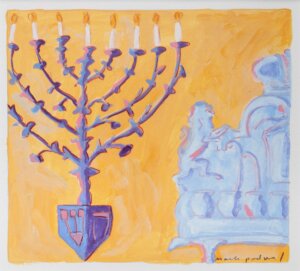
One of the better known artists in the group is Mark Podwal. In his 2002 “Dreidel Hanukkia,” an acrylic painting, we see a menorah balanced on a dreidel and on the opposite side of the page there’s a less readily definable bench lamp.
“It’s modern and old and very playful,” said Chevlowe. “And each Hanukkah light, the menorah and the bench lamp, is cut off by the frame, cut off by the rest of the world. It’s a fragment. We often see that in Degas too.”
Some of the painters are more deeply embedded in or influenced by particular schools of art than others. In Jacques Yankel’s joyful and expressionistic “Torah,” one can see the Marc Chagall and Chaim Soutine lineage. Yankel’s emigre artist father lived in Paris and was very much part of the Paris school of art, which included Chagall and Soutine.
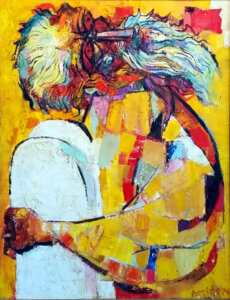
In New York, Ben-Zion, a Russian-born painter who arrived in the United States in 1920, was a recognized member of “The Ten,” abstract painters that consisted of, among others, Mark Rothko and Adolph Gottlieb, though curiously enough Ben-Zion was never really an abstract painter.
Moses was a frequent subject of his. In his 1962 “Moses Looking Down to the Promised Land,” our title character is viewed from the back, an imposing, heavily draped figure perched on a rocky terrain. He is staring out at Jericho, at once so close to and yet so far away from The Promised Land.
Abraham Rattner also employed Moses as the central figure and theme in his vibrant Picassoesque “Moses,” which features the Prophet clutching two blank tablets, devoid of the commandments or, indeed, any writings. His head twisted to the side and an integral element in a wild abstract design is as unsettling as it is thrilling. It is perhaps my favorite in the collection.
“I would like viewers to appreciate the richness in stylistic range and to be aware that these are highly trained, skilled and knowledgeable artists who come from a rich cultural tradition that includes all of art history,” Chevlowe told me. “At the same time they create something that’s original, authentic and beautiful.”
The post In the work of 21 artists, 49 different ways to be Jewish appeared first on The Forward.
Uncategorized
UK adopts sweeping measures against antisemitism in schools
(JTA) — The U.K. has adopted sweeping measures to combat antisemitism in English schools, prompting pushback from the country’s largest teachers’ union.
The move came after a new government-commissioned review found that three in five Jewish students reported experiencing antisemitism in English schools. The most common incidents were jokes, stereotypes and comments about Jewish people. About half of respondents who witnessed or experienced antisemitism said the incidents were not reported, most often because they did not think they would be taken seriously.
The government on Wednesday accepted 27 recommendations from the report, including dedicated antisemitism training for leaders and staff, improved recording of antisemitic incidents and moves to build a better understanding of Jewish life, identity and contemporary antisemitism.
The government commissioned the report following a spate of high-profile attacks on Jews in Britain, including an attack on a synagogue in Manchester last year that left two men dead.
The report’s author, Sir David Bell, the vice chancellor of the University of Sunderland and former chief inspector of schools in England, recommended addressing antisemitism distinctly from other forms of racism. He argued that antisemitism was a “uniquely complex” problem because of intertwined racial and religious dimensions, since Jewish identity can encompass both an ethnicity and a religion, along with expressions of prejudice that hold all Jews responsible for the actions of Israel.
The government will also encourage English schools to adopt the International Holocaust Remembrance Alliance (IHRA) working definition of antisemitism. The definition is supported by many mainstream Jewish organizations and has been adopted by 47 countries, including the U.K., but critics say that it conflates some forms of antisemitism with criticism of Israel.
British Education Secretary Lucy Powell called Bell’s review a “generational moment” and said that “implementation is now my priority.”
However, the National Education Union, the largest union representing teachers, lecturers, teaching assistants and support staff in the United Kingdom and Europe, raised concerns on Wednesday about recommending the IHRA definition for schools. NEU general secretary Daniel Kebede said in a statement that the definition “risks deepening the problem rather than tackling it, and actively undermining efforts to confront antisemitism.”
“The IHRA’s contested framing risks blurring the line between antisemitism and legitimate criticism of the Israeli government and the genocide in Gaza, leaving teachers with uncertainty when they need clarity,” said Kebede. He cited a risk that “children who cannot critically explore issues through classroom discussion will instead seek their answers in online and unsafe groups.”
Kebede also encouraged Britain’s Department for Education to strengthen guidance on all forms of racism, not only antisemitism, saying that 65% of teachers report they have not received any antiracism training in the past year.
The Board of Deputies of British Jews, an umbrella organization for British Jewish communities, celebrated the antisemitism report and the government’s adoption of its proposed measures. The group specifically praised the report’s “clear recommendations that schools and local authorities follow government guidelines by adopting the IHRA Working Definition of Antisemitism as a tool to deepen understanding of contemporary antisemitism.”
“We remain concerned about undue external influence on schools driven by narrow political agendas, and tendentious materials seeping into schools and increasing disharmony, and we will continue to press for vigilance against this,” said the Board of Deputies.
The post UK adopts sweeping measures against antisemitism in schools appeared first on The Forward.
Uncategorized
Orthodox Jewish man stabbed in midtown Manhattan
(New York Jewish Week) — An Orthodox Jewish man is in stable condition after being stabbed on Wednesday evening in the Diamond District of midtown Manhattan. Police are investigating the attack as a possible hate crime.
Police told the Jewish Telegraphic Agency that the NYPD’s Hate Crimes Task Force is investigating the incident as a possible antisemitic attack, and Manhattan Shomrim — the Jewish community watch group — has asked people to share footage as police search for the suspect. No arrests have been made.
The victim was identified by police as a 26-year-old man, and Orthodox Jewish outlet COLLive identified him as a resident of Crown Heights, the neighborhood that is home to the Chabad-Lubavitch Hasidic movement’s headquarters.
He was taken to Bellevue Hospital in stable condition. Police said they were called at about 5:50 p.m. on Wednesday after the man was stabbed in the back with “an unknown sharp object” on 47th Street near Fifth Avenue. ABC7 reported that the victim told investigators he believed he was stabbed with a needle or syringe.
According to the Chabad website, which published an interview with the victim, he is a recently ordained Hasidic rabbi named Joseph, who commutes to Midtown each day to wrap tefillin with Jewish merchants. The attacker, Joseph told the website, was a woman who seemed to be following him prior to the stabbing.
The attack comes as Jewish New Yorkers have been targeted in more than half of the hate crimes committed in New York City this year, despite making up about 12% of the city’s population.
In July, an assailant stabbed two men on the Upper West Side, including one who was leaving a synagogue, while yelling “Allahu akbar,” and was charged with committing hate crimes.
Louis Keene contributed reporting.
The post Orthodox Jewish man stabbed in midtown Manhattan appeared first on The Forward.
Uncategorized
VIDEO: A Hasid gives us a tour of Morocco in Yiddish
דער ירושלימער יוטוב־שטערן וועלוול קירשנבוים האָט לעצטנס אַרויסגעשטעלט אַ ווידעאָ אויף ייִדיש פֿון אַ פּרעכטיקן וויזיט, וואָס ער האָט געמאַכט אין מאַראָקאָ. עס באַגלייט אים זײַן חבֿר אַבֿרהם פּרץ.
אינעם ווידעאָ זעט מען ווי קירשנבוים דאַוונט שחרית מיט די אָרטיקע ייִדן און באַזוכט אַ גוט אָפּגעהיטענעם בית־עולם, וווּ עס ליגן באַערדיקט גרויסע צדיקים ווי למשל הרבֿ חיים בן עתר (1696–1743), באַקאַנט ווי דער „אור החיים“. „מענטשן מיינען, אַז נאָר אין אייראָפּע זענען דאָ קבֿרים פֿון צדיקים!“ זאָגט קירשנבוים.
מיר זעען אַ גרויסע, שיינע שיל מיט אַ פֿײַנער אַרכיטעקטור אין קאַזאַבלאַנקאַ; דעם גרויסן אַראַבישן שוק, וווּ קירשנבוים קויפֿט זיך אײַן מלבושים פּונקט ווי די מאַראָקאַנער גייען אָנגעטאָן. ער באַוווּנדערט אויך די שיינע טיי־גלעזער און טשײַניקן, וואָס מע פֿאַרקויפֿט דאָרט, און באַקענט זיך מיט אַ ייִדישן סוחר וואָס האַנדלט מיט זילבער און גאָלד, פּונקט אַזוי ווי זײַן טאַטע און זיידע האָבן געטאָן פֿאַר דור־דורות.
The post VIDEO: A Hasid gives us a tour of Morocco in Yiddish appeared first on The Forward.
