


Uncategorized
In the world of Jewish translators, she was known as a mentor, a friend and a literary giant
Barbara Harshav, widely considered one of the most important translators of Jewish literature of our time, passed away June 24 at age 85. She translated from French, German, Hebrew, and Yiddish — and won acclaim from scholars and fellow translators for her range and high standards. Her curiosity and willingness to tackle difficult material were legendary.
“Few people would be able to and feel comfortable translating from French and German alongside Hebrew and Yiddish,” Shachar Pinsker, professor of Judaic Studies and Middle East Studies at The University of Michigan, wrote in an email.
She translated giants, including Shmuel Yosef Agnon, winner of the Nobel Prize; Avrom Sutzkever, the towering Yiddish poet; the Israeli novelist Meir Shalev; and the beloved poet Yehuda Amichai. But she was also loved as a mentor and friend to scholars and translators of several generations.
“I knew Bobbi Harshav through reading her translations before I met her for the first time, when I helped her carry a suitcase to a room in Berkeley’s Bancroft Hotel in 2005,” Pinsker recalled. “Since then, we have seen each other in Ann Arbor, Tel Aviv, New York and Boston. It was always a thrill to meet her, speak and correspond with her, and learn from her.”
Her personality was reflected in the books she translated.
“Bobbi had a fierce sense of curiosity and independence that carried her forward. I can’t think of anyone else who would translate the Palestinian author Emile Habibi’s essay ‘Your Holocaust and our Catastrophe,’ alongside poetry by Abraham Sutzkever, Yehuda Amichai, the best of American Yiddish poetry, as well as novels, stories, and plays by Hanoch Levin, Yoram Kaniuk, Yehudit Hendel, Yehudit Kazir, and Leah Goldberg,” Pinsker wrote.
Harshav also co-translated many books with her late husband, Benjamin Harshav, including Sing Stranger: A Century of American Yiddish Poetry.
Her translations included some of the most challenging books in recent Jewish literature, like Agnon’s fiction. Made up of layers upon layers, with allusions to Jewish texts everywhere, it is notoriously challenging, if not impossible, to translate.
“Bobbi took on the heroic task of translating S.Y. Agnon’s Tmol Shilshom (“Only Yesterday”), which many considered untranslatable, and although she was aware of the limitations of Agnon in English, she proved them wrong,” Pinsker recalled.
“Perhaps the main thing about this translation is that Bobbi captured Agnon’s sense of irony, because of her own smart and wicked sense of humor.”
On social media, scholars mourned this loss.
“I just read her translation of The Loves of Judith. It’s a stunning and masterful translation of a book that plays with languages, gender, timelines and so much,” Shayna Weiss, Senior Associate Director of the Schusterman Center for Israel Studies at Brandeis, wrote. “What a loss.”
Weiss, in an email, shared that she was reading Harshav’s translation of Shalev’s book because she is speaking at a film festival that is showing For the Love of a Woman, a new film based on this book.
Bobbi, as she was known, was famous inside translation circles for her warmth and kindness to other translators, including invitations to live in her home, rent-free, while translating.
She was especially encouraging to beginners.
When I was a graduate student, she emailed me out of the blue and invited me to participate in a panel at the American Literary Translators Association conference, which was meeting that year in Chicago. I knew no one there, and made a friend — the Yiddish translator Leah Zazulyer, also gone now — while waiting for Bobbi to show up.
I did not know it then, but Bobbi was a celebrity in that conference; she was a past president of the American Literary Translators Association. Later she would become the only Hebrew or Yiddish translator in history to win the PEN/ Manheim medal.
The Manheim medal is awarded every three years for lifetime achievement in literary translation. Bernard Malamud and Gay Talese donated the initial funding for the award; it received additional support from the family and friends of Ralph Manheim, the American translator of Mein Kampf, who died in 1992, and it is now named after him.
The medal recognizes translators “whose career has demonstrated a commitment to excellence through the body of their work.” Prior winners include Gregory Rabassa, translator of A Hundred Years of Solitude, which Gabriel García Márquez famously declared superior to his original, and Edith Grossman, translator of Don Quixote and author of the influential book Why Translation Matters.
Harshav published more than 40 books of translation including works of poetry, drama, fiction, philosophy, economics, sociology and history.
“I know that the Manheim Lifetime Achievement medal acknowledges the full range of Barbara’s work, including her translations from French and German, but the fact that this award casts the spotlight on Hebrew and Yiddish translation, languages that often are overlooked in the world literary economy, is just monumental,” translator, scholar, and Oxford professor Adriana X. Jacobs said when Harshav won the medal.
“In all her translations, Barbara’s voice comes across so clearly and distinctly, even as she is capturing the qualities unique to a specific writer. And what I mean is that when you read Barbara’s translations, her commitment to her choices is evident. And every time I have heard Barbara speak on translation, this has been confirmed,” Jacobs said. “She can tell you why she made one choice and not another, why she chose to translate a particular text and not another, and she always — always — stands by her work.”
Harshav’s comments on writing and translation sometimes made it to Twitter and other social media, like this snippet from her talk at Davidson College: “Style is the morality of the mind. And obscurantism is sinful.”
She came of age in a time well before AI and before translation apps. Learning a language then was slow hard work. For French and German, she focused on basics, then read newspapers and novels.
“As for Hebrew, I started studying Jewish history and realized that I had a serious handicap because I did not know Hebrew at all, not the alphabet, nothing,” she told Rainer Schulte in Translation Review in 2012.
Unlike many Hebrew translators, Harshav came to the language relatively late, at 34.
“I literally fell in love with the language. There was the exhilarating feeling of learning a new language and a new alphabet at that age. It must have repeated the original childhood sense of learning to read, when the letters suddenly make sense and a new world is opened.” She learned Yiddish last.
Scholars and translators saw something distinctive in Bobbi Harshav’s work, in all four languages she translated from. In conversation, she often talked about translation quality; her goal was always excellence.
One reason for her excellence was that she was always reading. Another reason was her attitude, toward the text, and toward herself.
“I carry books all the time because you never know when the elevator will break down, and I am reading all the time,” she told Translation Review. “It is the element of play that is very important. Humility is also important, and the text is sacred. It is also true for performance. You have to have a kind of humility. I take what I do very seriously, but I do not take myself seriously.”
You can hear all of that in her translator’s note to Tmol Shilshom, or Only Yesterday, by Agnon. “If there is some other world, where translators can discuss ‘deviations’ with authors,” she wrote,” I hope Agnon will understand.”
The post In the world of Jewish translators, she was known as a mentor, a friend and a literary giant appeared first on The Forward.
Uncategorized
How Billy Wilder and B&H Dairy birthed ‘The Only Living Pickpocket in New York’
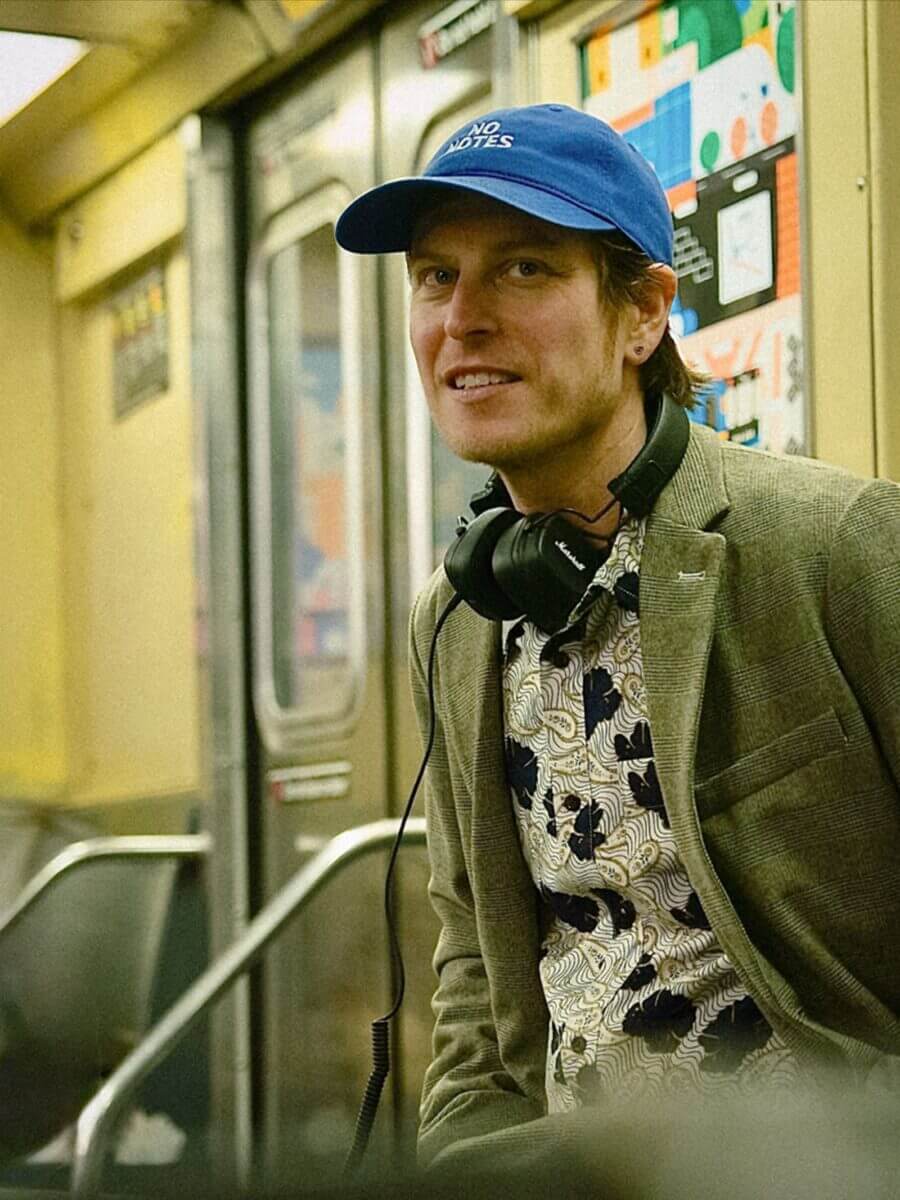
Noah Segan’s crime thriller The Only Living Pickpocket in New York has drawn comparisons to NYC auteurs Spike Lee, Elaine May and John Cassavettes. While the writer-director is far from anxious about these influences, he notes another, less obvious touchpoint: a Billy Wilder comedy.
“There’s a line in The Apartment, where the very kindly Jewish neighbor doctor says to Jack Lemmon’s character, after he’s been through all of this meshugas with his apartment,” Segan, wearing a shirt that reads “I [Image of a heart-shaped pretzel] New York,” said in a Zoom interview.
The neighbor advises Lemmon’s befuddled, hyper-gentile character to “be a mensch.” In explaining what it means, he says, “just be a person.”
In Pickpocket, Harry Lehman (John Turturro), the titular gentleman thief, calls his neighbor across the hall a mensch for looking out for his wife. Her response: “I’m just being a person.”
While the film, about what happens when an old-school filcher accidentally lifts a high-tech MacGuffin, has its share of grit and cynicism for an increasingly impersonal, online world, its open-hearted menschlikeit shines through.
I spoke with Segan about the film, his sophomore feature after his 2022 Jewish vampire romp Blood Relatives, about Yiddish, B&H Dairy and whether Turturro is the GOAT of non-Jewish actors playing Jews. The following conversation has been edited for length and clarity.
How did you arrive at this idea of an ode or elegy to a Luddite New Yorker?
I looked in the mirror. (Laughs) I’m sort of a Luddite New Yorker — at heart. But a realist, I guess.
It started with a character. It started with Harry. You go, “OK, what is he going through? How is he functioning? What are his challenges?” And then you go, “Oh man, this guy is New York. And this can happen in New York. And I’m from New York.” You’re looking for patterns, you’re looking for the thing that works for you — but is it a chicken and the egg? Is it New York? Is it Harry? Are they the same thing? But once you get those two aspects, the rest of it can blossom naturally.
Your embodiment of New York is an old Jewish guy.
The embodiment of me is an old Jewish guy! (He fishes out a chai necklace from under his collar.) I got my little chai. Represent for the Forward.

In your previous film, Blood Relatives, you were a Jewish vampire. You said in an interview you were thinking about the fear of “otherness.” I’m wondering if there’s something in that choice of making Harry Jewish. Someone with community, but kind of on the margins. Obviously, in New York we don’t think of ourselves as being marginal, but maybe it’s indicating a change.
I think for the first film, part of the conversation was how to discuss otherness through both a realistic lens: that of a Jew, and through a cinematic lens, that of a vampire. The more you think about things like blood libel, the more you think about things like how Jews were murdered, all of that colors that dynamic. In Pickpocket, it’s a little bit different because Harry isn’t really an “other” he is one of. Not just because there are lots of Jews in New York, but there’s lots of everybody in New York!
I think that New York is often unified less based on religious and racial lines, much more so on socioeconomic lines, which of course is something this movie talks about.
Part of the texture there is Yiddish as a kind of lingua franca. We have Giancarlo Esposito and Lori Tan Chinn — older, non-Jewish characters. They all use it. I know we all say “schlep,” but I teach kids at City College, they don’t all know the word “mensch.” Is that a disappearing part of New York for you, in the same way Harry is recognizing his obsolescence?
To me, it’s not a disappearing part because I run into it all the time, and I think most New Yorkers know a little bit of Yiddish, just like most New Yorkers know a little bit of Spanish and that’s how you get by.
You’ve spoken of the Jewish-Italian handshake, a principle in casting that lets Robert DeNiro play Ace Rothstein and James Caan play Sonny Corleone. I have long maintained that John Turturro is probably the greatest living non-Jewish portrayer of Jews.
I think the idea with John is that he embodies New York to such a degree, that he truly does get to do any version of a New York character. This is a guy who just is New York, and so if you let him be a New York-coded character, it is what it is. It is whatever it needs to be. That man knows more about Philip Roth than anybody I’ve ever met, which makes me feel like that makes him definitely an honorary Jew.
Harry’s doorpost has a mezuzah and he goes to visit his daughter and there’s a wreath on the door. I was wondering about that bit of set dressing.
The mezuzah on the door — it’s like painted over. The idea that it had been there a long time was really important to me. That this is a matter of fact of one’s life. There is probably a question of how much Harry’s culture and religion influenced his daughter, who he left at a young age, and her choices to identify or not with that. Obviously, who knows who she married and how they practice. There are Jews who feel jolly and put a wreath on their door, so there’s no rule about that. But I do think that it is safe to say that there were historic, cultural, ethnic identifying aspects that Harry did not pass on. And that is part of the tragedy, of course, of leaving one’s family.
Did you shoot the film before the death of the MetroCard, and do you think Harry would have been able to figure out OMNY? I feel like the transition from tokens might have been difficult for him.
The transition from tokens was definitely difficult for him. We still had MetroCards when we shot the movie. I think it was a combo. But he doesn’t have a phone to tap! So what’s he gonna do? He’s gonna get an OMNY card and load it up? I mean, I guess that’s sort of like having a MetroCard.
The other day my phone died, so I just used my credit card. So you could do that in theory.
I don’t know if Harry has a credit card.
He deals in cash.
I think what he’s doing is he’s just waiting for somebody to open the emergency door for him. And then he passes them a couple bucks.
How do you think he would feel about Mamdani and the Knicks championship?
I don’t know if Harry votes. I think he likes to stay off the rolls. The more off-the-grid he could be, the better. But I do think that he would be very pleased about the Knicks. I don’t know if he’d be as pleased as John is. But I think he would be very pleased about the Knicks.
We feel that the days of Harry and his analog life are numbered, but there’s also a glimmer of hope when we see him mentoring a younger guy in the old ways of the five-finger discount.
All hope is never lost, especially in New York. New York is a hopeful place. Because it is sarcastic and cynical and has a sense of humor and it’s very fast. People think that that somehow makes it not an optimistic or hopeful place. But no. New Yorkers are the most resilient people on earth — that’s why the all the Jews move here!
Any there other Jewish tidbits that you’re not going to get a chance to to speak about with the general press?
You picked up on B&H right?
I don’t know if I did!
The first scene with Harry, he’s having his matzo brei at B&H.
Oh! I wasn’t thinking of B&H Dairy. I was thinking of B&H Photo.
There used to be a whole cottage industry of these places that that showed up at the turn of the century called B&H, and people go, “Well, why is it called B&H.” It’s Baruch Hashem. It wasn’t anybody’s name. It was just like, ‘Well, I guess thank God we opened up a store.’
(Author’s Note: Regrettably, in the case of the dairy establishment, this tidbit, while widely believed, appears to be apocryphal; the founders of B&H, who catered to Yiddish actors on Second Ave. were named Abie Bergson and Jack Heller and gave their initials to the enterprise.)
B&H is such a great example of New York because it is still kosher. It is still signed off on by a rabbi. The rabbi puts the stamp on it. Remains kosher. It is run by a Catholic Polish lady, her Muslim-Egyptian husband, and the head chef is Mexican. And if you buy the T-shirt, the T-shirt says “Challah por favor.”
It is a great New York, multi-ethnic, multicultural institution, and I’m very proud that we got to shoot there.
The post How Billy Wilder and B&H Dairy birthed ‘The Only Living Pickpocket in New York’ appeared first on The Forward.
Uncategorized
A synagogue and Jewish-owned shops damaged in French riots
(JTA) — PARIS – Jewish-owned shops in Marseille were set ablaze and a synagogue in Paris was vandalized as part of widespread property damage caused by riots across France Saturday and Sunday, according to the Jewish Community Protection Service.
It is too early to assess the full extent of the riots protesting the rising cost of living and the damage they’ve caused, but various elements in the media have described them as civil unrest and chaos.
From Lille in the north to Marseille in the south and in the major cities in between, media estimate that nearly 800,000 people took to the streets and some 2,000 shops were vandalized or looted. Public buildings were set on fire, and hundreds of people or more were injured, including 150 police officers, with thousands arrested.
The riots followed a student uprising that blocked entrances to high schools across the country in recent weeks. Palestinian flags and keffiyas have been a recurring motif in most of the violent protests, acts of vandalism and looting.
But according to SPCJ, known as the Service de Protection de la Communaute Juive in French, there was no evidence that Jewish institutions or businesses were deliberately targeted.
Vandals broke into the Ohalei Yaakov synagogue in Paris’ 19th district overnight between Saturday and Sunday. On Sunday morning, members of the Jewish community discovered that their temporary place of worship had been broken into. The permanent synagogue building is currently undergoing renovations.
Inside the sanctuary, prayer books, tefillin, and various objects — taken from boxes and cupboards — were found scattered on the floor. The rabbi’s office was also searched. Despite the mess, the Torah scrolls appeared to be unharmed.
According to a member of the synagogue committee, the incident primarily points to an attempted theft. The suspects may have been looking for money, but nothing was believed to be missing.
This article originally appeared on JTA.org.
The post A synagogue and Jewish-owned shops damaged in French riots appeared first on The Forward.
Uncategorized
How much will Trump’s endorsement help Netanyahu?
(JTA) — JERUSALEM – Within minutes of President Donald Trump endorsing Prime Minister Benjamin Netanyahu in a post on Truth Social Sunday, Netanyahu’s campaign team had released a 30-second clip showing all the times Trump has lavished praise on the Israeli leader over the past few years.
With polls showing that Netanyahu and his governing coalition are slipping in their struggle to retain power in the upcoming Oct. 27 election and lag behind the opposition bloc, an endorsement from the president of the United States is a powerful statement.
But is it enough to tip the scales?
“I don’t think it will change anything,” said Ilana Shpaizman, a senior lecturer in the Department of Political Studies at Bar-Ilan University.
Of course, she said, “Netanyahu will say this is the proof that I’m a leader and all that, and I can speak to Trump … But so what? His followers already know that and they believe in him. They don’t need the endorsement.”
Those who oppose him, Shpaizman continued, “know that Trump forced him (Netanyahu) to accept the ceasefire in Gaza and accept the hostage deal, and that Trump runs the show around Iran. So they also don’t need the endorsement either,” Shpaizman said.
Some pundits speaking on Israeli news outlets criticized Trump for “interfering” in Israel’s election, while others put it down to the fact that Trump does not want America to return to fighting Iran alone if Netanyahu, who is hawkish on Iran, is replaced by someone less willing to act militarily. If Netanyahu loses, that is a scenario that could play out.
“This is the first time ever that the president, at least publicly, endorses a candidate in Israel’s election,” Bushinsky, a political commentator and former adviser to Netanyahu, told the Jewish Telegraphic Agency.
Bushinsky said he remembered Netanyahu complaining about U.S. intervention in previous elections in 1999 and 2001, when presidents less enamored of him were in office. He even pushed for an initiative that would block foreign funding for election campaigns.
Now, Bushinsky said, “I guess he is not complaining,” adding that the endorsement serves Netanyahu in two ways.
First, it signals that Trump thinks that Netanyahu is the most suitable guy for the job. Second, it puts Netanyahu’s election campaign back on track, refocusing attention on an issue where Netanyahu is strong – Iran.
“It lets him say ‘I can now finish a job, and I can finish a job with Trump,’ and ‘without Trump or without me, the job will not be finished,’” said Bushinsky.
He said that in the last few days, the political debate had pivoted to other issues such as Ashkenazim vs Sephardim, the draft law and the contentious efforts by the outgoing government to overhaul the judiciary.
“This [endorsement] is the ultimate campaign boost for Netanyahu,” Bushinsky said.
But that boost might not be enough.
Most of the polls taken in recent days show the opposition bloc led by former IDF chief Gadi Eisenkot pulling ahead of Netanyahu’s ruling coalition, but give neither bloc enough seats to gain the necessary 61 of 120 seats in Israel’s parliament, the Knesset, to form the next government.
“I think this might give Netanyahu one more seat, one more mandate, but not more than that,” said Bushinsky.
Prof. Tamar Hermann, director of the Israel Democracy Institute’s Viterbi Center for Public Opinion and Policy Research, said that the timing of Trump’s support for Netanyahu in this election race had come both “too late and too early.”
“It’s too late because people have already decided electoral preferences. They may shift within each bloc, but will not move between the blocs because of this,” she said. “And it’s too early because there are nine days to go to the elections, and we can already see other American leaders spilling some cold water over what he said, even on the Republican side of the aisle.”
This criticism, Hermann continued, will be transmitted to Israeli voters, and they will see that Trump is facing a huge battle in the upcoming midterm elections.
“The image of President Trump has deteriorated significantly since April 26, when he started the negotiations with Iran,” she said, pointing to one of the IDI’s recent public opinion surveys that found the president’s popularity had plummeted after he stopped the war with Iran without totally removing the threats against the State of Israel.
According to that poll, the Israeli public’s confidence in Trump as someone dedicated to Israel’s security fell from around 70% to just 42%.
“In my view, the endorsement will not make a big change,” Hermann added. “It will just strengthen Netanyahu’s political supporters, who will see it as a sign that he is still the internationally known figure that even the president of the United States is endorsing.”
She concluded, “The meaning of endorsement in Israel is totally different than in the United States … we are not that used to this kind of move, and it will not make people change their minds.”
This article originally appeared on JTA.org.
The post How much will Trump’s endorsement help Netanyahu? appeared first on The Forward.
