


Uncategorized
Israel advances to second round of men’s under-20 World Cup with dramatic last-minute defeat of Japan
BUENOS AIRES (JTA) — In its first-ever appearance in the tournament, Israel’s under-20 men’s soccer team advanced to the second round of the FIFA U20 World Cup with a last-minute goal against Japan on Saturday.
Israel was an underdog going into the match, but the victory was made even more improbable by something that happened in the 68th minute of the game: an Israeli player was ejected after receiving a second yellow card for a harsh foul. Israel proceeded to score both of its goals in the 2-1 win while down a man.
The winning goal was scored in the final few minutes of play. “This is incredible!” exclaimed the English-language announcer.
Histórico deja afuera a Japón en minuto 92 y con un jugador menos. Su primer mundial y clasifica en Mendoza Argentina #Sub20 #Israel @fifacom_es @fifaworldcup_es #FIFA @Israel @IsraelArgentina pic.twitter.com/i74o4tM131
— ITON GADOL es Israel y las comunidades judias (@Itongadol) May 27, 2023
“This is, maybe, the biggest win in the history of Israeli soccer. Historic, historic,” team manager Ofir Haim said to the Israeli Kan broadcaster after the match, with tears in his eyes.
With the victory, Israel advanced from the group stage into the knockout round, marking the first time an Israeli team has done so in any FIFA World Cup. The Israeli men’s team scored one goal in its only appearance in the general World Cup in 1970.
Israel will play Uzbekistan next, later today.
RELATED: Israel looks to make history at under-20 men’s World Cup
Jewish Argentines turned out in large numbers — at times in the thousands — to support the Israeli team in their group stage matches over the past week. In their first, a loss against Colombia, some Jewish fans shouted down a group of Colombia supporters who unfurled a Palestinian flag.
Before and during their second match, a tie with Senegal, members of the Hasidic Chabad-Lubavitch movement brought tefillin around to Jewish fans in the stands and outside the stadium in La Plata.
“This is for all of Israel, I dedicate this to you. I have no words,” Haim added.
The tournament was originally to be played in Indonesia, but FIFA, the international soccer body, stripped the country’s hosting rights after it protested Israel’s appearance in the competition.
—
The post Israel advances to second round of men’s under-20 World Cup with dramatic last-minute defeat of Japan appeared first on Jewish Telegraphic Agency.
Uncategorized
El-Sayed campaign disavows PAC ad linking US inflation to Israel
(JTA) — Abdul El-Sayed’s Senate campaign disavowed a pro-Palestinian group’s new ad that critics say invokes antisemitic tropes about U.S. support for Israel.
The ad comes from Rebellion PAC, which is fronted by left-wing political commentator Cenk Uygur. It depicts a couple in a supermarket saying they cannot afford groceries because they have to set money aside “for killing Palestinians.” It concludes by stating that the Michigan Democrat’s GOP opponent “is for they/them,” referring to Israelis.
In a statement to the Jewish Telegraphic Agency, an El-Sayed campaign representative said the ad “is not affiliated in any way” with his campaign and that it did not speak for him.
“Abdul is focused on pushing back against Trump’s agenda that is raising prices for Michiganders,” campaign spokesperson Roxie Richner said in the statement. “No one speaks for Abdul but himself and his campaign.”
Rebellion’s ad repurposes an ad originally released in 2024 for Uygur’s presidential campaign — but with a new ending that backs El-Sayed and knocks his Republican opponent, former U.S. Rep. Mike Rogers.
“Why does Mike Rogers care so much about what Israelis want and so little about what you want?” the new ad asks. A voiceover then riffs on Republican ads from 2024 that attacked Democrats over LGBTQ issues.
“Mike Rogers is for they/them,” the voiceover states over photos of Israeli politicians Benjamin Netanyahu, Itamar Ben-Gvir and Bezalel Smotrich. “Abdul El-Sayed is for you.”
A spokesperson for Rebellion PAC told JTA that the group is spending $1,000 on the ad, and that it will run online. Uygur, on X, stated on Friday that the ad would run “in Michigan.” Tensions among Jewish voters in the state are high: Many have expressed discomfort with El-Sayed’s strong criticism of Israel. The candidate has condemned antisemitism and looked to make inroads with Jewish voters.
“If you think this ad is antisemitic, you’ve lost your mind and you don’t know it,” the Rebellion PAC spokesperson, Kara Eastman, told JTA. “It’s saying we’re giving too much money to a foreign nation — and they’re misusing it. There’s nothing more normal than that. But when someone criticizes the government of Israel, and you hear ‘they hate all Jews,’ get clinical help.”
Shortly after Eastman’s response to JTA, Uygur himself added on X, “If you think this ad is antisemitic, you’re in a cult and don’t know it. You think Israel is owed all the money it wants from US and if Americans don’t hand it over — without complaint — they’re antisemites. That’s insane, but you don’t realize it because you’ve lost your mind.”
Michigan U.S. Rep. Haley Stevens, a favorite of the pro-Israel community who endorsed El-Sayed after losing to him in the primary, called the ad “fearmongering” and “wrong.” She added that its makers were “blaming the high costs of our goods on the only Jewish homeland in the world.” Melissa Byrne, a progressive activist and former staffer for Jewish progressive Sen. Bernie Sanders, wrote that Uygur “clearly wants Abdul El-Sayed to lose by doing this ad.”
A spokesperson for Michigan Jews for Democracy, an ad hoc group of Jews in the state who have pledged to vote for El-Sayed, called the ad “crap” in an interview with JTA.
“If they honestly think this is going to help, then they honestly have no idea what is going on in this state or this race,” Stacie Chaiken, the group’s representative, told JTA. “They’re just playing into the hands of people who are really trying to hurt him.”
This article originally appeared on JTA.org.
The post El-Sayed campaign disavows PAC ad linking US inflation to Israel appeared first on The Forward.
Uncategorized
U.S. and Israeli Jews are drifting apart? The data tell a different story.
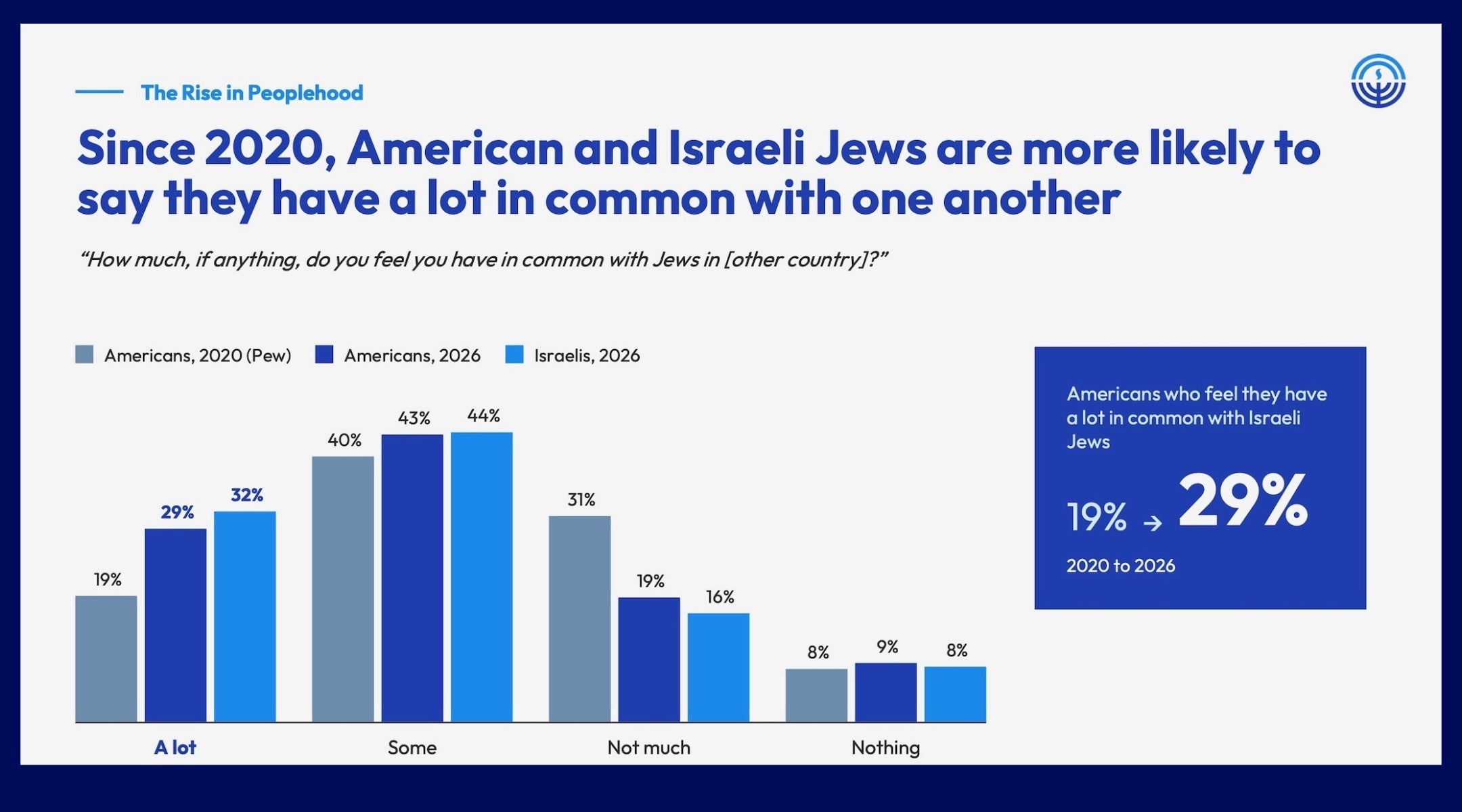
(JTA) — This is part one of a two-part analysis based on the Jewish Federations of North America’s 2026 binational study of Jewish Americans and Jewish Israelis, exploring where the communities are aligned and where they differ. Part two will address where American and Israeli Jews see things differently, and why.
The last three years have been historic for both American and Israeli Jews. Israel has experienced the trauma and loss of Oct. 7 and the ensuing wars firsthand. Many American Jews have worked to support Israel, while experiencing a dramatic rise in security threats, antisemitism and attacks on Zionism at home. It would be understandable, therefore, if the result was two Jewish communities less connected to one another, each struggling to deal with its own challenges. And indeed, many headlines have focused on division, distance and disagreement.
But our data, gathered in May and June, are clear: American and Israeli Jews feel closer to one another today than we have in years, and that closeness has grown alongside the “surge” — the sustained rise in American Jewish engagement we’ve tracked since Oct. 7.
To be sure, our research also found places where American and Israeli Jews see things differently. We’ll take that on directly in an upcoming piece. But it is important to start with the reawakening of shared peoplehood since Oct. 7, an important development that is the foundation upon which all other discussions should begin.
The share of American Jews who describe Israelis as extended family or part of their own community has climbed from 46% to 62% since 2021. Today, fully 71% of American Jews feel emotionally attached to Israel. In contrast, the share of American Jews who say they feel no real connection at all to Jews in Israel has dropped by more than half since 2021, from 28% to 13%.
Israelis show movement in the same direction. The share calling American Jews extended family or part of their own community climbed from 45% to 53% over the same period, while the share saying they feel nothing in common with American Jews dropped from 14% to 10%.
Seventy-nine percent of Israelis and 56% of Americans affirm that Jews around the world, regardless of where they live, share a common fate and must act accordingly. Most also reject the idea that Jewish life in the diaspora is a “problem” to be solved through aliyah, or immigration to Israel. Early Zionist thought was built in part on the concept of shlilat hagalut, the “negation of exile,” the belief that Jewish life outside Israel was inherently unsustainable and needed to be resolved through return to the land. That idea has receded sharply from mainstream Jewish and Zionist thought since the state’s founding.
This deepening sense of shared peoplehood shows up in action, not just sentiment. In the first two years following Oct. 7, the Jewish federation system raised $908 million through the Israel Emergency Campaign, funding more than 4,200 grants to 877 organizations across 208 communities in Israel. North American Jews made that giving possible. Israeli organizations and Israeli society did the work of turning it into recovery on the ground. Sixty-eight percent of Israelis said that American Jewish philanthropic giving after Oct. 7 made them feel that Diaspora Jews genuinely care about Israel and Israelis. (Jewish federations raised and allocated $908 million in emergency support for Israel following the attacks, before shifting to a new giving framework to “Rebuild Israel”).
As noted, the rise in a shared sense of peoplehood between U.S. and Israeli Jews closely mirrors the surge in Jewish engagement domestically that we’ve followed closely for three years. Engagement with Jewish life among American Jews is up 38% today, and that rise tracks with a rise in connection to Israel. That 38% reflects people who changed what they do. Another 12% felt a stronger pull toward Jewish identity and pride in peoplehood without yet changing their behavior. Together, that’s roughly half of AmericanJews registering some shift in connection since Oct. 7.
When we asked American Jews in open-ended discussion why they feel connected to Israel, the top reasons were remarkably consistent: seeing Israel as a safe place for Jews, including for themselves; seeing Israel as the homeland of the Jewish people; having a sense that Israel is where Jewish history began; believing that Jews are responsible for one another, and holding religious or biblical connection. Others pointed to feeling more whole in Israel, the belief that the Holocaust made a Jewish homeland necessary, that Israel is part of their own culture and simply feeling pride in Israelis themselves.
While much of this growing sense of interconnectedness emerges from the events of the last few years, especially the shock American Jews felt on Oct. 7 and the pain Israelis feel watching antisemitism rise around the world, there are clear elements of the results that we can build upon, influence and encourage. American Jews who have traveled to Israel once are 1.7 times as likely to feel real commonality with Israeli Jews. American Jews who have traveled to Israel more than once are 3.8 times more likely to feel commonality with Israeli Jews. American Jews who have lived in Israel, perhaps not surprisingly, are 11.2 times more likely to share this sense of peoplehood.

The same holds true in reverse. Visiting the U.S. as a tourist doesn’t move an Israeli’s sense of connection to American Jews. But compared to Israelis overall, those who participate in Jewish communal life while visiting are 2.8 times as likely to feel a sense of peoplehood with American Jews, and those who serve as emissaries, work at a Jewish camp or otherwise live inside an active American Jewish community while in the U.S. are 2.6 times as likely.
This is also true for Israeli Jews who encounter American Jews in Israel. Eighty-seven percent of Israeli Jews with real, engaged contact with American Jews feel commonality with us at far higher rates, compared to 52% among those with no contact. This gap holds even after taking into account religious practice and political ideology. Fifty-seven percent of Israeli Jews with real contact describe American Jews as siblings or extended family, compared to 45% among those with little or no contact.
We are in another challenging season for the Jewish people. Upcoming elections in Israel and the United States bring their own pressures and highlight disagreements both within and between our Jewish communities. It would be easy to conclude that we have more differences than we have commonalities, and to approach discussions from a place of distance and division. But there is opportunity in this tense moment to recognize our deep sense that we are one community.
Our data confirm that today we feel closer than ever, and we recognize that our lives are shaping each other’s. Perhaps even more importantly, our data show what we can do to strengthen and perpetuate this trend. We need to keep investing in things we know build connection: more travel, more Israeli emissaries in North American communities and more programs that put people in real contact — especially partnership programs between US and Israeli communities like Partnership2Gether, which has connected people and communities for more than three decades.
And we need to scale innovation that will enable shared volunteer projects, philanthropic partnerships across both communities, stronger business and professional ties and digital opportunities to learn from one another. These opportunities can ensure impact when travel is impractical, reach those who are less engaged and ensure that this sense of connection to and understanding of Jews across the world is accessible to everyone in our greater Jewish family and community.
Our tradition teaches that “kol yisrael arevim zeh bazeh,” all Jews are responsible for one another. That responsibility isn’t theoretical. It is the reason we show up for each other in moments that matter. Three years after Oct. 7, our data tell us we are still showing up.
This article originally appeared on JTA.org.
The post U.S. and Israeli Jews are drifting apart? The data tell a different story. appeared first on The Forward.
Uncategorized
Netanyahu or Eisenkot’s fate — and Israel’s — could hang on undecided voters
(JTA) — JERUSALEM — On the day before Israel’s Oct. 27 election, Nat Zitomer, a retired licensed tour guide, still hadn’t decided which party to vote for.
“I lean center-right, and during the last two elections I voted for Likud and before that, HaBayit HaYehudi,” said Zitomer, referring to the right-wing religious Zionist party founded in 2008.
Although he would prefer to vote for a center-right party this time around, he is in a quandary.
“I can’t see myself voting for the Haredi parties” because they promote draft evasion, Zitomer, who lives in the northern city of Karmiel. told Jewish Telegraphic Agency, adding that other parties also failed to fit the bill.
Among the ones he dismissed were Prime Minister Benjamin Netanyahu’s coalition partners Otzma Yehudit, led by National Security Minister Itamar Ben-Gvir and the Religious Zionist Party headed by Finance Minister Bezalel Smotrich.
“I can’t see myself voting for Ben-Gvir and Smotrich because they’re too extreme to the right,” Zitomer said.
Nor has he been happy with the parties opposing Netanyahu, such as the center party Byachad, led by former prime ministers Naftali Bennett and Yair Lapid. Bennett, Zitomer said, “is often described as a chameleon. He says one thing and does something else.”
Voting for Netanyahu is out of the question, said Zitomer, who blames him for not preventing the Hamas-led invasion of southern Israel on Oct. 7, 2023.
“When he was good he was very good. But Oct. 7 happened on his watch and whatever comes out of his mouth has pissed off pretty much all of the world against us. I’ve heard it said of him and I tend to agree: He’s outlived his shelf life.”
In short, “I can’t recall an election where I have been more ambivalent,” Zitomer said.
Opinion polls from Maariv, Channel 12 and Channel 13 estimate that between 5% and10% of eligible voters are undecided, though Mitchell Barak, a pollster who heads KEEVON Global Research believes the percentage is higher.
With almost every poll predicting that neither the right-wing bloc headed by Benjamin Netanyahu nor the center-left bloc led by Gadi Eisenkot will obtain the 61 Knesset seats needed to form a majority coalition government, those undecided votes could decide the election, Barak told JTA.
Barak, who placed the number of undecided voters at around 25% in early October, believes that the late deciders “will definitely have an effect.”
“Historically, undecided voters in Israel choose a party the weekend before election day, often after discussing the options at the Shabbat table,” he added.
If even one of the new smaller parties passes the 3.25% threshold to qualify for seats in the Knesset, “it will change the dynamics. Keep in mind that the margin of error in opinion polls is larger than the threshold to get into the Knesset,” Barak said.
Ofer Kenig, a research fellow at the Israel Democracy Institute (IDI) is less impressed with the undecided voters’ potential impact because the overwhelming majority have already chosen which bloc to support, opinion polls show.
He pointed to one Channel 12 poll from this month, which showed that 8% of voters were undecided. “But if you look closer, of this 8% of undecided, the majority are undecided between parties within the same bloc.”
If, for example, a voter is trying to decide between supporting Netanyahu’s Likud party or the far-right party of Itamar Ben-Gvir, “it doesn’t really matter,” Kenig said. Both parties have agreed to form a right-wing coalition government.” The same would be true of a voter in the center-left camp, he added.
“In the U.S., which has a two-party system, undecided votes can be very meaningful,” Kenig said. But in Israel’s multi-party system, where 37 parties will be vying for Knesset seats, “the difference between voting for Netanyahu versus Ben-Gvir isn’t very meaningful.”
Kenig estimated that less than 1% of undecided voters will cross the political divide, from left to right or vice-versa.
Alon Yakter, a senior lecturer and political scientist at Tel Aviv University, said some of the undecided voters are on the “soft or center-right.”
“If you believe in settlement expansion, you have a home. If you’re left or center, you can vote for the Democrats party” created from the merger of the leftist Meretz and center-left Labor parties, Yakter said.
In contrast, Israelis who are hawkish on the Palestinian issue but deeply dissatisfied with the current government’s handling of Oct. 7 and its aftermath, its refusal to draft Haredim and its attempts to weaken the court system among other issues feel “politically homeless,” Yakter said.
Daniel Meyer, a self-described right-wing voter who lives in the West Bank, is a prime example.
“I haven’t found a right-wing party to vote for, since a vote for such a party will be a vote for Bibi, but until Bibi takes responsibility for his role in October 7, and the 15 years proceeding it, by initiating a state inquiry, I can’t support him,” Meyer said. Nor will he vote for Bennett, because he believes the party is too far to the left.
Although he is not himself Haredi, Meyer said he is considering the new Haredi Public party, which advocates for greater Haredi integration into the IDF and Israel at large, “because they’re offering real changes desperately needed by Israeli society.”
Adele Raemer, who personally survived the Oct. 7 Hamas attack in a bomb shelter in her home in Kibbutz Nirim, said she is still weighing her options. But one thing is clear: She wants Netanyahu and his coalition partners out of office.
“This government has been a disaster for us, and I can’t understand how it’s still popular among many voters,” Raemer said. “I feel that so many politicians totally abandoned us,” not only following Oct. 7 but during the two decades of Hamas rocket attacks on the Gaza border that preceded it.
Raemer is looking for a party that will not only secure Israel’s borders but also provide much-need assistance to the victims of the Hamas attack, including the surviving hostages and soldiers who are now struggling with physical and emotional wounds.
“People have suffered great losses and feel abandoned. The hostages are supported by private initiatives, but not the government.”
Now, Raemer said, her priority is to vote in a centrist government “powerful enough to change things, to put the country first.”
Like Raemer, Eva Weiss, a writer who lives in Netanya, said she is “deeply dissatisfied” with Netanyahu and his current coalition partners, and will vote for the party she believes has the best chance of forming a coalition without far-right wing politicians and the major Haredi (ultra-Orthodox) parties.
With so many parties competing for 120 Knesset seats, voting in Israel is “a kind of Russian roulette,” Weiss said. Given the post-election horse-trading that exemplifies the formation of any government coalition, “I’m considering what’s the best horse to bet on,” Weiss said.
This article originally appeared on JTA.org.
The post Netanyahu or Eisenkot’s fate — and Israel’s — could hang on undecided voters appeared first on The Forward.
