


Uncategorized
Israel is revoking entry permits for U.S. activists involved in West Bank
Hannah was on her way to class on Jan. 8 when she opened her inbox and found an email from Israel’s Population and Immigration Authority. Due to a change of circumstances, it said, her authorization to enter Israel had been revoked.
“I had to read it a few times, honestly, and then I Googled it and just started crying. I was on my way to class. I was bawling,” Hannah told the Forward. Hannah asked that her last name not be published because she fears that speaking to the media could affect her ability to visit Israel in the future.
Hannah, whose boyfriend lives in Israel and who has family there, has spent almost every summer of her life in the country. She was left dumbfounded by the email. There was no explanation of the reason for the revocation, and nothing about how, or whether, she could appeal.
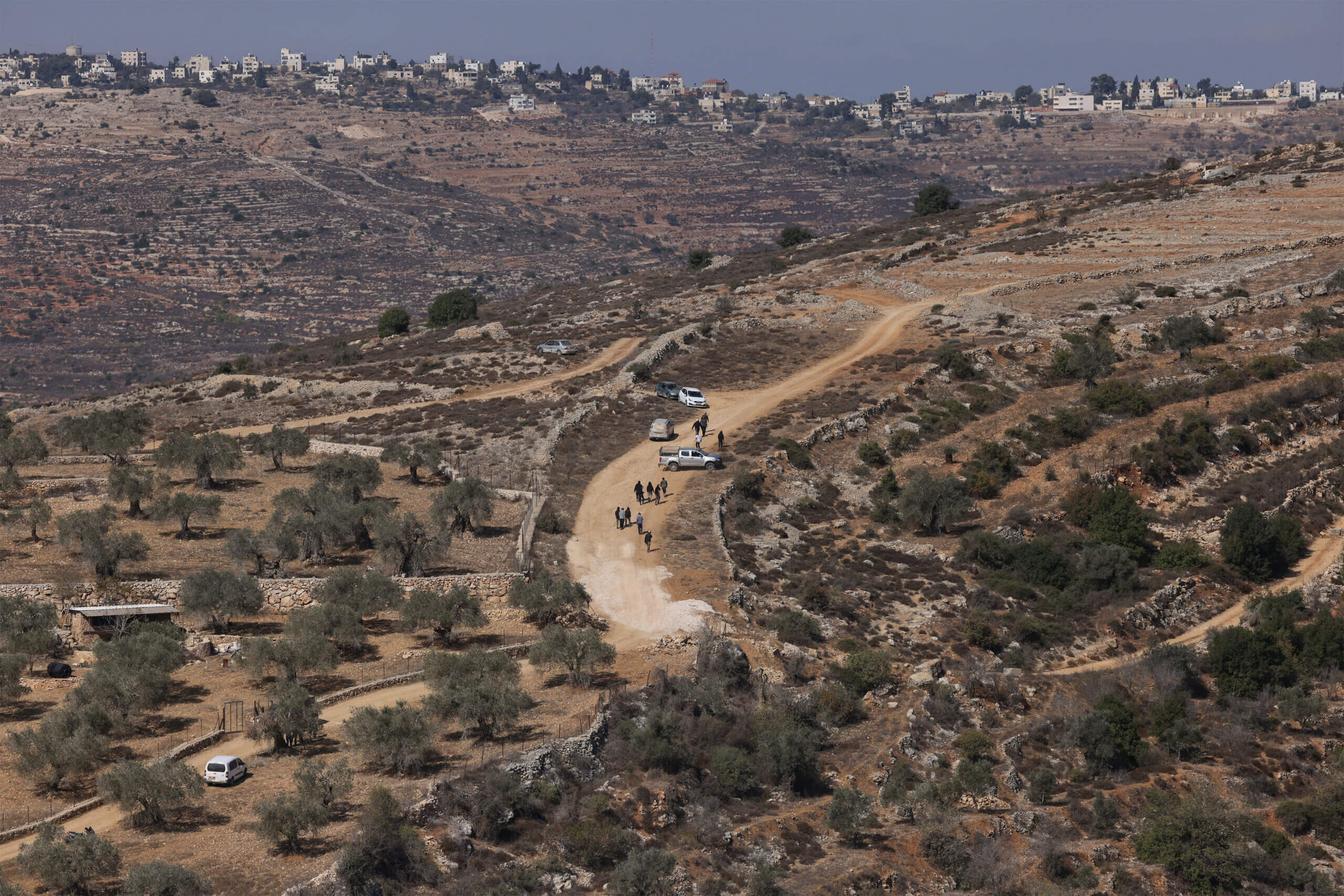
The closest thing to an incident she can point to came the previous July, when she joined her rabbi and a group of volunteers accompanying a Palestinian farmer during the grape harvest — a practice known as protective presence, in which foreign witnesses aim to deter settlers and soldiers from interfering. Israeli soldiers stopped the group and held them for hours. “They asked to see my passport and said they were looking to see if there was any reason to deport me,” she said. They found none, and told her she was free to go.
Hannah came up through the institutions Israel counts on to keep American Jews attached to it. In high school, Hannah was involved with hasbara fellowships, and her mother is active in her local Jewish federation. “It’s so odd that almost the more I become familiar with the place in ways that I wasn’t as a kid, and maybe less naive about it, now I don’t have the ability to be there,” she said. “I’m not welcome there anymore.”
Hannah is one of seven American Jews who told the Forward that Israel had revoked their electronic travel authorization, or ETA-IL, after they participated in protective presence activities in the West Bank.
A loose network of Jewish organizations recruits diaspora Jews for the work and frames it as an expression of Jewish values. Programs range from 10-day delegations to seasonal olive-harvest cohorts to Hineinu, Hebrew for “here we are,” a three-month placement in Palestinian communities in Masafer Yatta that the Center for Jewish Nonviolence launched in 2021.
According to figures from the Center for Jewish Nonviolence, dozens of participants in its Hineinu program and other protective presence initiatives have had their authorizations revoked since the system took effect.
Israel launched ETA-IL as a pilot in June 2024 and made it mandatory for travelers from visa-exempt countries, including the United States, on Jan. 1, 2025. The application is a brief online form, usually approved automatically within minutes, that allows visa-free entry for tourism or business. It functions as Israel’s counterpart to the U.S. ESTA system, and followed Israel’s admission to the American Visa Waiver Program in 2023.
A State Department spokesperson declined to comment on individual cases or on the department’s discussions with Israeli officials, but said the Department of Homeland Security, in consultation with State, regularly reviews whether Visa Waiver Program participants meet program requirements.

Israel was admitted to the program in 2023 only after signing a memorandum of understanding committing it to treat all American citizens equally at its borders, a longstanding program requirement that had kept Israel out for years over its treatment of Palestinian American travelers.
None of those who spoke to the Forward had been arrested or charged with a crime. Some received no notice at all, which Daniel Roth, executive director of the Center for Jewish Nonviolence, said has become increasingly common. Those who did get revocation emails received identical notices citing a change of circumstances, with no explanation of the duration of the ban.
By the letter of the law, all of those whose authorizations were revoked remain eligible to make aliyah — immigrate to Israel — unless they are deemed a security threat under a provision of the Law of Return. Neither of two immigration attorneys who spoke with the Forward could recall any applicant being blocked as a security threat.
The visitors could open a file with the group Nefesh B’Nefesh and, in theory, be Israeli citizens within months. For now, they are barred from entering.
The Forward asked the Population and Immigration Authority how many ETA-IL authorizations have been revoked and on what legal basis, and the Israel Police asking whether it recommends revocations. Neither responded.
The Jewish Agency, which facilitates immigration by Jews to Israel under the Law of Return, said in a statement: “There is no connection between the ETA process and the Aliyah process. Regardless, we cannot comment on ETA refusal because we do not handle any part of that process. The criteria for eligibility for Aliyah remain unchanged.”
Change of circumstances
That Israel’s government sees protective presence workers as an adversary and target for law enforcement is no secret.
In April 2024, National Security Minister Itamar Ben-Gvir ordered the creation of a police task force to handle foreign and Israeli left-wing activists in the West Bank, which he described as a team for dealing with “anarchists.”
The unit sits under the West Bank district police and works in coordination with the Population and Immigration Authority. Ben-Gvir publicly credited the immigration authority for its role in deporting 32 foreign activists in October 2025 following an olive harvest action in the northern West Bank.
Of the Jews the Forward interviewed, one described himself as an anti-Zionist. The others were liberal Zionists who said they are concerned about the rise of settler violence in the West Bank and the preservation of Israel as a liberal democratic state. They were day school and summer camp alumni. Most have family in Israel and visit regularly.
Sam Sherman, an actor and writer who lives in New York City, was in Masafer Yatta, a collection of hamlets in the southern West Bank, when he opened an email telling him that his ETA-IL had been revoked due to a change of circumstances.
He was about seven weeks into his stint with a Hineinu group, and he was not the only one. “It happened to me and a few others in my cohort … within the same hour,” Sherman said. “A few of us got the same email within minutes of each other.”
Sherman was never arrested. He describes one incident that he believes amounts to a detention in place, and otherwise a pattern of identification, soldiers, police and armed settlers photographing his passport during confrontations he says were initiated by settlers.
“We were just there hanging out with people, essentially,” he said. “But we were treated as if it was almost criminal for us to be there.”
His first reaction was confusion. “I was like, what does this mean?” he said. More experienced activists told him what it meant: once he left Israel, he would be unable to return unless he chose to make aliyah. “If I’m the wrong kind of Jew for Israel,” he said, “sure. Great.”

Rabbi Jill Jacobs is the CEO of T’ruah, a rabbinic human rights organization that has been sending American clergy to the West Bank for years. She said the revocations cut against Israel’s founding promise.
“The promise of Israel is that it’s going to be a refuge and a home for Jews everywhere in the world, not just for Jews with certain political opinions,” said Jacobs. “Israel should be the place in the world that is safest for Jews, no matter what your religious practices are, what country you’re coming from and what your political views are.”
Another participant in Hineinu said she never received an email at all.
Nina, who asked to be identified by her first name only, had a valid authorization when she left the country for a weekend in Cyprus to reset her tourist visa. When she tried to re-enter Israel, she said, she was held at the border and denied entry.
“I never got an email that my ETA had been revoked,” she recounted. “I never got any correspondence at all, and I never got anything written, that said that ETA had been canceled or revoked or anything.” Hours later she resubmitted the application from her phone and got an automatic rejection.
‘Nothing’s out of the question’
Critics of the volunteers say it is simply a law enforcement matter.
Naomi Kahn, director of the international division at Regavim, a right-wing Israeli legal advocacy group that campaigns against unauthorized Palestinian construction in the West Bank and lobbies for demolitions, said some of the accompaniment activity takes place in closed military zones and active IDF firing zones.
“It should not be considered unusual when a sovereign state chooses to deny entry to people whose declared intention is to break the law,” Kahn said. “It should come as no surprise when tourists are disinvited when they break the law. I don’t think this raises eyebrows anywhere else in the world.”
Closed military zones have become a point of contention between activists and the Israeli military. In late October 2025, two American Jewish women, Rachel Beth Flamholz and Leila Stillman-Utterback, were deported and banned from Israel for 10 years after entering a closed military zone imposed on the Palestinian village of Burin the same day they had arranged to pick olives there.
“In my experience, closed military zones are used as a tool to clear Palestinians and those supporting Palestinians, including us, from an area,” Roth said, “and by and large, to leave space for Israeli settlers to do whatever it is they want.”
Jacobs draws a distinction between conduct and status. A tourist who commits a crime in Israel is subject to Israeli law, she said, as a tourist would be subject to the law of any place they were visiting. That, she argues, is not what is happening here. None of the volunteers were charged with anything.
“These are the best of the best,” Jacobs said. “These are people who are devoting, in some cases, months or more of their lives, that they could be spending doing anything, to trying to make Israel a more just place for both Jews and Palestinians. And that’s exactly who Israel should want to be standing by and supporting.”
This fall, some will head to the West Bank as part of Protect the Harvest, an initiative run by an international coalition of Palestinian, American, Israeli and Jewish organizations responding to an invitation from Palestinian farmers. The campaign runs in week-long cohorts from mid-October through mid-November.
T’ruah is bringing a clergy delegation from Oct. 18 to 23, ending four days before Israel’s national elections. Jacobs expects many American rabbis on the ground, some bringing their own congregants.
“I don’t know what the Israeli government is going to do,” she said. “But I think if they decide they’re going to start deporting American rabbis, that would basically be picking a very big public fight with the American Jewish community.” Even people who haven’t been paying attention, she said, will be furious.
Asked whether she thought it was actually possible that an American rabbi could be deported during the harvest, she did not rule it out. “Nothing’s out of the question,” she said.
The post Israel is revoking entry permits for U.S. activists involved in West Bank appeared first on The Forward.
Uncategorized
Why Dolly Parton sang a song about a Jewish journalist

A Broadway show, a star-studded television tribute, a new hotel and museum in Nashville. As odes to Dolly Parton keep coming, a recording of the late country music singer honoring an American Jewish journalist has recently surfaced.
Never before released in America, the song, “A Bridge Across,” sung by Parton and accompanied by the Nashville Symphony, honors slain journalist Daniel Pearl.
The song features spare lyrics set to violin music composed in honor of Pearl, a Wall Street Journal reporter who was brutally murdered by terrorists in Pakistan in 2002.
Originally recorded in 2008 by Parton, renowned fiddler Mark O’Connor, and the Nashville Symphony, the song was intended to be part of a compilation album called This is My America, produced and funded, oddly enough, in Canada but never released in the U.S.
It was O’Connor and his wife Maggie who resurrected the recording this fall, shortly after the deaths of Parton and another musician that connected the four artists: Oregon violinmaker Jonathan Cooper, who died in September.
Deeply troubled by the journalist’s murder in 2002, Cooper learned Pearl was an amateur fiddler and set out to create a quartet of string instruments – two violins, a viola and a cello – in the journalist’s honor. He entrusted the instruments to O’Connor to use during his annual summer music camp in North Carolina. Every year since, four students from the camp have received one of the Daniel Pearl memorial instruments to play for a year.
“These young people carry the message that love fights hatred through music-making and understanding that Daniel Pearl’s family want him remembered for,” O’Connor told The New York Times. Likewise, Cooper’s loving gesture inspired Parton, O’Connor said.
Canadian violinist Samantha Robichaud received one of the violins in 2005 and has gone on to become a successful recording artist with more than a half dozen albums. She has toured North America as an ambassador for the Daniel Pearl Foundation, sharing Pearl’s story, including his passion for

music and its power to change lives. Enter songwriters Tom McBryde and Lynn Wilbanks, whose introduction to Robichaud inspired verse.
On the album, the Nashville Symphony played one of Robichaud’s compositions while Parton introduced Pearl to listeners.
“He believed that music was something that could cross all social barriers, political borders and imaginary boundaries,” Parton says, before singing McBride’s and Wilbanks’ lyrics.
“A bridge across a question one journey begins, one step at a time to a place within.
A bridge across a border, a hand reaching out one heart at a time to erase the doubt.
A bridge across a difference can close a divide, one song to be sung on the other side.”
“It was perfect. She knows what he stood for,” Pearl’s father, Dr. Judea Pearl, told the Forward. “She was such a giving person.”
Judea Pearl met Parton in 2018 at the Los Angeles Press Club where she received that year’s Public Service Award for Contributions to Civic Life for her Imagination Library, which sends free books to children. (It inspired the creation of the PJ Library for Jewish books.) The Press Club recently dedicated its upcoming National Arts & Entertainment Journalism Awards to Parton’s memory.
In 2018, Judea Pearl was there to present the Daniel Pearl Award for Courage and Integrity in Journalism to Saudi Arabian writer and blogger Raif Badawi whose wife accepted the award while he served a 10-year prison sentence for his online activism.
The foundation devoted to Daniel Pearl’s legacy has been less visible since the 2021 death of Pearl’s mother Ruth who, as a young girl, witnessed and survived the anti-Jewish pogroms in Baghdad known as the Farhud.
As the 25th anniversary of his son’s murder approaches in February, Judea Pearl said the foundation will start a new chapter under his daughters’ leadership. Parton’s song lends the effort a touching soundtrack.
The post Why Dolly Parton sang a song about a Jewish journalist appeared first on The Forward.
Uncategorized
Mamdani marks first Oct. 7 anniversary as mayor with statement blasting Israel’s war in Gaza as genocide
On the third anniversary of the Oct. 7, 2023, Hamas attack on Israel — his first commemoration as New York City’s mayor — Zohran Mamdani mourned the Israeli victims and the 251 people taken hostage before devoting most of a statement to condemning Israel’s war in Gaza as a “genocide” and accusing the U.S. government of complicity in Israeli war crimes.
“The suffering did not begin nor end that day,” Mamdani said in a 200-word statement, noting the Palestinian casualties of the war that was launched as a military campaign against Hamas. “Three years later, we must refuse to accept a world in which occupation and apartheid continue, where war crimes are met with impunity, and our federal government continues its complicity with every arms shipment.”
The mayor’s words were in stark contrast to statements released by other elected officials, including New York Gov. Kathy Hochul, who noted it was the deadliest day for the Jewish people since the Holocaust.
“The pain of that dark day has not faded,” she wrote. “But neither has the strength, resilience and enduring hope of the Jewish people.”
House Democratic leader Hakeem Jeffries also noted the attack was carried out by “Hamas terrorists intent on destroying Israel,” but also acknowledged Palestinian deaths and Gaza destruction.
New York Attorney General Letitia James also released a statement, to “honor the innocent people murdered and families forever changed by the Hamas terrorist attacks,” a term some noted Mamdani did not use.
Jonathan Greenblatt, CEO of the Anti-Defamation League, noted another term Mamdani did not include.
“Not once do you say ‘Jews,’ Greenblatt wrote on X.
“You are weaponizing a day meant for mourning the worst massacre of Jews since the Holocaust to recycle your usual antizionist talking points,” he added. “The city with the largest Jewish population outside Israel deserves a mayor who can honor the dead without exploiting them.”
Democratic congressional nominee Brad Lander, an outspoken Jewish ally of the mayor, did not criticize the mayor’s statement. Instead, on his Substack, he shared his reflections on the anniversary, calling for Israelis, Palestinians, Jews and Muslims to mourn together as a first step toward peace.
“We can mourn for those lost on October 7th and still acknowledge the enormous imbalance of power between Israel and the Palestinians,” he wrote. “Over the past three years, so much more death, destruction, and displacement has fallen on Palestinians.”
But David Greenfield, a former Councilmember and head of the Met Council charity group, called Mamdani’s statement unhelpful, one that risks “further dividing” New Yorkers. “I really wish the Mayor of NYC would just focus on NYC,” he wrote on X.
Alex Vindman, a former Democratic Senate candidate in Florida, also criticized the statement, posting on X that it “did a real disservice” to Democrats and democratic socialist candidates who are making their appeals to moderates and independents in battleground states.
Former Republican congressman turned-Trump critic Joe Walsh posted on X: “Shame on you @NYCMayor. You can’t just give one day for Israel to mourn? One day? The deadliest day for Jews since the Holocaust, and you can’t remember only that atrocity today? You must throw in everything else today?”
A pro-Palestinian activist since his college years, Mamdani has been unapologetic about his anti-Zionist views that continue to shape his tenure. His harsh rhetoric on Israel and handling of antisemitism — including refusal to define that term — and defense of pro-Palestinian protests outside synagogues have strained relations with parts of the Jewish community.
Mamdani drew fierce backlash earlier this year when he produced a Nakba Day video commemorating the displacement of Palestinians during Israel’s founding in 1948 around Israel’s independence day.
A new poll published Wednesday morning found that 64% of Jewish voters in the city prefer that Mamdani skip any event marking the Oct. 7 massacre. As a Democratic nominee last year, Mamdani attended an Oct. 7 commemoration marking the loss of Israeli and Palestinian lives. That event is not on the mayor’s daily public schedule, but a meeting with a group of local Palestinian Americans is on the calendar.
Still, he has failed to satisfy some of his supporters, including young activists who backed his bid for mayor and attended the pro-Palestinian protests on college campuses after the Oct. 7 attacks. Multiple chapters of the Young Democratic Socialists of America are planning to demonstrate outside city hall tonight on the premise that Mamdani failed the Palestinian movement, capitulating, they say, “to Zionist pressure.”
The mayor declined to comment on this demonstration.
The post Mamdani marks first Oct. 7 anniversary as mayor with statement blasting Israel’s war in Gaza as genocide appeared first on The Forward.
Uncategorized
Chicago Jewish theater drops Naomi Ragen play, saying actors feared repercussions of working with the Israeli writer
(JTA) — Naomi Ragen, the New York-born Israeli novelist and playwright known for her portrayals of Orthodox Jewish women in crisis, says the cancellation of a planned Chicago revival of one of her plays represents a “return to McCarthyism” in the American cultural scene.
Ragen, 77, has revealed that plans by a Jewish arts company in Chicago to revive her 2001 play “Women’s Minyan” have been shelved. In a post shared with her thousands of followers on Facebook, Ragen included an email from the company’s artistic director saying that she had been inundated by messages from actors, directors and designers who feared that working with a “a pro-Zionist Jew/Israeli” like Ragen could damage their careers.
Ragen told the Jewish Telegraphic Agency that Chicago-based Arts Judaica first approached her in July with a request to stage her play about a haredi woman trying to flee her abusive marriage. Elayne LeTraunik, the company’s artistic director, told Ragen they intended to stage 13 performances next March.
Happy to collaborate, Ragen asked for a contract. She heard nothing until this week when she received a reply from LeTraunik, saying she “must sadly withdraw my intent to do the show.”
LeTraunik’s email continued: “People were seeing you were a pro Zionist Jew/Israeli and I was bombarded with actors, directors and designers who were actually afraid that doing a show with you as playwright would hurt their careers. I never have faced this before and I was stunned about all the accusations of ‘genocide’ flying around.”
The episode stands in contrast to Arts Judaica’s stated mission: Its website says that “American audiences need Jewish stories on stage more than ever.”
“In the past I have done plays about suicide bombers and never had a peep from anyone,” LeTraunik told Ragen. “This world is getting insane. Perhaps once all this dies down (if it ever does) I will try again. I am so sorry.”
Born in New York, Ragen emigrated to Israel in 1971, where she settled in Jerusalem. In addition to best-selling novels like “Sotah” and “The Sacrifice of Tamar,” she regularly writes opinion pieces sharing her hawkish views on Israel. On her website and on social media, she shares dispatches from her “Israel War Diary,” expressing strong support for Prime Minister Benjamin Netanyahu and IDF military action against Hamas. She has also spoken against what she describes as a worldwide “climate of hatred, fear, and intimidation.”
Some people, she said, have suggested the play was canceled because she is a right-wing Zionist. “Are we now back to McCarthyism, where you have to check the political credentials of an artist [before deciding] whether or not to promote their work?” she said.
“I thought all the progressives were against McCarthyism. Now we’re back there where I have to pass some kind of political test in order to have my work shown.”
LeTraunik told JTA she could never have predicted the pushback or the cancellation when she first approached Ragen. “This situation is one I have never faced before after a lifetime in theater,” she said.
“Since the play has nothing to do with politics I didn’t anticipate any problems,” she continued. “But unfortunately people had done research on Naomi and felt so triggered by her politics it appeared that there were concerns from would-be actors, etc. and even the person who had offered to put up some of the funding was not comfortable.
“As for me, I am almost 80 years old, [a] lifetime American and Jew and I have long decided not to get involved in the current political turmoil. I just want to do interesting theater.”
Ragen told JTA that while it is “strange to get such a response from a Jewish venue,” particularly one whose mission statement includes Holocaust education, she is not angry at LeTraunik.
“I have only sympathy for her,” she said. “I think all these Jewish cultural organizations are now under fire and what we need is not to criticize them because they’re not brave enough, but to understand the pressures they’re under.”
Earlier this month the Anti-Defamation League published a report alleging “the systemic exclusion and marginalization of Jewish and Israeli artists across American cultural life.” In its examination of museums, publishing and live entertainment, the ADL said it found that Jewish, Israeli and Zionist artists have “faced growing scrutiny, organized protest activity, online targeting, event disruptions, reputational campaigns and, in some cases, cancellations or institutional distancing.”
Ragen said her play, originally commissioned by Habima, Israel’s national theater, has previously been staged in the United States. She is not taking the cancellation personally, she said, but as a symptom of a far greater problem.
“You had a situation in Germany in 1938 where you couldn’t produce a Jewish play or any play which didn’t toe the Nazi line,” she said. “Are we going back to that?”
In her conversation with JTA, Ragen called on “American Jews and good people” to “be a little brave,” adding: “It’s not time to build another Holocaust museum — it’s time to wake up, smell the coffee, and put your money and your time and your effort where your mouth is.
“If you are a person who wants to promote Holocaust education, well, you’re living in the middle of it.”
This article originally appeared on JTA.org.
The post Chicago Jewish theater drops Naomi Ragen play, saying actors feared repercussions of working with the Israeli writer appeared first on The Forward.
