


Uncategorized
Jan Schakowsky retracts endorsement in a congressional race over candidate’s AIPAC funding
(JTA) — Rep. Jan Schakowsky withdrew her endorsement of a congressional candidate in a neighboring Illinois district on Thursday, citing the AIPAC pro-Israel lobby as a reason.
Schakowsky endorsed Donna Miller, the Cook County commissioner, in the 2nd Congressional District last month. Now, she said, she cannot let her endorsement stand.
“Illinois deserves leaders who put voters first, not AIPAC or out-of-state Trump donors,” said Schakowsky, who herself was an AIPAC stalwart early in her tenure. “I cannot support any candidate running for Congress who is funded by these outside interests.”
Schakowsky’s comments reflected the increasing toxicity of AIPAC’s brand in Democratic politics — and an acknowledgment that the pro-Israel group is in fact playing a role in the district ahead of next month’s primary election.
Like two other candidates in different Illinois races, Miller has received contributions from a number of AIPAC-affiliated donors. She has also gotten boosts from ads paid for by brand-new local groups that have been accused of being AIPAC shell organizations.
But AIPAC has not endorsed her, and it has not put its name, or that of its affiliated super PAC, United Democracy Project, on any of the ads.
The dustup comes as AIPAC prepares to hold a major convening behind closed doors.
Back in early 2020, nearly 20,000 people attended AIPAC’s policy conference in Washington, D.C. When the group resumed in-person gatherings post-pandemic in 2023, it stuck with much smaller, closed-door affairs.
This week, after several years in which the lobby grew increasingly radioactive, fueled by backlash against the war in Gaza, the only public sign of its conference came from acknowledgement in Israeli media that Prime Minister Benjamin Netanyahu had canceled his plans to attend in person.
An AIPAC source confirmed late Thursday that a conference was taking place Sunday to Tuesday and said it would feature U.S. politicians from both parties as well as Israeli officials, including Netanyahu and opposition leader Yair Lapid, by video. The gathering would focus on “the evolving threats facing Israel; the negotiations with Iran; solidarity with the Iranian people seeking freedom from a brutal regime; continued U.S. security assistance; and expanding joint defense cooperation,” according to the source, who said the conference was meant “to further accelerate the community’s political efforts this election cycle.”
Even before that cycle got underway, AIPAC was looming large. Having targeted progressive politicians like “Squad” members Jamaal Bowman and Cori Bush in 2024, AIPAC drew the ire of many on the left. And its public image has become increasingly scrutinized as it has supported unconditional military aid to Israel throughout its war in Gaza.
This month’s primary in New Jersey’s 11th Congressional District was a coming-out party for AIPAC’s current strategy. There, it spent more than $2 million to attack a progressive Democrat, Tom Malinowski, who had joined dozens of his colleagues in saying he would support conditions on military aid to Israel under certain circumstances. An anti-Israel progressive prevailed.
Now, the group has shifted its energies to Illinois, one of the next states to hold primaries, scheduled for March 17.
The United Democracy Project has so far spent more than $750,000 in support of Chicago City Treasurer Melissa Conyears-Ervin in the 7th Congressional District, according to its federal filings.
Conyears-Ervin, a former state representative, is up against a crowded field that includes state Rep. La Shawn Ford, who said he turned down support from UDP because he would not support unconditional military aid to Israel; Jason Friedman, a longtime Jewish federation leader and real estate developer; and Kina Collins, who protested for a ceasefire in Gaza in November 2023 with anti-Zionist groups Jewish Voice for Peace and IfNotNow.
In three other races, the group has been accused of covertly backing candidates. Former Rep. Melissa Bean, state Sen. Laura Fine and Miller have not been formally endorsed by AIPAC, but have all received contributions from a number of donors who have also given to AIPAC. Fine raised $1.2 million last quarter — $1 million of which came from donors who’ve given to AIPAC-affiliated groups, according to the Washington Post, mostly from outside Illinois. Bean and Miller have reported more than $400,000 and $875,000 in donations from AIPAC donors, respectively.
They’ve also gotten boosts from ads paid for by Elect Chicago Women and Affordable Chicago Now, a pair of new organizations that have been accused of being AIPAC shell organizations. Like the Malinowski attack ads and others from the UDP playbook, the ads did not mention Israel.
The Democratic Majority for Israel PAC, another pro-Israel advocacy group, jumped in on Thursday, endorsing both Bean and Miller.
Fine’s opponents include Kat Abughazaleh, a progressive 26-year-old Palestinian-American who has called for an end to U.S. weapons sales to Israel and accuses Israel of committing genocide; and Daniel Biss, the Jewish mayor of Evanston who is the grandson of Holocaust survivors and supports the Block the Bombs Act that would limit some weapons from being sold to Israel.
One of Bean’s opponents in the 8th district, Junaid Ahmed, spoke against AIPAC at a joint press conference with Biss, plus candidates from the two other races where AIPAC is thought to have been spending. Ahmed’s platform includes ending all military aid to Israel and a right of return for Palestinians.
First elected in 1998, Schakowsky, who is Jewish, was once an AIPAC acolyte herself. Back in 2010, facing a challenger from the right who made Israel an issue in their campaign, she boasted of having a 100% record of voting with AIPAC; the lobby, meanwhile, said that it did not endorse candidates but noted that Schakowsky “has an excellent record on issues important to the pro-Israel community.” Over time, though, she emerged as a senior leader among the pro-Israel progressives, becoming a headliner at conferences of the liberal pro-Israel lobby J Street and protesting against Israeli government actions. She announced last year that she would not run again.
Responding to Schakowsky’s endorsement reversal, Miller did not mention AIPAC. Noting that she and Schakowsky had been friends for decades, she said her campaign would continue to focus on affordability issues.
Schakowsky added that she would continue to endorse Biss, who’s been outspoken against AIPAC amid reports of its involvement in Illinois’ congressional races, to replace her.
Biss responded enthusiastically on Thursday. “Proud to be endorsed by @RepSchakowsky,” he tweeted, “and proud to NOT be endorsed by AIPAC and MAGA donors.”
The post Jan Schakowsky retracts endorsement in a congressional race over candidate’s AIPAC funding appeared first on The Forward.
Uncategorized
Gene Shalit, a mensch with a personality as big as his mustache, turns 100
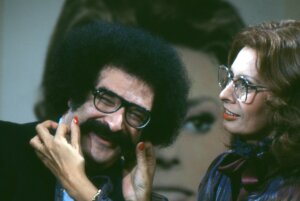
The television entertainment personality Gene Shalit, who celebrated his centenary on March 25, semaphored a Jewish appearance for decades to viewers of NBC’s early morning gabfest The Today Show.
With his Jew-fro hairstyle that fascinated celebrity interviewees and his abundant mustache that outdid Groucho Marx’s mere greasepaint simulacrum, Shalit was one of a kind. Born in New York City in 1926, he clearly aimed to be recognizable even through half-opened bleary eyes of half-asleep viewers. And audible too. Shalit’s precise pronunciation, always at a vigorous decibel level, sought to be comprehensible even during voiceovers. The Canadian comedian Eugene Levy, transfixed by this persona, imitated him on SCTV roaring at high decibel levels.
In one skit, Levy embodied Shalit with haimish affection, hawking a remedy for a migraine presumably caused by his own bellowing. In another, Levy spoofed Hollywood celebrities who were notorious fressers at local restaurants, including the American Jewish actress Shelley Winters (born Shirley Schrift). In still another lampoon, Levy-as-Shalit danced and also kibitzed with the late Catherine O’Hara as the Jewish gossip columnist Rona Barrett (born Burstein).
Shalit apparently kvelled at the notion that he was prominent enough in media culture to be affectionately kidded like other Jewish noteworthies Levy imitated, including Howard Cosell, Henry Kissinger, Menachem Begin, Milton Berle, Judd Hirsch, Jack Carter, James Caan, Lorne Greene, Norman Mailer and Neil Sedaka.
Years later, Levy recalled that when the SCTV comedy troupe was invited to appear on The Today Show, before the segment was filmed, chairs were arranged so that Catherine O’Hara was seated next to Shalit. Suddenly Shalit exclaimed: “Wait a minute, shouldn’t the person who [imitates] me be sitting beside me?” Another Jewish comedian, Jon Lovitz, would likewise attempt to imitate Shalit on Saturday Night Live, but without the zest of Levy’s indelible incarnation.
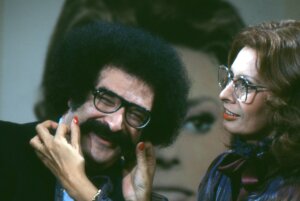
Shalit once told showbiz reporter Eileen Prose that at first, his looks limited him to radio jobs in more conventional times for TV talent. By the more liberated late 1960s, when long hair and a hirsute upper lip were more common, he was hired as quasi-permanent house Jew on The Today Show. Although his mustache fit the counterculture in the mode of Jewish activist Jerry Rubin’s, Shalit as an aspiring journalist may have grown his facial hair more in tribute to earlier literati like the playwright William Saroyan or the eminent humorist Mark Twain.
At times, Shalit’s appearance could be clown-like or cartoonish, so it was natural that characters inspired by him would appear on animated series such as SpongeBob SquarePants and Family Guy as well as The Muppet Show.
Famous interviewees like Peter Sellers were plainly at ease with Shalit’s persona. A conversation filmed shortly before Sellers’ untimely death was cordial, with the sometimes tetchy actor on his best behavior, acknowledging Shalit as a fellow entertainer. And with Mel Brooks in 1987, Shalit looked to be in paradise.
A warm-hearted empathizer and enthusiast, Shalit was more suited to promoting films than criticizing them. In 1989, a tzimmes occurred when a memo drafted by Bryant Gumbel, a Today Show colleague, deemed Shalit a “specialist in gushing over actors and directors” and added that Shalit’s interviews “aren’t very good.” To his credit, Shalit minimized the controversy, telling The Los Angeles Times that Gumbel’s disses were “not big whacks.”
“Listen, I’ve been interviewing people on the show for 17 years,” Shalit said. “I must be doing something right.”

Part of his inspiration was a sincere appreciation for humor, Jewish and otherwise. His 1987 anthology, Laughing Matters featured contributions by Jewish wits such as Dorothy Parker, S. J. Perelman, Woody Allen, Fran Lebowitz, Samuel Hoffenstein, Philip Roth, Mel Brooks, George S. Kaufman, Milt Gross, Arthur Kober, Leo Rosten, Allan Sherman, Max Shulman, Calvin Trillin, Rube Goldberg, Sam Gross, Roz Chast, B. Kliban, Robert Mankoff, J. B. Handelsman, Jules Feiffer and George Burns. The volume was dedicated to, among others, the Jewish screenwriter Samson Raphaelson, who was Shalit’s instructor at the University of Illinois at Urbana-Champaign.
His visceral reaction to Jewish parody was such that during one commuter train ride, Shalit admitted in a preface, Perelman’s story “No Starch in the Dhoti, S’il Vous Plait” caused a conductor to lean down with concern, stating: “A passenger says you’re crying.” To which Shalit retorted, choking and rubbing away tears: “I’m laughing.”
The subliminal message of Shalit’s book was that without Jews, America would have distinctly fewer tears of laughter. And he regretted not being able to include funny Jews like Jack Benny and Ed Wynn whose performances could not be transferred to the printed page.
Shalit also reviewed books for years. Sticking firmly to the content of cultural products with a few brief hints of value judgment, Shalit seemed to have neither the time nor presumably the inclination to subject new items to analysis of Freudian intensity. He clearly preferred boosting things to panning them, and when a film displeased Shalit, he could be uncomfortable saying so.
One occasion when Shalit raised hackles was his response on The Today Show to the 2005 film Brokeback Mountain. Shalit described one of the gay characters as a “sexual predator.” The LGBTQ media group GLAAD objected to Shalit’s characterization as a homophobic stereotype. Shalit’s son Peter wrote an open letter to GLAAD, identifying himself as a gay physician with a Seattle practice helping the gay community. Peter Shalit admitted that his father “did not get” the film in question, but was “not a homophobe.” He might have added that his father had even included an excerpt from Harvey Fierstein’s Torch Song Trilogy in the aforementioned humor collection.
Shalit followed up with his own apology, stating in a mensch-like way that he did not intend to cast “aspersions on anyone in the gay community or on the community itself.” When Shalit finally retired from broadcasting at age 84, with the Yiddish-inflected declaration: “It’s enough, already,” he left behind admiring viewers and decades of bonhomie as one of morning television’s most genial protagonists.
Mazel tov, Gene Shalit. Biz hundert un tsvantsik (May you live until 120)!
The post Gene Shalit, a mensch with a personality as big as his mustache, turns 100 appeared first on The Forward.
Uncategorized
How a song about the food chain became a Seder mainstay
I’m almost positive I heard about the old lady who swallowed a fly before the father who bought a goat for two zuzim.
This occurred to me a few years ago while riding in my sister’s minivan. My niece was in her car seat fidgeting with a toy that plays a catalogue of public domain children’s songs. But unlike the version I’d grown up hearing, where the old lady’s ravenous habit of devouring ever-larger animals is met with the prognostic shrug of “perhaps she’ll die,” the refrain was changed to the more kid-friendly “oh me oh my.”
The Seder tune “Chad Gadya,” which involves a quite similar conceit, has no such timidity when it comes to the ravages of death.
Jack Black once described it as the “original heavy metal song” for the way it progresses along the chain of life from a little goat bought for two zuzim, to the cat who ate the goat, to the dog who bit the cat, all the way up to the angel of death. (“Very Black Sabbath.”)
It is pretty metal — in a kosher Kidz Bop, tot Shabbat kinda way. But why we sing it should, in Jewish circles, be as popular a seasonal question as what a bunny with a clutch of eggs has to do with Jesus’ resurrection. (Some Haggadot explain the greater significance of “Chad Gadya;” my Maxwell House does not.)
Dating the song or rooting out its precise origins is not easy.
As historian Henry Abramson wrote, scholars have noted the song’s similarities to a late Medieval German folk rhyme. While the fact that it is mostly in Aramaic, not the vernacular in Europe in the Middle Ages, suggests an earlier provenance, it is missing from extant Sephardic and Yemenite Haggadot, where one would expect to find texts originating in the language, and the Aramaic itself has many errors.
Abramson reasons that, given the surviving written versions, it was likely adapted sometime in the 14th century from a German children’s rhyme called “The Foreman that Sent Jockel Out,” about an idler named Jockel who a foreman tries to rouse to fieldwork with an escalating series of messengers, ending with a hangman. (Abramson notes the original is characterized by “some Teutonic weirdness,” like a witch sent to subdue a vulture.)
“Chad Gadya” belongs, like its Seder companion “Echad Mi Yodea,” to a genre called “cumulative song,” where verses build with new information a la “12 Days of Christmas.” But “Chad Gadya” stands out for its strangeness and its more oblique message.
Abramson and others see the goat, small and vulnerable, standing in for the Jewish people, and the ensuing parade of antagonists corresponding to historical enemies (Assyrians, Babylonians) and periods of time (Exodus, various conquests), ending with redemption in the Messianic age when the Holy One smites death.
As Rabbi Jonathan Sacks wrote in a commentary for his Haggadah, the song “teaches the great truth of Jewish hope: that though many nations (symbolized by the cat, the dog, and so on) attacked Israel (the goat), each in turn has vanished into oblivion.”
That this truth is conveyed in song, with much banging on the table or animal noises, speaks to the centrality of children in the Passover Seder. And, some think, its inclusion serves a practical purpose: keeping the kids awake through the last leg of a long ritual meal.
My own interpretation is admittedly less lofty. I don’t think of Israel’s tribulations. I do think of the abundance of stray cats in Jerusalem, said to have originated during the British mandate when the city had a rat problem.
And, in the years since my own days as designated Four Questions asker, I’ve been reading “Chad Gadya” into non-Jewish contexts. “The White Cat,” off of Mitski’s new album, Nothing’s About to Happen to Me, contains a lyric that recalls the song, only altered to be a metaphor for the predations of capitalism.
In it, the speaker says she must work to pay for the cat’s house and “for the bugs who drink my blood/and the birds who eat those bugs/so that white cat can kill the birds.”
These cycles speak across cultures and time because they represent a fundamental rule of nature: There’s always a bigger fish (or cat or dog or stick).
To erase death from the equation, like my niece’s toy does with that hapless, insect-ingesting pensioner, is a concession to today’s sensitivities. That’s not to say “The Old Lady Who Swallowed a Fly” represents anything more homiletic than a choking hazard warning, but in the case of “Chad Gadya,” death is the story, and an end to death is the hope.
“The Haggadah ends with the death of death in eternal life,” Rabbi Sacks concluded his drash on the song, which ends when God strikes down the Angel of Death. “A fitting end for the story of a people dedicated to Moshe’s great command, ‘Choose life.’”
I know it’s a principle of faith all over the Haggadah, but I’m more agnostic as to that Messianic promise and maybe more in the camp of our old lady. My understanding of Jewishness, which accords with Moshe’s command, says life is best lived knowing that — perhaps — we’ll die.
The post How a song about the food chain became a Seder mainstay appeared first on The Forward.
Uncategorized
Katz: ‘Israel’s Goal in Lebanon is to Disarm Hezbollah’

Then-Israeli transportation minister Israel Katz attends the cabinet meeting at the Prime Minister’s office in Jerusalem, Feb. 17, 2019. Katz currently serves as the foreign minister. Photo: Sebastian Scheiner/Pool via REUTERS
i24 News – Israel’s Defense Minister Israel Katz held a situation assessment Friday with senior military and defense officials, reiterating that the country’s policy in Lebanon remains focused on disarming Hezbollah by military and political means. Katz emphasized that the goal applies “regardless of the Iran issue” and pledged continued protection for Israeli northern communities.
Katz said the Israel Defense Forces are completing ground maneuvers up to the anti-tank line to prevent direct threats to border towns. He outlined plans to demolish houses in villages near the border that serve as Hezbollah outposts, citing previous operations in Rafah and Khan Yunis in Gaza as models.
The Defense Minister added that the IDF will maintain security control over the Litani area and that the return of 600,000 residents of southern Lebanon who had evacuated north will not be permitted until northern communities’ safety is ensured. Katz also reaffirmed that the IDF will continue targeting Hezbollah leaders and operatives across Lebanon, noting that 1,000 terrorists have already been eliminated since the start of the current campaign.
“We promised security to the northern towns, and that is exactly what we will do,” Katz said. He further warned that the IDF will act decisively against rocket fire from Lebanon, stating that Hezbollah “will pay heavy prices.”