


Uncategorized
Gene Shalit, a mensch with a personality as big as his mustache, turns 100
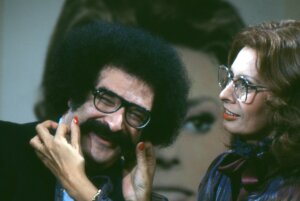
The television entertainment personality Gene Shalit, who celebrated his centenary on March 25, semaphored a Jewish appearance for decades to viewers of NBC’s early morning gabfest The Today Show.
With his Jew-fro hairstyle that fascinated celebrity interviewees and his abundant mustache that outdid Groucho Marx’s mere greasepaint simulacrum, Shalit was one of a kind. Born in New York City in 1926, he clearly aimed to be recognizable even through half-opened bleary eyes of half-asleep viewers. And audible too. Shalit’s precise pronunciation, always at a vigorous decibel level, sought to be comprehensible even during voiceovers. The Canadian comedian Eugene Levy, transfixed by this persona, imitated him on SCTV roaring at high decibel levels.
In one skit, Levy embodied Shalit with haimish affection, hawking a remedy for a migraine presumably caused by his own bellowing. In another, Levy spoofed Hollywood celebrities who were notorious fressers at local restaurants, including the American Jewish actress Shelley Winters (born Shirley Schrift). In still another lampoon, Levy-as-Shalit danced and also kibitzed with the late Catherine O’Hara as the Jewish gossip columnist Rona Barrett (born Burstein).
Shalit apparently kvelled at the notion that he was prominent enough in media culture to be affectionately kidded like other Jewish noteworthies Levy imitated, including Howard Cosell, Henry Kissinger, Menachem Begin, Milton Berle, Judd Hirsch, Jack Carter, James Caan, Lorne Greene, Norman Mailer and Neil Sedaka.
Years later, Levy recalled that when the SCTV comedy troupe was invited to appear on The Today Show, before the segment was filmed, chairs were arranged so that Catherine O’Hara was seated next to Shalit. Suddenly Shalit exclaimed: “Wait a minute, shouldn’t the person who [imitates] me be sitting beside me?” Another Jewish comedian, Jon Lovitz, would likewise attempt to imitate Shalit on Saturday Night Live, but without the zest of Levy’s indelible incarnation.
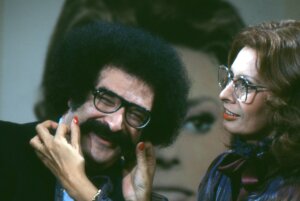
Shalit once told showbiz reporter Eileen Prose that at first, his looks limited him to radio jobs in more conventional times for TV talent. By the more liberated late 1960s, when long hair and a hirsute upper lip were more common, he was hired as quasi-permanent house Jew on The Today Show. Although his mustache fit the counterculture in the mode of Jewish activist Jerry Rubin’s, Shalit as an aspiring journalist may have grown his facial hair more in tribute to earlier literati like the playwright William Saroyan or the eminent humorist Mark Twain.
At times, Shalit’s appearance could be clown-like or cartoonish, so it was natural that characters inspired by him would appear on animated series such as SpongeBob SquarePants and Family Guy as well as The Muppet Show.
Famous interviewees like Peter Sellers were plainly at ease with Shalit’s persona. A conversation filmed shortly before Sellers’ untimely death was cordial, with the sometimes tetchy actor on his best behavior, acknowledging Shalit as a fellow entertainer. And with Mel Brooks in 1987, Shalit looked to be in paradise.
A warm-hearted empathizer and enthusiast, Shalit was more suited to promoting films than criticizing them. In 1989, a tzimmes occurred when a memo drafted by Bryant Gumbel, a Today Show colleague, deemed Shalit a “specialist in gushing over actors and directors” and added that Shalit’s interviews “aren’t very good.” To his credit, Shalit minimized the controversy, telling The Los Angeles Times that Gumbel’s disses were “not big whacks.”
“Listen, I’ve been interviewing people on the show for 17 years,” Shalit said. “I must be doing something right.”

Part of his inspiration was a sincere appreciation for humor, Jewish and otherwise. His 1987 anthology, Laughing Matters featured contributions by Jewish wits such as Dorothy Parker, S. J. Perelman, Woody Allen, Fran Lebowitz, Samuel Hoffenstein, Philip Roth, Mel Brooks, George S. Kaufman, Milt Gross, Arthur Kober, Leo Rosten, Allan Sherman, Max Shulman, Calvin Trillin, Rube Goldberg, Sam Gross, Roz Chast, B. Kliban, Robert Mankoff, J. B. Handelsman, Jules Feiffer and George Burns. The volume was dedicated to, among others, the Jewish screenwriter Samson Raphaelson, who was Shalit’s instructor at the University of Illinois at Urbana-Champaign.
His visceral reaction to Jewish parody was such that during one commuter train ride, Shalit admitted in a preface, Perelman’s story “No Starch in the Dhoti, S’il Vous Plait” caused a conductor to lean down with concern, stating: “A passenger says you’re crying.” To which Shalit retorted, choking and rubbing away tears: “I’m laughing.”
The subliminal message of Shalit’s book was that without Jews, America would have distinctly fewer tears of laughter. And he regretted not being able to include funny Jews like Jack Benny and Ed Wynn whose performances could not be transferred to the printed page.
Shalit also reviewed books for years. Sticking firmly to the content of cultural products with a few brief hints of value judgment, Shalit seemed to have neither the time nor presumably the inclination to subject new items to analysis of Freudian intensity. He clearly preferred boosting things to panning them, and when a film displeased Shalit, he could be uncomfortable saying so.
One occasion when Shalit raised hackles was his response on The Today Show to the 2005 film Brokeback Mountain. Shalit described one of the gay characters as a “sexual predator.” The LGBTQ media group GLAAD objected to Shalit’s characterization as a homophobic stereotype. Shalit’s son Peter wrote an open letter to GLAAD, identifying himself as a gay physician with a Seattle practice helping the gay community. Peter Shalit admitted that his father “did not get” the film in question, but was “not a homophobe.” He might have added that his father had even included an excerpt from Harvey Fierstein’s Torch Song Trilogy in the aforementioned humor collection.
Shalit followed up with his own apology, stating in a mensch-like way that he did not intend to cast “aspersions on anyone in the gay community or on the community itself.” When Shalit finally retired from broadcasting at age 84, with the Yiddish-inflected declaration: “It’s enough, already,” he left behind admiring viewers and decades of bonhomie as one of morning television’s most genial protagonists.
Mazel tov, Gene Shalit. Biz hundert un tsvantsik (May you live until 120)!
The post Gene Shalit, a mensch with a personality as big as his mustache, turns 100 appeared first on The Forward.
Uncategorized
They met on a Birthright trip then married. Now this American Israeli couple’s internet fame has turned to infamy.
Ethan and Hila Klein first met at Yad Vashem — Israel’s Holocaust museum — in 2007, a meet-cute they recounted, giggling, years later for their millions of YouTube followers.
“I think I went up to her and said something like, ‘They had it coming, don’t you think?’” said Ethan, known for his edgy humor and infamous internet trends, including Vape Nation and Papa Bless. “No I didn’t say that. I wonder if you would have laughed though.”
They were on a Birthright trip, Ethan an American and Hila an Israeli soldier on leave to join the group. Soon after the trip ended, Ethan moved to Israel to be with Hila, and the two began making videos under the name H3H3 Productions (the H for Hila and the 3 standing in as an E for Ethan). They married, moved to America, and started a popular podcast.
A Jewish love story, until Thursday, when Hila, now mother to their three children, accused Ethan publicly of having a months-long affair.
“The betrayal I feel is immeasurable,” Hila said in an Instagram post. “My only family on this side of the world. How do I even begin to make sense of this?”
Ethan reposted her statement.
Their podcast is run by a handful of crew members who often chime in and participate in various skits and bits. The crew also shared a statement saying they stand with Hila and refuse to work with Ethan, though they added they don’t know what this will mean for the future of the show.
A couple roiled by Oct. 7
The left-leaning, secular couple’s videos and podcasts focused primarily on pop culture, internet drama and general politics, not Jewish or Israeli issues.
Both Ethan and Hila would make statements sometimes when tensions in Israel flared, and they would occasionally speak out against IDF actions that upset them.
In 2021, Ethan started a podcast with political commenter Hasan Piker, a controversial left-wing influencer, called Leftovers, a nod to their leftist politics.
Then came Oct. 7.
Ethan, an American Israeli dual citizen like Hila, was horrified by the attacks but quick to call the IDF genocidal in the aftermath. In their first episode together after Oct. 7, Ethan and Piker said the show would continue through their disagreements. The episode was tense, and it was their last.
As Piker’s rhetoric on Israel intensified and became at times antisemitic, the two began a nasty internet feud, culminating in a nearly five-hour livestreamed debate.
Piker posted about the news of the affair on X, sharing a video of Ethan and expressing disgust for men who cheat.
“Now this is a high caliber man [with] good morals,” Piker said sarcastically. He also posted “Judge me by my enemies” after sharing Hila’s statement.
Hila, who owns a makeup and clothing company, increasingly came under scrutiny by Piker and others after Oct. 7 for her service in the IDF. Artists refused to work with her. One model she hired publicly disavowed her after finding out she was Israeli.
The couple was harassed, sometimes online, sometimes in-person, as they attempted to take what they viewed as a nuanced stance in the aftermath of Hamas’ attack on Israel and the ensuing war in Gaza. The united front seemed to fortify their relationship, as Ethan, ever outspoken, routinely came to his wife’s defense.
Their show lost thousands of subscribers, but loyal fans stuck with them — fans who now say they are gutted and confused by the news of the affair. Many in disbelief noted that Ethan had Hila’s face tattooed on his arm less than two years ago as a surprise for her.
“The greatest thing a man can do for his children is to love their mother,” says the quote surrounding the tattoo.
The Forward attempted to contact the Kleins through their work emails and did not immediately hear back.
The post They met on a Birthright trip then married. Now this American Israeli couple’s internet fame has turned to infamy. appeared first on The Forward.
Uncategorized
These Jewish college students have some ‘nonnegotiables’ for El-Sayed
At the University of Michigan, first-year student Robert Kashan, 18, and sophomore Jacob Reich, 19, sat behind a large blue sign. “Some things are nonnegotiable,” it declared in all caps.
The sign laid out their requirements for any candidate seeking their support: a commitment to Jewish safety, “including for Zionist Jews,” and supporting Jewish statehood in Israel, among other positions.
“Zionism is a legitimate part of the Democratic coalition, and a lot of us are feeling less represented by the Democratic Party,” Kashan told the Forward.
The students are part of a broader “Nonnegotiable” movement in Michigan, a coalition of Jewish Democrats who are spelling out their dealbreakers for candidates ahead of the Senate election between Democratic nominee Abdul El-Sayed and Republican nominee Mike Rogers.
The movement has attracted national attention, with hundreds of rabbis across 34 states signing on to the “Nonnegotiable” demands. Meanwhile, about 20 students at the University of Michigan have publicly signed, while hundreds more offered support anonymously, according to Reich.
The “Nonnegotiable” supporters aren’t saying whom they’ll vote for if their concerns aren’t addressed — or whether they’ll vote at all. But they are pushing back against the assumption that Jewish voters will, as the saying goes, “vote blue no matter who,” urging El-Sayed to engage with their demands if he hopes to earn their support.
That’s in contrast with two other Jewish political camps, including a group called Michigan Jews for Democracy that endorsed El-Sayed. Their petition, which has garnered almost 1,000 signatures, notes that some signatories hold reservations about El-Sayed but are voting for him nonetheless as a check on President Trump.
“We understand that a vote is not a valentine; it’s a strategic chess move,” the petition reads.
A competing petition, dubbed “Michigan Jews Against Extremism,” has drawn hundreds of signatures from Michigan Jews who plan to vote for Rogers. That petition similarly emphasizes that Rogers voters may still have reservations about the candidate: “Our vote for Mike Rogers does not require that we agree with him on every issue or that we support President Trump,” it reads.
“Nonnegotiable,” meanwhile, rejects the idea that Jewish voters would have to choose between Zionist and Democratic values. Some have criticized the nonnegotiable movement for ignoring the reality of the electoral choice at hand. Others have called it “a veiled attempt to excuse the actions of Jewish Democrats who want to feel validated about voting for Mike Rogers.”
But Kashan and Reich, who met at Hillel and plan to major in political science, said the “Nonnegotiable” movement was the only way they could see themselves engaging in the election, as they felt increasingly pulled between their identities as Democrats and as Jews.
Some Michigan Jews have expressed alarm at El-Sayed’s questioning of whether Israel should exist as a Jewish state and his decision to campaign alongside controversial Twitch streamer Hasan Piker, who has been accused of antisemitic rhetoric. Rogers, who Trump has endorsed, earlier this week called El-Sayed “anti-Jew.”
In a letter to Michigan Jews, El-Sayed has vowed to “stand up against antisemitism and take the threat of violence against our Jewish community incredibly seriously.” He has also hired a Jewish liaison in the final weeks leading up to the election.
This will be the first election when Kashan, who just turned 18, is eligible to vote, and Reich’s first national election after voting in a local primary in his hometown of Palo Alto, California. For both, voting Democratic in their first major election had once seemed like a given.
“I’m a Jewish Democrat, and I want Democrats to take the Senate,” Reich said. “I want to vote for a Democrat in my own state.”
They’re still holding out hope that will happen — and that, with less than two weeks until the Nov. 3 election, El-Sayed will sign on to their petition.
And if he doesn’t? Neither student is ready to say.
The post These Jewish college students have some ‘nonnegotiables’ for El-Sayed appeared first on The Forward.
Uncategorized
Does anyone in Jerusalem care what happens to us?
An Israeli think tank has put on paper what most American Jews know in their kishkas: Israel’s actions over there affect our safety here.
So here’s my question: Does anybody over there care?
The report, published by The Institute for National Security Studies (INSS), drew on the input of 20 Jewish leaders from five countries. It concluded that Israel’s actions since the Hamas attack on Oct. 7, 2023 have normalized hostility toward Israel, divided Jewish communities, sapped the political influence of pro-Israel organizations and fueled antisemitism.
Those actions include damaging statements by government officials, limits on humanitarian aid to Gaza at the height of the war, widespread damage to civilian infrastructure in Gaza and unchecked settler violence in the West Bank. The authors also cited as inflammatory “the proliferation of images of civilian death and suffering in Gaza” — though the actual civilian death and suffering has also alienated and enraged many outside Israel, including Jews.
“The conflict is not only over there in the Middle East, it is local all over the Jewish world now, and Diaspora Jewry has skin in the game,” said Theodore Sasson, one of the report’s authors, in an interview with JTA’s Andrew Silow-Carroll, who first wrote about the study.
To be clear, the report doesn’t excuse, exonerate or rationalize people who commit antisemitic acts. “Jews and Israelis are not to blame for antisemitism,” the report states.
“What we’re saying is that Israel is not the cause” of antisemitism, Sasson said, “but enlightened Israeli policy can seek to maintain robust Diaspora support for the state of Israel and can deny the antisemites the material that fuels their mostly spurious claims.”
This is not a novel connection. Three previous academic studies, in Belgium, Australia and the U.S. found statistically significant links between Israeli military operations that result in high Palestinian casualties and spikes in reported antisemitic incidents abroad. Not surprisingly, a Mellman group poll found that 56% of U.S. Jewish voters believe Israel’s policies have fueled antisemitism.
None of this means Israel shouldn’t act in its own interest and put the security needs of its own population first. Antisemites would continue to exist even if Israelis did nothing but play backgammon and sip arak. The report is not about eradicating antisemitism, but about Israeli actions that provoke and endanger Jews abroad — and what Israel can do about those.
I get the principled resistance to a report that seems to shift some of the burden of antisemitism onto the Jews. David Bernstein of the North American Values Institute told Silow-Carroll that American Jews aren’t agents of Israel, and that nobody would say an African country’s actions endanger African Americans. That’s not entirely true — the 9/11 attacks increased hate crimes against American Muslims and bigots targeted random Asian Americans during the COVID-19 pandemic. Pretending actions have no consequence even if the reaction is illegitimate is principled, but naive. If Israel can lower the temperature, it should.
But here’s the sad fact about the current Israeli government: it doesn’t even lower the temperature for its own citizens.
Exhibit A is Oct. 7. This is the government on whose watch that horror happened, and Prime Minister Benjamin Netanyahu has never engaged in a full, independent accounting of what went wrong. How do you prevent future Oct. 7s when you don’t know the weaknesses that enabled it in the first place?
Exhibit B is the flydubai near-disaster, which we in the Diaspora have already mythologized as yet another example of Israeli courage and pluck. It was that, but also a result of a complete breakdown of government responsibility. Israel’s rules should have kept the Omani pilot out of that cockpit, but, as Channel 12 reported, Minister of Transportation Minister Miri Regev took no action despite multiple warnings. Regev, a close ally of Netanyahu, remains in her job.
Finally, Exhibit C: Police under National Security Minister Itamar Ben Gvir have failed to curb violent crime in Israel’s Arab communities which recorded 252 murders in 2025 — and 2026 is on track to surpass that record.
Israel’s supporters often comfort themselves with the mantra that Israelis love life while their enemies love death. But this government has been pretty cavalier about life.
If that’s how Israel’s leaders treat their own citizens, is it so surprising they fail to be overly concerned about Jews abroad? Last year saw the highest death toll from antisemitic attacks in 30 years, while the agency Israel created specifically to deal with such calamities has been AWOL. The Ministry for Diaspora Affairs and Combating Antisemitism, a Tel Aviv University report found, has “not contributed in any meaningful way to the cause, and in some cases has been an embarrassment.”
All this is happening as the screws are tightening on Jewish communities in Australia, France, Italy, Canada and elsewhere. But Israel, established in part to keep Jews safe, has, under this government, too often increased or ignored the dangers. Zionism is supposed to be the Diaspora’s Iron Dome, but this government, by inexorably, deliberately foreclosing on the possibility of a democratic Jewish state, is functionally anti-Zionist.
The report listed several measures Israel could take to reduce the threat to Diaspora communities, among them controlling the incendiary rhetoric of government ministers and opening a diplomatic path with the Palestinians that stops the slide toward a single, non-democratic state.
One of the report’s recommendations is that Israel set up procedures to assess how its policies affect Jews abroad. In other words, the think tank is asking the government to start caring, formally.
It’s hard to imagine any of that happening unless, on Oct. 27, Israelis vote the current government out.
“Netanyahu cannot be part of the healing process. It is Netanyahu from whom we must be healed,” David Horovitz, the far-from-radical founding editor of The Times of Israel, wrote this week in an editorial titled, “For Israel’s Sake, Netanyahu Has to Go.”
As it turns out, it’s for all our sakes.
The post Does anyone in Jerusalem care what happens to us? appeared first on The Forward.
