


Uncategorized
Jewish groups defend European media monitors banned for what State Dept. calls ‘censorship’
Two major Jewish groups defended a digital hate-speech researcher who has been barred by President Donald Trump’s administration from entering the country.
Representatives for Jewish Federations of North America and the Jewish Council for Public Affairs responded after the U.S. State Department restricted the visas of five European digital speech activists. The banned activists include two who helped Jewish college students sue the social network X over the proliferation of antisemitic content on the platform, and another who has advised Jewish federations on social media hygiene. The government made the announcement late Tuesday.
Secretary of State Marco Rubio said he was taking these steps in order to combat “censorship.”
“For far too long, ideologues in Europe have led organized efforts to coerce American platforms to punish American viewpoints they oppose,” Rubio wrote on X. “The Trump Administration will no longer tolerate these egregious acts of extraterritorial censorship.”
But representatives for JFNA and the JCPA, two groups that have worked extensively with the British digital researcher Imran Ahmed, stood up for him in interviews with the Jewish Telegraphic Agency. Ahmed, the group leaders said, is an important ally in the fight against antisemitism.
“He is a valuable partner in providing accurate and detailed information on how the social media algorithms have created a bent toward antisemitism and anti-Zionism, and he will remain a valuable partner,” Dennis Bernard, head of government relations for JFNA, told JTA about Ahmed.
Ahmed’s research has helped inform the federation movement’s larger strategy to counter antisemitism on social media. Last month JFNA and Ahmed’s group, the Centre for Countering Digital Hate, jointly released a report detailing how Instagram’s algorithm promotes antisemitism.
Ahmed also presented his findings at JFNA’s recent General Assembly in Washington, as well as at a Jewish Funders Network convening, and has spoken at the Eradicate Hate Global Summit in Pittsburgh — which was founded in the aftermath of the 2018 Tree of Life shootings. Separately, he has researched the proliferation of antisemitic content across various social networks following the Oct. 7 Hamas attacks.
Bernard declined to comment on Rubio’s move to restrict Ahmed’s visa, but noted, “We will look into this.” Regarding Ahmed, Bernard said, “If there’s something there we don’t know about, of course we will terminate our relationship with him.”
JCPA CEO Amy Spitalnick also praised Ahmed’s work fighting antisemitism. She harshly criticized the State Department’s targeting of him.
“He’s dedicated his career to fighting online hate and extremism,” Spitalnick told JTA about Ahmed. She denounced his targeting as “all part of the broader weaponization of the federal government to go after perceived political enemies and advance an extremist agenda, which in this case is to push back against any regulation of tech.”
Ahmed and Spitalnick began working together in the aftermath of Spitalnick’s successful effort to prosecute the organizers of the “Unite the Right” march in Charlottesville, Virginia. They bonded over a shared interest in how online spaces were giving rise to hate activities like the rally. They have since partnered on a report about antisemitism on X. Shortly after Oct. 7, Ahmed appeared in a webinar with Spitalnick discussing how extremist groups were seizing on the attacks to spread antisemitism and anti-Muslim sentiments.
Ahmed wasn’t the only target on the State Department’s list with connections to Jewish groups.
In 2023 the European Union of Jewish Students, a group representing pro-Israel Jewish university students throughout Europe, sued X, then called Twitter, in German court over the proliferation of antisemitic content, including Holocaust denial, on the social network. Filing alongside them was HateAid, a German legal group that says it “advocates for human rights in the digital space.”
HateAid’s leaders, Josephine Ballon and Anna-Lena von Hodenberg, were also named on the State Department’s list of visa restrictions this week.
“Twitter has betrayed our trust. By allowing hateful content to spread, the company fails to protect users, and Jews in particular,” Avital Grinberg, then the head of the European Union of Jewish Students, said about her lawsuit at the time. “If Jews are forced out of the virtual space due to antisemitism and digital violence, Jewish life will become invisible in a place that is relevant to society.”
“Twitter owes us a communication platform where we can move freely and without fear of hatred and agitation,” Ballon, the head of HateAid’s legal team, said then.

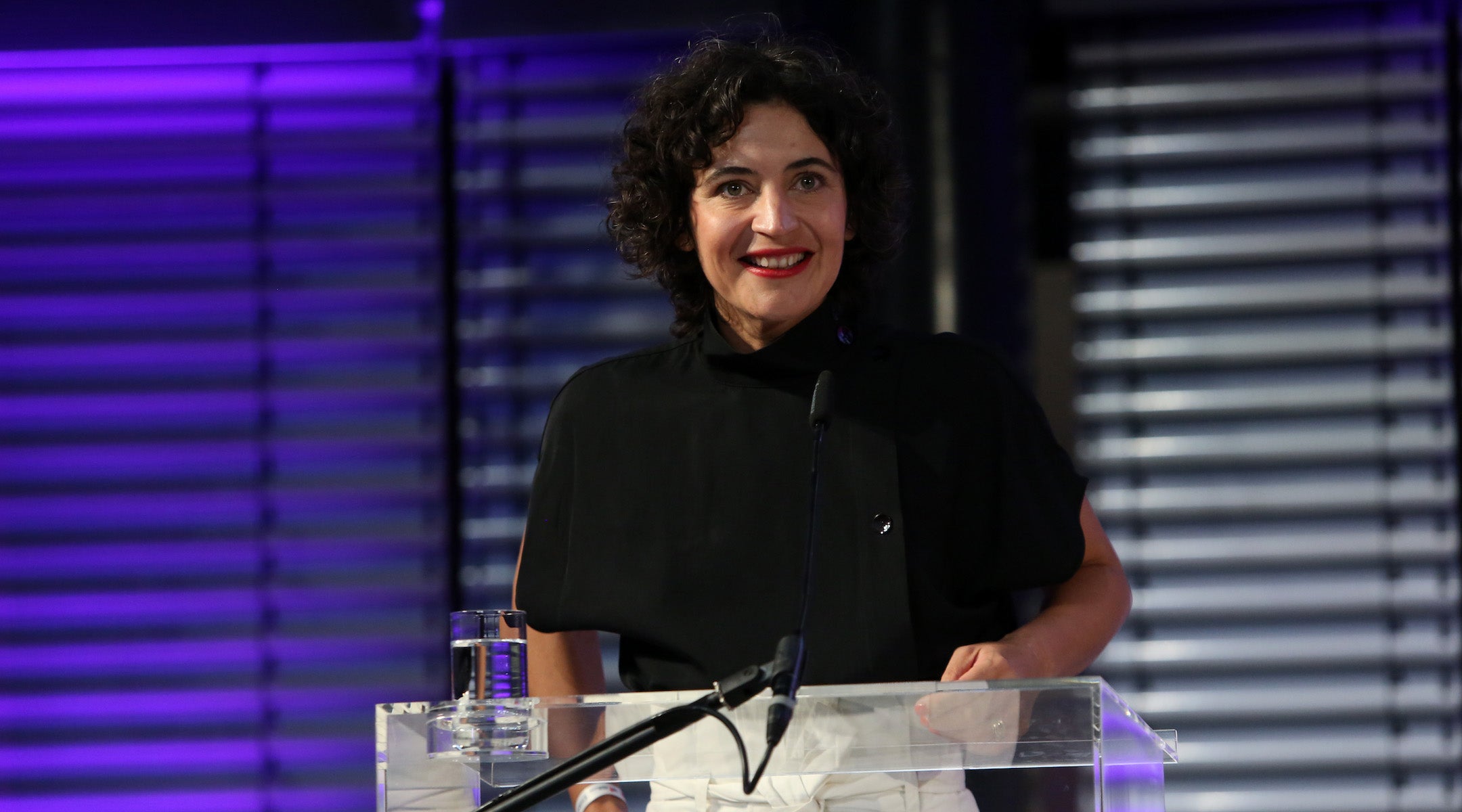
Anna-Lena von Hodenberg, founder of HateAid, attends the ceremony for the presentation of the 2021 ifa Award for the Dialogue of Cultures, at Allianz Forum in Berlin, Sept, 14, 2021. (Adam Berry/Getty Images)
Reached for comment Wednesday, Grinberg said the Trump administration’s move against HateAid’s leaders was “dangerous for people like us.”
“For me personally, and I think for many young Jews who are exposed to antisemitism online, these organizations are crucial,” she said. “These are people who give us tools to respond to the hatred we experience online every day, across all the platforms.”
Today Grinberg is general manager of EU Watch, a watchdog group that critiques the European Union from a pro-Israel perspective.
The individuals were targeted as part of a larger battle on the right to fight what conservatives see as an effort by tech activists to silence conservative voices — an effort that is clashing with institutional Jewish groups’ longstanding push for tougher restrictions on tech platforms to limit the spread of antisemitism and Holocaust denial.
In a statement explaining the restrictions, the State Department said the five activists had run afoul of a visa law passed earlier this year aimed at “foreign nationals who censor Americans.”
On X, Rubio said the administration “will take steps to bar leading figures of the global censorship-industrial complex from entering the United States. We stand ready and willing to expand this list if others do not reverse course.”
The U.S. crackdown on tech activists comes as antisemitism and other kinds of hate content have proliferated on American tech platforms, whose leaders — including some Jews like Instagram and Facebook owner Mark Zuckerberg — have largely cultivated warm relationships with President Trump since he reassumed power.
Regulators in Europe, where laws around Holocaust denial and other forms of hate speech are stricter than in the U.S., have sought to impose a stronger hand on tech platforms that operate on the continent. European regulators have particularly expressed concern about X, where antisemitism and Holocaust denial have become a particularly acute problem.
X is run by billionaire Elon Musk, who is both the world’s richest man and a onetime key Trump ally who played a prominent role in the early months of his administration. Though Musk and Trump have since appeared to have a falling-out, Musk has continued to promote right-wing ideas and Republican causes on X, and has also endorsed European far-right parties. He has long flirted with antisemitic ideas on the platform himself, and has regularly feuded with the Anti-Defamation League.
Sarah Rogers, U.S. undersecretary of state for public diplomacy, gave a more extensive rundown of the reasons behind each visa restriction on X (itself reposted by Musk).
HateAid, Rogers claimed, “routinely demands access to propriety [sic] social media platform data to help it censor more.” Rogers also singled out a remark Ballon had given on a 60 Minutes episode that she said the government found objectionable: “Free speech needs boundaries.”
Ahmed, according to Rogers, was a “key collaborator with the Biden Administration’s effort to weaponize the government against U.S. citizens.” She particularly took offense with the Centre for Countering Digital Hate’s focus on anti-vaccine rhetoric, which had included calls to deplatform Robert F. Kennedy Jr., who, among other things, has spread conspiracy theories linking Jews to COVID-19.
Today Kennedy is Trump’s Secretary of Health and Human Services. He praised the news of the visa restrictions on X, writing, “Once again, the United States is the mecca for freedom of speech!”

Imran Ahmed, CEO of the Centre for Countering Digital Hate, speaks at the Eradicate Hate summit in Pittsburgh, Pennsylvania, Oct. 5, 2023. On Dec. 23, 2025, the US State Department barred Ahmed and four other European digital anti-hate advocates from entering the country. (Screenshot via YouTube)
Rogers, the State Department undersecretary, also invoked a term closely associated with antisemitism — the blood libel — in her justification for why another European figure, Clare Melford, also fell under the new visa restrictions.
Melford runs the Global Disinformation Index, a British nonprofit that says it seeks to counter online disinformation but has been accused by conservative groups of bias. The group has in the past spoken out about misinformation “linking Jews to the origins of the COVID-19 pandemic.”
“If you question Canadian blood libels about residential schools, you’re engaging in ‘hate speech’ according to Melford and GDI,” Rogers wrote on X. She highlighted a description, purportedly from the group, referring to “digital denialism around residential schools.”
The passage highlighted by Rogers references Canada’s infamous residential school system, an effort to force cultural assimilation on the country’s Indigenous populations that resulted in the deaths of thousands of children and persisted for generations. Canada has issued formal apologies for residential schools, with a truth-and-reconciliation commission report concluding that they amounted to cultural genocide.
Conservative parties in Canada have questioned, downplayed or rejected accepted historical accounts of abuses under Canada’s residential school system.
The other European activist barred from the U.S. on Wednesday is Thierry Breton, a former European Union commissioner.
In a statement to JTA, HateAid blasted the decision to bar its leaders from the US as “an act of repression by a government that is increasingly disregarding the rule of law and trying to silence its critics by any means necessary.”
The group added, “We will not be intimidated by a government that uses accusations of censorship to silence those who stand up for human rights and freedom of expression. Despite the significant strain and restrictions placed on us and our families by US government measures, we will continue our work with all our strength — now more than ever.”
Grinberg, the Jewish former student who had sued X along with HateAid, wound up losing her case in German court. But the State Department’s latest moves against her allies, she said, may not amount to much in the end.
“It’s just a statement. Like, OK, two people cannot enter the US. It sucks for them. It sucks for democratic values and for the debating culture. But ultimately, I don’t see how Musk is particularly benefitting from that,” she said. “For me, it’s more a performative act.”
In early 2023, when they first sued Musk’s platform, “we thought antisemitism had never been as bad as it is now,” she said. “Now we see that it is even worse. But that’s why you need counterforces. You need people like them.”
This article originally appeared on JTA.org.
The post Jewish groups defend European media monitors banned for what State Dept. calls ‘censorship’ appeared first on The Forward.
Uncategorized
Pressure Mounts on UK Government to Ban Kanye West After Festival Backlash

Rapper Kanye West holds his first rally in support of his presidential bid in North Charleston, South Carolina, US, July 19, 2020. Photo: REUTERS/Randall Hill
The British government was under growing pressure on Monday to bar US rapper Kanye West from entering the country after he was named as the headline act for the Wireless Festival of rap and hip-hop music set for July.
West, now known as Ye, has been criticized in the past for antisemitic remarks and celebration of Nazism, which have led on several occasions to his social media accounts, including X, being barred.
The decision to book Ye prompted several companies to pull their sponsorship of the festival, while the main opposition Conservative Party wrote to Home Secretary [interior minister] Shabana Mahmood urging her to ban him from coming to Britain.
Asked by Reuters for comment, a Home Office source said ministers were currently reviewing his permission to enter the country.
The Home Office does not usually comment on individual cases, but Mahmood has powers to personally request Ye to be excluded from the UK. In January, the department revoked the Electronic Travel Authorization of Eva Vlaardingerbroek, a Dutch far-right activist for spreading false information.
Festival organizers and Ye’s representative did not respond immediately to a request for comment.
The Jewish Leadership Council last week condemned the organizers for booking Ye after a rise in attacks on Jewish people and Jewish targets.
‘DEEPLY CONCERNING’
Prime Minister Keir Starmer also described as “deeply concerning” the decision to book Ye for the London festival.
“Antisemitism in any form is abhorrent and must be confronted firmly wherever it appears,” Starmer said in comments first reported by the Sun on Sunday.
“Everyone has a responsibility to ensure Britain is a place where Jewish people feel safe and secure.”
A spokesperson for London mayor Sadiq Khan said the rapper’s comments did not reflect the city’s values and that the decision had been made by festival organizers.
Australia cancelled the rapper’s visa last July after he released “Heil Hitler,” a song promoting Nazism. The ban came a few months after Ye advertised a swastika T-shirt for sale on his website.
Ye took a full-page advertisement in the Wall Street Journal in January to apologize for his antisemitic remarks, attributing his behavior to an undiagnosed brain injury and an untreated bipolar disorder. He also apologized for his past expressions of admiration for Adolf Hitler and use of swastika imagery.
The 48-year-old has not performed in Britain since he headlined Glastonbury in 2015.
Drinks companies Diageo and Pepsi, a long-running sponsor, said they had withdrawn their support for the Wireless event over the decision to invite Ye. Pepsi-owner PepsiCo also confirmed its Rockstar Energy brand had pulled its sponsorship.
A spokesperson for PayPal told Reuters on Monday its branding would not appear in any future Wireless festival promotional materials.
Uncategorized
Iran Rejects Ceasefire as Deadline Nears on Trump ‘Hell’ Ultimatum

President Donald Trump arrives from the Blue Room to speak about the Iran war from the Cross Hall of the White House on Wednesday, April 1, 2026, in Washington. Photo: Alex Brandon/Pool via REUTERS
Iran said on Monday it wanted a lasting end to the war with the US and Israel, and pushed back against pressure to swiftly reopen the Strait of Hormuz under a temporary ceasefire as the Americans and the Iranians weighed a framework plan to cease their five‑week-old conflict.
Iran conveyed its response to the US proposal for ending the war to Pakistan, rejecting a ceasefire and emphasizing the necessity of a permanent end to the war, the official IRNA news agency said on Monday. The Iranian response consisted of 10 clauses, including an end to conflicts in the region, a protocol for safe passage through the Strait of Hormuz, lifting of sanctions, and reconstruction, the agency added.
President Donald Trump, who has threatened to rain “hell” on Tehran if it did not make a deal by 8 pm EDT Tuesday (midnight GMT) to open the vital route for global energy supplies, rejected the Iranian proposal on Monday and said his deadline was final.
“They made a proposal, and it’s a significant proposal. It’s a significant step. It’s not good enough,” Trump told reporters at an annual White House Easter event, referring to Iran.
Trump, who had extended his initial deadline, gave no indication he would do so again.
“Highly unlikely. They’ve had plenty of time. In fact, they asked for seven days. I said, I’m going to give you 10. But at the end of 10, all hell’s going to break out if you don’t get there,” he said.
Iran responded to US and Israeli attacks in February by effectively closing Hormuz, a conduit for about a fifth of the world’s oil and natural gas supply. The waterway’s stranglehold on the global economy has proved a powerful Iranian bargaining chip and on Monday it showed reluctance to relinquish it too easily.
The Pakistani-brokered framework for ending the war emerged from intense overnight contacts and proposes an immediate ceasefire, followed by talks on a broader peace settlement to be concluded within 15 to 20 days, a source aware of the proposals said on Monday.
Pakistan’s army chief, Field Marshal Asim Munir, was in contact “all night long” with US Vice President JD Vance, special envoy Steve Witkoff, and Iranian Foreign Minister Abbas Araqchi, the source said.
Iran‘s foreign ministry spokesperson Esmaeil Baghaei said on Monday that Tehran’s demands “should not be interpreted as a sign of compromise, but rather as a reflection of its confidence in defending its positions.” He added that earlier US demands, such as a 15-point plan, were rejected as “excessive.”
CEASEFIRE PROPOSAL ‘ONE OF MANY IDEAS’
Trump later told reporters that Iran could be taken out in one night, “and that night might be tomorrow night,” warning Tehran it had to make a deal by Tuesday night or face the consequences.
“The entire country can be taken out in one night, and that night might be tomorrow night,” he told a White House press conference.
US Defense Secretary Pete Hegseth told the briefing that the largest volume of strikes since day one of the operation against Iran would take place on Monday and warned Tuesday would have even more.
A White House official told Reuters that the president is considering multiple options for how to proceed but that military operations will continue.
“This is one of many ideas, and [Trump] has not signed off on it. Operation Epic Fury continues,” they said, referring to the US name for the operation against Iran.
Brent crude futures LCOc1 were up 0.5% to $109.60 a barrel at 1545 GMT.
In a post laden with expletives on his Truth Social platform on Sunday, Trump threatened further strikes on Iranian energy and transport infrastructure if Iran failed to make a deal and reopen the Strait by Tuesday.
Anwar Gargash, an adviser to the president of the United Arab Emirates, said any settlement must guarantee access through Hormuz. He warned that a deal that failed to rein in Iran’s nuclear program and its missiles and drones would pave the way for “a more dangerous, more volatile Middle East.”
Fresh aerial strikes were reported across the region on Monday, more than five weeks since the US and Israel began pounding Iran in a war that has killed thousands and damaged economies by sending oil prices surging.
Iranian state media said the Revolutionary Guards’ intelligence chief, Majid Khademi, has died. Israel on Monday claimed responsibility for his death.
A US-Israeli attack hit the data center at Sharif University of Technology in Tehran, damaging infrastructure underpinning the country’s national artificial intelligence platform and thousands of other services, Fars News Agency said on Sunday. According to US and Israeli officials, the Iranian regime has used the facility for military purposes.
ISRAEL VOWS TO DESTROY IRAN‘S INFRASTRUCTURE
Israeli Defense Minister Israel Katz in a statement issued on Monday threatened to destroy Iran’s infrastructure and hunt down its leaders “one by one.” The Israeli military also said they had targeted Iran‘s air force through a series of strikes on the Bahram, Mehrabad, and Azmayesh airports over the previous night.
Iran said on Monday two of its petrochemical complexes were attacked.
Emergency and firefighting teams brought a blaze under control at the South Pars complex in Asaluyeh, Iran‘s National Petrochemical Company said. No casualties were reported.
An Israeli attack in mid-March on the South Pars gas field that Iran shares with Qatar prompted an escalation in the war, with Iran striking energy targets across the Middle East.
Israeli Prime Minister Benjamin Netanyahu said on Monday that the strike on the petrochemical facility in southern Iran was part of dismantling Iran‘s Revolutionary Guards “money machine.”
“Iran is no longer the same Iran, and Israel is no longer the same Israel. Israel is stronger than ever, and the terrorist regime in Iran is weaker than ever,” Netanyahu said in a statement.
Trump has repeatedly warned Iran he could expand US strikes to include civilian infrastructure, such as power plants and bridges. Critics have said such actions would be war crimes, while others have noted that Iran’s Islamic Revolutionary Guard Corps (IRGC), an internationally designated terrorist organization, has embedded itself in such infrastructure to enrich itself and fuel its operations.
IRAN CONTINUES TO FIGHT BACK
Iranian weekend strikes on petrochemical facilities and an Israeli-linked vessel in Kuwait, Bahrain, and the UAE underscored the country’s ability to fight back despite Trump‘s repeated claims to have knocked out its missile and drone capabilities.
Israel saw a heavy day of rocket volleys on Monday, with the sounds of sirens and missile interception booms ringing out across the country throughout the day.
Israel’s military told Reuters there had been 20 missile launches from Lebanon and five from Iran during the day. Several of the attacks resulted in impacts, although it was unclear whether it was from falling missile debris or direct strikes. A missile hit Haifa overnight tearing a building apart and killing four under the rubble, taking the death toll in Israel to 23, according to Israel’s ambulance service.
Yemen’s Iran-aligned Houthis said on Monday that they also carried out missile and drones attack against Israel.
About 3,540 people have been killed in Iran in the war, including at least 244 children, said US-based rights group HRANA.
Israel has also invaded southern Lebanon and struck Beirut in a fight against Iran-backed Hezbollah terrorists, who initially launched rockets at northern Israeli communities, that has become the most violent spillover of the war on Iran.
Lebanon’s heavy casualties include 1,461 killed, including at least 124 children, Lebanese authorities say.
Thirteen US service members have died, and hundreds of others have been wounded.
Uncategorized
Ukraine Missile Maker Targets ‘Game Changer’ Air Defense System by 2027

An employee works with FP-1 long range drone at a production facility of Fire Point company, amid Russia’s attack on Ukraine, in an undisclosed location in Ukraine, April 2, 2026. Photo: REUTERS/Valentyn Ogirenko
Fire Point, maker of Ukraine‘s Flamingo cruise missile, is in talks with European companies to launch a new air defense system by next year, a senior executive told Reuters, creating a low-cost alternative to the increasingly hard-to-get Patriot system.
With governments seeking to defend their skies as the wars in Ukraine and Iran sow global instability, Fire Point’s co-founder and chief designer Denys Shtilierman said it aimed to slash the cost of intercepting a ballistic missile to below $1 million.
Shtilierman also said Fire Point was awaiting government approval for an investment by a Middle Eastern conglomerate that valued the company at $2.5 billion and would open the door to new business opportunities, including low-orbit satellite launches.
Years of know-how gained on the battlefield fighting Russian forces have made Ukraine a leading innovator in low-cost defense tech. With the outbreak of war in the Gulf, Kyiv has leveraged that expertise to sign security agreements with governments across the region.
Many Ukrainian defense firms are now seeking to export their excess capacity and cash in on a global boom in military spending. While the government recently loosened wartime export restrictions, each proposed deal is still subject to stringent checks and state approval.
DEVELOPING AN ALTERNATIVE TO THE PATRIOT SYSTEM
Ukraine and many other Western-allied nations rely heavily on the US-made Patriot system to stop ballistic missiles.
But Patriot missiles are in increasingly short supply amid extensive deployment in the Gulf against Iranian attacks. And Europe’s only anti-ballistic system, the Italo-French SAMP/T, is produced in relatively small numbers.
To bring down a ballistic projectile, the Patriot system – manufactured by Raytheon and Lockheed Martin – often requires two or three air defense missiles, each costing several million dollars, Shtilierman said.
“If we can decrease it to less than $1 million, it will be … a game changer in air defense solutions,” he said in an interview. “We plan to intercept the first ballistic missile at the end of 2027.”
Shtilierman declined to name the European companies involved in the discussions to develop the new system but said Fire Point is “deeply interested” in collaboration on radar, missile target-seeking and communications systems – areas where it lacks expertise.
European companies including Weibel, Hensoldt, SAAB, and Thales have good radar solutions, he noted.
Founded after Moscow’s 2022 invasion, Fire Point is Ukraine‘s biggest maker of the long-range drones used in the majority of strikes deep inside Russia.
In recent months, its FP5 long-range cruise missile – commonly known as the Flamingo – has also been used to hit Russian military facilities and arms factories, including a ballistic missile plant nearly 1,400 km (870 miles) inside Russian territory.
Shtilierman said Fire Point was now in the final stages of developing two supersonic ballistic missiles.
The smaller FP-7 missile, with a range of around 300 km, will have its first military deployment “in the close future,” he said, describing it as similar to Lockheed Martin’s ATACMS short-range ballistic system.
The larger FP-9, capable of carrying an 800 kg warhead up to 850 km, is about to enter testing and would place Moscow within range of Ukraine‘s ballistic arsenal, he added.
Shtilierman said strikes on Moscow, which is ringed by some of the world’s most formidable air defenses, would cause a “mass shift in the Russian mind and the mind of top guys in Russia.”
Russia’s defense ministry did not respond to a request for comment.
Fabian Hoffmann, a missile expert and senior researcher at the Norwegian Defense University College, said that, while Russia has experience in successfully downing ATACMS, more widespread use of ballistic missiles could stretch Russian air defenses, already degraded by Ukrainian strikes.
And while Fire Point’s 2027 target for launching a low-cost air defense system was “ambitious,” he said that, beyond Ukraine‘s own military needs, there would be strong demand from governments even if its kill rates per missile were less effective than the Patriot’s.
UAE INVESTMENT COULD START SATELLITE VENTURE
Ukraine‘s anti-monopoly authority has until around October to decide on the proposed $760-million acquisition of a 30% stake in Fire Point by the Middle Eastern investor, Shtilierman said.
Ukrainian media have identified the suitor as Emirati defense firm Edge Group. Edge Group and Ukraine‘s anti-monopoly authorities did not respond to a request for comment.
The investment would be the first step in a project to build a space launch terminal in the UAE, with the aim of eventually establishing a constellation of low-orbit European satellites. Shtilierman said the country’s location next to the Indian Ocean and geographical conditions were favorable for space launches.
“We built a carbon winding machine, which allows us to wind a big solid rocket booster for satellite delivery,” he said, noting the project remained at the conceptual stage although there were already agreements “with a couple of Western companies.”
Regardless of whether the UAE deal proceeds, Shtilierman said Fire Point would not take on further investors until after it had demonstrated success with its missile defense system, which will use the company’s FP7 missile.
Fire Point has, meanwhile, received interest from Gulf states for purchases of its existing drone products and is awaiting approval from Ukraine‘s government to begin exports. Shtilierman said the company has monthly capacity to export up to 2,500 long-range drones.
Exporting the Flamingo missile, however, is much more difficult due to regulatory barriers, he said.
Fire Point says it makes hundreds of long-range strike drones a day, each costing about 50,000 euros ($57,775) to produce, and three Flamingo missiles, at a cost of about 600,000 euros apiece. He acknowledged some “bottleneck” issues with the Flamingo, including with engine production.
Fire Point will increase production of the Flamingo when a new, in-house engine goes into mass production in October and a rocket fuel plant in Denmark comes online later this year, he said. The plant is awaiting two final approvals from Danish authorities.
($1 = 0.8654 euros)