


Uncategorized
Jewish lawyer quits Heritage Foundation’s antisemitism task force over Tucker Carlson defense
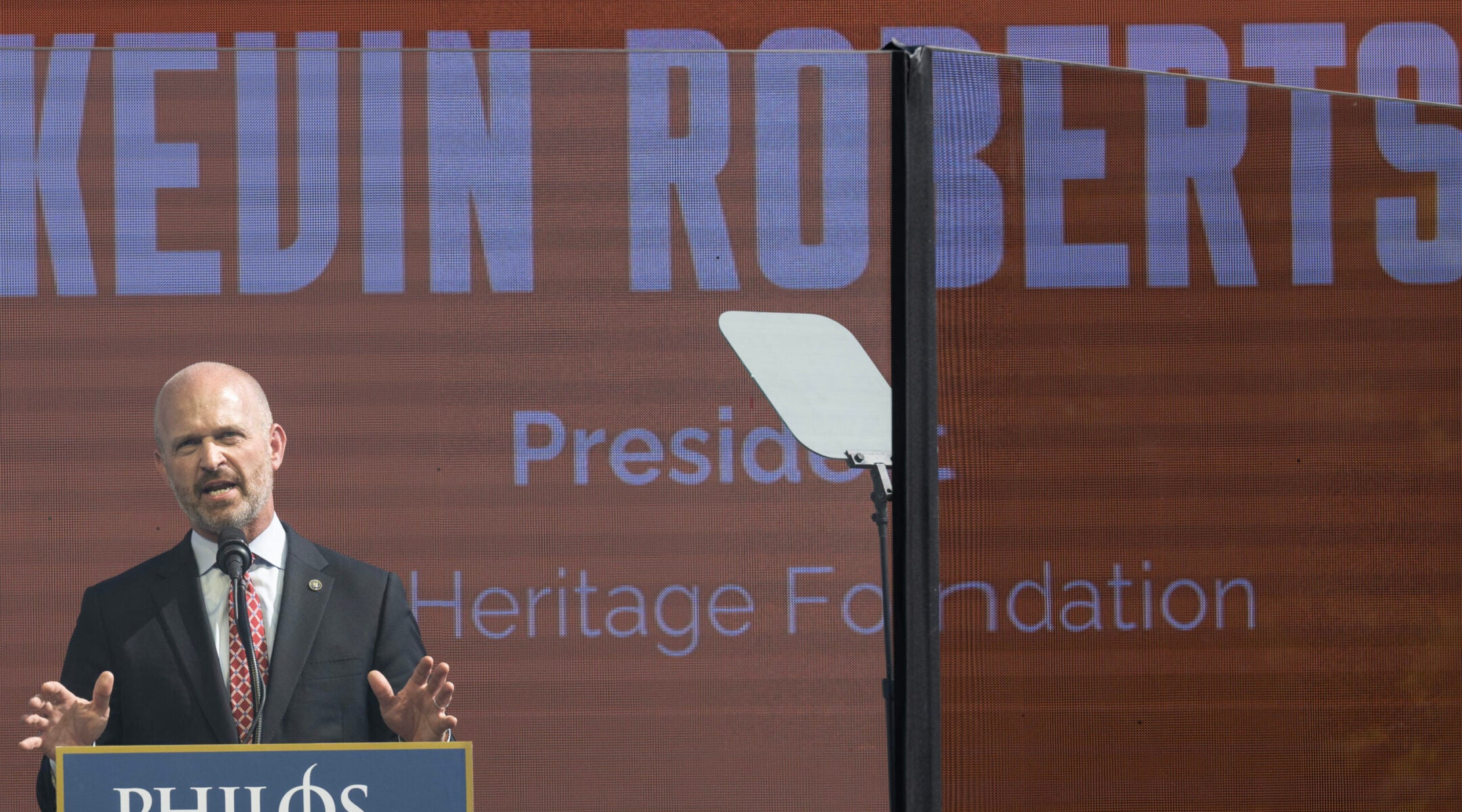
A prominent Jewish lawyer has quit a national initiative to fight antisemitism over comments by the president of the Heritage Foundation defending Tucker Carlson’s decision to host the white supremacist Nick Fuentes on his popular streaming show.
Mark Goldfeder, CEO of the National Jewish Advocacy Center, announced in a letter posted to social media on Sunday that he is quitting the National Task Force to Combat Antisemitism, convened by the Heritage Foundation, because of Kevin Roberts’ comments last week. The president of the Heritage Foundation both rejected calls to cut ties with Carlson and called conservatives criticizing him “a venomous coalition” within the Republican Party.
Goldfeder wrote that he had joined the national task force, launched in 2023, because he believed it would be nonpartisan, “transcend[ing] politics, ideology, and institutional affiliation.” Roberts’ defense of Carlson, he said, showed that it had departed from those values.
“Elevating him and then attacking those who object as somehow un-American or disloyal in a video replete with antisemitic tropes and dog whistles, no less, is not the protection of free speech. It is a moral collapse disguised as courage,” wrote Goldfeder, who is also an Orthodox rabbi.
He continued, “It is especially painful that Heritage, an institution with a historic role in shaping conservative policy, would choose this moment to blur the line between worthwhile debate and the normalization of hate.”
The episode comes as Republicans are increasingly divided over how to respond to antisemitism on the right, which many within the party say is surging. Some, including Sen. Ted Cruz, say antisemitism must be forcefully rejected, but other leading Republicans have downplayed the issue or, like Roberts, framed the presence of antisemitic rhetoric as a side effect of free speech.
Goldfeder rejected that idea in his letter.
“Free speech protects the right to speak. It does not compel anyone to provide a megaphone for a Nazi,” he wrote. “Those of us who lead or advise efforts to combat antisemitism have a responsibility to draw that line clearly. If we fail to do so, and if we equivocate when hatred dresses itself in the language of populism, we betray both our mission and our values.”
Goldfeder is not the first Jewish voice on the right to break ties with the Heritage Foundation, a key architect of conservative policy, over Roberts’ comments. Rep. Randy Fine, one of four Jewish Republicans in Congress, announced at the Republican Jewish Coalition convention in Las Vegas over the weekend that he would no longer allow Heritage staffers into his Capitol Hill offices and called on his colleagues to do the same.
Roberts’ video and the backlash has spurred open discord within an organization known for its unified conservative voice. The Free Press reported on Sunday that multiple people affiliated with Heritage had denounced the video on social media, and that Roberts’ chief of staff, seen as responsible for it, had been moved to another position.
Roberts responded to the backlash — and to goading by Fuentes — in a second social media statement late Friday that explicitly denounced Fuentes, citing specific comments in which Fuentes downplayed the Holocaust and called for the death penalty against Jews.
It did not mention Carlson, who is closer to the Republican Party’s mainstream and was the subject of protest at the Republican Jewish Coalition convention.

Rep. Randy Fine addresses the Republican Jewish Coalition’s national conference in Las Vegas, Nov. 1, 2025. (Joseph Strauss)
“Nick Fuentes’s antisemitism is not complicated, ironic, or misunderstood. It is explicit, dangerous, and demands our unified opposition as conservatives. Fuentes knows exactly what he is doing. He is fomenting Jew hatred, and his incitements are not only immoral and un-Christian, they risk violence,” Roberts wrote.
“Our task is to confront and challenge those poisonous ideas at every turn to prevent them from taking America to a very dark place,” he added. “Join us—not to cancel—but to guide, challenge, and strengthen the conversation, and be confident as I am that our best ideas at the heart of western civilization will prevail.”
The new statement earned praise from Jonathan Greenblatt, CEO of the Anti-Defamation League, which has long criticized Fuentes and Carlson as elevating antisemitism on the right. The ADL, founded to fight on behalf of Jews facing discrimination a century ago, had criticized the Carlson interview and amplified news reports critical of Roberts’ video.
“Credit to @KevinRobertsTX for stepping forward today and issuing a clear, cogent takedown of the toxic antisemitism and venomous racism expressed by Fuentes,” Greenblatt tweeted. “It was clarifying and crucial to hear firsthand that @heritaghas zero tolerance for this kind of poison.”
For his part, Goldfeder said he believed Heritage was feeling pressure from the antisemitism task force, which is chaired by Jewish and Christian Zionist figures. He also left the door open to a return.
“I want to personally thank the leaders of the task force, many of whom have already spoken up and about the need for Heritage to course-correct before it is too late,” Goldfeder wrote in his resignation letter. “I hope that Heritage will listen and, someday, reclaim the clarity that once defined its best moments. And I look forward to working together again as soon as that day comes.”
—
The post Jewish lawyer quits Heritage Foundation’s antisemitism task force over Tucker Carlson defense appeared first on Jewish Telegraphic Agency.
Uncategorized
Katz: ‘Israel’s Goal in Lebanon is to Disarm Hezbollah’

Then-Israeli transportation minister Israel Katz attends the cabinet meeting at the Prime Minister’s office in Jerusalem, Feb. 17, 2019. Katz currently serves as the foreign minister. Photo: Sebastian Scheiner/Pool via REUTERS
i24 News – Israel’s Defense Minister Israel Katz held a situation assessment Friday with senior military and defense officials, reiterating that the country’s policy in Lebanon remains focused on disarming Hezbollah by military and political means. Katz emphasized that the goal applies “regardless of the Iran issue” and pledged continued protection for Israeli northern communities.
Katz said the Israel Defense Forces are completing ground maneuvers up to the anti-tank line to prevent direct threats to border towns. He outlined plans to demolish houses in villages near the border that serve as Hezbollah outposts, citing previous operations in Rafah and Khan Yunis in Gaza as models.
The Defense Minister added that the IDF will maintain security control over the Litani area and that the return of 600,000 residents of southern Lebanon who had evacuated north will not be permitted until northern communities’ safety is ensured. Katz also reaffirmed that the IDF will continue targeting Hezbollah leaders and operatives across Lebanon, noting that 1,000 terrorists have already been eliminated since the start of the current campaign.
“We promised security to the northern towns, and that is exactly what we will do,” Katz said. He further warned that the IDF will act decisively against rocket fire from Lebanon, stating that Hezbollah “will pay heavy prices.”
Uncategorized
Pope Leo Urges Israel’s Herzog to End Iran War in Phone Call, Vatican Says

Pope Leo XIV delivers a homily during the Palm Sunday Mass in Saint Peter’s Square at the Vatican, March 29, 2026. Photo: REUTERS/Remo Casilli
Pope Leo spoke on the phone with Israeli President Isaac Herzog on Friday and urged him to “reopen all paths of dialogue” to end the Iran war, the Vatican said.
The pope, who has emerged as a sharp critic of the regional conflict, also urged Herzog to protect civilians and promote respect for international and humanitarian law, the Vatican added.
Uncategorized
Iran Leaders Join Crowds on Tehran’s Streets to Project Control in Wartime

Iranians gather at a park on Nature Day, amid the U.S.-Israeli conflict with Iran, in Tehran, Iran, April 2, 2026. Photo: Majid Asgaripour/WANA (West Asia News Agency) via REUTERS
After more than a month of being stalked by targeted assassinations, Iran’s leadership has adopted a new tactic to show it is still in control – with senior officials walking openly in the streets among small crowds who have gathered in support of the Islamic Republic.
In recent days, Iran’s president and foreign minister have separately mixed with groups of several hundred people in central Tehran. On Tuesday, state television aired footage of the two posing for selfies, talking to members of the public and shaking hands with supporters who had gathered in public areas.
According to insiders and analysts, the appearances are part of a calculated effort by Iran’s theocratic leadership to project resilience and authority — not only over the vital Strait of Hormuz but also over the population — despite a sustained US-Israeli campaign aimed at “obliterating” it.
One insider close to the hardline establishment said such public outings are intended to show that the Islamic Republic is “unshaken by strikes and that it remains in control and vigilant” as the war grinds on.
The US-Israeli war on Iran began on February 28 with the killing of veteran Supreme Leader Ayatollah Ali Khamenei and several senior military commanders in waves of strikes that have since continued to target top officials.
Iran’s new Supreme Leader, Mojtaba Khamenei, has not been seen in public since taking over on March 8 from his father. Foreign Minister Abbas Araqchi, meanwhile, was removed from Israel’s hit list amid mediation efforts last month, including by Pakistan, to bring Tehran and Washington together for talks to end the war.
Talks aimed at ending the war have since appeared to have petered out, as Tehran brands US peace proposals “unrealistic.” Against that backdrop, recent public appearances by President Masoud Pezeshkian and Araqchi appear designed to project defiance, if not a convincing display of public support.
A senior Iranian source said officials’ public presence demonstrates that “the establishment is not intimidated by Israel’s targeted killing of top Iranian figures.”
Asked whether Iran’s foreign minister or president were on any sort of kill list, an Israeli military spokesperson, Nadav Shoshani, said on Friday he would not “speak about specific personnel.”
NIGHTLY RALLIES TO SHOW RESILIENCE
Despite widespread destruction, Tehran appears emboldened by surviving weeks of intense US-Israeli attacks, firing on Gulf countries hosting US troops and demonstrating its ability to effectively block the Strait of Hormuz.
On Wednesday, US President Donald Trump vowed more aggressive strikes on Iran, without offering a timeline for ending hostilities. Tehran responded by warning the United States and Israel that “more crushing, broader and more destructive” attacks were in store.
Encouraged by clerical rulers, supporters of the Islamic Republic take to the streets each night, filling public squares to show loyalty even as bombs rain down across the country.
Analysts say the establishment is also seeking to raise the “political and reputational” cost of the strikes at a time when civilian casualties are deeply disturbing for Iranians.
Omid Memarian, a senior Iran analyst at DAWN, a Washington-based think tank, said the decision to send officials into gatherings reflects a layered strategy, including an effort to sustain the morale of core supporters at a moment of acute pressure.
“The system relies heavily on this base; if its supporters withdraw from public space, its ability to project control and authority weakens significantly,” Memarian said.
Speaking to state television, some in the crowds voice unwavering loyalty to Iran’s leadership; others oppose the bombing of their country regardless of politics; and some have a stake in the system, including government employees, students and others whose livelihoods are tied to it.
Hadi Ghaemi, head of the New York-based Center for Human Rights in Iran, said the establishment is using such loyal crowds as human shields to raise the cost of any assassination attempts.
“By being in the middle of large crowds they have protections that would make Israeli-American attacks against them very bloody and generate sympathy worldwide,” he said.
POTENTIAL PROTESTERS STAY OFF STREETS AT NIGHT
The Islamic Republic emerged from a 1979 revolution backed by millions of Iranians. But decades of rule marked by corruption, repression and mismanagement have thinned that support, alienating many ordinary people.
While there has been little sign so far of anti-government protests that erupted in January and abated after a deadly crackdown, the establishment has adopted harsh measures – such as arrests, executions and large-scale deployment of security forces – to prevent any sparks of dissent.
Rights groups have warned about “rushed executions” during wartime after Iran hanged at least seven political prisoners during the war.
“Many potential protesters are frightened by the continuing presence of armed men and violent crowds in the streets and largely stay at home once darkness falls,” Ghaemi said.