



Uncategorized
Jewish Sites in New York City Struck With Antisemitic Graffiti as Police Report Jews Targeted in 60% of Hate Crimes

Members of the Rego Park Jewish Center flanking swastika graffiti that was sprayed on the building on Sunday, May 3, 2026. Photo: Screenshot
Jewish residents of the Queens borough of New York City were outraged on Monday following an overnight spree of vandalism which left at least four Jewish properties — private homes and synagogues — marked with the swastika and other antisemitic graffiti.
The incidents were discovered as the New York City Police Department (NYPD) released its latest figures showing that Jews continued to be the target of the majority of all hate crimes across the five boroughs last month, despite comprising a small fraction of the total population.
The perpetrators of the latest wave of vandalism struck the Rego Park Jewish Center, the Congregation Machane Chodosh, as well as two private homes late Sunday night, according to local lawmakers and Jewish leaders. Police are still searching for the suspects. At least one lead has surfaced so far in the form of surveillance footage taken by the Rego Park Jewish Center near the site of one of the crimes.
The suspects allegedly responsible for drawing swastikas outside of the Rego Park Jewish Center. pic.twitter.com/VJBGzI4EgZ
— Dean_Moses (@Dean_Moses) May 4, 2026
Meanwhile, the graffiti remains a scourge on the buildings — appearing in one case next to a memorial to German Jews who survived Kristallnacht, a November 1938 pogrom when Nazi paramilitary forces launched a coordinated nationwide attack on the German Jewish community. The vandals left no doubt regarding their allusion to that period, graffitiing “Heil Hitler” at the Rego Park location.
“When rabbis and congregants arrive to pray this morning, they expected to be met with their usual loving community. When a family woke up, they were prepared to begin an otherwise normal week. Instead, they were me with terrifying signals of hatred and threats of violence,” New York City Council Speaker Julie Menin said in a social media post which addressed the incidents. “With antisemitism on the rise here and across the globe, we will always stand up for our Jewish community and fight back against hate.”
Multiple synagogues and private homes in Queens were vandalized overnight with swastikas and other antisemitic graffiti. @Lynn4NYC, @PhilWongNYC and I are at one of the sites, Congregation Machane Chodosh, in Forest Hills now.
When rabbis and congregants arrived to pray this… pic.twitter.com/s38TXvFHQt
— Speaker Julie Menin (@SpeakerMenin) May 4, 2026
Mark Treyger, CEO of the Jewish Community Relations Council of New York, noted on social media that one of the targeted sites houses a pre-K program for young children.
“This is not normal, and we need city leaders to act NOW,” he posted.
The vandalism was discovered as the New York City Police Department (NYPD) reported on Monday the surge in antisemitic hate crimes across the city had continued unabated.
According to the newly released data, Jews were targeted in 60 percent of all confirmed hate crimes last month, despite making up just 10 percent of the city’s population.
In April, the police confirmed 30 antisemitic incidents out of 50 total hate crimes in the city. As for all reported/suspected hate crimes, 38 out of the total of 65 targeted Jews.
The NYPD had previously reported suspected, but unconfirmed, hate crime incidents. In February, the police began reporting confirmed incidents instead. And then after receiving scrutiny, the department began reporting both suspected and confirmed hate crimes in March.
Regardless of the methodology, the majority of all hate crimes in New York City this year have targeted Jews, especially the Orthodox community, continuing a surge in antisemitism that has swept the city after the start of the Israel-Hamas war in Gaza in October 2023.
In just eight days between the end of October and the beginning of November 2024, for example, three Hasidim, including children, were brutally assaulted in the Crown Heights section of Brooklyn. In one instance, an Orthodox man was accosted by two assailants, one masked, who “chased and beat him” after he refused to surrender his cellphone in compliance with what appeared to have been an attempted robbery. In another incident, an African American male smacked a 13-year-old Jewish boy who was commuting to school on his bike in the heavily Jewish neighborhood. Less than a week earlier, an assailant slashed a visibly Jewish man in the face as he was walking in Brooklyn.
In November, just days after the election of Zohran Mamdani as mayor of New York City, hundreds of people amassed outside a prominent synagogue and clamored for violence against Jews.
“We don’t want no Zionists here!” the group chanted in intervals while waving the Palestinian flag outside the Park East Synagogue in the Upper East Side section of the borough of Manhattan. “Resistance, you make us proud, take another settler out.”
Mamdani has dismantled key parts of the civil rights architecture his predecessor built to combat antisemitism in the city. Former Mayor Eric Adams adopted the International Holocaust Remembrance Alliance (IHRA) definition of antisemitism, enforced a ban on awarding government money to adherents of the movement to boycott Israel, and established as a governing principle the idea that Zionism is central to Jewish peoplehood even as it remains a target of antisemitic activism.
“The connection between Jewish identity and the Land of Israel is not political preference but religious and cultural foundation extending back millennia,” Adams said in one of his final communications as mayor. “The practical consequence of anti-Zionist rhetoric is the dehumanization of Zionists (the vast majority of Jewish people) and the dehumanization of all Jewish people. When Zionism itself is characterized as racist or illegitimate, Jewish people become targets for hostility and violence. This dynamic helps explain why attacks on Israel’s legitimacy correlate with increased antisemitic incidents in the diaspora, targeting all Jewish people regardless of their politics.”
The change in New York City’s climate since Mamdani’s election is palpable, Jewish advocacy groups have said. One his first day in office in January, he voided the city government’s adoption of the IHRA definition, lifted the ban on contracts with companies boycotting Israel, and modified key provisions of an executive order directing law enforcement to monitor anti-Israel protests held near synagogues.
“Mayor Mamdani pledged to build an inclusive New York and combat all forms of hate, including antisemitism,” a coalition of leading Jewish groups said in a statement addressing the new administration. “But when the new administration hit reset on many of Mayor Adams’ executive orders, it reversed … significant protections against antisemitism.”
Follow Dion J. Pierre @DionJPierre.
Uncategorized
Majority of New York City Jewish Voters Dissatisfied With Mamdani, Poll Shows

Uncategorized
Molotov Cocktail Attacks Target Jewish Institutions in Argentina in Two Incidents Within a Week

A display in Buenos Aires of pictures and names of victims of the 1994 AMIA bombing, in which 85 people died and hundreds more were wounded. Photo: Reuters/Marcos Brindicci.
Argentine Jews are on edge after Jewish institutions in Buenos Aires were targeted in Molotov cocktail attacks in two separate incidents in less than a week, deepening security concerns within the local Jewish community.
On Sunday, unknown individuals threw a homemade firebomb at the Chabad Lubavitch Jewish Community Center in La Plata, a city in southeastern Buenos Aires, in a brazen attack marking the second within a week.
Local authorities reported no significant material damage or casualties, though the incident has fueled alarm over a broader pattern of violence targeting Jews across the country.
The Buenos Aires Security Ministry and Police Counterterrorism Division have opened an investigation into this latest incident, examining possible links to an attack last week that appears to share a similar modus operandi.
The Delegation of Argentine Israelite Associations (DAIA), the country’s Jewish umbrella organization, strongly condemned this second attack, warning of a disturbing pattern of incidents and calling for an urgent investigation and clear condemnation.
“Violence must be countered through education and by bringing those responsible to justice. When hatred goes unpunished, it escalates, and today it is once again surfacing in tangible acts that cannot be normalized,” DAIA said in a statement.
“There is no room for indifference. Antisemitism is not an isolated incident, it is a threat that demands a firm response, coordinated institutional action, and the strict enforcement of the law,” it continued.
NUEVO ATAQUE ANTISEMITA EN LA PLATA
Una vez másExpresamos nuestro más enérgico repudio frente a un nuevo ataque antisemita ocurrido en la ciudad de La Plata, esta vez contra la sede de Jabad Lubavitch.
Advertimos que la violencia debe ser combatida con educación y con el… pic.twitter.com/h1jrYg56hY
— DAIA (@DAIAArgentina) May 3, 2026
In an alarming earlier attack, the Israelite Literary Center and Max Nordau Library in La Plata was targeted Thursday when unidentified individuals threw a homemade Molotov-type device at the building’s entrance.
Although the device failed to ignite, it shattered the building’s windows and caused some material damage. Fortunately, no fires broke out and no injuries were reported.
The center condemned the attack, pointing to a “growing level of antisemitism nationally and internationally” and warning that such trends are contributing to a broader climate of hostility.
“We cannot separate this episode from the rise in antisemitism and the climate of intolerance that enables expressions of hatred. This compels us to promote, now more than ever, a democratic coexistence based on respect for pluralism,” the statement read.
“These acts do not intimidate us – they strengthen our conviction to continue building culture, critical thinking, and community,” it continued.
In response to these latest attacks, Jewish institutions across the country have strengthened preventive protocols and reinforced internal security and surveillance measures.
La Plata Mayor Julio Alak denounced the attack as an assault on democratic coexistence and pluralistic values, reiterating that the city will firmly uphold mutual respect and reject all forms of hatred.
The DAIA called on authorities to act swiftly, identify those responsible, and apply the full extent of the law, stressing the need for decisive action to prevent further incidents.
“Impunity cannot be an option. This is an expression of hatred that not only harms the Jewish community but also threatens the fundamental values of coexistence, respect, and democracy,” the organization said.
“Every act of antisemitism that goes unpunished sends a message of tolerance toward hatred. Every firm response from authorities is a clear signal that society is unwilling to back down,” it continued. “To ensure these incidents do not happen again, determination, action, and justice are required.”
Uncategorized
Israel Launches Mobile Climate Lab in Kenya to Improve Africa’s Data Collection for Environmental Policy
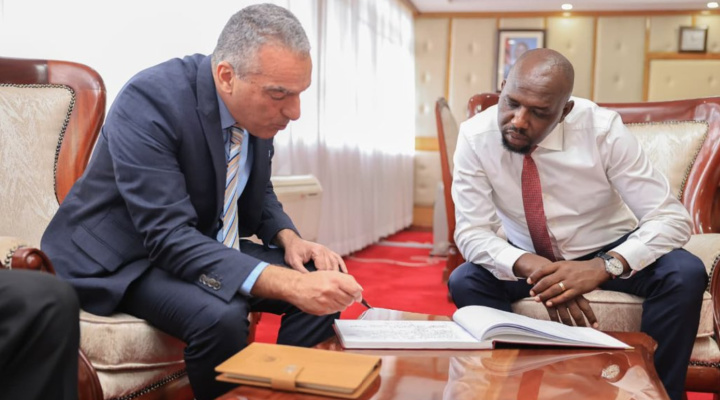
Israel’s Ambassador to Kenya, Gideon Behar, meets with Cabinet Secretary for Interior and National Security, Kipchumba Murkomen, on March 3, 2026. Photo: Screenshot
Israel’s Ambassador to Kenya has announced an initiative to deploy a mobile climate laboratory to grow data collection in the African nation, an effort to provide real-time information so policymakers can pursue solutions as temperatures continue to rise across the continent.
“There is a huge gap in climate data and climate knowledge in Africa, and the work of this laboratory helps us close this gap,” Gideon Behar said on Saturday while visiting the International Livestock Research Institute (ILRI) site in Kapiti, the current home of the mobile lab. He said that the plan would allow political leaders “to make better policy decisions based on real and accurate science.”
Israel’s Weizmann Institute of Science has spearheaded and operated the project. In December, the institute described the project’s importance, explaining that “Africa’s landscapes are transforming faster than almost anywhere else on earth, yet the continent remains one of the world’s largest blind spots in climate observations.”
The institute said that following a months-long journey around the African continent by sea, the “fully equipped Biosphere–Atmosphere Research Mobile Lab is about to roll onto African soil, launching an ambitious campaign to measure how land-use change is reshaping the region’s carbon, water, and energy cycles.”
ILRI’s Director General Appolinaire Djikeng described the importance of the project for not only Kenya but also the entire African continent.
“We are in a society where we need data to make decisions,” Djikeng said. “The pressure from the climate crisis requires precision. This facility allows us to generate the evidence needed to guide sustainable food production and environmental management.”
Academics leading the research team include Dan Yakir, professor in the Department of Earth and Planetary Sciences, staff scientist Eyal Rotenberg, and post-doctoral researcher Dan Elhanati. Rotenberg said that climate models in Africa today “are not well calibrated because there has been very little measurement. This initiative will provide the data needed to validate and improve those models.”
The mobile unit features more than 30 scientific instruments set to measure carbon exchanges, levels of solar radiation, water usage, and these factors’ impact on changes in vegetation. The lab’s ability to move enables much broader and more diverse data collection in a variety of ecosystems, according to the researchers.
“I’ve been working in this field for 25 years, studying vegetation – atmosphere interactions,” Rotenberg told Kenya’s Capital FM. “Not only how vegetation affects the atmosphere, but how the atmosphere affects vegetation.”
“That is my core motivation — to come to Africa,” he added. “Unlike in Europe, the United States, Japan or China, there is very little measurement here. But climate is global. We must understand it everywhere, especially in Africa.”
Behar — who also serves as Ambassador-Designated to Uganda, Tanzania, Malawi, and Seychelles and Permanent Representative of UNEP and UN HABITAT (UNON) — said “the measurements and scientific work being conducted here will serve the global fight against climate change.”
Rotenberg emphasized, “If vegetation uses most of the water, there is less available for human use … We need to understand that balance.”
The project plans to operate for three years before relocating to Mount Kenya and other regions. Weizmann then plans to expand to Tanzania, South Africa, and other countries.
According to the World Meteorological Organization (WMO) State of the Climate in Africa 2024 report, “extreme weather and climate change are intensifying hunger, insecurity, and displacement across Africa, impacting every facet of socio-economic development.” Depending on the data set, 2024 was either the warmest or second warmest year in Africa on record, and the previous decade was the warmest ever recorded.
WMO Secretary-General Celeste Saulo said the organization’s report “reveals a stark pattern of extreme weather events, with some countries grappling with exceptional flooding caused by excessive rainfall and others enduring persistent droughts and water scarcity.”
The effort in Kenya comes as Israel has expanded efforts in Africa to counter the impacts of climate change and the widespread droughts that have followed.
In February, officials and workers from Somaliland’s National Water Authority arrived in Israel for a course developed to train them on Israeli technology and techniques for water preservation and treatment. The trip came two months following Israel’s recognition of Somaliland, located in the Horn, as an independent, sovereign state.