


Uncategorized
Jews mobilized for Darfur 20 years ago. As violence surges again, where are they now?
They spoke of genocide and “Never Again.” They pushed to divest from entities that supported the offending government.
They protested the government’s blockade of humanitarian aid to the disputed region. They were arrested while protesting outside of an embassy.
The thousands of Jews who bused and flew to the National Mall from across the country on April 30, 2006 to call for these things fought on a platform that would be instantly recognizable to today’s pro-Palestinian protesters. But they were not there for Gaza. They were there for Darfur.
“Our halacha dictates that we help save lives,” Rebecca Stone, a Yeshiva University student who organized a fleet of buses from the Modern Orthodox school, told the Jewish Telegraphic Agency at the time, referring to Jewish law. “Apathy is really antithetical to Torah values.”
The Save Darfur Coalition sprung into being in the mid-2000s in response to the haunting spike in murders orchestrated by Sudanese dictator Omar al-Bashir, whose Arab Islamist government waged a civil war against ethnic African tribes in the country’s Darfur region. They would eventually kill an estimated 300,000 civilians and displace another 2.7 million.
Many of the coalition’s loudest voices were Jewish, and cited what they saw as a uniquely Jewish imperative to prevent genocide. Together, they worked to elevate Darfur as a significant foreign policy issue.
“The American Jewish community has been absolutely vital in uplifting the issue of Darfur, the crisis in Darfur, and the situation in Sudan in general in the American consciousness,” Noah Gottschalk, chief external relations officer for the Jewish immigrant aid group HIAS, said in a recent interview. “When you look at the organizations that were founded in the aftermath of the genocide in 2003, so many Jewish organizations were part of that.”
Today, six years after the end of al-Bashir’s reign and 14 years after the founding of South Sudan as an independent country, Darfur is again descending into chaos as the RSF, Sudan’s government-backed paramilitary forces, have laid siege to the town of el-Fasher. More than 150,000 people have been killed, and another 12 million have been forcibly displaced. Rape, kidnapping and famine are rampant. The bloodshed is so extreme that it is visible from space.
Yet nothing like the Save Darfur Coalition has been reconstituted on the activist front — neither by the mainstream Jewish groups who mobilized for the cause two decades ago, nor the progressive left that activated so strongly over what they deemed a genocide in Gaza, during the war that followed Hamas’ Oct. 7, 2023, attack on Israel.
“At this time, and simply for capacity reasons, we are not actively engaged in efforts around the ongoing tragedy in Darfur,” Barbara Weinstein, associate director of the Religious Action Center at the Union for Reform Judaism, told JTA.

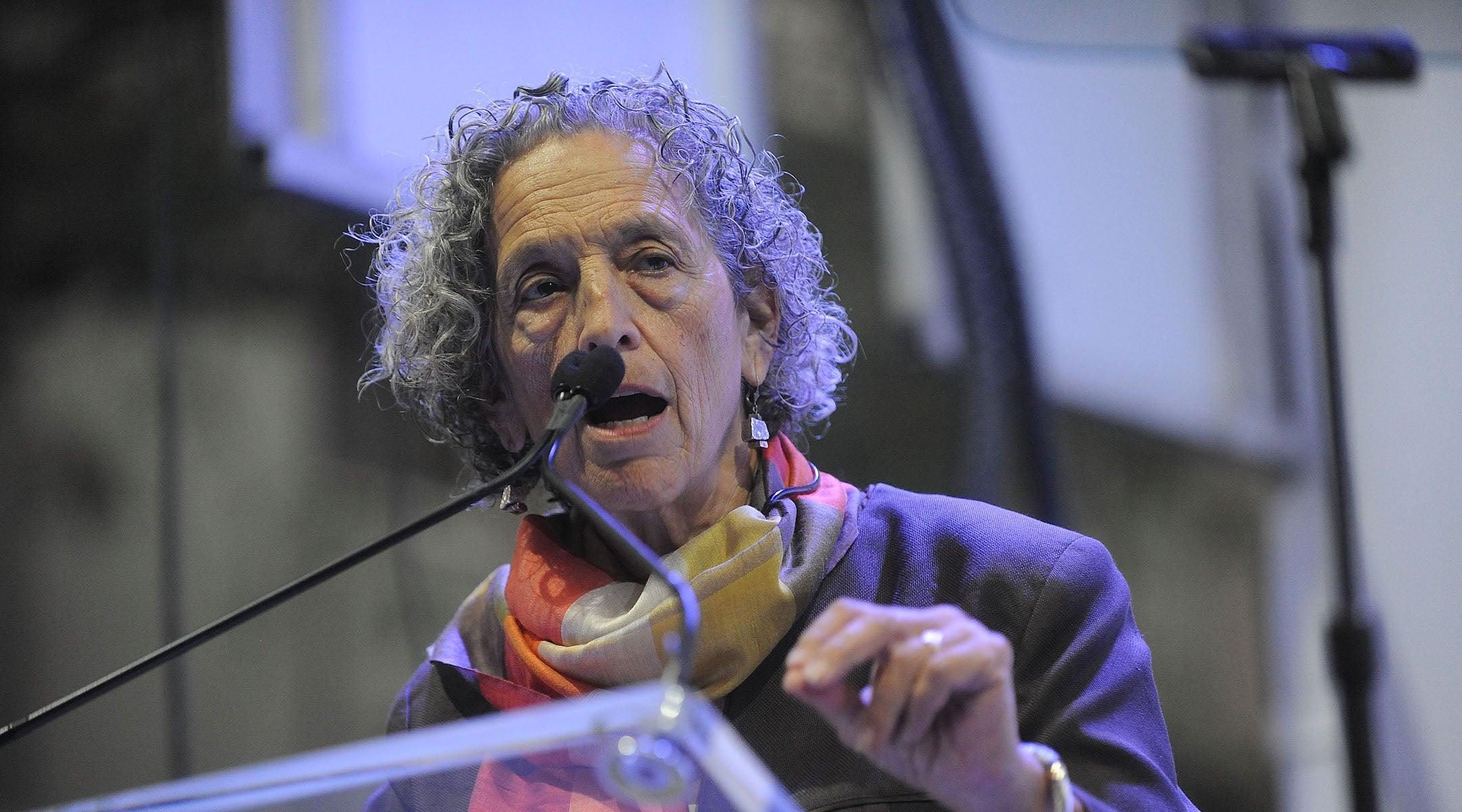
Ruth Messinger attends the New York Action 2015 global mobilization event on Sept. 24, 2015 in New York City. (Brad Barket/Getty Images for Action/2015)
“The Jewish community has legitimately had several dramatic issues that have raised attention and concern, and often caused crisis, in the last three years, particularly Oct. 7 and rising antisemitism,” Ruth Messinger, the longtime head of American Jewish World Service and former New York City mayoral candidate who co-founded the Save Darfur Coalition, told JTA.
Messinger continued, “Those issues have appropriately concerned the Jewish communities around the world, and so concerned the Jewish communities that it’s been hard to create space for other concerns.”
It’s a conclusion that would have been foreign to Messinger two decades ago. Back then, she was at the forefront of a movement to take the lessons of the Holocaust, still relatively fresh, and apply them to a contemporary crisis.
She and others were haunted by the 1994 genocide in Rwanda, which occurred over just 100 days when the country’s Hutu government led an attempted purge of its Tutsi ethnic minority. An estimated 1 million Tutsis were massacred, and the speed and scale of the killings — many of which took place in churches, or in open fields in broad daylight — shocked the global consciousness.
Later, President Bill Clinton said he would have taken stronger action against genocide in Rwanda if he had known more at the time. Messinger and other Jewish leaders — those who had embraced the Never Again ethos 50 years after the term genocide was coined in the wake of the Holocaust — took that as a charge.
“There were a lot of people in the Jewish community who felt like we had missed the boat on Rwanda,” Messinger recalled. “We considered ourselves watchdogs for the potential next genocide.”
When, a few short years later, New York Times columnist Nicholas Kristof started writing regularly about the crisis in Darfur, Messinger and others — a group including Rabbi Steve Gutow, diplomat Samantha Power and the Holocaust survivor and Nobelist Elie Wiesel— paid attention. In a meeting organized by American Jewish World Service and the U.S. Holocaust Memorial Museum, Wiesel directly implored Jewish leaders to do something.
“I will never forget that meeting as Wiesel addressed us in his soft-spoken, yet powerful, voice,” recalled Rabbi Marla Feldman, director emeritus of Women of Reform Judaism, who worked on social justice issues with the Reform Action Center at the time. “He looked directly at each of us gathered around, impressing upon us our personal responsibility to take action. No one could say no to his charge to organize that day.”
They decided to throw everything they had into mobilizing on Darfur. The coalition was born.
“Everyone who came to the meeting said, ‘Well, let’s continue working together, and we’ll call ourselves the Save Darfur Coalition,’” recalled Jerry Fowler, now a law professor at the University of Wyoming. At the time Fowler was the (non-Jewish) director for the Committee on Conscience — a division at the U.S. Holocaust Memorial Museum committed to applying the lessons of the Holocaust toward preventing future genocides.
The museum, and more specifically the Committee on Conscience, played a significant role in elevating the crisis in Darfur within the Jewish community by issuing a rare warning that the region was at risk of tipping into genocide. When, in 2004, the U.S. government declared that the Sudanese government and its related militia groups, including the Janjaweed, were indeed committing genocide in Darfur, citing the United Nations Genocide Convention, the combined effect was to put Darfur on the map as a Jewish issue.

Rabbi David Saperstein (center foreground) and Jerry Greenfield (background) of Ben & Jerry’s ice cream fame, are arrested outside the Sudanese embassy during a protest against the genocide in Darfur, July 29, 2004, Washington, D.C. (Marvin Joseph/The Washington Post via Getty Images)
“Social justice is a huge component of the way American Jewry expresses their Jewish identity,” said Rabbi David Saperstein, director emeritus of the Union for Reform Judaism’s Religious Action Center. He was an active figure in both the Save Darfur Coalition and an earlier movement to push for a peace accord to end the Second Sudanese Civil War.
Quickly, Saperstein recalled, “Save Darfur” signs made their way into synagogues across the country.
“Many people put Darfur into their Passover Seders,” he said. “That helped deepen the connection [to] people forced to flee out of oppression and persecution, and what it was like to live in the desert, in a place not your home, with the hope of finding safety and security.” American Jewish World Service encouraged such identification by distributing Darfur-specific seder material.
Back then, Darfur crossed Jewish denominational boundaries. Everyone from the Union for Reform Judaism’s advocacy arm to the Conservative summer camp Camp Ramah to Yeshiva University engaged on the issue. Synagogues jumped onboard “Nothing But Net,” a UN-led initiative to raise funds to send malaria nets to refugee camps — and raised enough on their own to fully stock several camps. Young observant Jews would go on to intern with Darfur policy groups and bring their activism to the upper levers of power.

Union for Reform Judaism leaders distribute bed nets to Sudanese refugees in Dabaab, Kenya, as part of their organizational efforts with the Save Darfur Coalition, Feb. 10, 2009. Rabbi Marla Feldman, at the time a leader of social justice issues with the Religious Action Center, is second from left. (Claudio Gallone)
“I have this vivid memory of sitting in the Beit Knesset at camp listening to a Jewish World Watch staffer talk about the Janjaweed and show photos of devastated villages,” Ami Fields-Meyer, a fellow at the Harvard Kennedy School and former White House policy advisor under former President Joe Biden, recalled about his time at Camp Ramah. “It was shocking. It was almost certainly my first exposure to human rights work.”
Adam Zuckerman was a 17-year-old high school student in Maine when Messinger came to his Portland synagogue to speak about Darfur. He was immediately engaged on the issue, making close friends with members of the state’s large Sudanese refugee community and riding buses to D.C. with them.
“I think a lot of it was that, with the legacy of the Holocaust, we had a responsibility to make sure that it never happened again to anyone,” Zuckerman recalled, about the pitch to Jews for getting involved in Darfur. “That was a sort of driving force in why I took on anti-genocide work.”
His friends in the refugee community included El-Fadel Arbab, a genocide survivor who spent nine years trying to enter the United States before finally being granted passage in 2004. Upon his arrival in Maine, Arbab was embraced by local Jewish groups. He would go on to tell his harrowing story, involving fleeing his village and living on the street as a child, at synagogues and Holocaust museums in the state and beyond.
Arbab quickly felt a kinship with his Jewish allies and supporters, rooted in shared trauma: what Darfur villagers suffered at the hands of the Sudanese groups had morbid similarities with the Jewish victims of the Holocaust.
“What they went through is also remarkable,” he told JTA. “So many Jewish people have been killed. Millions and millions have been killed. They’ve been tortured, they’ve been burned alive. And this is not right.”
Besides the brutality, the Jewish comparison also inspired Arbab — particularly the refrain “Never again,” which he often repeats himself. “They’re still fighting for justice. They’re saying, ‘These victims will learn from the history.’”
A list of the biggest voices within Save Darfur included some of the most prominent Jews in America at the time.
Speakers at the National Mall rally included Messinger; Saperstein; National Jewish Democratic Council director Steve Gutow; Rabbi Rick Jacobs of the Union for Reform Judaism, before he became its president; and Rabbi Marc Schneier.
They shared the stage with then-Sen. Barack Obama, months before he announced his presidential bid; the top Democrat in Congress, Nancy Pelosi; actor George Clooney; and a range of Sudanese and interfaith activists. “I don’t think there have been many rallies like it in recent years,” Feldman said.

Elie Wiesel speaks at a Save Darfur rally at the National Mall, Washington, D.C., April 30, 2006. (Screenshot via C-SPAN)
But perhaps the most noteworthy person to grace the stage was Wiesel, who had vocally lobbied not only on behalf of Rwanda but also over the plight of Soviet Jews. It was Wiesel who had inaugurated the U.S. Holocaust Memorial Museum’s Committee on Conscience in the first place, to, in the words of the committee’s mandate, “alert the national conscience, influence policy makers, and stimulate worldwide action to confront and work to halt acts of genocide or related crimes against humanity.”
Only a few months earlier, in January 2006, “Night,” Wiesel’s memoir of the concentration camps, was chosen as an Oprah’s Book Club selection 50 years after its original publication. Though already a bestseller, the Oprah exposure introduced “Night” to a new generation of readers and reinforced Wiesel as a global authority on humanitarian crises.
He threw all of that leverage behind Darfur.
“I, as a Jew, am here because when we needed people to come to help us, nobody came. Therefore, we are here,” Wiesel told the National Mall crowd. “I am here as a member of the human family, and we believe that we sinned with Rwanda. We could have saved 6-800,000 men, women and children in Rwanda, and we did not, and the world should be ashamed for that.”
Over applause, he continued, “We are here because in Darfur, families are being uprooted, starved; children tormented and slaughtered in the thousands; and in the eyes of the victims, the world remains indifferent to their plight. We are here because we refuse to be silent. Remember, silence helps the killer, never his victims.”
It was a galvanizing moment, an explicit bridging from the Jewish communal trauma of the Holocaust to the modern-day tragedy in a far-off corner of the world with no obvious Jewish connection. To Wiesel, it just made sense.
“For my father, there was no split between doing what was right on the global stage and standing up for the Jewish community,” Elisha Wiesel, Elie Wiesel’s son, told JTA. “It wasn’t like those were two completely separate projects. My father felt that to be a good Jew meant to stand up and do the right thing on a global scale.”
And there was a divestment push within the Jewish community. The Reconstructionist Rabbinical College, under pressure from its members, divested its holdings from companies that did business with the Sudanese government, as a means of economically hurting al-Bashir’s regime. In so doing, it joined dozens of similar actions from the country’s leading universities, including Harvard, Columbia, and MIT, all celebrated by the activist group Investors Against Genocide. (A spokesperson for the Reconstructionist movement declined to comment for this story.)
Sustained Jewish activism around Darfur continued for years. In 2009, Jewish leaders were arrested for staging a demonstration outside the Sudanese Embassy in protest of al-Bashir’s expulsion of more than a dozen aid groups from Darfur. The rabbis were joined at the protest by Democrats including civil rights leader John Lewis. Several Jewish leaders also signed a Save Darfur Coalition letter urging Obama — then president — to resume humanitarian aid in Sudan.
The following year, a delegation of Jewish leaders — including Messinger, Saperstein and Jacobs — traveled to visit a camp for Darfur refugees just over the border in Chad. The trip happened to coincide with the holiday of Sukkot, which, like the Passover Seders before it, drove home the Jewish resonance of the cause.
“To see people living out in the open and eating out in the open,” Saperstein said, “had a particular resonance for us.”
As the years passed, the focus and methods of the Save Darfur Coalition attracted scrutiny and criticism from some corners. “Darfur Wasn’t Saved,” Slate declared in 2017 in a postmortem; groups like Genocide Watch have reached similar conclusions.
Critics dinged the movement for proposing the wrong policy solutions; for infighting among leadership; and for failing to steer more of its own financial resources toward direct aid, among other issues. Some, as early as 2006, were already accusing the movement and its Jewish leaders of using Darfur to ignore Israeli conduct in Gaza — which had just elected Hamas to power earlier that year.

Columbia University professor Mahmood Mamdani (right) with son Zohran and wife Mira Nair at a mayoral campaign event for Zohran, June 24, 2025, New York, New York. (Michael M. Santiago/Getty Images)
One of the foremost critics of the Save Darfur movement was Mahmood Mamdani, the Ugandan-born Columbia University professor, prominent critic of Israel and father of New York City’s mayor-elect.
In his 2009 book Saviors and Survivors: Darfur, Politics and the War on Terror, Mamdani argued that Darfur did not constitute a genocide; that those who applied the label may have been operating from a prejudiced perspective against Islam; that activists like those in the coalition didn’t have the proper context for the situation; and that Western intervention may have made the conflict worse. In promoting the book, Mamdani also didn’t mince words in criticizing the Save Darfur Coalition.
“Save Darfur is telling its supporters that the lesson of Rwanda is that there’s no point in talking about causes of conflicts,” Mamdani said on WNYC’s “The Takeaway” in April 2009.
Strains of dissent could also be heard from within the Jewish world, where some argued against what they saw as a conflation of Jewish and progressive values. “Health care, labor unions, public-school education, feminism, abortion rights, gay marriage, globalization, U.S. foreign policy, Darfur: on everything Judaism has a position — and, wondrously, this position just happens to coincide with that of the American liberal Left,” the Israeli writer Hillel Halkin complained in the conservative Jewish magazine Commentary in 2008.
But the Darfur coalition transcended typical ideological divides, including a wide array of Jewish groups as well as fundamentalist Christians and figures motivated by anti-Islam animus. The combination could be awkward. A series of rapid leadership changes, accusations of financial mismanagement and other infighting through the late 2000s led to the group’s ultimate collapse as a viable political force. Jewish communal leaders who spoke to JTA acknowledged that the coalition’s momentum couldn’t be sustained, but they believed that it had a lasting effect, particularly on Jewish communal organizing.
Zuckerman went on to become a close disciple of Messinger at the American Jewish World Service. Today he works for Public Citizen, a progressive group, on environmental issues.
He credits his Darfur activism with his trajectory, as well as for something else: his pro-Palestinian activism, which he has expressed through work in IfNotNow as well as with Jewish Action Maine, a group affiliated with the local Jewish Voice for Peace chapter.
“It’s been tricky, because I don’t feel like I necessarily fit into a box on it, and I am uncomfortable with some of the rhetoric and some of the slogans in these spaces,” Zuckerman said.
At the same time, he said, “I think it would be hypocritical for me to speak out about Darfur and not say anything when people who share my religion are also committing atrocities.”

A man amongst a group of African refugees, mostly from Sudan’s troubled Darfur region, visits the Yad Vashem Holocaust Memorial Museum on Aug., 2009 in Jerusalem, commemorating the six million Jews killed by the Nazis during World War II. (Uriel Sinai/Getty Images)
Israel itself got involved in the initial round of Darfur activism, allowing hundreds of refugees from the region to apply for asylum there. (Upon arrival some of the refugees visited Yad Vashem, the national Holocaust museum.) Most of those asylum cases, which were handled by HIAS and did not involve Jews, took years to work their way through Israeli courts before a judge granted the Sudanese asylum seekers temporary status last year.
Today much of the same Jewish institutional muscle that once advocated for Darfur has turned inward, toward fighting antisemitism and shoring up Jewish support for Israel since Oct. 7. That has included fending off accusations that Israel has committed genocide in Gaza.
Over the last two years, Jews have at times disputed statistics and declarations about the state of Gaza’s humanitarian crisis — including allegations that Israel, like Sudan before it, has deliberately withheld humanitarian aid from a conflict zone — that come from the United Nations and various NGOs they had previously worked together with on Darfur causes. Jewish leaders, including at the RAC, have objected to resolutions to boycott or divest from Israel, usually on the grounds that such measures are divisive and unhelpful or can lead to antisemitism.
This has saddened some of the more progressive Jews who saw, in the Darfur fight, a commitment to a kind of universalism of Jewish values they now believe has atrophied.
“I don’t think our voice would have the same weight or the same legitimacy that it has now to speak out on Darfur, because we’ve been so silent, and in many cases so oppositional, to what’s been happening in Gaza,” Zuckerman said. “I think that when we are silent about something that people who share our religion are perpetrating, the world would look at us sort of sideways to be speaking out about [Darfur]. I think it would be seen as trying to distract from other crimes against humanity that are happening in another part of the world.”
Others worry that the fight over whether or when to declare a genocide is blinding people, including Jews, from focusing on what’s really important.
“The term ‘genocide’ is being used in different ways today than in the past, and that’s itself a challenge,” Feldman said. “You could get caught up in the wordsmithing of it — call it genocide, don’t call it genocide. There are atrocities and tragedies taking place around the world, and that speaks to us, and that has a claim on us.”
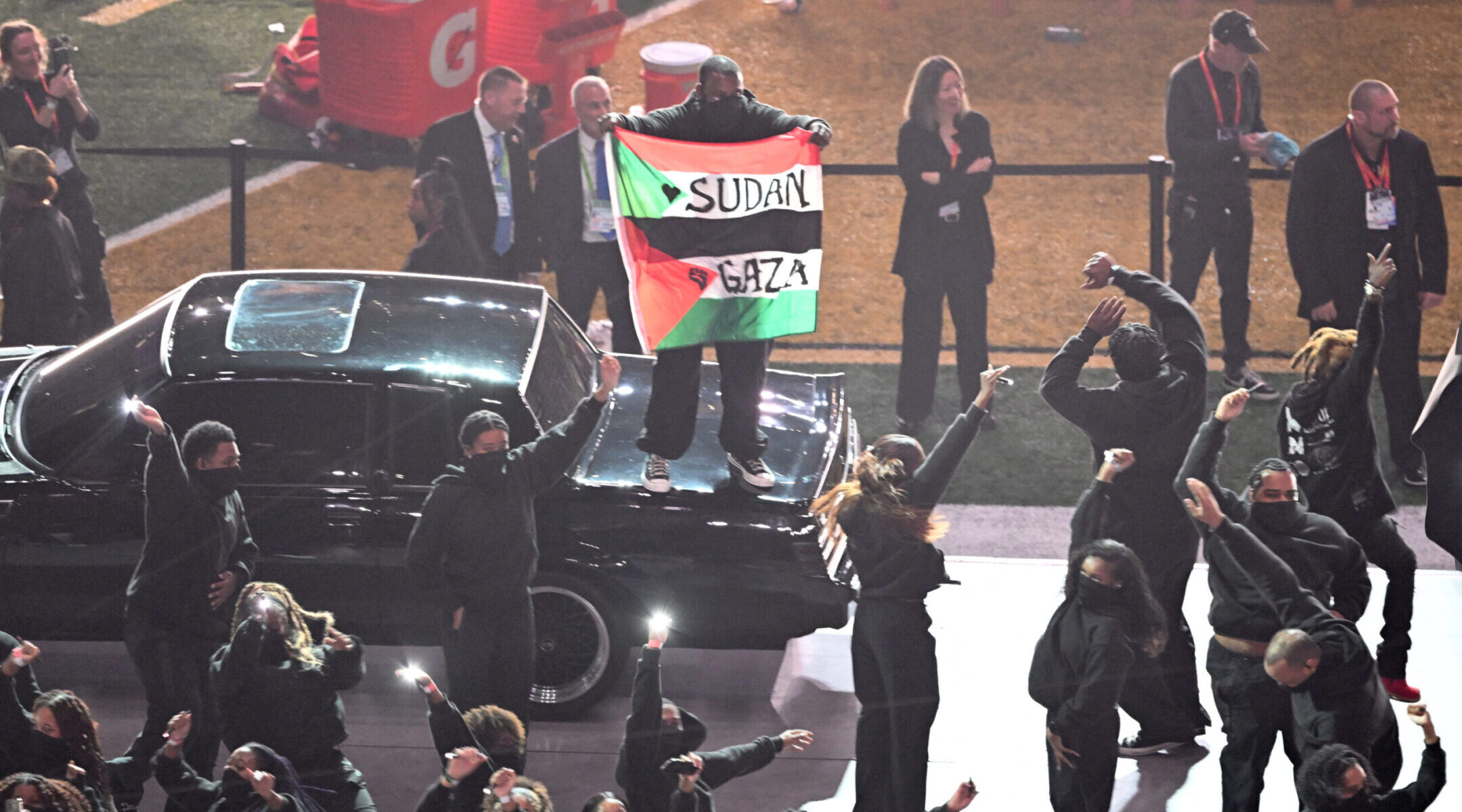
A protester holds a Sudan/Palestinian flag with the words “Gaza” and “Sudan” as US rapper Kendrick Lamar performs during the Super Bowl LIX halftime show, Feb. 9, 2025. (Chandan Khanna/AFP via Getty Images)
Meanwhile, with some exceptions, the global pro-Palestinian movement has also been relatively quiet on Darfur — further lending itself to criticisms that a purported principled stance against genocide didn’t extend further than Israel. Many Jews in a post-Oct. 7 climate have noted a fraying of the kinds of interfaith, intercultural alliances that once helped bolster the Save Darfur Coalition.
Jews who spoke to JTA for this article had mixed feelings on this shift. But some were quick to point out that they don’t see Darfur and Gaza as comparable.
“It’s not a parallel thing because you didn’t have an Oct. 7 in Darfur,” Saperstein said. “You didn’t have the people of Darfur attack the population centers where the Janjaweed were. This is just civilians caught in the middle of a horrible, horrible attack from the north and from the Janjaweed militias.”
Elisha Wiesel, like his father a staunch supporter of Israel, also believes Jews’ relative silence on Darfur in the wake of Gaza is a problem. In part, he said, he feared that Jews were allowing terms like “genocide” to become diluted by pro-Palestinian activists.
“I think we have to restore language to its proper use, and we have to call it as we see it,” he said, noting that the Wiesel family foundation has taken on the cause of the persecuted Uyghur minority in China. Similarly, the best way to assert Jewish credibility on the world stage, he argued, would be for Jews to advocate both for Israel and for global humanitarian concerns like Darfur.
“Since Oct. 7 we’ve been reeling, as an American Jewish community, with our own tragedy. And worse, we’ve been having to be on the back foot as accusations of genocide have been flung at Israel,” Wiesel said. “I feel now is the right time to reengage. I think the best way forward is to tackle real genocides.”
Arbab, the Darfur genocide survivor, also disagrees with the genocide label being applied to Gaza. He described feeling an immense empathy for Jews and Israelis after Oct. 7, noting that the brutal nature of the Hamas killings at the Nova music festival mirrored the nature of how the RSF and other Sudanese militias have targeted innocents.
“These monsters, they jumped on people partying, and they’re butchering everybody,” he said. “Israelis want to protect their people and their land, and they come and attack them.”

El-Fadel Arbab, a Sudanese refugee from the Darfur region, reunites with his family in the United States after they fled the region amid reignited hostilities, March 2024, Boston, Massachusetts. Arbab has allied with the Jewish community to advocate for Darfur’s victims. (Courtesy of El-Fadel Arbab)
Arbab continued, “If you’ve been through this struggle, you definitely will say, ‘I stand with Israel.’ If you did not go through these horrible things, you might go to the other side, you might say, ‘Oh, I will support the Palestinians.’ But that is not the case to me. If I have the power, I will protect my people. And anybody who comes to my people, I’m not going to leave them alone.”
Times have changed, some of Save Darfur’s Jewish leaders said. Even setting aside Gaza, the sheer scope and scale of the world’s challenges today means that pushing Jews to mobilize around something like Darfur has become much harder.
“We can’t fight every crisis everywhere,” Feldman, now retired, told JTA. “The current leaders have to be strategic, and the population, to a certain extent, is also going to speak with their feet in terms of what’s compelling them today.”
For more progressive Jews who cut their activist teeth on Darfur, the relative inaction — not just from Jewish communities, but more globally as well — especially stings.
“Darfur was in every Jewish space. And it felt like everyone had a green ‘do not stand idly by’ wristband,” Fields-Meyer recalled. “The unmistakable message was that our moral obligations as Jews bound us to people for no other reason other than that they are human. And a lot of us took that to heart. I certainly did.”
He continued, “Being consistent about those Jewish commitments means doing what’s necessary for families being torn apart by masked agents in Los Angeles, and for children under bombardment in Gaza, and for people under threat in Darfur, and for fellow Jews who are attacked for their identity. It means that there is no hierarchy of human dignity. We’re all worthy.”

A map of two years of hostilities in Darfur as of April 11, 2025. (AFP via Getty Images)
Today, the forces that are engaged on Darfur are trying to put pressure on the United Arab Emirates, currently Sudan’s largest arms dealer. President Donald Trump also signaled an interest in ending the conflict and dispatched Massad Boulos — a Lebanese-American businessman and Tiffany Trump’s father-in-law, who has also proposed a roadmap to Israeli-Palestinian peace — to try to negotiate a ceasefire.
But recent failed ceasefire efforts have led the United States to consider wider sanctions on Sudan. On Dec. 9, the Treasury Department seemed to follow through, sanctioning entities associated with a Colombian group that, the United States said, was funneling mercenaries to Darfur.
Some remain optimistic that American Jewish leadership could reactivate on Darfur today — and believe that it would be the right thing to do.
“I’m hopeful that there will be really positive energy for Darfur,” said Gottschalk, the HIAS staffer. He noted that HIAS, which operates a refugee camp in neighboring Chad, has remained active since the last conflict and is engaged again on Darfur today — in part thanks to the legacy of the coalition. “We haven’t left. It’s been more than 20 years. It’s an expression of the Jewish community’s solidarity.”

People displaced from El Fasher and other conflict-affected areas are settled in the newly established El-Afadh camp in Al Dabbah, in Sudan’s Northern State, on Nov. 9, 2025. Tens of thousands were forced to flee after the Rapid Support Forces (RSF) took control of the city of El Fasher on Oct. 26, triggering intensified clashes across North Darfur. (Stringer/Anadolu via Getty Images)
He continued, “When we’re working with people in Chad, we are absolutely the first and probably the only Jewish organization they’ve ever met or ever encountered with. We are representing our values and reflecting something really positive with the community.”
Today, Arbab still has family in Darfur under grave danger, though he was able to evacuate his wife and sons out of the region last year. He knows it’s harder now to get the international community to pay attention. He’s still speaking to some Jewish groups, though not as many as before.
The Sudanese government, he believes, fears the accountability that would come with the genocide label being applied once more to Darfur. He hopes the global community will activate again — and this time try to break the cycle of killing for good.
“The Jewish people, they went through their genocide a long time ago,” he said. “But the genocide now is the same, and even worse. These criminals, always, they’re thinking of new tactics and new ways to do more genocide, how to harm people. We have to stop that. Especially those who have felt the pain of the victims, they have to stand up.”
This article originally appeared on JTA.org.
The post Jews mobilized for Darfur 20 years ago. As violence surges again, where are they now? appeared first on The Forward.
Uncategorized
Democrats to weigh resolution condemning AIPAC, fueling concerns about ‘undercurrent of antisemitism’
(JTA) — The Democratic National Committee is set to consider a resolution at a meeting next week that “condemns the growing influence” of AIPAC.
The resolution also condemns large-scale outside spending in elections generally but calls out only the pro-Israel lobby specifically, even as other lobbies are pouring similar sums into trying to influence election outcomes.
The meeting is being held during an election cycle in which rejecting AIPAC support has become a defining issue in Democratic races. It also comes amid concerns from some Jewish Democrats — including ones critical of AIPAC — that the group’s emergence as a bogeyman in American politics is inappropriate or even antisemitic.
“I do think there is an undercurrent of antisemitism in the degree to which AIPAC seems to be vilified,” Rep. Dan Goldman told the Jewish Telegraphic Agency last month. Goldman has accepted an endorsement from AIPAC as he seeks a third term, but says he won’t take money from corporate PACs in this election.
The resolution, which is subject to amendments before it is voted on, specifically names AIPAC and its super PAC, United Democracy Project, as having been “one of the largest outside spenders in Democratic contests” in 2024. It also refers broadly to other “corporate money PACs” and sources of “dark money,” though it does not name any specific groups.
Committee member Allison Minnerly, who introduced the resolution, told the Intercept, a left-wing outlet, that formally distancing the Democratic party from AIPAC “could be one step toward” winning back voters who “might really not have felt represented or seen when it came to Gaza or seeing their party support Palestinian rights or stand against military conflict.” Minnerly also introduced a resolution last August calling for an arms embargo on Israel, which was defeated.
A recent NBC poll found that 57% of Democratic voters have a negative view of Israel, compared to 13% who have a positive view of the country.
Meanwhile, a growing number of the party’s congressional candidates — and politicians thought to be seeking its 2028 presidential nomination — are swearing off AIPAC, and crossing its red line of supporting conditions on military aid to Israel.
The group has also spawned opposition online. Track AIPAC, the social media watchdog that posts politicians’ pro-Israel lobbying campaign donation numbers, has amassed 442,000 followers on X since 2024.
At town halls and candidate forums, politicians on the campaign trail are often being asked whether they would accept an endorsement or donations from the group.
Alana Zeitchik, an Israeli-American advocate and writer, said she understands that candidates might be asked about AIPAC in those types of settings, and said that she personally “would love to hear candidates” reject all special interest and corporate dollars. But when they hone in on AIPAC “on their own accord,” she said, she views it as “a political strategy to feed the beast, this hyper-obsession with AIPAC.”
The proposed DNC resolution voices concern over “massive outside spending” on candidates based on their foreign policy positions, pointing specifically to AIPAC’s $14 million spend in a single Illinois primary. The threat of those expenditures “raises concerns about undue influence over democratic debate and policymaking,” the resolution reads, and in “shaping Democratic party positions.”
The resolution condemns “the growing influence of dark money and corporate-backed independent expenditures in Democratic elections.”
AIPAC has remained a major spender in this year’s midterm elections. The group, which is operating with the aim of electing a majority pro-Israel Congress, recently shelled out around $22 million in support of four Illinois candidates, three of whom it backed through shell PACs under different names. Two of its four preferred candidates won.
While it narrows in on AIPAC, the DNC resolution does not address other types of high-spending special interest groups, such as real estate lobbying groups or the burgeoning landscape of pro-AI PACs.
New Jersey Sen. Cory Booker, who has previously received AIPAC donations but is rejecting all PAC money this year, told Politico last week that the particular attention paid to AIPAC has been “problematic.”
“There are Iranian Americans that bundle money. There are Turkish Americans that bundle money. There are a lot of ethnic groups that bundle money, and often for things that I don’t agree with. But somehow AIPAC seems to be drawing a lot of attention, and that’s problematic to me,” Booker said. “[AIPAC] is not the problem in America. The problem in America is money in politics.”
Adam Carlson, head of the progressive polling form Zenith Research, poked fun at Booker’s comments with a facetious tweet that dismissed Booker’s concerns, and pointed out the lack of an AIPAC-sized group for Iranian and Turkish Americans.
“Cory’s right. I am sick and tired of the mainstream media refusing to report on PERSIAPAC and TURKPAC spending hundreds of millions of dollars meddling in primaries to boost their preferred candidates,” wrote Carlson, who is Jewish. “It’s an antisemitic double standard, and he’s a hero for pointing it out.”
Goldman, like Booker, says he isn’t taking corporate PAC money in this election, but he did accept AIPAC’s endorsement. Goldman is currently facing a primary challenge from Brad Lander, a Jewish progressive whose attacks against Goldman have centered the congressman’s AIPAC endorsement.
While the DNC’s proposed resolution suggests that AIPAC is shaping Democratic party positions, Goldman asserted that his views are independent from his endorsements.
“I have personally pushed AIPAC very much to recognize that it is an organization that supports first and foremost the State of Israel and the U.S.-Israel relationship, but that does not mean that they should be unwavering in their support for the Israeli government,” he said.
He added, “I am going to continue to operate independently, based on my own understanding and nuanced view of the situation, and work towards a peace in the region and two-state solution and security for Israel.”
Other Democrats have said they turned down AIPAC because of foreign policy disagreements. In Illinois, Rep. La Shawn Ford said he met with UDP but did not receive its endorsement because he was unwilling to meet its requirement of supporting unconditional military aid to Israel.
Zeitchik said she is not a fan of AIPAC’s “really dirty” tactics, which have included spending on attack ads against pro-Israel politicians because they are open to conditioning military aid — but she, too, has concerns about the particular attention paid to it.
“I think that the hyper-obsession with AIPAC amongst progressives, and making AIPAC the bogeyman, the problem, has an undercurrent of what I’d call an antisemitic worldview, or an antisemitic reaction,” Zeitchik said.
Joel Petlin, the school district superintendent in the heavily Jewish village of Kiryas Joel, outside New York City, wrote that the DNC’s proposed resolution “singles out AIPAC for doing precisely what many other lobby groups are doing every day.”
He added, “If this resolution passes, the DNC can finally stop calling themselves ‘the big tent party,’ because it clearly isn’t large enough for American Jews.”
Similar accounts to Track AIPAC have popped up online, though none have taken off in the same way. Oil PACs Tracker was founded in 2021 and has 43,000 followers. An account called Melt ICE, which tracks candidates’ stance on ICE, has garnered 3,000 followers since being created in January.
Zeitchik said she appreciates how congressional candidates such as Jack Schlossberg, who is running in New York’s 12th Congressional District, have approached the issue by rejecting all special interest money without harping specifically on AIPAC.
“When I see Israel become a wedge issue, and politicians continue to push and make it a wedge issue — that, to me, is alarming,” she said.
This article originally appeared on JTA.org.
The post Democrats to weigh resolution condemning AIPAC, fueling concerns about ‘undercurrent of antisemitism’ appeared first on The Forward.
Uncategorized
Stitched in faith, woven in memory, these precious artifacts bind Jews to their history

The red stitching has long since faded, and the hand-woven linen has softened from white to ivory. Embroidered with a menorah, a double-headed eagle, a lion, and a Magen David, the 18th-century Torah binder is simple in design yet rich in history.
The binder is among 25 artifacts from London’s Memorial Scrolls Trust making their American debut in Fordham University’s “Binders of the Covenant” exhibition. Aside from showing how these functional objects, beautified, in keeping with hiddur mitzvah (beautifying a ritual object) the exhibition reveals the binders’ dual purpose: securing parchment Torah scrolls while symbolically binding families to their community.
“The binders allow us to see the artistic expression of the devotion; of how they reflect traditional values of Jewish identity, like going toward the Torah, toward the chuppah, and doing good deeds. But there is also an acknowledgement of local identity like in the Hapsburg double eagle or a German flag,” Magda Teter, a chaired professor of History and Judaic Studies at Fordham, told me.

Though women were historically excluded from reading or carrying the Torah, they were the primary creators of these binders. Through intricate needlework, they forged a physical connection to the sacred text. The collection includes a binder created by a grieving husband for his late wife, Esther, and another inscribed by a mother celebrating her daughter’s birth.
“It shows that women managed to get close to the Torah, they are bound to the Torah even if their physical bodies were not allowed to do that,” Teter said.
The history of these binders is rooted in survival.
Between the 14th and 20th centuries, Ashkenazi parents in Central Europe swaddled newborn boys in linen strips called wimples. Women embroidered them with religious and secular symbols. When a boy began formal Torah studies around age three, the family donated the wimple to the synagogue to be reused during milestones, such as a recovery from illness or the Shabbat before a wedding.
“It’s a collective story of community. Seeing these artifacts brings history to life,” guest curator Warren Klein said.
Over time, the creation of these binders evolved as women moved beyond traditional linen and cotton to incorporate silk, leather and velvet, reflective of Bohemian artistic traditions.
An intricately decorated 18th century binder featuring intricate leatherwork flowers, embroidery and beads on plum-colored velvet is a prime example.
“It shows an exchange of artistic ideas,” Klein said.
Over time, production shifted from hand-embroidery to sewing machines and paint. The inscriptions shifted as well, as German, Czech, and Yiddish frequently replaced traditional Hebrew.
Visitors to the exhibit will note the lingering shadow of the Shoah. A 1922 binder depicts a Magen David alongside a German flag; a display of pride in both Jewish and national Jewish identity created just two decades before the Holocaust.
Embroidered in canary-yellow silk thread on linen, a 1918 Bar Mitzvah binder for Ludwig Rosenzweig serves as a reminder of this era. On Oct. 26, 1942, Rosenzweig, his wife, and child were murdered at Auschwitz. Today, these binders remain the only physical witnesses to such interrupted lives.
“You can’t escape the loss but in order to appreciate the loss you need to understand the life. Those binders bring the people to life; they capture the moments of joy and celebration, and of course death. The binders create communal memory,” Teter said.
The tradition of hand-sewn binders has faded over the last half-century. Families are more apt to commemorate a child’s birth with the donation of engraved silver Judaica or prayer books with commemorative bookplates.
Yet, rather than lament this change, the exhibit brings the practice of creating binders to the present with the display of contemporary works by fabric artist Rachel Kanter.
“These community binders show vibrancy,” Teter said. “They show that Jewish life is ongoing,”
The post Stitched in faith, woven in memory, these precious artifacts bind Jews to their history appeared first on The Forward.
Uncategorized
California College Employee Calling Jewish Professor ‘Colonizer’ Was Antisemitic, Investigation Finds

Sign reading “Welcome to City College of San Francisco” above glass entry doors with building number 88, San Francisco, California, Aug. 29, 2025. Photo: Smith Collection/Gado/Sipa USA via Reuters Connect
A City College of San Francisco (CCSF) staff member who called a Jewish professor a “colonizer” among other verbal attacks engaged in unlawful harassment and discrimination based on the academic’s Jewish identity, according to an independent investigation into the incident.
The Louis D. Brandeis Center for Human Rights Under Law and the StandWithUs Saidoff Legal Center, two Jewish advocacy groups, on Tuesday celebrated the upholding of a disciplinary investigation’s finding as a “significant victory” for Jewish faculty and students.
“The outcome establishes a critical precedent for how universities must evaluate conduct often mischaracterized as political speech but that, in context, targets Jewish identity,” the groups said in a statement.
The investigation stemmed from a series of incidents which escalated to an explosive May 2025 confrontation in which CCSF employee Maria Salazar-Colon, president of the local Service Employees International Union (SEIU) union, allegedly launched a volley of anti-Jewish invective at computer science professor Abigail Bornstein. Calling Bornstein a “colonizer” and telling her to “shut the f—k up,” Salazar-Colon converted the professor’s name into a sobriquet by denouncing her as “Dumb-stein” during the public comment portion in a meeting of the community college’s board of trustees, according to the Brandeis Center and StandWithUs.
That utterance, combined with other comments related to Israel, indicated Salazar-Colon’s awareness of Bornstein’s Jewishness and her willingness to degrade her over it, the Brandeis Center and StandWithUs said — noting that a trivial discussion on college “governance,” not politics or the Middle East conflict, set the staff member off.
Salazar-Colon allegedly continued targeting Bornstein through email, denouncing her again as a “colonizer” and making other crude statements. The conduct drove the professor off campus. She reported the alleged harassment to the CCSF administration and filed a criminal complaint with the local police.
However, Salazar-Colon hit back, filing her own grievance in response to allege that she was the victim. Meanwhile, the college hired a law firm as a third-party investigator to look into the matter. Its findings were conclusive, determining not only that Salazar-Colon was fully culpable but that her conduct, rising to “workplace violence,” was intentionally discriminatory against a Jewish colleague.
CCSF ultimately dismissed Salazar-Colon’s “retaliatory” complaint, but the finality of its decision hung on the opinion of the college trustees. Salazar-Colon filed an appeal with the body. It took no action, crystallizing, the Brandeis Center and StandWithUs said, a consensus on the “seriousness of the underlying conduct and the strength of support for the [third-party investigator’s] findings.”
On Monday, Brandeis Center staff litigation attorney Deena Margolies told The Algemeiner that, in this case, justice prevailed but that many other Jewish members of academia suffer similar indignities.
“The college did the right thing here. They brought in an independent investigator. They made clear that this was about discrimination based on Bornstein’s protected identity, that being Jewish — not union advocacy — and that’s important and a necessary distinction that we don’t often see being recognized,” Margolies said. “I’m seeing many more of these disciplinary matters in the employee context, and I notice that what often happens is that when a Jewish professor or staff member is targeted or files a complaint, there is often a cross complaint, a baseless complaint which is retaliatory. And yet, they always end up coming through.”
CCSF will be taking disciplinary action. against Salazar-Colon.
As previously reported by The Algemeiner, antisemitism promoted by university employees often disguises itself as politics, complicating higher education institutions’ response to it.
In September, a survey conducted by the Anti-Defamation League (ADL) and the Academic Engagement Network (AEN) found that staff and faculty accelerated the “antisemitism” crisis on US college campuses by politicizing the classroom, promoting anti-Israel bias, and even discriminating against Jewish colleagues. It found that 73 percent of Jewish faculty witnessed their colleagues engaging in antisemitic activity, and a significant percentage named the Faculty and Staff for Justice in Palestine (FSJP) group as the force driving it.
Of those aware of an FSJP chapter on their campus, the vast majority of respondents reported that the chapter engaged in anti-Israel programming (77.2 percent), organized anti-Israel protests and demonstrations (79.4 percent), and endorsed anti-Israel divestment campaigns (84.8 percent). Additionally, 50 percent of respondents said that anti-Zionist faculty have established de facto, or “shadow,” boycotts of Israel on campus even in the absence of formal declaration or recognition of one by the administration. Among those who reported the presence of such a boycott, 55 percent noted that departments avoid co-sponsoring events with Jewish or pro-Israel groups and 29.5 percent said this policy is also subtly enacted by sabotaging negotiations for partnerships with Israeli institutions. All the while, such faculty fostered an environment in which Jewish professors were “maligned, professionally isolated, and in severe cases, doxxed or harassed” as they assumed the right to determine for their Jewish colleagues what constitutes antisemitism.
Administrative officials responded inconsistently to antisemitic hatred, affording additional rationale to the downstream of hatred. More than half (53.1 percent) of respondents described their university’s response to incidents involving antisemitism or anti-Israel bias as “very” or “somewhat” unhelpful, and a striking 77.3 percent thought the same of their professional academic associations. In totality, alleged faculty misconduct and administrative dereliction combined to degrade the professional experiences of Jewish professors, as many reported “worsening mental and physical health, increased self-censorship, fear for personal safety,” and a sense that the destruction of their careers and reputations was imminent.
“Antisemitism cannot and should not be downplayed as political, academic, or workplace disagreement. Antisemitism is, clearly and concretely, insidious discrimination,” Brandeis Center chairman Kenneth Marcus, a former US assistant secretary of education for civil rights, said in a statement released with the news of the outcome of the CCSF incident. “Institutions have both the authority and the obligation to intervene, and we are hopeful that these outcomes encourage those who wish to report incidents of antisemitism to come forward without fear of retaliation.”
Follow Dion J. Pierre @DionJPierre.