


Uncategorized
King David gets the kiddie treatment
The figure of David is most often imagined nude, and for some people that’s a problem.
Michelangelo’s statue was once made to don a fig leaf in exhibition replicas. As recently as 2023, a school principal in Tallahassee, Florida resigned after parents complained that an image of the marble used in a lesson on Renaissance art was pornographic. (Interestingly, no one is calling for a redacted edition of the Bible, where David is an unabashed adulterer who dances naked before the lord.)
David, like Odysseus, was a man of twists and turns, and that’s what makes him so compelling. Yet there has always been a temptation to contort him into a tidier package, PG and legible to youth. In Hebrew school — and, I imagine, Christian Sunday schools — we hear of his underdog exploits with Goliath. We rarely hear what happens next.
As novelist Geraldine Brooks observed in her book The Secret Chord, David was “the first man in literature whose story is told in detail from early childhood to extreme old age.” It is also a singularly strange story to adapt for children beyond that initial showdown with a Philistine with a pituitary disorder — the rest of David’s story is rife with sex and violence.
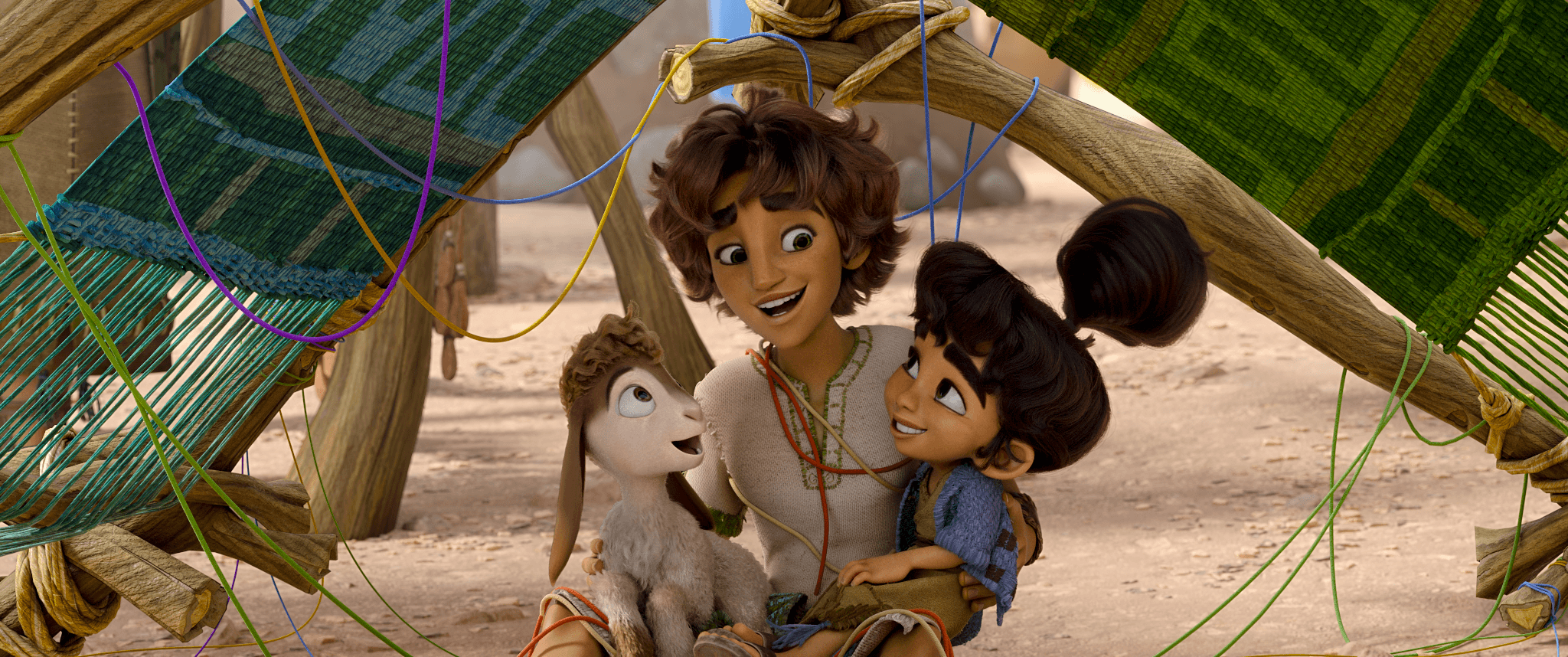
Even so, Angel Pictures, the up-and-coming, largely faith-based production house behind The Sound of Freedom (a fear-mongering pageant about human trafficking) and The King of Kings (about you know who) endeavored to put this narrative to film, following a “prequel” series, called Young David. The resulting animated musical David punches above its weight in production value with meticulous filaments of CGI hair and charismatic character design. If you’re looking for biblical fidelity, it mostly follows the text, but in making it family friendly — and perhaps to point in the direction of a certain legacy sequel — it slaps a narrative fig leaf over the interesting bits. Somehow, like so many neutered renditions of Leonard Cohen’s “Hallelujah,” it makes David boring.
Why target this one to kids? David is introduced as a shepherd boy with a sling, making him ripe for a young audience, at least if you skip the part where he decapitates Goliath and carries his head around as a trophy, which this film does. Most children’s media about him emphasizes those salad days heroics or his side hustle as a psalmist.
But the boy will go on, soon after he reaches his age of majority, to procure 200 Philistine foreskins in battle as a bride price. In exile from Saul, we’re told that, when he raided a region, “he would leave no man or woman alive.” At Hebron, he rewards the eager assassins of his rival by relieving them of their hands and feet.
What about this demands the Dreamworks treatment? The aforementioned prequel kiddie show, with its humble pastoral lessons, had to lead to something, I suppose, and here it’s a musical time jump with a new character model and older voice actor. The ads invite us to “watch how a boy becomes a man,” and, more saliently, to do the watching “this Christmas.”
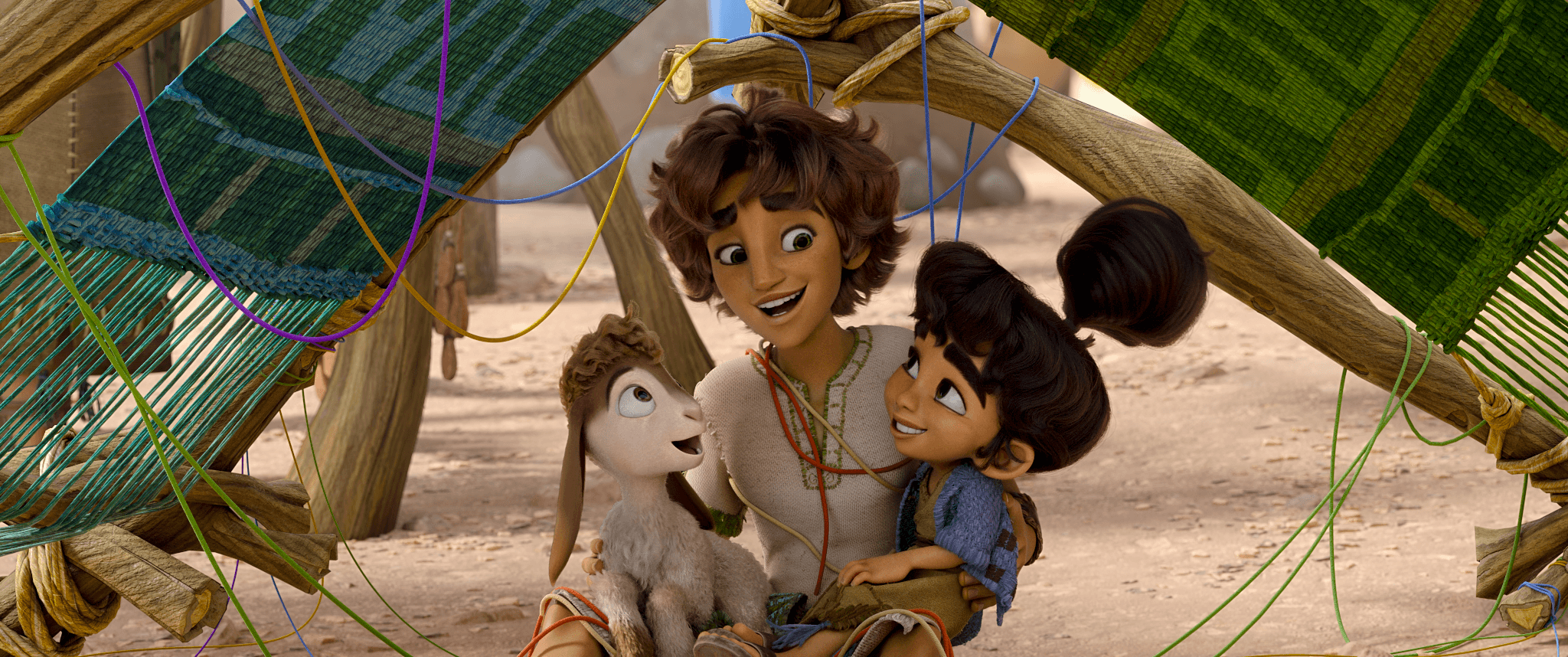
To Christians, David is a sort of Old Testament flashing arrow pointing to Christ. “Christ” means anointed one; David, as we see in the film’s opening moments, after he saves a whelping lamb from a lion, had a horn of oil poured over him by Samuel. Jesus, a metaphorical shepherd, is sometimes called the Son of David.
As scholars of Christianity like Elaine Pagels have noted, the genealogy laid out by Matthew and Luke connects Jesus to David as a way of fulfilling messianic prophecies in Isaiah. This is then, a stealth Christmas story or almost a Jesus prequel, kind of a biblical Phantom Menace, with the added benefit of capturing a Jewish audience that goes out to the movies on Christmas and may be looking for family fare. Catholic comedian Kevin James has promoted it, as has Michael Rappaport.
The story, buoyed by boilerplate praise pop that sings of running towards adventure and “following the light,” tracks the moment David is selected as the future king up to his coronation, stopping before his uniting of the kingdoms in a new capital and his late vocation as a rooftop voyeur with major character flaws.
This David — auburn-haired and American-accented, while all other characters sound vaguely Israeli — is instantly likable, and unbearably insipid, “a man after God’s own heart.” The film had a rabbi advisor — one whose focus is on “ministering to Christians” — and that brings a veneer of Jewish authenticity. Samuel sings some of Psalm 118 in Hebrew as he anoints David (an odd choice given that David is the traditionally-credited author). Production notes boast of paleo Hebrew text appearing throughout and identify some of the songwriters as “Jewish believers in Jesus.” There are wolf motifs littering in the palace of Saul, whose tribe’s founder was likened to a ravenous wolf. Despite these trappings, the project feels derived from a familiar Christian impulse, and errs by taking David’s story beyond the Valley of Elah, where our hero still had a semblance of innocence.
The infancy narrative of Jesus may work for young people around Christmas time, sparing them the gory details of the crucifixion. But beyond a point, David’s early life can’t be so neatly detached from what follows, as the rest of the Bible, even the Christian parts, relies on it. It is hard to imagine this David — pure, faithful, a good shepherd who is reluctant to lead and ostensibly asexual — conquering Jerusalem. It’s harder still to imagine him having his way with Bathsheba (in what many now regard as rape), sending her husband to his death and losing several children as God’s punishment for these transgressions.
None of these events are the film’s concern, but without those pivotal plot points, we don’t have the Temple or the king — Solomon, born of Bathsheba — to build it. Without a temple in Jerusalem, there’s no backdrop for the Passion the film’s hinting at to play against.
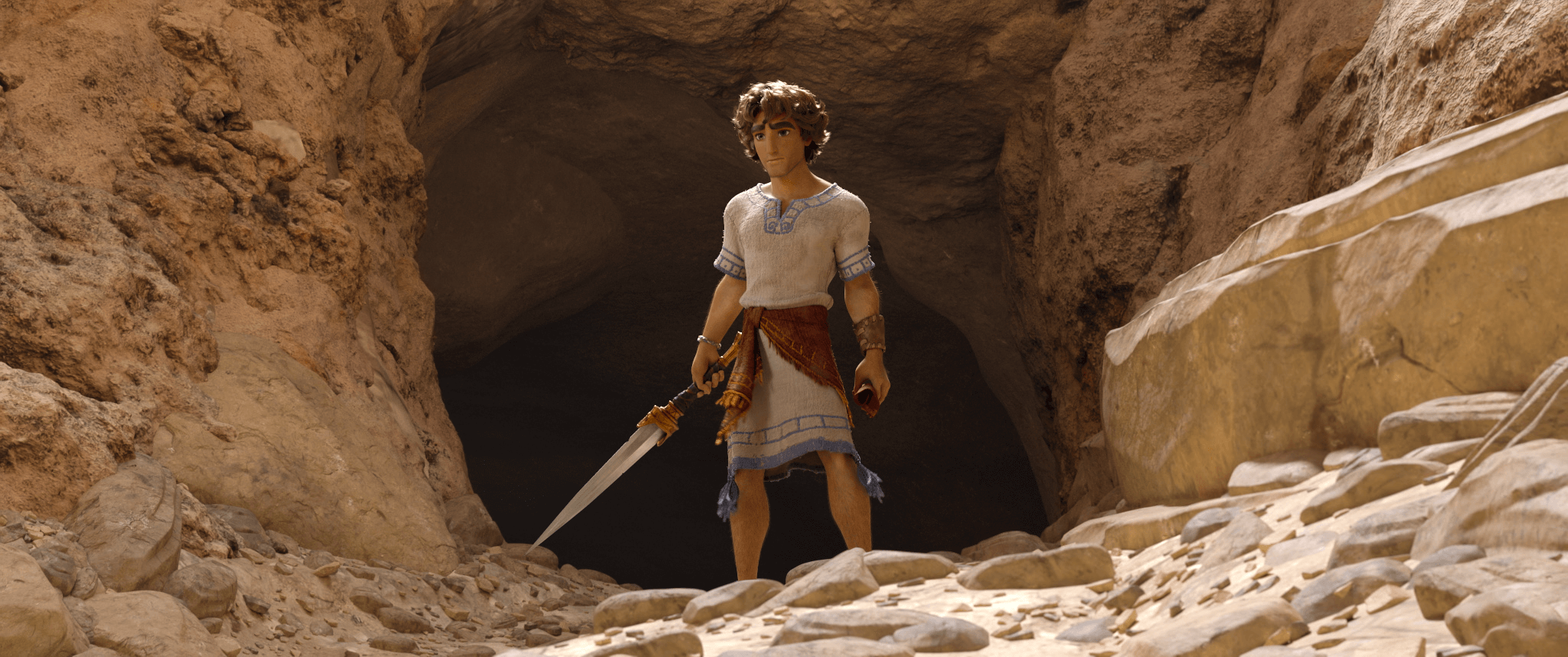
The screenplay, by directors Brent Dawes and Phil Cunningham, seems to be optimizing for action — Cunningham described David’s journey as “packed with adventure, with music, with fun” — while staying too squeamish to mount a proper battle scene. There’s the intrigue of Saul’s court, and the thread of dramatic irony, as the old king confides in David about his fear of God’s appointed successor, not knowing it’s him. We see David dash into exile in the wilderness, but we don’t witness his raids or any other mischief, only a crisis of faith. We get a glimpse of the mincing Philistine king Achish (we know he’s evil because of his eyeshadow and earrings) and the skull-laden Amalekites who raze David’s outpost at Ziklag and take his followers captive. (Saul’s failure with the Amalekites is appropriately sanitized — he fell short by letting them escape, not in sparing Agag’s life and keeping his best livestock. If God ordered their genocide, as he does in the source material, we don’t hear about it.)
In case there was any doubt, after David’s mom — here a speaking character — praises God as “the way and the light,” there’s a specific endgame in mind that necessitates our hero be presented as older and on his way to kingship.
To drive the point home, in an invention of the film, the Amalekites hoist David onto a tree to kill him while his mother weeps at his feet. This isn’t some first chapter of David’s rule but the foreshadowing of Jesus’ reign, and you can’t exactly crucify the little shepherd boy with the lyre. (Spoiler: He lives.)
While not to my taste, this would be forgivable if the film, however handsomely animated, didn’t fall into the same old timeworn tropes that even kids are surely bored of now: the precocious younger sister, the fat brother gorging on dates, the upstart Israelite army with vases for helmets who gulp, “Yup, we’re dead,” upon seeing the well-equipped Philistines and their six-cubit champion.
Worse still, the film calls to mind other, better ones, appropriate for children but nowhere near as condescending.
A standout number has David’s mother singing about the world as a tapestry (Carole King she ain’t) and “the view that heaven sees,” essentially a rip off of Prince of Egypt’s “Through Heaven’s Eyes.” You may also cringe at the line “like the way we work the loom, he knit you from inside the womb,” seemingly a play on Jeremiah 1:5, often used by Christians to justify pro-life positions.
David deserves better, but the good news is there’s competition. Amazon’s House of David, now in its second season, goes deep on the dynamics of Judah and Israel, often employing midrash to add texture to the intrigue, and it was reported in 2022 that Leviathan Productions, an outfit focused on Jewish stories, had optioned Brooks’ excellent The Secret Chord.
That shepherd boy from Bethlehem became a giant himself — and we will never stop singing his psalms or wrestling with his complicated, at times cancel-worthy, story. Angel Studios’ David may still challenge Goliath, just not the audience.
The post King David gets the kiddie treatment appeared first on The Forward.
Uncategorized
Downed Planes Raise New Perils for Trump as Tehran Hunts for Missing US Pilot

Traces of an Iranian missile attack in Tehran’s sky, amid the U.S.-Israeli conflict with Iran, in Tehran, Iran, April 3, 2026. Photo: Majid Asgaripour/WANA (West Asia News Agency) via REUTERS
Two US warplanes were downed over Iran and the Gulf, Iranian and US officials said on Friday, with two pilots rescued and a third still missing and being hunted by Tehran’s forces.
The incidents show the risks still faced by US and Israeli aircraft over Iran despite assertions from US President Donald Trump and his Defense Secretary Pete Hegseth that their forces had total control of the skies.
The first plane, a two-seat US F-15E jet, was shot down by Iranian fire, officials in both countries said.
The second plane, an A-10 Warthog fighter aircraft, was hit by Iranian fire and crashed over Kuwait, with the pilot ejecting, two US officials said.
Two Blackhawk helicopters involved in the search effort for the missing pilot were hit by Iranian fire but made it out of Iranian airspace, the two US officials told Reuters.
The degree of injuries among the crew of the aircraft remained unclear. The status and whereabouts of the missing F-15E crew member was not publicly known.
Iran’s Revolutionary Guard Corps said it was combing an area near where the pilot’s plane came down in southwestern Iran and the regional governor promised a commendation for anyone who captured or killed “forces of the hostile enemy.”
Iranians, who have been pummeled by American air power for weeks, posted gleeful messages celebrating the plane downings. Iran’s Parliament Speaker Mohammad Baqer Qalibaf said on X that the U.S. and Israel’s war had been “downgraded from regime change” to a hunt for their pilots.
Trump has been in the White House receiving updates on the search-and-rescue operation, a senior administration official told Reuters. The Pentagon and US Central Command did not immediately respond to requests for comment.
NO SIGN OF END TO WAR
The prospect of a US service person being alive and on the run inside Iran raises the stakes for Washington in a conflict with low public support and no sign of an imminent end.
Iran has officially told mediators it is not prepared to meet with US officials in Islamabad in coming days and that efforts to produce a ceasefire, led by Pakistan, have reached a dead end, the Wall Street Journal reported on Friday.
The US and Israel opened the campaign with a wave of strikes that killed Iran’s Supreme Leader Ayatollah Ali Khamenei on February 28. The war has killed thousands and threatened lasting damage to the global economy.
So far, 13 US military service members have been killed in the conflict and more than 300 have been wounded, according to the US Central Command.
Iran has rained down drones and missiles on Israel. It has also taken aim at Gulf countries allied to the US, which have so far held back from joining the war directly for fear of further escalation.
In a security alert on Friday, the US embassy in Beirut said Iran and its aligned armed groups may target universities in Lebanon and urged US citizens in the country to leave while commercial flights are still available.
Israel has been waging a parallel campaign against Iran-backed Hezbollah in Lebanon after the militant group fired at Israel in support of Iran.
TRUMP THREAT TO STRIKE BRIDGES, POWER PLANTS
On Friday, as Trump threatened to hit its bridges and power plants, Iran struck a power and water plant in Kuwait, underlining the vulnerability of Gulf states that rely heavily on desalination plants for drinking water.
On Thursday, Trump posted footage on social media showing dust and smoke billowing up as US strikes hit the newly constructed B1 bridge between Tehran and nearby Karaj, which was due to open this year, and said more attacks would follow.
“Our Military, the greatest and most powerful (by far!) anywhere in the World, hasn’t even started destroying what’s left in Iran. Bridges next, then Electric Power Plants!” he wrote in a subsequent post.
On Friday, a drone hit a Red Crescent relief warehouse in the Choghadak area of Iran’s southern Bushehr province.
Kuwait Petroleum Corporation said its Mina al-Ahmadi refinery had been hit by drones. Other attacks were also reported to have been intercepted in Saudi Arabia and Abu Dhabi. Missile debris landed near the Israeli port of Haifa, site of a major oil refinery.
Oil markets were closed after benchmark U.S. crude prices gained 11% on Thursday following a speech by Trump that offered no clear sign of an imminent end to the war.
Uncategorized
US-Iran: Diplomatic Push Falters as Qatar Steps Back and Pakistan Talks Stall

Qatari Prime Minister and Foreign Minister Sheikh Mohammed bin Abdulrahman Al Thani speaks after a meeting with the Lebanese president at the presidential palace in Baabda, Lebanon, Feb. 4, 2025. Photo: REUTERS/Emilie Madi
i24 News – Diplomatic efforts to secure a ceasefire between Washington and Tehran appear to have reached an impasse, as key regional mediators pull back and broader talks stall.
According to reporting by The Wall Street Journal, Qatar has informed US officials that it does not wish to take a central role in mediating between the two sides. Officials familiar with the matter said Doha has made clear it is “not willing” to lead negotiations or act as the primary broker.
At the same time, Pakistan-led efforts to bring Iranian and American officials together have also stalled. Mediators say Tehran has refused to attend proposed meetings in Islamabad, calling Washington’s conditions “unacceptable,” further underscoring the widening gap between the two sides and the growing difficulty of restarting dialogue.
Despite the deadlock, diplomatic channels have not fully closed. Turkey and Egypt are continuing parallel efforts to revive talks, with discussions underway about potential alternative venues, including Doha and Istanbul.
US President Donald Trump downplayed the impact of recent military developments on diplomacy, including the destruction of a US fighter jet during operations in Iran. Speaking in a brief exchange with an NBC News journalist, he said: “No, not at all. It’s war. We are at war.”
He further fueled speculation with a cryptic social media post on Truth Social, writing: “Keep the oil, anyone?” criticising international allies on Friday over rising fuel prices. Trump appeared to mock allies such as the United Kingdom, writing that they should “keep the oil.”
Uncategorized
Report: Iran Retains Significant Missile Capability Despite Weeks of US-Led Strikes

Iranian missiles are displayed in a park in Tehran, Iran, Jan. 31, 2026. Photo: Majid Asgaripour/WANA (West Asia News Agency) via REUTERS
i24 News – Despite weeks of sustained airstrikes by the United States and its allies, Iran has reportedly managed to retain a substantial portion of its military capabilities, particularly its ballistic missile arsenal.
According to a report by The New York Times citing US intelligence assessments, Tehran has developed methods to mitigate the impact of the strikes, allowing it to preserve and restore key parts of its missile infrastructure.
While the Pentagon has claimed responsibility for striking more than 11,000 targets over five weeks and reducing the rate of Iranian missile fire, intelligence officials now caution that the actual damage may be more limited than initially assessed. Iranian forces are reportedly able to rapidly repair or reactivate missile launchers stored in heavily fortified or underground facilities, sometimes within hours of being hit.
Analysts also point to the widespread use of decoy sites, which may have drawn strikes away from operational assets. Many of the targeted locations are believed to have contained dummy installations, complicating efforts to accurately gauge the degradation of Iran’s ballistic capabilities. Combined with deep underground bunkers and dispersed storage networks, this approach is seen as enabling Tehran to maintain a higher level of readiness than publicly estimated.
US intelligence officials assess that this resilience reflects a deliberate strategy: preserving a credible long-range strike capability as both a deterrent and a bargaining tool in any future negotiations, while ensuring regime survival and continued regional influence.
Despite sustained air dominance claimed by Washington and its allies, Iran’s adaptive tactics continue to complicate battlefield assessments, leaving the true balance of power in the conflict uncertain.