


Uncategorized
Looking for the right Yiddish word? This 1950 reference book finds it for you
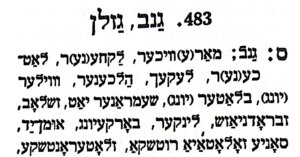
As more people explore Yiddish, a thick 1950 book I discovered on a beloved friend’s shelf can help anyone find the exact right word for any situation.
Der Oytser fun der Yidisher Shprakh (The Treasure of the Yiddish language) published by the YIVO Institute in New York and available digitally through the Yiddish Book Center, is a 1,000-page Yiddish thesaurus, modeled on Roget’s Thesaurus of the English Language.
Like Roget’s, a standard source for writers and students of English, Der Oytser is not arranged alphabetically, but according to concepts. If you’re looking for a word related to evil, you look up the concept “evil,” and there you find many words related to it, for example, “untoward, black, sinister, wicked, wrong, vicious, sinful and criminal.”
The book was born of a project by author Nahum Stutchkoff to create a new kind of lexicon for the Yiddish language. He launched the project under the editorial oversight of Max Weinreich, the great Yiddish philologist and then director of YIVO. Yiddish had had many dictionaries over the course of its existence, but never a thesaurus of this kind. The result is a magnificent work of lexicography, 15 years in the making, a storehouse of over 175,000 Yiddish words, phrases, folk sayings, and idioms.
The book is out of print but Yiddish students and enthusiasts can download it from the Yiddish Book Center’s digital library. There’s also a free digitized version of the book printed in the English alphabet for people who don’t read Yiddish. Instead of an index, readers use the search box.
In 1950, a mere five years after the Holocaust, the Oytser was finally published. It included a preface by Weinreich, with the following words:
The very fact that, despite the years of the huge catastrophe that befell our people, a great man with vision has appeared to gather the scattered treasures of our language, can surely serve as a symbol of our unbroken collective will to survive. In Nahum Stutchkoff we see a love of mame-loshn, a keen understanding of both broad concepts and the smallest of details, tireless perseverance and pragmatism in carrying out the designated plan for Der Oytser fun der Yidisher Shprakh.
It is without a doubt, the greatest complete achievement of Yiddish lexicography since Jehoshua Mordechai Lifschitz‘s dictionary, compiled during the last third of the nineteenth century.
For the first time we see the full inventory of the Yiddish language, in accordance with the knowledge that the field of Yiddish research has accumulated under the authority of the YIVO Institute.
Weinreich goes on to speak about the problems of standardizing Yiddish, Yiddish dialectology, the Germanisms, Americanisms, Slavicisms in Yiddish and how Stutchkoff addresses these issues.
In his own introduction, Stutchkoff states he had two purposes in mind: (1) to gather as many Yiddish words, phrases and proverbs as he could, and (2) to provide a helpful tool for the Yiddish speaker and writer.
When you use a dictionary, says Stutchkoff, you have a word in mind and want to find or clarify its meaning. The words in a dictionary, therefore, are arranged alphabetically. His thesaurus, on the other hand, like Roget’s, is for a user who has an idea but can’t recall the right word. It is therefore arranged according to ideas. He created 620 categories, such as onheyb, or beginning (category No. 41); glaykhayt, equality (153), and libe, love (500).
Let’s say you’re looking for a Yiddish word related to thieves. You may know the word ganef, thief, but need a different word. So you turn to the index at the back of the Oytser where there are thousands of words arranged alphabetically and find the word ganef, which has the number 483 next to it That means all the words related to ganef are listed under number 483 of the 620 idea categories. You would then turn to the section for number 483 and find no less than seven pages of terms and expressions related to ganef, including, for example, the word marvikher — a dealer in stolen items, as well as the proverb dos ken nor a ganef (Only a thief would think of that). Those seven pages demonstrate the incredible richness of the Yiddish language.

The Oytser also contains the colorful slang of various occupations and groups such as klezmers, thieves, cobblers, actors, tailors and butchers.
Nahum Stutchkoff wasn’t an academic. He was an actor, a playwright, and a popular radio personality before he became a masterful lexicographer.
Stutchkoff was born in 1893 in a town called Brok in Czarist Poland. When he was 7, his family moved to Warsaw, where he was sent to cheder and yeshiva. At the age of 16, he was drawn to the theatre. He began translating and reworking plays for a Yiddish theatrical company from the standard European repertoire, such as, for example, Moliere’s The Miser. Eventually he became an actor too, touring with the company throughout Poland and Russia.
In 1912 he served a stint in the Czarist army. Upon his release in 1917, he again joined a theatrical troupe, eventually becoming director of the Yiddish State Theatre in Vitebsk. In 1923, he emigrated to the United States.
In New York, where he settled, he performed in various Yiddish theatres and authored plays, musical comedies and operettas for the Yiddish theatre. In 1926, he became secretary of The Yiddish Playwrights League of America.
He then took up a radio career. Every Sunday, starting in 1932, on the Forward radio station WEVD (the call letters are the initials of Eugene Victor Debs, the leader of the American Socialist Party), he performed a children’s radio show called The Uncle Nahum Hour, as well as other radio programs.
In 1931, he turned to lexicography, publishing another creative work: a 330-page Yiddish rhyming dictionary.
Stutchkoff died in 1965, but he left us a great legacy: a wealthy storehouse of the Yiddish language that continues to inform and entertain Yiddish enthusiasts everywhere.
The post Looking for the right Yiddish word? This 1950 reference book finds it for you appeared first on The Forward.
Uncategorized
UK adopts sweeping measures against antisemitism in schools
(JTA) — The U.K. has adopted sweeping measures to combat antisemitism in English schools, prompting pushback from the country’s largest teachers’ union.
The move came after a new government-commissioned review found that three in five Jewish students reported experiencing antisemitism in English schools. The most common incidents were jokes, stereotypes and comments about Jewish people. About half of respondents who witnessed or experienced antisemitism said the incidents were not reported, most often because they did not think they would be taken seriously.
The government on Wednesday accepted 27 recommendations from the report, including dedicated antisemitism training for leaders and staff, improved recording of antisemitic incidents and moves to build a better understanding of Jewish life, identity and contemporary antisemitism.
The government commissioned the report following a spate of high-profile attacks on Jews in Britain, including an attack on a synagogue in Manchester last year that left two men dead.
The report’s author, Sir David Bell, the vice chancellor of the University of Sunderland and former chief inspector of schools in England, recommended addressing antisemitism distinctly from other forms of racism. He argued that antisemitism was a “uniquely complex” problem because of intertwined racial and religious dimensions, since Jewish identity can encompass both an ethnicity and a religion, along with expressions of prejudice that hold all Jews responsible for the actions of Israel.
The government will also encourage English schools to adopt the International Holocaust Remembrance Alliance (IHRA) working definition of antisemitism. The definition is supported by many mainstream Jewish organizations and has been adopted by 47 countries, including the U.K., but critics say that it conflates some forms of antisemitism with criticism of Israel.
British Education Secretary Lucy Powell called Bell’s review a “generational moment” and said that “implementation is now my priority.”
However, the National Education Union, the largest union representing teachers, lecturers, teaching assistants and support staff in the United Kingdom and Europe, raised concerns on Wednesday about recommending the IHRA definition for schools. NEU general secretary Daniel Kebede said in a statement that the definition “risks deepening the problem rather than tackling it, and actively undermining efforts to confront antisemitism.”
“The IHRA’s contested framing risks blurring the line between antisemitism and legitimate criticism of the Israeli government and the genocide in Gaza, leaving teachers with uncertainty when they need clarity,” said Kebede. He cited a risk that “children who cannot critically explore issues through classroom discussion will instead seek their answers in online and unsafe groups.”
Kebede also encouraged Britain’s Department for Education to strengthen guidance on all forms of racism, not only antisemitism, saying that 65% of teachers report they have not received any antiracism training in the past year.
The Board of Deputies of British Jews, an umbrella organization for British Jewish communities, celebrated the antisemitism report and the government’s adoption of its proposed measures. The group specifically praised the report’s “clear recommendations that schools and local authorities follow government guidelines by adopting the IHRA Working Definition of Antisemitism as a tool to deepen understanding of contemporary antisemitism.”
“We remain concerned about undue external influence on schools driven by narrow political agendas, and tendentious materials seeping into schools and increasing disharmony, and we will continue to press for vigilance against this,” said the Board of Deputies.
The post UK adopts sweeping measures against antisemitism in schools appeared first on The Forward.
Uncategorized
Orthodox Jewish man stabbed in midtown Manhattan
(New York Jewish Week) — An Orthodox Jewish man is in stable condition after being stabbed on Wednesday evening in the Diamond District of midtown Manhattan. Police are investigating the attack as a possible hate crime.
Police told the Jewish Telegraphic Agency that the NYPD’s Hate Crimes Task Force is investigating the incident as a possible antisemitic attack, and Manhattan Shomrim — the Jewish community watch group — has asked people to share footage as police search for the suspect. No arrests have been made.
The victim was identified by police as a 26-year-old man, and Orthodox Jewish outlet COLLive identified him as a resident of Crown Heights, the neighborhood that is home to the Chabad-Lubavitch Hasidic movement’s headquarters.
He was taken to Bellevue Hospital in stable condition. Police said they were called at about 5:50 p.m. on Wednesday after the man was stabbed in the back with “an unknown sharp object” on 47th Street near Fifth Avenue. ABC7 reported that the victim told investigators he believed he was stabbed with a needle or syringe.
According to the Chabad website, which published an interview with the victim, he is a recently ordained Hasidic rabbi named Joseph, who commutes to Midtown each day to wrap tefillin with Jewish merchants. The attacker, Joseph told the website, was a woman who seemed to be following him prior to the stabbing.
The attack comes as Jewish New Yorkers have been targeted in more than half of the hate crimes committed in New York City this year, despite making up about 12% of the city’s population.
In July, an assailant stabbed two men on the Upper West Side, including one who was leaving a synagogue, while yelling “Allahu akbar,” and was charged with committing hate crimes.
Louis Keene contributed reporting.
The post Orthodox Jewish man stabbed in midtown Manhattan appeared first on The Forward.
Uncategorized
VIDEO: A Hasid gives us a tour of Morocco in Yiddish
דער ירושלימער יוטוב־שטערן וועלוול קירשנבוים האָט לעצטנס אַרויסגעשטעלט אַ ווידעאָ אויף ייִדיש פֿון אַ פּרעכטיקן וויזיט, וואָס ער האָט געמאַכט אין מאַראָקאָ. עס באַגלייט אים זײַן חבֿר אַבֿרהם פּרץ.
אינעם ווידעאָ זעט מען ווי קירשנבוים דאַוונט שחרית מיט די אָרטיקע ייִדן און באַזוכט אַ גוט אָפּגעהיטענעם בית־עולם, וווּ עס ליגן באַערדיקט גרויסע צדיקים ווי למשל הרבֿ חיים בן עתר (1696–1743), באַקאַנט ווי דער „אור החיים“. „מענטשן מיינען, אַז נאָר אין אייראָפּע זענען דאָ קבֿרים פֿון צדיקים!“ זאָגט קירשנבוים.
מיר זעען אַ גרויסע, שיינע שיל מיט אַ פֿײַנער אַרכיטעקטור אין קאַזאַבלאַנקאַ; דעם גרויסן אַראַבישן שוק, וווּ קירשנבוים קויפֿט זיך אײַן מלבושים פּונקט ווי די מאַראָקאַנער גייען אָנגעטאָן. ער באַוווּנדערט אויך די שיינע טיי־גלעזער און טשײַניקן, וואָס מע פֿאַרקויפֿט דאָרט, און באַקענט זיך מיט אַ ייִדישן סוחר וואָס האַנדלט מיט זילבער און גאָלד, פּונקט אַזוי ווי זײַן טאַטע און זיידע האָבן געטאָן פֿאַר דור־דורות.
The post VIDEO: A Hasid gives us a tour of Morocco in Yiddish appeared first on The Forward.
