


Uncategorized
Mamdani’s antisemitism chief pledges trust-building amid early skepticism
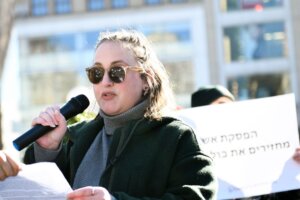
Phylisa Wisdom, the progressive Jewish leader chosen to head New York City’s Mayor’s Office to Combat Antisemitism, says she is preparing to take a broad view of her mandate as she steps into the role under intense scrutiny.
In an exclusive interview with the Forward, her first since Mayor Zohran Mamdani named her last week, Wisdom laid out an ambitious early agenda focused on building trust across the city’s diverse Jewish communities and developing a comprehensive strategy modeled in part on the Biden White House’s national plan to counter antisemitism.
She described her overall approach as “being creative and committing resources to doing what we can to turn the tide.”
Wisdom, who is 39 and lives in Brooklyn, said Friday that one of her first steps when she assumes the role later this month will be launching a citywide “listening tour” spanning five borough-based hubs, including homes, schools and community centers. The goal is to understand the concerns and experiences of a broad cross-section of Jewish New Yorkers and build a sustainable relationship.
Her appointment comes as the city grapples with a sharp rise in antisemitic attacks and as the Mamdani administration faces scrutiny from the Jewish leaders after a divisive election shaped in part by his positions in opposition to Israel.
Wisdom acknowledged she faces a “challenging task” confronting rising antisemitism while serving a mayor whose anti-Zionist posture has left some questioning his commitment to the city’s prevention and response efforts.
Nonetheless, she stressed that the Mamdani administration is taking its commitment “very seriously,” and is prepared to deploy other city agencies to the work. Wisdom didn’t elaborate on how that cooperation would be structured. Mamdani outlined a broad framework for the office in his Day One executive order.
Serving as Mamdani’s point person on this issue, she said she aims to outline a framework to define antisemitism to help determine which incidents to investigate or pursue. The office, established by former Mayor Eric Adams last year through an executive order, initially adopted the controversial International Holocaust Remembrance Alliance definition of antisemitism, which considers most forms of anti-Zionism as antisemitic. Mamdani revoked the IHRA definition on his first day in office, prompting swift backlash from mainstream Jewish organizations.
To address the need for a working definition of antisemitism, Wisdom said she is looking to craft a city plan similar to the Biden White House’s national plan, which was released in 2022. Rather than adopting a single codified definition of antisemitism, Wisdom said the office will draw from the multiple established working definitions, including IHRA, the Nexus Document — which states that most criticism of Israel and Zionism is not antisemitic — and the Jerusalem Declaration on Antisemitism, which was released in 2021 as a progressive alternative to IHRA.
“We want to ensure that it’s really focused on policy, practice and investment, and not getting caught up in the definitional fight,” Wisdom said. “I think the best practice is to use myriad resources, including those three definitions.”
Wisdom said she hopes to release the plan before the High Holidays in the fall, when Jewish communal life is most visible.
She added that the office will work closely with both the New York City Commission on Human Rights and the New York State Division of Human Rights to coordinate enforcement and education efforts. Wisdom said she is also considering reviving the previous administration’s interagency task force on antisemitism to ensure cross-agency collaboration, including the New York Police Department and the Office for the Prevention of Hate Crimes.
Orthodox backlash
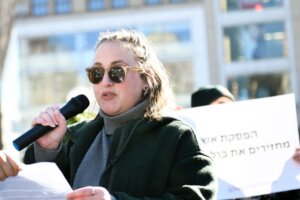
Wisdom’s appointment drew immediate backlash from Orthodox leaders and activists over her past work at an advocacy group that has pushed for enforcement of state secular education standards in yeshivas.
Wisdom, who had been the executive director of the progressive and pro-Zionist New York Jewish Agenda since 2023, was previously director of development and government affairs at Yaffed, which scrutinized yeshivas in Brooklyn over inadequate secular education. That history was not mentioned in City Hall’s official bio for Wisdom, an omission that immediately fueled suspicion.
The backlash also sharpened a political contradiction Mamdani himself has cultivated. During the campaign, he promised Satmar and other Hasidic sects that he would protect yeshivas from government intervention.
In the interview, Wisdom indicated that she has moved past her prior activism to focus on the office’s singular task: combating antisemitism in all its forms. She said she’s “acutely aware” that Orthodox New Yorkers “face the lion’s share” of antisemitic incidents in the city and that protecting visibly Jewish communities would be a top priority. Questions about yeshiva curriculum policy, she added, fall under the purview of the Department of Education.
Wisdom also pointed to her work at NYJA advancing a state hate crimes bill and helping implement the Stop Hiding Hate social media reporting law as evidence of her experience translating advocacy into enforceable policy.
“We are really going to be thinking about, rather than a sledgehammer approach, a scalpel approach to combating antisemitism,” Wisdom said. “One that will ensure all Jewish New Yorkers can feel safe and belong in the city.”
The post Mamdani’s antisemitism chief pledges trust-building amid early skepticism appeared first on The Forward.
Uncategorized
50 years after the Dirty War, Argentinians remember the Jews who ‘disappeared’
(JTA) — BUENOS AIRES — As Argentina marks the 50th anniversary of the 1976 military coup, a lesser-known aspect of the dictatorship is gaining attention: the disproportionate number of Jews among the disappeared.
Estimates suggest that as many as 1,900 Jews were abducted, tortured and murdered by the military junta during the six-year Dirty War, when many sources say 30,000 people were disappeared. Depending on the source, Jews represented 5% to 8% of the total, even though Jews made up less than 1% of Argentina’s population at the time.
That grim history is being explored in educational initiatives by Argentina’s Jewish community, aimed at younger generations and focused on understanding how the dictatorship operated and the disproportionate suffering it inflicted on Jews.
“The Jews were subjected to a particular form of treatment that resulted in greater brutality on the part of the repressive forces,” according to a new curriculum released by the education department of AMIA, the Jewish community center in Buenos Aires. “The experience of Jewish Argentines who were victims of state terrorism was marked by a strong antisemitic imprint among many members of the task forces.”
The AMIA project includes meetings between Jewish youth and relatives of the Jewish “disappeared,” as well as visits to memorial sites. Some 1,000 students are expected to take part this month.
A parallel digital project, Eduiot (“Testimonies”), documents the stories of Jewish victims of the military dictatorship and includes meetings between relatives of the disappeared and high school students.
The materials rely on personal testimonies to explain the human impact of the dictatorship and to put individual stories in the broader historical context.
Eduiot includes the story of Fernando Ruben Brodsky, a 22-year-old student who disappeared in 1979, including accounts from relatives who continue to seek answers. His mother, Sarah Brodsky, shares accounts of her son, a psychology student and kindergarten teacher who was abducted from his home on Aug. 8 and never seen again.
The testimonials relate how security forces subjected Jews to antisemitic abuse when they were kidnapped or detained, including Nazi language and symbols and “special” interrogations reserved for Jews.
The anniversary comes amid renewed debate over how Argentina interprets the dictatorship. President Javier Milei’s government has called for a broader account that also includes victims of left-wing guerrilla violence, which some suggest is a way to minimize the crimes of the dictatorship. Milei and other voices close to the government have also questioned the 30,000-victim figure, promoting a lower number (often 9,000).
Under the junta, the military and state security forces targeted suspected left-wing sympathizers, including students, unionists, journalists and activists.
In 1979, Jewish advocacy groups such as the Anti‑Defamation League expressed grave concern over the disappearances, focusing on the Jewish victims, and Jewish families in Argentina and abroad helped compile lists of the missing. According to an ADL official at the time, “Jews are not specifically targeted as Jews. However, the security agents tend to be suspicious of Jews.”
The best-known Jewish target of the state was journalist Jacobo Timerman, who published a left-leaning newspaper, La Opinion. In 1977, the generals who ruled Argentina shut down the paper and imprisoned Timerman. Among other things, Timerman was accused of masterminding a plot to establish a Jewish homeland in the remote Patagonia region of southern Argentina.
He survived, and in his 1981 memoir, “Prisoner Without a Name, Cell Without a Number,” he recounted how he was subjected to torture during his 2 1/2 years in confinement.
According to Eduiot, Jewish advocacy for the disappeared “proved effective in bringing early attention to human rights violations.” The U.S. Congress launched investigations, and in a 1978 article in Le Monde, novelist and Holocaust survivor Marek Halter compared the persecution of Argentine Jews to Nazi-era atrocities.
The Eduiot site includes photographs and audiovisual material, and features the accounts of parents, siblings, cousins, nephews and nieces of Jews persecuted and disappeared under the dictatorship.
“Because every testimony matters and holds great value,” according to its website. “Because these dark episodes of our history must never be repeated, and because we want each of the disappeared to have a space of remembrance on this site, helping families sustain their memory and uphold the call for justice.”
The post 50 years after the Dirty War, Argentinians remember the Jews who ‘disappeared’ appeared first on The Forward.
Uncategorized
Fortnite tops ADL’s new ‘leaderboard’ ranking video games on antisemitism safeguards
(JTA) — The online video game Fortnite tops the Anti-Defamation League’s “leaderboard” ranking online video game companies on their efforts to curb antisemitism and extremism on their platforms.
The Online Gaming Leaderboard, which the antisemitism watchdog billed as the “first comprehensive public evaluation” of how online multiplayer games address antisemitism, ranked 10 popular online games based on safety features, moderation, player protections and written policies meant to address antisemitism and hate.
Fortnite was followed at the top of the rankings by Grand Theft Auto Online, Call of Duty and Minecraft. Games labeled as having “limited protection” by the ADL included Counter-Strike 2 and PUBG: Battlegrounds.
Madden NFL, Valorant, Clash Royale and Roblox, a collaborative computer gaming platform for children as young as 7, were ranked as having “moderate protection.”
“Without strong safeguards, these platforms can become breeding grounds for harassment and hateful activity that harms players directly, normalizes hateful ideologies and damages trust,” Jonathan Greenblatt, the CEO of the ADL, said in a statement Wednesday. “This leaderboard provides the transparency that parents, gamers and the industry need to understand where companies are succeeding and where urgent improvements are necessary.”
The leaderboard’s release coincided with a landmark Los Angeles jury verdict finding Meta and YouTube liable for harming a young user through addictive design features.
In the virtual worlds of online gaming, players have posted abusive messages in chats, created antisemitic imagery and even given themselves bigoted usernames.
While Fortnite ranked first, the popular online game has also previously faced scrutiny over allegations that it enabled antisemitic content. Last September, it disabled a character dance feature after users said its gestures resembled a swastika.
Roblox, which has long faced criticism over content moderation, has also been the subject of controversy, including in 2022 when it removed a user-created simulation of a Nazi gas chamber. In the wake of the Oct. 7 attacks in 2023, the Israeli government also urged users to report pro-Palestinian activity in the game that it said included antisemitic content.
The post Fortnite tops ADL’s new ‘leaderboard’ ranking video games on antisemitism safeguards appeared first on The Forward.
Uncategorized
Iran Posts AI Video Showing Missile Striking Statue of Liberty

An Israeli air defense system intercepts a ballistic missile barrage launched from Iran to central Israel during the missile attack, February 27, 2026. Photo: Eli Basri / SOPA Images via Reuters Connect
Iran on Tuesday released an AI-generated video depicting a missile striking the Statue of Liberty in New York Harbor, a global symbol of American freedom and democracy, in one of the regime’s latest propaganda efforts to influence public perception abroad.
Shared by Iranian state broadcaster IRIB as well as a Telegram channel affiliated with the Islamic Revolutionary Guard Corps (IRGC), the minute-long video ends with the slogan “One vengeance for all.”
IRGC Official Telegram Channel Releases AI Video Depicting Iranian Ballistic Missile Strike on United States, Hitting New York City and Toppling Statue of Liberty Shown as Idol of Baal Holding Babylonian Talmud pic.twitter.com/JhgNgHW2Zz
— MEMRI (@MEMRIReports) March 25, 2026
The video was also circulated by Russian state outlet RT, in what appears to be a stark and symbolic threat against the United States.
‘ONE VENGEANCE FOR ALL’ — Iran ‘bombs’ the Statue of Liberty WITH THE HEAD OF BAAL pic.twitter.com/6tPH15fqkZ
— RT (@RT_com) March 25, 2026
Since the start of the US-Israel war with Iran, which began on Feb. 28, Iranian officials have ramped up their propaganda and disinformation efforts, trying to portray Washington and Jerusalem as responsible for decades of regional conflict while seeking to influence left-leaning Americans to mobilize domestic opposition to the war.
This latest widely circulated video presents a striking sequence portraying the United States as the world’s enemy, drawing on imagery from the dispossession of Native Americans and the atomic bombings of Japan to the Vietnam War and more recent Middle Eastern conflicts to craft a sweeping narrative of American aggression.
The clip also features footage alluding to a child on Jeffrey Epstein’s private island — a recurring theme in Iran’s messaging used to suggest that US President Donald Trump launched the current war to distract the public from the Epstein scandal, in which the late financier was convicted of running a sex-trafficking ring involving underage girls and, allegedly, various influential figures.
Later in the video, AI-generated figures of Iran’s former Supreme Leader Ayatollah Ali Khamenei and the late Iranian Major General Qassem Soleimani are shown gazing skyward. Khamenei was killed in an Israeli airstrike on Feb. 28, and Soleimani was killed in a US drone strike in 2020.
The final sequence of the video depicts a missile in Iranian colors striking the Statue of Liberty in New York Harbor, whose head has been replaced with that of Baal, a false god from the Bible, while the statue holds the Talmud, a key collection of Jewish religious teachings and laws.
This video is the latest example of AI-generated propaganda released since the start of the war with Iran.
Last week, Chinese state television CCTV released a separate AI-generated clip illustrating Beijing’s perspective on the Strait of Hormuz crisis, featuring Persian cats in martial arts combat and an eagle-headed human representing the United States.
Experts note that Russian dissemination of Tehran’s video reflects a broader coordinated effort to use visual propaganda to challenge US foreign policy and influence global perceptions amid rising regional tensions.
The latest video came as the US and Iran began engaging in diplomacy over a possible resolution to the war, although Tehran has reportedly responded negatively to Washington’s proposal.