


Uncategorized
Mamdani’s Wife Liked Posts Celebrating October 7. Why Didn’t the Media Ask Harder Questions?

Zohran Mamdani is sworn in as mayor of New York City at Old City Hall Station, New York, US, Jan. 1, 2026. Photo: Amir Hamja/Pool via REUTERS
A report by Jewish Insider has sparked political controversy in New York after revealing that Rama Duwaji, the wife of New York City Mayor Zohran Mamdani, liked several Instagram posts in the hours and days following Hamas’ October 7, 2023 massacre in Israel.
The reaction from the mayor and the muted response from parts of the media have raised questions about standards of scrutiny in news coverage.
Jewish Insider exposed that Duwaji liked posts on Instagram that celebrated the Hamas assault and framed it as “resistance.” One post showed individuals standing on what appeared to be a captured Israeli military vehicle with the caption “resisting apartheid since 1948.” Another featured an image of a bulldozer breaching the Gaza-Israel border fence with the caption “breaking the walls of apartheid and military occupation, October 7, 2023.”
The report also stated that Duwaji liked posts calling on supporters to back “Palestinian resistance” and attend a New York protest the day after the attack. Another post she engaged with contained the slogan “from the river to the sea, Palestine will be free.”

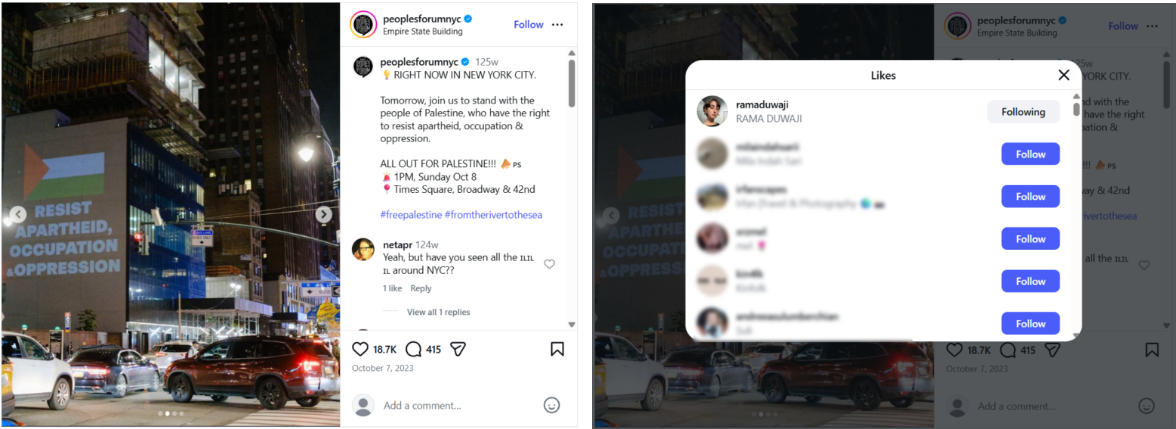

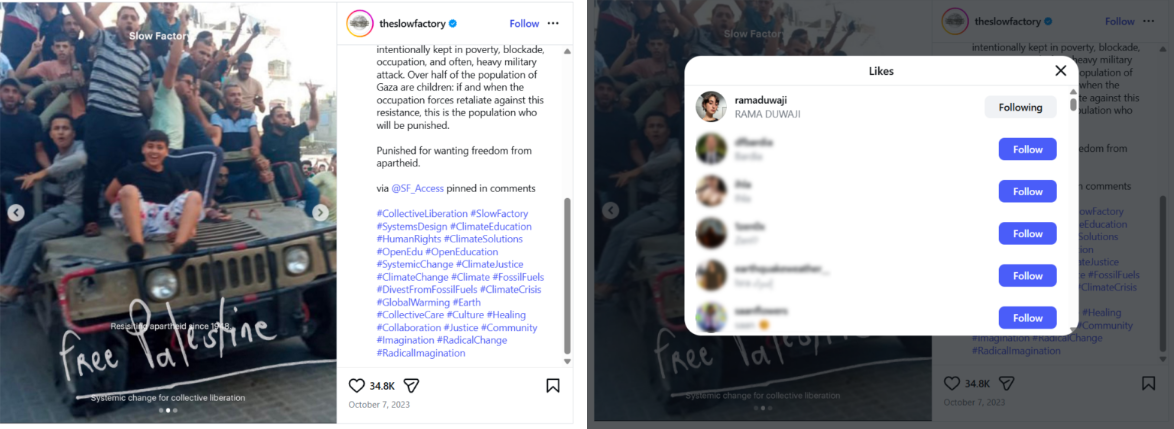
In response to the revelations, Mamdani did not directly address the substance of the posts. Nor did he condemn them or his wife’s conduct. Instead, he said that his wife is a private person who holds no official role in his administration or campaign.
The episode quickly gained traction on social media and in political circles. Commentators and journalists like The Free Press’ Olivia Reingold highlighted the posts and a far wider pattern of radical anti-Israel posts, suggesting that public figures should face scrutiny over the views and public activity of those close to them.
Guys that post was just the tip of the iceberg,
I found 70+ radical anti-Israel posts liked by Rama Duwaji, wife of Zohran Mamdani. One calls October 7 a “mass rape hoax.” https://t.co/ogwZfweh4v
— Olivia Reingold (@Olivia_Reingold) March 7, 2026
At the same time, the story has also sparked debate about media coverage and standards.
Observers noted that some major outlets that have previously examined the social media activity of pro-Israel officials or figures connected to Israel have not shown the same level of investigative attention to the Mamdani story.
A widely shared post by opinion writer Joel M. Petlin pointed out that The New York Times had previously reported critically on the pro-Israel social media activity of an official’s wife, but had not pursued comparable scrutiny in this case.
What’s infuriating about this story is not the fact that Mayor Mamdani’s wife supports the Oct 7th massacre. We obviously knew they both do.
What’s infuriating is that the NY Times revealed that Congressman Dan Goldman’s wife supports Israel, and he was forced to publicly… https://t.co/zzTadIRTwp pic.twitter.com/4SvOgMtARR
— Joel M. Petlin (@Joelmpetlin) March 6, 2026
The New York Times has also whitewashed the contents of the posts liked by Mamdani’s wife, by labeling them as “support for the Palestinian cause.” In reality, these posts called for and celebrated the murder of Jews.
The contrast has fueled accusations of a double standard in how politically sensitive issues related to Israel and Hamas are covered. When individuals connected to Israeli institutions express controversial views, major outlets often pursue the story aggressively. Yet when the controversy involves content appearing to praise Hamas’ October 7 attack, the same level of follow-up reporting can be harder to find.
As the story continues to circulate online, the key issues remain straightforward. When a public figure’s close family member publicly engages with posts celebrating a terrorist attack, it warrants deeper scrutiny. And that scrutiny should apply evenly across the political spectrum.
Meanwhile, Mamdani’s wife’s voice has not been heard. She did not apologize, and no media outlet questioned her silence.
As the political fallout in New York continues, the global media should be asking harder questions.
The author is a contributor to HonestReporting, a Jerusalem-based media watchdog with a focus on antisemitism and anti-Israel bias — where a version of this article first appeared.
Uncategorized
Trump Issues New Warning to Tehran, Iran Calls US Peace Proposals ‘Unrealistic’

A blaze after Israel’s Fire and Rescue Service said that an industrial building and a fuel tanker at Israel’s Oil Refineries were hit by debris from an intercepted Iranian missile, amid the US-Israel conflict with Iran, in Haifa, Israel, March 30, 2026. Photo: REUTERS/Rami Shlush
US President Donald Trump warned on Monday that Iran‘s energy plants and oil wells would be obliterated if it did not open the Strait of Hormuz, after Tehran described US peace proposals as “unrealistic” and fired waves of missiles at Israel.
Israel’s military said two drones from Yemen had also been intercepted on Monday, two days after the Iran-aligned Houthis entered the war by firing missiles at Israel, and that Lebanon’s Hezbollah had fired rockets at Israel.
Israeli forces carried out missile strikes on what they called military infrastructure in Tehran and infrastructure used by Iran-backed Hezbollah in Beirut, leaving black smoke hanging over the Lebanese capital.
Turkey’s defense ministry said a ballistic missile launched from Iran entered Turkish airspace before being shot down by NATO air and missile defenses deployed in the eastern Mediterranean, the fourth such incident since the start of the war.
US REINFORCEMENTS ARRIVE IN REGION
Thousands of soldiers from the US Army’s elite 82nd Airborne Division have started arriving in the Middle East, two US officials told Reuters on Monday, part of a reinforcement that would expand Trump‘s options to include the deployment of forces inside Iranian territory.
Tehran remained defiant in the month-old war, which began with US-Israeli attacks on Iran on Feb. 28 and has spread across the region, killing thousands, disrupting energy supplies and hitting the global economy. The majority of those reported killed were in Iran and Lebanon, and many were civilians.
Iran confirmed on Monday the death of Revolutionary Guards Navy Commander Alireza Tangsiri, the latest of its leaders killed including Supreme Leader Ayatollah Ali Khamenei, who has been replaced by his son Mojtaba Khamenei.
The Iranians have effectively blocked the Strait of Hormuz, a narrow waterway which normally carries about a fifth of global oil and liquefied natural gas supplies.
Iran said on Monday it had received US peace proposals via intermediaries, following talks on Sunday between the foreign ministers of Pakistan, Egypt, Saudi Arabia, and Turkey.
But Iranian Foreign Ministry spokesperson Esmaeil Baghaei said the proposals were “unrealistic, illogical, and excessive.”
“Our position is clear. We are under military aggression. Therefore, all our efforts and strength are focused on defending ourselves,” he told a press conference.
Soon after Baghaei’s remarks, Trump said in a social media post that the United States was in talks with a “more reasonable regime” to end the war in Iran, but he also issued a new warning over the Strait of Hormuz.
“Great progress has been made but, if for any reason a deal is not shortly reached, which it probably will be, and if the Hormuz Strait is not immediately ‘Open for Business,’ we will conclude our lovely ‘stay’ in Iran by blowing up and completely obliterating all of their Electric Generating Plants, Oil Wells and Kharg Island,” Trump wrote.
Trump also threatened to attack the desalination plants that supply clean water in Iran. He said last week he would pause attacks on Iran‘s energy plants for 10 days, which would be until April 6, US time.
A Pakistani security official, whose country is trying to mediate in the war, said that at this stage it appeared unlikely there would be direct US-Iran talks this week.
Baghaei also said Iran‘s parliament was reviewing a possible exit from the Nuclear Non-Proliferation Treaty, which recognizes the right to develop, research, produce, and use nuclear energy as long as nuclear weapons are not pursued.
Trump has cited preventing Iran obtaining nuclear weapons as one of the reasons for attacking Iran on Feb. 28. Tehran denies it is seeking a nuclear arsenal.
On Sunday, Trump said the US and Iran had been meeting “directly and indirectly.” But he has also been sending more US troops to the region and Iran has remained defiant, maintaining its blockade of the Strait of Hormuz.
FEARS OF ESCALATION
Iran has fired on Arab Gulf states during the conflict and war has been reignited between Israel and Hezbollah in Lebanon. Two members of the UN peacekeeping mission in Lebanon (UNIFIL) were killed in southern Lebanon on Monday after an explosion of “unknown origin” destroyed their vehicle.
The incident is the second in 24 hours after another UNIFIL peacekeeper was killed when a projectile exploded at one of its positions in a southern Lebanese village.
Brent crude futures pared earlier gains by 1700 GMT on Monday but are on course for a record monthly rise of close to 60 percent.
The Houthis’ attacks on Israel raised the prospect that they could target and block a second important shipping route, the Bab el-Mandeb Strait.
The oil market has all but discounted the prospect of a negotiated end to the war and “is bracing for a sharp escalation in military hostilities,” said Vandana Hari of oil-market provider Vanda Insights.
The Financial Times quoted Trump on Sunday as saying in an interview that the US could seize Kharg Island, from where Iran exports much of its oil.
ECONOMIC CONSEQUENCES
The International Monetary Fund warned that war in the Middle East has caused serious disruption to the economies of frontline countries, and is dimming the outlook for many economies that had just started to recover from previous crises.
G7 finance leaders also said they were ready to take “all necessary measures” to safeguard energy market stability and limit broader economic spillovers from recent volatility.
Uncategorized
Spain Closes Airspace to US Planes Involved in Iran War, Defense Minister Says

Spain’s Defense Minister Margarita Robles arrives at the informal EU Defense Ministers’ meeting in Copenhagen, Denmark, Aug. 29, 2025. Photo: Ritzau Scanpix/Thomas Traasdahl via REUTERS
Spain has closed its airspace to US planes involved in attacks on Iran, a step beyond its previous denial of use of jointly-operated military bases, Defense Minister Margarita Robles said on Monday.
“We don’t authorize either the use of military bases or the use of airspace for actions related to the war in Iran,” she told reporters in Madrid.
Spanish newspaper El Pais had first reported the news on Monday, citing military sources.
The closure of the airspace forces military planes to bypass NATO member Spain en route to their targets in the Middle East, but it does not include emergency situations, El Pais added.
“This decision is part of the decision already made by the Spanish government not to participate in or contribute to a war which was initiated unilaterally and against international law,” Economy Minister Carlos Cuerpo said during an interview with radio Cadena Ser when asked if the decision to close Spain‘s airspace could worsen relations with the United States.
Spanish Prime Minister Pedro Sanchez has been one of the most vocal opponents of the US and Israeli attacks on Iran, describing them as reckless and illegal.
President Donald Trump has threatened to cut trade with Madrid for denying the US use of Spain‘s bases in the war.
Uncategorized
US Formally Reopens Caracas Embassy as Ties With Venezuela Warm

Venezuela’s interim president Delcy Rodriguez speaks during a press conference, more than a week after the US launched a strike on the country and captured President Nicolas Maduro and his wife Cilia Flores, at Miraflores Palace in Caracas, Venezuela, Jan. 14, 2026. Photo: REUTERS/Leonardo Fernandez Viloria
The United States on Monday formally reopened its embassy in Caracas, the State Department said, citing “a new chapter” in diplomatic relations with Venezuela less than three months after US forces seized the country’s then-President Nicolas Maduro in a raid on the capital.
President Donald Trump’s administration has engaged with an interim government led by former Maduro ally Delcy Rodriguez, including on an agreement for the US to sell Venezuelan oil, and has issued sanctions waivers to encourage US investment.
The two countries agreed in early March to re-establish diplomatic relations that were severed in 2019 after the first Trump administration refused to recognize Maduro as the country’s legitimate leader, following a disputed election, and instead recognized an opposition lawmaker as the country’s president.
“Today, we are formally resuming operations at the S. Embassy in Caracas, marking a new chapter in our diplomatic presence in Venezuela,” the State Department said on Monday.
US forces captured Maduro on Jan. 3 after months of heightened tensions between the two countries, setting off a chain of changes in Venezuela. Maduro and his wife, Cilia Flores, are on trial in New York on drug trafficking charges.
The raid came after the Trump administration said it would reassert US dominance in the Western Hemisphere, but Trump has also cited the success of deposing Maduro as a model for the war with Iran that began last month. The move against Venezuela cut off a major source of oil to Cuba, where the president has also hinted at US military action.
Secretary of State Marco Rubio said days after the Caracas raid that Washington would first seek to stabilize Venezuela, then begin a recovery phase where US companies would have access to the country’s energy resources, before finally beginning a political transition.
The Trump administration appointed Ambassador Laura Dogu, a career diplomat with experience in Latin America, to lead engagement with the interim government.
The State Department on March 19 removed a “do not travel” advisory for Venezuela and said Americans were no longer at risk of wrongful detention by authorities there, although it still warns US citizens to reconsider travel due to the risk of crime, kidnapping, terrorism and poor health infrastructure in the country.
The State Department said on Monday that Dogu’s team was restoring the Caracas embassy‘s chancery building “to prepare for the full return of personnel as soon as possible and the eventual resumption of consular services.”
“The resumption of operations at US Embassy Caracas is a key milestone in implementing the President’s three‑phase plan for Venezuela and will strengthen our ability to engage directly with Venezuela’s interim government, civil society, and the private sector,” the State Department said.