


Uncategorized
Mayor Zohran Mamdani reassures Jewish New Yorkers at inauguration: ‘I will protect you’
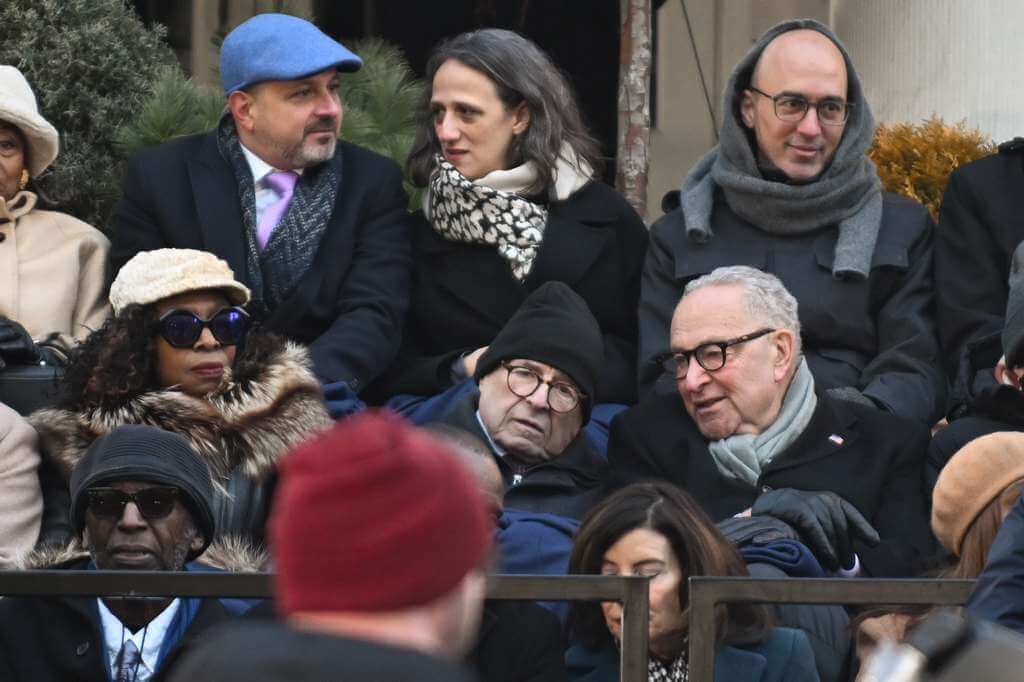
Zohran Mamdani’s swearing-in at City Hall on Thursday afternoon highlighted the full diversity of New York City and included a striking display of Jewish presence and pride during a historic change in leadership.
In a scene rich with symbolism, Sen. Bernie Sanders, who once ran to become the nation’s first Jewish president, administered the oath of office to the city’s first Muslim mayor as Mamdani placed his hand on a Quran.
Looking on from the dais was Sen. Chuck Schumer, the highest-ranking elected Jewish official in the United States. Jewish actor Mandy Patinkin, who hosted Mamdani for Hanukkah, led a musical performance with elementary school students from Staten Island. A bagel and lox schmear even got a mention during Mamdani’s inaugural remarks.
Mamdani’s vision of New York City
Mamdani, a democratic socialist and Israel critic whose surprise rise divided the city’s Jewish community, used his address to cast New York as a shared civic project shaped by its many languages and faiths. “The authors of this story will speak Pashto and Mandarin, Yiddish and Creole,” he said. “They will pray in mosques, at shul, at church, at Gurdwaras and Mandirs and temples — and many will not pray at all.”
The new mayor also mentioned Russian Jewish immigrants in Brighton Beach, who, along with other immigrant communities, came to America with a dream of a better life and nodded to his own upbringing deeply rooted in Jewish culture. “Where else could a Muslim kid like me grow up eating bagels and lox every Sunday,” Mamdani said, a line that drew cheers from the crowd.
Mamdani, a supporter of the Boycott, Divestment and Sanctions movement against Israel, drew louder applause when he acknowledged Palestinian New Yorkers in Bay Ridge, saying that under his tenure, they “will no longer have to contend with a politics that speaks of universalism and then makes them the exception.” Mamdani faced fierce backlash during the Democratic primary for defending the slogan “globalize the intifada,” used by some at the pro-Palestinian protests and perceived by many as a call for violence against Jews. In the inauguration crowd was Mahmoud Khalil, the Columbia University graduate who was held for deportation for his role in pro-Palestinian protests.
Mamdani also pledged to divest from city investments in Israel. This commitment could create a clash with Mark Levine, the incoming city comptroller, who has pledged to repurchase the bonds as part of the city’s portfolio. “This has been a rock-solid investment for decades,” he said. “Israel has never missed a bond payment, and a good, balanced portfolio should have global diversity.”
Levine, who is Jewish, took the oath of office on the Five Books of Moses, called the Chumash. “How remarkable is it that on these steps today, we have three swearings-in,” Levine said, “One by a leader using a Quran, one by a leader using a Christian Bible, and one by a leader using a Chumash or Hebrew Bible. I am proud to live in a city where this is possible.”
Mamdani orders new antisemitism office to stay open
In a signing ceremony for his first three executive orders, Mamdani announced that he will keep open the recently-created mayor’s office to combat antisemitism. “That is an issue that we take very seriously,” he told reporters. Former Mayor Eric Adams used the office to counter antisemitism, including pursuing a measure adopting the controversial International Holocaust Remembrance Alliance definition of antisemitism, which considers most forms of anti-Zionism as antisemitic.
According to the executive order about the structure of the city government, the second measure Mamdani signed after the ceremony, the office will lead efforts to reduce antisemitism and anti-Jewish hate crimes using existing resources and act as a liaison between the city and the Jewish community on safety and security issues. It would regularly advise Mamdani on public education, tracking enforcement cases and reviewing city materials for bias.
Mamdani also issued an executive order revoking all previous executive orders issued by Adams after September 26, 2024, the day of his indictment on federal bribery and fraud charges. That includes the June 2025 measure adopting the IHRA antisemitism definition.
At the inauguration, Mamdani addressed skeptics directly, in a move to lower the temperature after a polarizing campaign. “I know there are some who view this administration with distrust or disdain, or who see politics as permanently broken,” he said. “And while only action can change minds, I promise you this: if you are a New Yorker, I am your mayor. Regardless of whether we agree, I will protect you, celebrate with you, mourn alongside you, and never, not for a second, hide from you.”
The Anti-Defamation League, which clashed with Mamdani during the election and launched a “Mamdani Monitor” to track and scrutinize the new administration’s appointments, said in a statement on Thursday that while holding him actions, the advocacy group will “stand ready to engage constructively” with the new mayor.
On City Hall steps and in the plaza
The ceremony featured a benediction delivered by Imam Khalid Latif, executive director of the Islamic Center at NYU, who co-founded the NYU ‘Of Many’ Institute for Multifaith Leadership with Rabbi Yehuda Sarna. Appearing alongside the Imam was Rabbi Ellen Lippmann, founder and rabbi emerita of Kolot Chayeinu/Voices of Our Lives in Brooklyn and a board member of the progressive Jews For Racial & Economic Justice.
Levine, who speaks fluent Hebrew and Spanish, used the Hebrew terms for welcome and thank you in his remarks as the city’s new comptroller. “Welcome, everyone. What a joy that you came,” he said in Hebrew, after using similar terms in Spanish and Greek. “To those of you who don’t understand Spanish, Hebrew or Greek, welcome, thank you, and please download Duolingo,” he quipped.
Patinkin, an early supporter of Mamdani who appeared in a get-out-the-vote video with the candidate during the campaign, performed “Somewhere over the Rainbow” with the PS22 Chorus of Staten Island.
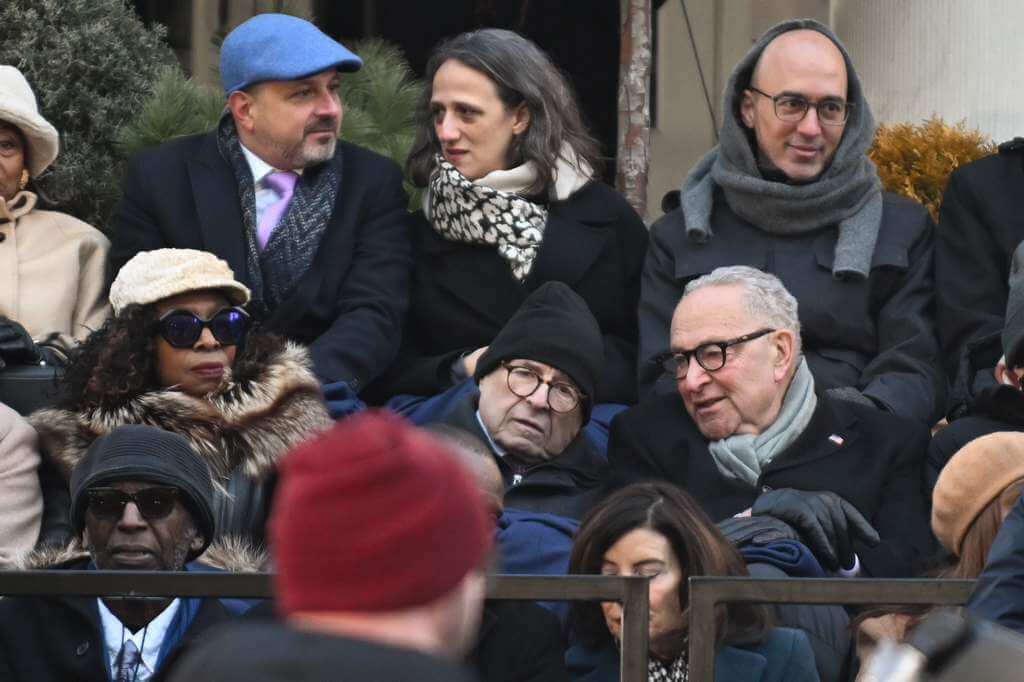
Rep. Jerry Nadler, co-chair of the Congressional Jewish Caucus, sat on the dais next to Schumer, who refused to endorse Mamdani during the election.
Among the 4,000 guests was Rabbi Moshe Indig, the leader of the Hasidic Satmar Ahronim faction who endorsed Mamdani in the general election. Also present were some Orthodox leaders who didn’t endorse and were close allies of Adams — Rabbi Chaim Dovid Zwiebel, executive vice president of Agudath Israel of America, and Josh Mehlman, head of the Flatbush Jewish Community Coalition.
Outside, a group of rabbis protested Mamdani’s swearing-in by displaying Israeli flags. It was led by Rabbi Avi Weiss, founding rabbi of the Hebrew Institute of Riverdale, and Rabbi Chaim Steinmetz of Congregation Kehilath Jeshurun on the Upper East Side. Both rabbis publicly opposed Mamdani during the election. In an interview with Talkline Network, a Jewish online radio, Steinmetz said it was a “demonstration of Jewish pride.” However, he said, New York Jews shouldn’t be fixated on Mamdani, they should assess his actions day by day.
The post Mayor Zohran Mamdani reassures Jewish New Yorkers at inauguration: ‘I will protect you’ appeared first on The Forward.
Uncategorized
Somerville councilors to discuss Israel divestment proposal
(JTA) — SOMERVILLE, Mass. — The issue of divestment from Israel returns to the Somerville City Council in Massachusetts on Tuesday night as lawmakers plan to discuss how to implement a nonbinding ballot question on the matter that passed last year.
The divestment push has divided the city of more than 84,000 residents, which has a long-standing Jewish population. It is located between Cambridge, home to Harvard University, and Medford, a city with which it shares the Tufts University campus.
After Question 3 passed with 55.7% of the residents’ vote in November 2025, the City Council that same month passed a resolution committing to work toward an ordinance within a year to enact the ballot’s goals.
The measure to that effect, introduced in June, would bar the city from investing in or procuring labor, services or goods from companies that support entities identified by the ordinance as violating international law, including Israel.
Unlike the divestment proposal awaiting a November ballot vote in Providence or the binding human rights divestment ordinance passed by Medford’s city council in 2025, the Somerville ordinance specifically mentions Israel and Palestine.
In response to the push for a binding ordinance, 74 registered voters in Somerville submitted a petition for a hearing, which was held in September, before final action is taken, citing concerns about its impact on the city. The issue has now moved to the city’s Legislative Matters Committee, which is meeting Tuesday night.
Among the groups opposing divestment is Shalom Somerville, which submitted the September petition stating that “the sense of belonging and safety experienced by Jewish, Israeli and other residents of diverse backgrounds” is at risk as a result of the ordinance.
Sam Gechter, co-founder and president of Shalom Somerville, said that the ordinance singles out Jews who support Israel, which makes it antisemitic. Deputy City Solicitor David Shapiro also advised in November 2024 that such an ordinance would be “likely invalid,” according to a letter from the Anti-Defamation League and the Louis D. Brandeis Center for Human Rights Under Law.
“I think it’s incredibly irresponsible,” Gechter said, suggesting that the ordinance would slow down governmental action. “But the biggest thing for me is that it makes Jews feel unwelcome in Somerville.”
A local organization, Somerville for Palestine (S4P), has been a driving force behind both the ballot question and the ordinance, which the group developed in collaboration with sponsoring city councilors Ben Ewen-Campen, Ben Wheeler, Wilfred N. Mbah and Jon Link. “It’s what people voted for,” said Mo Katz-Christy, a member of S4P’s leadership and Jewish Caucus. “We want to follow the will of the people.”
The ADL issued a statement condemning the ordinance in June. It also joined the Brandeis Center in issuing a letter calling the proposal an unconstitutional intrusion into foreign affairs.
Other Jewish organizations disagree. Jewish Voice for Peace Boston has worked closely with S4P to back the measures. “I don’t think that those objections have validity,” said Eli Gerzon, a longtime member of JVP. “As a Jewish organization, we are especially concerned that ‘never again’ really means what it says: never again, that we never let a Holocaust, a genocide happen.”
This article originally appeared on JTA.org.
The post Somerville councilors to discuss Israel divestment proposal appeared first on The Forward.
Uncategorized
A major Jewish museum hopes to join the Smithsonian – at a difficult moment for the storied institution
(JTA) — Philadelphia’s Weitzman National Museum of American Jewish History is moving closer to becoming part of the Smithsonian Institution at a moment of significant upheaval for the storied museum network.
A new congressional commission will study whether to make the museum part of the Smithsonian. Its members were sworn in Tuesday, when they also held their first meeting.
In an exclusive interview with the Jewish Telegraphic Agency, the commission’s new chair Philip Darivoff, a former longtime chair of the Weitzman, and vice chair Dara Horn, a New York Times bestselling author, said that the Weitzman joining the Smithsonian would send a powerful message that Jews are a crucial component of the history of the country.
“It’s a different statement that our country makes when it says that the study of Jewish American history and culture is important to this nation,” Darivoff said. Both he and Horn also hope that a boost in the Weitzman’s profile could combat what they called an “epidemic of ignorance” among Americans when it comes to knowledge of Jewish history and culture.
“This really would be an elevation of the Jewish community,” Horn, author of “People Love Dead Jews” and “The Final Solution to the Jewish Question,” told JTA. “The place that Jews show up in a school curriculum is typically more about the Holocaust” — an area that the author has written critically about in the past as too limiting a view of Jewish life.
Horn believes in the Weitzman project, she said, because she hopes to emphasize the ways that Jews have contributed to American founding ideals such as religious pluralism.
“I’m really interested in the connections between the Jewish story and a lot of our foundational ideas in this country,” she said. Jewish ideas such as the Exodus from Egypt in the Passover story “were inspiring to Americans,” she added.
The wheels for the Weitzman joining the Smithsonian began turning in 2024, when Congress passed legislation in 2024, then signed by President Biden, to establish the commission. The group spent the next two years putting the commission together, and has two years from its first meeting to research and publish a report on the feasibility of such a move — though Darivoff said he hopes to finish the work well before the deadline.
Adding a new member to the Smithsonian has been known to take years, if not decades. The two most recent additions, the National Museum of the American Latino and the American Women’s History Museum, were both long in the works.
Founded in 1976, the Weitzman is already an existing, fully functioning institution — and also already a Smithsonian affiliate, meaning it can share resources with other museums in the system. Unlike a museum being built from scratch, the Weitzman already has a building and collection, which proponents hope could speed the process.”
Dan Tadmor, the Weitzman’s CEO, told JTA that joining the Smithsonian would improve their educational mission.
“We have a national footprint for our educational programming, but of course we’d like to widen it,” he said. “Who would say no to a curriculum that’s been developed by a Smithsonian museum?”
The Weitzman’s bid for increased prominence within the Smithsonian comes as the Trump administration has sought to exert greater control over the latter — home to such storied institutions as the National Museum of American History, the National Portrait Gallery and the National Zoo.
This summer the White House issued a report alleging “radical ideology” in the museums’ content, and Interior Secretary Doug Burgum recently announced plans for signs accusing Smithsonian leaders of ideological bias. Observers say such signs are indicative of larger administration priorities opposing the teaching of historical subjects such as slavery. Smithsonian Secretary Lonnie Bunch III is stepping down at the end of the year.
A representative from the Smithsonian declined to comment to JTA on the Weitzman’s bid, or on its current political conditions.
The commission’s chair and vice chair of the new Weitzman said that the current political upheaval shouldn’t affect their work. The Smithsonian, Horn said, “has lasted through many political winds.”
“I think we see this as a long-term project that’s about the place of Jewish Americans in this country’s history,” Darivoff said. “The Smithsonian is a really important institution for this country, and it is the great museum complex of our nation. God willing, it will be flourishing for centuries to come. It’d be an honor to be included in the Smithsonian.”
This article originally appeared on JTA.org.
The post A major Jewish museum hopes to join the Smithsonian – at a difficult moment for the storied institution appeared first on The Forward.
Uncategorized
Two deaths in Manchester synagogue attack last year will be probed through public inquiry, Britain says
(JTA) — The deaths of two Jewish men in an attack on a synagogue in Manchester last year will be examined through a public inquiry, the British home secretary announced on Monday, a necessary step to include sensitive information in the investigation.
Melvin Cravitz and Adrian Daulby were killed during the attack on Yom Kippur on Oct. 2, 2025, when Jihad Al-Shamie rammed a car into a group of worshippers outside the Heaton Park Hebrew Congregation in Manchester and stabbed two people. Cravitz died from stab wounds and another man, Andrew Franks, was seriously injured but survived. Daulby was shot by police while blocking the synagogue doors to stop Al-Shamie from entering. Two other people were seriously injured.
Al-Shamie, a Syrian-born British citizen, said he was acting for the Islamic State, also known as ISIS, before police shot him dead.
Home Secretary Shabana Mahmood announced the public inquiry in a statement about national security at the House of Commons, saying that “what happened that day must be fully understood.”
“This will ensure that all evidence can be heard, including any sensitive national security material that could not otherwise be fully heard in the coroner’s court,” said Mahmood.
Judge Alexia Durran, the chief coroner of England and Wales, was overseeing inquests into the deaths of Cravitz and Daulby. Durran last month recommended that Mahmood convert the inquests into a public inquiry, following statements from Home Office lawyers that some information from MI5 would be withheld from open court due to national security concerns. A full investigation that involves hearing sensitive material in private requires a public inquiry.
Earlier this year, Greater Manchester Police’s chief constable Stephen Watson said he was “deeply sorry” for a “missed opportunity” to uncover the plot against the Heaton Park synagogue. Watson made the apology after prosecutors revealed that Al-Shamie had two prior arrests for allegedly breaching a non-molestation order and alleged rape, and his mobile devices were not examined until after the synagogue attack.
Mahmood listed “a series of attacks on our Jewish community” in the year since the synagogue attack, including the stabbing of two Jewish men in the London neighborhood of Golders Green, a spate of arson attacks and a “foiled but potentially lethal plot” against Jews in Manchester on the eve of Yom Kippur last month. In the last case, two Iranian men have been charged with terrorism offenses.
“Faced with the threat posed to our Jewish community, we have increased funding to the police by an additional £250 million to boost police presence in key Jewish areas and to tackle antisemitism on our streets,” said Mahmood.
She added, “I know we cannot simply build higher walls around our Jewish community and expect them to live in fear. So we must root out the evil of antisemitism wherever it lurks in society, and this government is committed to that effort.”
Mahmood’s announcement comes days after the Home Office released data showing that hate crimes against Jewish people in England and Wales rose 10% in the year ending in March.
Mahmood said the United Kingdom was aware that “the Iranian state is targeting our Jewish community,” adding that the threat posed to Jews demonstrated “how the lines are increasingly blurring between extremism and state threats.”
The post Two deaths in Manchester synagogue attack last year will be probed through public inquiry, Britain says appeared first on The Forward.
