



Uncategorized
Memories of Bubbe Khave-Leye at the marketplace in Buenos Aires
אין אונדזערע צײַטן זענען ווייניק יונגע מענטשן זוכה אויסצוּוואַקסן אין אַ שטוב וווּ עס וווינען דרײַ דורות.
איך בין געבוירן געוואָרן אין אַ שטוב, וווּ עס האָבן געוווינט צוזאַמען מײַנע טאַטע־מאַמע מיט די טאַטע־מאַמע פֿון מײַן מאַמע – באָבע חווה־לאה און זיידע חיים־מענדל — יעדער דור מיט זײַן אייגענער גײַסטיקער וועלט, שפּראַך און נסיון אין לעבן. און דערפֿאַר האָב איך געזען, געהערט און איבערגעלעבט צוזאַמען מיט מענטשן פֿון 19טן יאָרהונדערט, געבוירענע אין מיזרח־אייראָפּע. די באָבע חווה־לאה איז געבוירן געוואָרן אין סטאָלפּצע (שטייבץ); דער זיידע חיים־מענדל — אין דראָהיטשן; די מאַמע, ברכה, פֿון פּינסק; דער טאַטע, שמואל, פֿון סטערדין (וואָלין), און איך – פֿון ייִדישן שפּיטאָל אין בוענאָס־אײַרעס.
פֿון די אַכט זין און טעכטער וואָס די באָבע חווה־לאה האָט געהאַט זײַנען פֿיר געבליבן לעבן. די ייִנגסטע טאָכטער, דודה עליזה (פֿראַדל אויף ייִדיש), האָט געוווינט מיט אונדז ביז זי האָט עולה געווען קיין מדינת־ישׂראל אין יאָר 1949. דערצו זײַנען צוויי ברידער פֿון מײַן מאַמען — פֿעטער יוסף און פֿעטער הערשל — געקומען מיט דער גאַנצער משפּחה פֿון פּינסק קיין בוענאָס־אײַרעס אין יאָר 1937.
אַרום פּסחדיקן טיש פֿלעגן זיצן בײַ אונדז די מומע עטעלע פֿון ווילנע און די מומע לאה פֿון בריסק – צוזאַמען מיט די פֿריִער דערמאָנטע משפּחה־מיטגלידער – אַ פֿיל־שפּראַכיק געזעמל פֿון מיזרח־אייראָפּעיִשע ייִדן, וועלכע האָבן געשמועסט אויף ייִדיש, העברעיִש, רוסיש, פּויליש און אויך שפּאַניש.
מײַן באָבע חווה־לאה איז געווען למעשׂה איינשפּראַכיק, געבוירן מן־הסתּם אָנהייב 1880ער יאָרן, איז איר ייִדיש געווען די זעלבע וואָס עס האָבן גערעדט אירע טאַטע־מאַמע און זיידע־באָבע. דער באָבעס ייִדיש איז געווען אײַנגעטונקען אין לומדישן לשון־קודש. זי פֿלעגט אַלע שבת מעבֿיר זײַן די סדרה אין חומש צוזאַמען מיט פּירושים און אַגדות אויף ייִדיש, גלײַך פֿון צאינה־וראינה. וואָך־אײַן וואָך־אויס, יאָר נאָך יאָר, פֿלעגט זי איבערחזרן דעם גאַנצן חומש מיט זײַנע פּירושים און מדרשים, וואָס האָט צוגעגעבן איר פּערזענלעכקייט אַ פּסיכאָלאָגישע טיפֿקייט און געפֿורעמט איר כאַראַקטער און געמיט.
אין דער רוסישער אימפּעריע האָט די משפּחה פֿון מײַן מאַמעס צד געלעבט פֿון דער אַרבעט פֿון מײַן זיידן חיים־מענדל שוואַרץ, ווי אַ בוכהאַלטער אין אַ טאַרטאַק, אָבער מײַן באָבע איז געווען אַ קראַסאַוויצע אין די אויגן פֿון די גויים, האָבן זיידע־באָבע געמוזט אַוועק וווינען אין דער שטאָט פּינסק. דאָרט איז די פּרנסה געווען אַ קליין געוועלב, וווּ מײַן באָבע האָט פֿאַרקויפֿט קאַלך און פֿאַרב.
פֿון קינדווײַז אָן האָב איך דערפֿאַר געהערט אַ לעבעדיקן ליטוויש־ייִדיש, ווי ייִדן האָבן גערעדט זינט, לכל־הפּחות, פֿון אָנהייב 19טן יאָרהונדערט. דאָס ליטווישע ייִדיש האָט אײַנגעזאַפּט אין זיך רוסישע ווערטער, וועלכע זענען מיט דער צײַט געוואָרן אַן אינטעגראַלער טייל פֿון ליטווישן ייִדיש. די משפּחה איז געגאַנגען אַלע שבת און אין די יום־טובֿים אין שיל. צוזאַמען מיטן אָפּהיטן כּשרות איז דאָס טעגלעכע לעבן געווען אײַנגעהילט אין אַ טראַדיציאָנעלן נישט־פֿאַנאַטישן סטיל. זינט איך בין געווען דרײַ יאָר אַלט און ביז נאָך מײַן בר־מצווה איז מײַן וועלט געווען באַאײַנפֿלוסט פֿון אָט דער אַטמאָספֿער. דער וואָס האָט נישט איבערגעלעבט אין זײַן קינדהייט די יום־טובֿדיקייט פֿון שׂמחת־תּורה בעת די הקפֿות אין שיל, איז נישט מסוגל צו באַגרײַפֿן וואָס מיינט אַ ליכטיקע שׂימחה פֿון אַ ציבור וואָס פֿרייט זיך פֿון גאַנצן האַרצן, האַלטנדיק אין זײַנע הענט אַ ספֿר־תּורה, דער אויטאָריטאַטיווער מקור וואָס באַפֿאַרבט זײַן לעבן מיט אַ זין. אַהרן צייטלין האָט אַמאָל וועגן דעם געשריבן אין זײַן פּאָעמע „דנאָען‟:
זײַן אָדער נישט זײַן, נישט דאָס איז די פֿראַגע. די פֿראַגע איז: זין אָדער נישט זין?
דער לוח, מיט זײַנע געדענקטעג און יום־טובֿים, האָט אָרגאַניזירט דאָס לעבן פֿון ייִדישן ציבור, אַרום געשיכטלעכע דאַטעס און טעג פֿון חשבון־הנפֿש, וועלכע האָבן געשטאַרקט דעם געפֿיל פֿון צוגעהעריקייט פֿון יעדן פּרט און יחיד, צו אַ גײַסטיקער און קולטור־טראַדיציע. אַזאַ צוגעהעריקייט באַפֿרײַט דעם יחיד פֿון זײַן איזאָלירונג און פֿירט אים אַרײַן אין אַ קאָלעקטיוו סײַ אין צײַט סײַ אין רוים.
באָבע חווה־לאה און איר טאָכטער, מײַן מאַמע, האָבן געפֿירט אין צווייען די ווירטשאַפֿט פֿון דער היים. אין מאַרק פֿלעג איך גיין אײַנקויפֿן מיט דער באָבען, פֿון זינט איך בין געווען דרײַ צי פֿיר יאָר אַלט. מיר פֿלעגן גיין צו פֿוס אַ האַלבן קילאָמעטער ביז אַ געדעקטן מאַרק, אַן אומגעהײַער גרויסער, אַ צוויישטאָקיקער. דאָס גיין אין מאַרק מיט מײַן באָבען איז געווען בײַ מיר אַן אויסערגעוויינלעכע געשעעניש, וואָס האָט זיך איבערגעחזרט אַלע דאָנערשטיק, כּדי האָבן די מעגלעכקייט צוצוגרייטן דעם שבת פֿרײַטיק אין דער פֿרי. אַזוינע עקסקורסיעס האָבן מיר געמאַכט ביז איך בין געוואָרן זעקס יאָר אַלט און אָנגעהויבן זיך לערנען סײַ אין חדר אין דער פֿרי, און סײַ אין אַ מלוכהשער שולע בײַ טאָג.
עס איז געווען פֿאַר מיר אַן איבערראַשנדיקער איבערגאַנג, פֿון אַ שטילער טראַדיציאָנעלער היים אַלע טעג פֿון דער וואָך, ביז דעם הו־האַ פֿון מאַרק. אַרײַנגייענדיק אין מאַרק פֿלעג איך זיך אָנטרעפֿן מיט אַ רעש און מיט קלינגענדיקע קולי־קולות פֿון מסחר – די פֿאַרקויפֿער און די קויפֿער. עס פֿאַרהילכט דער גרילצנדיקער רעש פֿון דער עלעקטרישער זעג פֿון לעמל דעם קצבֿ, און עס פֿאַרטויבן די געשרייען פֿון די פֿיש־פֿאַרקויפֿער וואָס פֿאַרקויפֿן פֿרישע פֿיש אין אײַזקאַסטנס, אָנגעטאָן אין הויכע שטיוול. זיי פֿאַרבעטן די קונים מיט ברייטע העוויות… און די פֿיש שטינקען, שטינקען דאָך… אַלע פֿינף חושים וואַכן אויף אין מאַרק. צו דעם אַלעם קומען צו אין אָט דעם קאַקאָפֿאָנישן כאָר אויך די קולות פֿון די קליענטן וואָס באַלאַגערן די סוחרים, שטופּן זיך און שרײַען איבער איינער דעם צווייטן.
אָט די איבערראַשנדיקע ווירקלעכקייט האָט מיך פֿאַרכּישופֿט און צעטומלט אין איין און דער זעלבער צײַט. איך בין נאָך געווען אַ נידעריקער קאַרליק פֿון אַזוינע פֿיר צי פֿינף צי זעקס יאָר, און בין נאָך נישט דערגאַנגען ביז צו די טאָמבענק אין מאַרק כּדי צו זען וואָס עס טוט זיך דאָרט איבער מײַן קעפּל פֿון דער אַנדערער זײַט. איך האָב נאָר געהערט קלאַנגען און ריחות. דער עיקר פֿלעג איך שטיין ווי צוגעשמידט און פֿאַרוווּנדערט אַנטקעגן דעם אַרײַנגאַנג צו זושע דעם שוחט, וואָס איז געזעסן און געשאָכטן עופֿות.
איך און באָבע חווה־לאה, מיט קוישן אין די הענט, פֿלעגן שטענדיק דורכגיין אין מאַרק דעם זעלבן מאַרשרוט: מע הייבט אָן בײַ לעמל דעם קצבֿ. אַרום זײַן פֿירקאַנטיקן טאָמבאַנק, פֿון דרײַ זײַטן ווי דער אות חית, איז שטענדיק געווען אַ גראַטשקע, מענטשן זײַנען געשטאַנען קעפּ אויף קעפּ, אין צוויי צי דרײַ שורות און געוואַרט, ווער מיט געדולד, און ווער מיט שטופּערײַ. לעמל האָט פֿאַרקויפֿט כּשר פֿלייש. די קונים האָבן זיך געסטאַרעט צוצוציִען די אויפֿמערקזאַמקייט פֿון לעמלען און זײַן משפּחה, מע זאָל זיי באַדינען. לעמל און זײַן משפּחה האָבן נישט גערוט אַ רגע, באַדינענדיק זייערע קונים.
נאָכן וויזיט בײַם קצבֿ פֿלעגן מיר אַרויפֿגיין מיט די טרעפּ אויפֿן צווייטן שטאָק פֿון מאַרק, צו די פֿיש. פֿון דאָרטן און ווײַטער האָב איך געוווּסט אַז באַלד וועל איך ווערן באַלוינט פֿאַר מײַן געדולדיקייט. מיר פֿלעגן זיך ווײַטער דאָרט צוגיין צו דער פֿרוי וואָס פֿאַרקויפֿט ברויט, בייגל, געבעקס און פּלעצעלעך מיט געפּרעגלטע ציבעלעס. שוין מיד פֿון באַגלייטן מײַן באָבען פֿון איין טאָמבאַנק צו אַ צווייטן, פֿלעג איך אויפֿעסן אַ פּלעצל בעת מיר זײַנען געגאַנגען ווײַטער – מיט אָדער אָן פּוטער. בײַ אונדז אין שטוב זײַנען אַזוינע מאַכלים געווען אַ דעליקאַטעס. למשל, מיר האָבן זייער ליב געהאַט עסן כאַלעמיטקעס און כאַלעאָנקעס – דאָס וואָס מע רופֿט ריכטיקער חלה מיט קעז אָדער חלה אָן קעז.
דער הויכפּונקט פֿון דעם שפּאַציר מײַנעם מיט דער באָבען איבערן מאַרק איז געווען בײַ דעם אָרט וווּ מע האָט פֿאַרקויפֿט עופֿות. שוין פֿון דער ווײַטנס פֿלעג איך דערהערן דעם קוואַקען פֿון די לעבעדיקע הינער אין זייערע שטײַגן, וועלכע זושע דער שוחט פֿלעגט פֿון דאָרטן אַרויסנעמען. זושע האָט זיי איינציקווײַז געהאַלטן אין איין האַנט, און אין דער צווייטער – דעם חלף. אַ ייִד מיט אַ געדיכטער ווײַסער באָרד, ראָזעווע באַקן און אַ קײַלעכדיקן פּנים — אַ מין „סאַנטאַ קלאַוס‟, וואָס האָט געדונגען אַ צימער אין הויז פֿון דער מומע לאה, די מומע פֿון מײַן מאַמען.
אויפֿן טאָמבאַנק פֿון געוועלב פֿון די עופֿות זענען געמאַכט געוואָרן די געשעפֿטן מיט די עופֿות, נאָך דער שחיטה. אין אַ זײַט איז געווען אַ מין אַרײַנגאַנג צו דער אַרענע פֿון די געשעענישן. דאָרט פֿלעג איך זיך אַוועקשטעלן און גאַפֿן, זעענדיק די שטײַגן אין וועלכע די הינער האָבן געליאַרעמט, דערפֿילנדיק מן־הסתּם אַז עס דערנענטערט זיך זייער סוף. זייערע קולות האָבן צוגעגעבן דעם גאַנצן סצענאַריאָ אַ דראַמאַטישע אַטמאָספֿער. הײַנט צו טאָג בין איך גענויגט צו קלערן אַז מײַן טאַלאַנט נאָכצומאַכן די קולות פֿון הינער in extremis איז נישט קיין אײַנגעבוירענער טאַלאַנט, נאָר איז דעראָבערט געוואָרן אין יענע יאָרן אין יענעם אָרט… און די קולות פֿון די הינער הילכן נאָך ביז הײַנט אין מײַן זכּרון פֿון די פּאַלעווינעס אַרויס.
אין יענע קינדעריאָרן האָב איך באַטראַכט מיט אומשולדיקע אויגן, אָן קיין שום מאָראַלישע אָפּהאַלטן, איינע פֿון די שפּײַזקייטן אין אונדזער פֿליישפֿרעסערישער וועלט. די פֿילפֿאַרביקייט אויפֿן שחיטה־שלאַכטפֿעלד האָט פֿאַרכאַפּט מײַן אויג אָנהייבנדיק פֿון דער קלאָר ווײַסער באָרד פֿון זושע דעם שוחט, צוזאַמען מיט די רויטלעכע הינער און די רויטע קאַמען פֿון די הענער, מיט דעם געלבלעכן זעגעכץ אויסגעשפּרייט אין דער לענג און אין דער ברייט אויף דער פּאָדלאָגע, און ענדיקנדיק מיט דער שחיטה אַליין וואָס האָט זיך אָפּגעשפּילט פֿאַר מײַנע אויגן, װען זושע האָט אויפֿגעהויבן דעם בלאַנציקן חלף. אָט דאָס איז וואָס מײַנע אויגן האָבן דערזען:
זושע דער שוחט נעמט אַרויס אַ הון פֿון אַ שטײַג, ער באַרויִקט זי מיט לײַכטע גלעטן פֿון אַ פּראָפֿעסיאָנעלן שוחט, אַ בעל־רחמים, פּאַמעלעך פֿאַררײַסט ער דאָס קעפּל אויף אַהינטער, און אַנטבלויזט דאָס העלדזל. זושע הייבט אויף דעם מעסער, און מיט אַ שאַרפֿער תּנועה פֿון אויסגעשאַרפֿטן חלף גיט ער אַ שניט וווּ מע דאַרף. אַ דינער רויטער שטראָם בלוט צייכנט אָפּ אַ בויגן אין דער לופֿט און נידערט אויפֿן געלן געזעגעכץ. דאָס געקוילעטע הינדל ווערט אַוועקגעוואָרפֿן אויף דער פּאָדלאָגע, און די שעקספּירישע וויזיע וואָס מיר היפּן איבער צוליב דעם כּבֿוד פֿון די געשאָכטענע, קומט צו אַ סוף.
איך וועל זאָגן אַ ליגן, אויב איך וועל טענהן אַז אין עלטער פֿון דרײַ ביז זעקס יאָר האָב איך געוואָלט ווערן אַ שוחט. אָבער אָט די גאַנצע סצענע האָט מיך פֿאַרכאַפּט, נאָך איידער איך האָב פֿאַרשטאַנען וואָס צער־בעלי־חיים איז. פֿונעם געוועלב פֿון די עופֿות זײַנען מיר צוגעגאַנגען צו די טרעפּ וואָס פֿירן אַרונטער, כּדי אײַנצוקויפֿן פֿרוכט און גרינסן. אָבער איידער מיר זײַנען אַראָפּ, האָבן מיר זיך פֿאַרהאַלטן בײַ דעם מילכיקן, וואָס פֿאַרקויפֿט כּל־מיני קעזן און מילכיקע פּראָדוקטן. בײַם אַרויסגאַנג זענען מיר אַרײַן אין אַ געשעפֿט וווּ מיר האָבן געקויפֿט געזאַלצענע הערינג אַרויסגעצויגן בלײַך פֿון אַ פֿאַס, מאַסלינעס, גרויפּן, פֿאַרשיידענע געווירצן און ניס.
אין יענער צײַט זענען אין בוענאָס־אײַרעס נישט געווען קיין פֿרידזשידערן. פֿלייש און מילכיקע פּראָדוקטן האָט מען געהאַלטן אין אַן אײַזקאַסטן — אַ הילצערנעם קאַסטן וווּ מע האָט אַרײַנגעלייגט גרויסע שטיקער אײַז, וועלכע מע האָט געקויפֿט אין דער גאַס. די פֿור מיט די גרויסע שטיקער אײַז פֿלעגט קומען אויף אונדזער גאַס, און מיר פֿלעגן זיי קויפֿן לויט קוביק־מעטערס וואָס דער פֿאַרקויפֿער פֿלעגט אויסהאַקן מיט אַ ספּעציעלן אינסטרומענט.
במשך צענדליקער יאָרן האָב איך דאָ אין ישׂראל געזוכט אין יעדן אָרט וווּ איך האָב געגעסן דעם טעם פֿון אַמאָל, פֿון דער מיזרח־אייראָפּעיִשער קיך בײַ אונדז אין שטוב אין בוענאָס־אײַרעס. ניין… עס איז נישט דער טעם וואָס איז געווען בײַ מיר אין דער היים, האָב איך מיט אַ ווידערווילן אַרויסגעזאָגט בײַ אַלעמען אין שטוב און בײַ מײַן שוויגער און אַפֿילו בײַ מײַן פֿרוי אין קיך. איך טענה נישט חלילה, אַז זיי האָבן נישט געוווּסט ווי אַזוי צו קאָכן, אָדער אויספֿאַרטיקן פּאָטראַוועס. פֿאַרקערט, אָבער דאָס עסן מיט זײַן געשמאַק פֿון אַמאָל איז אַנטרונען… בײַ־בײַ, סאָו־לאָנג… ביז מיט אַ קורצער צײַט צוריק, איז מיר קלאָר געוואָרן פֿאַר וואָס איך געפֿין שוין מער נישט דעם טעם פֿון אָמאָל. הײַנט קאָכט מען אויף אַ גאַז־אייוועלע אָדער אויף עלעקטרע אָבער אין די 1940ער און 1950ער יאָרן האָט מען געקאָכט אויף קוילן. לענג־אויס דער וואַנט אין קיך בײַ אונדז אין שטוב אין בוענאָס־אײַרעס איז געשטאַנען אַן אויוון אויסגעבויט מיט ציגל, מיט דרײַ עפֿענונגען, אין וועלכע עס האָבן געברענט שוואַרצע קוילן, וואָס מיר פֿלעגן אײַנקויפֿן אין אַ קוילן־געשעפֿט, לויט קילאָגראַמען.
פּלוצלינג איז מיר געוואָרן קלאָר, אַז דאָס קאָכן אויף קוילן — למשל, אַ טשאָלנט אין אײַזערנע טעפּ פֿאַרדעקט מיט אַן אײַזערנער דעקל און פֿאַרוויקלט אַרום און אַרום מיט שמאַטעס — אַזאַ טאָפּ וואָס שטייט אויפֿן פֿײַער (נישט פֿון גאַז און נישט פֿון עלעקטרע) 24 שעה, וועט דער טעם זײַן רײַכער ווי דער טעם פֿון גאַז־ און עלעקטרע־געקעכצן. די איינציקע „מאַכלים‟ וואָס מעגן האָבן אַן ענלעכן טעם, זײַנען די קומזיץ־מאַכלים וואָס חלוצים האָבן געספּראַוועט אין די ליכטיקע אויסגעשטערנטע ארץ־ישׂראל־נעכט, און געזונגען: „אַרום דעם פֿײַער/ מיר זינגען לידער/ די נאַכט איז טײַער/ זי קומט נישט ווידער// באַפּוצט די קעפּ/ מיט בלומען קראַנצן/ אַרום דעם פֿײַער/ איז גוט צו טאַנצן…‟ עס איז נישט צו פֿאַרגלײַכן אָפּגעברענטע פּאָטייטעס און פֿאַרטשאַדעטע פּראָדוקטן בײַ אַ קומזיץ מיט די גורמע פּאָטראַוועס פֿאַרגאַזטע און עלעקטריפֿיצירטע.
The post Memories of Bubbe Khave-Leye at the marketplace in Buenos Aires appeared first on The Forward.
Uncategorized
The Jewish community accepts interfaith families in principle — but it doesn’t look that way in practice
There is a photograph from my wedding that I think about more than any other. My wife Donna and I are standing under a chuppah. But we are not in a synagogue. Or even on a beach. We are in the beautifully ornate St. Matthew’s Cathedral in Washington, D.C. — the same church where John F. Kennedy’s funeral Mass was held.
Donna is Catholic. I am Jewish. The ceremony, which took place a little more than 20 years ago, was co-officiated by a rabbi and a priest. Before we exchanged vows, we signed a ketubah — the Jewish marriage contract — on the altar, beneath the Cathedral’s great mosaic of St. Matthew, the apostle who was himself a tax collector before he was called to follow Jesus: a man of two worlds, presiding over our union with what I have chosen to interpret as equanimity.
We like to call it a “Ḥuppah in the Ḥurch.” The guttural Hebrew Ḥet — the sound that “chuppah” and “church” share when English speakers say them — makes the joke land differently out loud than it does on the page. But the feeling it captures is real: that the most Jewish act of my adult life happened inside a Catholic cathedral, and that this was not a contradiction; it was the whole point.
I did not fully understand, at the time, what that photograph meant. I understand it better now, with one child who stood on a bimah at our synagogue to become b’nei mitzvah in 2024, and a second who followed this October. The earlier wedding chuppah at St. Matthew’s was not a compromise. It was a declaration of intent of how we would define our family.
According to the 2025 Greater Boston Jewish Community Study — a comprehensive survey of Jewish communal life commissioned by Combined Jewish Philanthropies and released earlier this year — only 23% of children ages 14-17 from interfaith families have a bar or bat mitzvah, compared to 82% of children from families where both parents are Jewish. That gap — 59 points — is not a rounding error. It is a chasm. I believe it measures less a failure of Jewish identity than a failure of Jewish institutions.
The Boston study found that 65% of Jewish households with children in the greater Boston area are interfaith — a majority. Nationally, the 2020 Pew Research Center survey found that 42% of married American Jews were married to a non-Jewish spouse, with that number rising among younger and non-Orthodox Jews. Interfaith families are not an edge case in American Jewish life. They are the center of it.
Jodi Bromberg, who led 18Doors — a nonprofit dedicated to supporting interfaith families in Jewish life — for a decade before stepping down in 2024, put it bluntly: Interfaith families “aren’t a drop in the ocean. We are the ocean.” The irony is that 18Doors itself has since become a casualty of the communal prioritization it was warning against. After Oct. 7, 2023, donors shifted their giving toward Israel and antisemitism-related causes; earlier this year, according to JTA, 18Doors slashed its staff from 15 to four. Bromberg left asking: “The question it left in the minds of families like mine: whose priority are mixed heritage and interfaith families in Jewish life?”
The Jewish community has largely supported welcoming interfaith families. The language has shifted — from “intermarriage” as problem to “interfaith family” as constituency. What has not yet shifted, in too many places, is what actually happens when those families show up.
My family showed up. What happened to us is a complicated story about what Jewish continuity actually costs — and who is being asked to pay for it.
The first wall we encountered was not unwelcoming people. It was doctrine.
Matrilineal descent — the principle that Jewish identity passes through the mother — is not stated plainly in the written Torah. The rule was codified by the early rabbis, likely in the first or second century CE, and yet it functions today, in Conservative and Orthodox congregations, as a theological absolute — a sorting mechanism that places children of Jewish fathers and non-Jewish mothers in a separate category, recognized as fully Jewish by Reform and Reconstructionist movements but not by much of the rest of the Jewish world.
I grew up in a Reform congregation, but in my twenties I spent time studying at Aish HaTorah in Jerusalem — an Orthodox yeshiva — and came home with a deeper appreciation for traditional observance. When Donna and I started a family, I was drawn toward a more traditional congregation. What I found, at more than one Conservative synagogue, was that my daughters — daughters of a Jewish father and a devoted, deeply engaged Catholic mother — would need to convert to be considered fully Jewish. The synagogue said it would accept our family. But our daughters would need to be processed.
This is not outright rejection. It is something subtler: the message that your children’s belonging is conditional, something to be granted rather than inherited. You are welcome, but the rest of your family is a question we haven’t resolved yet.
I almost let it win.
Our older child started Hebrew school at a large synagogue in northern Virginia and came home crying. The environment was harsh; she was behind and everyone knew it. After several months, she asked us if she could stop. The pandemic arrived, and we let it make the decision for us.
When restrictions lifted, we found a congregation in Arlington that had built a hybrid model during the pandemic — Sunday morning religious school in person, Hebrew instruction via individual Zoom sessions during the week. What looked like an emergency accommodation turned out to be an unintended innovation: a model that removed the social pressure of being seen to struggle. Away from the eyes of their peers, our child learned and caught up. In February 2024, they led their own bat mitzvah service, then started a Jewish student cohort at their school.
What saved their Jewish education was not ideological commitment. It was an accident of pandemic logistics. That is a fragile kind of salvation. Most interfaith families do not find it. The data says so.
There is something the data does not capture: what the work actually looks like inside an interfaith home. Donna agreed, before the Ḥuppah at St. Matthew’s, to raise our children in the Jewish tradition, and she has kept that agreement with a fidelity that still catches me off guard. She runs our Jewish household calendar, ensures the girls study their Hebrew and Torah portions, has made raisin kugel and matzo ball soup from scratch, and has shown up for every bat mitzvah preparation meeting — all as a Catholic woman who continues to practice her own faith and has not surrendered anything of herself to make room for ours.
Meanwhile, I string the outdoor Christmas lights every year, drove the girls to Catholic Sunday school for years, gave Donna a diamond cross necklace early in our relationship that she still wears today. An interfaith marriage requires not one partner’s sacrifice and the other’s gratitude, but a genuine doubling of belonging.
When I asked Donna what the harder moments were, she said they were not in our own home. They were in other people’s institutional spaces — the moments when she felt regarded as a problem to be managed rather than a parent to be welcomed. The 23% is often read as a story about interfaith families failing to commit. It is at least as much a story about Jewish institutions failing to make the non-Jewish partner feel that her commitment matters.
My younger daughter stood on the bimah on Oct. 3. She is a different person than her older sibling— a social butterfly with her own questions, her own relationship to what this all means — and she was honest with me about those questions in ways that required me to listen rather than answer. She completed her bat mitzvah not because she had resolved those questions, but because she made a commitment and she was going to honor it. There is something deeply, if unintentionally, Jewish about that: a covenant is not a feeling, it is a promise kept because you said you would keep it.
She was in the 23%. She almost wasn’t.
The fear behind the continuity crisis narrative has been used to justify exclusion, to draw lines, to send signals to interfaith families about whether they truly belong. Those signals are self-fulfilling. The families who make it to the bimah found an institution that treated them as members rather than complications, had a non-Jewish partner committed enough to keep showing up anyway, and got lucky with a workaround that happened to be exactly what their child needed. That is too much to ask, and too random a path to count on.
The Jewish community has accepted interfaith families in principle. The 23% tells you what that acceptance looks like in practice. If the number is going to change, something structural has to change with it — not just the language of welcome, but the architecture of it. Not just the open door, but what’s waiting on the other side.
My daughter chanted her Torah portion with her Catholic mother who was on the bimah behind her, and her older sister in the front row, wearing a cross and a Star of David together because she has decided there is no reason she cannot wear both.
If we truly believe interfaith families are the future of American Judaism, what do we owe the 77% who never made it to the bimah?
The post The Jewish community accepts interfaith families in principle — but it doesn’t look that way in practice appeared first on The Forward.
Uncategorized
Trump’s empire is crumbling, much like the Berlin Wall in 1989
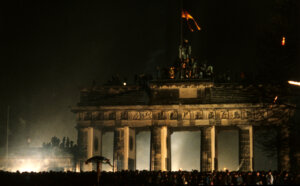
As a foreign correspondent during the Cold War, I witnessed and reported on the collapse of East Germany’s corrupt communist state. Nearly four decades later, I feel a sense of déjà vu as I watch Donald Trump’s corrupt MAGA regime crumble at an accelerating pace.
German social media influencers and national news platforms have been posting videos of American mid-term election scenes that remind me of the night the Berlin Wall cracked open in 1989 — dancing in the streets, strangers hugging, laughter spilling out of Democratic watch parties, tears of relief and disbelief.
In Austin, Texas, Sally Lisa Starken, a German journalist and influencer, stood amid a roaring crowd of James Talarico supporters when the Democrat was declared the victor over Ken Paxton. Lifting her phone to capture the eruption for her Instagram followers, Starken looked just as stunned and jubilant as the sea of people surrounding her,.
For a moment, Austin was Berlin.
“Texas is turning blue! This is insane!” Starken said in her live post. A follower back in Germany wrote: “Yeah! Fantastic! Thank you for this wonderful news this morning!” Another added: “The USA has woken up!!! Hopefully that will soon happen here.”
Since Trump’s second inauguration, his autocratic style of governing has carried echoes of the Third Reich. And now, as the politically wounded American president enters the last half of his second term, his crumbling MAGA machine is looking like the corrupt Stalinist regime that ruled East Germany for four decades.

The opening of the Berlin Wall released East Germans from repression. While Trump has another two years to go as president, American voters rescued democracy by restoring Congress to its role as a check on overreaching executive power by rejecting Republican officeholders and candidates who had turned themselves into Trumpian marionettes.
Responding to citizen demands for accountability, German authorities after reunification pursued hundreds of cases against former East German officials, charging them with offenses that spanned the system’s spectrum of abuse — from the misuse of state resources to the killing of East Germans trying to flee to the West.
Corruption was endemic within the East German leadership. Senior officials, including Erich Honecker, lived in comfort inside a walled enclave at Wandlitz outside East Berlin and vacationed on the Baltic Sea in exclusive manor homes on Vilm, an island off limits to ordinary Germans. Luxury goods for the communist elite flowed through a secretive government agency called Commercial Coordination, which trafficked in Western technology, arms deals, and hard-currency diversions to Swiss accounts.
Few of the senior officials ended up paying for their misdeeds. Many were spared because of illness or frailty. Erich Honecker initially found refuge in Moscow but in 1992 was sent back to Germany to stand trial on charges of abuse of power and manslaughter for the killing of East Germans who tried to escape to the West. The case was abandoned because Honecker was seriously ill. He died of cancer in 1994 in Chile, where he had moved to reunite with his wife and his daughter.
As sensational as the proceedings against Honecker and his comrades were, they may well pale next to the scrutiny Donald Trump, his two oldest sons, his son-in-law, and their associates could face with Democrats now in control of Congress. After the GOP’s shellacking, Rep. Robert Garcia had two words for Trump administration officials linked to corruption and abuses of power: “Lawyer up.”
Garcia, a California Democrat who is in line to become the chair of the House Committee on Oversight and Government Reform, has outlined an aggressive agenda for investigating the Trumps and their political and business circles.
“If we’re really going to take on the affordability crisis, we’ve got to take on the corruption of the Trumps because they’re stealing people’s money, their labor,” Garcia told Punchbowl News.
Garcia said his top areas of focus include Trump family corruption, alleged abuses by ICE and the Department of Homeland Security, corporate misconduct, and cover-ups in the Jeffrey Epstein scandal.
Although Trump and his allies have done little to conceal their conflicts of interest, compelling testimony under oath would force them to confront conduct they have evaded accountability for throughout Trump’s second term. We can expect hearings on the $2.2 billion in wealth Trump has accumulated as president, Eric and Donald Trump Jr.’s shady business dealings and Jared Kushner’s financial relationships with Middle Eastern governments.
Congressional hearings on Trump’s massive immigration crackdown would have the potential to become a sort of American analog to the post-unification trials of senior East German officials, mid-level commanders, and border guards in the killing of East Germans who tried to flee to the West — scaling the Berlin Wall, sprinting across the death strip along the border, or attempting other desperate escapes.
Democrats will likely try to shine a light on decision-making processes that led up to foreign university students being swept off the streets by federal agents, traffic stops in which immigrants were violently pulled from their cars, masked agents terrorizing families during raids on immigrants’ homes, the warehousing of Latinos and others in detention centers with allegedly inhumane conditions, the spiriting away of detainees to African countries with which they have no connection, and brutal tactics of the kind that resulted in the deaths of Renee Good and Alex Pretti.
Among those likely to face subpoenas are top Trump aide Stephen Miller, the former Homeland Security secretary Kristi Noem and possibly Trump himself. Oversight hearings would force senior officials to explain, under oath, how these policies were conceived, approved and carried out — a public accounting that echoes, in form if not in historical circumstance, the post-reunification scrutiny faced by East German officials responsible for the lethal border regime.
What happens if all of this ends the way East Germany’s reckoning did — with months of public testimony, thousands of pages of evidence, and almost no real accountability? Trump retains broad pardon powers, and the Supreme Court has already granted him sweeping presidential immunity. As long as he remains in office, his Justice Department is unlikely to pursue anything Congress uncovers. The result could resemble the East German experience: a great airing-out of abuses, and perhaps a sense of moral clarity, but the central figures keeping the riches and advantages they have reaped during Donald Trump’s reign and escaping any real punishment.
Even so, such an airing-out would not be meaningless. It would stand as a warning that the vast corruption of Trump’s second term will never again be tolerated — and as a record of how close America came to losing the checks that make democracy possible.
.
The post Trump’s empire is crumbling, much like the Berlin Wall in 1989 appeared first on The Forward.
Uncategorized
Eisenkot moves closer to ousting Netanyahu. Here’s what could come next.
(JTA) — Yashar party leader Gadi Eisenkot leaped ahead of Prime Minister Benjamin Netanyahu this week in the effort to secure enough support from the rest of the parliament to form Israel’s next governing coalition. But that doesn’t mean he’ll succeed in his quest to become prime minister.
Yashar won the most seats – 21 – of any party not aligned with Netanyahu in last month’s vote. But neither the prime minister’s bloc nor the opposition garnered the 61-seat minimum needed to form a governing majority.
Israeli President Isaac Herzog on Sunday will announce who is being given the first shot at forming a coalition. By the end of this week, Eisenkot was able to announce that 67 parliamentarians had endorsed giving him the first chance to do so, compared to 46 for Netanyahu.
That means Herzog is all but certain to tap Eisenkot on Sunday to form a government – but Eisenkot’s path forward remains far from clear.
Eisenkot leads a bloc of four Zionist parties that make up Israel’s so-called change bloc, united by their stated goal of replacing Netanyahu. Together, they hold 48 seats in the incoming parliament, or Knesset, which means they need to enlist the support of parties whose seats total at least 13 to reach the magic number of 61 out of 120 Knesset seats. Or, they could gain a plurality if enough other parties abstain from voting in the new coalition.
Eisenkot has 28 days to negotiate that arrangement once given the opportunity, or mandate, to do so by Herzog, plus a 14-day extension if the president allows it. If Eisenkot fails, another candidate could get a shot at forming a coalition, or another round of elections might loom.
Sixty-seven lawmakers supported Herzog giving Eisenkot the mandate. But that’s different from voting for him to actually take power. Here are the paths he could take, and why each one is fraught.
An unlikely alliance?
The first option, which has gained traction in the days since the election, is to cooperate with the ultra-Orthodox parties. These parties have a longstanding alliance with Netanyahu but have served in governments with leaders in the center and left in the past.
There are several indications that such an arrangement may already be taking shape. For starters, United Torah Judaism, one of the two haredi Orthodox parties in the Knesset, told Herzog that it would not endorse either candidate for prime minister – seemingly breaking from the alliance with Netanyahu.
During the consultations with Herzog, the party’s leaders made clear that their support would go to whichever bloc was willing to make concessions on Haredi conscription, including abandoning sanctions against those who refuse to enlist.
If United Torah Judaism with its 7 seats shifts its support from Netanyahu’s coalition to the change bloc, Eisenkot could secure a plurality, provided the Arab parties at least abstain.
Another indication that such an arrangement may be in the works came from Avigdor Lieberman, leader of the Yisrael Beiteinu party and a member of the change bloc. For years, Lieberman has been best known in Israeli politics for his fierce opposition to the haredi parties.
In a stunning change of course, Lieberman signaled in a Friday post on X that he was open to cooperating with the haredi parties to replace Netanyahu — an arrangement that would have been almost unimaginable until recently.
“The election results require all of us to rethink our approach and recognize that there are no good alternatives or magic solutions before us,” Lieberman wrote. He said politicians would need to “show flexibility and make compromises,” including on the issue of haredi military conscription.
“Our national responsibility requires us to make difficult decisions and be prepared for painful compromises,” he added.
The other leaders of the change bloc have been considerably more vague, focusing on the need to replace Netanyahu without specifying how they intend to do so.
“In recent days, I have been advancing a plan with my partners to establish a national emergency government,” Eisenkot wrote on Friday of the four parties that comprise the opposition bloc coming out of the election.
“The logic behind it is to quickly swear in a government based on the four Zionist parties of change and renewal, with any party or Knesset member who agrees to my four basic principles joining immediately or gradually,” he explained. These principles include recognizing Israel as a Jewish and democratic state, accepting the values enshrined in Israel’s Declaration of Independence, mandatory military or civilian service, and recognizing Hamas as a terrorist organization.
But in the same post in which he announced his willingness to compromise with the haredi parties, Lieberman also introduced a potential obstacle that could derail the entire effort. The veteran politician ruled out supporting any minority government, raising the number of seats the change bloc needs to secure to 61. That would require the support of both haredi parties, United Torah Judaism and Shas, rather than just the former.
That is a considerably greater challenge. Shas is considered more right-wing than United Torah Judaism, and its leader, Aryeh Deri, has maintained an especially close relationship with Netanyahu for years. The party also endorsed Netanyahu for prime minister during the consultations. So far, there has been no indication that Shas intends to abandon him, casting serious doubt on the viability of a change-bloc government backed by the haredi parties.
And that is far from the only obstacle facing such an arrangement. One of the central themes of the change bloc’s election campaign was the need to enlist haredi men in the military and change the state’s longstanding approach to their exemption from service. One of the bloc’s strongest campaign arguments was Netanyahu’s unpopular alliance with the two haredi parties. Every leader in the bloc, without exception, pledged before the election not to sit with them in government.
Forming a government with the haredi parties, likely involving significant compromises on military conscription, would be seen by many change-bloc voters as a stunning betrayal.
The first signs of a revolt have already emerged within the bloc. Dan Illouz, an elected Knesset member from Lieberman’s party, wrote on Friday that “we cannot give up on a conscription law,” making clear that he would oppose compromises on the issue.
An unprecedented partnership?
Another scenario that could theoretically allow Eisenkot to form a government would be to rely on cooperation with another minority, the Arab parties — an arrangement that has long been controversial in Israeli politics. The 19 seats won by Ra’am and the Joint List, the two Arab parties in the bloc, could provide the additional support needed for a change bloc government.
Eisenkot would need active support from Ra’am, the more moderate of the two Arab parties, which previously joined the coalition that replaced Netanyahu in 2021 and has made integration into Israeli society a central part of its platform, alongside an abstention or support from outside the coalition, i.e. not actively joining the coalition, by the Joint List. The more hard-line Arab party has signaled its willingness to engage in unprecedented cooperation with the change bloc to bring down Netanyahu’s coalition.
But here, too, cooperation is far from straightforward, and the obstacles again come from within the change bloc itself.
In addition to ruling out support for a minority government, including one backed by Ra’am, Lieberman made clear that he would oppose any government relying on the Arab parties. “We must not establish a government that relies on the abstention of the Joint List and Ra’am,” he emphasized in his Friday post.
Without Lieberman’s support, cooperation between the change bloc and the Arab parties appears unlikely. It would require the active support of both Arab parties, rather than just Ra’am, a prospect likely to create significant difficulties for members of the change bloc who may be reluctant to cooperate with a party that many Jewish Israelis view as hostile to the Jewish state and the Zionist project. Israeli media have reported that some lawmakers in the bloc have already conveyed that they would struggle to sit in a government with the Arab parties.
Here, too, such an arrangement would represent a clear breach of a campaign promise made by every leader in the change bloc. Eisenkot himself said in a late September interview with Channel 12 News that the Arab parties, including Ra’am, did not meet his conditions for joining a government. Among those conditions, he said, was recognizing Hamas as a terrorist organization.
A unity government after all?
The third possible route to forming a government would be a national unity coalition between Netanyahu and the change bloc, or at least some of its constituent parties.
So far, all the leaders of the change bloc appear to have categorically ruled out such an arrangement after the election.
In his Friday post, Eisenkot said there was an “urgent need to replace” Netanyahu’s leadership. Lieberman declared that “the Netanyahu era must come to an end.” Yair Golan, leader of the Democrats, said the bloc had a “historic responsibility” to send Netanyahu home, while Naftali Bennett, the former prime minister who leads B’Yachad, also emphasized the urgency of replacing the current government.
The underlying assumption is that Netanyahu, who will remain prime minister if neither bloc succeeds in forming a new government and new elections are called, would prefer another election to giving up the office.
That would mean any unity arrangement would likely require Netanyahu to remain prime minister, at least initially, under a rotation agreement. Some have speculated that the change bloc’s overtures to the ultra-Orthodox parties are intended to lower Netanyahu’s bargaining power ahead of potential negotiations over a unity government.
For all the momentum behind Eisenkot’s bid to replace Netanyahu, none of the available paths to a governing majority looks straightforward. Securing the mandate may have been the easy part – forming a government could prove much harder.
This article originally appeared on JTA.org.
The post Eisenkot moves closer to ousting Netanyahu. Here’s what could come next. appeared first on The Forward.
