


Uncategorized
One of America’s first Jewish farms was nearly lost to history. Now these Brooklyn parents are risking everything to keep their family’s legacy alive.
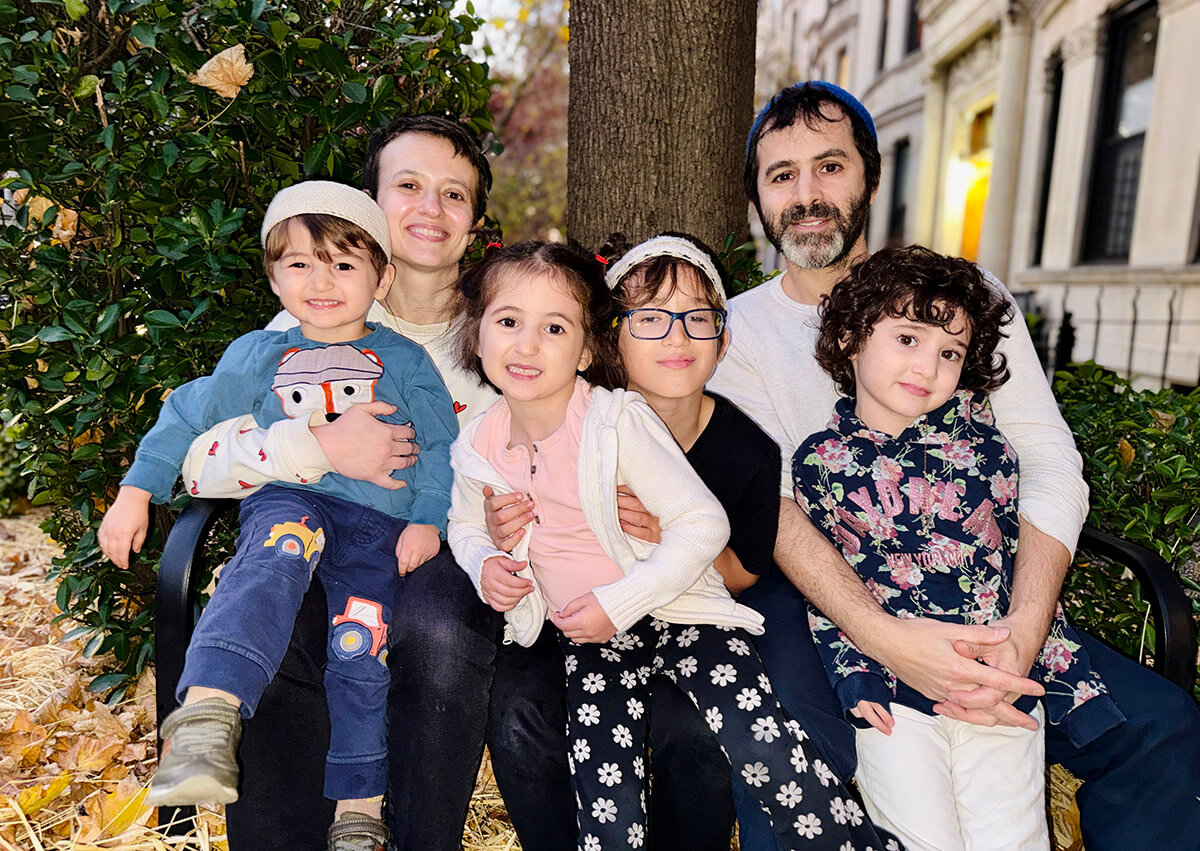
The 350-square-foot Brooklyn apartment where Malya and William Levin live with their four children is barely big enough for their family, much less their ambitions. From this compressed space, they’re reaching for something vast — the revival of one of America’s first Jewish farms, built by William’s ancestors in rural South Jersey.
Their quixotic quest is larger than acreage; it’s continuity, in a time and place where nothing stays rooted for long. It’s a tight staging ground for an unusually wide dream.
“We aren’t just trying to save land,” Malya said, their toddler Julius perched on her lap. “We are trying to save the story.”
The story she’s referring to reaches back to 1882, when 43 Jewish families fled pogroms in Russia and the Pale of Settlement. They carried what they could — and what they couldn’t bear to leave behind.
Backed by Baron de Hirsch and other Jewish benefactors who believed farming could offer both refuge and respectability, they were sent not to the teeming tenements of Manhattan but to a thousand acres of pine forest and sandy soil.
It was a bold wager: Eastern European Jews, often caricatured in their home countries as “unproductive,” could instead be seen growing their own food as capable, contributing citizens. Those same Jewish immigrants — tailors, peddlers, clerks — could become farmers, rooted and self-reliant, all trying to prove that Jews could stand on American land and make it yield.
“It’s almost a completely different story than we’re used to hearing,” said Adrienne Krone, a religious studies professor at Allegheny College and the author of Free-Range Religion. “We’re used to the Lower East Side and factories and crowded apartments, and what was happening in these farming communities was almost the exact opposite.”
Around the same time, dozens of such Jewish agricultural colonies were established across the United States, including in Louisiana, Utah, and both Dakotas. Yiddish-speaking socialists established a similar settlement, Happyville, in South Carolina.
In New Jersey, they called their 1,000-acre settlement the Alliance Colony.
What began as tents and barracks grew into a rural Jewish community of hundreds of families: homes, vineyards, chicken farms, a school, three synagogues, and a mikvah. The colonists built a tobacco factory that failed, and a button factory that didn’t. Reinvention wasn’t strategy so much as muscle memory.
Among the colony’s early leaders was William’s great-great-grandfather, Moses Bayuk. His generation carved Alliance out of wild ground: clearing land, organizing the community, building the institutions that held it together.
After World War II, a second wave of immigrants arrived in the region — Holocaust survivors who settled in nearby Vineland and Pittsgrove and built successful chicken farms. For decades they sustained a thriving Jewish agricultural center across South Jersey.
But by the 1970s, most families had moved into city jobs. The Jewish presence waned. The land quieted.
What led them back to the farm
For William and Malya, the draw toward Alliance was never just historical. It was personal.
Malya, 41, grew up in New Jersey steeped in Jewish text and memory. She is the daughter of Rabbi Arthur Kurzweil, the noted author whose career has long focused on Jewish continuity. Her childhood was Orthodox, threaded with rituals that made the past feel close enough to touch.
William, 54, arrived at Jewish life differently. He didn’t grow up religious. His first real brush with Judaism came through, of all things, animation: In the early 2000s, before the days of YouTube and social media, he was making viral Jewish videos that somehow found their way across the internet. Several, including a cartoon in which a robot meets 50 Cent and raps about the Ten Plagues, reached millions.
“I didn’t even know what the word frum meant until Frumster hired me,” he said of the Orthodox dating site. “They paid me in a Frumster.com membership.”
It worked.
He met Malya at a Jewish singles event in 2009. They married the next summer, on Tu B’Av, known as the Jewish festival of love.
“We both had a penchant for offbeat stuff,” Malya said. “Neither of us wanted to be accountants and move to the suburbs on Long Island.”
That sensibility carried them to Sukkahfest 2014 at the Isabella Freedman Jewish Retreat Center in Connecticut, where they witnessed a modern Jewish farming movement that wove land, ritual, ecology and community into a single experience.
“It was beautiful and intoxicating,” William said.
“All these young Jews were so into farming,” Malya added. “And we were like: Wait, we have the first Jewish farm.”
Their cramped apartment in Brooklyn feels like the furthest thing from this expansive ideal. A desk presses into a couch, the couch brushes against the mattress where William and Malya sleep. In the lone bedroom, their four children climb into a handmade Jenga-tower of bunk beds.

William opens a cigar box filled with brittle letters from Alliance’s earliest families — the kind of fragile paper that survives only because someone keeps choosing to protect it. For the couple, preserving the land has always meant preserving the story stitched through it.
The idea gained force. The place that kept resurfacing was the 85 acres William’s extended family still owned in the old Alliance Colony, land that had never fully slipped from their hands.
So the couple, an animator and an elder justice attorney, did something audacious: They spent their life savings to buy it back.
When the vision met reality
Their vision was expansive. They imagined retreats, Shabbatons, Jewish holidays at the farm, a hybrid life where city and country sat side by side. But figuring out what the land could actually do required trying almost everything.
They planted organic vegetables and heirloom crops. Built raised beds. Experimented with fruit trees. Started a micro-vineyard. (“Who doesn’t want wine tasting on a kosher vineyard in a historic Jewish farm?” Malya asked.) They considered raising geese, then heritage chicken breeds with old-sounding names. Partnered with local growers. Applied for grants. Taught programs on Jewish agricultural history.
Some ideas lived a season. Some never made it out of the notebook. They tried all these things because not trying felt like betrayal.
They fielded proposals — some compelling, some outlandish. A solar company wanted to cover their fields with panels. A hemp grower pitched them on the green rush. One man wanted to install cryptocurrency servers in the barn, a futuristic-sounding plan that fizzled when William learned the man was tied to a dubious investment scheme.
The Levins were not just fighting weeds and property taxes. They were fighting the economics that hollowed out rural America; the cultural drift that carried Jews away from small towns; the logistical strain of raising four children while holding two demanding jobs.
“We weren’t trying to be homesteaders,” Malya said. “We were trying to find something sustainable that didn’t require uprooting our whole life in Brooklyn.”
Their approach — try, fail, adjust, try again — echoed the original colonists. “Honestly, it’s what we’re doing,” Malya said. “Throwing these things against the wall and seeing what sticks, just like they did.” Reinvention has always been part of Jewish life here, as it is for many small communities trying to stay alive.
Some things they tried did stick.
Descendants began returning for regular Alliance reunions, gatherings that grew each year. Young Jews from the city arrived curious about Jewish farming. And as activity grew, the synagogue — which has hosted High Holiday services continuously since 1889 — flickered back to life, hosting monthly Shabbat services.
A visit to the farm
Driving to the site of the Alliance Colony 60 miles west of Atlantic City, the landscape dissolves into fields of corn, hay and soybeans. The road straightens, the sky widens, and then the white wooden synagogue appears. Tall, narrow, arched windows, still standing after 136 years.
Howard Jaffe is waiting on the steps.
He is 70, with a long white beard, a ponytail, and a gold hoop earring. He looks like a Jewish Santa Claus who once sold jewelry at Grateful Dead concerts — which, as it happens, he did.
His grandfather prayed in this sanctuary. Howard has made it his mission to maintain it. “This place raised me,” he says, and swings the door open. “I guess now I raise it.”

The building is neither grand nor fragile. It simply persists. Inside, the sanctuary offers the cool hush of old buildings: sunlight slanting across pews, floorboards worn to a soft gloss by generations of feet from farmers, factory workers, and families.
He walks upstairs to the women’s gallery, a reminder of the building’s Orthodox roots. From here, the sanctuary stretches below like a diorama. Then Howard opens a small doorway into the attic, a low, sloping space where traveling rabbis once slept, the rafters forming a rib cage of wood.
The Alliance Cemetery, 20 acres across the road, tells the story more plainly than any archive. The early graves belong to the colonists who cleared the land; the later ones to the survivors who arrived after the war and tried to build something new.
Howard stops to brush leaves from one stone. Names repeat across the rows: Gershal, Shiff, Brotman — the same names that mark the roads nearby. Some headstones tilt like old teeth; others sink into the earth as if tired of holding their stories upright. A few mark children. Many bear Hebrew inscriptions weathered thin by rain and time.

Deeper in, on a small rise, stands the cemetery’s most arresting structure: a large Holocaust memorial carved with the names of camps: Auschwitz. Buchenwald. Dachau. Treblinka.
It was built in the 1990s, by Irving and Esther Raab, who met in Auschwitz and immigrated to the area after the war. It’s where they built a successful kosher poultry business, at one point employing 12 butchers. Howard worked for them for a stretch, managing the killing room.
Its heavy stone rises among wooden farmhouses built by immigrants who had fled an earlier era of violence. It’s a reminder that the colony, like so much of American Jewish life, was shaped both by those who fled Europe in the 1880s and those who survived it in the 1940s.
Today, thanks to the Levins’ efforts and a new documentary about Alliance, Howard finds himself giving more tours than he has in years — to school groups, descendants, even curious Mennonites.
The work of reanimation
To the left of the cemetery stands a bright mural, painted last summer, which retells the colony’s story in bold colors. A shtetl burning. A steamship crowded with families. A wide field waiting for them. The present looking back at the past, asking what it still requires.
The last panel centers on William’s own lineage. In vivid purples stands Moses Bayuk holding a cluster of grapes from the Alliance vineyards — grapes that Welch’s once bought from this very farm.
The mural is not decoration. It is instruction: a reminder of how the story began, painted so it cannot be forgotten by whoever comes next.

Past the mural stands William’s grandparents’ home, which had long sat empty. But the bones were good: the clean lines of midcentury design, a peaceful view of fields, the kind of quiet that city families crave.
So the Levins renovated it.
They’ve now opened it as a kosher Airbnb, a place where Jewish families could spend Shabbat, celebrate holidays, or simply breathe outside the city without worrying about kitchen logistics. It wasn’t the centerpiece of their vision, but it became a steady foothold — a way to bring people onto the land, reconnect them with Alliance, and slowly rebuild around the place.
When the Levins go down to Alliance, they line up events — a tour, a talk, a small gathering — that fold into their monthly visits. The point isn’t profit. It’s presence.
For Krone, the professor who studies Jewish agricultural communities, what the Levins are doing at Alliance is not a resurrection. It’s a reanimation.
“Alliance is unique in that they have this historic connection,” she said. “They’re part of a contemporary movement of Jews reconnecting to agriculture, but they’re doing it in a place where there has been that connection before, and they’re very intentional about that.”
In her view, the Levins have already begun shifting the trajectory.
“I think they’ve reinvigorated it,” she said. “They’re growing food through collaborations, hosting events, drawing descendants back at regular reunions, keeping the synagogue active. The community that’s forming around them — that’s already the project.”
In a world where Jewish stories often end with what was lost, Alliance is a rare one still asking what might yet be found.
When William and Malya talk about Alliance now, they sound like hopeful realists with a mortgage. The early, expansive dream has settled into something steadier — less about rebuilding a vanished colony and more about tending what remains so it can keep growing.
“We really like our life in Brooklyn, but we also really like having this other place that is meaningful,” Malya said. “It’s rare for Jewish kids in America to have a place where their family has six generations of history.”
Alliance has always been an exercise in reinvention: first by the colonists, then by the survivors, and now by a family trying to reconcile two very different forms of Jewish life. The Levins move between the noise of one life and the quiet persistence of another.
They are not trying to rebuild the past. They’re trying to keep it from disappearing. And in doing so, they’ve carved out a place where Jewish life, in all its improvisation and resilience, can still take root.
The post One of America’s first Jewish farms was nearly lost to history. Now these Brooklyn parents are risking everything to keep their family’s legacy alive. appeared first on The Forward.
Uncategorized
‘For As Long As Necessary’: Katz Says Campaign Against Iran Entering Decisive Stage

Israel’s Defense Minister Israel Katz and his Greek counterpart Nikos Dendias make statements to the press, at the Ministry of Defense in Athens Greece, Jan. 20, 2026. Photo: REUTERS/Louisa Gouliamaki
i24 News – Israel Katz said Saturday that the confrontation with Iran had entered a “decisive phase,” as US and Israeli strikes on Iranian targets continued and regional tensions escalated.
Speaking after a security assessment at Israel’s defense headquarters alongside Eyal Zamir, chief of staff of the Israel Defense Forces, and senior military and intelligence officials, the Israeli defense minister said the campaign against the Islamic Republic would continue “for as long as necessary.”
“The global and regional struggle against Iran, led by American President Donald Trump and Israeli Prime Minister Benjamin Netanyahu, is intensifying and entering its decisive phase,” Katz said.
Katz also praised US strikes on Kharg Island, a key Iranian oil hub, describing them as a “severe blow” to the Iranian regime. He said the attacks were an appropriate response to Iranian threats against the strategic Strait of Hormuz and to what he called Tehran’s attempts to pressure the international community.
At the same time, Katz said the Israeli Air Force was continuing a “powerful wave of attacks” against targets in Tehran and other parts of Iran.
He accused the Iranian leadership of using “regional and global terrorism” and strategic blackmail in an effort to deter Israel and the United States from pursuing their military campaign, warning that such actions would be met with a “strong and uncompromising response.”
Katz added that the outcome of the conflict would ultimately depend on the Iranian population. “Only the Iranian people can put an end to this situation through a determined struggle, until the overthrow of the terrorist regime and the salvation of Iran,” he said.
According to the minister, the confrontation now pits the Iranian regime’s determination to survive against growing military pressure from Israel and its allies.
Uncategorized
Trump Rejects Efforts to Launch Iran Ceasefire Talks, Sources Say

US President Donald Trump speaks on the day he honors reigning Major League Soccer (MLS) champion Inter Miami CF players and team officials with an event in the East Room of the White House in Washington, DC, US, March 5, 2026. Photo: REUTERS/Jonathan Ernst
President Donald Trump’s administration has rebuffed efforts by Middle Eastern allies to start diplomatic negotiations aimed at ending the Iran war that started two weeks ago with a massive US-Israeli air assault, according to three sources familiar with the efforts.
Iran, for its part, has rejected the possibility of any ceasefire until US and Israeli strikes end, two senior Iranian sources told Reuters, adding that several countries had been trying to mediate an end to the conflict.
The lack of interest from Washington and Tehran suggests both sides are digging in for an extended conflict, even as the widening war inflicts civilian casualties and Iran’s closure of the Strait of Hormuz sends oil prices soaring.
US strikes on Iran’s Kharg Island, the country’s main oil export hub, on Friday night underscored Trump’s determination to press ahead with his military assault. Iran’s new Supreme Leader Mojtaba Khamenei has vowed to keep the Strait of Hormuz shut and threatened to step up attacks on neighboring countries.
The war has killed more than 2,000 people, mostly in Iran, and created the biggest-ever oil supply disruption as maritime traffic has halted in the Strait of Hormuz, through which a fifth of the world’s oil is transported.
ATTEMPTS TO OPEN LINES OF COMMUNICATION
Oman, which mediated talks before the war, has tried multiple times to open a line of communication, but the White House has made clear it is not interested, according to two sources, who like others in this story were granted anonymity in order to speak freely about diplomatic matters.
A senior White House official confirmed Trump has rebuffed those efforts to start talks and is focused on pressing ahead with the war to further weaken Tehran’s military capabilities.
“He’s not interested in that right now, and we’re going to continue with the mission unabated. Maybe there’s a day, but not right now,” the official said.
During the first week of the war, Trump wrote on his Truth Social platform that Iran’s leadership and military were so battered by US-Israeli strikes that they wanted to talk, but that it was “Too Late!” He has a history of shifting foreign policy stances without warning, making it hard to rule out that he might test the waters for restarting diplomacy.
“President Trump said new potential leadership in Iran has indicated they want to talk and eventually will talk. For now, Operation Epic Fury continues unabated,” a second senior White House official said when asked to comment on this story.
The Iranian sources said Tehran has rejected efforts by several countries to negotiate a ceasefire until the US and Israel end their airstrikes and meet Iran’s demands, which include a permanent end to US and Israeli attacks and compensation as part of a ceasefire.
Egypt, which was involved in mediation before the war, has also tried to reopen communications, according to three security and diplomatic sources. While the efforts do not appear to have made progress, they have secured some military restraint from neighboring countries hit by Iran, according to one of the sources.
Egypt’s foreign ministry, the government of Oman and the Iranian government did not respond to requests for comment.
POSITIONS HARDEN ON ALL SIDES
The war’s impact on global oil markets has significantly increased the cost for the United States.
Some US officials and advisers to Trump urge a quick end to the war, warning that surging gasoline prices could exact a high political price from the president’s Republican Party, with US midterm elections looming.
Others are pressing Trump to maintain the offensive against the Islamic Republic to destroy its missile program and prevent it from obtaining a nuclear weapon, according to Reuters reporting.
Trump’s rejection of diplomatic efforts could indicate that, for now, the administration has no plans for a quick end to the war.
Indeed, both the United States and Iran appear even less willing to engage than during the opening days of the war, when senior US officials reached out to Oman to discuss de-escalating, according to several sources.
One source said Iran’s top security official, Ali Larijani, and Foreign Minister Abbas Araghchi had also sought to use Oman as a conduit for ceasefire discussions that would have involved U.S. Vice President JD Vance.
But those discussions have not materialized.
Instead, Iran’s position has hardened, said a third senior Iranian source.
“Whatever was communicated previously through the diplomatic channels is irrelevant now,” said the source.
“The Guards strongly believe that if they lose control over the Strait of Hormuz, Iran will lose the war,” the source added, referring to the Islamic Revolutionary Guard Corps, an elite paramilitary force that controls large parts of the economy.
“Therefore, the Guards will not accept any ceasefire, ceasefire talks, or diplomatic efforts, and Iran’s political leaders will not engage in such talks despite attempts by several countries.”
Uncategorized
US Strikes More Than 90 Iranian Military Targets on Kharg Island, CENTCOM Says

A satellite image shows an oil terminal at Kharg Island, Iran, February 25, 2026. Photo: 2026 Planet Labs PBC/Handout via REUTERS
United States forces executed a large-scale precision strike on Kharg Island in Iran on Friday night, the US Central Command said on Saturday.
“US forces successfully struck more than 90 Iranian military targets on Kharg Island, while preserving the oil infrastructure,” CENTCOM said.
The strike destroyed naval mine storage facilities, missile storage bunkers, and multiple other military sites, the US military said in a post on X.
President Donald Trump threatened on Friday to strike the oil infrastructure of Iran’s Kharg Island hub, unless Tehran stopped attacking vessels in the Strait of Hormuz.