


Uncategorized
Liberal Zionist groups criticize Trump administration’s travel ban on those with Palestinian Authority passports
(JTA) — The Trump administration has extended its travel ban to Palestinian Authority passport holders amid a crackdown on legal immigration and travel.
The White House said the ben was needed because “several U.S.-designated terrorist groups operate actively in the West Bank or Gaza Strip and have murdered American citizens.”
“Also, the recent war in these areas likely resulted in compromised vetting and screening abilities,” the announcement continued. “In light of these factors, and considering the weak or nonexistent control exercised over these areas by the PA, individuals attempting to travel on PA-issued or endorsed travel documents cannot currently be properly vetted and approved for entry into the United States.”
The ban formalizes a practice revealed this fall when the United States declined to issue visas to Palestinian officials, including Palestinian Authority President Mahmoud Abbas, to attend the United Nations General Assembly. It includes waivers for certain cases, including athletes traveling to compete in the Olympics or World Cup.
The expansion of the travel ban was condemned by several liberal-leaning Jewish groups, including J Street, a liberal Zionist advocacy and lobby group.
“At a time when the Trump administration claims that it is working to advance the second phase of the Gaza ceasefire deal, its decision to bar Palestinian travel to the US is both deeply damaging and counterproductive,” said Adina Vogel-Ayalon, J Street’s vice president and chief of staff, in a statement. “Rather than advancing stability, this policy further delegitimizes and weakens the Palestinian Authority at the very moment when US policy should be focused on strengthening its capacity to sideline Hamas, improve governance, and help stabilize and secure Gaza and the West Bank.”
Hadar Susskind, the president and CEO of New Jewish Narrative, a progressive Zionist Jewish organization, also criticized the ban.
“We urge the administration to reverse these restrictions and to pursue security policies that are targeted, evidence-based, and consistent with human rights,” said Susskind in a statement. “True security is built through inclusion, engagement, and justice—not through walls or racist bans.”
The White House announced the ban on travelers with P.A. passports on Tuesday along with similar prohibitions on nationals from Burkina Faso, Mali, Niger, South Sudan and Syria.
The countries join 12 others whose passport-holders were barred from entering the United States starting in June, which included Afghanistan, Myanmar, Chad, the Republic of Congo, Equatorial Guinea, Eritrea, Haiti, Iran, Libya, Somalia, Sudan and Yemen.
“AMERICA FIRST SECURITY 🇺🇸,” wrote the White House in a post on X. “President Donald J. Trump just signed a new Proclamation, STRENGTHENING our borders & national security with data-driven restrictions on high-risk countries with severe deficiencies in screening & vetting.”
The new additions come as the White House continues to impose severe restrictions on immigration following the shooting of two National Guard members by a suspect who is an Afghan national last month.
Last week, the Trump administration also rolled out new draft regulations that would require travelers from Israel and dozens of other countries to provide five years of social media history for entry to the United States.
The post Liberal Zionist groups criticize Trump administration’s travel ban on those with Palestinian Authority passports appeared first on The Forward.
Uncategorized
How a search for my Jewish Chicago led me to the Forward – and back home again
When I headed to New York for college, I knew I’d be leaving behind my peach-colored bedroom, Thursday nights watching Hill Street Blues with my parents and our cat Shayna, and the Belden Deli. But I didn’t realize that I would also be leaving behind my Jewish Chicago – and beginning a decades-long search to rediscover it.
At first I didn’t notice what I was missing, since I was focused mostly on what I was gaining. But over the years, I felt a quiet yearning that came back to me last week while sitting on a deck overlooking a cornfield in Sterling, Illinois, eating Leonard’s coffee cake with Margo Jakobs, whose son Nik is building a synagogue nearby, with a center to teach tolerance in honor of the family’s Holocaust history.
I was visiting the Jakobs family and farm as the Forward’s new editor-in-chief and chief content officer, and as the editor of a series of stories by Benyamin Cohen, who brought me to Sterling and has been writing about the family’s journey for more than a year. But I realized, in that moment, I was also there, unexpectedly, as a Chicagoan, who could taste my childhood in the sweet welcoming crumble on top of the coffee cake.
The Jewish Chicago that nurtured me wasn’t all lox boxes on Sunday mornings and Sam & Hy’s, but food was a focal point. My family didn’t go to temple regularly or observe Shabbat. We were light on ritual, heavy on schmaltz, with a container of it in the refrigerator at my grandparents’ home. But what we lacked in observance, we made up for in Yiddishkeit.
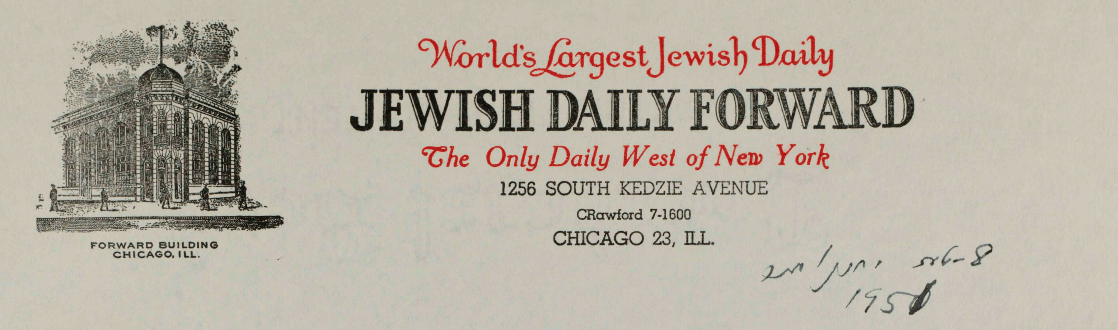
The Joys of Yiddish, Exodus, and The Jews of Chicago sat on our bookshelves just as the Forward sat in my grandparents’ home on Chicago’s West Side. The Forward’s Chicago paper was one of the larger local editions we published, with a building in my dad’s childhood neighborhood, not far from his high school, from the 1930s through early ‘50s.

After my dad and his five siblings left home, moved to the suburbs (Wilmette for us) and had children of their own, we gathered for Passover in West Rogers Park at my Aunt Shirley and Uncle Jack’s. The Seder was long, but after we avoided the gefilte fish and found the afikomen we would flee either upstairs to my cousin Suzy’s room to look at her books or downstairs to the basement to watch older cousins play pool or ping-pong until it was our turn. My Jewish Chicago was family. And a sturdy kind of faith that didn’t ask more of us than we could give.
We eventually moved from Wilmette into the city, where a very good friend – who played Golde in our high school production of Fiddler on the Roof – introduced me to a new Jewish world during Simchat Torah at Anshe Sholom on Melrose, next door to what was then the Lincoln Park/Lakeview JCC, where I went on to work as a camp counselor for several summers.
By the time I went to college, I was committed to learning Hebrew, davening regularly, and exploring a new Jewish landscape. But four years of Zabar’s and life on the Upper West Side did not make me a New York Jew. Living in North Carolina – even working at our synagogue there – didn’t make me a southern Jew. And living in Florida, with its ready supply of Vienna hot dogs, just made me miss Chicago – and long for a deli that served kishke, half-sour pickles, and hard salami.

It wasn’t until I was back in Chicago for work a dozen years ago that I began to understand what I had been missing. While I was in town for a journalism conference, my cousin Michelle took me to Mishkan Chicago for Rosh Hashanah. It was there that I found the Jewish soul of my family, the Jewish joy of my first Simchat Torah, and the Jewish heart of community.
In the years that followed, I, like so many people, explored Jewish life online. My husband and I joined Shabbat and holiday livestreams from our home in Virginia, watching services at synagogues across 35 states, including Mishkan Chicago once the pandemic made that possible. Mishkan began livestreaming weekly, and their morning minyan became a daily habit. My Jewish Chicago had come to me.
I also inched closer to it when I began talking with Jodi Rudoren and Rachel Fishman Feddersen in 2020 about joining the Forward. The more Jewish my life was becoming, the more important it felt to align my professional and personal commitments. After Oct. 7, it seemed particularly urgent. In June 2024, I became the Forward’s managing editor for audience.
There have been many moments since when I’ve felt grateful to be doing this work. One of the best bonuses has been to work alongside our Executive Editor Adam Langer (coincidentally, he’s editing this column), whose name I first knew not from the Forward, but as the author of Crossing California, one of the books that captures my Jewish Chicago best. He indulges my nostalgia – and fact-checks my memories – about the Chicago that once was. (Editor’s Note: Though Wilmette is located north of Chicago, true Chicagoans do not consider it part of the city.)
Last week, Benyamin and I and the Jakobs’ went from Sterling to Glencoe, for a public conversation with Margo and Nik about resilience, family and community. I was back in my Jewish Chicago again, and it felt like home.
The post How a search for my Jewish Chicago led me to the Forward – and back home again appeared first on The Forward.
Uncategorized
Why both sides are ducking settler violence ahead of Israel’s elections
(JTA) — For American Jews who follow Israel closely, one of the hardest things to understand about Israeli politics today is the gap between the severity of settler violence in Judea and Samaria, also known as the West Bank, and the relatively limited role it plays in the election campaign.
The phenomenon is not being ignored altogether. Israeli politicians across the political spectrum condemn acts of violence by Jewish extremists, and security experts have warned that Jewish terrorism and nationalist crime have become a serious threat to Israel’s security and democratic institutions. Yet the issue has not emerged as a major dividing line in the elections.
Why? Part of the answer is that Jewish violence in Judea and Samaria is politically inconvenient for both major blocs. On one side stands Prime Minister Benjamin Netanyahu’s coalition. On the other stands the loosely aligned “change bloc” seeking to replace it. That bloc includes parties with markedly different ideologies: Naftali Bennett’s B’Yachad, Avigdor Lieberman’s Yisrael Beiteinu, Gadi Eisenkot’s Yashar and Yair Golan’s Democrats. They agree on the need for political change, but they do not share a common position on the future of the settlements, Palestinian statehood or the long-term status of Judea and Samaria.
The reason settler violence has not become a defining campaign issue becomes even clearer once two different questions are separated. The first is straightforward: How should Israel deal with violence committed by Israeli Jews against Palestinians? The second is much broader: What should Israel do about the settlements, its control over Judea and Samaria and the long-term future of the territory? These are not the same question.
Distinguishing between these two lines of thought matters because the Israeli opposition may be united in its condemnation of settler violence, but it remains deeply divided over the settlements themselves. Yashar does not advocate for a general evacuation of settlements. B’Yachad supports Jewish settlement and opposes the establishment of a Palestinian state. Yisrael Beiteinu supports strengthening Jewish settlement and Israeli control in parts of Judea and Samaria. The Democrats take a substantially different position, including opposition to illegal settler outposts and an explicit commitment to fighting what they call “Jewish terrorism.”
There is, however, potentially a much broader consensus around law, order and state authority. That is where the political framing becomes important.
The Netanyahu camp does not entirely deny the existence of Jewish violence. After recent incidents in Samaria, Netanyahu condemned what he called a “handful of rioters” and called on law enforcement authorities to prosecute them. Foreign Minister Gideon Sa’ar described those responsible as criminals who should be dealt with severely.
This framing treats the problem primarily as one of law enforcement: Extremists are committing crimes, and the state must enforce the law against them.
That approach is also reflected in a significant proposal by Defense Minister Israel Katz. In August, Katz instructed the IDF to prepare a plan for transferring civilian enforcement involving Israelis in Judea and Samaria to the Israel Police, in part to reduce the military’s involvement in civilian law-and-order incidents.
This position is coherent: If Israel regards itself as sovereign over the territory, Israeli civilians who violate the law should be dealt with by the police, while the military should concentrate on security threats.
But this logic is not inherently a right-wing argument. It can serve the change bloc just as well. The change bloc can describe Jewish violence as evidence of governmental failure, loss of control and the erosion of state authority. That allows parties with very different views about the future of Judea and Samaria to agree on an immediate principle: The state must enforce its laws.
For politicians such as Bennett, Lieberman and Eisenkot, this is a much easier political proposition than making the future of the settlements and their legal status the central issue.
This is where Yair Golan, leader of the Democrats, stands out. Golan does not limit himself to terms such as “rioters,” “criminals,” “extremists” or “lawlessness.” He repeatedly uses the term “Jewish terrorism.” While the change bloc party leaders have on occasion used that phrase in English, they do not often use it in Hebrew. Golan is the one who uses the term repeatedly.
In August, Golan said explicitly: “What we are seeing today is Jewish terrorism that is receiving legitimacy from the Israeli government.” He has also presented the fight against Jewish terrorism as one of the issues on which he believes the change bloc can agree.
This choice of language is more consequential than it may initially appear. Once the phenomenon is called terrorism, difficult questions follow: If this is terrorism, should Israel not fight it with some of the tools it uses to fight other forms of terrorism? If Palestinian terrorism is understood as a national security threat requiring intelligence, organized investigation and preventive measures, what should happen when the perpetrators are Jewish Israelis?
Israel has developed extensive counterterrorism mechanisms for dealing with Palestinian terrorism: intelligence gathering, investigations by the Shin Bet internal security and counterintelligence service, administrative detention, military and security operations and other exceptional legal tools.
That does not mean those tools should automatically be applied identically to Israeli citizens. There are important legal and practical differences. But calling settler violence “Jewish terrorism” inevitably raises the question of whether it should be treated as more than ordinary criminality, and is important to harnessing the attention and power of the state to address it even as it labels it something that is an outlier.
The future of Judea and Samaria may be one of the most consequential questions facing Israel, but voters appear to be focusing more immediately on security, the economy, military service and Netanyahu’s political future. Here’s the dilemma all the parties are facing: The issue of settler violence can be important enough to condemn, but too politically complicated to campaign on.
For the Netanyahu bloc, emphasizing the systemic nature of settler extremism risks highlighting failures within a political constituency that is central to its coalition. For the change bloc, emphasizing it as a distinct political problem risks reopening the much larger argument over the settlements — an issue on which the change bloc itself remains divided.
Nevertheless, ahead of the elections, politicians can demand vigorous enforcement against violent settlers without supporting the dismantling of settlements. One can oppose illegal outposts without opposing the settlement enterprise as a whole. And one can regard Jewish violence primarily as a security, governance and even terrorism problem without having a position on the ultimate political status of Judea and Samaria, as important as that may be.
This article originally appeared on JTA.org.
The post Why both sides are ducking settler violence ahead of Israel’s elections appeared first on The Forward.
Uncategorized
How a Jewish play from 1908 enshrined the idea of America as a cultural ‘melting pot’

It’s long been unfashionable to refer to the United States as a “melting pot.” Identity politics and multiculturalism have undermined the ideal of an assimilation so complete that it obliterates ethnic distinctions. Now the persistence of difference is hailed, at least in some quarters, as enriching rather than estranging, even if the associated metaphors — “salad bowl,” “kaleidoscope,” “mosaic” — lack poetic vigor.
The first reference to the U.S. as a melting pot is said to date to J. Hector St. John de Crèvecoeur’s 1782 Letters from an American Framer, in which he wrote: “Here individuals of all nations are melted into a new race of men.” Similar notions surfaced in the writings of Ralph Waldo Emerson, Henry James and the historian Frederick Jackson Turner. But it was Israel Zangwill’s 1908 play, The Melting Pot, that injected that industrial metaphor into the national consciousness.
Set in New York City, the play is a love story between a musically gifted Russian Jewish immigrant of Sephardic extraction and a gentile settlement house worker from the pogrom-wracked city that he fled. Its backdrop is the turmoil of an early 20th-century America trying to make sense of massive waves of Eastern European, and particularly Jewish, immigration. The playwright was an English Jew, a disillusioned Zionist who had begun looking to the U.S. as the promised land.
After its debut in Washington, where it was praised by President Theodore Roosevelt, The Melting Pot moved to Broadway in 1909 and has since enjoyed occasional revivals. Crescendoing debates around immigration, antisemitism and who deserves to be an American seem to lend it renewed currency.
So, at least, was the reasoning of Jesse Bernstein, producing artistic director of Philadelphia’s Theatre Ariel, whose focus is Jewish-themed work. Bernstein adapted and directed Zangwill’s play, and has teamed with the Philadelphia Artists’ Collective, which produces rarely seen classics, to mount it. Their streamlined, modern-dress version, part of the America250 celebration, opened Wednesday at Philadelphia’s historic Arch Street Meeting House.

Bernstein said in an interview that he pruned as much as half an hour from the original (it now runs about 95 intermission-less minutes) with an ear to modern sensibilities. He also has made some additions that undercut the play’s triumphalism. The Melting Pot nonetheless remains an odd fusion of melodrama and polemic, interesting mostly as an historical curiosity.
Bernstein’s direction does the piece no favors with a stiff, presentational style, in which characters frequently address the audience rather than one another. On the other hand, when they turn away, the meeting house’s unfavorable acoustics make them more difficult, sometimes impossible, to hear. Offstage characters sit in chairs behind the action awaiting their cues. Meghan Jones’s spare set, representing both the Quixano family home and different locations within the settlement house, is draped with oriental rugs and strewn with steamer trunks and valises.
The protagonist, David Quixano, played with endearing sensitivity by Adam Galloway, survived the infamous 1903 Kishinev pogrom, in which all his immediate family were murdered and he himself was shot and left for dead. After that trauma, America has become both his dream and his salvation. In New York, he lives with his cynical uncle, Mendel, also a musician; his Yiddish-speaking grandmother; and an Irish American housemaid, Kathleen (Jessy Gruver), who wrestles comically with Jewish customs and dietary laws.
Through a violin concert, David meets and falls for the lovely Vera (Lexi Thammavong), a former Russian “revolutionist” who now combats poverty through settlement house work. David is composing an American symphony that will convey his rapturous views of his adopted homeland. He finds a ready admirer in the German conductor Herr Pappelmeister (Adam Pelta-Pauls, speaking convincing German).

Standing in David’s way, personally and professionally, are two villains — the wealthy, unscrupulous nativist Quincy Davenport (Eli Lynn), a married man who lusts after Vera, and Vera’s estranged father, Baron Ravendal (Brian McCann), a reactionary Russian military commander who turns up unexpectedly. McCann brings a strangely mannered intensity to a role that is already a caricature.
Zangwill’s characters represent a spectrum of early 20th-century attitudes. Ravendal and Davenport, brutal in different ways, both give free rein to their antisemitism. Frau Quixano (played by a bewigged McCann) and Mendel Quixano (J Hernandez, appropriately world-weary) reflect the resistance of older immigrants to assimilation — and especially to its culmination in interfaith romance.
The Melting Pot is deadly serious at times, larded with apocalyptic symbolism and images of Jewish suffering. But it also has its share of comedy, including the maid Kathleen’s gradual embrace of Jewish traditions and some playful digs directed at critics.
It is up to David, the musical prodigy, to articulate the famous message at the play’s core. Early on, he declares his fealty to a new American ideal:
America is God’s Crucible, the great Melting-Pot where all the races of Europe are melting and re-forming! …A fig for your feuds and vendettas! Germans and Frenchmen, Irishmen and Englishmen, Jews and Russians—into the Crucible with you all! God is making the American. The real American has not yet arrived. He is only in the Crucible, I tell you — he will be the fusion of all races, perhaps the coming superman.
David returns repeatedly to this soaring rhetoric, lauding American greatness born of industrial-grade homogenization, and seeking to embody it in his symphony.
The original play ended exuberantly, with both love and David’s melting pot vision of “the glory of America” conquering all. Bernstein’s adaptation, with its insistence on relevance, duly complicates that vision. He wraps the action with supporting characters challenging David’s view of American harmony, and with the future of the betrothed couple clouded in doubt.
The Melting Pot runs at the Arch Street Meeting House, 320 Arch St., Philadelphia, through Nov. 8.
The post How a Jewish play from 1908 enshrined the idea of America as a cultural ‘melting pot’ appeared first on The Forward.
