


Uncategorized
Our greatest folksinger wrote about America, Dust Bowl refugees and Jewish identity
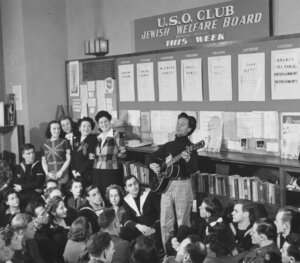
Woody Guthrie is best known as one of the giants of 20th-century American folk music. From the late 1930s through the early 1950s, he wrote thousands of songs, many of which became modern-day standards, including “So Long, It’s Been Good to Know Yuh,” “I Ain’t Got No Home,” “Tom Joad,” “Hard Travelin’,” “Pastures of Plenty,” and, of course, “This Land Is Your Land.” His songs gave voice to working people and Dust Bowl refugees. He wrote playful children’s songs and songs that railed against fascism and greed. He even wrote a protest song called “Old Man Trump,” about developer Fred Trump, the father of the current president of the United States, decrying the strict racial segregation he enforced in his housing projects.

Guthrie’s influence on generations of singer-songwriters cannot be overstated. His songs have been recorded by hundreds of singers around the world, including Joan Baez, Judy Collins, Bruce Springsteen, Lucinda Williams, Ani DiFranco, Lou Reed, Sweet Honey in the Rock, Lila Downs, and Susan McKeown. The desire to meet Woody Guthrie, who was his hero, is what led Robert Allen Zimmerman to hitchhike from Minneapolis to New York City, where he subsequently fell upon the thriving Greenwich Village folk scene and reinvented himself as a rootsy singer-songwriter named Bob Dylan. The latter’s eponymous first album included an original song entitled “Song to Woody.”
As Steven Pressman makes clear in his new documentary film, Dust Bowls and Jewish Souls: Another Side of Woody Guthrie, there was another side to Guthrie and his songs. As his son, Arlo Guthrie, explains in the film: “My father studied Judaism and he knew something about it. He never exchanged his faith for something else; he added to his faith. And that something else he added … was a Jewish identity. He understood what that meant traditionally, historically, culturally. And he knew more about Judaism than my zeyde. And so, my bubbe was thrilled.”

It just so happens that Arlo’s bubbe — his grandmother — was acclaimed Yiddish poet and lyricist Aliza Greenblatt. When Guthrie married Aliza’s daughter, Marjorie Mazia (née Greenblatt), the two chose to raise their children in Coney Island, and Marjorie’s parents, Aliza and Isadore Greenblatt, moved from Philadelphia to be close to their expanding brood. And it was primarily through his close relationship with his mother-in-law that Guthrie became knowledgeable about and enamored of Jewish history and culture. Says Arlo, “My father saw something inside the Jewish tradition that inspired him.”
Pressman’s documentary traces the close links between Aliza Greenblatt and Woody Guthrie. “My father and my bubbe had a respect for each other as writers, as thinkers, as people of the heart,” says Arlo. Arlo’s sister, Nora Guthrie, echoes her brother’s comments: “Bubbe would share ideas and lyrics with Woody. So, they were able to form a relationship.” Nora’s daughter, Anna Canoni — seen in the film at the Guthrie family plot in a cemetery in Woody’s hometown of Okemah, Oklahoma — elaborates on the special relationship between her grandfather and great-grandmother: “Aliza and Woody were actually interestingly similar in terms of a hardship and displacement that happens at a young age. There were so many interesting parallels between the two of them, which is why there was so much understanding, empathy and love between the two of them.”
While Aliza Greenblatt took to Woody right away, her husband Isadore was not thrilled about his daughter marrying a Gentile. He did, however, give Guthrie a gift of a Hebrew-English version of the rabbinical text called Pirkei Avot (The Ethics of the Fathers). In the film, Nora Guthrie displays the book, which is filled with Woody’s notes and annotations — even drawings. Woody provided the cover illustration for one of Aliza’s poetry volumes.

The film includes interviews with dozens of people who either knew Woody Guthrie and Aliza Greenblatt or who became familiar with their story. Among them are Guthrie biographer Will Kaufman, who has written three books about the folksinger. Kaufman suggests that Woody and Aliza bonded over being artists and socialists. “[Woody] would have seen in Aliza and Isadore kindred spirits politically,” says Kaufman. “[As refugees], Woody would have seen in them a real fellowship with the Dust Bowl refugees that he had been championing….”
A who’s who of contemporary Yiddish musicians, including vocalist Eleanor Reissa, singer-songwriter Daniel Kahn, and Lorin Sklamberg, cofounder and lead vocalist of the Klezmatics, are among those who pay tribute to them and are heard performing Guthrie and Greenblatt songs. Kahn says, “[Woody] was a staunch anti-Nazi, which makes him Jewish in the most important ways to me.” When the U.S. became involved in the Second World War, Guthrie signed on with the Merchant Marine, and he was overseas for nearly two years. What he experienced there found its way into songs like “You Fascists Bound to Lose,” “Mister Hitler,” and “Ilsa Koch,” about the so-called beast of Buchenwald. In it he sang,
I’m here in Buchenwald.
My number’s on my skin….
The guards have shot a man.
Some more have starved to death.
Here comes the prisoner’s car.
They dump them in the pen.
They load them down the chute.
The trooper cracks their skulls.
He steals their teeth of gold.
He shoves them on the belt.
He swings that furnace door.
He slides their corpses in.
I see the chimney smoke.
I see their ashes hauled.
I see their bones in piles.
Lamp shades are made from skins.
Old Ilsy Koch was jailed.
Old Ilsy Koch went free.
The song was brought to life when Nora Guthrie, president of the Woody Guthrie Foundation, gave the Klezmatics a sheaf of lyrics with Jewish themes that Guthrie never put to music or recorded. The modern klezmer group released two albums worth of these songs in 2006, including “Wonder Wheel,” which garnered the group a Grammy Award, the only klezmer group ever to have received such honor. The album also included their version of the song “Mermaid’s Avenue,” a tribute to the very Jewish Coney Island neighborhood where the Guthries lived. The song even includes the Yiddish word meydele:
Mermaid Avenue that’s the street
Where the lox and bagels meet…
Where the prettiest of the meydeles
Leave their legprints in that sand….
Where the smokefish meets the pretzel
Where the borscht sounds like the seas….

The film also recounts the relationship between Guthrie and Moses “Moe” Asch, a Jewish-Polish immigrant whose father was Sholem Asch, the great Yiddish novelist and playwright. Moe Asch had a recording studio and record label based in New York City. In addition to recording and releasing many Guthrie songs, Asch encouraged Guthrie’s Jewish education and helped steer him to write songs with Jewish content, such as “The Many and the Few,” which retold the story of the Jews. The song was “basically the entire story of Hanukkah set up as an Appalachian ballad,” says Lorin Sklamberg, who recorded it with the Klezmatics on their album “Woody Guthrie’s Happy Joyous Hanukkah.”
Woody Guthrie died in 1967. His ashes were scattered at the beach in Coney Island. “For a guy from Oklahoma, that was pretty unique,” says Arlo Guthrie. Aliza Greenblatt died in 1975 at the age of 87. With Pressman’s Dust Bowls and Jewish Souls: Another Side of Woody Guthrie, their common legacy is now cemented for all time.
Dust Bowls and Jewish Souls: Another Side of Woody Guthrie will screen at the Nashville Jewish Film Festival (Aug. 18), Circle Cinema in Tulsa (Aug. 20) and the Yiddish Book Center — where Marjorie Mazia Guthrie was a board member — in Amherst, Mass., on Sept. 27.
The post Our greatest folksinger wrote about America, Dust Bowl refugees and Jewish identity appeared first on The Forward.
Uncategorized
The Supreme Court considers ‘chutzpah’ case as rabbinical and civil courts collide
Can courts instruct a rabbinical court to withdraw accusations of chutzpah? This unlikely question was posed to the U.S. Supreme Court this month when a nursing home dispute offered a rare window into how American courts and rabbinical courts operate in parallel. The case illustrates how law – and life – get messy when one encroaches on the other’s authority.
The case centers on an ownership dispute over a New York nursing home, with millions of dollars at stake.
To resolve the dispute, one of the parties — Samuel Strulovitch — turned to a beit din, or rabbinical court, in Monsey, New York. Rabbinical courts across the United States regularly resolve a wide range of business disputes like this one. Beit dins have been growing across the U.S., with more locations, increasing caseloads, and a growing number of rulings popping up in civil courts.
Their popularity reflects two legal systems working together. First, Jewish law generally requires disputes between Jews to be resolved before rabbinical courts rather than civil courts — a rule that, like any good Jewish law rule, comes with plenty of exceptions and caveats. Second, American law treats rabbinical arbitration like other forms of commercial arbitration. When parties voluntarily agree to arbitration, a civil court will generally confirm the resulting “award,” giving it the force of a legal judgment. Going to a beit din thus serves two purposes simultaneously: satisfying a religious obligation and resolving a commercial dispute.
In this case, overlapping interests of multiple investors complicated matters. Strulovitch obtained an award from the Monsey beit din granting him an ownership stake in the nursing home. But the proceeding included Strulovitch and one co-owner, while other owners never agreed to submit the dispute to that beit din. That agreement matters to American courts because arbitration rests on consent, and a beit din’s award cannot bind parties who never agreed to its authority.
The result was more than two years of litigation in two civil courts and three rabbinical courts. That litigation ultimately wound its way before Judge Linda Jamieson of Westchester County, New York. Initially, she barred Strulovitch from confirming or enforcing the original rabbinical award while the court considered whether it affected the rights of investors who had never agreed to arbitration. The bar on civil enforcement was largely uncontroversial: deciding whether a religious ruling should carry the force of an American legal judgment is the civil court’s job.
A second injunction, however, transformed this commercial dispute into a constitutional controversy worthy of the Supreme Court’s attention. After Strulovitch summoned another investor, Moshe Bain, before a Brooklyn beit din, Bain asked Jamieson to bar proceedings in any other forum, “including any beis din,” which she did. In Jamieson’s view, the new beit din proceeding could encompass the same ownership disputes already before her court.
The beit din, however, viewed the order as a form of judicial overreach into religious matters. It thus issued a seruv — a religious contempt order that can expose its target to communal shunning — against Bain, citing the “chutzpah of enjoining [Strulovitch] from pursuing his Halachic rights.” The rabbis emphasized that the beit din had acted “of its own volition,” without any request from Strulovitch or his agents following Jamieson’s injunction.
Such a contempt order, of course, carries no civil legal force, but can have reputational consequences — and trigger social sanctions — within the Jewish community. Judge Jamieson nevertheless viewed the beit din’s actions as an attempt to circumvent her injunction and draw the dispute away from her court. She therefore ordered Strulovitch to “take all steps necessary” to have the beit din withdraw it, “including withdrawing the entire proceeding.” And while Strulovitch argued that intervening in internal rabbinical court matters violated the First Amendment, Jamieson concluded that the matters before the beit din were “not religious,” but commercial disputes that her court had authority to resolve under secular law.
It is here that the judge began to veer from her lane, causing Strulovitch to seek emergency relief from the Supreme Court. By requiring Strulovitch to seek reversal of a religious contempt order that has no civil consequences, the court moved beyond determining civil legal rights and into matters of religious practice. Participation in a beit din is both a means of resolving a commercial dispute and a religious requirement, which under Jewish law is no different than observing Shabbat or keeping kosher. Its commercial subject does not erase its religious significance. And under the First Amendment, it is the believer, not the state, who defines what his faith requires.
The key constitutional question is which authority gets to decide. Courts should decide legal questions, such as whether to enforce an agreement to arbitrate before a beit din or give its award the force of a legal judgment.
But questions of whether to pursue a case in beit din or religiously sanction a party for refusing to participate generally stand beyond the court’s authority so long as those decisions do not violate an independent civil legal right.
The same holds for a religious obligation to pay: A civil court can decline to enforce a beit din’s award, but whether Jewish law nevertheless requires payment remains a matter for the beit din. By demanding Strulovitch work to withdraw the seruv, however, Jamieson crossed into determining religious matters — precisely the sphere the First Amendment protects from judicial interference. That boundary makes this case worthy of Supreme Court inquiry: a judge can decide whether a religious ruling has legal force, but deciding what Jewish law counts as chutzpah is another matter.
For now, the Supreme Court has left those questions unresolved. Justice Sonia Sotomayor required Bain to formally respond to Strulovitch’s request — a sign that it warranted closer consideration. And while she ultimately declined to intervene, she left the door open for him to return once the case played out in the New York courts.
No doubt, as the beit din system grows, harder questions will emerge. But a good rule of thumb is this: Matters of religious doctrine, or of a party’s standing in a religious community, generally lie beyond a civil court’s reach, so long as they leave the party’s rights under American law untouched. Matters that affect those rights belong to the civil courts, even if they also implicate matters that Judaism considers religious. That is how these parallel legal systems can operate alongside one another — each staying in its lane.
(Both of us are affiliated with the Beth Din of America, which is not involved in this case.)
The post The Supreme Court considers ‘chutzpah’ case as rabbinical and civil courts collide appeared first on The Forward.
Uncategorized
Huckabee calls settler attack on Washington Post photographer a ‘despicable act of terror’
(JTA) — U.S. Ambassador to Israel Mike Huckabee on Saturday condemned an attack in the West Bank by masked settlers on a Washington Post photographer. The attack, which also targeted Palestinians harvesting their olives, occurred Friday and comes amid a sharp rise in settler violence.
Heidi Levine, the Washington Post photographer who holds U.S. citizenship, described the attack to reporters from her hospital bed.
“I got jumped and I saw in the very beginning at least 25, maybe 50 of them, and I was on the ground and they were kicking me for like 10 minutes,” she said.
“We have called for a full investigation, arrest, and prosecution to the fullest extent of the law to whoever participated in this,” Huckabee wrote on X. “Attacking a female photographer is a despicable act of terror carried out by masked cowards. Dishonorable act of senseless violence.”
Israeli President Isaac Herzog also condemned the “shocking violence” and said he had called Levine to apologize. “I expressed my deepest sorrow to Heidi and apologized for what she went through. The despicable behavior of the perpetrators of this attack does not represent the citizens or the values of the State of Israel.”
Video footage from the scene shows masked settlers surrounding and attacking Levine. Some settlers at the scene were masked and carrying weapons. Palestinians can also be seen throwing stones toward the settlers.
A Palestinian was reportedly shot in additional clashes in the area. The Israel Defense Forces alleged in an official statement that soldiers “fired toward a suspect who ran toward them, carrying a sharp object and posed a threat.” Several vehicles were set on fire by the settlers.
Prime Minister Benjamin Netanyahu was equivocal in addressing the attack, stopping short of directly condemning the assailants.
He said that the circumstances in which Levine was allegedly assaulted “remain unclear,” while adding that “Israel unequivocally condemns violence against anyone.”
According to Netanyahu’s statement, “200 Arabs and far-left activists confronted approximately 40 Israeli youths.”
“We will not allow disputed incidents to be exploited to demonize the hundreds of thousands of law-abiding Jewish residents of Judea and Samaria,” the statement said, using the biblical names for the West Bank.
Netanyahu faces elections in less than two weeks and can ill afford to alienate his far-right coalition partners who are aligned with extreme settler factions.
Israeli opposition leader Yair Lapid, by contrast, issued a forceful condemnation of the attack and linked it to the policies of Netanyahu’s government.
“Jewish terror attacks, this time targeting a Washington Post photographer as well, are not a failure of the government — they are the government’s policy,” Lapid said.
“We will put an end to this. It is a disgrace to the State of Israel, a disgrace to the Jewish people, and a disaster on the international stage,” he added. Settler violence against Palestinians in the West Bank has surged since the Oct. 7, 2023, Hamas-led attack on Israel. Netanyahu’s government has sought to downplay the phenomenon, often portraying the perpetrators as a small group of violent youths. But numerous figures in Israel’s political and security establishments have warned that the violence is a broader and dangerous phenomenon.
Levine told reporters the settlers forcibly took her equipment. “All I remember afterwards is that Palestinians managed to come and rescue me and try to carry me, and then an ambulance came,” she said.
The IDF acknowledged the incident in an official statement, saying that “a female journalist was injured” during a “confrontation.” The military said troops dispersed those involved and that “details of the incident will be examined.”
“Violence against innocent civilians is a grave and intolerable phenomenon that requires a coordinated, multi-agency response. The IDF will work together with the relevant authorities to eradicate this phenomenon,” the military said.
The IDF did not announce any arrests in connection with the attack. Settler violence against Palestinians in the West Bank has frequently gone unpunished, with many such incidents resulting in no arrests.
The Foreign Press Association, which represents international media in Israel and the Palestinian territories, condemned the attack, saying Levine was “badly beaten by Israeli settlers” and had sustained moderate injuries.
“This is the latest in a long line of violent attacks by Israeli settlers against journalists and other civilians in the occupied West Bank. Yet our repeated calls for action to confront this lawlessness have been ignored by Israeli authorities,” the association said.
Matt Murray, executive editor of the Post, issued a statement calling for an investigation. “While we are relieved that Heidi has received medical care and is safe, we are outraged by this unwarranted attack on a journalist doing her job and urge a thorough investigation and follow-through from authorities,” Murray said.
The post Huckabee calls settler attack on Washington Post photographer a ‘despicable act of terror’ appeared first on The Forward.
Uncategorized
As Netanyahu loses support before election, Ben-Gvir rises in polls
(JTA) — RAMLA – Prime Minister Benjamin Netanyahu and the parties in his coalition seem to be losing support heading into Israel’s first election since Oct. 7 – with one exception. Otzma Yehudit, headed by Minister of National Security Itamar Ben-Gvir, is seeing a rise in the polls.
Ben-Gvir’s growing popularity ahead of the Oct. 27 election was on full display on a recent weekday when the far-right politician, surrounded by a massive entourage of security guards, police and flag-waving fans, made his way through the central Israeli city of Ramla’s marketplace.
Yet, amidst the cheering and celebration, the extreme nationalism that has contributed to his meteoric rise through the ranks of Israel’s political system – and made Ben-Gvir a household name even beyond Israel’s borders – also drew ire and deep-seated fear in this city known for its mixed Jewish-Arab population.
“Here comes the next defense minister,” a gaggle of teenage boys in matching Ben-Gvir T-shirts chanted as the minister walked through the market, greeting shoppers and stallholders begging for selfies. Ben-Gvir has his sights set on being Israel’s next minister of defense, a huge promotion from his current role managing internal security.
At several of the stalls, the controversial minister stopped to embrace vendors. At a pickle stand, he sampled olives. At a candy store, the owner joyously threw handfuls of small candies over the passing group. And at a juice stand, Ben-Gvir and his entourage were treated to complimentary cups of lemonade.
The minister, elated by the welcome, smiled and waved at passersby, grabbing phones to take selfies, and even chatting with excited fans on video calls.
Beyond the celebration in Ramla, however, Ben-Gvir has been condemned in Israel and beyond for calling for the expulsion of Gazans and using dehumanizing language about Palestinians. A disciple of Jewish extremist Meir Kahane, he for years kept a photo of Baruch Goldstein, who mowed down Palestinian worshippers at a Hebron mosque, in his living room.
It is not only his rhetoric and symbolic gestures that have drawn polarizing admiration and anger. During his four years as national security minister, Ben-Gvir has actively downgraded conditions in Israeli jails, pushed through a law establishing a death penalty for Palestinian terrorists and has led the police during the proliferation of settler violence against West Bank villagers.
These measures have earned opprobrium abroad, but they appear to be winning votes. His supporters are ever more impressed with how he puts his words, and paperwork, into action – and shares it proudly on TikTok.
Polls published this week show that even as Netanyahu and his coalition partners are losing votes to the opposition bloc led by former IDF chief Gadi Eisenkot, Ben-Gvir is getting more. Otzma Yehudit, translated as “Jewish Power,” is predicted to increase from its current six seats to as many as nine.
On the ground, in the marketplace in Ramla, Ben-Gvir’s visit drew extreme reactions ranging from sheer joy to pure anger.
“I love Ben-Gvir,” gushed Hodaya Nabara, 52, who seconds before snapped a selfie with the politician. “He does what he says he will do.”
A resident of southern Israel, Nabara said she was most impressed by how he had ordered the demolition of illegally built homes, in some cases whole villages, built by the burgeoning Israeli Bedouin population, in the Negev region where there is little oversight of construction, and where Bedouin say the government neglects their needs.
“They need to know there is a red line and they can’t do whatever they want,” she said.
But as the entourage passed by Michal Sharabi, the 53-year-old began hurling insults at him and shaking.
“I can’t stand him at all, because of him there is no peace in this country,” she told JTA after calming down. “He is a lowlife, and the people going with him don’t believe in themselves. Is he not embarrassed to come to this city, where Jews and Arabs live together … It’s a chutzpah. I’m furious.”
In a nearby grocery store, a mixed group of Arabs and Jews frowned at the unfolding spectacle.
“We don’t like being defined as Arabs or Jews; we are ‘Ramlaim’ (residents of Ramla),” insisted Uri, who said he was Jewish but declined to give his full name. “We are all neighbors here, and he is making people fight.”
His friend, Hamudi Abu Ghanam, said Arab residents of the city like him were impacted by the events of Oct. 7, 2023, when Hamas launched deadly raids inside Israel, just like the Jews, and many came to help out but that Ben-Gvir still incited against them.
“He is racist,” he said. “Since Oct. 7, we are all against Hamas, and instead of saying thank you, he comes and destroys people’s homes.”
Ben-Gvir’s stop in Ramla struck a particular nerve because the city, which is about 78% Jewish and 22% Arab, was a central point of tension in 1948 when Israel was created. For Arabs, the evidence of the Nakba, which Palestinians call the “catastrophe” of Israel’s creation that displaced the local Palestinian Arab population during its war of independence, is all around in ruins.
At one point on his jaunt through the market, two Arab girls donning traditional hijab headcoverings hovered nearby, but they quickly made a U-turn when they realized who was at the center of the commotion.
Some Jewish onlookers pointed to his theatrics as reasons they were unimpressed by him. Benny Muhtar, 68, a Jewish resident of Ramla, told JTA he thought Ben-Gvir was full of “hot air” – a populist with no substantial policies.
“Look at the young men surrounding him; they are making a lot of noise like this is a serious campaign … that is what is making the people look up and take notice, but none of it is real, and he is doing a lot of damage,” he said.
Others enjoyed the spectacle but, with less than two weeks to go until casting their vote, were still unsure whom they would choose.
“He’s done a lot of really good things,” said Edna Mahbesh, 65, who was handing out the free lemonade. “I really hope he is successful in the election.”
But she was not sure if she would actually vote for him.
“I’ll decide that next week,” she said.
Arbel Flehandler, 19, a first-time voter, stood on the side, watching in awe as the politician passed by.
“He is really good and does a lot of good things,” he said. “I am definitely going to vote for a right-wing party, but not sure if I will vote for him or not. This is my first time, and I am still thinking about it.”
Zehava Perets, 80, said the reactions to Ben-Gvir showed just how polarized Israel is right now.
“It is such a shame there are so many divisions,” she said. “I really don’t know who I will vote for … There are a few good people in each bloc, but it is impossible to get them to work together.”
Liron Lavie, an assistant professor in the Department of Political Studies at Bar-Ilan University, said the extreme reactions for and against Ben-Gvir “speaks to how politics works these days” – as politicians “connect with the electorate through emotional reaction and a sense of pride or fear.”
She said Ben-Gvir should be viewed as part of the “larger global trend where far-right parties are getting stronger.”
Lavie assessed that Otzma Yehudit benefited from the growing appeal of providing simple solutions and simple messaging – and that Ben-Gvir was especially effective on social media platforms such as TikTok.
“At the end of the day, people prefer simple messages,” said Lavie.
She also said that Ben-Gvir, despite being in the government on Oct. 7, had successfully distanced himself from that fact and positioned himself as a strong alternative to Netanyahu on the right.
“Likud and Netanyahu are losing ground,” she said. “They are being criticized about how they managed the situation, either from the center and left or from the right, allowing voters to go to Ben-Gvir, who was able to position himself as an [alternative] to Netanyahu from the right.”
This article originally appeared on JTA.org.
The post As Netanyahu loses support before election, Ben-Gvir rises in polls appeared first on The Forward.
