


Uncategorized
Rabbi Alvin Kass, longest-serving NYPD chaplain famed for 9/11 response, dies at 89
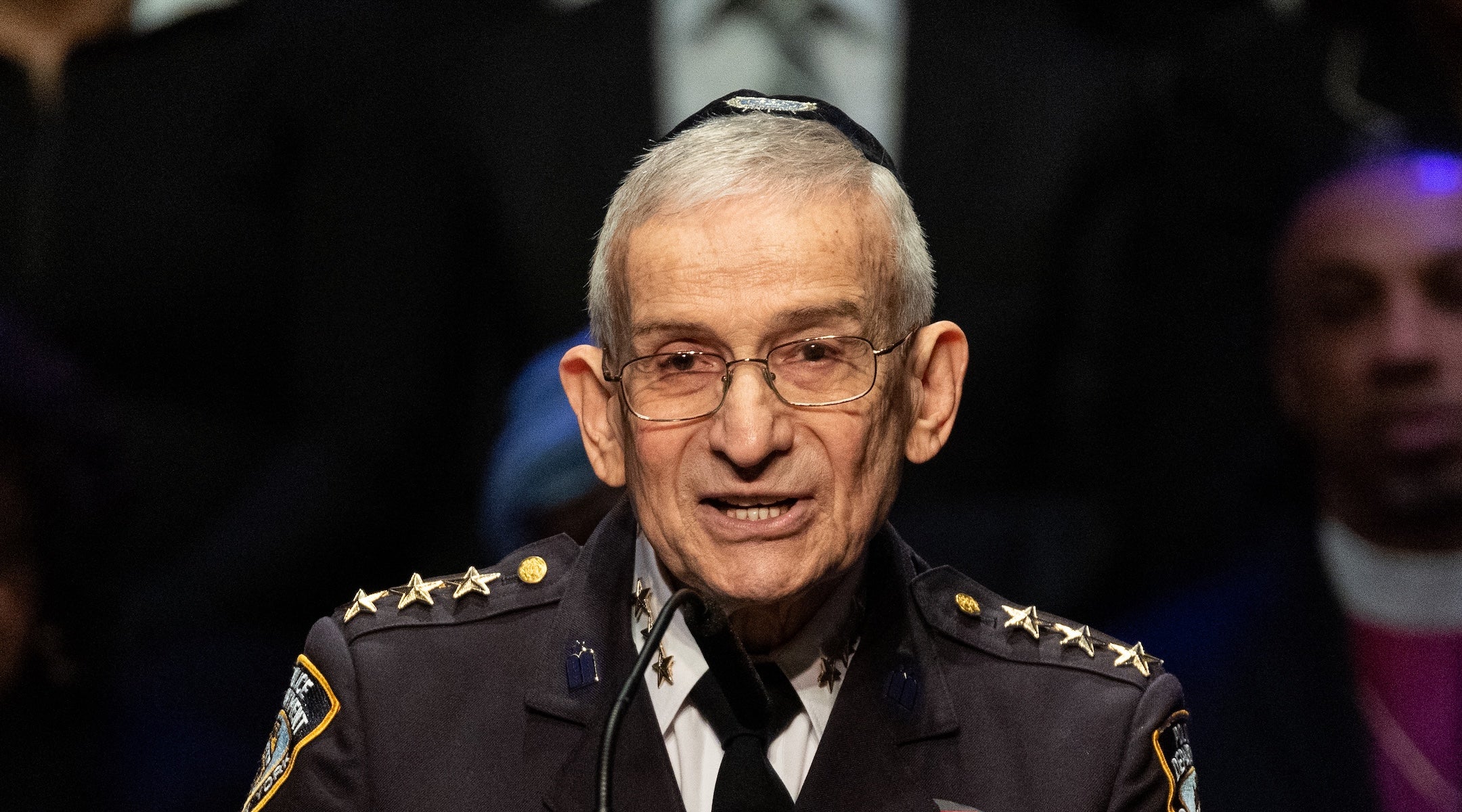
(JTA) — Less than a week after rushing to Ground Zero as a police chaplain on 9/11, Rabbi Alvin Kass led Rosh Hashanah services — not only for his Brooklyn congregation but at a makeshift synagogue at LaGuardia Airport for emergency responders who had flooded into New York City after the terrorist attacks.
“It was,” he would later say, “the most meaningful religious service in my career.”
Kass died Tuesday at 89 as the longest-serving chaplain in the New York Police Department, with a career that included responses to global terrorism, local violence and the intimate needs of police officers — as well as a hostage crisis that he famously resolved with a non-kosher pastrami sandwich.
Born and raised in New Jersey, Kass attended Camp Ramah before enrolling at Columbia University in 1953. His freshman-year roommates there were Robert Alter, who would become a preeminent translator of the Bible, and Shalom Schwartz, later a leading psychologist in Israel.
After graduating from college, he earned both a doctorate from New York University and ordination as a Conservative rabbi from the Jewish Theological Seminary of America before joining the U.S. Air Force as a chaplain. Returning stateside, he took a pulpit in Queens before being urged to join the city’s police department as a chaplain.
At the time, he was only the third Jewish chaplain to work for the NYPD. He would become its longest-serving and the first three-star chaplain, working under eight mayors and 21 police chiefs, while also helming the East Midwood Jewish Center, a Conservative synagogue in Brooklyn, for 36 years until 2014.
The NYC Benevolent Association called Kass “a true pillar of the NYPD” in a Facebook post mourning him. “Every time we bowed our heads for one of his prayers, we appreciated his deep faith, his old-school wit and his unshakable devotion to the men and women who protect NYC,” the group said. “He was a champion of all that is good and noble about our profession. May his memory be a blessing.”
NYPD Police Commissioner Jessica Tisch, who is Jewish, mourned Kass in a statement following his death. She noted that he was the youngest chaplain in the department’s history when he came on at age 30.
“Nearly six decades later, he remained its spiritual heart — a source of strength, guidance, and faith for generations of police officers and their families,” Tisch said, adding, “His loss is immeasurable. His example is everlasting.”
Within the NYPD, Kass was responsible for the spiritual care of all officers but especially the thousands who are Jewish. Kass successfully advocated for the right of Jewish police officers not to work on Shabbat and major Jewish holidays while also serving as the primary Jewish figure for Jewish officers who were otherwise unaffiliated with Jewish communities. He also served as spiritual director of the Shomrim Society, a fraternal organization for Jewish police officers.
“The main responsibility for a spiritual leader is to bring all people closer together, including those of your own faith,” he told the New York Jewish Week when he was honored as one of “36 to Watch” in 2024. “I feel particularly proud that the Shomrim Society embraces Jews of all backgrounds and points of view. The organization is a paragon of the unity that ought to bind all Jews together.”
After the terrorist attacks in Lower Manhattan on Sept. 11, 2001, Kass reported to Ground Zero, where he encountered a police officer he described as “crying like a baby” as well as the families of officers who were unaccounted for. Later, he attended the funerals of ever police officer who was killed that day, including two who were Jewish.
“I told their families that you’re supposed to say ‘Baruch atah Adonai, eloheinu melech ha’olam, dayan ha emet’: Blessed is the Lord our God, ruler of the universe, who is a judge of truth, or truthful judge. This means, essentially, that He knows what He’s doing. We don’t,” Kass wrote in an essay for The Forward on the 20th anniversary of the attack.
“We can’t comprehend what He’s doing very often, but presumably He knows what he is doing, and we submit. We bow our head to what is often inscrutable and incomprehensible, and we accept it with a measure of faith and hope,” he continued. “That really is the essential message of Judaism, in the face of evil.”
Kass would later say that 9/11 marked a transition in the role of the chaplain within the NYPD, peeling back some of the stigma that had been associated with seeking spiritual care in a department where machismo was long the currency.
Kass’ own encounters on the job ranged from lofty to the low-brow. He was pulled away from his son’s bar mitzvah celebration to tend to an officer who had been shot, according to a 2006 profile in the Columbia alumni magazine. On another occasion he flew upstate between Friday night services and Shabbat morning services to inform a family that their officer son had been murdered.
One of Kass’s more famous escapades came in 1981 when he was called in to negotiate with a Jewish man who had taken a woman hostage.
“I talked to him all night to give up his gun,” Kass recalled in a 2012 interview with the Wall Street Journal, neither the first nor last time he would recount the incident. “I was an utter failure. But by morning he was hungry.”
The hostage team ordered pastrami sandwiches from the (nonkosher) Carnegie Deli for the hostage-taker and for Kass. Kass traded one overstuffed sandwich for the man’s gun — but it turned out he had another. Kass, who ate only kosher meat, had not touched his sandwich and persuaded the man to accept it in exchange for the other gun. The police swooped in and ended the crisis.
The NYPD commissioner noted the incident when promoting Kass to three-star chief in 2016, saying, “In a feat that has become legendary, you were able to trade two pastrami sandwiches for the man’s two guns.”
But for Kass, whose small stature added to a widespread impression of modesty, the real feat came not in his ability to disarm the hostage-taker but in the man’s appetite. “Have you seen the sandwiches from the Carnegie Deli?” he recalled. “They’re huge.”
Kass is survived by his three children and three grandchildren. He was married for 54 years to Miryom Kass, an educator, until her death in 2017. Speaking at the 2016 ceremony marking 50 years with the NYPD, Kass said about Miryom, “She has been by confidant, my partner, my co-worker, she’s been my inspiration, she’s been my chaplain.”
The post Rabbi Alvin Kass, longest-serving NYPD chaplain famed for 9/11 response, dies at 89 appeared first on The Forward.
Uncategorized
UK adopts sweeping measures against antisemitism in schools
(JTA) — The U.K. has adopted sweeping measures to combat antisemitism in English schools, prompting pushback from the country’s largest teachers’ union.
The move came after a new government-commissioned review found that three in five Jewish students reported experiencing antisemitism in English schools. The most common incidents were jokes, stereotypes and comments about Jewish people. About half of respondents who witnessed or experienced antisemitism said the incidents were not reported, most often because they did not think they would be taken seriously.
The government on Wednesday accepted 27 recommendations from the report, including dedicated antisemitism training for leaders and staff, improved recording of antisemitic incidents and moves to build a better understanding of Jewish life, identity and contemporary antisemitism.
The government commissioned the report following a spate of high-profile attacks on Jews in Britain, including an attack on a synagogue in Manchester last year that left two men dead.
The report’s author, Sir David Bell, the vice chancellor of the University of Sunderland and former chief inspector of schools in England, recommended addressing antisemitism distinctly from other forms of racism. He argued that antisemitism was a “uniquely complex” problem because of intertwined racial and religious dimensions, since Jewish identity can encompass both an ethnicity and a religion, along with expressions of prejudice that hold all Jews responsible for the actions of Israel.
The government will also encourage English schools to adopt the International Holocaust Remembrance Alliance (IHRA) working definition of antisemitism. The definition is supported by many mainstream Jewish organizations and has been adopted by 47 countries, including the U.K., but critics say that it conflates some forms of antisemitism with criticism of Israel.
British Education Secretary Lucy Powell called Bell’s review a “generational moment” and said that “implementation is now my priority.”
However, the National Education Union, the largest union representing teachers, lecturers, teaching assistants and support staff in the United Kingdom and Europe, raised concerns on Wednesday about recommending the IHRA definition for schools. NEU general secretary Daniel Kebede said in a statement that the definition “risks deepening the problem rather than tackling it, and actively undermining efforts to confront antisemitism.”
“The IHRA’s contested framing risks blurring the line between antisemitism and legitimate criticism of the Israeli government and the genocide in Gaza, leaving teachers with uncertainty when they need clarity,” said Kebede. He cited a risk that “children who cannot critically explore issues through classroom discussion will instead seek their answers in online and unsafe groups.”
Kebede also encouraged Britain’s Department for Education to strengthen guidance on all forms of racism, not only antisemitism, saying that 65% of teachers report they have not received any antiracism training in the past year.
The Board of Deputies of British Jews, an umbrella organization for British Jewish communities, celebrated the antisemitism report and the government’s adoption of its proposed measures. The group specifically praised the report’s “clear recommendations that schools and local authorities follow government guidelines by adopting the IHRA Working Definition of Antisemitism as a tool to deepen understanding of contemporary antisemitism.”
“We remain concerned about undue external influence on schools driven by narrow political agendas, and tendentious materials seeping into schools and increasing disharmony, and we will continue to press for vigilance against this,” said the Board of Deputies.
The post UK adopts sweeping measures against antisemitism in schools appeared first on The Forward.
Uncategorized
Orthodox Jewish man stabbed in midtown Manhattan
(New York Jewish Week) — An Orthodox Jewish man is in stable condition after being stabbed on Wednesday evening in the Diamond District of midtown Manhattan. Police are investigating the attack as a possible hate crime.
Police told the Jewish Telegraphic Agency that the NYPD’s Hate Crimes Task Force is investigating the incident as a possible antisemitic attack, and Manhattan Shomrim — the Jewish community watch group — has asked people to share footage as police search for the suspect. No arrests have been made.
The victim was identified by police as a 26-year-old man, and Orthodox Jewish outlet COLLive identified him as a resident of Crown Heights, the neighborhood that is home to the Chabad-Lubavitch Hasidic movement’s headquarters.
He was taken to Bellevue Hospital in stable condition. Police said they were called at about 5:50 p.m. on Wednesday after the man was stabbed in the back with “an unknown sharp object” on 47th Street near Fifth Avenue. ABC7 reported that the victim told investigators he believed he was stabbed with a needle or syringe.
According to the Chabad website, which published an interview with the victim, he is a recently ordained Hasidic rabbi named Joseph, who commutes to Midtown each day to wrap tefillin with Jewish merchants. The attacker, Joseph told the website, was a woman who seemed to be following him prior to the stabbing.
The attack comes as Jewish New Yorkers have been targeted in more than half of the hate crimes committed in New York City this year, despite making up about 12% of the city’s population.
In July, an assailant stabbed two men on the Upper West Side, including one who was leaving a synagogue, while yelling “Allahu akbar,” and was charged with committing hate crimes.
Louis Keene contributed reporting.
The post Orthodox Jewish man stabbed in midtown Manhattan appeared first on The Forward.
Uncategorized
VIDEO: A Hasid gives us a tour of Morocco in Yiddish
דער ירושלימער יוטוב־שטערן וועלוול קירשנבוים האָט לעצטנס אַרויסגעשטעלט אַ ווידעאָ אויף ייִדיש פֿון אַ פּרעכטיקן וויזיט, וואָס ער האָט געמאַכט אין מאַראָקאָ. עס באַגלייט אים זײַן חבֿר אַבֿרהם פּרץ.
אינעם ווידעאָ זעט מען ווי קירשנבוים דאַוונט שחרית מיט די אָרטיקע ייִדן און באַזוכט אַ גוט אָפּגעהיטענעם בית־עולם, וווּ עס ליגן באַערדיקט גרויסע צדיקים ווי למשל הרבֿ חיים בן עתר (1696–1743), באַקאַנט ווי דער „אור החיים“. „מענטשן מיינען, אַז נאָר אין אייראָפּע זענען דאָ קבֿרים פֿון צדיקים!“ זאָגט קירשנבוים.
מיר זעען אַ גרויסע, שיינע שיל מיט אַ פֿײַנער אַרכיטעקטור אין קאַזאַבלאַנקאַ; דעם גרויסן אַראַבישן שוק, וווּ קירשנבוים קויפֿט זיך אײַן מלבושים פּונקט ווי די מאַראָקאַנער גייען אָנגעטאָן. ער באַוווּנדערט אויך די שיינע טיי־גלעזער און טשײַניקן, וואָס מע פֿאַרקויפֿט דאָרט, און באַקענט זיך מיט אַ ייִדישן סוחר וואָס האַנדלט מיט זילבער און גאָלד, פּונקט אַזוי ווי זײַן טאַטע און זיידע האָבן געטאָן פֿאַר דור־דורות.
The post VIDEO: A Hasid gives us a tour of Morocco in Yiddish appeared first on The Forward.
