


Uncategorized
Rabbi among dozens arrested in faith leaders’ anti-ICE protest in Minnesota
(JTA) — At least one local rabbi was arrested Friday in Minneapolis as hundreds of faith leaders from around the country gathered to protest Immigration and Customs Enforcement activity in the Twin Cities.
Rabbi Emma Kippley-Ogman, the Jewish and interfaith chaplain at Macalester College in St. Paul, was briefly detained by police alongside leaders of other faiths while staging a protest at the airport.
In photos and video from the protest just before the arrest, Kipley-Ogman can be seen delivering brief remarks while wearing a rainbow tallit and standing in a line at the airport’s arrivals gate with several other faith leaders who hold hands and pray. Kipley-Ogman did not immediately return a Jewish Telegraphic Agency request for comment.
Rabbi Aaron Weininger, who leads the Conservative Adath Jeshurun Congregation in Minnetonka, was also demonstrating at the airport and witnessed Kippley-Ogman’s arrest. He said the rabbi “was in the lineup of clergy being prepared to get arrested.”
“The goal was to disrupt operations because [the airport] is being used to deport folks, like three flights a day,” Weininger told JTA. He described the overall mood of the protest as “very peaceful.” In photos from the event, he is wearing a tallit and holding a sign reading “ICE Out of Minneapolis.”
He continued, “The clergy brought out the best of what faith does, which is lifting people up, building community and speaking up for justice. There was song, there was prayer, a lot of relationship-building. The crowd was calm but also very clear, calling to the end of the atrocities that ICE is committing.”
In an Instagram video from the airport, Rabbi Daniel Kirzane of the Reform KAM Isaiah Israel in Chicago, wearing a beanie from the Hebrew Union College-Jewish Institute of Religion, said he had come to the protest because “the Torah teaches us that society and government are meant to protect people, not to scare them and not to brutalize them.”
The three were among an estimated 100 rabbis and Jewish leaders on the ground for “ICE Out” events across the Twin Cities Friday, after local clergy issued a broader call for a show of strength to combat the region’s intensified ICE activity over the past few weeks. Many local Jewish institutions, including the federation, the JCC, Jewish day schools and Jewish social services groups, have condemned ICE’s presence.
While mainstream Jewish groups say they are not opposed to responsible immigration enforcement, a steady stream of distressing incidents in Minnesota — including including the shooting death of Renee Good by an ICE agent, the detention of a 5-year-old child, and agents reportedly forcing open the door of a U.S. citizen — have galvanized a faith-based response in starkly moral terms.
“What did we learn from the Holocaust? We have to act and we have to resist,” one visiting rabbi, Diane Tracht of Reform-affiliated Temple Israel near Gary, Indiana, told Religion News Service while patrolling a heavily Hispanic and Somali region looking for ICE activity. “If I’m not going to act and resist now, then I shouldn’t call myself a rabbi and I can’t be a proud Jew.”
Dozens of the rabbis on the ground Friday were activated through T’ruah, the Jewish social justice network. Also present were Rabbi Jonah Pesner, head of the Union for Reform Judaism’s religious action center; Avodah CEO Cheryl Cook; Bend the Arc CEO Jamie Beran; and members of Conservative Judaism’s social justice commission, among others.
“It’s all rooted in the biblical commandment that we were slaves in Egypt, and we’re to love the stranger,” Pesner told TC Jewfolk, a local Jewish news site. “The biblical text repeats that 36 different times in 36 different ways, and it really calls our clergy to action.”
The airport protest was just one of several anti-ICE events that local and national clergy staged in the Twin Cities area Friday, amid frigid temperatures that saw wind chill as low as 40-below. Temple Israel, a prominent Reform congregation in Minneapolis, also hosted an interfaith prayer service.
“Each and every one of our traditions believes in the dignity of every human being,” Temple Israel Senior Rabbi Marcia Zimmerman told the gathered crowd Friday morning, to applause.
After extolling the virtues of the region’s diversity, Zimmerman added, “When I began this work, and I was ordained in 1988, I said these words. But it wasn’t against the reality that we have today. Now we have to walk these words. We have to live these words. And it is, in my mind, the moment that history will define us. And guess what, history is on our side.”
Another local Jewish leader took a different protest tactic, urging a day of fasting on Friday.
“In Jewish tradition, when a community faces crisis, violence, injustice or moral collapse, we do not look away. The Talmud describes an ancient custom of instituting communal fast days,” Rabbi Tamar Magill-Grimm, senior rabbi at the Conservative Beth Jacob Congregation in Mendota Heights, said during an interfaith press conference earlier in the week. “Fasting is not about self-affliction. It is about clarity. It is about refusing to numb ourselves to suffering.”
Vice President JD Vance visited Minneapolis on Thursday, where he sought to defend the Trump administration’s immigration policies while also hoping to “turn down the temperature.”
Faith communities have emerged as a crucial dimension of the protests, with Attorney General Pam Bondi announcing Thursday the arrests of three anti-ICE protesters who had been involved in disrupting a church service over the weekend. A planned anti-ICE rally in New York City Friday afternoon was set to feature Rabbi Stephanie Kolin, of Congregation Beth Elohim in Brooklyn, as one of the speakers.
The post Rabbi among dozens arrested in faith leaders’ anti-ICE protest in Minnesota appeared first on The Forward.
Uncategorized
For this unconventional Jewish organization, tradition takes a back seat to community
Despite a temporary boost after Oct. 7 — the so-called ‘solidarity spike’ — traditional Jewish community in the United States has been in decline for at least a generation.
Synagogue attendance, regular Shabbat practice, paying congregational dues — never have these seemed less appealing to more Jews.
This isn’t all that surprising. American Jewry is evolving — interfaith households are up, support for Israel is down — and the onus, to a degree, is on the Hillels and Jewish Community Centers and large metropolitan synagogues to respond to these changes.
Yet the growth of a group like Judaism Unbound, a digitally-savvy Jewish organization founded in part as an alternative to the mainstays of American-Jewish life, would seem to suggest that, in certain quarters, the usual offerings just aren’t cutting it.
What the organization’s members share above all, said Lex Rofeberg, its senior Jewish educator, is a failure to connect meaningfully with “classic Jewish institutions.”
Unbounders — Rofeberg’s somewhat hokey name for the group’s members — are on the fringes of Jewish community for several reasons: among them, political beliefs; accessibility; interfaith dynamics; or a perceived knowledge deficit. There are, for example, a disproportionately high number of converts and Jews from interfaith backgrounds in the organization.
Lisa Heineman, a professor of Gender, Women’s and Sexuality Studies at the University of Iowa, and a longtime Unbounder, told me over email that despite her repeated efforts to get involved with Jewish institutions, she “simply felt like an outsider — I didn’t know the rituals, couldn’t play Jewish geography, didn’t fit into the ethnic Yiddishkeit.”
For many Unbounders, distance from mainstream Jewish community is not just figurative, but literal. “There’s a ton of creativity off the beaten path,” Heineman wrote. “And Judaism Unbound has been alert to what we have to gain by listening to Jews in places like Iowa, Oklahoma or Mississippi — and by really integrating them into their conception of American Jewish life.”
An unconventional approach
Judaism Unbound — or the ‘Institute for the Next Jewish Future,’ the group’s lesser-used official name — has embraced what Rofeberg calls “digital-first” Judaism, the better to reach those Jews in far-flung locations. With occasional exceptions, most events take place online. “Digitally, you are able to reach everywhere,” Rofeberg said. “People who are ostracized, people who are marginalized in whatever ways, find us. We had a lot of success very quickly online in ways that could not have happened offline.”
The events themselves — in keeping with the group’s anti-institutional bent — are sold as a departure from tradition.
“To be a Judaism Unbounder,” Rofeberg said, “is not to presume that the status quo is eternal.” One recent program, for instance, explored books from the Apocrypha, the liturgical texts that, though hugely influential, were never accepted into the biblical canon. The ‘Apocrafest,’ as the event was known, was typical of an Unbound program: zany and experimental, deeply if unconventionally Jewish, and, in truth, a little intellectually demanding.
Another of Unbound’s principal offerings is the ‘UnYeshiva’, a virtual beit knesset of sorts that offers online classes on an increasingly sprawling suite of topics, such as ‘Genesis: People and Solidarity in Bereshit’; ‘Every Body Beloved: A Jewish Embrace of Fatness’; and ‘Jews and Revolution: Socialists, Anarchists, and Radicals in the Modern World.’
The ‘UnYeshiva’ debuted in 2021 and was so well-received that Rofeberg and co. added a longer certificate program for the especially dedicated. These can take up to three years to complete, and consist of four separate classes, followed by a so-called capstone project, which the organization’s website describes as “a unique expression of each student’s holy work in the world.”
Heineman’s capstone project was a day-long, genre-spanning workshop — art, text study, meditation — that invited participants to reflect on a “path to a meaningful Jewish future.” That Heineman had had a previous capstone proposal shot down, on the grounds that her idea was too conventional, captures Judaism Unbound’s animating spirit, its insistence that participants innovate and experiment.
This programming is, suffice it to say, atypical, not least when set against the broader American-Jewish landscape. “Our premise from the get-go,” Rofeberg told me, “is that it’s very hard for existing legacy organizations to drastically change what they do in ways that will reach a new constituency, when they also have their own constituency.”
Matt Perry, another UnYeshiva graduate, agrees. “If there’s one idea that I’ve noticed many participants perhaps share,” he wrote, “it might be the belief that a revolution is unlikely to emerge from within existing Jewish structures.”
UnBound, through the airwaves
For all the UnYeshiva’s successes, the organization’s most popular venture remains its first: its eponymous podcast, hosted by Rofeberg and, until very recently, Dan Liebenson, Judaism Unbound’s founder. (Liebenson has stepped back from the organization’s day-to-day affairs to focus on a new Jewish venture.)
Both Perry and Heineman came to Judaism Unbound through the podcast, which launched in March 2016, and has since been downloaded over 3 million times. Heineman compared its array of guests and topics to “entering Narnia.”
In an era of ideological insularity, guests have run pretty much the full gamut of serious opinion. To name a few: Sarah Hurwitz, Peter Beinart, Shai Held, Danya Ruttenberg, Hey Alma founder Molly Tolsky. “Week after week,” Heineman told me, “I’d discover a new book, a new musician, a new activist organization, a new online educator — all working on this incredibly exciting project of re-thinking and re-invigorating Judaism.”
Rofeberg, for his part, wasn’t always so satisfied with the podcast. For a while, he felt it was creating a kind of epistemic distance between hosts and listeners. “Other than listening to us and emailing us,” he said, “they weren’t able to really actively participate.”
In 2023, the organization hired Miriam Terlinchamp, an Ohio-based rabbi, as executive director. Rofeberg credits her with introducing a less top-down pedagogical vision, and today the group has “more spaces where our people can come up with their own experiments,” he said. It hosts monthly Shabbat gatherings — online, naturally — during which participants explore one prayer in depth. There’s also an annual Shavuot event, Shavuot Live, a 24-hour-long Zoom gathering that draws hundreds of Unbounders and generates lengthy discussions in the event’s chatroom.
“In every respect, we’re trying to broaden who Judaism Unbound is,” Rofeberg said. “We’re not dictatorial, right?”
A post-Oct. 7 boost
The organization has grown sharply, especially of late, precisely because it hasn’t changed all that much. It’s always been a little counter-cultural and vaguely transgressive; it’s long suggested that Jewish life has passed over vital constituencies; and it’s consistently held that “the oldest Jewish tradition,” in Rofeberg’s phrase, “is upending Jewish tradition.”
The salient difference recently — read: since Oct. 7 — is that more Jews have come around to that interpretation. “We’ve had a lot of people find our work in the last few years, because more people than before feel alienated from other organizations,” Rofeberg said.
Concern over Israel’s actions in Gaza certainly helps explain this shift. As Rofeberg conceded, Judaism Unbound welcomes anti- and non-Zionists “in a Jewish world that largely doesn’t.”
The organization doesn’t have an official stance vis-a-vis Zionism. (“We’re a space that does not define itself with any ‘ism,” Rofeberg said.) One of its more impressive accomplishments, in fact, is gathering together under a single banner, albeit a virtual one, Jews who would otherwise scarcely interact.
In short, Judaism Unbound is that often-invoked-but-harder-to-realize idea of a big tent, where different beliefs mingle freely but are held together by a set of unifying values. For many, therefore, it has been a refuge from the division that has lately defined much of organized Jewish life.
Yet, for Perry, it’s more than that. “Over time, and combined with other semi-aligned efforts,” he wrote, “it has the potential to transform the Jewish world.”
The post For this unconventional Jewish organization, tradition takes a back seat to community appeared first on The Forward.
Uncategorized
Can an Israeli and a Palestinian restaurant coexist peacefully in the shadow of Columbia University?
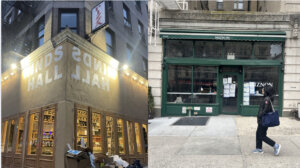
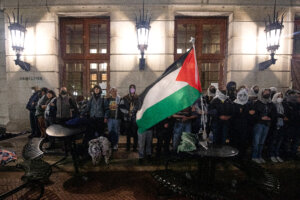
In the fall of 2023, in response to protests following Hamas’ Oct. 7 attack and Israel’s invasion of Gaza, Columbia University closed its wrought-iron gates. Since then, the Ivy League school in Manhattan’s Morningside Heights neighborhood has rarely left the news cycle. With the encampments, student occupation of Hamilton Hall, police in riot gear, congressional hearings on campus antisemitism, and ICE arrests of student activists, Columbia has become a flashpoint in debates about free speech, antisemitism and the limits of dissent.
The encampments are gone, as are the hostage posters. There are no more protests and counter-protests outside the campus gates, but soon the remnants of that political fight may play out in the opening of two restaurants, one Palestinian, one Israeli.
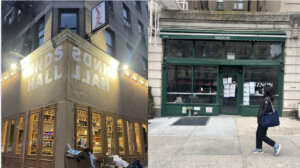
Ayat, the fast-growing Palestinian chain owned by Brooklyn-born couple Abdul Elenani and his wife Ayat Masoud — the restaurant’s namesake — is opening on 106th and Amsterdam Avenue. They’ve named it Hinds Hall Ayat, which was what student activists called the occupied Hamilton Hall in 2024. Hind was a five-year-old girl killed during Israel’s assault on Gaza that year.
Seven blocks north, Miznon, the international Israeli pita chain owned by Eyal Shani, the 67-year-old Tel Aviv celebrity chef known as the godfather of Israeli cuisine, is expected to open on 113th and Broadway, though no date has been set.
Miznon pitches itself as a destination for elevated Israeli street food, while Ayat specializes in Palestinian soul food, meaning larger homestyle platters. The concepts might be different as well as the vibe, but both offer superb, freshly baked, pillowy pita stuffed with spiced meats and topped with brightly flavored pickles and tahini.
The two restaurants arrive at different moments in their trajectories. Shani has been an internationally recognized chef for decades, with 60 restaurants from Singapore to Los Angeles and a Michelin star in Manhattan. Ayat opened its first location in a former Bay Ridge tanning salon five years ago. It now has 10 outposts, and Al Badawi, another Palestinian restaurant owned by Elenani and Masoud with two locations, was named one of the city’s 43 best restaurants in 2025 by New York magazine.
Owners of both restaurants say their decisions to open in the neighborhood are coincidental, and motivated by business, not politics. But in a conflict with competing national identities and claims to the land at its core, food has become a powerful proxy. To eat a babka from an Israeli bakery, or kunafa from a Palestinian, has become political. At the same time, restaurants have become targets of activists. Israeli chefs are accused of appropriating traditional Arab foods and bearing responsibility for Israel’s policies, while restaurants with displays of Palestinian nationalism are accused of promoting violence.
A mile north of Columbia, Tsion, an Ethiopian Jewish restaurant in Harlem, closed earlier this year after repeated harassment over its owner’s pro-Israel stance. Both Miznon and Ayat have had locations vandalized and staff threatened simply because they are Jewish and Israeli or Muslim and Palestinian.
All of this is avoidable. Just a couple blocks away from Ayat’s new location, Claire’s Kitchen Cafe on Manhattan Avenue is owned by Israelis and offers an “Israeli Bowl” of marinated chicken on its menu, alongside Greek and Mexican options. Claire’s, like nearby Halal shawarma spots Zaad and Zurna, pitches itself as Mediterranean, a commonly used catchall label that avoids controversy, but renders the experience generic: hummus scooped into a bowl stripped of the culture that produced it. Ayat and Miznon offer something different — the experience of a Palestinian family meal in East Jerusalem or a taste of a hip Tel Aviv food stall — powerful statements in themselves, with meanings shifting over time.
The Ayat story
In 2014, Elenani, then a student at City College, opened a food stall at Gansevoort Market in Manhattan’s Meatpacking District. The food was “Palestinian orientated,” but he says he didn’t have “the balls” to say so. Instead, he gave it the more generic name, MTerranean. When the market closed in 2016, so did the restaurant,
Elenani, now 33, grew up in Bensonhurst, Brooklyn, the son of Egyptian immigrants during a time of increased Islamophobia after 9/11. In a January interview with the British-based online publication Middle East Eye, he recounted how at the age of five, he witnessed his mother, who wore a hijab, called a terrorist.
His parents modeled how to navigate a diverse city, even one that was at times hostile to Muslims. His father owned Chock Full O’ Nuts coffee shops and several Dunkin Donuts, including one with a Kosher certification in Brooklyn. “In the first grade,” he told me in a phone conversation, “my mom used to give me certain Christian gifts or certain Jewish gifts to give to my teachers when it was their holiday.”
After MTerranean closed, he turned his focus to growing his chainlet of Cocoa Grinder cafes and a Bay Ridge bagel shop. When the pandemic wiped them out, he faced a choice about what to do next. “Going through COVID and seeing how fast things can change, and losing everything overnight, it built a thick skin,” he told Middle East Eye.
He rented out a former Bay Ridge tanning salon with his wife, Palestinian-American Ayat Masoud, 31, whose family owns the Halal market Balady nearby. “I remember thinking I’ll just be very bold about Palestine and not care about what will happen after,” he said.
Masoud, a former prosecutor in the Brooklyn DA’s office who has a private practice, developed the menu with her East Jerusalem-born mother. They included not just the mainstream Levantine staples of hummus and shawarma, but harder to find traditional dishes like Mansaf, heaps of lamb cooked in a thick yogurt sauce served with rice, and Palestine’s national dish, Musakhan, a half chicken roasted with sumac and caramelized onions served over freshly fired taboon bread.
Their goal was to transport customers to Palestine. “If I can eat mansaf over here in New York and think, ‘wow, this tastes just like when I was in Jerusalem,’ that connects those two dots,” Elenani told me. This time, Elenani chose the less generic name, Ayat.
At first, he recalled, many customers called it “Pakistinian cuisine,” confusing Palestine with Pakistan. “I think that was the first moment where I thought I’m going to drive myself to the max to make sure I open up as many locations as possible to communicate that culture and tradition,” he told Middle East Eye.
While MTerannean came and went with little notice, Ayat is leaving its mark. There are now seven Ayats in New York City, one in Texas, one in Princeton and locations set to open in DC and Philadelphia. Elenani plans to franchise and expand to 20 locations nationwide within the next year.
Ayat’s biggest growth has been in the two-and-a-half years since the Oct. 7 attack and Israel’s invasion of Gaza. Palestinian-American families gather over heaps of rice and meat, keffiyeh-wearing activists show solidarity over mint tea, and then there are many just curious about the cuisine and culture of a people who are almost solely portrayed in the American media in terms of violence, either as victims or perpetrators.
But the representation of Palestine comes with a price. Ayat was bombarded with thousands of fake one-star reviews after Pete Wells gave it a rave write-up in The New York Times in 2020. Since Oct. 7, according to Elenani, locations have been vandalized, and staff members have been called terrorists and threatened.
In the face of hostility, Elenani says, he always responds with kindness in accordance with his faith. In 2016, when a Cocoa Grinder cafe was robbed of thousands, he didn’t call the police. Instead, he posted a letter of forgiveness outside the store. “If the money you stole was to better you and your family’s living, then I forgive you,” it read. And this past Thanksgiving, when an Islamophobic caller threatened him and his staff, he invited him to the restaurant.
“I didn’t respond with hate,” he told me, “He ended up coming in and he apologized. He gave me a hug. I feel like people just need to hear a little bit from other backgrounds, just to understand each other.”
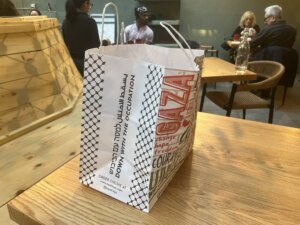
Still, Elenani and Masoud have not softened their political stance. Diners at Ayat’s other locations are greeted by murals of the Al-Aqsa Mosque looming over Palestinian children held at gunpoint by IDF soldiers. The menu calls to “End the Occupation” in Arabic, English and Hebrew. In 2024, the restaurant caused controversy with its seafood section title “From the River to the Sea,” a slogan, Elenani claims, is a call for equality, but which the Anti-Defamation League says is an incitement to genocide. The phrase remains on the menu in the original Brooklyn location, but at other locations, the menu reads “From the Rind to the Seed,” a tongue-in-cheek play on the watermelon as a pro-Palestinian symbol
When I asked Elenani how he weighs the risk of alienating customers against the mission of representing Palestinian culture, he pushed back on the premise. “One thing about Palestinian cuisine — you cannot keep politics out of it,” he said. “But I don’t even call it politics. I call it oppression. I call it genocide. Politics is Democrats and Republicans. We’re talking about who’s living and who’s dying.”
The Miznon story
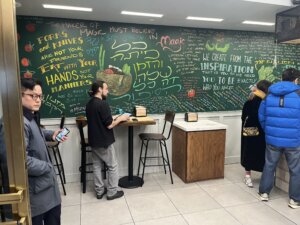
If Ayat with its jugs of oil as decoration, faux olive trees and large platters made to share family-style represents deep rooted tradition, Miznon is the opposite. At each location, the menus along with wall art of pita sandwiches and poetic quotes about the food in Hebrew and English are drawn in chalk. Miznon means canteen, so there are few seats, and the food is offered in individual-sized portions and designed to be eaten quickly or taken to-go.
“The Israeli lifestyle is to live in the now as if it’s all going to disappear,” Shani told Surface Magazine in 2022 in describing Israeli cuisine. “We’re always looking for the new and mostly prefer to forget the past.”
At Miznon, that means vegetable-forward plates, like its star dish, a roasted baby cauliflower. Some traditional Middle Eastern dishes are prepared with a twist. Instead of shawarma, pitas are filled with “ribeye minute steak” or “a folded cheeseburger.” The vibe is cosmopolitan and modern. While Elenani and Masoud sometimes have oud players at their restaurants, Shani books DJs.
At the age of 30 in 1989, Shani opened the Jerusalem restaurant Oceanus. A former film student who taught himself to cook from a Julia Child cookbook, he had almost no culinary tradition to draw from. What he built became the foundation of modern Israeli fine dining, one rooted in the land with local tomatoes, eggplants, wild herbs and tahini, as well as a melting pot of the country’s multicultural influences.
“I just had a feeling that I have to invent the Israeli cuisine,” Shani said last year on the podcast, Being Jewish with Jonah Platt. He was inspired, he said, by the Palestinian women he watched in the Old City markets, carefully tending to a few tomatoes and cucumbers.
“They were my first vision,” he said. His other inspiration was the land itself — the mountains around Jerusalem where he gathered wild sage, thyme and hyssop. When asked about his relationship with those Palestinian women and what he took from them, he answered simply: “There’s no borders when we are talking about food.”
Shani closed Oceanus in 2000, the same year the Second Intifada began. In 2008, he and his partner Shahar Segal, a filmmaker and advertising executive, opened HaSalon, a high-end Tel Aviv restaurant. Two years later, his fame grew when he served as a judge on the Israeli version of MasterChef, where he became popular for his poet-philosopher approach to food. Others called for his removal after he penalized a contestant for living in a West Bank settlement.
In 2011, he and Segal opened the first Miznon in Tel Aviv, pitching it as a democratization of his fine dining sensibility. “Young people did not come to my other restaurants because they couldn’t afford it,” he told The New York Times. Paris followed in 2013, then Vienna, Singapore, Melbourne and, in 2018, New York. He now operates around 60 restaurants worldwide. In each one, he says, he spends weeks with the head chef, instilling them with his “spirit and beliefs” until, as he put it on the podcast, “I print my mind on his mind.”
While Elenani was afraid to call his restaurant Palestinian, and publishers hesitated to put Palestine on cookbook covers out of fear that it would be seen as a provocation, Shani was part of a global Israeli food wave. Israeli chefs like Yotam Ottolenghi in London and Michael Solomonov in Philadelphia won Michelin stars and James Beard Awards. The Israeli brand Sabra, part-owned by Pepsi, defined hummus for many Americans. Israeli food was having a moment. Palestinian food was shunned.
But things have changed. In July 2025, masked protesters stormed the Melbourne Miznon throwing food and chairs, damaging the restaurant. In a statement, the protesters claimed they targeted Miznon because the co-owner Segal was a spokesperson for the U.S. and Israeli-backed Gaza Humanitarian Foundation (GHF) whose food distribution system was accused of endangering the lives of Gazan civilians.
Two weeks later, amid calls to boycott Miznon, Segal stepped down from his position at GHF, but the controversy didn’t go away. Miznon London is the site of a weekly Friday protest by a Jewish anti-Zionist group against Shani’s initiative to provide meals for Israeli soldiers.
“Israel is seen as violent,” Shani told the Forward last June noting a decrease in non-Jewish customers. “It’s not cool anymore, and we can feel it.”
‘Do what you gotta do’
Miznon’s intention to open near Columbia was first announced in 2023 and generated almost no reaction. Last August, when news broke that Ayat was opening nearby, the response online was immediate and sharp. One article called it the “‘From the River to the Sea’ Eatery.”
Elenani has leaned into the controversy. Since 2014 when he wasn’t bold enough to label his restaurant as “Palestinian,” there has been a shift. “It feels like now those Muslim 9/11 kids are having the moment where we can show that this city is our home,” Amani Al-Khatahtbeh, a Muslim-American author, told The New York Times, after Zohran Mamdani won the New York mayoral election. Elenani marked the occasion by closing every Ayat kitchen and feeding more than 4,000 Mamdani volunteers in Bushwick. Three weeks later, he announced the restaurant would be named “Hinds Hall Ayat”
Many in the community, still raw from two years of protests and divisions, would prefer places that facilitate dialogue, not deepen divisions. “I’d like to try Palestinian food,” Allison Lander, a 46-year-old piano teacher and Morningside Heights resident, told me, but said that she felt torn about going, given Ayat’s choice of name “Hinds Hall” and the political slogans on the menu.
“It’s hard for me to take a strong stance against Palestinians right now who are trying to draw attention to the conflict,” she said, but added that “you have to be more sensitive to Jewish community members.”
Shani, characteristically, has said nothing political at all. When I asked what a Columbia student should take away from eating at Miznon, he responded by email: “I want them to care about the experience inside the pita. The feeling, flavors and texture. I want people to fall in love with the pita.” Still, students who have promoted boycotts of pro-Israel businesses, might have opinions beyond the pita.
On Ayat opening nearby, Shani wrote: “We come from the same region and share many food behaviors, ingredients and ways of cooking, and those naturally inspire one another. Food is about bringing people together by reminding us of what we share.”
Elenani had more to say. “I have no idea if they’re even opening up there, but it’s all good,” he said. Still, he took issue with Shani calling his cuisine Israeli, when he says it is Palestinian. “I just wish they could appreciate the culture and cuisine, but not appropriate it and rebrand it into something that it’s not.” Then he offered them a name: “Do what you got to do,” he said. “Call it modern Mediterranean.”
The post Can an Israeli and a Palestinian restaurant coexist peacefully in the shadow of Columbia University? appeared first on The Forward.
Uncategorized
Romania’s secret police trailed a Jewish photographer. Decades later, their files have become a film.
(JTA) — BERLIN — He had wild hair and wore jeans. He was American — and Jewish. He had a camera.
That was enough to trigger surveillance by the notorious secret police of communist Romania, the Securitate.
Now, 41 years after photojournalist Edward Serotta boldly stepped behind the Iron Curtain, we can see just how obsessed the Romanians were with him, thanks to a short documentary by renowned Romanian director Radu Jude and historian Adrian Cioflâncă.
“Plan contraplan/Shot Reverse Shot,” which had its world premiere at the Berlinale international film festival last month, gives equal time to Serotta’s reminiscences about Romania in the 1980s, and to the Securitate’s observations of him.
And of course, to the photos: After his Romania adventure, Serotta put down new roots in Europe, and has spent decades documenting the Jewish life that was nearly obliterated in the Holocaust. He has published several books of photographs documenting Jewish communities. He also documented the fall of the communist regimes in which he’d set foot as a young man.
Twenty-two minutes long, the film was one of several shown at the festival with themes related to Jewish life and history, or to the Israeli-Palestinian conflict.
The obsessive spying of the communist regime, as documented here, appears absurd today. But it was fully serious at the time.
In his narration, Serotta — born in 1949 in Atlanta — recalls how communist authorities in 1985 “had given me the permission to come to Romania under the idea that they would have glowing and fine articles and positive articles about Romania.” His stated intention was to document World War II memorials, of which at the time there were only a handful. Today, there are many more.
“He will be put under surveillance,” declares the spy, narrated in the film’s second half by Romanian political scientist Diana Mărgărit, “in order to prevent contact with parasitic protest elements.”
While Serotta was aiming his lens, the informants were sneaking around, snapping quick shots and jotting down observations. They also slipped into his hotel room one day, and exposed a roll of film.
The things they frantically recorded are “funny right now,” a reminder of a bygone regime that at the time was deadly serious, said Cioflâncă in an interview. Cioflâncă is on the advisory college of the National Council for the Study of the Securitate Archives, a state institution that deals with the history of communism. “I lived for 15 years when I was a child under communism. And it was not fun.”
For 41 years, until the regime’s fall and the execution of president Nikolae Ceaușescu and his wife, Elena, in 1989, the Securitate spied on and terrorized citizens of Romania, suppressing dissent. According to the virtual Cryptomuseum, based in the Netherlands, the Securitate had up to 11,000 agents and 500,000 informants monitoring a population of 22 million.
In 2006, a governmental commission reported that more than 600,000 Romanians — and potentially around 2 million — were incarcerated for political crimes, and more than 100,000 died.
Western journalists, though suspect and surveilled, were to some extent wooed — at least in the 1980s. When Serotta requested to visit in 1985, Ceaușescu had been president for some 11 years (after heading the communist party from 1965). Ceaușescu was seen as more friendly to the west: He had refused to contribute troops to invade former Czechoslovakia in 1968; and he kept up relations with Israel when other communist countries severed their ties.
At the time, the regime wanted to gain “most favored nation” economic status from the United States, which depended on their allowing some freedom of movement to its population.
“There were 855 western journalists coming to Romania during the Ceaușescu period, and 80 of them were American,” said Cioflâncă, who also directs the Bucharest-based Center for the Study of Jewish History, under the Federation of Jewish Communities in Romania.
“Many of these visits were organized as a propaganda instrument. In all the cases, they wanted to interfere with the journalist and to influence his work. They tried something similar with Edward when he came,” he added.
“They felt that the Jews are so influential, especially in the relationship with the United States,” Serotta said in an interview.
“In their mind, everything that was Israeli, Jewish, or American Jewish was deemed like an important piece of influence to use for their political PR at that time,” said Serotta, who eventually moved to Europe and in 2000 founded the Centropa nonprofit archive aimed at preserving Jewish memory in Central and Eastern Europe, the Balkans, the Baltics, and the former Soviet Union.
Centropa was purchased by the US Holocaust Memorial Museum in 2024.
Given Serotta’s obsession with documenting history, Cioflâncă said he was surprised to learn that his friend had never viewed his Securitate files. Several years ago, he asked Serotta if he’d like to see them.
“The funny thing is, I didn’t think I was important enough to have any,” Serotta recalled.
Cioflâncă found some 300 pages of documents. The informants had tried to influence the photojournalist, saying that the World War II killings of Jews in the region were “a marginal moment,” Cioflâncă noted. “They wanted to make sure that their reputation remained clean, that they were not collaborators” with the Nazis.
According to the US Holocaust Memorial Museum and Yad Vashem, at least 380,000 Romanian Jews were killed during the Holocaust.
“I was there for a matter of several weeks,” Serotta said. He recalled “a very tense atmosphere. Nothing worked properly. We barely found food in stores. It was awful.”
And he is still astonished that the Securitate spent so much time following him. “It’s funny stuff.”
“Many Securitate officers were pretty stupid,” Serotta said in the interview. “They were so distorted in doing their job that they didn’t have this sense of [the] ridiculous and humor.”
Moreover, “their [photo] equipment, first of all, was not very good. Secondly, they were usually doing it surreptitiously: behind a wall or a door or something or something like that. But as the old expression goes, the pictures are great because I look young. I look like a casting reject from ‘Flashdance.’”
Serotta, for the most part, ignored or was unaware of the surveillance, except for when the only two cars on remote roads, hour after hour, were his and that of a spy on his tail.
And yet the trip to Romania was priceless. On one of his first visits to a Jewish community in Romania, he said to himself, “Wow, this is interesting. This is like the old country.”
“Then I said, ‘It’s not like the old country. It is the old country, and I’m in it,’” he added. “From that moment on, I felt like I had opened a door, and I’ve never come back through it.”
The post Romania’s secret police trailed a Jewish photographer. Decades later, their files have become a film. appeared first on The Forward.