


Uncategorized
Resignations Continue From Heritage Foundation’s Antisemitism Task Force Amid Carlson-Fuentes Controversy

Tucker Carlson speaks at Indiana University in Bloomington, Indiana, Oct. 21, 2025. Photo: Gage Skidmore/ZUMA Press Wire via Reuters Connect
The Heritage Foundation, a prominent think tank that has been at the center of US conservative politics for decades, is continuing to receive intense backlash over President Kevin Roberts’ refusal to condemn his friend and right-wing podcaster Tucker Carlson’s platforming of neo-Nazi commentator Nick Fuentes in a recent two-hour long interview.
Two members of the Heritage Foundation’s National Task Force to Combat Antisemitism resigned this week while one suspended its participation.
Ian Speir, an attorney at Covenant Law and fellow at the Religious Freedom Institute, announced Tuesday on X that he had resigned from the group.
Rabbi Yaakov Menken, the executive vice President of the Coalition for Jewish Values, made the same decision, sharing a letter announcing the choice with the Washington Free Beacon.
Arie Lipnick, a member of the Board of Governors for the Combat Antisemitism Movement (CAM), sent a letter to Roberts suspending further participation with Heritage pending a meeting with him.
“I cannot in good conscience stand with Heritage or continue on the task force under its current auspices,” Speir said in his resignation letter, which he shared on social media. “I have great respect for all of you, and I consider many of you personal friends. And at the urging of the co-chairs, I was prepared to defer this decision at least until we could get important questions answered about the future of Heritage and the conservative movement. But then Roberts made his statement at Hillsdale last night.”
On Monday, Roberts stated in a speech at Hillsdale College that he had made a “mistake.”
“Sometimes you can make a mistake with the best of intentions,” Roberts said, adding that “my mistake was not saying that we’re not going to participate in cancel culture — we’re not. My mistake was letting that, which we will never backtrack from, override the central motivation that I had in doing that.”
In his resignation letter, Speir described Roberts’ remarks as “strategic non-apology that doubles down on ‘loyalty’ to Tucker Carlson, muses about welcoming groypers and the groyper-curious into the movement, and continues to gaslight everyone about ‘cancelation’ when that clearly isn’t the issue.”
Groypers are part of a loose network of white nationalists and internet trolls who adhere to the racist and antisemitic views of Fuentes, who claims he seeks to preserve the white, European identity and culture of the US.
“It is the elevation of blind loyalty and a thirst for power above principle — the very opposite of historical American conservatism,” Speir wrote. “I cannot tread this path with you. The stakes for our country and for our Jewish friends are simply too high, too existential. I welcome efforts, already underway, to reconstitute some part of this auspicious group and continue the important work of stewarding our American freedoms, combating antisemitism, and renewing the great Judeo-Christian spirit of our civilization.”
Menken’s letter began in anguish: “It is with pain and regret that I tender the resignation of the Coalition for Jewish Values (CJV) from the National Task Force to Combat Antisemitism (NTFCA). We cannot grant legitimacy to an effort to combat antisemitism operated by the Heritage Foundation while Heritage is validating antisemitism and giving it a platform.”
CJV explained the incompatibility of Carlson’s anti-Israel rhetoric and promotion of antisemitic conspiracy theories with the goals of the task force.
“When Carlson welcomes guests and reposts content calling Israel’s effort to subdue Hamas and rescue hostages a ‘genocide,’ he makes himself an integral part of the Hamas Support Network that Project Esther aims to fight,” Menken said. “So, it is not that we are leaving the NTFCA as much as that Mr. Roberts has declared that Heritage itself threatens to scuttle the NTFCA’s efforts.”
In CAM’s letter to Roberts, Lipnick wrote that the group “requests an immediate meeting with you to discuss our ongoing relationship with the Heritage Foundation. Until such time, CAM is suspending our participation as a member of the National Task Force to Combat Antisemitism, a project of the Heritage Foundation.”
Lipnick noted that CAM defended Carlson’s constitutionally protected right to feature Fuentes on his X podcast, and that “indeed, Mr. Carlson has the right to practice antisemitism himself — a right he appears to have greedily exercised in recent years.”
Lipnick described how CAM likewise possesses “the right to criticize Mr. Carlson for eagerly nodding along with comments that channel the literature of the Third Reich, for challenging the First Amendment rights of Christian Americans to practice their faith and for labeling them ‘heretics,’ and not least for allowing his show to become a welcome home for America’s adversaries.”
CAM saw Roberts’ Hillsdale speech as failing to correct the damage done from his previous advocacy of Carlson.
“Given the opportunity to apologize and retract your comments criticizing ‘a venomous coalition of globalists,’ ‘the globalist class,’ and ‘their mouthpieces in Washington,’ comments that feed into the very antisemitic tropes you claim to ‘abhor,’ your speech at Hillsdale College yesterday fell well short of the mark,” Lipnick wrote. “Taken together with your defense of Mr. Carlson’s decision to treat Holocaust denial as legitimate political discourse begs the question of whether Holocaust survivors, their families, and the American Jewish community at large have a home at Heritage.”
The letter from CAM to Roberts concluded, “Frankly, your comments leave us skeptical of whether the Heritage Foundation has the necessary moral leadership to house the Task Force to Combat Antisemitism.”
CJV ended its correspondence with the terms for its continued collaboration with Heritage.
“CJV cannot, in good conscience, remain affiliated with an institution that normalizes or excuses antisemitism under the guise of political commentary or free speech. The moral clarity required to fight Jew-hatred cannot coexist with public expressions of support for those who amplify it,” Menken wrote. “Until such time as there is a complete reversal of Mr. Roberts’ position, or, alternatively, his resignation is accepted by the Heritage Board of Directors, CJV cannot be part of a program, event, or effort claiming to combat antisemitism in which the Heritage Foundation is a sponsoring partner.”
The resignations began last week. On Sunday, Mark Goldfeder, CEO of the National Jewish Advocacy Center and an Orthodox rabbi, posted his own letter of resignation on X.
Uncategorized
Iran Expands Child Soldier Recruitment, Cracks Down on Dissent Amid Escalating US-Israeli Strikes

A blaze after Israel’s Fire and Rescue Service said that an industrial building and a fuel tanker at Israel’s Oil Refineries were hit by debris from an intercepted Iranian missile, amid the US-Israel conflict with Iran, in Haifa, Israel, March 30, 2026. Photo: REUTERS/Rami Shlush
As US and Israeli strikes pound Iranian military sites, Iran is lowering the enlistment age for security roles to 12 and threating civilians with death for photographing war damage, fueling international outrage.
Last week, Iran’s Islamic Revolutionary Guard Corps (IRGC) announced a campaign recruiting children as young as 12 to serve as “Homeland Defending Combatants for Iran,” assisting with patrols, checkpoints, and logistics.
With the minimum age for war roles officially lowered to 12, human rights groups are now condemning the move, demanding that Iranian authorities immediately halt the campaign while imposing a complete ban on enlisting children under 18 in all military and paramilitary forces.
“There is no excuse for a military recruitment drive that targets children to sign up, much less 12-year-olds,” Bill Van Esveld, associate director for children’s rights at Human Rights Watch, said in a statement. “What this boils down to is that Iranian authorities are apparently willing to risk children’s lives for some extra manpower.”
“The officials involved in this reprehensible policy are putting children at risk of serious and irreversible harm and themselves at risk of criminal liability,” Van Esveld continued. “Senior leaders who fail to put a stop to this can make no claim to care for Iran’s children.”
For years, Iran has drafted children under 18 into the Basij militia, with Human Rights Watch documenting boys as young as 14 years old killed in combat, revealing a brutal pattern of exploiting children on the battlefield.
In the past, widely circulated social media images and videos have repeatedly shown children and teenagers in military-style uniforms cracking down on protests, including during the 2022 Woman, Life, Freedom uprising, which erupted nationwide after Mahsa Amini, a young Kurdish woman, died in a Tehran police station following her arrest for allegedly violating hijab rules.
Under international law, Iran’s latest initiative flagrantly violates the Convention on the Rights of the Child, which explicitly prohibits the use of children in military activities, marking a dramatic breach of its global obligations.
Human Rights Watch also uncovered multiple other war crimes, including the Iranian government’s relentless use of cluster munitions delivered by ballistic missiles at Israel since the conflict erupted last month. At least four civilians have been killed in these strikes, which constitute clear violations of international humanitarian law.
“Iran’s use of cluster munitions in populated areas in Israel pose a foreseeable and long-lasting danger to civilians,” Patrick Thompson, a researcher in HRW’s Crisis, Conflict, and Arms Division, said in a statement. “Cluster munition bomblets are dispersed over a wide area, making them unlawfully indiscriminate in violation of the laws of war.”
Fired from rockets, missiles, or aircraft, cluster munitions spread dozens of explosive bomblets across large areas, leaving many unexploded and posing a long-term, landmine-like danger to civilians for years or even decades.
Amid relentless US and Israeli attacks and mounting international pressure, the regime is also intensifying its domestic crackdown, now warning that photographing war-damaged areas could carry the death penalty.
Under this newly enacted policy, people accused of spying or cooperating with “hostile states” could face the death penalty and have all their assets confiscated.
Anyone caught photographing damaged sites could be accused of espionage, potentially providing intelligence to coalition forces, and face execution.
“People who take photos or videos of damaged sites and share them are effectively confirming whether strikes hit their targets,” Iran’s judiciary spokesperson Asghar Jahangir said on Tuesday, describing the action as the equivalent of cooperating with and providing intelligence to the enemy.
According to Iranian media and watchdog groups, more than 1,000 people have been arrested this month for filming sensitive locations, sharing anti-government content online, or allegedly “cooperating with the enemy.”
Against the backdrop of large-scale US and Israeli strikes pounding key regime strongholds in Shiraz and Isfahan — where critical military infrastructure has been repeatedly hit — tensions have surged to a boiling point as the pressure campaign intensifies
On Tuesday, the Israeli Air Force launched another sustained wave of precision airstrikes against Iranian weapons production and research facilities around Tehran, seeking to disrupt and dismantle the missile supply and manufacturing networks that support Tehran’s military arsenal.
Meanwhile, the IRGC this week threatened 18 American multinational technology and industrial companies, accusing them of involvement in “terrorist operations” and labeling them as “legitimate targets.”
“We advise the employees of these institutions to immediately distance themselves from their workplaces to preserve their lives,” the statement published on Tuesday said. “These companies should expect the destruction of their respective units in exchange for each terror act in Iran, starting from 8 PM Tehran time on Wednesday, April 1st.”
Among the companies mentioned were major corporations such as Microsoft, Google, Apple, Intel, IBM, Tesla, and Boeing.
Uncategorized
Jews paused Indiana’s abortion ban — by turning a religious freedom law against the evangelical right

When Elly Cohen chose to terminate her pregnancy in 2022, it aligned with her understanding of Jewish law that life begins at birth, not conception.
Cohen and her husband were eager to give their then 4-year-old daughter a sibling. But her fetus had been diagnosed with Trisomy 18, a severe chromosomal disorder that, in most cases, leads to death before birth or within the first year of life. She decided to end the pregnancy.
Had she gotten pregnant just a few months later, she might not have had that choice. She lives in Indiana, one of 13 states that enacted near-total bans on abortion following the Supreme Court’s Dobbs decision, which overturned Roe v. Wade.
Indiana’s law does allow abortion for for lethal fetal anomalies up to 22 weeks, but doctors bear legal risk in determining whether a particular diagnosis meets the statute’s definition — a gray area that can lead to delays or reluctance to provide care.
That reality stirred Cohen into action. She co-founded Hoosier Jews for Choice, a Jewish group that advocates for abortion access, which joined five anonymous women of multiple faiths in a lawsuit backed by the American Civil Liberties Union. Their argument relied on a religious freedom law — the Religious Freedom Restoration Act, or RFRA — signed by former Indiana governor Mike Pence in 2015. It was one of many such state laws passed amid calls from some evangelical Christians to establish their right not to do business that violated their beliefs, such as baking a wedding cake for a gay wedding.

Hoosier Jews for Choice saw an opening for Jews to exercise their religious freedom under the same law, but for a purpose at odds with evangelical Christianity: to gain access to abortion. Earlier this month, Judge Christina Klineman of Marion County Superior Court agreed, permanently blocking enforcement of the state’s abortion ban for plaintiffs with sincere religious objections.
Hoosier Jews for Choice is celebrating the ruling as the biggest legal win to date in support of the argument that abortion bans violate Jews’ religious freedom. The group is hopeful that similar cases can build on the Indiana case’s success nationwide.
The ruling could still be reversed: Indiana Attorney General Todd Rokita has appealed the decision, and the case is headed to the Indiana Supreme Court, where all five justices are Republican appointees. Meanwhile, Klineman, elected to the bench in 2014 after winning a Democratic primary, has faced calls for her impeachment over her decision, in what U.S. Sen. Jim Banks (R-IN) called “one of the most ridiculous rulings I’ve seen in a long time.”
But for Amalia Shifriss, who testified on behalf of Hoosier Jews for Choice in the lawsuit, the latest ruling is a positive sign that the law will be applied consistently. If religious freedom applies to Christians objecting to baking a same-sex wedding cake, she said, then it must apply to liberal Jews, too.
“RFRA should not just be for what some lawmakers see as the religious right,” Shifriss told the Forward. “It should be for all religions.”
‘Perversion of the law’s intent’
In winning the right to an abortion, Hoosier Jews for Choice relied on a law passed by Pence, who would become Donald Trump’s vice presidential running mate on the strength of his reputation as a stalwart advocate for evangelical Christians. Pence rose to national prominence based on his unwavering opposition to abortion — and his conservative leadership as Indiana governor.
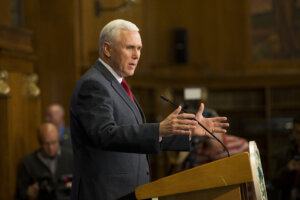
Anti-abortion advocacy organizations — including Indiana Right to Life and SBA Pro-Life America — supported the law.
Back in 2015, the debate over RFRA centered on small-business owners that sought to refuse service to LGBTQ+ people. Eric Miller, a conservative activist who was in the room when Pence signed the law, wrote then that “Christian bakers, florists and photographers should not be punished for refusing to participate in a homosexual marriage!”
Massive backlash against the law — notably by the NCAA the weekend before the Final Four basketball game was slated to occur in Indianapolis — led Pence to sign into law a clarification that businesses could not use the Religious Freedom Restoration Act to deny services to people on the basis of their sexual orientation.
But the law itself remained on the books — ripe for abortion-rights groups to wield a decade later.
Now, a little over a decade after Indiana first passed RFRA, organizations that once supported the law’s broad application have changed their tune.
“For the court to rule that taking the life of an unborn child is an exercise of religious freedom is deeply distressing — and a perversion of the law’s intent,” Indiana Right to Life president Mike Fichter said in an online statement following Klineman’s March 5 ruling. Indiana Right to Life did not respond to the Forward’s request for comment.
That shift has been part of a larger legal trend: Conservative Christian groups like Alliance Defending Freedom have long argued that the government must have a compelling reason to force someone to act against their religious beliefs — whether mandating vaccines, serving LGBTQ clients, or covering contraception in employee health care plans.
But when it came to religious plaintiffs who support abortion access, some on the Christian right didn’t think the same expansive view of religious freedom applied.
“Indiana’s religious freedom laws were passed for the purpose of protecting religious practice, not to protect the ending of a human life,”Indiana’s religious freedom laws were passed for the purpose of protecting religious practice, not to protect the ending of a human life,” Alexander Mingus, executive director of the Indiana Catholic Conference, said in an online statement after Klineman’s ruling. “Religions that preach violence are not protected by religious freedom claims.”
Mingus did not respond to the Forward’s request for an interview.
The Becket Fund for Religious Liberty, a nonprofit that has made its name arguing religious freedom cases in front of the Supreme Court, also objected to the Jewish plaintiffs’ interpretation of RFRA. In 2014, Becket successfully argued in Burwell v. Hobby Lobby Stores, Inc. that employers could refuse to cover contraception on religious grounds. Meanwhile, in the Indiana case, Becket filed a brief questioning the sincerity of the Jewish plaintiffs’ religious beliefs.
“The case fails RFRA’s test for multiple reasons, including allowing people to join Hoosier Jews for Choice by filling out an anonymous Google form with zero requirement to actually agree with Jewish religious teachings,” Lori Windham, senior counsel for Becket, said in a statement to the Forward.
Cohen disputed that characterization. She said that all members of Hoosier Jews for Choice were required to share their name and contact information, which it did not make public in order to protect members’ confidentiality. She added that group members who joined the lawsuit were asked to indicate whether they could connect their view on the abortion ban to their Jewish values and beliefs, and the vast majority of members did.
David Schraub, an assistant professor at Lewis & Clark Law School who has written about the Indiana case, said that courts do assess whether a religious belief seems genuine. But according to Schraub, the bar for establishing sincerity is low — typically an issue only in cases clearly brought in bad faith. For instance, Schraub recalled a case in which a defendant, trying to avoid paying taxes, cycled through various legal arguments before ultimately inventing “the Church of Ayn Rand.”
The Indiana case is fundamentally different, Schraub said, given the long-standing religious grounding for more permissive Jewish views on abortion.
“They tried to argue that this was not a sincerely held religious belief, which I think was really quite disrespectful, because it flies in the face of a lot of evidence about what we know about how Jews conceptualize the relationship to reproductive freedom,” Schraub said. “They’re just not willing to accept that there is such a thing as a sincere and genuine liberal religious tradition.”
Jewish beliefs, Jewish practices
A 2014 Pew Research poll found an estimated 83% of American Jews believe that abortion should be legal in all or most cases. That’s likely because Jews across denominations largely agree that life begins at birth, not conception. Sources in the Talmud say that in the first 40 days of pregnancy, the fetus is considered “mere water.” Jews value the fetus as “potential life,” gaining the legal status of nefesh, or personhood, at birth.
Still, Jews do not have monolithic views on abortion. Orthodox groups are divided, though couples generally consult rabbis on the matter and believe the choice to get an abortion should be governed by Jewish law, not personal choice.
The Conservative movement’s Rabbinical Assembly supports the right to choose abortion in cases where “continuation of a pregnancy might cause severe physical or psychological harm, or where the fetus is judged by competent medical opinion as severely defective.”
Reform Judaism emphasizes bodily autonomy, with the view that “the decision to terminate a pregnancy is one that, in all circumstances, should ultimately be made by the individual within whose body the fetus is growing.”
Rabbi Sandy Sasso — one of three rabbis the ACLU asked to give expert testimony in the Indiana case, and the first woman ordained a rabbi in Reconstructionist Judaism — told the Forward that the diversity of opinion within Judaism underscores the argument for challenging abortion bans.
“That actually is just the point — there are different religious views,” Sasso said. “The Constitution does not allow you, since there is separation of church and state, to enshrine one religious view over the other.”

Can religion and abortion coexist?
Shira Zemel, abortion access campaign director at the National Council of Jewish Women, is helping lead a national push to reframe “reproductive freedom as religious freedom.”
Each year since 2021, the Council has organized “Repro Shabbat,” which aligns with the Torah portion from Exodus Parashat Misphatim. The portion says that if a man pushes a pregnant woman, causing her to miscarry, he should pay a fine. But if any other damage results, the punishment should be according to the principle of “eye for an eye.” The portion is often interpreted as evidence that Judaism does not view a fetus as having the same legal status as a person.
The group has also backed that argument in court, filing a brief with 21 other organizations of faith in support of the plaintiffs challenging Indiana’s abortion ban — and hoping similar lawsuits will build on that case’s success nationwide.
The legal pathway exists in many places: 29 states have their own versions of the Religious Freedom Restoration Act, including at least 11 that severely restricted abortion after the Dobbs decision. According to Ken Falk, legal director of the ACLU of Indiana, the same legal reasoning used in Indiana could feasibly be applied in any of those states.
Some legal challenges are already underway, including in Kentucky and South Carolina, where litigation is ongoing. Others have faltered: In Missouri, a judge upheld the state’s abortion ban after a group of interfaith clergy sued on religious grounds. In Florida, a Jewish-led challenge to a ban after six weeks of pregnancy fizzled out after Rabbi Barry Silver, who brought the case on behalf of his synagogue, died of colon cancer in 2024.
Zemel said she hopes the Indiana case can serve as not only a legal blueprint, but also as a sign of a broader cultural shift in how religion is understood in the abortion debate.
“It’s incredible to me to see how this legal argument is bolstering what I like to think is a huge narrative shift,” Zemel said. “For far too long, it’s been weaponized that religion and abortion can’t coexist, but we know that that’s not the case.”
The post Jews paused Indiana’s abortion ban — by turning a religious freedom law against the evangelical right appeared first on The Forward.
Uncategorized
Syria Will Stay Out of Iran conflict Unless It Faces Aggression, President Says

Syrian President Ahmed al-Sharaa attends the Ministry of Awqaf conference titled “Unity of Islamic Discourse” at the Conference Palace in Damascus, Syria, Feb. 16, 2026. Photo: REUTERS/Khalil Ashawi
Syrian President Ahmed al-Sharaa said on Tuesday that his country will stay out of the US-Israeli war against Iran unless Syria is subject to aggression and has no diplomatic solutions.
“Unless Syria is targeted by any party, Syria will remain outside any conflict,” the Syrian president said at an event hosted by think tank Chatham House in London.
“We do not want Syria to be an arena of war. But unfortunately, today, things are not governed by wise minds. The situation is volatile and random,” the president said.
The month-long conflict has spread across the region, killing thousands, disrupting energy supplies, and threatening to send the global economy into a tailspin.
“We want Syria to have ideal relationships with the entire region, with Lebanon, Iraq, Turkey, Saudi Arabia, and world powers like the UK, France, Germany, and the US. I think that Syria is qualified to start a strategic relationship network,” he said, responding to a question on whether Syria would stay neutral while the conflict goes on.
Syria has been keen to stay on the sidelines of the regional conflict that has pulled in neighboring countries, including Lebanon, where armed group Hezbollah is locked in fighting with Israeli ground troops, and Iraq, where Iran-aligned factions have launched drone and rocket attacks.
Syria sent thousands of troops to its western border with Lebanon and its eastern border with Iraq earlier this month. Syria‘s defense ministry said the deployment was part of efforts to “protect and control the borders amid the escalating regional conflict.”
“We had enough war. We paid a large bill. We are not ready for another war experience,” Syria‘s president said.