


Uncategorized
Roswell, New Mexico, is rife with UFOs, scorpions and conspiracy theories — but few Jews
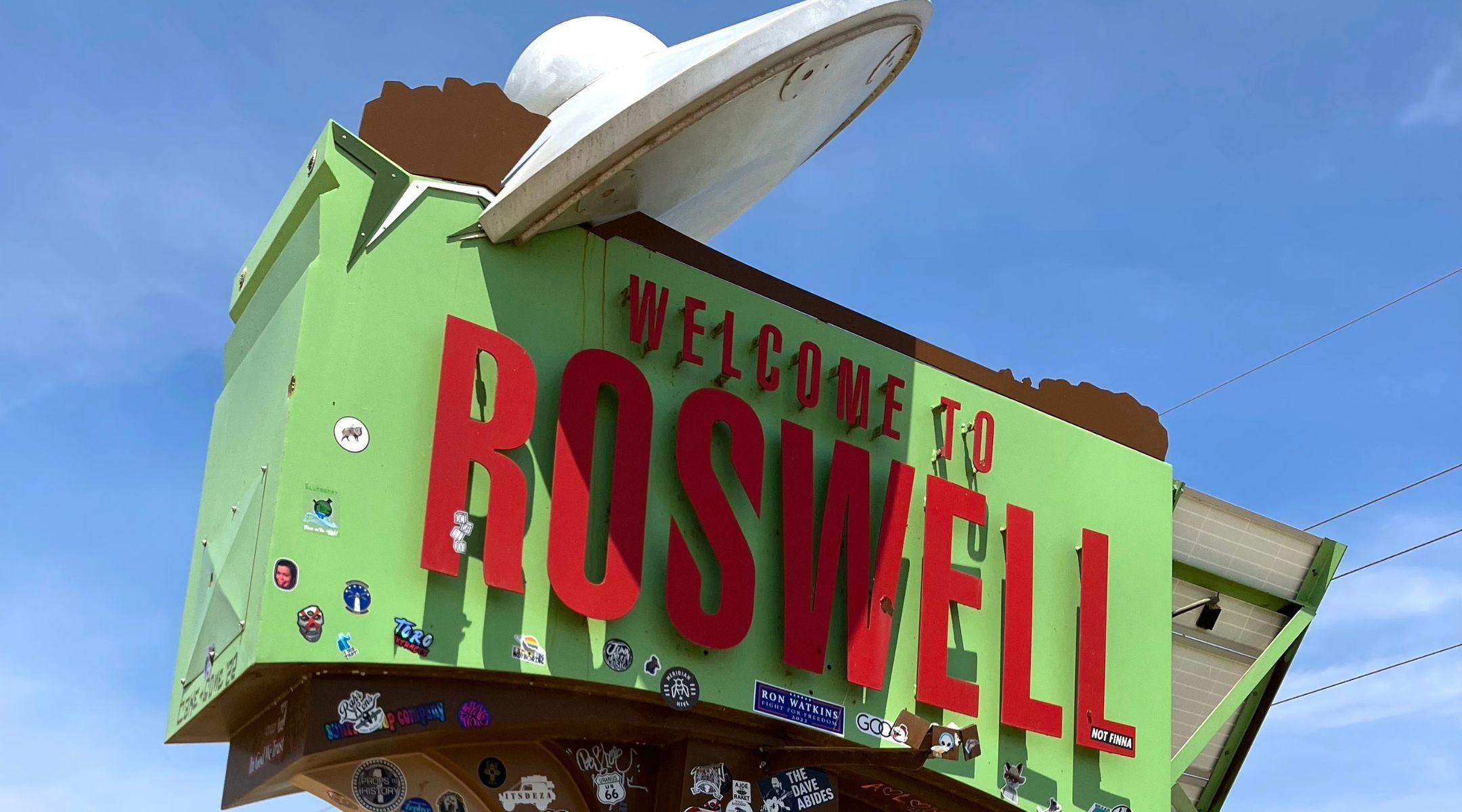
ROSWELL, New Mexico — If it weren’t for an Ashkenazi Jew named Stanton T. Friedman, the world might have long ago forgotten what’s come to be known simply as the “Roswell incident.”
Instead, countless books, documentaries and made-for-TV dramas have explored the 1947 discovery of mysterious materials found on a New Mexico ranch that Friedman argued were the relics of extraterrestrials. A wave of successors, including a prominent Israeli-American physicist, continue to press the case for alien contact. And this dusty desert town has been transformed according to an unusual paradox: It’s shaped by conspiracy theories, yet is home to virtually no Jews.
Roswell’s only synagogue, Congregation B’Nai Israel, closed up and moved to Albuquerque five years ago.
“They didn’t have a rabbi and they only met twice a month, on Fridays,” said Leslie Lawner, who made the move with her husband in 2020, reducing Roswell’s tiny Jewish population by two. “There was really nothing we could do for them.”

A granite monument in front of the Chaves County Courthouse in Roswell, New Mexico, displays the Ten Commandments and a Star of David. (Larry Luxner)
The Lawners left behind a town that is largely defined by what happened in the summer of 1947, when local rancher W.W. “Mac” Brazen found rubber strips, tin foil, thick paper and other debris on his property and shared the material with Sheriff George Wilcox of Roswell. The sheriff brought the unusual artifacts to the attention of the Roswell Army Air Field, which on July 9 of that year announced that it had recovered the remains of a “flying disc.”
The outrageous RAAF claim was quickly denounced as erroneous by local military officials who said the debris was actually the wreckage of a crashed weather balloon and related equipment.
That would have been the end of it, if not for Friedman, a nuclear physicist and highly regarded “ufologist” who revisited the incident in the 1970s, devoting the rest of his life to proving the existence of flying saucers. In 1987, Friedman — who died six years ago — told the New York Times that federal officials had engaged in a “cosmic Watergate” to cover up the truth.

The plaque honoring the late Jewish scientist Stanton T. Friedman and his research on UFOs in downtown Roswell, New Mexico. (Larry Luxner)
Now, this remote city of 47,000, located east of the White Sands Missile Range and about a three-hour drive southeast of Albuquerque, is known for one thing and one thing only: flying saucers.
Here in Roswell, those saucers are ubiquitous — beginning with one atop the “Welcome to Roswell” sign east of town along U.S. 380. There’s also a UFO-shaped McDonald’s, along with a bug-eyed little green alien relaxing under an umbrella in front of the nearby Western Inn.
Another extraterrestrial creature reclines on a bed in the display window of White Mattress, not to mention yet another, even more tacky, E.T. proudly holding up the Dunkin Donuts marquee along Main Street. Not surprisingly, Martians are a common theme in Halloween displays here.
In 1997, the Air Force — attempting to dispel rumors that had persisted for decades — released a 231-page report concluding that alien bodies recovered at the Roswell crash site weren’t aliens at all, but dummies used in parachute tests. It also said that the “spacecraft” that had fallen to Earth on Brazen’s ranch was really an Air Force balloon used in a top-secret program code-named Project Mogul to monitor the atmosphere for evidence of Soviet nuclear tests.
Asked at the time if the new report would finally put the matter to rest, retired Air Force Col. Richard Weaver told NBC’s Today show said: “No, I doubt it. This has become a religion to many people. It’s almost a cult. Certainly, an unbelievable financial opportunity for many folks. So I think this is going to endure.”
Now, the town has taken on added prominence with the Pentagon’s recent establishment of an All-Domain Anomaly Resolution Office. President Donald Trump is a known skeptic of UFOs. But in a 2020 campaign video, he said, “Roswell’s a very interesting place with a lot of people that would like to know what’s going on.”
In a town forged around the religion of aliens, Jewish life is virtually nonexistent. There aren’t enough Jews here to make a minyan — let alone support a synagogue — and the few who did live here have mostly died off or moved away.
Lawner and her husband Bob rarely attended services at Congregation B’nai Israel, located a block from their house at 8th and Washington, during their 27 years in Roswell. But Lawner did help develop a curriculum on Holocaust studies for Sidney Gutierrez Middle School, which she helped found and where she taught for 17 years.
It was an area of inquiry that overlapped with one outlandish but persistent theory about the Roswell incident. Annie Jacobsen claims in her 2012 book, “Area 51: An Uncensored History of America’s Top Secret Military Base,” that just before the Roswell crash, Soviet dictator Joseph Stalin recruited Nazi war criminal Josef Mengele — the infamous Auschwitz “angel of death” — to create “grotesque, child-size aviators” to pilot a plane in order to trigger widespread panic throughout the United States.

The obsession with aliens has divided Jewish voices. An Orthodox Jewish rabbinical authority, Rabbi Pini Dunner of Beverly Hills, California, has called the Roswell incident “nonsense.”
“Most people don’t believe any of this, nor, for that matter, do we entertain the claims of those who maintain that the Apollo moon landings were all an elaborate hoax, or that Denver International Airport stands above an underground city that serves as a headquarters for the masonically inspired New World Order,” Dunner wrote in an online post. “It’s not that any of these conspiracy stories can be categorically disproved, but we feel they do not need to be. The question is: why would any intelligent person believe such nonsense to be true?”
But some Jews are attached to the idea that aliens are out there — including one of the most prominent scientists making the case today. The Israeli-American physicist Avi Loeb, who runs a lab at Harvard University, argues that some objects and phenomena in space cannot be explained except as evidence of extraterrestrial technology.
Loeb has emphasized the appeal of aliens and space exploration on Jewish grounds. “It is reasonable to imagine the absence of antisemitism in interstellar space,” he wrote earlier this year, noting that anything traveling from the other side of the Milky Way would have had to set out before there were Jews.
This month, Loeb released new data that he said suggested that an object in space that will come within 269 million kilometers of Earth later this year may have extraterrestrial origins. The resulting frenzy has embroiled U.S. transportation officials and even Kim Kardashian.
Loeb’s argument is rooted in theoretical physics. But here in Roswell, aliens are experienced in concrete terms. Factual or not, this past July, Roswell marked 78 years since the mysterious 1947 event, with an annual Roswell UFO Festival that lures thousands of tourists from all 50 states and beyond.
Every year, sidewalk vendors do a brisk business selling funnel cakes, alien salt-and-pepper shakers and other trinkets, while tourists happily pay $5 each to visit the downtown International UFO Museum and Research Center.
“These exhibits are designed not to convince anyone to believe one way or another about their subjects,” says a sign at the museum’s entrance. “Visitors are encouraged to ask questions.”
Local merchants don’t seem to care much what really transpired that night in 1947. They’re just grateful for all the desperately needed cash this festival generates.

Storefront ad for the 2025 UFO Festival in Roswell, New Mexico. (Larry Luxner)
“Roswell didn’t have a tourist industry and one of my friends was telling me about this UFO stuff. So we started the UFO Festival,” said Tim Jennings, the town’s mayor. “I don’t know what happened, but something definitely happened. It’s not unreasonable. We live out in the middle of the desert, and without a lot of bright lights, at night you can see a lot.”
Added Todd Wildermuth, Roswell’s public information officer: “I don’t have an opinion about it. I haven’t really given it any deep thought.”
To say Roswell is remote is a vast understatement. Some 140 miles from the nearest interstate highway, the town is also unbearably hot and dry. One quickly learns not to go anywhere without a water bottle; it’s even better to stay inside where there’s air-conditioning.
Roswell is certainly not the kind of place to visit if you don’t like reptiles and other poisonous creatures. At the local Home Depot, two of the biggest-selling items, along with plywood and barbecue grills, are Harris Scorpion Killer and Snake-A-Way pellets.
These days, only a handful of Jews remain in Roswell. A Google search for “Roswell” and “Jewish” reveals three synagogues in Roswell, Georgia — a suburb of Atlanta — one of which is a Messianic church.
“There was never a large community here,” said Cymantha Liakos, a Philadelphia native who wasn’t raised as a Jew but recently took a DNA test and discovered she has Jewish ancestry. Liakos, a former geologist, settled in Roswell with her husband, William, a doctor.
Her 23-year-old son, John, a graduate of the nearby New Mexico Military Institute, visited Israel in 2022 as the first Roswell native (and quite possibly the last) ever to participate in Birthright, the program that takes young Jews to Israel on free trips.
Today, the corner structure that had housed B’nai Israel since its establishment in the 1940s is a medical clinic.
“The building was deteriorating and there was no one within the group who knew how to keep it up,” said Judy Stubbs, B’nai Israel’s former treasurer. “Since there was so few of us left, we decided it was in our best interests to sell it.”
The community’s Torah, meanwhile, has found a new home at Congregation Nahalat Shalom in Albuquerque, New Mexico’s largest city and home to many of the state’s estimated 25,000 Jews. In 2018, Roswell’s dwindling Jewish community agreed to “indefinitely loan” Nahalat Shalom the sacred scroll, which had been rescued from a small town in Czechoslovakia by the Karnowsky family during World War II.

Roswell’s Jewish community agreed to “indefinitely loan” a synagogue in Albuquerque their sacred scroll in 2018. (Courtesy)
In 2018, Nahalat Shalom’s spiritual leader, Rabbi Min Kantrowitz, led a special Simchat Torah dedication service in the presence of Kathryn Karnowsky and her Jewish friends from Roswell.
So what do the handful of Jews remaining in Roswell think about the 1947 “incident” that made their town famous?
“My husband is from a ranching family with longtime roots in this area, and all of their ranch neighbors strongly believe it is not a hoax,” said Liakos. “There was an incident, and a government cover-up. Both of us are scientists, and we’re not shrugging it off as ridiculous.”
Stubbs, a longtime resident of Roswell and former city council member, agrees with her friend.
“People ask me that all the time,” said Stubbs, who remains active in politics. “With all the continued hype, I believe something must have happened. A lot of people come here to find out, but no one has the answer. Unless the federal government chooses to open the records, it’s a question that will never be answered.”
—
The post Roswell, New Mexico, is rife with UFOs, scorpions and conspiracy theories — but few Jews appeared first on Jewish Telegraphic Agency.
Uncategorized
They met on a Birthright trip then married. Now this American Israeli couple’s internet fame has turned to infamy.
Ethan and Hila Klein first met at Yad Vashem — Israel’s Holocaust museum — in 2007, a meet-cute they recounted, giggling, years later for their millions of YouTube followers.
“I think I went up to her and said something like, ‘They had it coming, don’t you think?’” said Ethan, known for his edgy humor and infamous internet trends, including Vape Nation and Papa Bless. “No I didn’t say that. I wonder if you would have laughed though.”
They were on a Birthright trip, Ethan an American and Hila an Israeli soldier on leave to join the group. Soon after the trip ended, Ethan moved to Israel to be with Hila, and the two began making videos under the name H3H3 Productions (the H for Hila and the 3 standing in as an E for Ethan). They married, moved to America, and started a popular podcast.
A Jewish love story, until Thursday, when Hila, now mother to their three children, accused Ethan publicly of having a months-long affair.
“The betrayal I feel is immeasurable,” Hila said in an Instagram post. “My only family on this side of the world. How do I even begin to make sense of this?”
Ethan reposted her statement.
Their podcast is run by a handful of crew members who often chime in and participate in various skits and bits. The crew also shared a statement saying they stand with Hila and refuse to work with Ethan, though they added they don’t know what this will mean for the future of the show.
A couple roiled by Oct. 7
The left-leaning, secular couple’s videos and podcasts focused primarily on pop culture, internet drama and general politics, not Jewish or Israeli issues.
Both Ethan and Hila would make statements sometimes when tensions in Israel flared, and they would occasionally speak out against IDF actions that upset them.
In 2021, Ethan started a podcast with political commenter Hasan Piker, a controversial left-wing influencer, called Leftovers, a nod to their leftist politics.
Then came Oct. 7.
Ethan, an American Israeli dual citizen like Hila, was horrified by the attacks but quick to call the IDF genocidal in the aftermath. In their first episode together after Oct. 7, Ethan and Piker said the show would continue through their disagreements. The episode was tense, and it was their last.
As Piker’s rhetoric on Israel intensified and became at times antisemitic, the two began a nasty internet feud, culminating in a nearly five-hour livestreamed debate.
Piker posted about the news of the affair on X, sharing a video of Ethan and expressing disgust for men who cheat.
“Now this is a high caliber man [with] good morals,” Piker said sarcastically. He also posted “Judge me by my enemies” after sharing Hila’s statement.
Hila, who owns a makeup and clothing company, increasingly came under scrutiny by Piker and others after Oct. 7 for her service in the IDF. Artists refused to work with her. One model she hired publicly disavowed her after finding out she was Israeli.
The couple was harassed, sometimes online, sometimes in-person, as they attempted to take what they viewed as a nuanced stance in the aftermath of Hamas’ attack on Israel and the ensuing war in Gaza. The united front seemed to fortify their relationship, as Ethan, ever outspoken, routinely came to his wife’s defense.
Their show lost thousands of subscribers, but loyal fans stuck with them — fans who now say they are gutted and confused by the news of the affair. Many in disbelief noted that Ethan had Hila’s face tattooed on his arm less than two years ago as a surprise for her.
“The greatest thing a man can do for his children is to love their mother,” says the quote surrounding the tattoo.
The Forward attempted to contact the Kleins through their work emails and did not immediately hear back.
The post They met on a Birthright trip then married. Now this American Israeli couple’s internet fame has turned to infamy. appeared first on The Forward.
Uncategorized
These Jewish college students have some ‘nonnegotiables’ for El-Sayed
At the University of Michigan, first-year student Robert Kashan, 18, and sophomore Jacob Reich, 19, sat behind a large blue sign. “Some things are nonnegotiable,” it declared in all caps.
The sign laid out their requirements for any candidate seeking their support: a commitment to Jewish safety, “including for Zionist Jews,” and supporting Jewish statehood in Israel, among other positions.
“Zionism is a legitimate part of the Democratic coalition, and a lot of us are feeling less represented by the Democratic Party,” Kashan told the Forward.
The students are part of a broader “Nonnegotiable” movement in Michigan, a coalition of Jewish Democrats who are spelling out their dealbreakers for candidates ahead of the Senate election between Democratic nominee Abdul El-Sayed and Republican nominee Mike Rogers.
The movement has attracted national attention, with hundreds of rabbis across 34 states signing on to the “Nonnegotiable” demands. Meanwhile, about 20 students at the University of Michigan have publicly signed, while hundreds more offered support anonymously, according to Reich.
The “Nonnegotiable” supporters aren’t saying whom they’ll vote for if their concerns aren’t addressed — or whether they’ll vote at all. But they are pushing back against the assumption that Jewish voters will, as the saying goes, “vote blue no matter who,” urging El-Sayed to engage with their demands if he hopes to earn their support.
That’s in contrast with two other Jewish political camps, including a group called Michigan Jews for Democracy that endorsed El-Sayed. Their petition, which has garnered almost 1,000 signatures, notes that some signatories hold reservations about El-Sayed but are voting for him nonetheless as a check on President Trump.
“We understand that a vote is not a valentine; it’s a strategic chess move,” the petition reads.
A competing petition, dubbed “Michigan Jews Against Extremism,” has drawn hundreds of signatures from Michigan Jews who plan to vote for Rogers. That petition similarly emphasizes that Rogers voters may still have reservations about the candidate: “Our vote for Mike Rogers does not require that we agree with him on every issue or that we support President Trump,” it reads.
“Nonnegotiable,” meanwhile, rejects the idea that Jewish voters would have to choose between Zionist and Democratic values. Some have criticized the nonnegotiable movement for ignoring the reality of the electoral choice at hand. Others have called it “a veiled attempt to excuse the actions of Jewish Democrats who want to feel validated about voting for Mike Rogers.”
But Kashan and Reich, who met at Hillel and plan to major in political science, said the “Nonnegotiable” movement was the only way they could see themselves engaging in the election, as they felt increasingly pulled between their identities as Democrats and as Jews.
Some Michigan Jews have expressed alarm at El-Sayed’s questioning of whether Israel should exist as a Jewish state and his decision to campaign alongside controversial Twitch streamer Hasan Piker, who has been accused of antisemitic rhetoric. Rogers, who Trump has endorsed, earlier this week called El-Sayed “anti-Jew.”
In a letter to Michigan Jews, El-Sayed has vowed to “stand up against antisemitism and take the threat of violence against our Jewish community incredibly seriously.” He has also hired a Jewish liaison in the final weeks leading up to the election.
This will be the first election when Kashan, who just turned 18, is eligible to vote, and Reich’s first national election after voting in a local primary in his hometown of Palo Alto, California. For both, voting Democratic in their first major election had once seemed like a given.
“I’m a Jewish Democrat, and I want Democrats to take the Senate,” Reich said. “I want to vote for a Democrat in my own state.”
They’re still holding out hope that will happen — and that, with less than two weeks until the Nov. 3 election, El-Sayed will sign on to their petition.
And if he doesn’t? Neither student is ready to say.
The post These Jewish college students have some ‘nonnegotiables’ for El-Sayed appeared first on The Forward.
Uncategorized
Does anyone in Jerusalem care what happens to us?
An Israeli think tank has put on paper what most American Jews know in their kishkas: Israel’s actions over there affect our safety here.
So here’s my question: Does anybody over there care?
The report, published by The Institute for National Security Studies (INSS), drew on the input of 20 Jewish leaders from five countries. It concluded that Israel’s actions since the Hamas attack on Oct. 7, 2023 have normalized hostility toward Israel, divided Jewish communities, sapped the political influence of pro-Israel organizations and fueled antisemitism.
Those actions include damaging statements by government officials, limits on humanitarian aid to Gaza at the height of the war, widespread damage to civilian infrastructure in Gaza and unchecked settler violence in the West Bank. The authors also cited as inflammatory “the proliferation of images of civilian death and suffering in Gaza” — though the actual civilian death and suffering has also alienated and enraged many outside Israel, including Jews.
“The conflict is not only over there in the Middle East, it is local all over the Jewish world now, and Diaspora Jewry has skin in the game,” said Theodore Sasson, one of the report’s authors, in an interview with JTA’s Andrew Silow-Carroll, who first wrote about the study.
To be clear, the report doesn’t excuse, exonerate or rationalize people who commit antisemitic acts. “Jews and Israelis are not to blame for antisemitism,” the report states.
“What we’re saying is that Israel is not the cause” of antisemitism, Sasson said, “but enlightened Israeli policy can seek to maintain robust Diaspora support for the state of Israel and can deny the antisemites the material that fuels their mostly spurious claims.”
This is not a novel connection. Three previous academic studies, in Belgium, Australia and the U.S. found statistically significant links between Israeli military operations that result in high Palestinian casualties and spikes in reported antisemitic incidents abroad. Not surprisingly, a Mellman group poll found that 56% of U.S. Jewish voters believe Israel’s policies have fueled antisemitism.
None of this means Israel shouldn’t act in its own interest and put the security needs of its own population first. Antisemites would continue to exist even if Israelis did nothing but play backgammon and sip arak. The report is not about eradicating antisemitism, but about Israeli actions that provoke and endanger Jews abroad — and what Israel can do about those.
I get the principled resistance to a report that seems to shift some of the burden of antisemitism onto the Jews. David Bernstein of the North American Values Institute told Silow-Carroll that American Jews aren’t agents of Israel, and that nobody would say an African country’s actions endanger African Americans. That’s not entirely true — the 9/11 attacks increased hate crimes against American Muslims and bigots targeted random Asian Americans during the COVID-19 pandemic. Pretending actions have no consequence even if the reaction is illegitimate is principled, but naive. If Israel can lower the temperature, it should.
But here’s the sad fact about the current Israeli government: it doesn’t even lower the temperature for its own citizens.
Exhibit A is Oct. 7. This is the government on whose watch that horror happened, and Prime Minister Benjamin Netanyahu has never engaged in a full, independent accounting of what went wrong. How do you prevent future Oct. 7s when you don’t know the weaknesses that enabled it in the first place?
Exhibit B is the flydubai near-disaster, which we in the Diaspora have already mythologized as yet another example of Israeli courage and pluck. It was that, but also a result of a complete breakdown of government responsibility. Israel’s rules should have kept the Omani pilot out of that cockpit, but, as Channel 12 reported, Minister of Transportation Minister Miri Regev took no action despite multiple warnings. Regev, a close ally of Netanyahu, remains in her job.
Finally, Exhibit C: Police under National Security Minister Itamar Ben Gvir have failed to curb violent crime in Israel’s Arab communities which recorded 252 murders in 2025 — and 2026 is on track to surpass that record.
Israel’s supporters often comfort themselves with the mantra that Israelis love life while their enemies love death. But this government has been pretty cavalier about life.
If that’s how Israel’s leaders treat their own citizens, is it so surprising they fail to be overly concerned about Jews abroad? Last year saw the highest death toll from antisemitic attacks in 30 years, while the agency Israel created specifically to deal with such calamities has been AWOL. The Ministry for Diaspora Affairs and Combating Antisemitism, a Tel Aviv University report found, has “not contributed in any meaningful way to the cause, and in some cases has been an embarrassment.”
All this is happening as the screws are tightening on Jewish communities in Australia, France, Italy, Canada and elsewhere. But Israel, established in part to keep Jews safe, has, under this government, too often increased or ignored the dangers. Zionism is supposed to be the Diaspora’s Iron Dome, but this government, by inexorably, deliberately foreclosing on the possibility of a democratic Jewish state, is functionally anti-Zionist.
The report listed several measures Israel could take to reduce the threat to Diaspora communities, among them controlling the incendiary rhetoric of government ministers and opening a diplomatic path with the Palestinians that stops the slide toward a single, non-democratic state.
One of the report’s recommendations is that Israel set up procedures to assess how its policies affect Jews abroad. In other words, the think tank is asking the government to start caring, formally.
It’s hard to imagine any of that happening unless, on Oct. 27, Israelis vote the current government out.
“Netanyahu cannot be part of the healing process. It is Netanyahu from whom we must be healed,” David Horovitz, the far-from-radical founding editor of The Times of Israel, wrote this week in an editorial titled, “For Israel’s Sake, Netanyahu Has to Go.”
As it turns out, it’s for all our sakes.
The post Does anyone in Jerusalem care what happens to us? appeared first on The Forward.
