


Uncategorized
Shifka, a new pita shop on the Bowery, aims to be the Chipotle of Israeli cuisine
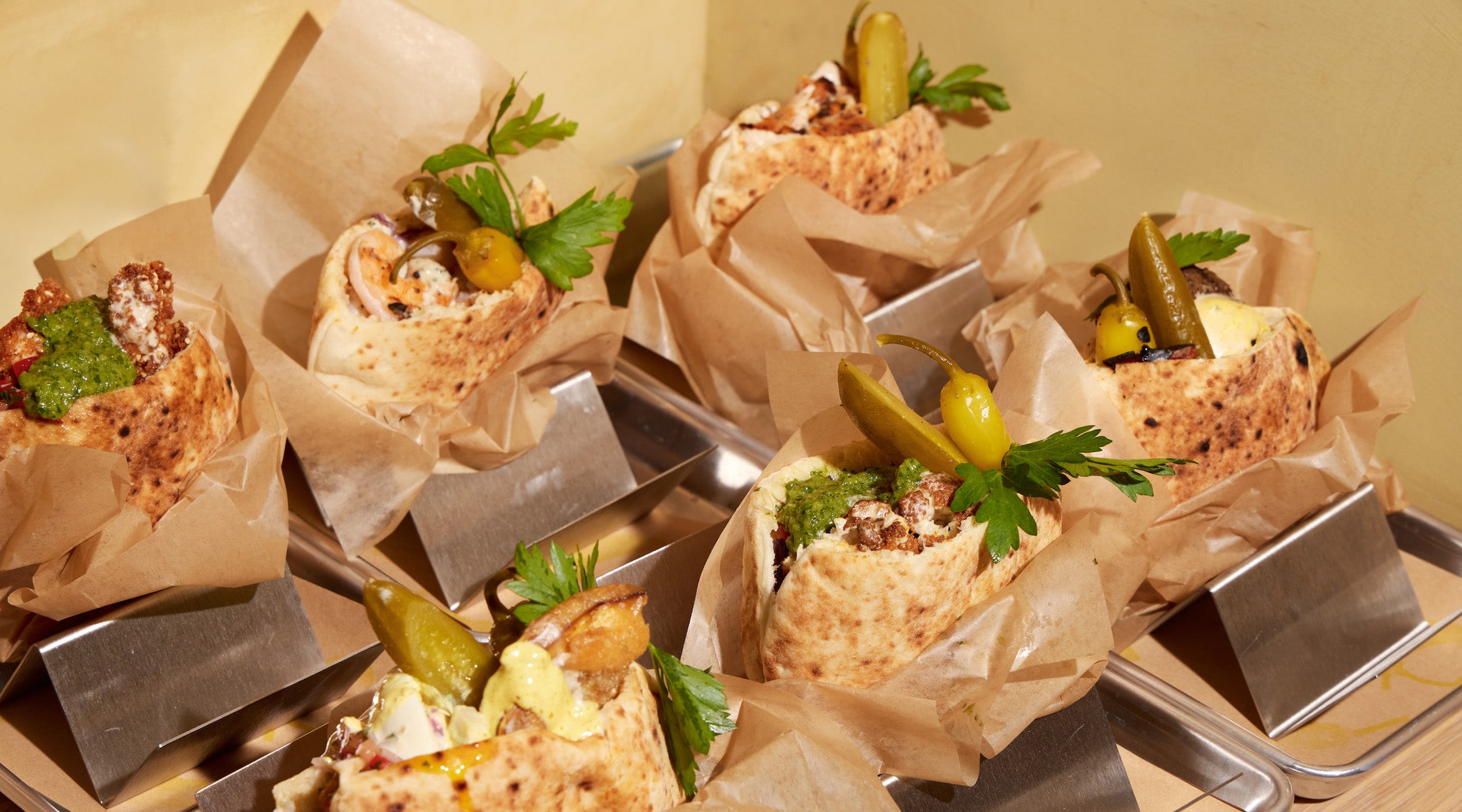
Fans of Sami & Susu, the Mediterranean-inspired Lower East Side wine bar and restaurant that opened during the pandemic, will be happy to know that its Jewish owners have opened a lower priced, more casual spinoff just a few blocks away.
Shifka at 324 Bowery offers elevated Israeli-style street food — like pita stuffed with schnitzel, Yemenite hot sauce, pickles, hot pepper and red cabbage, drizzled with creamy Har Bracha tahini.
Shifka is named after the spicy, light green pickled pepper that’s a popular condiment at falafel shops across Israel. “It was supposed to be called The Pita Shop, but you can’t trademark that name — it’s too general,” said Amir Nathan, 39, one of Shifka’s store’s four owners and a co-founder of Sami & Susu. “I said, why don’t we call it after the pepper, like Chipotle. I like names that trigger curiosity. You need to think about the experience that you are about to have.”
Nearly a half-decade in the making — Nathan and his partner, executive chef Jordan Anderson, conducted years of pita sandwich experiments at Sami & Susu — Shifka opened its doors on Oct. 14, just after a fragile ceasefire between Israel and Hamas in Gaza began.
Throughout the development of Shifka, Nathan said that he and his partners were undeterred about opening another Israeli restaurant during a time of heightened antisemitism in New York. “When I see a crisis, I decide to do something positive,” said Nathan, who was born and raised in Beersheba, in southern Israel. “Opening Sami & Susu during the pandemic was a big one. And since Oct. 7, we emphasize more our Israeli and Jewish identity with the food that we do.”
Last winter, Nathan and Anderson took a “R&D trip” to Israel together. The goal, said Nathan, was to share Israeli cuisine with his partner, who was raised Jewish in New Jersey and had never visited Israel before.

“We went to classic pita shops in Israel but also toured the ASIF Culinary Institute and Arabic restaurants,” Nathan said. “How does a pita shop in Israel operate? How do they organize and order? Let’s be up to date with what is happening in the new generation of restaurants. It was a good introduction. We went to Akko to eat hummus and to a Druze restaurant in the north — all of the staples that together make this cuisine what it is.”
Nathan believes that their wide-ranging trip gave Anderson a better understanding of the flavors of the Middle East.
“Baguette, harissa, preserved lemon, hard-boiled egg — a Tunisian sandwich is what I ate in my school cafeteria in Beersheba,” Nathan said. “When I tried to explain to Jordan the idea behind it — now when he saw it in Machane Yehuda Market he said, ‘Wow, this is where it comes from.’ He saw food from Iraq to Yemen to East Jerusalem. The idea that a mash of those cultures can work together actually clicked.”
They also visited two restaurants that Anderson had read about: HaBasta, near the Carmel Market in Tel Aviv and known for the freshness and seasonality of its dishes, and HaKatan, a seafood restaurant in Tel Aviv’s Levinsky Market.
“These chefs are cooking like me,” Anderson, who has a French culinary background, said of his new inspiration.
“We do a lot of upscale food at Sami & Susu,” the 33-year-old added. “It’s refreshing to do sandwiches and fast casual and spread your mind that way.”
At Sami & Susu, the menu is seasonal and changes eight times a year. The menu at Shifka, by contrast, is streamlined and stable. Customers choose from stuffed pita sandwiches and bowls with an option of rice, freekeh — an ancient Middle Eastern grain imported from Israel — and or salad as its base. As for proteins, options include chicken marinated in yogurt, lamb kebabs drizzled with amba and shrimp served with tzatziki, roasted red peppers and red cabbage.
Of course, you can also order shifka peppers at Shifka; served as a side dish ($2), they are imported from Israel. Other sides include french fries coated in zaatar ($8), as well as muhammara, a walnut and roasted red pepper spread, or matbucha, a roasted tomato and smoked paprika salad ($8 each). Alcoholic beverages and dessert — like creamy, nutty soft-serve ice cream made with Israeli tahini ($8) — are on offer, too.
Nathan said he and his partners considered using kosher meat but ultimately decided it was too costly. “Kosher is part of our heritage and history, but it’s not the only way,” he said. “What we do here is not traditional. I hope that people see it as a voice of our new generation of Jews all over the world.”
He added: “We’re going to do breakfast here at some point, and we will have bacon, egg and cheese bourekas and it’s phenomenal. And a shakshuka in a pita — that’s how we want to eat.”

The exterior of Shifka, an new Israeli pita sandwich shop at 324 Bowery. (Courtesy of Shifka)
More than “just” an Israeli restaurant, Nathan stresses that Shifka’s influences are far flung. “Obviously, I’m from Israel but the influences are from all around,” he said. “We have tzatziki in a pita. We have lamb kebab, a hybrid of Romanian kebab combined with Yemenite spices. It is not just Israeli.”
Nonetheless, Nathan said that Sami & Susu — which garnered a Michelin Bib Gourmand award in 2022, 2023 and 2024 — has been subject to some anti-Israel vandalism during the two-year war between Israel and Gaza.
“We got tagged a couple of times,” he said. “People sprayed on our window.”
And yet, Nathan and Anderson say that the war in Gaza impacted their business in an unexpectedly good way.
“It actually gave us more business I think,” Nathan said. “More Jews are coming to Sami & Susu after Oct. 7. Hipster couples from Fort Greene to Upper West Siders. Maybe they are looking for that kind of food — I call it Mediterranean because it is actually not meant to be just Israeli but food of the Diaspora.”
He added: “Israel, as much as I love it, is not the only heritage we have as Jews. We have a long history before the country existed.”
Since its opening three weeks ago, Shifka has garnered rave reviews. According to the Infatuation, “Shifka makes lunchtime in NOHO so much better,” while Grub Street named Shifka to its list of the city’s best new restaurants.
“Knock on wood, said Nathan. “We are fortunate to have a good beginning on this project.”
And like Chipotle — which is named for a smoked, dried jalapeno pepper and operates 3,700 restaurants around the globe — Nathan and his partners are hoping to scale Shifka one day. Unlike the fast-casual juggernaut, which is primarily owned by institutional investors, Shifka’s partners’ plans are more modest.
“We are looking for small growth, not duplicating it dozens of times. We are planning to expand Shifka and move Sami & Susu to a bigger location,” Nathan said. “We never prevent ourselves from dreaming big and maybe expanding to other cities.”
For now, though, the focus is on the Bowery location. On a recent morning, Shifka’s kitchen was abuzz as staffers busily filled dozens of lunch orders for local businesses. By lunchtime, “the whole place is packed,” Anderson said. “Delicious food, fair prices, creative. No fear about all the hate that is going around the city right now.”
—
The post Shifka, a new pita shop on the Bowery, aims to be the Chipotle of Israeli cuisine appeared first on Jewish Telegraphic Agency.
Uncategorized
They met on a Birthright trip then married. Now this American Israeli couple’s internet fame has turned to infamy.
Ethan and Hila Klein first met at Yad Vashem — Israel’s Holocaust museum — in 2007, a meet-cute they recounted, giggling, years later for their millions of YouTube followers.
“I think I went up to her and said something like, ‘They had it coming, don’t you think?’” said Ethan, known for his edgy humor and infamous internet trends, including Vape Nation and Papa Bless. “No I didn’t say that. I wonder if you would have laughed though.”
They were on a Birthright trip, Ethan an American and Hila an Israeli soldier on leave to join the group. Soon after the trip ended, Ethan moved to Israel to be with Hila, and the two began making videos under the name H3H3 Productions (the H for Hila and the 3 standing in as an E for Ethan). They married, moved to America, and started a popular podcast.
A Jewish love story, until Thursday, when Hila, now mother to their three children, accused Ethan publicly of having a months-long affair.
“The betrayal I feel is immeasurable,” Hila said in an Instagram post. “My only family on this side of the world. How do I even begin to make sense of this?”
Ethan reposted her statement.
Their podcast is run by a handful of crew members who often chime in and participate in various skits and bits. The crew also shared a statement saying they stand with Hila and refuse to work with Ethan, though they added they don’t know what this will mean for the future of the show.
A couple roiled by Oct. 7
The left-leaning, secular couple’s videos and podcasts focused primarily on pop culture, internet drama and general politics, not Jewish or Israeli issues.
Both Ethan and Hila would make statements sometimes when tensions in Israel flared, and they would occasionally speak out against IDF actions that upset them.
In 2021, Ethan started a podcast with political commenter Hasan Piker, a controversial left-wing influencer, called Leftovers, a nod to their leftist politics.
Then came Oct. 7.
Ethan, an American Israeli dual citizen like Hila, was horrified by the attacks but quick to call the IDF genocidal in the aftermath. In their first episode together after Oct. 7, Ethan and Piker said the show would continue through their disagreements. The episode was tense, and it was their last.
As Piker’s rhetoric on Israel intensified and became at times antisemitic, the two began a nasty internet feud, culminating in a nearly five-hour livestreamed debate.
Piker posted about the news of the affair on X, sharing a video of Ethan and expressing disgust for men who cheat.
“Now this is a high caliber man [with] good morals,” Piker said sarcastically. He also posted “Judge me by my enemies” after sharing Hila’s statement.
Hila, who owns a makeup and clothing company, increasingly came under scrutiny by Piker and others after Oct. 7 for her service in the IDF. Artists refused to work with her. One model she hired publicly disavowed her after finding out she was Israeli.
The couple was harassed, sometimes online, sometimes in-person, as they attempted to take what they viewed as a nuanced stance in the aftermath of Hamas’ attack on Israel and the ensuing war in Gaza. The united front seemed to fortify their relationship, as Ethan, ever outspoken, routinely came to his wife’s defense.
Their show lost thousands of subscribers, but loyal fans stuck with them — fans who now say they are gutted and confused by the news of the affair. Many in disbelief noted that Ethan had Hila’s face tattooed on his arm less than two years ago as a surprise for her.
“The greatest thing a man can do for his children is to love their mother,” says the quote surrounding the tattoo.
The Forward attempted to contact the Kleins through their work emails and did not immediately hear back.
The post They met on a Birthright trip then married. Now this American Israeli couple’s internet fame has turned to infamy. appeared first on The Forward.
Uncategorized
These Jewish college students have some ‘nonnegotiables’ for El-Sayed
At the University of Michigan, first-year student Robert Kashan, 18, and sophomore Jacob Reich, 19, sat behind a large blue sign. “Some things are nonnegotiable,” it declared in all caps.
The sign laid out their requirements for any candidate seeking their support: a commitment to Jewish safety, “including for Zionist Jews,” and supporting Jewish statehood in Israel, among other positions.
“Zionism is a legitimate part of the Democratic coalition, and a lot of us are feeling less represented by the Democratic Party,” Kashan told the Forward.
The students are part of a broader “Nonnegotiable” movement in Michigan, a coalition of Jewish Democrats who are spelling out their dealbreakers for candidates ahead of the Senate election between Democratic nominee Abdul El-Sayed and Republican nominee Mike Rogers.
The movement has attracted national attention, with hundreds of rabbis across 34 states signing on to the “Nonnegotiable” demands. Meanwhile, about 20 students at the University of Michigan have publicly signed, while hundreds more offered support anonymously, according to Reich.
The “Nonnegotiable” supporters aren’t saying whom they’ll vote for if their concerns aren’t addressed — or whether they’ll vote at all. But they are pushing back against the assumption that Jewish voters will, as the saying goes, “vote blue no matter who,” urging El-Sayed to engage with their demands if he hopes to earn their support.
That’s in contrast with two other Jewish political camps, including a group called Michigan Jews for Democracy that endorsed El-Sayed. Their petition, which has garnered almost 1,000 signatures, notes that some signatories hold reservations about El-Sayed but are voting for him nonetheless as a check on President Trump.
“We understand that a vote is not a valentine; it’s a strategic chess move,” the petition reads.
A competing petition, dubbed “Michigan Jews Against Extremism,” has drawn hundreds of signatures from Michigan Jews who plan to vote for Rogers. That petition similarly emphasizes that Rogers voters may still have reservations about the candidate: “Our vote for Mike Rogers does not require that we agree with him on every issue or that we support President Trump,” it reads.
“Nonnegotiable,” meanwhile, rejects the idea that Jewish voters would have to choose between Zionist and Democratic values. Some have criticized the nonnegotiable movement for ignoring the reality of the electoral choice at hand. Others have called it “a veiled attempt to excuse the actions of Jewish Democrats who want to feel validated about voting for Mike Rogers.”
But Kashan and Reich, who met at Hillel and plan to major in political science, said the “Nonnegotiable” movement was the only way they could see themselves engaging in the election, as they felt increasingly pulled between their identities as Democrats and as Jews.
Some Michigan Jews have expressed alarm at El-Sayed’s questioning of whether Israel should exist as a Jewish state and his decision to campaign alongside controversial Twitch streamer Hasan Piker, who has been accused of antisemitic rhetoric. Rogers, who Trump has endorsed, earlier this week called El-Sayed “anti-Jew.”
In a letter to Michigan Jews, El-Sayed has vowed to “stand up against antisemitism and take the threat of violence against our Jewish community incredibly seriously.” He has also hired a Jewish liaison in the final weeks leading up to the election.
This will be the first election when Kashan, who just turned 18, is eligible to vote, and Reich’s first national election after voting in a local primary in his hometown of Palo Alto, California. For both, voting Democratic in their first major election had once seemed like a given.
“I’m a Jewish Democrat, and I want Democrats to take the Senate,” Reich said. “I want to vote for a Democrat in my own state.”
They’re still holding out hope that will happen — and that, with less than two weeks until the Nov. 3 election, El-Sayed will sign on to their petition.
And if he doesn’t? Neither student is ready to say.
The post These Jewish college students have some ‘nonnegotiables’ for El-Sayed appeared first on The Forward.
Uncategorized
Does anyone in Jerusalem care what happens to us?
An Israeli think tank has put on paper what most American Jews know in their kishkas: Israel’s actions over there affect our safety here.
So here’s my question: Does anybody over there care?
The report, published by The Institute for National Security Studies (INSS), drew on the input of 20 Jewish leaders from five countries. It concluded that Israel’s actions since the Hamas attack on Oct. 7, 2023 have normalized hostility toward Israel, divided Jewish communities, sapped the political influence of pro-Israel organizations and fueled antisemitism.
Those actions include damaging statements by government officials, limits on humanitarian aid to Gaza at the height of the war, widespread damage to civilian infrastructure in Gaza and unchecked settler violence in the West Bank. The authors also cited as inflammatory “the proliferation of images of civilian death and suffering in Gaza” — though the actual civilian death and suffering has also alienated and enraged many outside Israel, including Jews.
“The conflict is not only over there in the Middle East, it is local all over the Jewish world now, and Diaspora Jewry has skin in the game,” said Theodore Sasson, one of the report’s authors, in an interview with JTA’s Andrew Silow-Carroll, who first wrote about the study.
To be clear, the report doesn’t excuse, exonerate or rationalize people who commit antisemitic acts. “Jews and Israelis are not to blame for antisemitism,” the report states.
“What we’re saying is that Israel is not the cause” of antisemitism, Sasson said, “but enlightened Israeli policy can seek to maintain robust Diaspora support for the state of Israel and can deny the antisemites the material that fuels their mostly spurious claims.”
This is not a novel connection. Three previous academic studies, in Belgium, Australia and the U.S. found statistically significant links between Israeli military operations that result in high Palestinian casualties and spikes in reported antisemitic incidents abroad. Not surprisingly, a Mellman group poll found that 56% of U.S. Jewish voters believe Israel’s policies have fueled antisemitism.
None of this means Israel shouldn’t act in its own interest and put the security needs of its own population first. Antisemites would continue to exist even if Israelis did nothing but play backgammon and sip arak. The report is not about eradicating antisemitism, but about Israeli actions that provoke and endanger Jews abroad — and what Israel can do about those.
I get the principled resistance to a report that seems to shift some of the burden of antisemitism onto the Jews. David Bernstein of the North American Values Institute told Silow-Carroll that American Jews aren’t agents of Israel, and that nobody would say an African country’s actions endanger African Americans. That’s not entirely true — the 9/11 attacks increased hate crimes against American Muslims and bigots targeted random Asian Americans during the COVID-19 pandemic. Pretending actions have no consequence even if the reaction is illegitimate is principled, but naive. If Israel can lower the temperature, it should.
But here’s the sad fact about the current Israeli government: it doesn’t even lower the temperature for its own citizens.
Exhibit A is Oct. 7. This is the government on whose watch that horror happened, and Prime Minister Benjamin Netanyahu has never engaged in a full, independent accounting of what went wrong. How do you prevent future Oct. 7s when you don’t know the weaknesses that enabled it in the first place?
Exhibit B is the flydubai near-disaster, which we in the Diaspora have already mythologized as yet another example of Israeli courage and pluck. It was that, but also a result of a complete breakdown of government responsibility. Israel’s rules should have kept the Omani pilot out of that cockpit, but, as Channel 12 reported, Minister of Transportation Minister Miri Regev took no action despite multiple warnings. Regev, a close ally of Netanyahu, remains in her job.
Finally, Exhibit C: Police under National Security Minister Itamar Ben Gvir have failed to curb violent crime in Israel’s Arab communities which recorded 252 murders in 2025 — and 2026 is on track to surpass that record.
Israel’s supporters often comfort themselves with the mantra that Israelis love life while their enemies love death. But this government has been pretty cavalier about life.
If that’s how Israel’s leaders treat their own citizens, is it so surprising they fail to be overly concerned about Jews abroad? Last year saw the highest death toll from antisemitic attacks in 30 years, while the agency Israel created specifically to deal with such calamities has been AWOL. The Ministry for Diaspora Affairs and Combating Antisemitism, a Tel Aviv University report found, has “not contributed in any meaningful way to the cause, and in some cases has been an embarrassment.”
All this is happening as the screws are tightening on Jewish communities in Australia, France, Italy, Canada and elsewhere. But Israel, established in part to keep Jews safe, has, under this government, too often increased or ignored the dangers. Zionism is supposed to be the Diaspora’s Iron Dome, but this government, by inexorably, deliberately foreclosing on the possibility of a democratic Jewish state, is functionally anti-Zionist.
The report listed several measures Israel could take to reduce the threat to Diaspora communities, among them controlling the incendiary rhetoric of government ministers and opening a diplomatic path with the Palestinians that stops the slide toward a single, non-democratic state.
One of the report’s recommendations is that Israel set up procedures to assess how its policies affect Jews abroad. In other words, the think tank is asking the government to start caring, formally.
It’s hard to imagine any of that happening unless, on Oct. 27, Israelis vote the current government out.
“Netanyahu cannot be part of the healing process. It is Netanyahu from whom we must be healed,” David Horovitz, the far-from-radical founding editor of The Times of Israel, wrote this week in an editorial titled, “For Israel’s Sake, Netanyahu Has to Go.”
As it turns out, it’s for all our sakes.
The post Does anyone in Jerusalem care what happens to us? appeared first on The Forward.
