


Uncategorized
Simchat Torah in Hostages Square lays bare divide over just how much to celebrate yet
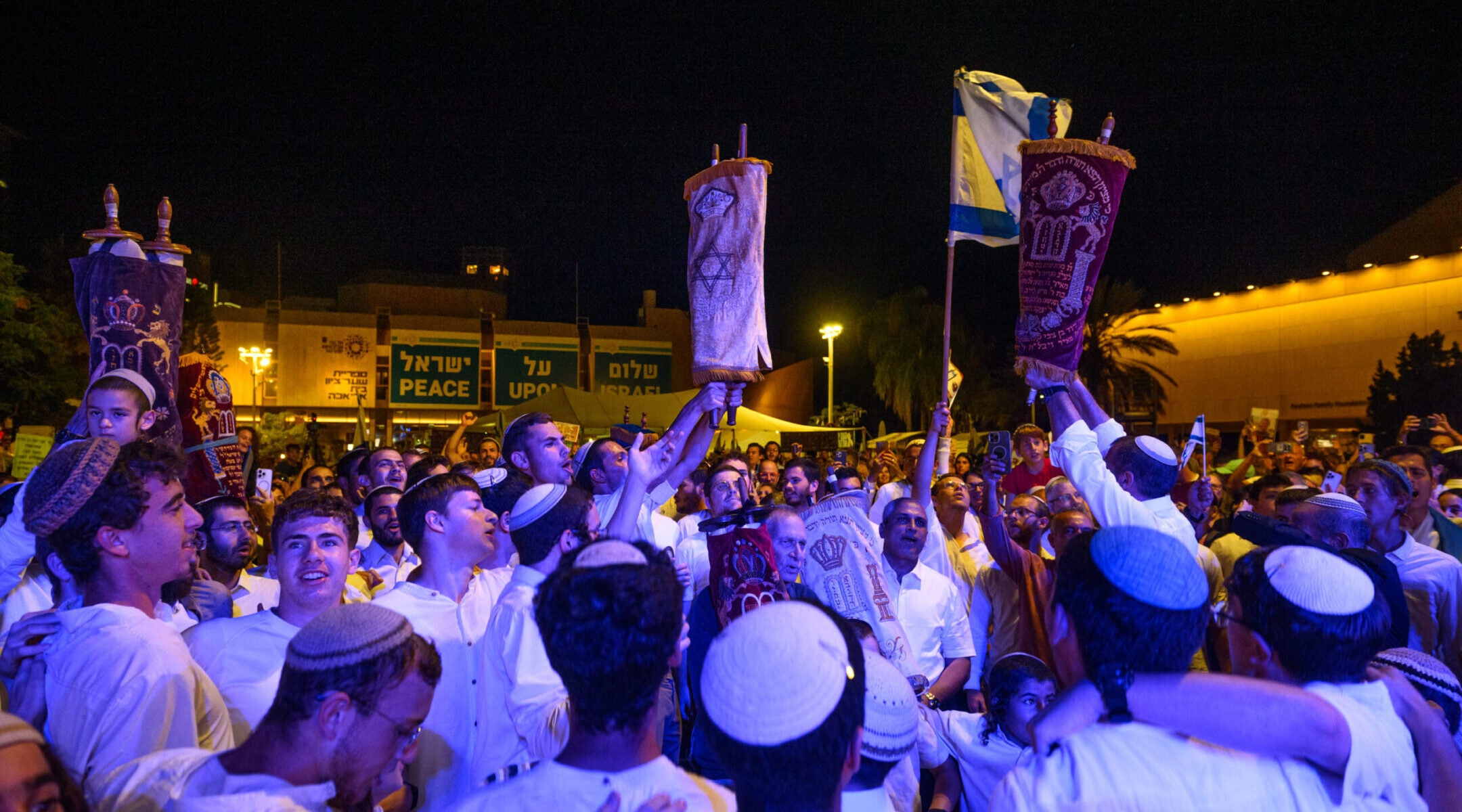
(JTA) — Rabba Anat Sharbat, the unofficial “rabbi of Hostages Square,” wept as she recited the Shehechiyanu blessing after lighting the candles to mark the beginning of Simchat Torah holiday on Monday evening, hours after all 20 living hostages returned to Israel.
Two years before, the same holiday had been marked by silence and fear after the Hamas-led massacre in southern Israel ended celebrations across the country.
Before the plaza even became known as Hostages Square, Sharbat had established what became a ritual — Kabbalat Shabbat services and Havdalah every week, in her words, “out of a deep belief that there needed to be a space here for prayer,” not only for protest.
Faith, she said, had played a role in the hostages’ return.
“The prayers in the square were an integral part of the effort to return them,” Sharbat said. “We heard from hostages who came back that they heard and felt the prayers, and that it gave them strength.”
Last Simchat Torah, she faced uncertainty about whether to hold prayers at all. There was barely a minyan — the quorum of 10 needed for Jewish prayer — and dancing felt impossible. Still, she insisted on continuing “out of a deep belief in the need to maintain hope, together with the families, that their loved ones will return home.” That conviction was validated when Dvora Leshem, the nonagenarian grandmother of the hostage Romi Gonen, approached the small group that night and said she was glad the prayers were taking place. Romi Gonen would be released about three months later.
On this year’s Hebrew anniversary, a very different scene unfolded in the square. As evening fell, a few dozen men and women gathered for prayers followed by hakafot, the traditional Simchat Torah dances encircling the Torah scrolls. The crowd of dancers quickly swelled to more than 200, while onlookers filmed and applauded from the sidelines. Among them was a woman in a Bring Them Home T-shirt who recalled that less than two weeks before Oct. 7, the sight of public, gender-separated prayer during Yom Kippur services had filled her with “extreme anguish.”
“But today, let them dance,” she said. “We are all dancing, finally.”
But the joy was marred by the knowledge that not all the deceased hostages had returned. For some, that reality was impossible to reconcile with the scenes of jubilation. One man, wearing a T-shirt that read in Hebrew, English, and Arabic “We are all created equal,” shouted at the dancers while filming on his phone. “These religious zealots can’t just stand respectfully, they have to dance like animals,” he said.
By Wednesday morning, eight bodies had been brought to Israel for burial. Seven were identified as hostages, while the eighth did not match any of the 28 confirmed dead. Two more, both Israelis, were returned on Wednesday.
The tension carried into Tuesday night, when tens of thousands filled Hostages Square again for a second round of Torah dancing traditionally held after the holiday. The seven dances alternated between grief and gratitude, each dedicated to a different group, including the fallen hostages still in Gaza, those who had returned, reservists, and their families.
Tel Aviv Deputy Mayor Chaim Goren said the event, organized annually by the municipality with Ma’ale Eliyahu Yeshiva and other national-religious groups, was originally meant to take place at a nearby plaza. “It felt detached to hold it there,” he said. The Hostages and Missing Families Forum agreed to move it to the square, though the decision wasn’t final until the last minute.
“There was back-and-forth until the holiday started about whether and how to do it,” Goren said. “With all the joy, there’s still a kvetch in the heart” — using the Yiddish word for ache — “but there’s also a deep need to give thanks to God for what we’ve witnessed.”
For Tel Aviv resident Sapir Barak, the night offered a release she hadn’t allowed herself since Oct. 7, 2023.
“When they announced the release yesterday, I basically had a nervous breakdown,” she said. “I was crying so much. There are so many emotions. It’s like a dream come true, but you don’t know what to do with it.”
Nearby, Henri Rosenberg cut an unusual figure in Hasidic garb with a fur shtreimel and a “Bring Them Home” dog tag around his neck, standing beside his grandson who wore a red MAGA baseball cap. But despite appearances, Rosenberg said he no longer identified as haredi Orthodox, having grown disillusioned by what he called indifference within some haredi circles to the pain felt by other Israelis during the war. Health problems had led him to attend a nearby national-religious synagogue over the High Holidays, where, he recalled, “the cantor wept for the hostages and the soldiers.”
“They are our flesh and blood, and that’s why I’m here tonight,” he said.
From the stage, Genia Erlich Zohar, aunt of American-Israeli hostage Omer Neutra — whose body remains in Gaza and who would have turned 24 on Tuesday — called on the crowd to respect the duality of the moment.
“We hold both joy for those who came home and hope and pain for those who haven’t,” she said. “We are one people, one heart.”
Miri Polachek, a friend of the Neutra family who has volunteered with relatives of the hostages, said she came to the event to support the Neutras and the other families. Recalling her own son’s playdates with Omer when they were children, she said, “It’s a never-ending reminder that it could have been any of our children.”
Among those on stage was Elkana Levy, a Golani Brigade officer who lost both legs in an explosion in Khan Younis. One of three brothers wounded in the Gaza war, he led a silent hakafa from his wheelchair and vowed that those “fighting day and night for the return of our brothers … would never break.”
At the edge of the square, a few dozen demonstrators held posters of those still in Gaza, chanting “Everyone, now!” — the familiar rallying cry for the hostages’ return.
Hagit Chen, holding “Gucci,” the small white dog that had belonged to her son, slain hostage and dual American-Israeli citizen Itay Chen, whose body has not yet been returned, called Monday’s release “a huge miracle,” even as she admitted her faith had been shaken.
“I was convinced Itay would be returning home yesterday with the others,” she said. Still, she added, the elation around her was not an affront. “I don’t look at joy that way. I embrace what’s happening here. We all need the strength it gives us.”
“But we cannot take our foot off the gas,” she said. “The deal is not a good one for the fallen hostages.” She pointed to what she described as the vague language of the Trump.-brokered agreement, which requires Hamas to make “all necessary efforts” to secure their release. “If we don’t see their return, it will be an open wound for all of us.”
Dani Miran, whose son Omri was among those freed on Monday, said Israel should halt the next stage of the deal until every hostage is accounted for.
“We should have resumed fighting at 1 p.m. yesterday, the moment we understood the 28 bodies weren’t coming home,” he said at Tel Aviv Sourasky Medical Center, where his son is receiving treatment. “[Hamas] will not understand anything else.”
Miran said he would remain in Tel Aviv, where he has lived since his son’s abduction, until the last hostage returns. He declined to say whether he would shave his long white beard, a vow he made to keep until Omri came home.
Activist and artist Hila Galilee, posed with Miran’s longtime partner, Galia Korel, while holding a mock yellow Torah scroll with images of the hostages. “The entire Torah is the hostages,” she said.
The question of what to do with the hostages’ symbols no longer has a single answer. Romi Gonen was filmed with friends tearing off the tape marking the number of days the hostages have been held, cheering as they did. Rachel Goldberg-Polin, who began the tape tradition for her son, slain hostage Hersh, said on Wednesday that she would continue to wear hers.
Hagit and her husband, Ruby Chen, criticized Knesset Speaker Amir Ohana for removing his hostage pin during President Trump’s visit to the Knesset. “It isn’t over,” Chen addressed Ohana in a video posted to social media. “Put the pin back on until the last hostage is back.”
After Trump announced that the living hostages would be returning home, Miran urged Tel Aviv mayor Ron Huldai to rename the site Returnees’ Square. But Hagit Chen said in an interview on Tuesday night that the name Hostages Square should remain until all are home.
In the square, posters of freed hostages have been taken down, some replaced by new banners, including one with Trump’s words, “Now is the time for peace.” Other features remain unchanged, including the mock tunnel evoking the underground passages where many hostages were held in Gaza and the digital clock counting the days and seconds since the attacks.
Miran, who had walked the one block from the hospital to the square, led the crowd in a psalm of thanksgiving. “Secular, religious — I hate these distinctions. All I see from up here is Jews,” he said from the stage. “Let’s stay like this. The nation of Israel lives.”
The post Simchat Torah in Hostages Square lays bare divide over just how much to celebrate yet appeared first on The Forward.
Uncategorized
Minnesota man charged with ISIS-inspired plot on Jewish-owned Mall of America
(JTA) — The FBI accused an 18-year-old man of buying an AK-47 assault rifle with plans to commit a mass shooting in support of ISIS at the Mall of America in Bloomington, Minnesota, the largest indoor shopping mall in North America.
Sheikhdoon Abdullahi Mohamud, of Richfield, Minnesota, was charged on Wednesday with one count of knowingly receiving a firearm and ammunition in order to commit a federal crime of terrorism, according to a federal complaint filed on Wednesday.
Mohamud’s attorney did not respond to JTA’s request for comment.
Mohamud wanted to attack the Mall of America because he believed its owners to be Jewish, the FBI said in a statement. He planned to kill between 30 and 60 people, according to messages he exchanged with a confidential source, according to the complaint.
Mall of America is owned and operated by Triple Five Group, controlled by the Ghermezian family, a Canadian family of Iranian Jewish origin.
Messages sent in September 2026 included a video in which Mohamud pledged allegiance to ISIS, the complaint said. He planned his attack for Oct. 24 because he expected a crowd at the Hmong Arts Celebration scheduled for that day.
The complaint said an undercover FBI agent sold an AK-47 rendered inoperable, four 30-round magazines and 200 rounds of ammunition to Mohamud for $600 on Oct. 6. During the sale, Mohamud confirmed his plans to commit a mass shooting. Mohamud was arrested shortly after the sale.
The complaint said Mohamud wanted to commit an attack similar to the 2016 Pulse nightclub shooting in which 49 victims were killed; the Bondi Beach mass-shooting in Sydney last December, during which 15 victims were killed during a Hanukkah celebration; and a New Orleans truck-ramming attack that killed 14 victims in New Orleans on Jan. 1, 2025.
The investigation into Mohamud began around December 2024, when he messaged the confidential source on multiple social media platforms, according to the complaint, detailing his desire to travel to Somalia to join a group that the U.S. has designated a foreign terrorist organization. If travel was not possible due to financial constraints, he said would move forward with an attack in Minnesota.
This article originally appeared on JTA.org.
The post Minnesota man charged with ISIS-inspired plot on Jewish-owned Mall of America appeared first on The Forward.
Uncategorized
Is Israel or Iran a bigger threat to the U.S.? Michigan’s Abdul El-Sayed won’t say
(JTA) — Michigan Democrat Abdul El-Sayed was asked multiple times by a debate moderator on Thursday which country he considers a bigger threat to the U.S.: Iran or Israel.
Each time, he parried.
“That’s a ridiculous hypothetical because here’s what’s happening right now: Our ostensible ally in Israel has lobbied us to go to war with Iran,” said El-Sayed, Michigan’s Democratic nominee for U.S. Senate.
“I don’t consider an ally a country that takes us to wars we don’t need to fight, and I don’t want to be fighting wars we don’t need to fight,” he added, describing both as “kind of dangerous.” Another attempt yielded a similar response, with El-Sayed denouncing “one at risk of attacking us, one getting us into wars we have no business fighting.”
El-Sayed, a former county health official, was responding to a question repeatedly posed by WOOD TV8 political reporter Rick Albin, in a debate against his Republican opponent, former U.S. Rep. Mike Rogers. The two candidates hurled insults at each other during the hourlong discussion, often returning to issues related to Israel and the Middle East.
After making criticism of Israel a top issue in his primary campaign, El-Sayed eked out a victory against U.S. Rep. Haley Stevens in that early August race. Although he has earned the support of many democratic socialists, including Vermont independent Sen. Bernie Sanders, El-Sayed has stated that he is not a member of the Democratic Socialists of America.
Rogers, on the other hand, has the official endorsement of President Donald Trump. However, the candidate has been distancing himself from the president, including by criticizing the trade war with Canada.
Results of a CBS News poll published earlier this week showed El-Sayed leading Rogers, by 45.6% to 41.4%, with a 3.8% margin of error. A Quantus Insights poll released on Wednesday, meanwhile, gave El-Sayed a slightly narrower lead, with 47.6% to Rogers’s 46.5%, and a 7.8% margin of error.
While El-Sayed has been meeting with Jewish voters and leaders, he has not budged on certain issues of concern to many Jewish voters. For example, he has indicated only a willingness to recognize Israel’s identity as a Jewish nation-state if Israelis and Palestinians jointly agree to it..
Liberal Michigan rabbis last month signed a petition from the Zioness Action Fund, a progressive Zionist group, calling upon the Democratic Party to agree to “nonnegotiable” principles related to Jewish safety and Israel. A separate cohort of Michigan Jewish leaders urged community members to reject El-Sayed entirely.
Rogers and his representatives in August indicated that they would like AIPAC to refrain from spending directly on him in the general election, according to media reports. Asked about this at the Thursday debate, he said he’d welcome “anybody that wants to help my campaign stop a guy who can’t condemn terrorism in our own country.”
El-Sayed condemned the March attack on Temple Israel in West Bloomfield Township, but added that “hurt people hurt people,” which critics interpreted as justifying the attacker’s actions. He later apologized for those remarks.
Rogers has repeatedly slammed his opponent for taking funds from donors affiliated with the Council on American-Islamic Relations, the Unity & Justice Fund super PAC and other groups and individuals.
El-Sayed, on the other hand, accused Rogers on Thursday of accepting corporate PAC money and labeled him the “guy who’s going to rubber stamp everything Donald Trump tells him to rubber stamp.”
The two candidates criticized each other’s policies and interrupted each other so often that Albin, the moderator, needed to step in.
“We’ve got dozens of questions we want to get to,” Albin said. “You can’t litigate all of these with 14 different rebuttals.”
Even prior to a pause for ads, Albin announced that the station is going “to take a break from this pleasant conversation.” When they returned, he declared that “in 30 years of doing debates, I’ve never seen it continue during the commercial, but it did.”
The candidates continued to clash over Iran, with El-Sayed accusing the U.S. government of teaching “the Iranian regime that they had a choke [hold] on the Strait of Hormuz.”
“That’s the kind of policy you’re going to get from a guy who wants to be a sock puppet for the Trump administration,” El-Sayed added.
Rogers, meanwhile, claimed that the U.S. had set back Iran’s nuclear program by at least 20 years, adding that “this would be the time to wrap it up.”
As for Israel, Rogers said he supports “the right to exist for the Jewish state, and the right to defend itself in a very difficult neighborhood.” The only way Israel could lose his support, Rogers stated, would be if the country talked about using nuclear weapons.
Israel is widely assessed to possess an arsenal of approximately 90 nuclear warheads, according to the Stockholm International Peace Research Institute. The country is not a party to the Nuclear Non-Proliferation Treaty. Israel has never acknowledged possessing nuclear weapons.
Albin then turned to El-Sayed, noting the politician’s opposition to direct U.S. military funding for Israel. He asked, however, whether that position could change “if Israel were attacked tomorrow by Iran or another state actor.”
“I want our tax dollars spent here,” El-Sayed responded. “Israel has pushed us to go to war in Iran, and of course, my colleague, who thinks there’s a war for everything, went right along with it.”
When Albin pushed again for a yes or no answer, El-Sayed replied that he doesn’t want the U.S. “buying weapons for other countries.”
Toward the end of the discussion related to the Middle East, Rogers recognized the third anniversary of the Oct. 7, 2023, Hamas attack on Israel. He blasted his opponent for failing “to even acknowledge the pain, the terrorism, the rape, the murders.”
To this accusation, El-Sayed responded, “I’ve condemned that. I didn’t turn it into theater like you did.”
This article originally appeared on JTA.org.
The post Is Israel or Iran a bigger threat to the U.S.? Michigan’s Abdul El-Sayed won’t say appeared first on The Forward.
Uncategorized
Ossoff says IDF violated law of armed conflict in Gaza, but genocide is an issue for international courts
(JTA) — Democratic Sen. Jon Ossoff and Republican challenger Rep. Mike Collins clashed over Israel’s conduct in Gaza, U.S. weapons sales to Israel and the war in Iran during Thursday’s debate in Georgia’s closely watched Senate race.
The race could help determine control of the Senate, with implications for U.S. policy toward Israel.
The incumbent Ossoff, who is Jewish, has long supported Israel’s security, but over the last two years he has criticized its conduct in the Gaza war and voted to block some U.S. arms sales to the country.
A day after the third anniversary of the Oct. 7 Hamas-led attack, Ossoff was asked whether Israel had committed genocide in Gaza, whether he was concerned about growing anti-Israel sentiment within the Democratic Party and whether he would support a proposed $2.8 billion U.S. weapons package for Israel.
“The question of genocide is a question of whether a government has the specific intent to destroy a national or ethnic group, and that is a question for the International Criminal Court,” Ossoff responded. “There is no doubt in my mind that Israeli forces prosecuting the war in Gaza violated the law of armed conflict and international humanitarian law, and I care deeply about the security of the Israeli people, among whom are members of my family.
“I also care about innocent Palestinian life,” Ossoff continued, “and make no apology for my votes.”
Collins accused Ossoff of having aligned himself with anti-Israel figures including Twitch streamer Hasan Piker and Michigan U.S. Senate candidate Abdul El-Sayed.
“Imagine being a U.S. senator, and out there recruiting, endorsing, and supporting these people that want to see Israel wiped off the map,” Collins said. “They would rather be for Iran than for Israel — now that’s who Jon Ossoff is supporting.”
Piker had previously called Ossoff a possible contender for the 2028 Democratic presidential nomination. He subsequently disavowed Ossoff after the senator condemned antisemitic comments, Jewish Insider reported in August.
During the hourlong debate, Ossoff repeatedly condemned the U.S. war in Iran while highlighting Collins’ support for it. At least three times Ossoff called the war in Iran a “disaster” or “disastrous,” and he blamed the war for rising gas prices in the state of Georgia.
Collins, on the other hand, said he supported the war as necessary to prevent Iran from obtaining nuclear weapons. “The president had every right to go in there and make sure that Iran does not get a nuclear weapon,” Collins said. “The IAEA [International Atomic Energy Agency], they had already sounded the bells, the alarms that Iran was close to getting a nuclear weapon. And the thing is, Iran doesn’t only want to decimate and kill Israel, they want us as well.”
The evening was not without its personal attacks. Collins described Ossoff as “a radical” and a “trust-fund kid who has never had a job in his life,” while Ossoff repeatedly spotlighted the alleged ties between Collins and white nationalists. A recent report alleged that Collins’ former aides were involved with antisemitic and white nationalist rhetoric.
Ossoff leads Collins by about nine percentage points in FiftyPlusOne’s polling average as of Oct. 9.
The candidates are scheduled for a second debate hosted by the Atlanta Press Club on Oct. 13.
This article originally appeared on JTA.org.
The post Ossoff says IDF violated law of armed conflict in Gaza, but genocide is an issue for international courts appeared first on The Forward.
