



Uncategorized
Taiwan Donates Humanitarian Aid to Israel, Sends ‘Message of Hope and Solidarity’ Amid Iran Strikes

A Taiwan flag can be seen on an overpass ahead of National Day celebrations in Taipei, Taiwan, Oct. 8, 2025. Photo: REUTERS/Ann Wang
Taiwan has donated NT$5.14 million (more than $160,000) for emergency operations and life-saving equipment to Israel amid Iranian ballistic missiles strikes on the Jewish state, expressing “solidarity” with a fellow democracy under constant threat as China continues to support Iran.
Taiwan’s representative to Israel, Abby Lee, said on Tuesday that the donation reflected continued cooperation and mutual concern for civilian safety amid shared security challenges, Taiwan News reported.
“Our contribution is more than financial assistance. It is a message of hope and solidarity to those affected by the war,” Lee said on Tuesday at a conference for ZAKA, Israel’s volunteer civilian emergency service and rescue organization. “Taiwan and Israel may be geographically distant, but we are neighbors in our values, small democracies under constant external threat that continue to thrive and stand by one another.”
The announcement came after the US and Israel last weekend launched a military campaign against Iran, targeting the Iranian military and security apparatus. Tehran has responded with drone and ballistic missile strikes at Israel and other Middle Eastern countries, aimed specifically at civilian sites.
One Iranian missile strike hit the Israeli city of Beit Shemesh on Sunday, killing nine people and wounding dozens, in what authorities described as a direct impact on a public bomb shelter.
Lee said that ZAKA volunteers used portable lighting towers purchased with Taiwan’s donation and that the equipment enabled emergency work under complex conditions and at night.
“We are particularly proud to contribute to initiatives led by ZAKA and are pleased to see our contribution transformed into equipment of real value on the ground,” she said.
Since the Hamas-led invasion of and massacre across southern Israel on Oct. 7, 2023, “Taiwan was among the first to strongly condemn the terrorist attacks and provided humanitarian aid and financial assistance to support kibbutzim, communities, and local authorities that were affected by the attacks and the threats that followed them,” Lee added.
The donation came less than three months after China condemned a senior Taiwanese official’s reported secret trip to Israel. The Reuters news agency reported in December that Taiwan’s Deputy Foreign Minister Francois Wu made a previously unpublicized visit to Israel.
China considers Taiwan, a nearby island run by a democratic government, as a renegade Chinese province that must be reunited with the mainland — by force, if necessary. Due to pressure from Beijing, few countries have formal diplomatic ties with Taiwan. Israel only recognizes Beijing but not Taipei, which has been increasingly looking to Israel for defense cooperation.
In October, Taiwanese President Lai Ching-te said that Israel is a model for Taiwan to learn from in strengthening its defenses, citing the Biblical story of David versus Goliath on the need to stand up to authoritarianism.
“The Taiwanese people often look to the example of the Jewish people when facing challenges to our international standing and threats to our sovereignty from China. The people of Taiwan have never become discouraged,” he said. “Israel’s determination and capacity to defend its territory provides a valuable model for Taiwan. I have always believed that Taiwan needs to channel the spirit of David against Goliath in standing up to authoritarian coercion.”
He made the remarks during a dinner of the American Israel Public Affairs Committee (AIPAC) in Taiwan.
Lai in October also announced a new multi-layered air defense system called “T-Dome” to defend itself against a possible future attack by China. It is partly modeled on Israel’s air defense system.
Lai told the AIPAC dinner that T-Dome had been inspired by Israel’s Iron Dome missile defense system, as well as US President Donald Trump’s “Golden Dome” missile defense shield plan.
“I believe that trilateral Taiwan-US-Israel cooperation can help achieve regional peace, stability, and prosperity,” he said.
Meanwhile, China, a key diplomatic and economic backer of Iran, has moved to deepen ties with the Islamist regime in recent years, signing a 25-year cooperation agreement, holding joint naval drills, and continuing to purchase Iranian oil despite US sanctions.
China is the largest importer of Iranian oil, with nearly 90 percent of Iran’s crude and condensate exports going to Beijing.
With regional tensions rising and great-power competition shaping the Middle East, diplomatic and security relations between Beijing and Jerusalem have become increasingly strained.
Last year, China slammed the Jewish state for joining a United Nations declaration condemning Beijing’s human rights record.
Israel had endorsed a US-backed declaration, signed by 15 other countries — including the United Kingdom, Australia, and Japan — that expressed “deep and ongoing concerns” over human rights violations in China.
In a rare move, Jerusalem broke with its traditionally cautious approach to China — aimed at preserving diplomatic and economic ties — by signing on to the statement. The signatory countries denounced China’s repression of ethnic and religious minority groups, citing arbitrary detentions, forced labor, mass surveillance, and restrictions on cultural and religious expression.
These diplomatic moves came amid an already tense relationship with China, strained since the start of the war in Gaza. In September, Israeli Prime Minister Benjamin Netanyahu accused Beijing, along with Qatar, of funding a “media blockade” against the Jewish state.
According to a report released by the Institute for National Security Studies (INSS), an Israeli think tank, China has increasingly used state media and covert campaigns to spread anti-Israel and antisemitic narratives in the United States.
The report examined how China’s state media portrays Israel and the United States as solely responsible for the war in Gaza, depicting them as destabilizing actors while spreading anti-Israel and antisemitic messages.
“It is evident that China and its proxies play a significant role in the current wave of antisemitism and anti-Israel sentiment in the United States,” Ofir Dayan, a research associate in the Israel-China Policy Center at INSS, wrote in the report.
Last month, the Jewish People Policy Institute (JPPI) published a new report showing how China has embraced overt antisemitic messaging in its domestic propaganda in recent years. The study tied the move to both geopolitical rivalry with the United States and efforts to curry favor with Arab and Muslim countries hostile to Israel.
Uncategorized
London Police Set Up Specialist Jewish Protection Team

A police officer stands at the scene, after a man was arrested following a stabbing incident in the Golders Green area, which is home to a large Jewish population, in London, Britain, April 29, 2026. Photo: REUTERS/Hannah McKay
British police are setting up a new team of 100 officers including counter terrorism specialists to help protect Jewish communities across London after a series of antisemitic attacks including the stabbing of two men.
The plan announced on Wednesday for a dedicated protection team comes as officers announced more arrests for antisemitism, including detaining a 35-year-old man on Saturday after rocks were thrown at an ambulance belonging to the Jewish community.
London‘s top police boss Mark Rowley said Jewish communities were facing “sustained threats” from hostile state actors as well as extreme right-wing groups, elements of the extreme left, and Islamist terrorists.
Detectives are examining whether the arson incidents have possible Iranian links, after British security officials warned that Iran was using criminal proxies to carry out hostile activity.
Since late March, there have been a number of high-profile arson attacks with four Jewish ambulances burned and synagogues targeted. Last week, two Jewish men were also stabbed. Both victims survived the attack.
Over the past four weeks, police said they had arrested around 50 people for antisemitic hate crimes and charged eight individuals. On top of that, 28 arrests have been made as part of investigations alongside counter terrorism policing for arson and other serious incidents.
“This new team will be primarily focused on protecting the Jewish community, which faces some of the highest levels of hate crime alongside significant terrorist and hostile state threats,” said a statement from London‘s Metropolitan Police force.
British Prime Minister Keir Starmer convened a meeting on Monday with business, health and cultural leaders aimed at trying to tackle antisemitism.
Uncategorized
Iran Reviewing US Proposal to End War, Though Key Demands Remain Unaddressed
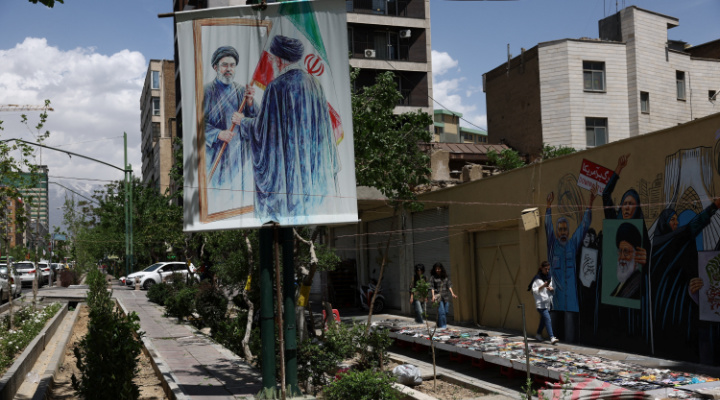
People walk on a street near a mural featuring an image of the late Supreme Leader of Iran, Ayatollah Ali Khamenei, in Tehran, Iran, May 6, 2026. Photo: Majid Asgaripour/WANA (West Asia News Agency) via REUTERS
Iran said on Wednesday it was reviewing a US peace proposal that sources said would formally end the war while leaving unresolved the key US demands that Iran suspend its nuclear program and reopen the Strait of Hormuz.
An Iranian foreign ministry spokesperson cited by Iran‘s ISNA news agency said Tehran would convey its response. US President Donald Trump said he believed Iran wanted an agreement.
“They want to make a deal. We’ve had very good talks over the last 24 hours, and it’s very possible that we’ll make a deal,” Trump told reporters in the Oval Office on Wednesday.
Earlier in the day, Trump had sounded more pessimistic about the chances of a deal. In a Truth Social post, he threatened to restart the US bombing campaign in Iran, calling the possibility of Tehran agreeing to the latest US proposal a “big assumption.”
Trump has repeatedly played up the prospect of an agreement that would end the war that started Feb. 28, so far without success. The two sides remain at odds over a variety of difficult issues, such as Iran‘s nuclear ambitions and its control of the Strait of Hormuz, which before the war handled one-fifth of the world’s oil and gas supply.
A Pakistani source and another source briefed on the mediation said an agreement was close on a one-page memorandum that would formally end the conflict. That would kick off discussions to unblock shipping through the strait, lift US sanctions on Iran, and set curbs on Iran‘s nuclear program, the sources said.
It was unclear how the memorandum differs from a 14-point plan proposed by Iran last week, and Iran has yet to respond to the latest US proposal.
Iran‘s semi-official Tasnim news agency, citing an unnamed source, said the US proposal contained some unacceptable provisions, without specifying which ones.
Iranian lawmaker Ebrahim Rezaei, a spokesperson for parliament’s powerful foreign policy and national security committee, described the text as “more of an American wish-list than a reality.”
“The Americans will not gain anything in a war they are losing that they have not gained in face-to-face negotiations,” he wrote on social media.
OIL PRICES TUMBLE
Reports of a possible agreement caused global oil prices to tumble to two-week lows, with benchmark Brent crude futures falling around 11% to around $98 a barrel at one point before rising back above the $100 mark.
Global share prices also leapt and bond yields fell on optimism about an end to a war that has disrupted energy supplies.
Trump on Tuesday paused a two-day-old naval mission to reopen the blockaded strait, citing progress in peace talks.
The US military has kept up its own blockade on Iranian ships in the region. US Central Command said forces fired at an unladen Iranian-flagged tanker on Wednesday, disabling the vessel as it attempted to sail toward an Iranian port in violation of the blockade.
NO MENTION OF KEY US DEMANDS
The source briefed on the mediation said the US negotiations were being led by Trump’s envoy Steve Witkoff and son-in-law Jared Kushner. If both sides agreed on the preliminary deal, that would start the clock on 30 days of detailed negotiations to reach a full agreement.
The full agreement would end the competing US and Iranian blockades on the strait, lift US sanctions, and release frozen Iranian funds. It would also include some curbs on Iran‘s nuclear program, with the aim of a pause or moratorium on Iranian enrichment of uranium.
While the sources said the memorandum would not initially require concessions from either side, they did not mention several key demands Washington has made in the past, which Iran has rejected, such as curbs on Iran‘s missile program and an end to its support for proxy militias in the Middle East.
The sources also made no mention of Iran‘s existing stockpile of more than 400 kg (900 pounds) of near-weapons-grade uranium.
Israeli Prime Minister Benjamin Netanyahu, Trump’s ally against Iran, said on Wednesday the two leaders agreed that all enriched uranium must be removed from Iran to prevent it from developing a nuclear bomb.
Tehran denies wanting to acquire a nuclear weapon.
Uncategorized
Musée d’Orsay Opens Permanent Exhibition Space Dedicated to Nazi-Looted Artwork
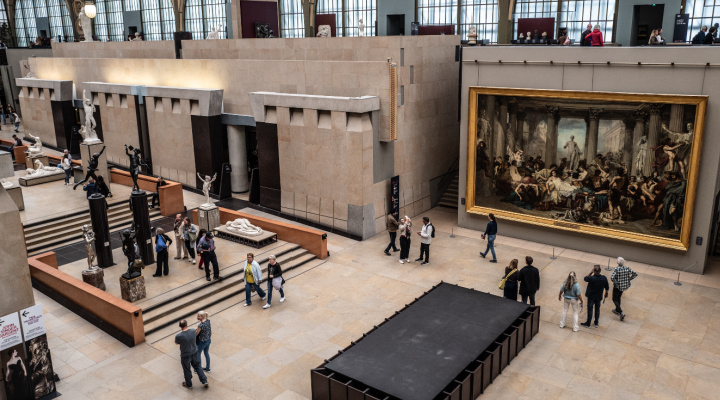
Inside the Musée d’Orsay. Photo: ZUMA Press Wire via Reuters Connect
The Musée d’Orsay in France opened a new permanent exhibition room on Tuesday dedicated to works of art that were owned by Jews and looted by the Nazis across Europe during World War II before being returned to France after the war.
The new gallery room is titled “To whom do these works belong?” and will feature rotating installations of works of art recovered after World War II also known as Musées Nationaux Récupération (National Museums Recovery) pieces. Provenance investigators and researchers are still working to identify the original owners of these MNR artworks.
“Over time, the room is intended to evolve to present to the public the discoveries resulting from this research, some of which could allow new restitutions,” said the museum. “It thus constitutes a space of memory, transparency and active research, at the heart of contemporary issues related to the history of the collections.”
Now on display in the exhibition is 13 works, including the 1879 painting “Dinner at the Ball” by Edgar Degas, according to The Times. The painting was previously owned by Fernand Ochsé, a Jewish merchant and art collector living in France who was murdered in the Auschwitz concentration camp during the Holocaust along with his wife. The painting was among thousands of artworks stolen by the Nazis or forcibly sold to Nazi occupiers in France. Also on display in the exhibit is Pierre-Auguste Renoir’s portrait “Madame Alphonse Daudet” from 1876.
The new gallery room and research done by provenance investigators is being funded with support from the nonprofit organization American Friends of Musées d’Orsay et de l’Orangerie (AFMO). According to the organization, 60,000 artworks looted by the Nazis during World War II around Europe were returned to France by 1950 and 224 of those recovered artworks are housed at the museum and in need of further provenance research to find their original owners. Fifteen MNRs kept at the Musée d’Orsay have already been returned to its rightful owners.
Over the next few years, AFMO will fund a team of art historians and researchers, led by provenance expert Dr. Ines Rotermund-Reynard, and they will focus on finding the owners of the 224 recovered artworks in the Musée d’Orsay’s collections, but also approximately 200 additional pieces acquired by the museum after 1933.