



Uncategorized
Trump Wants Say on Iran’s Next Leader, Claims Tehran Calling US About a Deal

US President Donald Trump speaks on the day he honors reigning Major League Soccer (MLS) champion Inter Miami CF players and team officials with an event in the East Room of the White House in Washington, DC, US, March 5, 2026. Photo: REUTERS/Jonathan Ernst
US President Donald Trump claimed the right to join Iran in deciding its next leader as the war escalated on Thursday, with US and Israeli jets hitting areas across the country and Gulf cities coming under renewed bombardment.
In a phone interview with Reuters, Trump said Mojtaba Khamenei, the son of the late Supreme Leader Ali Khamenei – a hardliner who has been considered a favorite to succeed his father – was an unlikely choice.
“We want to be involved in the process of choosing the person who is going to lead Iran into the future,” he said.
Trump also encouraged Iranian Kurdish forces to go on the offensive.
“I’d be all for it,” said Trump, whose administration has had contact with Iranian Kurdish groups since the US-Israeli strikes began. He would not say whether the United States would provide air cover for any Kurdish offensive.
The attack is a major political gamble for the Republican president, with opinion polls showing little public support and Americans concerned about the rise in gasoline prices caused by disruption to energy supplies. Trump dismissed that concern.
He said later in the day that Tehran was reaching out to the United States about making a deal amid US and Israeli strikes on Iran, adding that further action to reduce pressure on oil was imminent.
“They’re calling, they’re saying ‘how do we make a deal?’ I said you’re being a little bit late,” said Trump, speaking at an event with the Inter Miami soccer team at the White House.
Trump touted the US military actions in Iran, saying they were destroying Tehran’s missile and drone capability and that “their navy is gone – 24 ships in three days,” as he called on Iranian diplomats to request asylum and help shape a better country.
“We also urge Iranian diplomats around the world to request asylum and to help us shape a new and better Iran,” he said.
ISRAELIS WARN TEHRAN RESIDENTS
On the war’s sixth day, Iran launched a series of attacks on Israel, the United Arab Emirates, and Qatar. Fire crews in Bahrain extinguished a blaze at a refinery following a missile strike.
Two drone attacks targeted an Iranian opposition camp in Iraqi Kurdistan, as well as an oil field operated by an American firm, security sources said.
The Israeli military warned residents to evacuate areas including eastern Tehran, while Iranian media reported blasts were heard in various parts of the capital. An air attack killed 17 people in a guest house on a road northwest of the capital, Iranian state television said.
MANY MUNITIONS, IRAN‘S ATTACKS DROPPED
US Defense Secretary Pete Hegseth and Admiral Brad Cooper, who leads US forces in the Middle East, said that the US has enough munitions to continue its bombardment indefinitely.
“Iran is hoping that we cannot sustain this, which is a really bad miscalculation,” Hegseth told reporters at Central Command headquarters in Florida. “Our munitions are full up and our will is ironclad.”
Cooper said the US had now hit at least 30 Iranian ships, including a large drone carrier that he said was the size of a World War Two aircraft carrier. He added that B-2 bombers had in the past few hours dropped dozens of 2,000 penetrator bombs targeting deeply buried ballistic missile launchers, and that bombings were also targeting Iran‘s missile production facilities.
Iran‘s ballistic missile attacks had decreased by 90% since the first day of the war, while drone attacks had decreased by 83% in that time frame, he said.
WARNING SIRENS BLARE IN MULTIPLE NATIONS
Azerbaijan on Thursday became the latest country drawn in, as it accused Iran of firing drones at its territory and ordered its southern airspace closed for 12 hours. Iran, which has a significant Azeri minority, denied it had targeted its neighbor, but the episode underlined how rapidly the war has spread since the surprise US and Israeli airstrikes that killed Khamenei on Saturday.
Along with the gleaming cities of the Gulf, in easy range of Iranian drones and missiles, Cyprus and Turkey have both been targeted. European nations have pledged to deploy ships to the eastern Mediterranean and hostilities have been seen as far afield as waters off Sri Lanka, where a US submarine sank an Iranian warship on Tuesday, killing 80 crew members.
In Iran, at least 1,230 people have been killed, according to the Iranian Red Crescent Society, including 175 schoolgirls and staff killed at a primary school in Minab in the country’s south on the first day of the war. Another 77 have been killed in Lebanon, its Health Ministry says. Thousands fled southern Beirut on Thursday after Israel warned residents to leave.
NETANYAHU SAYS ‘MUCH WORK STILL LIES AHEAD’
Shares on Wall Street fell on Thursday, weighed by surging oil prices, as the economic impact of the campaign intensified, with countries around the world cut off from a fifth of global supplies of oil and liquefied natural gas and air transport still facing chaos and global logistics increasingly snarled.
On Thursday, Iran‘s Revolutionary Guards said they had hit a US tanker in the northern part of the Gulf and the vessel was on fire, the latest of numerous reports of such attacks.
Visiting an air force base in the south of the country, Israeli Prime Minister Benjamin Netanyahu said Israel’s achievements so far in Iran had been “great” but that “much work still lies ahead.”
Iran‘s foreign minister said Washington would “bitterly regret” the precedent it had set by sinking a ship in international waters without warning. A commander of the Revolutionary Guards, General Kioumars Heydari, told state TV: “We have decided to fight Americans wherever they are.”
The body of Supreme Leader Ayatollah Ali Khamenei, killed in the first hours of the US-Israeli air campaign in the first assassination of a country’s top ruler by an airstrike, had been due to lie in state in a Tehran prayer hall from Wednesday evening to launch three days of mourning.
But the memorial, expected to draw many thousands of mourners to the streets, was abruptly postponed.
Two sources familiar with Israel’s battle plans said that Israel, having killed many Iranian leaders, was now planning to enter a second phase when it would target underground bunkers where Iran stores its missiles.
Uncategorized
London Police Set Up Specialist Jewish Protection Team

A police officer stands at the scene, after a man was arrested following a stabbing incident in the Golders Green area, which is home to a large Jewish population, in London, Britain, April 29, 2026. Photo: REUTERS/Hannah McKay
British police are setting up a new team of 100 officers including counter terrorism specialists to help protect Jewish communities across London after a series of antisemitic attacks including the stabbing of two men.
The plan announced on Wednesday for a dedicated protection team comes as officers announced more arrests for antisemitism, including detaining a 35-year-old man on Saturday after rocks were thrown at an ambulance belonging to the Jewish community.
London‘s top police boss Mark Rowley said Jewish communities were facing “sustained threats” from hostile state actors as well as extreme right-wing groups, elements of the extreme left, and Islamist terrorists.
Detectives are examining whether the arson incidents have possible Iranian links, after British security officials warned that Iran was using criminal proxies to carry out hostile activity.
Since late March, there have been a number of high-profile arson attacks with four Jewish ambulances burned and synagogues targeted. Last week, two Jewish men were also stabbed. Both victims survived the attack.
Over the past four weeks, police said they had arrested around 50 people for antisemitic hate crimes and charged eight individuals. On top of that, 28 arrests have been made as part of investigations alongside counter terrorism policing for arson and other serious incidents.
“This new team will be primarily focused on protecting the Jewish community, which faces some of the highest levels of hate crime alongside significant terrorist and hostile state threats,” said a statement from London‘s Metropolitan Police force.
British Prime Minister Keir Starmer convened a meeting on Monday with business, health and cultural leaders aimed at trying to tackle antisemitism.
Uncategorized
Iran Reviewing US Proposal to End War, Though Key Demands Remain Unaddressed
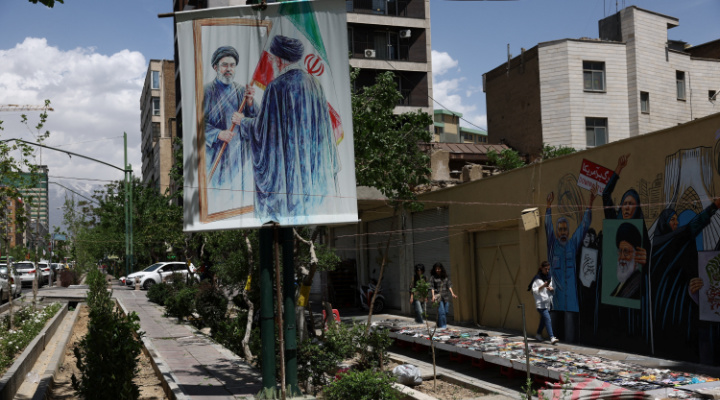
People walk on a street near a mural featuring an image of the late Supreme Leader of Iran, Ayatollah Ali Khamenei, in Tehran, Iran, May 6, 2026. Photo: Majid Asgaripour/WANA (West Asia News Agency) via REUTERS
Iran said on Wednesday it was reviewing a US peace proposal that sources said would formally end the war while leaving unresolved the key US demands that Iran suspend its nuclear program and reopen the Strait of Hormuz.
An Iranian foreign ministry spokesperson cited by Iran‘s ISNA news agency said Tehran would convey its response. US President Donald Trump said he believed Iran wanted an agreement.
“They want to make a deal. We’ve had very good talks over the last 24 hours, and it’s very possible that we’ll make a deal,” Trump told reporters in the Oval Office on Wednesday.
Earlier in the day, Trump had sounded more pessimistic about the chances of a deal. In a Truth Social post, he threatened to restart the US bombing campaign in Iran, calling the possibility of Tehran agreeing to the latest US proposal a “big assumption.”
Trump has repeatedly played up the prospect of an agreement that would end the war that started Feb. 28, so far without success. The two sides remain at odds over a variety of difficult issues, such as Iran‘s nuclear ambitions and its control of the Strait of Hormuz, which before the war handled one-fifth of the world’s oil and gas supply.
A Pakistani source and another source briefed on the mediation said an agreement was close on a one-page memorandum that would formally end the conflict. That would kick off discussions to unblock shipping through the strait, lift US sanctions on Iran, and set curbs on Iran‘s nuclear program, the sources said.
It was unclear how the memorandum differs from a 14-point plan proposed by Iran last week, and Iran has yet to respond to the latest US proposal.
Iran‘s semi-official Tasnim news agency, citing an unnamed source, said the US proposal contained some unacceptable provisions, without specifying which ones.
Iranian lawmaker Ebrahim Rezaei, a spokesperson for parliament’s powerful foreign policy and national security committee, described the text as “more of an American wish-list than a reality.”
“The Americans will not gain anything in a war they are losing that they have not gained in face-to-face negotiations,” he wrote on social media.
OIL PRICES TUMBLE
Reports of a possible agreement caused global oil prices to tumble to two-week lows, with benchmark Brent crude futures falling around 11% to around $98 a barrel at one point before rising back above the $100 mark.
Global share prices also leapt and bond yields fell on optimism about an end to a war that has disrupted energy supplies.
Trump on Tuesday paused a two-day-old naval mission to reopen the blockaded strait, citing progress in peace talks.
The US military has kept up its own blockade on Iranian ships in the region. US Central Command said forces fired at an unladen Iranian-flagged tanker on Wednesday, disabling the vessel as it attempted to sail toward an Iranian port in violation of the blockade.
NO MENTION OF KEY US DEMANDS
The source briefed on the mediation said the US negotiations were being led by Trump’s envoy Steve Witkoff and son-in-law Jared Kushner. If both sides agreed on the preliminary deal, that would start the clock on 30 days of detailed negotiations to reach a full agreement.
The full agreement would end the competing US and Iranian blockades on the strait, lift US sanctions, and release frozen Iranian funds. It would also include some curbs on Iran‘s nuclear program, with the aim of a pause or moratorium on Iranian enrichment of uranium.
While the sources said the memorandum would not initially require concessions from either side, they did not mention several key demands Washington has made in the past, which Iran has rejected, such as curbs on Iran‘s missile program and an end to its support for proxy militias in the Middle East.
The sources also made no mention of Iran‘s existing stockpile of more than 400 kg (900 pounds) of near-weapons-grade uranium.
Israeli Prime Minister Benjamin Netanyahu, Trump’s ally against Iran, said on Wednesday the two leaders agreed that all enriched uranium must be removed from Iran to prevent it from developing a nuclear bomb.
Tehran denies wanting to acquire a nuclear weapon.
Uncategorized
Musée d’Orsay Opens Permanent Exhibition Space Dedicated to Nazi-Looted Artwork
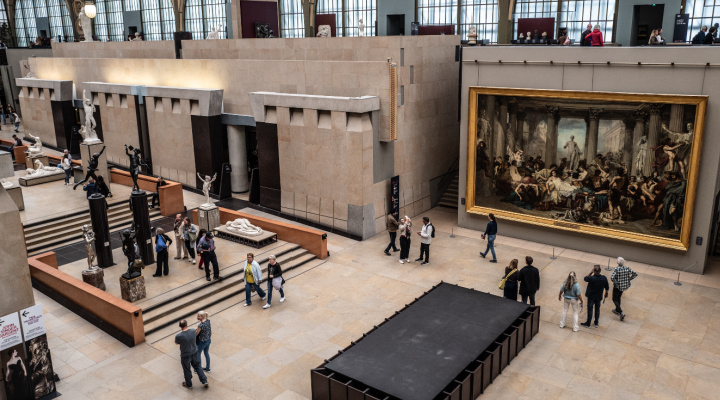
Inside the Musée d’Orsay. Photo: ZUMA Press Wire via Reuters Connect
The Musée d’Orsay in France opened a new permanent exhibition room on Tuesday dedicated to works of art that were owned by Jews and looted by the Nazis across Europe during World War II before being returned to France after the war.
The new gallery room is titled “To whom do these works belong?” and will feature rotating installations of works of art recovered after World War II also known as Musées Nationaux Récupération (National Museums Recovery) pieces. Provenance investigators and researchers are still working to identify the original owners of these MNR artworks.
“Over time, the room is intended to evolve to present to the public the discoveries resulting from this research, some of which could allow new restitutions,” said the museum. “It thus constitutes a space of memory, transparency and active research, at the heart of contemporary issues related to the history of the collections.”
Now on display in the exhibition is 13 works, including the 1879 painting “Dinner at the Ball” by Edgar Degas, according to The Times. The painting was previously owned by Fernand Ochsé, a Jewish merchant and art collector living in France who was murdered in the Auschwitz concentration camp during the Holocaust along with his wife. The painting was among thousands of artworks stolen by the Nazis or forcibly sold to Nazi occupiers in France. Also on display in the exhibit is Pierre-Auguste Renoir’s portrait “Madame Alphonse Daudet” from 1876.
The new gallery room and research done by provenance investigators is being funded with support from the nonprofit organization American Friends of Musées d’Orsay et de l’Orangerie (AFMO). According to the organization, 60,000 artworks looted by the Nazis during World War II around Europe were returned to France by 1950 and 224 of those recovered artworks are housed at the museum and in need of further provenance research to find their original owners. Fifteen MNRs kept at the Musée d’Orsay have already been returned to its rightful owners.
Over the next few years, AFMO will fund a team of art historians and researchers, led by provenance expert Dr. Ines Rotermund-Reynard, and they will focus on finding the owners of the 224 recovered artworks in the Musée d’Orsay’s collections, but also approximately 200 additional pieces acquired by the museum after 1933.