



Uncategorized
The History of the Jews of Brazil — the Oldest Jewish Community in the Americas

The Estaiada Bridge in Sao Paulo, Brazil. Photo: Wikimedia Commons.
It’s not New York, Cincinnati, or Philadelphia. The oldest and first Jewish community in the Americas was established in Brazil, where Sephardic Jews founded the first synagogue in Recife in 1636. This is the fascinating story of the Jews of Brazil.
Following a century of successful discovery and colonization, the Portuguese monarchy told Pedro Alvares Cabral in the year 1500 to take his ships as far west as he could to see if he could find an alternate route to India. Accompanying Cabral on this trip as the interpreter was a Jew, Gaspar da Gama.
Gaspar was “discovered” by famed explorer Vasco da Gama in India, where Vasco da Gama was shocked to find a white man serving as an advisor to one of the local rulers. Vasco da Gama decided that he could use someone who spoke the Eastern languages, so he decided to take this man back with him to Lisbon. He had the Jew convert to Catholicism and adopt the name of Gaspar da Gama in deference to the explorer.
When Cabral traveled to the West, he thought it would be helpful to have Gaspar with him to converse with the natives. After crossing the Atlantic Ocean, they arrived at the land that would eventually be known as Brazil. The first man to set foot on this new land was Gaspar. Unfortunately, his knowledge of Indian dialects was of no value in trying to talk to the Brazilians, and it was then that the Portuguese settlement in Brazil began.
After discovering Brazil, the Portuguese settlers moved westward, hoping to discover gold and silver and extend their landmass. They were known as the Bandeirantes because they carried a bandeira (flag) with them. Based on their names, records suggest that many of them were conversos, hidden Jews. One of the most important Bandeirantes was Fernando de Noronha, a Portuguese converso with many contacts in the Lisbon court. He convinced the crown to lease him the land, and that in exchange, he would give them a wood named Pau Brazil that provided a dye and other precious items he would find. The wood that he sent gave the land the name Brazil.
Historians suggest that his leasing scheme was an effort to help Portuguese Jews by creating a place for them to live away from the growing threats of the Catholic Church and the Inquisition. This was crucial because after they were expelled from Spain in 1492 by the infamous Alhambra Decree, many Jewish Spaniards moved to nearby Portugal where they were far more tolerant of Jews.
But this haven came to an end in 1497 when Portugal expelled its Jews. At this point, some Jews moved to the Netherlands, and others tried to move to the far-flung colonies, hoping to get as far as possible from the centralized government and its Inquisition. Thus, many New Christians or conversos settled in Brazil, where they would benefit from Fernando de Noronha’s settlement.
Dutch Brazil 1624-1654
In 1600, the Dutch’s East Indies Company that imported spices and exotic products from the Far East was highly successful. So the Dutch decided to create a West Indies Company that would import natural resources from New York, the Caribbean Islands, and Brazil, a major producer of sugar.
The Dutch defeated the Portuguese in Northeastern Brazil and began to establish a Dutch settlement there, called New Holland. The Dutch allowed religious freedom in New Holland. As a result, many Portuguese conversos who lived in the Portuguese-controlled areas of Brazil moved to there to become full-fledged Jews once again. Two hundred Dutch Jews were also part of the original Dutch settlement. The Jews established a variety of businesses in New Holland and were particularly involved in the development of Brazil’s sugar industry.

The Street of the Jews in Brazil. Photo: provided.
Most of these Jewish merchants lived on the Rua dos Judeus — Street of the Jews. It was on this street that the first synagogue in the Western Hemisphere was built in 1636. It was called Kahal Tzur Israel, the Rock of Israel.
Synagogue records show a well-organized Jewish community with high participation, including a Talmud Torah school, a tzedakah fund, and an overseeing executive committee. In 1642, Rabbi Isaac Aboab da Fonseca, a well-known Amsterdam rabbi, and Moses Raphael d’Aguilar came to Brazil as spiritual leaders to assist the congregations of Kahal Zur in Recife and Magen Abraham in Mauricia.
For years, the Dutch settlement prospered, but then the West Indies Company began to lose interest in the colony, as the profits were less than other areas under its control. The Portuguese successfully drove the Dutch out of Brazil in 1654, following a nine-year war.
In the Treaty of Guararapes, the Portuguese promised to respect the religious freedom of those who chose to remain in Brazil under Portuguese control. However, in the coming years, the Portuguese went back on their word and accused the Jews of heresy and persecuted them.
At that point, 150 Jewish families chose to return to Amsterdam, but others moved to Dutch-controlled areas of the Western Hemisphere. Twenty-three of these Dutch Jews traveled to New Amsterdam, today’s New York. Peter Stuyvesant was the governor of New Amsterdam and did not like Jews. He asked permission from the West Indies Company to expel them, not realizing that a percentage of the shareholders were in fact Jews. He received a response from Amsterdam telling him to treat “our shareholders” with consideration.
The Inquisition in Brazil
Despite the Jews’ hope that distance would protect them from the long arm of the Inquisition, Portuguese persecution followed them to the New World. In 1647, Isaac de Castro was arrested for teaching Judaism in Portuguese-controlled Brazil. He was deported to Portugal, where the Inquisition sentenced him to death and burned him at the stake. Recognizing the danger, Jews hid their Jewish identities, immigrated to Dutch-controlled areas, or moved to the interior of Brazil where there was less oversight.
Historians have recently come across populations in Brazil’s interior that have seemingly Jewish practices. These groups can’t explain why but they light candles on Friday, read only the “Old Testament,” do not eat pork or shellfish, and refrain from eating bread during Easter.
One of the most famous cases regarding the Inquisition in Brazil was that of Antonio José da Silva. Da Silva was a law student living in Rio de Janeiro, and he also wrote several successful plays. He was denounced to the Inquisition and arrested and sent to Portugal. He refused to recant and was burned at the stake on October 19, 1739. His courage inspired Jewish and non-Jewish Brazilians and in 1996 his story was made into a Brazilian film called O Judeu — The Jew.
The End of Official Persecution and the Moroccan Community
In 1773, a Portuguese royal decree abolished persecution against Jews. As a result, Jews gradually settled in Brazil, although nearly all of the original Brazilian conversos had assimilated by then.
In 1822, after Brazil gained its official independence from Portugal, Moroccan Jews began moving to Brazil. In 1824, they founded a synagogue in Belem (northern Brazil) called Porta do Cebu (Gate of Heaven). By World War I, the Sephardic community of Belem, composed primarily of Moroccans, had approximately 800 members. In the 1950s, an additional wave of Jewish immigration brought more than 3,500 Moroccan Jews to Brazil.

Porta do Cebu (Gate of Heaven) in Belem, Brazil. Photo: provided.
Ashkenazi European Jews began arriving in Brazil around 1850. Brazil was not the preferred destination of European Jews seeking a new life in South America. Jewish and non-Jewish Europeans tended to prefer the more cosmopolitan Argentina. At the beginning of the 20th century, Argentina had one of the highest standards of living in the world. It is possible that the immigrants who chose Brazil did so because the fare was far less than traveling by boat to Buenos Aires, which was 1,500 miles to the south.
Almost 30,000 Western European Jews, mainly from Germany, came to Brazil in the 1920s to escape European antisemitism. By 1929, they had established communities to the extent that there were 27 Jewish schools.
Rise of Antisemitism in Brazil
In the 1930s, Brazilian intellectuals began slandering the Jews, portraying them as non-European, impoverished communists, greedy capitalists, and detrimental to progress. The Nazi Party also encouraged antisemitism among the German diaspora, though they were far more successful in nearby Argentina.
In 1938, Brazil began an active assimilation effort and closed Yiddish newspapers and the Jewish organizations, both secular and religious. A wave of antisemitism followed, including several printings of the Protocols of the Elders of Zion. With the outbreak of World War II, Brazil adopted an immigration policy that banned any more Jewish refugees from entering the country.
Yet, the Brazilian ambassador to France, Ambassador Luis Martins de Souza Dantas, saw things differently and heroically chose to ignore the Brazil ban on Jewish immigration. Seeing what would happen to the Jews should they remain in France, he granted immigration visas to hundreds of French Jews, saving their lives from the Holocaust.
After the Holocaust, Brazil adopted a new, more democratic constitution, and antisemitism decreased. Jewish immigration strengthened the community with increasing numbers, and by the 1960s, Brazilian Jewry was thriving. In the 1966 parliamentary elections, six Jews representing various parties were elected to the federal legislature. In addition, Jews served in state legislatures and municipal councils.
Horacio Lafer was the Jewish Minister of Finance in the 1950s and 1960s. He was instrumental in arranging for thousands of displaced Jews from Syria, Lebanon, and other Middle Eastern countries to be able to settle in Brazil.
Modern-Day Brazilian Jewish Community
Today, Brazil has the ninth largest Jewish community in the world, and the second-largest Jewish population in Latin America after Argentina. The Jewish population totals about 130,000. About 70,000 Jews live in Sao Paulo, which is the commercial and industrial heart of Brazil, and another 30,000 live in Rio.
The remaining 30,000 Jews are distributed throughout the other towns in the country. In fact, there is a saying in Brazil that “if a town doesn’t have a Jewish merchant, it doesn’t deserve to be called a town.”
Sao Paulo Jews are particularly proud of their support of the Hospital Israelita Albert Einstein, considered by many the best hospital in all of South America. It was the first hospital outside of the United States to be accredited by the Joint Commission.
In present-day Brazil, the Jewish community lives in peace and stability and is able to practice their religion freely. In contrast to the antisemitism that marred its history, today the greatest threat to Brazilian Jewry is intermarriage and assimilation.
At the same time, due to the efforts of many individuals, Jewish schools, adult education classes, and kosher establishments have begun to flourish.
Incredibly the Kahal Zur synagogue in Recife, the first shul ever built in the Americas, was reopened in 2002, 347 years after it was closed by Portuguese colonial rule.

The Kahal Zur synagogue in Recife, the first shul ever built in the Americas. Photo: provided.
The synagogue had not been used since the mid-17th century when the Portuguese defeated the Dutch at Recife and expelled the estimated 1,500 Jews and banned Judaism. The synagogue is now open once again thanks to the generosity of the Safra banking family.
After World War II, Binyomin Citron was a builder and communal leader in Sao Paulo. In the early 1950s, he met with the leading American sage, Rabbi Aharon Kotler, and proudly told him about a beautiful building that he had built for use as a yeshiva, describing how he was going to produce strong educated Jews just like a great American yeshiva.
With great insight, Rabbi Kotler responded to him, “Buildings don’t create strong educated Jews, people do. If you have the right rabbis as teachers, you can produce great strong educated Jews. We will send you the best rabbi in the system to help build Torah in Brazil.” Rabbi Kotler sent Reb Zelig Privalsky to Brazil, where he and many others helped create a Jewish future for thousands of Brazilian Jews — a future for the oldest Jewish community in the Western Hemisphere.
Rabbi Menachem Levine is the CEO of JDBY-YTT, the largest Jewish school in the Midwest. He served as Rabbi of Congregation Am Echad in San Jose, CA, from 2007 to 2020. He is a popular speaker and writes for numerous publications on Torah, Jewish History, and Contemporary Jewish Topics. Rabbi Levine’s personal website is https://thinktorah.org
A version of this article was originally published at Aish.
Uncategorized
Alleging conflicts, California judge boots Jewish DA from trying Stanford pro-Palestinian protesters
(JTA) — This story originally appeared in J. The Jewish News of Northern California.
Jewish groups in the Bay Area are protesting a judge’s removal of a local Jewish district attorney from a case involving pro-Palestinian protesters accused of vandalizing Stanford University’s president’s office.
The district attorney, Jeff Rosen, was disqualified from retrying a felony case against five protesters after the judge ruled that Rosen had crossed a legal line when suggesting in a campaign message that the protest was antisemitic.
“Rosen is allowed to take a strong stance against crime in the community, against antisemitism. But caution and care need to be taken when utilizing active litigation in campaign communication,” Judge Kelley Paul said from the bench.
The judge said Rosen had erred when publicly labeling the incident antisemitic when it was not charged as a hate crime.
“This case is not a hate crime,” Paul said. “The characterization of the prosecution as a fight against antisemitism runs afoul of case law.”
In an email to J. The Jewish News of Northern California, Rosen’s office wrote that while it “disagrees with the judge’s ruling, we respect it.”
In a joint statement, the Jewish Community Relations Council Bay Area and Jewish Silicon Valley wrote that they are “deeply troubled” by Paul’s decision and that the case “must proceed.”
“This decision uniquely targets minority prosecutors, suggesting they are incapable of pursuing justice in cases perceived to be impacting their own communities,” the statement says, adding that it “risks reinforcing longstanding antisemitic prejudices and invites future defendants to weaponize a prosecutor’s identity against them.”
The five protesters face felony vandalism and conspiracy counts stemming from a June 2024 protest in which 13 people broke into Stanford’s executive offices and caused an estimated $300,000 in damages. A jury deadlocked in February, splitting 9-3 on the vandalism count and 8-4 on conspiracy. Rosen quickly announced his plan to retry them.
The disqualification motion was filed by deputy public defender Avi Singh, who argued that Rosen had compromised his office’s neutrality by featuring the prosecution on a campaign fundraising page titled “DA Rosen Fighting Anti-Semitism,” alongside a donation button.
Singh argued that the fundraising campaign falsely implied that the defendants were antisemitic. None was charged with a hate crime.
Rosen, who has spoken publicly about his commitment to fighting antisemitism and supporting Israel, has denied any conflict of interest.
In her decision, Paul pointed to Rosen’s remarks in a March 2025 speech he gave for the San Jose Hillel, about a month before his office filed charges against the protesters. A video of the speech is linked on the “Fighting Anti-Semitism” page on his campaign website.
In the speech, Rosen equated antisemitism and “anti-Americanism,” a phrase that Deputy District Attorney Robert Baker also used to describe the conduct of the protesters during the trial’s closing arguments. Paul ruled that the similarities in the language disqualified the entire DA’s office from the case, not just Rosen.
In their own statement, the local Jewish groups suggested Rosen was being disqualified because he is Jewish.
“Generations of American Jews in positions of public trust have all too often been treated as suspect or inherently conflicted,” JCRC Bay Area and Jewish Silicon Valley said. “This decision risks reinforcing longstanding antisemitic prejudices and invites future defendants to weaponize a prosecutor’s identity against them, casting any public opposition to hate as grounds for disqualification.”
Rosen’s challenger in his June primary election, former prosecutor Daniel Chung, has turned the ruling into a campaign video. Chung called Rosen’s pursuit of the Stanford case “overzealous” and “a waste of time and money.”
“This is a humiliating loss for DA Rosen and his entire office,” Chung said in an Instagram video. “For years, millions of dollars have been spent trying to prosecute Stanford student protesters with felony charges.” Rosen’s actions, Chung said, “jeopardized the due process of the defendants” and “exemplifies the undermining of integrity, competence and compassion under DA Rosen for the last 16 years.”
The ruling hands the case to California’s attorney general, which will decide whether to retry the defendants — German Gonzalez, Maya Burke, Taylor McCann, Hunter Taylor-Black and Amy Zhai — or drop the charges.
The post Alleging conflicts, California judge boots Jewish DA from trying Stanford pro-Palestinian protesters appeared first on The Forward.
Uncategorized
Iran’s Deepening Water Crisis Threatens 35 Million as Economy Buckles Under US Pressure, Mounting Domestic Strain
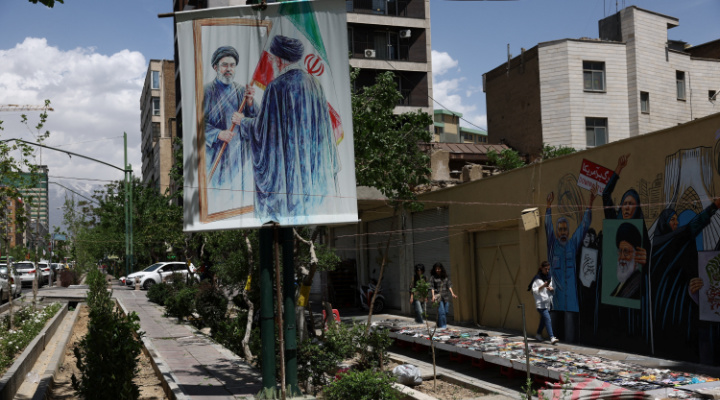
People walk on a street near a mural featuring an image of the late Supreme Leader of Iran, Ayatollah Ali Khamenei, in Tehran, Iran, May 6, 2026. Photo: Majid Asgaripour/WANA (West Asia News Agency) via REUTERS
As talks with the United States over a possible deal to end the war remain uncertain, Iran’s economy is under mounting strain, with prolonged water shortages, pressure on energy infrastructure, and slowing industrial output deepening what authorities describe as an “economic war.”
With Iran entering the summer months amid a deepening water and electricity crisis, government officials estimate that around 35 million people will face water shortages, intensifying concerns over deteriorating living conditions, mounting economic strain, and daily hardship across the country.
On Monday, Issa Bozorgzadeh, a spokesman for the country’s water industry, reported that rainfall has fallen “below normal” levels across 11 provinces, warning that Tehran is among the worst affected as it enters its sixth consecutive year of drought.
Now, Iranian authorities are urging citizens to cut consumption and adopt stricter usage habits, pointing to deep structural failures in the water and power sectors as public frustration rises over supply disruptions, mismanagement, and declining living standards.
Officials have also announced planned summer power outages, warning that the deepening energy crisis could lead to factory shutdowns, reduced industrial output, rising unemployment, and higher prices.
On Sunday, Arash Najafi, head of the Energy Commission of Iran’s Chamber of Commerce, noted that household, commercial, and office blackouts are likely to continue daily throughout the summer, while the industrial sector will continue to be targeted for power cuts” or “will continue to bear the brunt of power cuts.
Given the damage to several petrochemical facilities in Israeli and US strikes and their reliance on electricity from the national grid, Najafi said most available power would now be directed toward keeping these complexes operational around the clock.
“The Islamic Republic will be forced to impose electricity consumption restrictions for about 120 days, and given the lack of effective means for people to significantly reduce usage, this will result in widespread blackouts,” the Iranian official said in a statement.
Amid growing public frustration over the ongoing crisis, Majid Doustali, a member of Iran’s parliamentary planning and budget committee, called on citizens to cut back on electricity, water, and fuel consumption as part of the country’s resistance efforts in what he described as an “economic war.”
“Every effort by the public to save resources represents a direct challenge to the enemy’s economic conspiracy,” Doustali said.
Even as the crisis continues to weigh heavily on the Iranian people, a nationwide internet blackout remains in place, having exceeded 1,728 hours as of Monday, after authorities imposed the shutdown more than two months ago, effectively isolating millions of Iranians from independent reporting on the war and access to global news.
Across much of the country, unstable internet forces many people to rely on illegal black-market virtual private networks (VPNs) — tools that bypass government censorship — to stay connected beyond Iran’s borders, with access costing millions, and users risking imprisonment and national security charges.
According to a CNN estimate, Iranians have spent roughly $1.8 billion on internet access over the past two months.
Soaring costs and crumbling infrastructure have also forced businesses to cut jobs on a massive scale, leaving many workers unemployed and intensifying social and economic pressures across the country, The New York Times reported.
Dozens of major companies have reportedly laid off hundreds of employees across multiple industries, with the industrial sector alone potentially putting up to 3.5 million workers at risk, as the country’s economy reels from the impact of a US naval blockade on Iranian ports that began in mid-April.
The US blockade has prevented the regime from exporting energy through the Strait of Hormuz — a critical global energy chokepoint through which about one-fifth of the world’s oil supply passes.
With companies sharply reducing or freezing production amid shutdowns and mass layoffs, the private sector downturn is further threatening the regime by reducing tax revenues, which the government has come to rely on heavily amid mounting sanctions and trade restrictions.
Iran’s new supreme leader, Ayatollah Mojtaba Khamenei, has attempted to contain the fallout by urging companies to avoid layoffs “to the extent possible.”
But the regime’s internet shutdown alone has cost businesses and companies an estimated $80 million in daily losses, The New York Times reported.
As the Iranian currency continues to plunge and inflation peaks near 60 percent, senior official Gholamhossein Mohammadi said the war has already cost around one million jobs, alongside “the direct and indirect unemployment of two million people.”
Meanwhile, Iran’s energy sector is also under severe strain, with exports falling sharply, storage capacity nearing its limits, and infrastructure under growing pressure.
According to data from commodity analytics firm Kpler, Iran could exhaust its oil storage capacity within 25 to 30 days if the crisis continues, prompting cuts in output at several oil fields to ease pressure.
Amid an export collapse exceeding 70 percent, the government now faces a critical decision between shutting wells to manage storage constraints or risking long-term damage to key oil fields.
Even though Kpler’s report estimates Tehran may not feel the full revenue hit for another three to four months due to payment delays and pre-existing sales flows, the regime is expected to face a heavy blow, with losses potentially reaching $200–250 million per day.
With domestic tensions rising and the internal economic crisis worsening, Iranian officials are increasingly wary that renewed protests could erupt in the coming days, further destabilizing an already volatile situation.
Uncategorized
Sen. Cory Booker Reaffirms Commitment To Maintaining Israel’s ‘Qualitative Military Edge,’ Criticizes ‘Reckless War’ In Iran

April 12, 2026, New York, New York, United States: (NEW) 2026 NAN Convention. April 11, 2026, New York, New York, USA: U.S. Senator Cory Booker speaks during Day 4 of the National Action Network (NAN) 35th Anniversary Convention at Sheraton New York Times Square Hotel on April 11, 2026 in New York City. (Credit: M10s / TheNews2)(Foto: M10S/Thenews2/Zumapress) (Credit Image: © M10s/TheNEWS2 via ZUMA Press Wire)
Sen. Cory Booker (D-NJ) defended his continued support for Israel in a recent interview while distancing himself from what he described as a “reckless war,” underscoring the increasingly delicate balancing act facing pro-Israel Democrats amid mounting political pressure from the party’s progressive wing.
In an interview with the media outlet RealClearPolitics, Booker emphasized that his opposition was not directed at Israel itself, but rather at policies he believes risk further destabilizing the Middle East and weakening long-term regional security.
“Let’s be clear, I’m opposed to a reckless war that has made the United States and Israel less safe, as well as our other Arab allies. I will not support arms from the United States or any of our allies, including Israel, in a context of a war that is endangering our national security and Israel’s. I continue to support our US military being the strongest in the world,” Booker said.
The comments come as divisions within the Democratic Party over Israel have intensified following over two years of conflict in Gaza and escalating tensions involving Iran-backed militant groups across the region. While a growing faction of Democrats has pushed for stricter conditions on military aid to Israel, Booker sought to position himself as firmly supportive of the US-Israel alliance even as he voiced concern about the conduct and trajectory of the conflict.
Booker, however, emphasized that he still supports helping Israel maintain its military advantage over its neighbors in the Middle East, a position which analysts argue helps bolster American geopolitical interests in the region.
“I continue to support Israel having a qualitative military edge, the ability to defend themselves, and offer deterrents. But in the context of this war, I will not support more military armaments to conduct what I think is a disaster that’s endangering American lives, Israeli lives, and as we see in the UAE and Saudi Arabia, our regional allies as well.”
Booker, long viewed as one of the Senate’s more traditionally pro-Israel Democrats, has historically backed military assistance to the Jewish state and has frequently spoken about the importance of Israel as America’s closest democratic ally in the Middle East. His latest remarks appeared aimed at reassuring pro-Israel voters and donors wary of the party’s leftward shift on the issue.
However, Booker raised eyebrows recently when he joined a record number of Democratic senators to vote in favor of Sen. Bernie Sanders’ (D-VT) resolution against sending more arms to Israel, raising questions among some pro-Israel observers about his position on Israel.
Of the 47 Senate Democrats, 40 voted in favor of blocking sales of bulldozers and 36 voted in favor of blocking transfers of so-called “dumb” bombs.
The failed votes represent the largest show of opposition to military aid for Israel within the party in recent memory. While previous efforts spearheaded by Sanders drew support from a smaller bloc, this vote saw roughly 80 percent of Senate Democrats vote against transferring aid to the Jewish state, signaling a seismic shift in the dynamic between the Democratic Party and Israel.
Booker’s framing may reflect a broader strategy among mainstream Democrats: separating criticism of specific military operations from opposition to Israel’s existence or security needs.
Supporters of Israel argue that distinction is increasingly important as anti-Israel rhetoric grows more common in some activist circles following Hamas’ October 7 attacks and the subsequent war in Gaza. A growing number of Democratic officials and ambitious progressive candidates have accused the Jewish state of committing “genocide” in Gaza. Israeli officials have repeatedly argued that military operations are necessary to dismantle Hamas and prevent future attacks against Israeli civilians.
Booker’s comments may signal an effort to preserve bipartisan support for Israel at a time when polling shows younger Democratic voters becoming more critical of the Israeli government. At the same time, pro-Israel advocates have warned that weakening US backing could embolden Iran and its regional proxies, including Hamas and Hezbollah.
The senator did not indicate support for ending military cooperation with Israel altogether, instead emphasizing that American leadership should focus on both protecting Israeli security and preventing a wider regional war.