



Uncategorized
The rabbi’s son who drew an antisemitic mural on Wilshire Boulevard
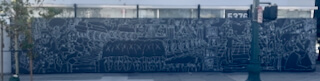
The mural went up in a day in the mid-Wilshire district of Los Angeles. By Thursday morning, Los Angeles Jews who saw it expressed outrage, calling it hateful and incendiary. The artist who drew it, meanwhile, told me he is the son of a Jewish father who didn’t mean to offend, just start a conversation.
Welcome to the bizarro world of antisemitism, circa 2026.
The 40-foot by 12-foot mural depicts Jews dancing on caskets and holding missiles above the heads of grieving mothers, rows of tanks and a sign that reads: “Buy More Things,” alongside images of diamonds and televisions.
One section depicts parents who appear to be Muslim holding their children and weeping. Five bodies of children are laid out on an altar-like table beside a figure with a yarmulke holding a missile. As your eyes move to the left, there’s a dollar sign and the words, “Freedom has Never Been Free.”
The piece, drawn in chalk against painted slate on a long panel of plywood construction fencing, combines the graphic scope and drama of Picasso’s “Guernica” with antisemitic caricatures straight out of the pre-World War II Nazi periodical Der Sturmer.
I’ve seen photos and videos of the mural, located at 5376 Wilshire Blvd. between Cloverdale Street and S. Detroit Street next to The Heart LA Church and just a few blocks from the Los Angeles County Museum of Art. My wife, Rabbi Naomi Levy, received the video via an urgent text message on Thursday from a congregant who came across it on her morning walk.
The “grotesque expressions on their faces, surrounded by images of war/suffering/greed,” the congregant wrote, play into “the worst antisemitic propaganda imagery.”
She’s not wrong. The congregant reported the mural to the city’s 311 complaint line. The Jewish Federation of Los Angeles confirmed it also fielded complaints.
The location is close to L.A.’s Orthodox Jewish Pico-Robertson neighborhood and just over a mile east of the headquarters of the city’s Jewish Federation and Shalhevet, a large Jewish day school.
The mural isn’t signed by the artist, but a phone number appears in the same chalk on an adjoining panel. David Sabastian, long a fixture in the L.A. fashion, music and art scene, posts the same phone number on his Instagram account bio.
So I called him.
“Right now there’s people who are offended by you simply saying ‘Free Palestine’,” he told me. “So can somebody be offended? Hell yeah! I offend people when I go to Whole Foods sometimes and I’m like wearing shorts. People get offended for everything.”
Sabastian said he doesn’t see the mural as antisemitic, or even that political.
“I’m not some radical pro-Palestine or pro-anything,” he said. “I’m an artist who simply illustrates my human experience.”
Sabastian told me he likes art that provokes conversation and stands for something. That’s one way to describe the mural. Another is that it crosses the line to hate.
“That would be a vast exaggeration and an irresponsible one,” he said. “But it is art. It could be interpreted in many ways, but I don’t think that way.”
When I pointed out that Jews I spoke with took offense, he told me he didn’t see it as representing all Jews.
“My father was a Hasidic rabbi,” he said.
Sabastian’s given name is David Miklatski. A 2016 profile of Sabastian in the L.A. Weekly reported that his father was a gallery owner who had recently died. Sabastian told me his father had a brief liaison with his mother, who lived in Watts. Then his father became very religious. He led a synagogue in the Pico-Robertson district — Sabastian couldn’t recall the name — and then moved to Israel.

“That story goes deep,” said Sabastian, who is in his late 30s. “He pretty much disowned me when I was a child.”
I told him there was a long history of antisemitic cartoons fueling hate and violence, and many people would see what he drew as offensive, just as they would stereotypical images of Blacks or Latinos. What does he see as the line between symbolism and vilification?
He answered me with a question of his own.
“I’ve lived the Black experience growing up in Los Angeles, right?” he said. “If I wanted to paint a picture that kind of dealt with that human experience of racism, and I chose to include a white person in it, am I villainizing all white people?”
I brought up George Floyd. The images that spread after his murder, a white foot or a white hand on Floyd’s neck, were clearly about the officers who killed him. They weren’t an indictment of all white people.
But his mural, I said, reads as an indictment of all Jews when it’s the Israeli army fighting the war.
“If you know who are murdering and slaughtering Palestinians, is it Mexicans? Is it Chinese?” he said. “It’s the Israeli army. Do the majority of them happen to be Jewish? Sure. So that’s just the drawing. If it was Black people doing it, then I would draw Black people or whatever the case may be. It’s simply like a political cartoon.”
Of course, it’s not so simple, given the way antisemitic images get weaponized to incite violence against Jews.
In our conversation, Sabastian himself wasn’t sure who he was targeting. He called the dancing figures “Jews,” not “the Israeli army.” Then, defending the piece, he said he’s drawing “the Israeli army” and that most of them “happen to be Jewish.” That shift from Israeli army to Jews and back is the exact line that is so easily blurred when criticism of Israel bleeds into antisemitism.
If that’s a matter of interpretation, it’s clear from the comments in Sabastian’s Instagram post of the mural how others are reading the artwork, which he titled, “Palestina.”
“You forgot to put them on there the ancient families that pull the strings while everyone fights on religion color or where they were born,” wrote one commenter.
“Now do a star of David symbol with a swatzika [sic]and a heart,” read another, followed by laughing emojis.
No word yet on any institutional response, but the social media popularity the mural has already garnered — more than 2,000 likes shortly after he posted it — will complicate any attempt to address it, to say the least.
So much of antisemitism these days comes down to a judgment call, especially when it comes to the line between criticizing the government of Israel and attacking all Jews. This mural, even if Sabastian didn’t intend for it to endanger Jews, isn’t a close call. That puts Jews in the no-win position of living with a work in their neighborhood that regurgitates and broadcasts age-old antisemitic tropes, or being seen as the enemies of artistic freedom.
It’s not a simple problem. Just consider the rapper Macklemore — who received massive support and attention for saying “Free Palestine” at an Ed Sheeran concert. Macklemore, by the way, follows Sabastian on Instagram.
The post The rabbi’s son who drew an antisemitic mural on Wilshire Boulevard appeared first on The Forward.
Uncategorized
‘Jews are welcome, Zionists are not’: Is a Zionist ban at a restaurant legal?
Sap Sua, a Vietnamese restaurant in Boulder, Colorado, was one of Emily Lanigan’s favorite restaurants. She even celebrated her 44th birthday there in June. So Lanigan was stunned when the restaurant posted this since-deleted message on Instagram in September: “Jews are welcome, Zionists are not.”
Lanigan, a former synagogue president, identifies as a Zionist, which she defines as the Jewish right of self-determination. Was she really no longer welcome at the place where she had received a complimentary dessert just months before?
She wondered if the restaurant had a different definition of Zionism, she said, and thought maybe reaching out and offering to have an in-person discussion could clear things up.
“Being a Zionist does not mean I do not also believe in the freedom and autonomy of Palestinians,” Lanigan said she commented on Instagram. “You and I are not so far apart.”
But Sap Sua’s owner, Anthony “Ni” Nguyen, doubled down: “As you clearly saw, the full statement was ‘Jews are welcome. Zionists are not.’ Jews are a protected class, and all Jews are welcome,” Nguyen wrote in messages to Lanigan reviewed by the Forward. “Zionism is a political ideology, like Nazism.”
Nguyen’s response to Lanigan implied the law was on his side. He could ban “Zionists,” it seemed, so long as he let in Jews who shared his views about Israel.
Legally speaking, Nguyen was partially correct. Neither federal civil rights law nor Colorado law prohibits businesses from refusing service based on customers’ political beliefs — meaning turning someone away based solely on their political support for Israel could be allowed.
But the line gets murkier when “Zionist” is used as a stand-in for Jewish or Israeli identity, which can violate laws prohibiting discrimination based on religion or national origin.
The distinction matters not only for Sap Sua, as spaces from coffee shops to book festivals to concert venues make disavowing Israel a condition of entry or participation. The troubling practice raises a thorny question: How should the law distinguish between excluding someone because of their political beliefs and excluding them because of who they are?
The right to exclude?
Sap Sua was not the first business to declare itself off-limits to Zionists with no legal consequences. In Utah, after a bar called Weathered Waves declared “no Zionists allowed” in 2024, the attorney general found no evidence of legal wrongdoing. (Weathered Waves later closed over a dispute with its landlord.)
But that doesn’t mean “Zionist” bans are always legal. According to Richard Katskee, a professor of law at Duke University with expertise in public accommodation law, the legality depends on how the ban is enforced.
Does the business ask only Jewish or Israeli customers to disclose their views? Does it make assumptions about the politics of customers wearing kippahs? If Jewish customers are being singled out, Katskee said, that would make a finding of illegal discrimination more likely.
Omer Wiczyk, senior counsel at the Brandeis Center, told the Forward that two cases he’s currently litigating cross that line. At a coffee shop in Oakland, California, a customer wearing a Star of David baseball cap was asked on video if he was a Zionist and told to leave. At an eyebrow salon in Northern Virginia, a customer was kicked out after disclosing she was Israeli-American.
Businesses “cannot turn a customer’s identity into objectionable politics, and then invoke that to justify their exclusion,” Wiczyk told the Forward. “Being Israeli is not a political issue. Being a Jew is not a political issue. It’s who you are.”
But if a business required every customer, regardless of their identity, to affirm a particular political position on Israel before receiving service, that could be legal, Katskee said — though enforcing such a policy fairly would inevitably prove difficult in practice.
“It might be legal, like putting up a sign saying ‘Republicans only’ or ‘Democrats only,’” Katskee said.
Jenin Younes, legal director of the American-Arab Anti-Discrimination Committee, argues that businesses have some latitude to refuse service based on customers’ politics. The ADC is currently making that case on behalf of Poetica Coffee, which is fighting a Department of Justice investigation into its decision to publicly bar Rep. Dan Goldman over his support for Israel.
In Goldman’s case, Younes said, his public profile and easily searchable voting record help support the idea that the coffee shop targeted him for his political views.
“It’s harder to make the argument that ‘No, this was really about just not letting Jewish people in’ — because he’s a public figure,” Younes said. “He’s said what he thinks on these issues.”
Even Goldman himself said that the coffee shop incident did not warrant a civil rights investigation because of his status as a public figure.
Younes argues that the same principle applies to situations unrelated to Israel and Zionism.
In 2018, for example, the owner of a Virginia restaurant kicked out White House press secretary Sarah Huckabee Sanders citing the Trump administration’s “inhumane and unethical” policies. The restaurant faced social backlash, but no legal consequences.
And last year, a Martha’s Vineyard farmers’ market stand refused to sell lawyer Alan Dershowitz pierogi, citing his legal defense of Jeffrey Epstein and other men accused of sexual assault. Dershowitz threatened legal action, but it appears he never actually filed suit.
“In my opinion, businesses should have the right to exclude people whose views it doesn’t like,” Younes said. “And by the way, I would apply this in the other context: If there’s a pro-Israel coffee shop owner and they wanted to say, ‘We don’t want anyone wearing a pro-Palestine pin in here,’ I think they have that right.”
The law’s limits
Whether businesses have the legal right to exclude certain customers is a different question than whether they should.
Such bans can end up holding ordinary Jews responsible for the actions of the Israeli government — with the misguided idea that denying them a meal or a cup of coffee will somehow advance the Palestinian cause.
And since “Zionist” means different things to different people, using the label as a litmus test will almost inevitably lead to erroneous assumptions about peoples’ views.
In cases where the law is not a remedy, the free market may be. Businesses that turn away “Zionists” must be so committed to their beliefs that they are willing to refuse a paying customer, risking boycotts and reputational damage.
At the same time, some businesses may believe the publicity will draw in new clientele. Karimi Brows, which turned away the Israeli-American customer, boasted that it gained 40,000 TikTok followers in the month after the incident.
For its part, Sap Sua appeared to backtrack amid intense public pressure, posting to Instagram that it would welcome “every guest who walks through our doors.” (Sap Sua did not respond to the Forward’s request for comment.)
But for Lanigan, the damage was done.
“It was one of my favorite restaurants,” Lanigan told the Forward. “But I will never set foot in that place again.”
The post ‘Jews are welcome, Zionists are not’: Is a Zionist ban at a restaurant legal? appeared first on The Forward.
Uncategorized
Explainer: Gadi Eisenkot’s four conditions for forming Israel’s next government
(JTA) — JERUSALEM – Israeli President Isaac Herzog tasked Gadi Eisenkot on Sunday with forming Israel’s next government, giving him up to six weeks to assemble a coalition with a total of 61 seats out of 120 in Israel’s parliament, the Knesset.
If he fails to do so, then the president can give another Knesset member the opportunity; most likely this will be incumbent Prime Minister Benjamin Netanyahu. For his part, Netanyahu, has urged Eisenkot to join him in an emergency national unity government that will keep Israel strong against ongoing threats.
Eisenkot has responded that the “national emergency government” he will form will comprise the “four Zionist parties” of the change bloc – his own Yashar Party, B’Yachad headed by former prime ministers Naftali Bennett and Yair Lapid, Avigdor Liberman’s Yisrael Beitenu Party and the Democrats under Yair Golan.
He also said he would welcome “parties and Knesset members who support Yashar’s four principles” to join the coalition.
At the President’s Residence in Jerusalem on Sunday, Eisenkot said he would be sending out formal invitations as soon as possible “to every Knesset faction, calling on all their members, both as parties and as individuals, to take part in forming the government and bringing it to its swearing-in.
“The rule is simple,” he added. “If you are prepared to sign on to the four principles I have set out, you are potential partners in a national emergency government under my leadership.”
Throughout his campaign, and particularly since the Oct. 27 election, Eisenkot has emphasized these four principles as the basis for forming the next government. But what are they exactly? And who, out of the other 11 parties, will be able to accept them and join his coalition?
1) Recognition of the State of Israel as a Jewish and democratic state.
Eisenkot wants to define his coalition as a government that is committed to Israel’s Jewish national identity and to democracy, not simply an alliance united by opposition to Netanyahu.
Any party wanting to join must accept Israel’s identity as the national home of the Jewish people first. The requirement has historically been contentious for Israel’s two Arab parties, who represent 19 Knesset members.
Parties must also accept the country’s democratic institutions, which uphold equality and rights for all citizens and prioritize the rule of law.
This means parties, such as the far-right and the ultra-Orthodox, that, as members of the outgoing government, have been pushing to overhaul the country’s judiciary – a key institution in Israel’s system of democratic checks and balances – might think twice about joining.
2) Acceptance of the values of the Declaration of Independence.
Israel’s Declaration of Independence, proclaimed and signed on May 14, 1948, is a foundational document that has helped shape the country’s constitutional principles, although Israel does not have a single, formal written constitution.
In it, the signatories laid out their vision for Israel, including the historical ties the Jewish people have to the land of Israel and its place as a safe haven for Jews around the world who are in trouble.
For Eisenkot, the emphasis appears to be on one particular section that declares: “The State of Israel will foster the development of the country for the benefit of all its inhabitants; it will be based on freedom, justice and peace as envisaged by the prophets of Israel; it will ensure complete equality of social and political rights to all its citizens, irrespective of religion, race or sex; it will guarantee freedom of religion, conscience, language, education and culture; and it will safeguard the Holy Places of all religions; and it will be faithful to the principles of the Charter of the United Nations.”
By embracing the Declaration of Independence, Eisenkot is recognizing the place of Israel’s minority groups, highlighting their “full and equal citizenship.” A point mentioned twice in the declaration.
The declaration also reaffirms that Israel is a country seeking peace, rather than endless conflict, at a time when Netanyahu has recently been criticized over his handling of the country’s wars on multiple fronts.
3) Mandatory service for all — military, national, and civilian, to strengthen the IDF and expand its ranks.
Including this condition for joining the government is a direct message to the ultra-Orthodox parties, at least one of which is considering supporting Eisenkot’s coalition.
United Torah Judaism, which has been aligned closely with Netanyahu’s bloc for at least the past two decades, on Thursday refused to recommend the prime minister as Israel’s next leader. Instead, the party, which holds seven seats, abstained from recommending any candidate.
Both UTJ and the second ultra-Orthodox party, Shas, have resisted efforts that would include ultra-Orthodox young men studying in yeshiva under a universal draft law requiring all eligible Israelis to perform military service.
Previous exemption laws have expired, and Israel’s Supreme Court has ruled that the state’s blanket exemption of yeshiva students from military service has no legal basis and violates principles of equality before the law.
By including this condition, Eisenkot is telling the ultra-Orthodox – and even the Arab community, most of whose members are also exempt from mandatory military service – that everyone in Israel must do their part, whether through military service or some type of national or community service.
This stipulation could either keep the ultra-Orthodox out of the government, even though Eisenkot’s partners have expressed willingness to allow their participation. Or it could force them to be more flexible on an issue that until now they have appeared unrelenting.
4) Recognition of Hamas as a terrorist organization and commitment to dismantling its military and governing power.
Leaders of the two Arab parties, the Islamist Ra’am Party and the more nationalist Joint List, have refused to make this statement out loud.
Ra’am leader Mansour Abbas, who has repeatedly condemned the Oct. 7 attack, has said he does have a clear position on this but refuses to state it publicly for several reasons ranging from concerns about his personal safety to his ties to the Muslim Brotherhood, to which Hamas is also affiliated. He has also questioned why Arab politicians are required to pass loyalty tests that are not applied equally to Jewish politicians.
When President Herzog pressed him on the matter last week, Abbas said: “I have an unequivocal answer, but leave me space to be a bridge. To also influence the other side.” He argued that maintaining channels of communication with Palestinians requires him not to adopt language that would immediately alienate them.
For the Joint List, the continued refusal to call Hamas a terror group appears to reflect the view that Hamas is part of the broader Palestinian political movement. Some of its members argue that labeling it a terrorist organization risks delegitimizing Palestinian political aspirations as a whole.
Members of the 11-member faction have condemned the Oct. 7 massacre, but are unlikely to accept this particular condition because it could be used to justify Israel’s military campaigns in Gaza and the West Bank. Its leaders also want to preserve their credibility among Palestinian voters, many of whom see the conflict through the lens of occupation and Palestinian national rights.
This article originally appeared on JTA.org.
The post Explainer: Gadi Eisenkot’s four conditions for forming Israel’s next government appeared first on The Forward.
Uncategorized
Photos: Pro-Israel counter-protesters overwhelm anti-Zionist bike rally in Philadelphia, where police arrest 3
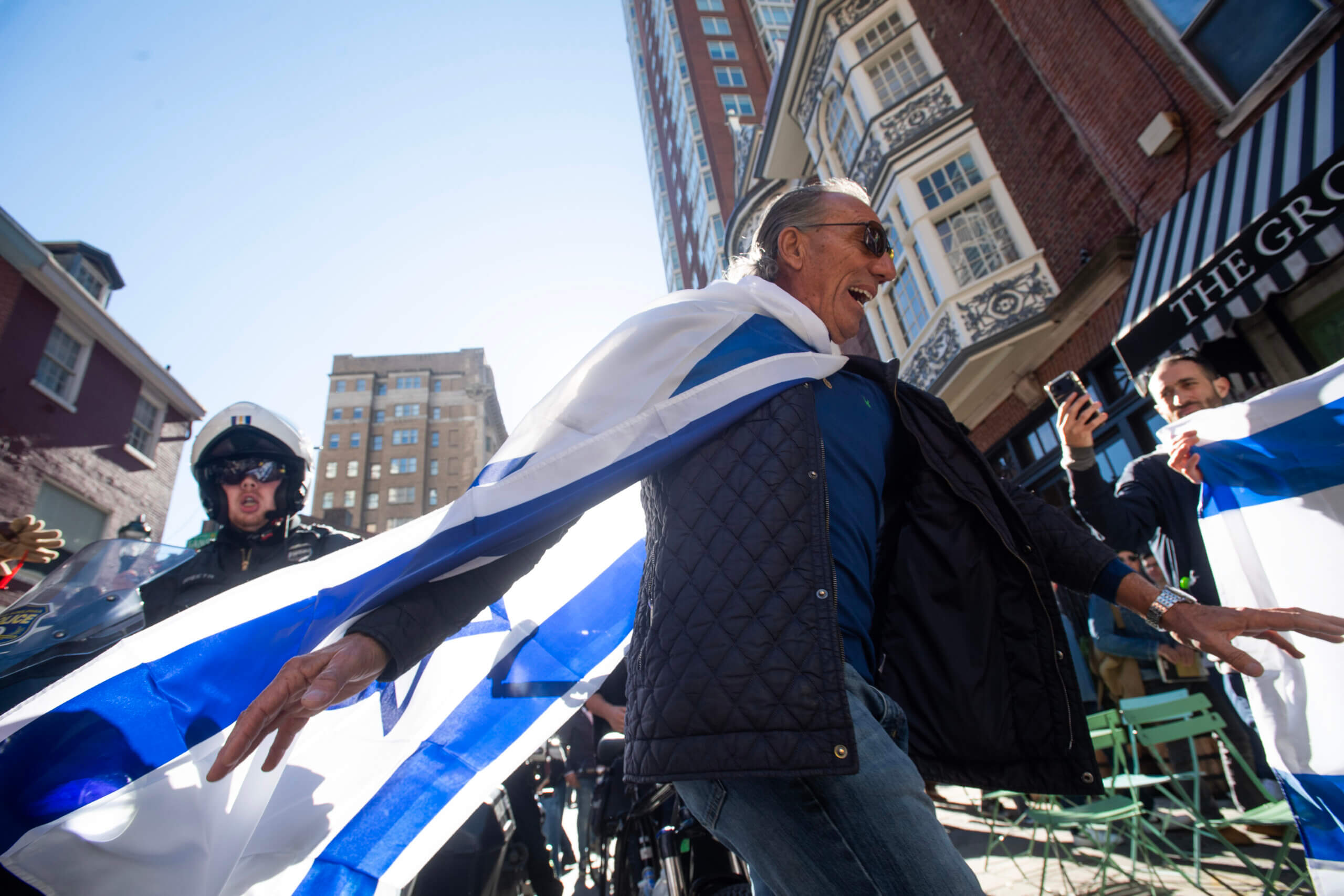
Hundreds of pro-Israel counter-protesters gathered around Philadelphia’s Rittenhouse Square Sunday morning ahead of a bike rally targeting six Jewish-owned restaurants. There were about 300 anti-Zionist protesters and about 200 pro-Israel counterprotesters, police estimated. Rally organizers said the timing — just before the 88th anniversary of Kristallnacht, when Nazis attacked Jewish shops and homes — was coincidental.
Three people were arrested Sunday, according to police. Pennsylvania Gov. Josh Shapiro, who is Jewish, said a few hours after the crowd had dispersed, “In the midst of blatant antisemitic targeting of Jewish-owned restaurants on the anniversary of Kristallnacht, the City of Brotherly Love showed up to support our neighborhood businesses and prove once again that hate has no place in our Commonwealth.”


The post Photos: Pro-Israel counter-protesters overwhelm anti-Zionist bike rally in Philadelphia, where police arrest 3 appeared first on The Forward.
