


Uncategorized
These Jews are defending Drag Story Hour against far-right protestors. Here’s why.
(New York Jewish Week) — As right-wing protestors descend upon Drag Story Hour events across New York, they have frequently been met by a loosely connected movement of counter protestors that includes many progressive Jewish groups.
Since September, right-wing activists have routinely protested Drag Story Hour events, where a person dressed in drag reads to children. The aim of these story times, according to the founder of the Drag Story Hour New York chapter, is to promote literacy while giving children positive queer role models.
At the Queens Public Library in Jackson Heights on Dec. 29, at least five members of the Proud Boys, a far-right extremist group, showed up to harass people attending a story session. Those protestors were met by hundreds of activists from the other side, many of whom are Jewish. They included members of Jews For Racial and Economic Justice, Outlive Them, United Against Racism and Fascism and other other organizations.
“We’re out here,” said Sharona Farber, 32, who is a member of the Jewish anti-fascist group Outlive Them, which formed in response to the 2018 Pittsburgh Tree of Life shooting and has since become involved with other forms of activism across New York such as fighting for the homeless and against U.S. Immigration Customs and Enforcement (ICE) raids.
Those protesting Drag Story Hours claim the events are harmful to children, calling parents who are bringing their kids to the event “groomers” and “pedophiles” to their face. Demonstrators have breached library doors in the city on three separate occasions. They have also vandalized the homes and offices, using anti-LGBTQ slurs, of three New York City Council members who have shown support for Drag Story Hour.
Hundreds of people defended the Queens Public Library at Jackson Heights against right-wing protestors, including members of the Proud Boys and neo-Nazis, last Thursday. (Gili Getz/Courtesy)
Protestors have targeted 10 Drag Story Hour events in New York, according to independent reporter Talia Jane, who has been documenting the group on Twitter since September.
This group of protestors, which calls itself the Guardians of Divinity, started as an anti-vaccine movement in the pandemic. “We have lost our jobs and been arrested for protesting this madness,” a statement on the group’s Twitter said. “Now they are coming for your kids with programs like Drag Queen Story Hour, where they steal your tax money to pay grown men in dresses to read gender questioning books.”
Farber told the New York Jewish Week that last Thursday there were at least 300 people defending Drag Story Hour at the Queens library branch, from all ages and backgrounds. Farber added that “there are a lot of Jews” doing the behind-the-scenes work, the organizing and the outreach that goes into “pulling these defenses off.”
“Jews are so heavily represented in the left,” Farber said. “There’s been a reinfusion of energy on what people call the Jewish Left. There are people getting self organized into small groups that do take political action into what they believe is needed to create a better world.”
Sophie Ellman-Golan, communications director for Jews for Racial & Economic Justice, another prominent activist group that’s defending Drag Story Hour, told the New York Jewish Week that it’s important “to drown out fascists and neo-Nazis” by showing up in solidarity.
“When there’s a threat of neo-Nazi violence against synagogues, the idea is not that we should stop going to synagogue,” Ellman-Golan said. “We actually deserve to be able to gather and pray or engage in whatever culture and ritual we want to. We believe that a community of diverse New Yorkers coming together to ensure that can happen, that’s the best way to do that, with community defense.”
She described the scene as “two sides”: one that included colorful rainbow signs, glitter and Disney songs, while the other side included a neo-Nazi giving a “Heil Hitler” salute while talking about “a future for white children.”
A man seen throwing a ‘Nazi Salute’ outside of NYC Drag Queen Story Hour event was confronted by both sides “If you are doing a Roman Salute get the fuck out of here, you are worse than them”
4/10 pic.twitter.com/8TgAQbz1Ft
— Oliya Scootercaster (@ScooterCasterNY) December 30, 2022
“It’s a violent attempt to stamp out trans people,” Ellman-Golan said, adding that there is “a very clear link between antisemitism and transphobia that is increasing at a terrifying rate.”
Ariela Rothstein, a queer Jewish parent who took her 6-month-old child to the Jackson Heights Drag Story Hour last Thursday, told the New York Jewish Week that these shouldn’t be controversial events. “It’s people sharing stories with kids,” Rothstein said. “There were people shouting all kinds of names. Things that are really disgusting, that I don’t really want to repeat or put in print. All we wanted to do was go into the library and hear some stories for our child.”
Rothstein’s partner, Lauraberth Lima, told the New York Jewish Week that the right-wing protestors are “embarrassing themselves.”
“It’s actually sad,” she said. “What we’re actually doing is talking about love and spreading representation of different types of people.”
After last Thursday’s event, a video circulated online showing members of the Proud Boys being led by members of the New York Police Department into the 74th Street-Broadway subway station in Jackson Heights without paying.
“We don’t feel like the NYPD is there to actually protect or defend or anything like that,” Ellman-Golan said. “If their goal is to make sure that Drag Story Hours can continue in peace, they are failing.”
NYPD help Proud Boys commit fare evasion & then tell journalists to go back and pay for the fare. Everyone should see this video. pic.twitter.com/wrkPjFhQoq
— Brenna Lip (@LipBrenna) January 2, 2023
The NYPD said in a statement on Monday that it was trying to “to deescalate the situation and prevent further violence a decision was made to escort one group to the Jackson Heights subway station to remove the group from the area.”
According to Lima, however, the video of the police letting the Proud Boys into the subway showed them getting “a literal free pass for what they were doing.”
“The police never protected families like ours,” Lima said. “That’s not who we turn to for safety. We are protecting ourselves. The queer community understands very well what it means to be ostracized or hated, and knows how to show up for people.”
Miriam, a queer Jewish activist who regularly shows up to defend Drag Story Hour, told the New York Jewish Week that she was only comfortable giving out her first name out of fear of being doxxed — having her private information made public — by the right-wing protestors. “This can result in significant stress, but also loss of unemployment, housing and in some cases physical attacks,” Miriam said. “If your employers get 50 calls a day from people telling them that you are a pedophile, that may make your life hard. It’s a significant concern.”
Miriam said that these protests are a personal attack on her queer identity, but “it doesn’t mean I’m there as a queer person rather than a Jew.”
“I’m there as both things,” Miriam said. “Jews have to be opposed to fascism because fascism is opposed to Jews. Jewish history and Jewish culture gives us ample reasons to oppose fascism. We should never be letting fascists in the streets unopposed, no matter what they are doing.”
Rabbi Rachel Goldenberg of Malkhut, a progressive congregation in Jackson Heights, showed up at a Drag Story Hour defense on Oct. 28 at the library. She told the New York Jewish Week that “it was a pretty unnerving experience, to be facing such right-wing vitriol.”
“The hatred feels like it’s coming from the same place of white supremacist activism, which holds hands with antisemitism,” Goldenberg said. “It was really painful and shocking to hear the language that was being used.”
She recalled how a large man burst into her group while they were singing in front of the library. “He was very loud, hostile and violent,” Goldenberg said. “Not by throwing punches, but he had a violent vibe. You get the sense that they have been riled up by lies and conspiracy theories. They have no qualms about getting in our faces and accusing us of wanting to groom children.”
Goldenberg surmised that so many Jews are showing up to protect Drag Story Hour because they’re inspired by the emphasis Judaism places on education. “We value learning,” Goldenberg said. “We value being open to multiple opinions, we value open discussion — that’s what Torah is about. Drag Story Hours and public libraries are then all very much tied into Jewish values.”
“These are our family members,” she added. “These are our friends. These are our neighbors. This is us as Jews.”
—
The post These Jews are defending Drag Story Hour against far-right protestors. Here’s why. appeared first on Jewish Telegraphic Agency.
Uncategorized
‘We need to save our country’: Bay Area Israelis fly home to vote in pivotal election
(JTA) — This article was produced by J.–The Jewish News of Northern California in partnership with the Jewish Telegraphic Agency.
ABOARD EL AL FLIGHT 48 — Ayelet Frank was one of the first people to check in on Sunday, Oct. 25, for a nonstop flight from San Francisco to Tel Aviv. A resident of Redwood City, California since she left Israel in 1984, she is flying back for one reason: to vote in the Oct. 27 election.
It’s the first time in her more than 40 years abroad that she is going back to cast a ballot.
“This election is unique. It’s very different than any other,” she told J. “It’s about Israel’s very existence. This election is between the destruction of the country, or building it up in a positive way.”
A native of Kibbutz Ein Harod in the Jezreel Valley, she is spending only two days in Israel before returning to California. It’s a long way to travel just to vote, but, she said, “It’s that important.”
Frank was one of 271 passengers on El Al flight 48, which landed in Israel less than 24 hours before the polls open. It was the first nonstop flight from San Francisco to Israel since the Oct. 7, 2023 Hamas attack. Many on board were part of what one organizing group estimates is a wave of 67,000 Israelis abroad flying home for an election widely seen as a referendum on Prime Minister Benjamin Netanyahu. In a tight race, the Israel Democracy Institute said, that many voters could swing nearly two Knesset seats.
Those travelers are spending thousands of dollars for the chance to cast their ballots in what many are calling the most consequential election in Israel’s history.
The mood in the boarding area at the San Francisco International Airport was buoyant. Lots of people seemed to know one another and were running up to hug friends and chat excitedly. There were families with children and plenty of babies in strollers and carriers. There were a smattering of black kippahs as well as one Hasidic family. There were also Israeli residents returning home from vacation in the Bay Area. But judging from the conversations as well as from people interviewed by J., most passengers were Israeli expats flying back to vote.
Capitola resident Udi Pardo left Israel in 1983, a year before Frank. Most of his family still lives in Israel and he visits twice a year. But for him, this was his first time flying home for an election.
“I never tried to go and vote before because I don’t live there,” he said. “But now it’s a national emergency. I can’t not go.”
“Israel is on the verge of an abyss,” he continued, saying that he has not yet decided between Gadi Eisenkot’s Yashar and Naftali Bennett’s B’Yachad — both center-right parties opposed to Netanyahu’s government. “We need to bring back sanity to Israel and to Israeli politics and reestablish liberal democracy because it’s about to disappear.”
The Oct. 27 election is the first since the Hamas attack and the war that followed. The stakes are so high, pundits say, that Israelis living abroad are flying home to vote in what appear to be unprecedented numbers. Israel does not allow absentee voting, except for diplomats and other state employees posted abroad, so expats who want to cast a ballot must do so in person.
The 67,000 estimate comes from Fly & Vote, a project of the U.S.-based America Israel Democracy Coalition to help expats navigate the logistics of participating in the election. The group cautioned that the figure is based on a voluntary August survey and its own registration data, not a count of arrivals. No comparable data exists for previous elections.
Israel’s Likud-led government has tried to impede Fly & Vote’s efforts with legal action, which was blocked in October by Israel’s Supreme Court. The government reportedly also considered closing or slowing down traffic at Ben Gurion International Airport in the days before the election. Analysts say this is because Netanyahu and his allies believe that many, if not most, of those responding to Fly & Vote’s initiative will vote against the current government.
Indeed, that seemed to be true of most of the expats on this El Al flight from San Francisco. Every person interviewed spoke about the “need for change” in Israel’s government, and those who declared their support for candidates mentioned either Eisenkot or leaders of other anti-Netanyahu parties. The Silicon Valley-based Israeli expat group UnXeptable, which emerged to protest Netanyahu’s judicial overhaul and has become a major anti-Netanyahu voice globally, had a large presence on the flight, with about a dozen key members sporting light blue T-shirts emblazoned with the date of the election and the Hebrew words for “Flight for Change.”
They were handing out shirts to any other passengers who would take them, some of whom put them on right away. Local TV stations showed up for an UnXeptable press conference held at the check-in counter.
Roni Bar-Niv of Sunnyvale is one of several people interviewed who is spending just a few days in Israel, in her case enough time to vote, turn around and fly back to the Hebrew-language school she runs near her Silicon Valley home.
In the 26 years since she left Givatayim, a suburb of Tel Aviv, Bar-Niv said, she visits Israel four or five times a year but she, too, has never flown back to vote until now.
“I thought I didn’t need to vote because I don’t live there,” she said. But everything changed, she added, after Oct. 7. “If we pay taxes — we have an apartment there — and if we send money for the war effort, and if we have children there — my daughter made aliyah five years ago — we need to go and vote,” she said. “The direction our country is going is very bad, for Israelis living there and for us also.”
Berkeley resident Rivka Amado left Jerusalem 22 years ago. A retired ethics professor and Ladino singer, she said it’s the duty of Israeli expats to show up.
“This election is critical, and it’s important for every Israeli to vote, whether you live here or there,” she said.
The surge in emigration since Oct. 7 has also swelled the pool of Israelis abroad. Some 82,800 Israelis left the country in 2024, according to Israel’s Central Bureau of Statistics, up from 55,000 in 2023. More than 69,000 left in 2025, the Times of Israel reported, the second straight year that emigration outpaced immigration.
Gilad Kariv, an opposition lawmaker from the Democrats party who chairs the Knesset’s Diaspora Affairs Committee, has warned of a “tsunami of emigration,” according to the Jerusalem Post. He has called it a “strategic threat to the future of Israel” tied to the government’s conduct.
J Street regional director Shimrit Braun Kamin (left) hugs Galit Lipsitz Goldental near the El Al counter at San Francisco International Airport, Oct. 25, 2026. (Aaron Levy-Wolins/J. Staff/Report for America)
Experts point to the war in Gaza and opposition to Netanyahu’s judicial overhaul as driving forces, suggesting that many recent emigrants are critical of the government.
Thirty-seven parties are on the Oct. 27 ballot, but only about a dozen are expected to clear the 3.25% electoral threshold needed to win Knesset seats. With Netanyahu’s Likud party polling neck-and-neck with his main opponent, Eisenkot’s Yashar party — the final pre-election polls show Yashar winning 22 to 23 seats to Likud’s 19 to 21 — every seat matters.
Neither party is projected to win a clear majority, meaning either one will have to negotiate intensely to form a governing coalition.
That’s why these expats have ponied up the dough, packed their bags and jumped on planes.
Eyal, a tech designer in his 40s who has been living in Mountain View since 2004, declined to give his last name because of his former job in the Israeli military. This, too, is his first trip home to vote.
In general, he said that he agrees with Israelis who believe expats should not have a voice in elections that no longer affect them personally.
“But in this particular election, I think a lot of Israelis want us to come and vote,” he said. “I know my parents do.”
Shlomi from Sunnyvale, who left Israel more than 15 years ago and also declined to give his last name, is worried that if there is not a new government, Israel’s brain drain will accelerate.
“We are in the final moments,” he said, likening Israel’s political situation to a soccer game. “If the government doesn’t change, I think a lot of good people who contribute to the future of the country will leave Israel.”
Shlomi is also worried that Israel will lose its partnership with the United States.
“It’s not about right or left,” he said, declining to say how he’ll vote. “It’s about dignity, about taking responsibility, about leaders that actually make decisions for the people rather than their personal benefit.”
Iddo Tal, a Jerusalem native, has lived in Palo Alto for 15 years, where he is a tech entrepreneur and teaches fundraising to startup founders around the world. He has launched “five start-ups and two kids,” he said, joking that “the kids have been a huge success.”
Unlike most of those interviewed, he has traveled back to vote before. He made the trip to visit his parents but timed it around an election.
“They always say every election is historic, and they’re always right,” he said.
Tal believes expats should vote, saying it keeps Israelis at home and abroad closely connected. “There’s something very exciting about making the Israeli diaspora part of Israel [proper], by coming back to fight, to raise money, to vote,” Tal said.
Hadar Aviram teaches law at UC Law San Francisco while studying to become a rabbi through Hebrew Union College. Born in Israel, she grew up “all over the world” and landed in San Francisco in 2001 for grad school. She wore one of the blue UnXeptable shirts and has joined some of the group’s protests.
“Let’s start with taking accountability for the Oct. 7 massacre and the ensuing war,” she said. “And long before that, we were all hostages to this hateful, bigoted, corrupt government.… I’m flying to release us from him, and him from us.”
She bristles at people who don’t understand why Israelis like her feel so strongly about this election.
“If some of those ignorant folks ask what Zionism is, I invite them to look around at all the people here who have packed their bags and emptied their savings accounts because they want to save their country,” she said, waving at the crowded boarding area. “When you love something very, very, very much, you are willing to go to great lengths to save it.”
The post ‘We need to save our country’: Bay Area Israelis fly home to vote in pivotal election appeared first on The Forward.
Uncategorized
El-Sayed campaign disavows PAC ad linking US inflation to Israel
(JTA) — Abdul El-Sayed’s Senate campaign disavowed a pro-Palestinian group’s new ad that critics say invokes antisemitic tropes about U.S. support for Israel.
The ad comes from Rebellion PAC, which is fronted by left-wing political commentator Cenk Uygur. It depicts a couple in a supermarket saying they cannot afford groceries because they have to set money aside “for killing Palestinians.” It concludes by stating that the Michigan Democrat’s GOP opponent “is for they/them,” referring to Israelis.
In a statement to the Jewish Telegraphic Agency, an El-Sayed campaign representative said the ad “is not affiliated in any way” with his campaign and that it did not speak for him.
“Abdul is focused on pushing back against Trump’s agenda that is raising prices for Michiganders,” campaign spokesperson Roxie Richner said in the statement. “No one speaks for Abdul but himself and his campaign.”
Rebellion’s ad repurposes an ad originally released in 2024 for Uygur’s presidential campaign — but with a new ending that backs El-Sayed and knocks his Republican opponent, former U.S. Rep. Mike Rogers.
“Why does Mike Rogers care so much about what Israelis want and so little about what you want?” the new ad asks. A voiceover then riffs on Republican ads from 2024 that attacked Democrats over LGBTQ issues.
“Mike Rogers is for they/them,” the voiceover states over photos of Israeli politicians Benjamin Netanyahu, Itamar Ben-Gvir and Bezalel Smotrich. “Abdul El-Sayed is for you.”
A spokesperson for Rebellion PAC told JTA that the group is spending $1,000 on the ad, and that it will run online. Uygur, on X, stated on Friday that the ad would run “in Michigan.” Tensions among Jewish voters in the state are high: Many have expressed discomfort with El-Sayed’s strong criticism of Israel. The candidate has condemned antisemitism and looked to make inroads with Jewish voters.
“If you think this ad is antisemitic, you’ve lost your mind and you don’t know it,” the Rebellion PAC spokesperson, Kara Eastman, told JTA. “It’s saying we’re giving too much money to a foreign nation — and they’re misusing it. There’s nothing more normal than that. But when someone criticizes the government of Israel, and you hear ‘they hate all Jews,’ get clinical help.”
Shortly after Eastman’s response to JTA, Uygur himself added on X, “If you think this ad is antisemitic, you’re in a cult and don’t know it. You think Israel is owed all the money it wants from US and if Americans don’t hand it over — without complaint — they’re antisemites. That’s insane, but you don’t realize it because you’ve lost your mind.”
Michigan U.S. Rep. Haley Stevens, a favorite of the pro-Israel community who endorsed El-Sayed after losing to him in the primary, called the ad “fearmongering” and “wrong.” She added that its makers were “blaming the high costs of our goods on the only Jewish homeland in the world.” Melissa Byrne, a progressive activist and former staffer for Jewish progressive Sen. Bernie Sanders, wrote that Uygur “clearly wants Abdul El-Sayed to lose by doing this ad.”
A spokesperson for Michigan Jews for Democracy, an ad hoc group of Jews in the state who have pledged to vote for El-Sayed, called the ad “crap” in an interview with JTA.
“If they honestly think this is going to help, then they honestly have no idea what is going on in this state or this race,” Stacie Chaiken, the group’s representative, told JTA. “They’re just playing into the hands of people who are really trying to hurt him.”
This article originally appeared on JTA.org.
The post El-Sayed campaign disavows PAC ad linking US inflation to Israel appeared first on The Forward.
Uncategorized
U.S. and Israeli Jews are drifting apart? The data tell a different story.
(JTA) — This is part one of a two-part analysis based on the Jewish Federations of North America’s 2026 binational study of Jewish Americans and Jewish Israelis, exploring where the communities are aligned and where they differ. Part two will address where American and Israeli Jews see things differently, and why.
The last three years have been historic for both American and Israeli Jews. Israel has experienced the trauma and loss of Oct. 7 and the ensuing wars firsthand. Many American Jews have worked to support Israel, while experiencing a dramatic rise in security threats, antisemitism and attacks on Zionism at home. It would be understandable, therefore, if the result was two Jewish communities less connected to one another, each struggling to deal with its own challenges. And indeed, many headlines have focused on division, distance and disagreement.
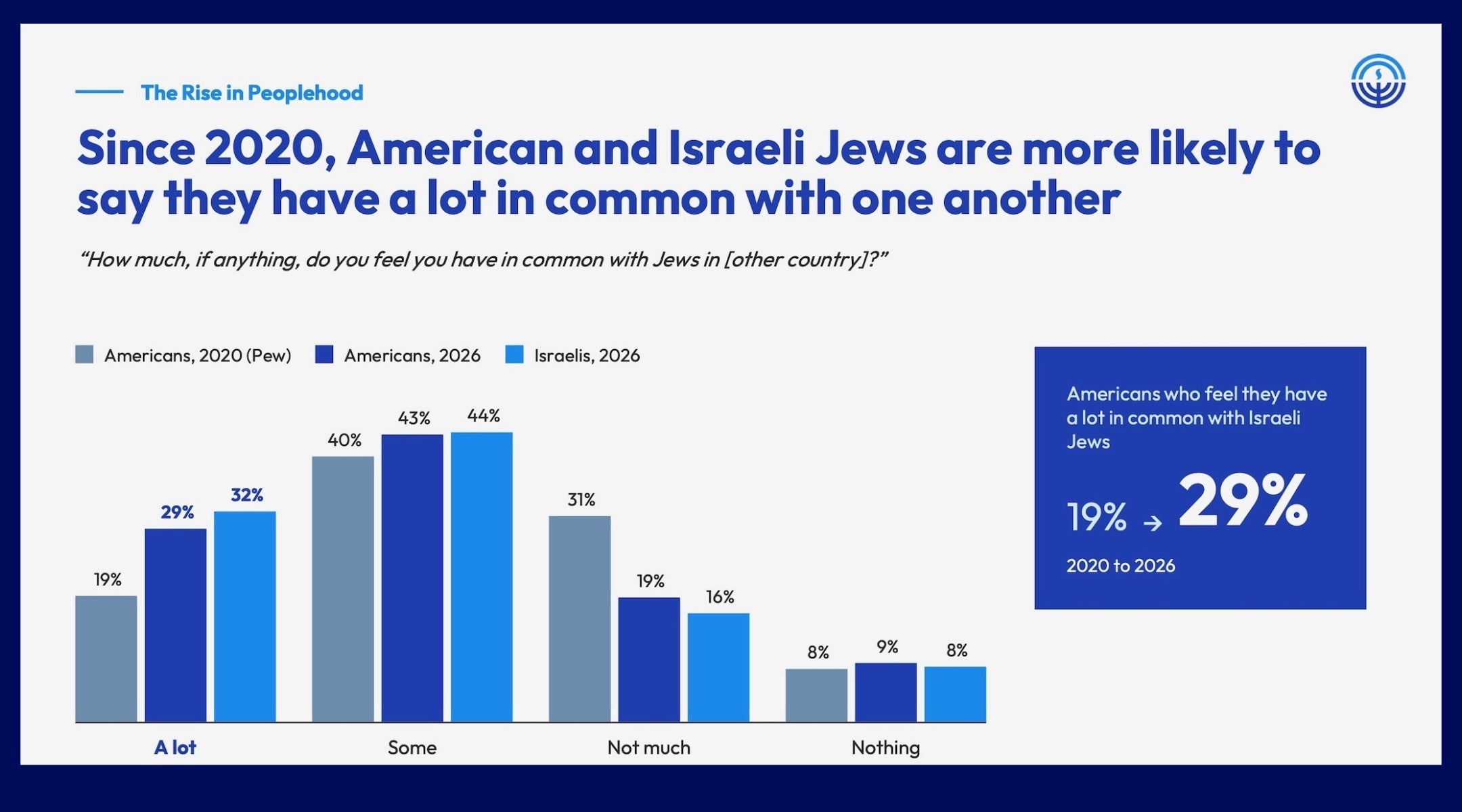
But our data, gathered in May and June, are clear: American and Israeli Jews feel closer to one another today than we have in years, and that closeness has grown alongside the “surge” — the sustained rise in American Jewish engagement we’ve tracked since Oct. 7.
To be sure, our research also found places where American and Israeli Jews see things differently. We’ll take that on directly in an upcoming piece. But it is important to start with the reawakening of shared peoplehood since Oct. 7, an important development that is the foundation upon which all other discussions should begin.
The share of American Jews who describe Israelis as extended family or part of their own community has climbed from 46% to 62% since 2021. Today, fully 71% of American Jews feel emotionally attached to Israel. In contrast, the share of American Jews who say they feel no real connection at all to Jews in Israel has dropped by more than half since 2021, from 28% to 13%.
Israelis show movement in the same direction. The share calling American Jews extended family or part of their own community climbed from 45% to 53% over the same period, while the share saying they feel nothing in common with American Jews dropped from 14% to 10%.
Seventy-nine percent of Israelis and 56% of Americans affirm that Jews around the world, regardless of where they live, share a common fate and must act accordingly. Most also reject the idea that Jewish life in the diaspora is a “problem” to be solved through aliyah, or immigration to Israel. Early Zionist thought was built in part on the concept of shlilat hagalut, the “negation of exile,” the belief that Jewish life outside Israel was inherently unsustainable and needed to be resolved through return to the land. That idea has receded sharply from mainstream Jewish and Zionist thought since the state’s founding.
This deepening sense of shared peoplehood shows up in action, not just sentiment. In the first two years following Oct. 7, the Jewish federation system raised $908 million through the Israel Emergency Campaign, funding more than 4,200 grants to 877 organizations across 208 communities in Israel. North American Jews made that giving possible. Israeli organizations and Israeli society did the work of turning it into recovery on the ground. Sixty-eight percent of Israelis said that American Jewish philanthropic giving after Oct. 7 made them feel that Diaspora Jews genuinely care about Israel and Israelis. (Jewish federations raised and allocated $908 million in emergency support for Israel following the attacks, before shifting to a new giving framework to “Rebuild Israel”).
As noted, the rise in a shared sense of peoplehood between U.S. and Israeli Jews closely mirrors the surge in Jewish engagement domestically that we’ve followed closely for three years. Engagement with Jewish life among American Jews is up 38% today, and that rise tracks with a rise in connection to Israel. That 38% reflects people who changed what they do. Another 12% felt a stronger pull toward Jewish identity and pride in peoplehood without yet changing their behavior. Together, that’s roughly half of AmericanJews registering some shift in connection since Oct. 7.
When we asked American Jews in open-ended discussion why they feel connected to Israel, the top reasons were remarkably consistent: seeing Israel as a safe place for Jews, including for themselves; seeing Israel as the homeland of the Jewish people; having a sense that Israel is where Jewish history began; believing that Jews are responsible for one another, and holding religious or biblical connection. Others pointed to feeling more whole in Israel, the belief that the Holocaust made a Jewish homeland necessary, that Israel is part of their own culture and simply feeling pride in Israelis themselves.
While much of this growing sense of interconnectedness emerges from the events of the last few years, especially the shock American Jews felt on Oct. 7 and the pain Israelis feel watching antisemitism rise around the world, there are clear elements of the results that we can build upon, influence and encourage. American Jews who have traveled to Israel once are 1.7 times as likely to feel real commonality with Israeli Jews. American Jews who have traveled to Israel more than once are 3.8 times more likely to feel commonality with Israeli Jews. American Jews who have lived in Israel, perhaps not surprisingly, are 11.2 times more likely to share this sense of peoplehood.

The same holds true in reverse. Visiting the U.S. as a tourist doesn’t move an Israeli’s sense of connection to American Jews. But compared to Israelis overall, those who participate in Jewish communal life while visiting are 2.8 times as likely to feel a sense of peoplehood with American Jews, and those who serve as emissaries, work at a Jewish camp or otherwise live inside an active American Jewish community while in the U.S. are 2.6 times as likely.
This is also true for Israeli Jews who encounter American Jews in Israel. Eighty-seven percent of Israeli Jews with real, engaged contact with American Jews feel commonality with us at far higher rates, compared to 52% among those with no contact. This gap holds even after taking into account religious practice and political ideology. Fifty-seven percent of Israeli Jews with real contact describe American Jews as siblings or extended family, compared to 45% among those with little or no contact.
We are in another challenging season for the Jewish people. Upcoming elections in Israel and the United States bring their own pressures and highlight disagreements both within and between our Jewish communities. It would be easy to conclude that we have more differences than we have commonalities, and to approach discussions from a place of distance and division. But there is opportunity in this tense moment to recognize our deep sense that we are one community.
Our data confirm that today we feel closer than ever, and we recognize that our lives are shaping each other’s. Perhaps even more importantly, our data show what we can do to strengthen and perpetuate this trend. We need to keep investing in things we know build connection: more travel, more Israeli emissaries in North American communities and more programs that put people in real contact — especially partnership programs between US and Israeli communities like Partnership2Gether, which has connected people and communities for more than three decades.
And we need to scale innovation that will enable shared volunteer projects, philanthropic partnerships across both communities, stronger business and professional ties and digital opportunities to learn from one another. These opportunities can ensure impact when travel is impractical, reach those who are less engaged and ensure that this sense of connection to and understanding of Jews across the world is accessible to everyone in our greater Jewish family and community.
Our tradition teaches that “kol yisrael arevim zeh bazeh,” all Jews are responsible for one another. That responsibility isn’t theoretical. It is the reason we show up for each other in moments that matter. Three years after Oct. 7, our data tell us we are still showing up.
This article originally appeared on JTA.org.
The post U.S. and Israeli Jews are drifting apart? The data tell a different story. appeared first on The Forward.
