


Uncategorized
They rallied rabbis against Mamdani’s anti-Zionism. What does The Jewish Majority do next?
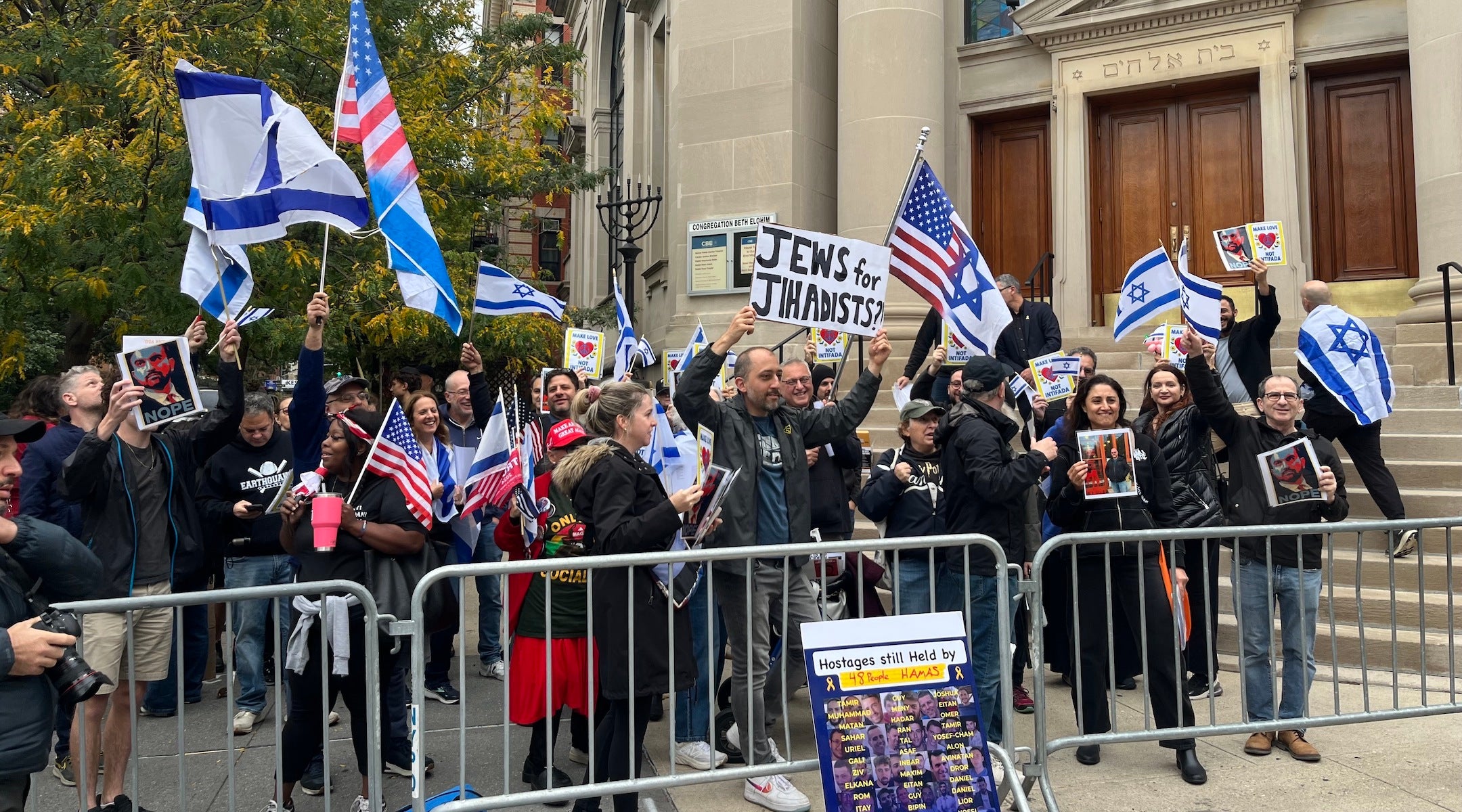
(JTA) — Plenty of Jews were concerned about the specter of Zohran Mamdani becoming mayor of New York. But few did as much to mobilize other Jews around the issue as Jonathan Schulman.
Via his newly formed organization, The Jewish Majority, Schulman circulated a letter to rabbis and cantors around the country opposing “rising anti-Zionism and its political normalization throughout our nation.” The letter, which called out Mamdani by name, was signed by more than 1,100 Jewish congregational leaders — one of the most widely endorsed missives of its kind — and galvanized many clergy who had been reluctant to use their pulpits to wade into a political arena.
They didn’t get what they wanted. Yet the day after a decisive victory by Mamdani, Schulman wasn’t as despondent as one might imagine. Instead, he sees his group’s work as a success.
“This wasn’t about Mamdani,” he told the Jewish Telegraphic Agency on Wednesday, rejecting the suggestion that his campaign amounted to an effort to get Jews to vote against the mayor-elect.
Instead, Schulman said, The Jewish Majority proved that it could combat a “subversion of the accurate representation of the Jewish narrative.”
He sees his work as simple: providing an organized Jewish voice, on Israel and other issues, to counteract what he sees as the growing influence of left-wing Jewish groups like Jewish Voice for Peace and Jews for Racial and Economic Justice. As members of those groups have aligned closely with Mamdani and stand to grow their influence under his administration, the Jewish Majority aims to serve as a counter-narrative.
“They exist to present fringe views to the public as normative,” he said. “If we decide to let them be the only ones to hold the microphone, that would be a mistake we can’t afford to make.” That includes on the issue of “political anti-Zionism,” which Schulman insists was the goal of the rabbinic letter — rather than an explicit anti-endorsement of Mamdani as a candidate.
There are an estimated 3,000 to 4,000 rabbis in the United States, meaning that potentially a third of them signed on to a single statement. Others indicated that they agreed with the sentiments but chose not to sign for other reasons.
“We’ve seen countless examples over the past couple of years of Jews coming out in support of anti-Zionist candidates,” Schulman said. “And now that narrative has shifted. Now you look at that narrative and it’s hard to say, ‘Well, look, these rabbis are supporting this candidate.’ Well, in fact, what you’re seeing is overwhelmingly one of the largest displays of rabbinic unity that we’ve seen in our country, saying we don’t accept the normalization of political anti-Zionism.”
He is skeptical of early exit polling purporting to show as many as one-third of Jewish voters in New York breaking for Mamdani, and suspects the actual number is closer to the “80-20” split that research suggests also reflects the Jewish consensus around Zionism.
Promoting an institutional Jewish consensus will continue post-Mamdani. Schulman insisted The Jewish Majority would not be making policy, only amplifying the views of major Jewish groups such as the Anti-Defamation League, the American Jewish Congress, Jewish federations and the New York Board of Rabbis. He also said he would not seek to join the Conference of Presidents of Major Jewish Groups or other coalitions.
“We’re here to reflect,” he said. “It’s not my job to weigh in.” One item on his agenda, he said, is instituting “training programs” to teach Jewish leaders how to “present normative communal perspectives.”
Schulman has felt his own priorities within the Jewish community shift. Before striking off on his own, he spent 18 years at the pro-Israel lobbying giant AIPAC. One of his duties was to “work with congregations throughout the United States to increase the level of pro-Israel political activism in American synagogues.”
He left AIPAC in August 2024, as the group’s brand was becoming increasingly toxic amid the war in Gaza. Today even some moderate Democrats, like Massachusetts Senate candidate Seth Moulton, have sworn off accepting AIPAC donations. When radio host Charlamagne tha God wanted to insult Democratic Minority Leader Hakeem Jeffries as someone with no real principles, he called the Brooklyn congressman “AIPAC Shakur.”
Schulman declined to comment on whether he had split from AIPAC ideologically. “I have a lot of respect for my former colleagues, and it’s a great organization,” he said. Nor does he see his work with The Jewish Majority as a throughline from his work there. Despite the overlapping focus on Jewish clergy, he insisted, this is “not ‘AIPAC by a different name.’”
Instead, he said, he left AIPAC because he had identified this new problem — the growing influence of left-wing Jewish groups after Oct. 7 — and wanted to counteract it, in a way he deemed non-political in nature. Even with all the Jewish organizations that were opposing anti-Zionism on the national stage, he said, “there is nobody whose job is to make sure that the Jewish community is accurately represented, that Jewish communal values are accurately represented.”
Those same Jewish groups, whose priorities he hopes to give a megaphone to, are scrambling in the wake of Mamdani’s big win. The ADL has launched a “Mamdani monitor” to keep tabs on the new mayor’s administration. JFREJ, meanwhile, sees no reason to come to the Jewish center: A victory Zoom call scheduled for Thursday to “celebrate our massive win” is set to feature pro-Palestinian activist Linda Sarsour and Jamaal Bowman, the former “Squad” congressman who is rumored to be on Mamdani’s schools chancellor shortlist.
Schulman is optimistic about building an organized Jewish counter-narrative to that perspective — so long as the ceasefire in Gaza holds.
“The American Jewish community has been undergoing a profound change, and because we’ve been in the middle of this war, which has been a propaganda war here in America that we’ve seen proliferating, we haven’t had the capacity to really think about, ‘What is the future going to look like?’” he said.
“People are starting to finally say, OK, the fighting has stopped, and we need to think about how the Jewish community is going to be able to represent itself for the long haul.”
The post They rallied rabbis against Mamdani’s anti-Zionism. What does The Jewish Majority do next? appeared first on The Forward.
Uncategorized
Canadian progressive party picks Jewish anti-Zionist politician as its leader
(JTA) — Canada’s main progressive party aims to make a comeback under its new leader Avi Lewis, a Jewish anti-Zionist.
Lewis, a filmmaker and former journalist, was elected to lead the New Democrats on Sunday. He campaigned on principles that have energized the global left, including affordability, the environment and unapologetic anti-Zionism. He repeated his position on Israel in his acceptance speech in Winnipeg.
“When Israel commits a genocide in Gaza, we call it by its name, and we do everything in our power to bring it to an end,” Lewis said in his speech.
Lewis hopes to rebuild a party that suffered its worst losses in history during the 2025 federal election. Center-left voters who were alarmed by President Donald Trump’s threats to Canada flocked to the Liberal Party and elected Mark Carney as prime minister.
Lewis comes from a line of progressive royalty. His grandfather, David Lewis, was one of the founding members of the New Democrats and its leader in the 1970s. His father, Stephen Lewis, led the party in Ontario. He is also the great-grandson of Moishe Lewis, who was an outspoken member of the socialist Jewish Labour Bund in Eastern Europe and immigrated to Canada in 1921.
Lewis is married to Naomi Klein, a prominent author and critic of Israel. Klein was among several writers who declined to participate in PEN America’s annual World Voices festival in 2024, saying the group failed to “stand firmly” with Palestinian writers. She also addressed protesters during a rally outside U.S. Senate Majority Leader Chuck Schumer’s residence in Brooklyn during Passover that year, called “Seder in the Streets to Stop Arming Israel,” and urged Jews against worshipping the “false idol” of Zionism.
Lewis was formerly a reporter for the Canadian Broadcasting Corporation and Al Jazeera. In a debate with other candidates in January, he described himself as an “anti-Zionist Jewish person” seeking to “unlearn and unpack the Zionist myths that most Canadian Jews were brought up with.”
The Centre for Israel and Jewish Affairs, an advocacy arm of the Jewish Federations of Canada, said it acknowledged Lewis’ victory “with a deep sense of sadness.”
“Avi Lewis is himself Jewish, and we respect his family’s history in this party,” the group said a statement. “But Jewish identity is not a shield against accountability. When a leader declares that Zionism is inseparable from ethnic cleansing, he is not engaging in legitimate policy critique. He is telling Jewish Canadians that a core part of their identity is illegitimate.”
On the eve of the New Democratic Party’s leadership convention, CIJA joined dozens of rabbis from across the country in an open letter criticizing the party.
“Too often, the NDP’s response to antisemitism in Canada has been inconsistent, hesitant, or clouded by rhetoric that fails to recognize how hatred manifests in today’s environment,” said the letter.
Perhaps anticipating Lewis’ victory, they added, “Even more troubling is the repeated elevation of fringe or non-representative Jewish voices to deflect, dilute, or dismiss the legitimate concerns of the vast majority of the Canadian Jewish community.”
This article originally appeared on JTA.org.
The post Canadian progressive party picks Jewish anti-Zionist politician as its leader appeared first on The Forward.
Uncategorized
Netanyahu orders Church of the Holy Sepulchre open after Palm Sunday closure flares tensions
(JTA) — Israeli Prime Minister Benjamin Netanyahu has ordered that the top Catholic clergy in Israel be allowed into the Church of the Holy Sepulchre ahead of Easter, in an attempt to calm tensions that flared after police blocked their access.
Police cited wartime restrictions when prohibiting Cardinal Pierbattista Pizzaballa and three other Catholic representatives from visiting the church, located in the Old City of Jerusalem, on Palm Sunday, a holy day for Christians.
Many holy sites in the city, including the Western Wall for Jews and al-Aqsa Mosque for Muslims, have been closed or tightly restricted since the start of the Iran war last month because they lack bomb shelters for the number of people who typically gather there. Shrapnel from Iranian missiles have landed in the Old City multiple times, including near the Church of the Holy Sepulchre.
But the prohibitions on Pizzaballa’s access come at a time when some Christians are expressing concern that Israel is discriminating against them. A statement from the Latin Patriarchate on Sunday accusing Israel of having made a “hasty and fundamentally flawed decision, tainted by improper considerations,” seemed to fuel those sentiments.
“For the first time in centuries, the Heads of the Church were prevented from celebrating the Palm Sunday Mass at the Church of the Holy Sepulchre,” the Latin Patriarchate said. “This incident is a grave precedent and disregards the sensibilities of billions of people around the world who, during this week, look to Jerusalem.”
Christians believe that the church is the site of Jesus’ burial and resurrection, making prayers at the site on Palm Sunday, which kicks off the week leading up to Easter, particularly significant. Pizzaballa was seeking to pray privately at the site, not lead a major service as is typical.
Criticism over the closure resounded across the globe, including among allies of the Israeli government. Italian Prime Minister Giorgia Meloni condemned the closure as “an insult” and U.S. Ambassador to Israel Mike Huckabee called it “difficult to understand or justify” given that wartime rules prohibit only gatherings of 50 or more.
Soon, Israeli authorities were negotiating a special arrangement that would allow Pizzaballa and a handful of other Christian leaders access to the holy sites without opening them widely. Israeli President Isaac Herzog said he called Pizzaballa personally to express his commitment to religious freedom.
“I reiterate the unwavering commitment of the State of Israel to the freedom of worship for people of all faiths and the importance of upholding the status quo at the holy sites in Jerusalem,” Herzog said in a statement.
For his part, Pizzaballa downplayed the incident when speaking to a Catholic news channel. “There were no clashes, and we don’t want to force matters, but rather figure out what to do while respecting the right to prayer,” he said. “There were misunderstandings, we didn’t understand each other, and that’s what happened. It’s never happened before; it’s a shame this happened. This morning’s events are important, but we must consider the broader context. There are people who are much worse off than us who cannot celebrate for very different reasons. Once again, we are celebrating a subdued Easter.”
The police said the closure was justified because in addition to the lack of bomb shelters in the Old City, the area’s narrow and winding streets make it hard for emergency vehicles to reach anyone who might be injured in an attack.
Netanyahu said that while he understood the safety considerations involved in turning Pizzaballa back on Sunday, he had called for changes going forward.
“I have instructed the relevant authorities that Cardinal Pierbattista Pizzaballa, the Latin Patriarch, be granted full and immediate access to the Church of the Holy Sepulchre in Jerusalem,” he said in a statement.
The dustup came as Pope Leo, in his Palm Sunday address in the Vatican, condemned the Iran war and lamented that Christians in the Middle East “are suffering the consequences of a brutal conflict and, in many cases, are unable to observe fully the liturgies of these holy days.”
This article originally appeared on JTA.org.
The post Netanyahu orders Church of the Holy Sepulchre open after Palm Sunday closure flares tensions appeared first on The Forward.
Uncategorized
While sculpting Jesus, this Jewish artist wrestled with his demons
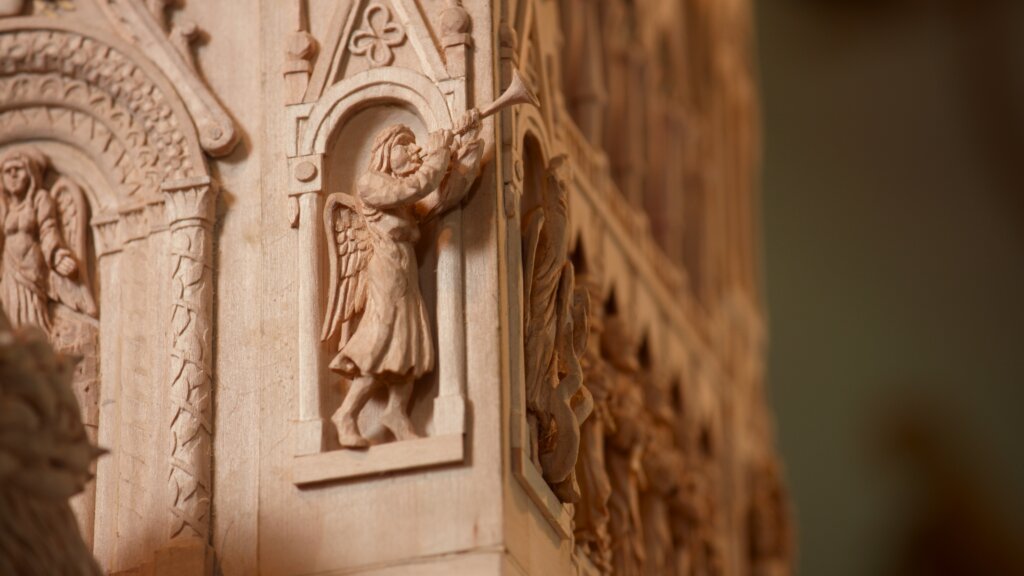
You may not know the name Jimmy Grashow, but it’s likely you’ve seen his work. His psychedelic drawings have been featured in The New York Times, Ms. and Playboy. He illustrated album covers for The Yardbirds and Jethro Tull. His cardboard sculptures of people, animals and buildings have been shown all over the country, including at MoMA, the Library of Congress, and the San Jose Museum of Art. Within the first 30 seconds of Jimmy & the Demons, a documentary about the artist directed by Cindy Meehl, I recognized his cardboard sculptures of a dancing couple; a version lives in the Cameron Art Museum in Wilmington in my home state of North Carolina.
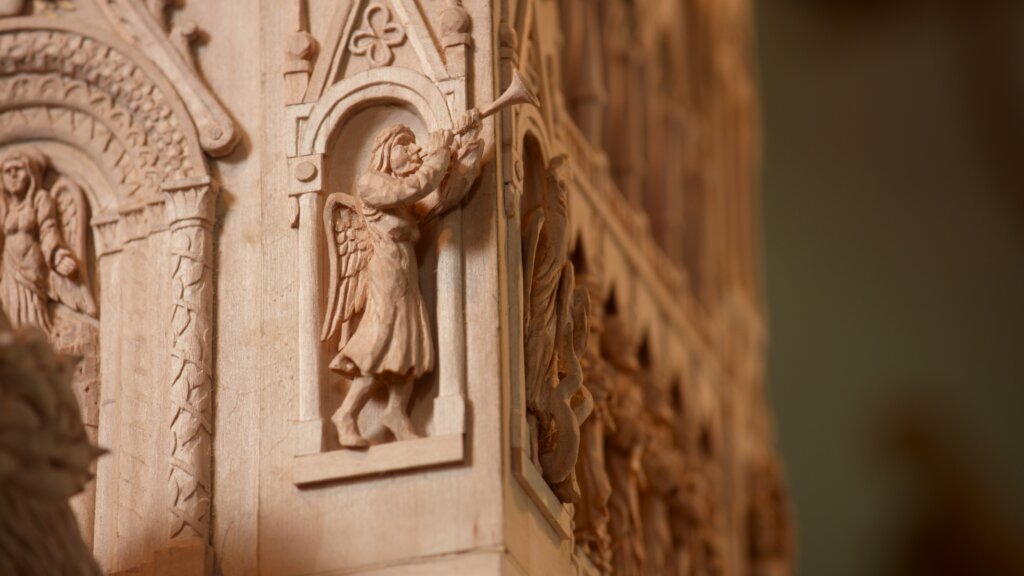
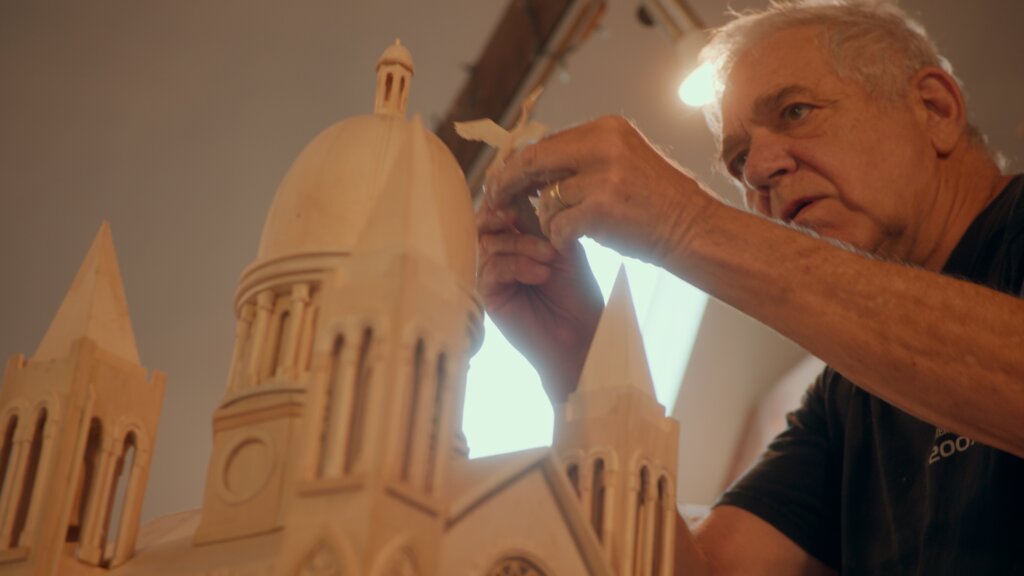
The documentary follows Grashow as he works on his latest commission: an eight-foot tall wooden sculpture of Jesus hoisting a cathedral on his back, while demons, each one completely different from the other, reach out of the flames around his feet. The cathedral’s intricate exterior is matched by an equally elaborate interior: A mural of Eden decorates the cathedral wall and a figure resembling the piece’s commissioner Michael Marocco, a Catholic art collector who has several Grashow pieces in his private sculpture garden, kneels in prayer. If you look closely at the mural, you can see God’s name written in Hebrew on a painted banner. The cathedral’s stained glass windows are illuminated by an electric bulb.
Grashow’s work is painstakingly detailed and took years to complete, as the slightest error in measurement or cut could have ruined the whole thing. While the documentary doesn’t last for years the way the project did, it follows a similarly leisurely pace, spending lots of moments in silence with Grashow in his home workshop in Redding, Connecticut. It’s a close look at the mostly solitary work of an artist, although viewers also get a few moments to meet Grashow’s family, including his daughter who is a rabbi.
Meehl has profiled unconventional figures in her past documentaries, such as Buck, about horse whisperer Dan “Buck” Brannaman, and The Dog Doc, about holistic veterinarian Marty Goldstein. Grashow, who passed away in September 2025, three months after the film premiered at the Tribeca Film Festival, is no exception.
Despite his artistic talent, Grashow said that as a kid he “felt inadequate in every way.” Dyslexic and bad at math, Grashow struggled in his Brooklyn high school. At home, he felt overshadowed by his athletic brother and brilliant older sister. But he found a place to succeed at the Pratt Institute, where he studied woodworking, and received a Fulbright to study in Florence. There he fell in love with the cathedrals that would appear in many of his projects over the years.
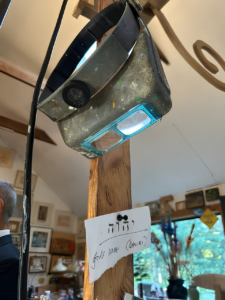
Grashow did not view his sculpture of Christ as conflicting with his Jewish faith, noting the relationship between the word “Israel,” which means one who wrestles with God, and the meaning he saw in the piece.
“The world is full of peril and devils,” Grashow said. “And there you are trying to carry your faith and keep your faith alive. It’s a simple idea of trying to move forward in life with chaos and the possibility of chaos everywhere.”
“I’m wrestling all the time,” Grashow said. “It’s a brutal world.”
Grashow told the filmmakers that, when the idea for Marocco’s sculpture came to him, he “knew it was like a hineini moment,” using the term which means “here I am” and is also the name of a prayer traditionally chanted during the High Holidays, implying that one is showing up as their full self, with all of their flaws.
“It was God saying ‘Here’s this’ and it was up to me to say ‘Here I am. I’ll do it,’” Grashow said.
It was not a simple task. In addition to the years spent building the project, there was an emotional toll. Early in the film, Grashow says that the project feels like “the grand finale.” He asks that the filmmakers not share that information with his wife, Guzzy, although she later tells them herself that she feels Grashow’s time is running out.
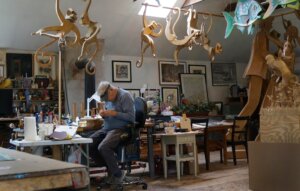
Later in the film, the Museum Contemporary Art in Westport, Connecticut offers Grashow a retrospective exhibit of his work, with the new piece at the center. Grashow’s musings about death imbue the project with a sense of urgency and the proposed exhibit title is fittingly Man, Mortality: A Retrospective. However, when the museum refuses to fully fund the show, Grashow and Guzzy are left scrambling for a way to showcase his life’s work.
As Grashow wrestles with his own corporality, his art is both an escape from and an expression of his worries.
“When I’m doing demons, I know that it’s a little boy playing,” he said. “And an old man being terribly afraid.”
Jimmy & the Demons opens in New York at the Quad Cinema on April 3, 2026.
The post While sculpting Jesus, this Jewish artist wrestled with his demons appeared first on The Forward.