
Uncategorized
They were denied Jewish weddings in the Soviet Union. So these 3 couples just got married again.
BOSTON (JTA) – Veiled brides holding white bouquets; a gold-colored chuppah; the signing of ketubahs, Jewish marriage contracts; lively Jewish music wafting through a social hall as guests danced the hora.
It had all the telltale signs of a traditional Jewish wedding. But the three couples were already married — and had been for a collective total of 125 years.
The event on Wednesday was an opportunity for three Ukraine-born couples to have the Jewish ceremonies they could not have when they first wed, when Jewish practice was forbidden under communism in their country.
“It was my dream for many, many years and dreams come true,” said Elisheva Furman, who first married her husband Fishel in Ukraine 50 years ago.
Held by Shaloh House, a Chabad Lubavitch organization in Boston that serves Jews from the former Soviet Union, the event was also an opportunity for Chabad rabbinical students to practice officiating at Jewish weddings.
Shaloh House launched a rabbinical training institute in 2021, after Rabbi Shlomo Noginski, an educator at the school, was stabbed eight times outside the building in a vicious attack that jolted Boston and especially its Jewish community.
“This wedding ceremony is a victory of love and kindness over oppression and hate,” said Rabbi Dan Rodkin, director of Shaloh House, in a statement. “It is a testament to the strength of the Jewish people and the resilience of these Soviet-born couples, who want to celebrate their union in accordance with their faith and heritage.”
Rodkin himself grew up in Russia. The Chabad movement, which is especially strong in the former Soviet Union, where it was born, has sought to reach Jews from the region whose practices and connection to Judaism were attenuated by living under communism. Shaloh House offers a school, synagogue and community center all focused on Boston’s substantial community of Russian-speaking emigres.
Growing up, despite antisemitic repression, Elisheva and Fishel Furman both said their families maintained a strong Jewish identity and privately observed Jewish holidays. But “it was dangerous” to show their faith in public, said Elisheva, the grandmother of four. So when they got married, they did so only in a civil ceremony.
A couple prepares to step on a glass, a symbol in Jewish weddings, after their Jewish ceremony in Boston, Feb. 7, 2023. (Photo by Igor Klimov)
Their religious ceremony and the two others that took place Wednesday, individualized for each couple, stretched for more than four hours and featured a festive meal and desserts including traditional Ukrainian and Russian foods.
The event took place in the lead-up to the one-year anniversary on Feb. 24, of Russia’s invasion into the couples’ homeland that is under ruthless bombardment that is devastating Ukraine.
Rimma Linkova, who’s been married to Alexander Linkov for 40 years, and one was of the other couples being married, has a cousin still in Ukraine. They talk regularly, she said.
“It’s almost one year of the war and it’s still not ended. It’s very difficult. It’s dying for no reason.” Linkov said.
The third couple was Sofya Hannah and Gedalia Gulnik, who used their Hebrew names.
Yelena Gulnik said she was thrilled to see her parents have a Jewish wedding, something she said her father was initially hesitant to do after so many years of marriage. The mother of three, whose kids attend Shaloh House’s day school, was born in Odessa and came in 1994 with her parents to Boston when she was 12 years old.
“My parents never had a chuppah, they never had a religious ceremony. They were not familiar with many religious Jewish traditions,” Gulnik said. “But it was an amazing opportunity. I don’t think they would have ever done this if Rabbi Rodkin hadn’t offered.”
Being at a wedding for her grandparents is “a little weird since you don’t see it every day,” Yelena’s oldest daughter said. “But it’s certainly exciting.”
Among the attendees were New England Patriots Jewish owner Robert Kraft, and his wife, Dana Blumberg, who themselves were married in November. Kraft, whose Campaign to Fight Antisemitism philanthropy launched in 2019, made a $250,000 donation following the attack on Noginski that helped start the rabbinic program.
New England Patriots owner Robert Kraft dances at a wedding ceremony for Ukrainian couples who did not have Jewish weddings in their native country, Boston, Feb. 7, 2023. Rabbi Shlomo Noginski is on his left. (Photo by Igor Klimov)
“When I saw Rabbi Noginksi getting stabbed in my hometown of Boston, it hurt me,” Kraft told JTA at the wedding.
“This hit close to home, which was shocking to me,” he elaborated in an email response to a question. “It’s an important reminder that antisemitism and hate happens everywhere, even in a community like ours.”
“Since the attack, I have been moved by how Rabbi Noginski has used this horrible incident as an opportunity to raise awareness of the prevalence of antisemitism and the need to stand up to all acts of hatred,” Kraft wrote. “He is a real hero, who not only saved lives that day, but continues to use his experience to educate others.”
Noginski’s personal story has struck a chord for many. As a young man growing up in St. Petersburg, he and his mother experienced antisemitism, eventually leading them to move to Israel. He and his wife, who at the time of the attack had only recently arrived in Boston, have 12 children.
He has added his voice beyond Boston, speaking in Hebrew at a Washington D.C. rally on antisemitism in July 2021, less than two weeks after the attack. His alleged attacker was arrested but has not yet been tried.
But while the attack was in the background at the wedding event, it was not the main focus as the families celebrated together.
“The wedding has enormous meaning,” said Dmitry Linkov about his parents’ ceremony.
He was 5 when his family left Kyiv and settled in Boston. They lived secular lives when he and his younger sister was growing up, he said, but he and his wife, active in Chabad in Chestnut Hill, now embrace more religious practice and observe Shabbat and keep a kosher home.
“What my parents have done tonight will be passed on for generations. It’s a blessing for our future generations,” Dmitry Linkov told JTA.
He hopes the Jewish wedding ceremony inspires other Jews from the former Soviet Union who fled persecution.
“They are celebrating for a nation,” he said. “It’s pretty amazing.”
Mazels: Tell Us About Your Life Milestones
Have you or a loved one celebrated a Jewish life-cycle event recently? We’re thinking bar/bat mitzvahs, weddings, conversions, and so on. We want to hear about them!
Share some details with us below, and we may reach out for more information.
By filling this out, you acknowledge you agree to JTA’s Privacy Policy: jta.org/privacy-policy
What type of milestone are you sharing?(Required)
—
The post They were denied Jewish weddings in the Soviet Union. So these 3 couples just got married again. appeared first on Jewish Telegraphic Agency.
Uncategorized
How the Global Religious Landscape Changed from 2010 to 2020

Muslims grew fastest; Christians lagged behind global population increase
• Christians are the world’s largest religious group, at 28.8% of the global population. They are a majority everywhere except the Asia-Pacific and Middle East-North Africa regions. Sub-Saharan Africa has surpassed Europe in having the largest number of Christians. But Christians are shrinking as a share of the global population, as millions of Christians “switch” out of religion to become religiously unaffiliated.
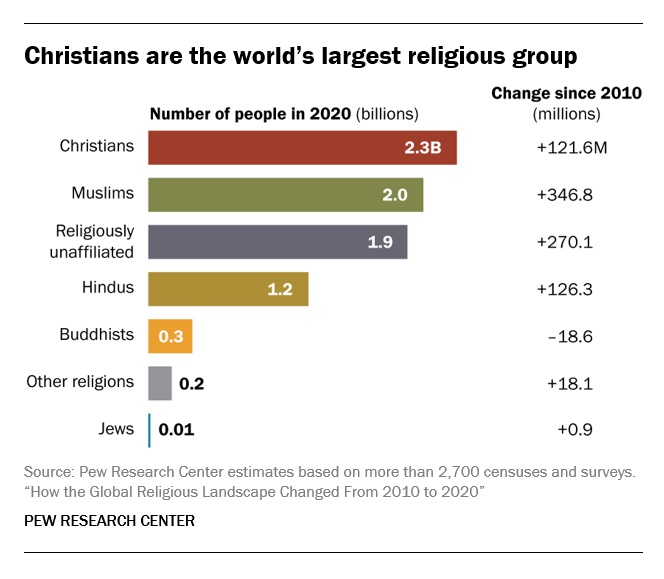
• Muslims are the world’s second-largest religious group (25.6% of the world’s population) and the fastest-growing major religion, largely due to Muslims’ relatively young age structure and high fertility rate. They make up the vast majority of the population in the Middle East-North Africa region. In all other regions, Muslims are a religious minority, including in the Asia-Pacific region (which is home to the greatest number of Muslims).
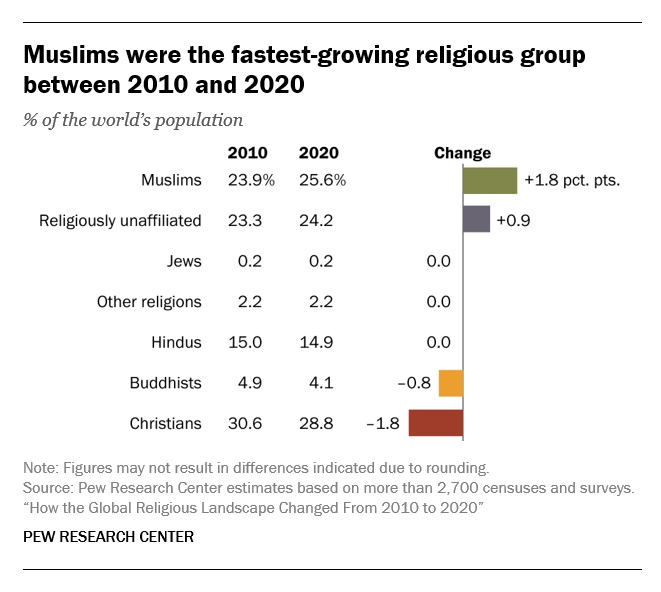
• The religiously unaffiliated population is the world’s third-largest religious category (24.2% of the global population), after Christians and Muslims. Between 2010 and 2020, religiously unaffiliated people grew more than any group except Muslims, despite their demographic disadvantages of an older age structure and relatively low fertility. The unaffiliated made up a majority of the population in 10 countries and territories in 2020, up from seven a decade earlier.
• Hindus are the fourth-largest religious category (14.9% of the world’s population), after Christians, Muslims and religiously unaffiliated people. Most (99%) live in the Asia-Pacific region; 95% of all Hindus live in India alone. Between 2010 and 2020, Hindus remained a stable share of the world’s population because their fertility resembles the global average, and surveys indicate that switching out of or into Hinduism is rare.
• Buddhists (4.1% of the world’s population) are the only group in this report whose number declined worldwide between 2010 and 2020. This was due both to religious disaffiliation among Buddhists in East Asia and to a relatively low birth rate among Buddhists, who tend to live in countries with older populations. Most of the world’s Buddhists (98%) reside in the Asia-Pacific region, the birthplace of Buddhism.
• Jews, the smallest religious group analyzed separately in this report (0.2% of the world’s population), lagged behind global population growth between 2010 and 2020 – despite having fertility rates on par with the global average – due to their older age structure. Most Jews live either in North America (primarily in the United States) or in the Middle East-North Africa region (almost exclusively in Israel).
These are among the key findings of a Pew Research Center analysis of more than 2,700 censuses and surveys, including census data releases that were delayed due to the coronavirus pandemic. This report is part of the Pew-Templeton Global Religious Futures project, which analyzes global religious change and its impact on societies around the world. Funding for the Global Religious Futures project comes from The Pew Charitable Trusts and the John Templeton Foundation.
Uncategorized
Antisemitism in some unlikely places in America
By HENRY SREBRNIK Antisemitism flourishes in a place where few might expect to confront it – medical schools and among doctors. It affects Jews, I think, more emotionally than Judeophobia in other fields.
Medicine has long been a Jewish profession with a history going back centuries. We all know the jokes about “my son – now also my daughter – the doctor.” Physicians take the Hippocratic Oath to heal the sick, regardless of their ethnicity or religion. When we are ill doctors often become the people who save us from debilitating illness and even death. So this is all the more shocking.
Yes, in earlier periods there were medical schools with quotas and hospitals who refused or limited the number of Jews they allowed to be affiliated with them. It’s why we built Jewish hospitals and practices. And of course, we all shudder at the history of Nazi doctors and euthanasia in Germany and in the concentration camps of Europe. But all this – so we thought – was a thing of a dark past. Yet now it has made a comeback, along with many other horrors we assume might never reappear.
Since the Hamas attack on Israel on October 7, 2023, there has been a resurgence of antisemitism, also noticeable in the world of healthcare. This is not just a Canadian issue. Two articles on the Jewish website Tablet, published Nov. 21, 2023, and May 18, 2025, spoke to this problem in American medicine as well, referencing a study by Ian Kingsbury and Jay P. Greene of Do No Harm, a health care advocacy group, based on data amassed by the organization Stop Antisemitism. They identified a wave of open Jew-hatred by medical professionals, medical schools, and professional associations, often driven by foreign-trained doctors importing the Jew-hatred of their native countries, suggesting “that a field entrusted with healing is becoming a licensed purveyor of hatred.”
Activists from Doctors Against Genocide, American Palestinian Women’s Association, and CODEPINK held a demonstration calling for an immediate cease-fire in Gaza at the Hart Senate Office Building in Washington, D.C., Nov. 16, 2023, almost as soon as the war began. A doctor in Tampa took to social media to post a Palestinian flag with the caption “about time!!!” The medical director of a cancer centre in Dearborn, Michigan, posted on social media: “What a beautiful morning. What a beautiful day.” Even in New York, a physician commented on Instagram that “Zionist settlers” got “a taste of their own medicine.” A Boston-based dentist was filmed ripping down posters of Israeli victims and a professor at the University of Pennsylvania Perelman School of Medicine did the same. Almost three-quarters of American medical associations felt the need to speak out on the war in Ukraine but almost three-quarters had nothing to say about the war in Israel.
Antisemitism in academic medical centres is fostering noxious environments which deprive Jewish healthcare professionals of their civil right to work in spaces free from discrimination and hate, according to a study by the Data & Analytics Department of StandWithUs, an international, non-partisan education organization that supports Israel and fights antisemitism.
“Academia today is increasingly cultivating an environment which is hostile to Jews, as well as members of other religious and ethnic groups,” StandWithUs director of data and analytics, and study co-author, Alexandra Fishman, said on May 5 in a press release. “Academic institutions should be upholding the integrity of scholarship, prioritizing civil discourse, rather than allowing bias or personal agendas to guide academic culture.”
The study, “Antisemitism in American Healthcare: The Role of Workplace Environment,” included survey data showing that 62.8 per cent of Jewish healthcare professionals employed by campus-based medical centres reported experiencing antisemitism, a far higher rate than those working in private practice and community hospitals. Fueling the rise in hate, it added, were repeated failures of DEI (diversity, equity, and inclusion) initiatives to educate workers about antisemitism, increasing, the report said, the likelihood of antisemitic activity.
“When administrators and colleagues understand what antisemitism looks like, it clearly correlates with less antisemitism in the workplace,” co-author and Yeshiva University professor Dr. Charles Auerbach reported. “Recognition is a powerful tool — institutions that foster awareness create safer, more inclusive environments for everyone.”
Last December, the Data & Analytics Department also published a study which found that nearly 40 per cent of Jewish American health-care professionals have encountered antisemitism in the workplace, either as witnesses or victims. The study included a survey of 645 Jewish health workers, a substantial number of whom said they were subject to “social and professional isolation.” The problem left more than one quarter of the survey cohort, 26.4 per cent, “feeling unsafe or threatened.”
The official journal of the Alliance for Academic Internal Medicine concurs. According to “The Moral Imperative of Countering Antisemitism in US Medicine – A Way Forward,” by Hedy S. Wald and Steven Roth, published in the October 2024 issue of the American Journal of Medicine, increased antisemitism in the United States has created a hostile learning and practice environment in medical settings. This includes instances of antisemitic behaviour and the use of antisemitic symbols at medical school commencements.
Examples of its impact upon medicine include medical students’ social media postings claiming that Jews wield disproportionate power, antisemitic slogans at the University of California, Los Angeles (UCLA) David Geffen School of Medicine, antisemitic graffiti at the University of California, San Francisco (UCSF) Cancer Centre, Jewish medical students’ exposure to demonization of Israel diatribes and rationalizing terrorism; and faculty, including a professor of medicine at UCSF, posting antisemitic tropes and derogatory comments about Jewish health care professionals. Jewish medical students’ fears of retribution, should they speak out, have been reported. “Our recent unpublished survey of Jewish physicians and trainees demonstrated a twofold increase from 40% to 88% for those who experienced antisemitism prior to vs after October 7,” they stated.
In some schools, Jewish faculty are speaking out. In February, the Jewish Faculty Resilience Group at UCLA accused the institution in an open letter of “ignoring” antisemitism at the School of Medicine, charging that its indifference to the matter “continues to encourage more antisemitism.” It added that discrimination at the medical school has caused demonstrable harm to Jewish students and faculty. Student clubs, it said, are denied recognition for arbitrary reasons; Jewish faculty whose ethnic backgrounds were previously unknown are purged from the payrolls upon being identified as Jews; and anyone who refuses to participate in anti-Zionist events is “intimidated” and pressured.
Given these findings, many American physicians are worried not only as Jewish doctors and professionals, but for Jewish patients who are more than ever concerned with whom they’re meeting. Can we really conceive of a future where you’re not sure if “the doctor will hate you now?”
Henry Srebrnik is a professor of political science at the University of Prince Edward Island.
Uncategorized
The 2025 Toronto Walk (and talk ) for Israel
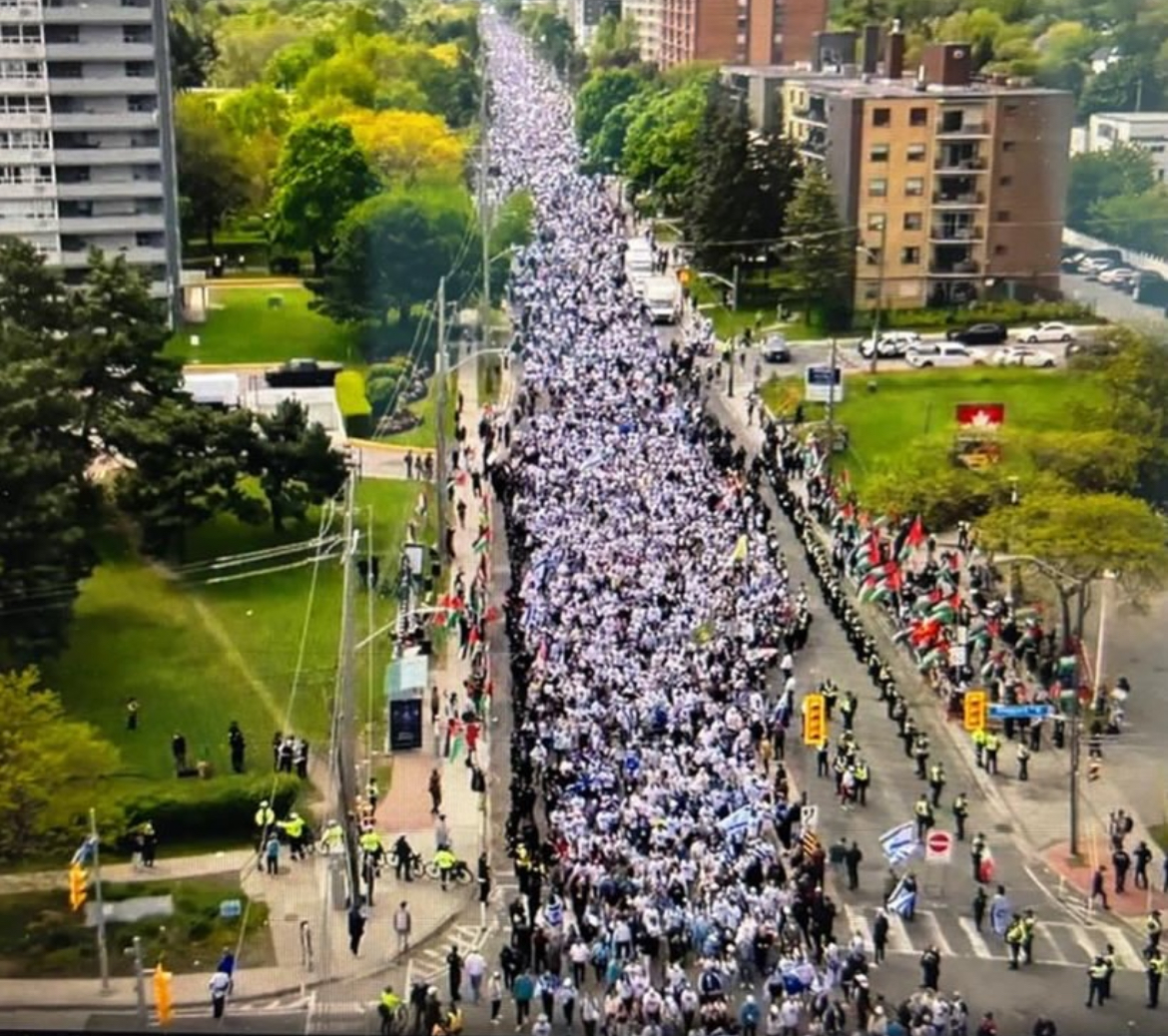
By GERRY POSNER There are walks and then there are walks. The Toronto UJA Walk for Israel on May 25, 2025 was one of a kind, at least as far as Canada and Jews are concerned. The number of people present was estimated to be 56,000 people or 112,000 total shoes. (How they get to that number is bewildering to me, since there is no one counting). This was 6,000 more than last year. Whether it is true or not, take it from me, it was packed. The synagogues in Canada should be so fortunate to get those numbers in total on High Holidays. The picture here gives you a sense of the size of the crowd.
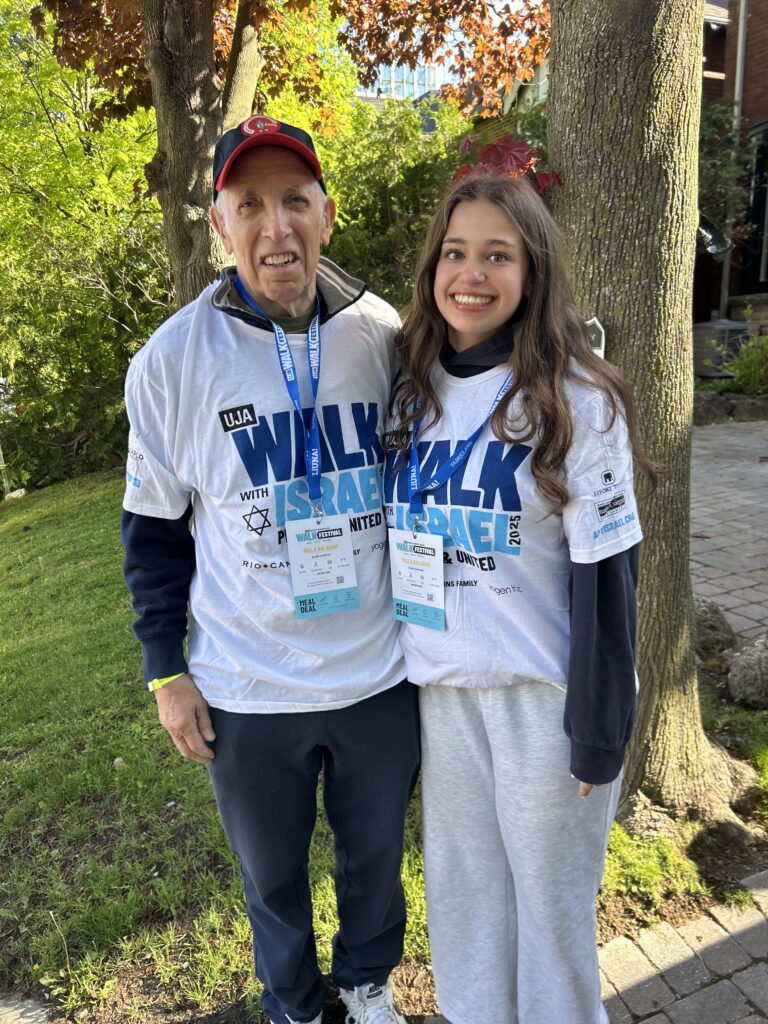
This was my first walk in Toronto for Israel and I was with my granddaughter, Samantha Pyzer (not to forget her two friends whom she managed to meet at the site, no small feat, even with iPhones as aids). The official proceedings began at 9:00 a.m. and the walk at 10:00 a.m. There was entertainment to begin with, also along the way, and at the finish as well. The finish line this year was the Prosserman Centre or the JCC as it often called. The walk itself was perhaps 4 kilometres – not very long, but the walking was slow, especially at the beginning. There were lots of strollers, even baby carriages, though I did not see any wheelchairs. All ages participated on this walk. I figured, based on what I could see on the faces of people all around me that, although I was not the oldest one on the walk, I bet I made the top 100 – more likely the top 20.
What was a highlight for me was the number of Winnipeggers I met, both past and present. Connecting with them seemed to be much like a fluke. No doubt, I missed la lot of them, but I saw, in no particular order (I could not recall the order if my life depended on it): Alta Sigesmund, (who was, a long time ago, my daughter Amira’s teacher), Marni Samphir, Karla Berbrayer and her husband Dr. Allan Kraut and family. Then, when Samantha and I made it to the end and sat down to eat, I struck up a conversation with a woman unknown to me and as we chatted, she confirmed her former Winnipeg status as a sister-in- law to David Devere, as in Betty Shwemer, the sister of Cecile Devere. I also chanced upon Terri Cherniack, only because I paused for a moment and she spotted me. As we closed in near the finish, I met ( hey were on their way back), Earl and Suzanne Golden and son Matthew, as well as Daniel Glazerman. That stop caused me to lose my granddaughter and her pals. Try finding them amid the noise and size of the crowd – but I pulled it off.
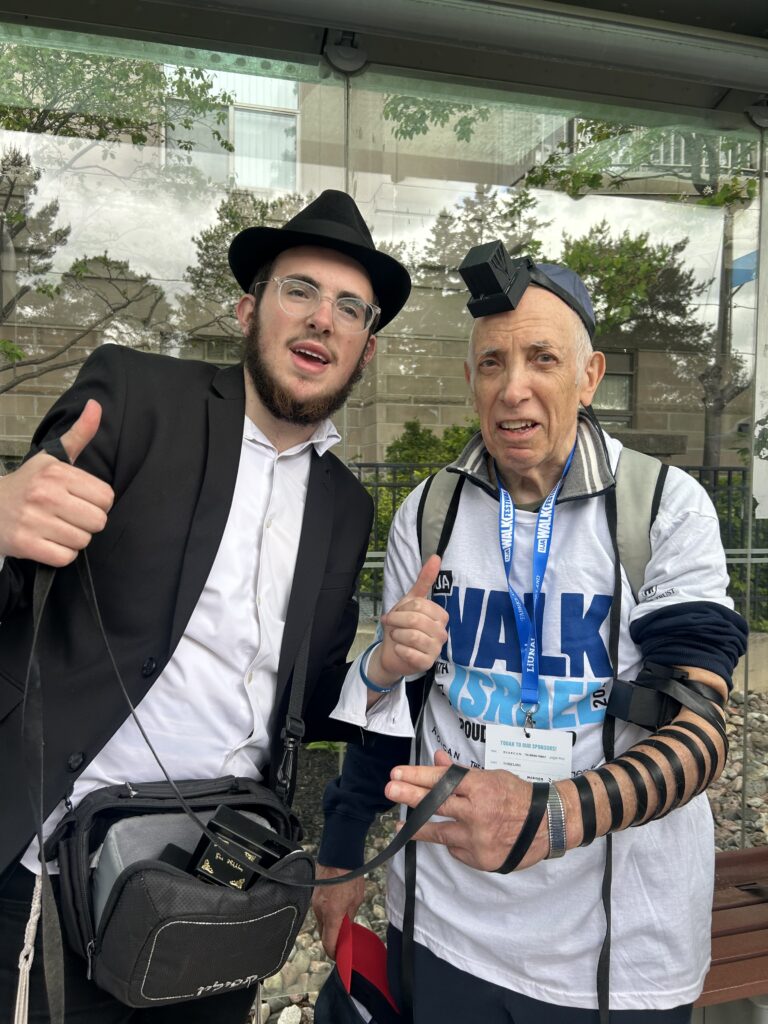
As I was in line to get food, I started chatting with a guy in the vicinity of my age. I dropped the Winnipeg link and the floodgates opened with “ Did I know Jack and Joanie Rusen?” So that was an interesting few minutes. And I was not too terribly surprised to come across some of my Pickleball family. All of these meetings, along with spotting some of my sister’s family and other cousins, were carried on with the sound of the shofar as we moved along the way. In short, this was a happening. Merchants selling a variety of products, many of them Israeli based, were in evidence and, of course, the day could not have ended without the laying of tefillin, aided by Chabad, who have perfected the procedure to take less than a minute. See the photo. Chabad had a willing audience.
Aside from the joy of sharing this experience with my granddaughter, the very presence of all these Jews gathered together for a common reason made this day very special to me. However, there was a downside to the day. The downside was that, as we began to walk back to our car there was no other way I could figure out how to return when the rains came and came. While we walked faster, we were impeded by pouring rain and puddles. But Samantha wanted to persevere, as did I. We made it, but were drenched. My runners are still drying out as I write this two days later.
What with being surrounded by 56,000 people, the noise, the slow walking, and the rain, I can still say the day was a real highlight for me – one of the better moments since our arrival in Toronto in 2012. As well as the photos we took along the way, I have the reminder of the day, courtesy of the UJA, as evidenced from the photo. It was not just the walk, but the talk that accompanied the walk that made it so worthwhile for me. I would do it again, minus the rain.