


Uncategorized
This isn’t Barbra Streisand’s ‘Yentl’ — it isn’t I.B. Singer’s either
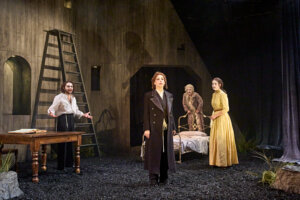
There’s an FAQ on the website of the London theater where the Kadimah Yiddish Theatre of Melbourne’s production of Yentl is running through April 16. The very first item reads:
Is this a stage version of the 1983 musical film starring Barbara Streisand?
No — the London production of Yentl is a play. It is a new adaptation of Isaac Bashevis Singer’s 1962 short story,“ Yentl the Yeshiva Boy“ — just like the Streisand film was at the time.
This explanation does more than relieve box office staff of the tedious duty of informing Mrs. Lipschitz and Mrs. Rosenblatt from the sisterhood that no, they shouldn’t come expecting to sing along to “Papa, Can You Hear Me.” It argues that this theatrical “reimagining” (to use Kadimah’s own term) of Yentl is no less authentically Singerian than the musical. It also hints at how Kadimah prevailed, against considerable odds, in adapting a story whose rights Streisand still owns and fiercely guards.
As Gary Abrahams, Kadimah’s executive director and the director of the production, recently told the Jewish Telegraph, Singer’s estate gave him their approval on the condition that it be a Yiddish language, non-musical production. The London transplant, which comes on the heels of earlier stagings in Melbourne and Sydney, is enjoying a six-week run at the Marylebone Theatre, which is housed inside of an anthroposophical center. Both the limited duration of the run and the Off West End venue were critical to securing the Singer estate’s approval.
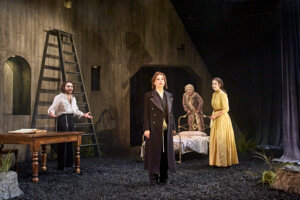
Kadimah’s production, a bilingual Yiddish-English chamber piece that has gained a certain notoriety for featuring male and female nudity, is the latest chapter in the long and unruly afterlife of Singer’s deceptively simple tale.
In “Yentl the Yeshiva Boy,” which first appeared, in English translation, in Commentary in September 1962, a rabbi’s daughter, shut out from the Talmud learning reserved for men, cuts her hair, dons male clothing, changes her name to Anshel, finds a chavrusa, the heartbroken Avigdor, and enters a yeshiva. But Singer’s tale is considerably stranger than both that simple summary and Streisand’s popular version suggest.
Yentl is not simply a tale of female exclusion and feminist defiance. It is also a story of impersonation, erotic confusion, spiritual hunger and metaphysical trespass. Yentl does not cross one line and stop there. Once she begins living as Anshel, all the categories meant to keep life orderly — male and female, study and desire, law and transgression — begin to blur.
That instability may explain why Yentl has proved so durable. Before Streisand made it famous on screen, Singer had already adapted it for the stage in the mid-1970s together with Leah Napolin. The show opened at the Brooklyn Academy of Music in 1974 and transferred to Broadway the next year, with Tovah Feldshuh in the title role.
“As a play it is altogether too anecdotal,” wrote Clive Barnes in the 1974 Times review. “The storyline wanders on and on like a river through a landscape, but the landscape happens to be worth looking at.” Napolin, who died in 2018 (and who claimed that Singer didn’t write a single word of the script) suggested that the second wave feminism of the time made the story and its themes feel relevant to contemporary audiences.
“This dark little gender-bending tale had an impact on many people who identified, as I did, with the heroine’s struggle to reinvent herself, to redefine herself,” Napolin once told an interviewer.
Half a century later, Kadimah’s Yentl leans heavily, and not always successfully, into our contemporary discourse about sex and gender. The story reemerges in a markedly — and overtly — queerer form than in previous versions.

Streisand’s film absorbed the title character so completely into her own star persona that for many people Yentl is now synonymous with Babs, not Singer. Her approach is expansive where Singer is compressed, ardent where he is dry-eyed, and schmaltzy where he is severe. Streisand gave the story glamor, emotional clarity and uplift. It also tilted the material away from Singer’s sharper ambiguities and toward the all-American theme of becoming oneself. The film, which Streisand also directed, produced and co-wrote, even ends with Yentl aboard a ship bound for America! (In Singer, Yentl simply ups and vanishes, an ending that has been interpreted as a reference to the legend of the Wandering Jew).
Yet Streisand’s victory over the material came with at an expense. As Linda Besner notes in an essay on Singer and Streisand and published in the Canadian arts review Arcade, the film’s feminist reclamation of Yentl also trims away some of the story’s deepest instability. Singer’s Yentl tells Avigdor, “I’m neither one nor the other,” and the story allows a degree of erotic and ontological confusion that the film flattens into a drama of self-realization.
Kadimah’s production, adapted by Abrahams, Elise Esther Hearst and Galit Klas, starts from dissatisfaction with that inheritance. Hearst has said the team wanted to get back to the story’s darker, more transgressive roots. In an interview with The Times of London, Abrahams said he had been struck by how unlike the movie Singer’s story really was, and described the original as a work about spirituality, identity, gender, sexuality, as well as plain old sex.
Those ambitions are evident from the outset. This is not a shy Yentl. It foregrounds the body, goes hard on the story’s sexual unease and sharpens its queer implications. Amy Hack is alluringly androgynous in the title role, both attracted by and attractive to Avigdor and Hodes (Genevieve Kingsford in a very stiff performance), Avigdor’s erstwhile fiancée, who Yentl marries in bad faith. As in the film, she casts a prurient gaze at the bathing Avigdor (Ashley Margolis bares all onstage, one-upping Mandy Patinkin, whose naked tush is one of the film’s most memorable sights). Singer’s story can accommodate plenty of sexual discomfort and frustration, but Abrahams’ production lays it on too thick. Did he really need to make Avigdor a mikveh peeper?
The production also never settles on a convincing tone and register. The one-set production, with its vaguely Expressionist look, goes for too much shtetl schlock. The acting keeps sliding between modes without enough control to make the shifts meaningful: naturalistic for a few minutes, then suddenly pitched into something like Yiddish melodrama. Additionally, there isn’t any discernible logic to why certain passages are spoken in English while others are in Yiddish (with subtitles projected onto the set). The result is less daring than uncertain. No performance fully steadies the evening, although Evelyn Krape comes the closest. As the spectral “Figure,” she hovers, narrates, inhabits minor roles and hangs over the proceedings like a comic dybbuk. The device of a spectral conferencier does not entirely cohere, but Krape — hammy in a grotesque-vulgar-goofy way — almost pulls it off.
Kadimah’s production was lauded in Melbourne and Sydney but has met with a very different reception in London, which is, of course, a no-nonsense theater town. Despite the tepid and sometimes outright negative reviews (“Even with nude scenes, this is a schlep,” The Times of London’s critic wrote), the Thursday evening performance I attended was nearly full. And, the mostly grey-haired audience members, several of whom I recognized, from a nearby kosher deli where I wolfed down a pastrami sandwich before the show, were enthusiastic. A Yiddish Yentl in London now is enough of an event to draw not only the usual suspects but the theatrically adventurous — and, no doubt, some Streisand fans who should know to check their expectations at the door.
Kadimah Yiddish Theater, which recently passed its centenary, is, by some counts, Australia’s oldest theater company. This Yentl might well be the biggest hit they’ve had in their long history. Despite its shortcomings — and there any many, both in concept and execution — the production shows that the company understands the need to strive for more than nostalgia and sentimentality, à la Streisand, and to be a little impious and even impish.
Today’s most interesting Yiddish theater (and also film, to an extent) inscribes itself within tradition while treating that heritage as unstable, literate and vulgar. That is what makes the Yiddish work of another Australian director, Barrie Kosky, so refreshing and bracingly alive.
Earlier this season, Kosky directed K., a “Talmudic vaudeville” inspired by Kafka’s “The Trial” at the Berliner Ensemble. In interviews, Kosky has spoke of the polyglot, code-switching, cross-dressing Yiddish theater that formed part of Kafka’s world. His haunting and unsettling production moves between German, Hebrew and Yiddish (including a gorgeous translation of Schumann’s Dicherliebe into mamaloschen) and injects intellectual seriousness with showbiz energy.
There’s another reason I bring up Kosky, a prolific, influential, and deeply Jewish theater and opera director. In summer 2027, he will present a fresh musical version of Yentl at the Fisher Center for the Arts at Bard College, created together with Lisa Kron (the Tony-winning writer and lyricist of Broadway’s Fun Home) and Adam Benzwi, one of the director’s regular musical collaborators in Berlin. According to Bard’s announcement, Benzwi’s score will draw on American and European Yiddish theater, music hall and Hasidic choral traditions. That sounds less like an attempt to strip Yentl back to some pristine original than like an effort to push through the whole layered history of the piece and make something gloriously heterodox.
By this point Yentl exists not as a single work. Singer gave it severity, mischief and danger. Streisand gave it melody and yearning. Kadimah has tried, admirably if unsuccessful, to restore taboo, Yiddish abrasion and folkloric unease, sometimes vividly, sometimes crudely. Kosky may prove better placed than most to let those elements collide without trying to reconcile them too neatly.
The post This isn’t Barbra Streisand’s ‘Yentl’ — it isn’t I.B. Singer’s either appeared first on The Forward.
Uncategorized
They met on a Birthright trip then married. Now this American Israeli couple’s internet fame has turned to infamy.
Ethan and Hila Klein first met at Yad Vashem — Israel’s Holocaust museum — in 2007, a meet-cute they recounted, giggling, years later for their millions of YouTube followers.
“I think I went up to her and said something like, ‘They had it coming, don’t you think?’” said Ethan, known for his edgy humor and infamous internet trends, including Vape Nation and Papa Bless. “No I didn’t say that. I wonder if you would have laughed though.”
They were on a Birthright trip, Ethan an American and Hila an Israeli soldier on leave to join the group. Soon after the trip ended, Ethan moved to Israel to be with Hila, and the two began making videos under the name H3H3 Productions (the H for Hila and the 3 standing in as an E for Ethan). They married, moved to America, and started a popular podcast.
A Jewish love story, until Thursday, when Hila, now mother to their three children, accused Ethan publicly of having a months-long affair.
“The betrayal I feel is immeasurable,” Hila said in an Instagram post. “My only family on this side of the world. How do I even begin to make sense of this?”
Ethan reposted her statement.
Their podcast is run by a handful of crew members who often chime in and participate in various skits and bits. The crew also shared a statement saying they stand with Hila and refuse to work with Ethan, though they added they don’t know what this will mean for the future of the show.
A couple roiled by Oct. 7
The left-leaning, secular couple’s videos and podcasts focused primarily on pop culture, internet drama and general politics, not Jewish or Israeli issues.
Both Ethan and Hila would make statements sometimes when tensions in Israel flared, and they would occasionally speak out against IDF actions that upset them.
In 2021, Ethan started a podcast with political commenter Hasan Piker, a controversial left-wing influencer, called Leftovers, a nod to their leftist politics.
Then came Oct. 7.
Ethan, an American Israeli dual citizen like Hila, was horrified by the attacks but quick to call the IDF genocidal in the aftermath. In their first episode together after Oct. 7, Ethan and Piker said the show would continue through their disagreements. The episode was tense, and it was their last.
As Piker’s rhetoric on Israel intensified and became at times antisemitic, the two began a nasty internet feud, culminating in a nearly five-hour livestreamed debate.
Piker posted about the news of the affair on X, sharing a video of Ethan and expressing disgust for men who cheat.
“Now this is a high caliber man [with] good morals,” Piker said sarcastically. He also posted “Judge me by my enemies” after sharing Hila’s statement.
Hila, who owns a makeup and clothing company, increasingly came under scrutiny by Piker and others after Oct. 7 for her service in the IDF. Artists refused to work with her. One model she hired publicly disavowed her after finding out she was Israeli.
The couple was harassed, sometimes online, sometimes in-person, as they attempted to take what they viewed as a nuanced stance in the aftermath of Hamas’ attack on Israel and the ensuing war in Gaza. The united front seemed to fortify their relationship, as Ethan, ever outspoken, routinely came to his wife’s defense.
Their show lost thousands of subscribers, but loyal fans stuck with them — fans who now say they are gutted and confused by the news of the affair. Many in disbelief noted that Ethan had Hila’s face tattooed on his arm less than two years ago as a surprise for her.
“The greatest thing a man can do for his children is to love their mother,” says the quote surrounding the tattoo.
The Forward attempted to contact the Kleins through their work emails and did not immediately hear back.
The post They met on a Birthright trip then married. Now this American Israeli couple’s internet fame has turned to infamy. appeared first on The Forward.
Uncategorized
These Jewish college students have some ‘nonnegotiables’ for El-Sayed
At the University of Michigan, first-year student Robert Kashan, 18, and sophomore Jacob Reich, 19, sat behind a large blue sign. “Some things are nonnegotiable,” it declared in all caps.
The sign laid out their requirements for any candidate seeking their support: a commitment to Jewish safety, “including for Zionist Jews,” and supporting Jewish statehood in Israel, among other positions.
“Zionism is a legitimate part of the Democratic coalition, and a lot of us are feeling less represented by the Democratic Party,” Kashan told the Forward.
The students are part of a broader “Nonnegotiable” movement in Michigan, a coalition of Jewish Democrats who are spelling out their dealbreakers for candidates ahead of the Senate election between Democratic nominee Abdul El-Sayed and Republican nominee Mike Rogers.
The movement has attracted national attention, with hundreds of rabbis across 34 states signing on to the “Nonnegotiable” demands. Meanwhile, about 20 students at the University of Michigan have publicly signed, while hundreds more offered support anonymously, according to Reich.
The “Nonnegotiable” supporters aren’t saying whom they’ll vote for if their concerns aren’t addressed — or whether they’ll vote at all. But they are pushing back against the assumption that Jewish voters will, as the saying goes, “vote blue no matter who,” urging El-Sayed to engage with their demands if he hopes to earn their support.
That’s in contrast with two other Jewish political camps, including a group called Michigan Jews for Democracy that endorsed El-Sayed. Their petition, which has garnered almost 1,000 signatures, notes that some signatories hold reservations about El-Sayed but are voting for him nonetheless as a check on President Trump.
“We understand that a vote is not a valentine; it’s a strategic chess move,” the petition reads.
A competing petition, dubbed “Michigan Jews Against Extremism,” has drawn hundreds of signatures from Michigan Jews who plan to vote for Rogers. That petition similarly emphasizes that Rogers voters may still have reservations about the candidate: “Our vote for Mike Rogers does not require that we agree with him on every issue or that we support President Trump,” it reads.
“Nonnegotiable,” meanwhile, rejects the idea that Jewish voters would have to choose between Zionist and Democratic values. Some have criticized the nonnegotiable movement for ignoring the reality of the electoral choice at hand. Others have called it “a veiled attempt to excuse the actions of Jewish Democrats who want to feel validated about voting for Mike Rogers.”
But Kashan and Reich, who met at Hillel and plan to major in political science, said the “Nonnegotiable” movement was the only way they could see themselves engaging in the election, as they felt increasingly pulled between their identities as Democrats and as Jews.
Some Michigan Jews have expressed alarm at El-Sayed’s questioning of whether Israel should exist as a Jewish state and his decision to campaign alongside controversial Twitch streamer Hasan Piker, who has been accused of antisemitic rhetoric. Rogers, who Trump has endorsed, earlier this week called El-Sayed “anti-Jew.”
In a letter to Michigan Jews, El-Sayed has vowed to “stand up against antisemitism and take the threat of violence against our Jewish community incredibly seriously.” He has also hired a Jewish liaison in the final weeks leading up to the election.
This will be the first election when Kashan, who just turned 18, is eligible to vote, and Reich’s first national election after voting in a local primary in his hometown of Palo Alto, California. For both, voting Democratic in their first major election had once seemed like a given.
“I’m a Jewish Democrat, and I want Democrats to take the Senate,” Reich said. “I want to vote for a Democrat in my own state.”
They’re still holding out hope that will happen — and that, with less than two weeks until the Nov. 3 election, El-Sayed will sign on to their petition.
And if he doesn’t? Neither student is ready to say.
The post These Jewish college students have some ‘nonnegotiables’ for El-Sayed appeared first on The Forward.
Uncategorized
Does anyone in Jerusalem care what happens to us?
An Israeli think tank has put on paper what most American Jews know in their kishkas: Israel’s actions over there affect our safety here.
So here’s my question: Does anybody over there care?
The report, published by The Institute for National Security Studies (INSS), drew on the input of 20 Jewish leaders from five countries. It concluded that Israel’s actions since the Hamas attack on Oct. 7, 2023 have normalized hostility toward Israel, divided Jewish communities, sapped the political influence of pro-Israel organizations and fueled antisemitism.
Those actions include damaging statements by government officials, limits on humanitarian aid to Gaza at the height of the war, widespread damage to civilian infrastructure in Gaza and unchecked settler violence in the West Bank. The authors also cited as inflammatory “the proliferation of images of civilian death and suffering in Gaza” — though the actual civilian death and suffering has also alienated and enraged many outside Israel, including Jews.
“The conflict is not only over there in the Middle East, it is local all over the Jewish world now, and Diaspora Jewry has skin in the game,” said Theodore Sasson, one of the report’s authors, in an interview with JTA’s Andrew Silow-Carroll, who first wrote about the study.
To be clear, the report doesn’t excuse, exonerate or rationalize people who commit antisemitic acts. “Jews and Israelis are not to blame for antisemitism,” the report states.
“What we’re saying is that Israel is not the cause” of antisemitism, Sasson said, “but enlightened Israeli policy can seek to maintain robust Diaspora support for the state of Israel and can deny the antisemites the material that fuels their mostly spurious claims.”
This is not a novel connection. Three previous academic studies, in Belgium, Australia and the U.S. found statistically significant links between Israeli military operations that result in high Palestinian casualties and spikes in reported antisemitic incidents abroad. Not surprisingly, a Mellman group poll found that 56% of U.S. Jewish voters believe Israel’s policies have fueled antisemitism.
None of this means Israel shouldn’t act in its own interest and put the security needs of its own population first. Antisemites would continue to exist even if Israelis did nothing but play backgammon and sip arak. The report is not about eradicating antisemitism, but about Israeli actions that provoke and endanger Jews abroad — and what Israel can do about those.
I get the principled resistance to a report that seems to shift some of the burden of antisemitism onto the Jews. David Bernstein of the North American Values Institute told Silow-Carroll that American Jews aren’t agents of Israel, and that nobody would say an African country’s actions endanger African Americans. That’s not entirely true — the 9/11 attacks increased hate crimes against American Muslims and bigots targeted random Asian Americans during the COVID-19 pandemic. Pretending actions have no consequence even if the reaction is illegitimate is principled, but naive. If Israel can lower the temperature, it should.
But here’s the sad fact about the current Israeli government: it doesn’t even lower the temperature for its own citizens.
Exhibit A is Oct. 7. This is the government on whose watch that horror happened, and Prime Minister Benjamin Netanyahu has never engaged in a full, independent accounting of what went wrong. How do you prevent future Oct. 7s when you don’t know the weaknesses that enabled it in the first place?
Exhibit B is the flydubai near-disaster, which we in the Diaspora have already mythologized as yet another example of Israeli courage and pluck. It was that, but also a result of a complete breakdown of government responsibility. Israel’s rules should have kept the Omani pilot out of that cockpit, but, as Channel 12 reported, Minister of Transportation Minister Miri Regev took no action despite multiple warnings. Regev, a close ally of Netanyahu, remains in her job.
Finally, Exhibit C: Police under National Security Minister Itamar Ben Gvir have failed to curb violent crime in Israel’s Arab communities which recorded 252 murders in 2025 — and 2026 is on track to surpass that record.
Israel’s supporters often comfort themselves with the mantra that Israelis love life while their enemies love death. But this government has been pretty cavalier about life.
If that’s how Israel’s leaders treat their own citizens, is it so surprising they fail to be overly concerned about Jews abroad? Last year saw the highest death toll from antisemitic attacks in 30 years, while the agency Israel created specifically to deal with such calamities has been AWOL. The Ministry for Diaspora Affairs and Combating Antisemitism, a Tel Aviv University report found, has “not contributed in any meaningful way to the cause, and in some cases has been an embarrassment.”
All this is happening as the screws are tightening on Jewish communities in Australia, France, Italy, Canada and elsewhere. But Israel, established in part to keep Jews safe, has, under this government, too often increased or ignored the dangers. Zionism is supposed to be the Diaspora’s Iron Dome, but this government, by inexorably, deliberately foreclosing on the possibility of a democratic Jewish state, is functionally anti-Zionist.
The report listed several measures Israel could take to reduce the threat to Diaspora communities, among them controlling the incendiary rhetoric of government ministers and opening a diplomatic path with the Palestinians that stops the slide toward a single, non-democratic state.
One of the report’s recommendations is that Israel set up procedures to assess how its policies affect Jews abroad. In other words, the think tank is asking the government to start caring, formally.
It’s hard to imagine any of that happening unless, on Oct. 27, Israelis vote the current government out.
“Netanyahu cannot be part of the healing process. It is Netanyahu from whom we must be healed,” David Horovitz, the far-from-radical founding editor of The Times of Israel, wrote this week in an editorial titled, “For Israel’s Sake, Netanyahu Has to Go.”
As it turns out, it’s for all our sakes.
The post Does anyone in Jerusalem care what happens to us? appeared first on The Forward.
