


Uncategorized
This Jewish farmer is harvesting corn — and planting a synagogue — in the Illinois prairie
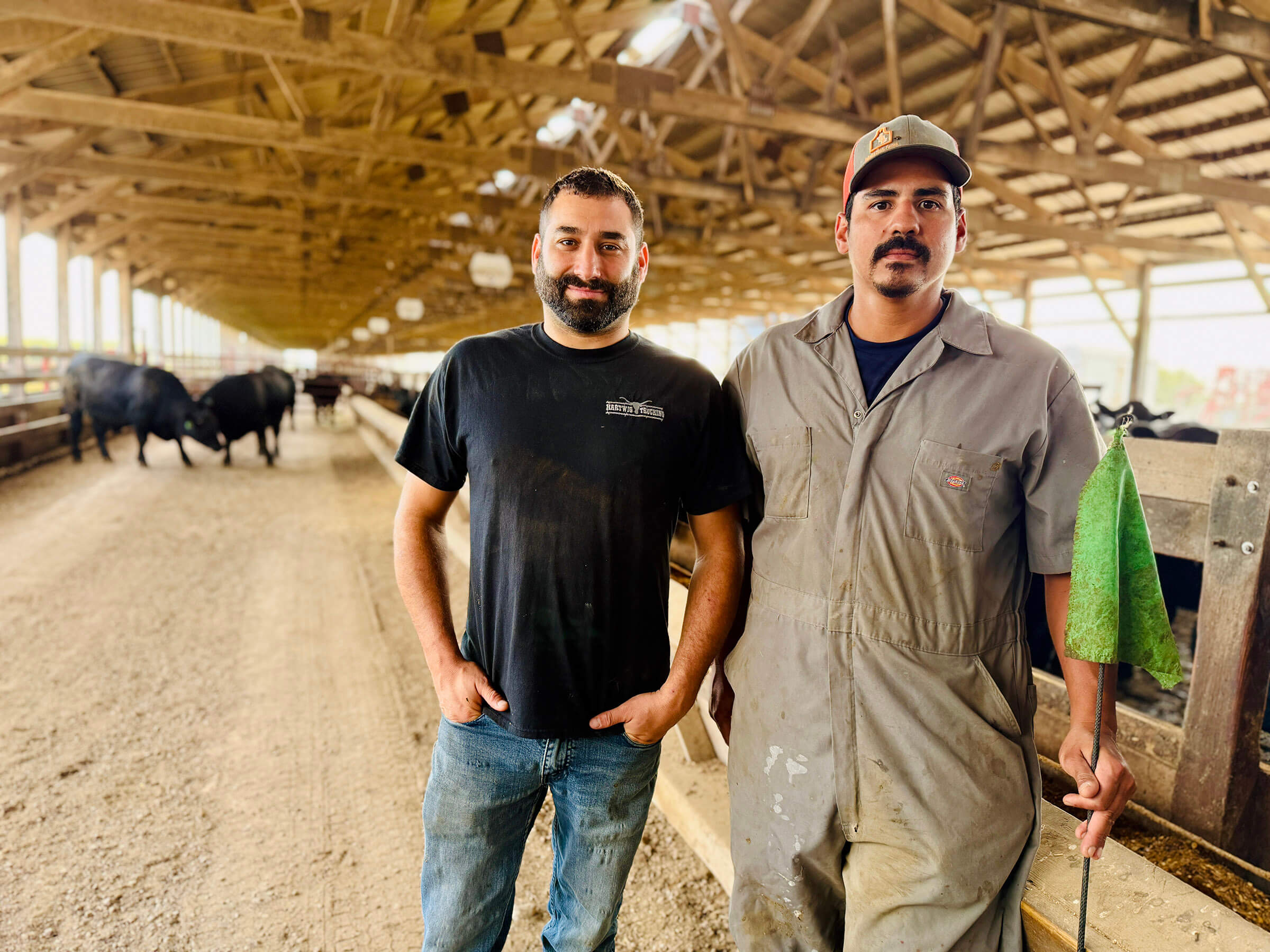
STERLING, ILLINOIS — Nik Jakobs crouched down and scooped a handful of dirt. A third-generation cattle farmer and grandson of Holocaust survivors, he rubbed the soil between his fingers, testing its weight the way his father and grandfather once did.
But this time, he wasn’t thinking about crops. He was thinking about a synagogue.
Jakobs, 40, plans to build one right here: a 3,000-square-foot sanctuary and museum near land his family has worked for decades. It will house an ark, a bimah, a Torah, and twelve stained glass windows — all rescued by Nik from a shuttered Pennsylvania synagogue, fragments of light and lineage hauled halfway across the country.
The heirlooms sit in storage for now — not as relics, but as seeds waiting to be planted. Come spring, the Jakobs family plans to break ground.
Across the American heartland, sanctuaries that once anchored small-town Jewish life are closing faster than they can be saved. Some have become yoga studios or condos or Airbnbs; others have simply fallen silent. But in Sterling, Illinois, a family of farmers is trying something radical in its simplicity: to plant one again.
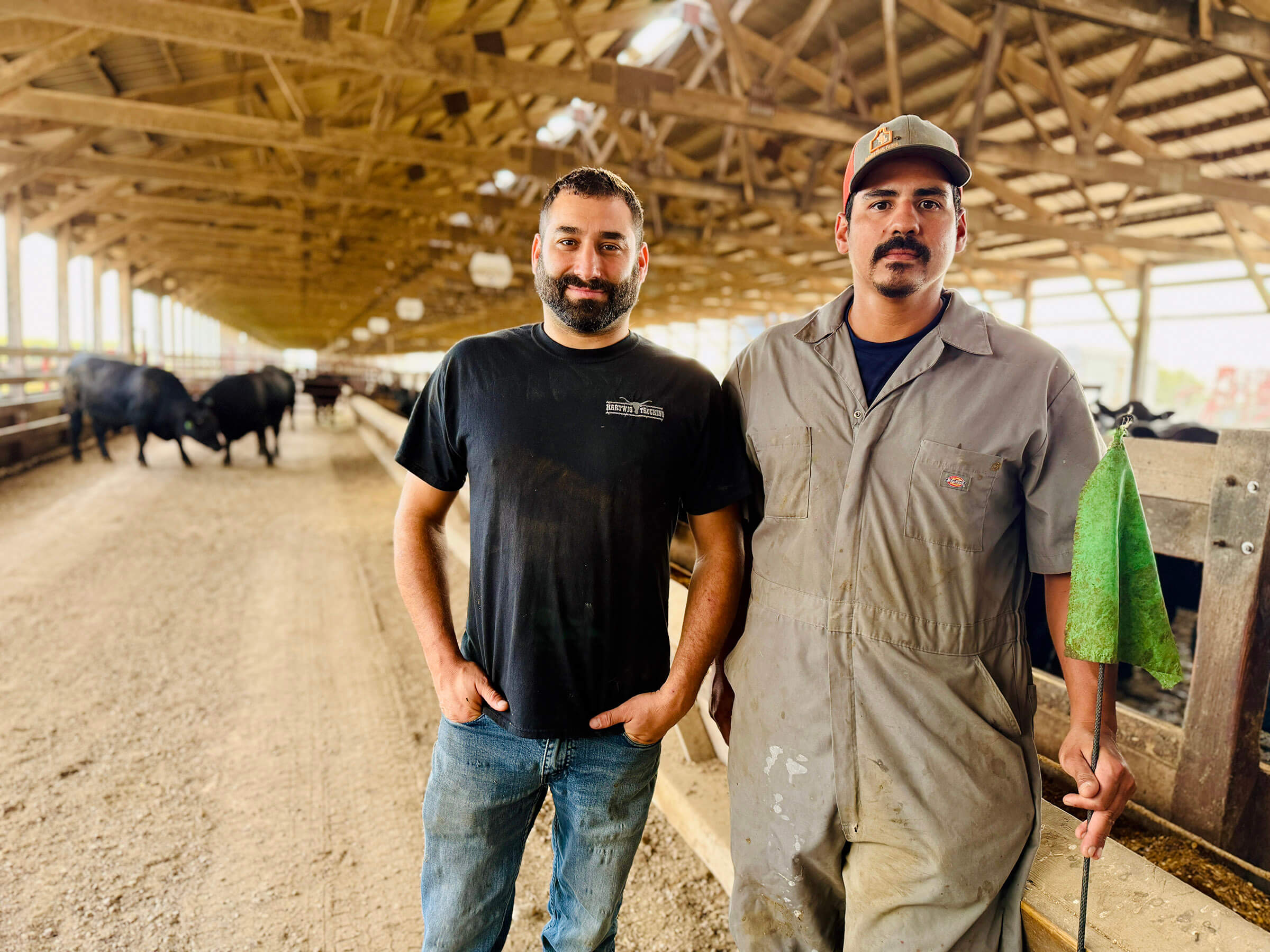
For Nik, that act is as familiar as it is audacious. The question isn’t just whether these sacred objects will find a home, but whether a tradition built on movement and memory can keep reinventing itself. Even among family and friends, there are doubts — about the cost, the scale, the odds of filling pews again. But Nik shrugs them off the way he does bad weather: “You plant anyway.”
It’s a lesson passed down from his grandfather, who started the farm after the war and taught his children that survival was only the first step. You work the soil, you care for it, you hand it off. That’s how things last — not through miracles, but through maintenance.
In the meantime, this fall, as crops ripened and combines roared to life, the family pitched a tent for Rosh Hashanah services. Nearly 50 people came to pray. An offering not of corn or soy, but of continuity, sown for the generations that might come after.
In Sterling, the Jakobses braid family, farm, and faith together.
Of corn and continuity
Jakobs Bros. Farms began with a refugee and a field.
After surviving the Holocaust, Norbert Jakobs arrived in Illinois in 1949, bought some land, and began again: raising cattle, planting corn and soybeans, and teaching his sons that survival was a kind of gratitude. Over the decades, the family grew the operation, a testament to their roots in this soil.
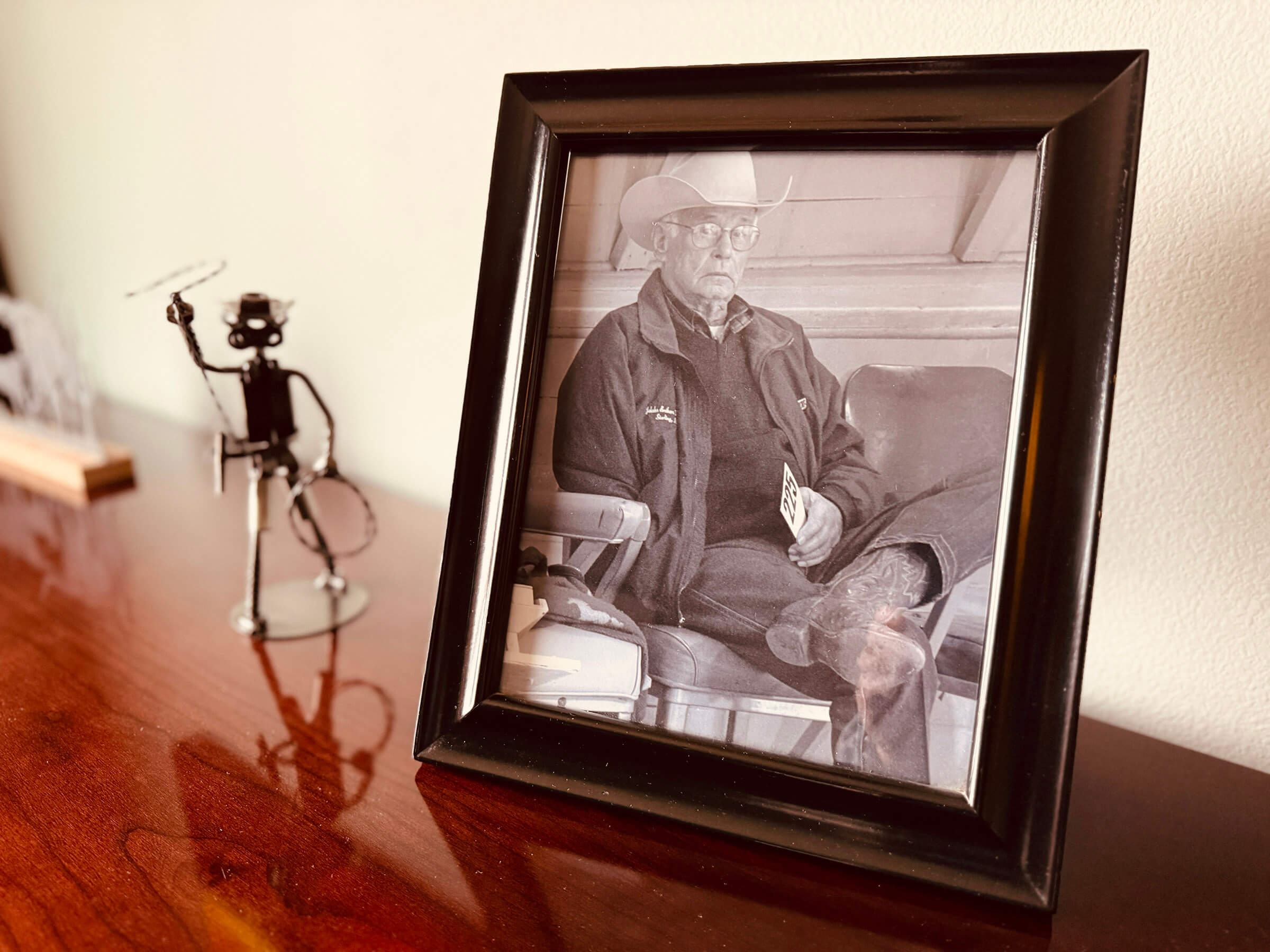
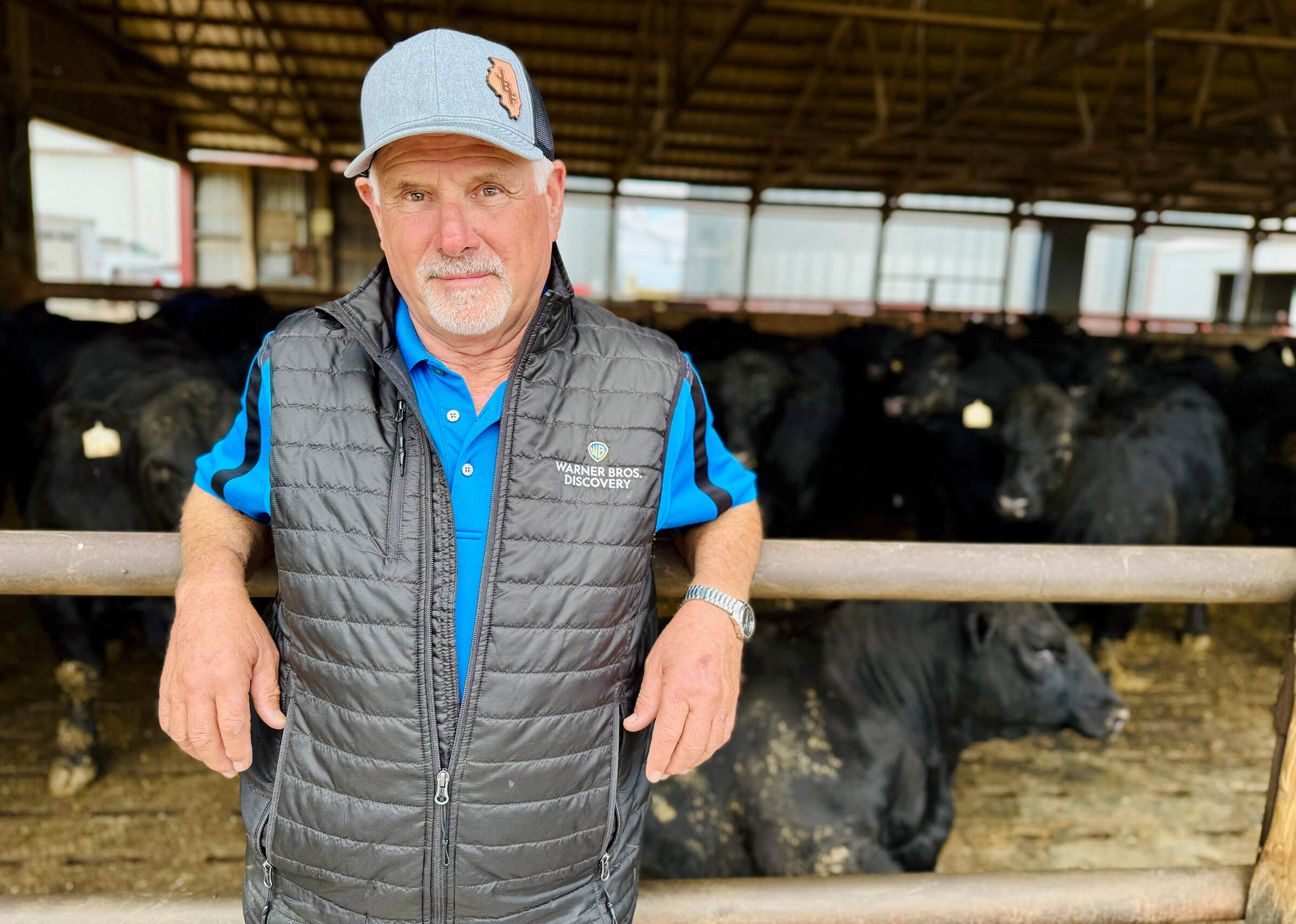
Dave Jakobs — Norbert’s son, Nik’s father, and the keeper of those fields — sat high in the cab of his combine, slicing through a sea of corn his father originally planted. He wore a cap adorned with the farm’s logo and a blue short-sleeve shirt that matched the afternoon sky. Outside, the air shimmered with dust; inside, the cab vibrated with the engine’s low thunder.
“I pitch, he catches,” Dave said, nodding to the tractor hauling a grain cart beside us. “Teamwork. That’s how the harvest gets done.”
For two hours, as he cut through the fields, Dave’s AirPods stayed in and his mounted iPhone on the dash blinked while he fielded calls from family and farmhands. Markets, moisture, machinery. The unseen math of keeping a farm alive. But before long, the talk turned to the synagogue.
“You don’t build the baseball diamond for them to come,” he said. “You build it because you love baseball.”
The line sounded like something out of Field of Dreams, and in a way, the Jakobs’ vision isn’t so different: faith built in the middle of a cornfield, for whoever still believes enough to show up.
He knows Sterling may never attract new Jewish families. The Jakobs family isn’t naïve about that. But the project was never only for them. The building will include a museum to tell the story of Jewish life in the region — and of families like theirs who rebuilt after the Holocaust. It’s a place for their children, yes, but also for their neighbors: a living record of what endurance looks like in the Midwest.
“Being a farmer, we’re at the mercy of God,” Dave said. “You take care of the land, and it takes care of you.”
If the harvest of corn measured what they could reap, this other harvest — the synagogue they were planting now — would measure what they could hand down.
A feast and a future
Back at the house, the roar of the combine gave way to a gentler rhythm — knives scraping, oven doors clicking, the percussive sounds of another kind of harvest.
Margo Jakobs, Nik’s mom, called out from the kitchen, her voice rising above the clatter of pots and the hum of an old house. She stood barefoot on the wood floor, auburn hair brushing her shoulders, a heather-gray T-shirt with “Peaches” across the front. On the counter sat a sous-vide cooler holding the evening’s main course: prime rib for Rosh Hashanah.
She moved with the calm and choreography of someone who had done this many times before, stirring and chopping, calling out to her husband and sisters-in-law as they passed through. Every motion felt purposeful, like another line in a prayer.
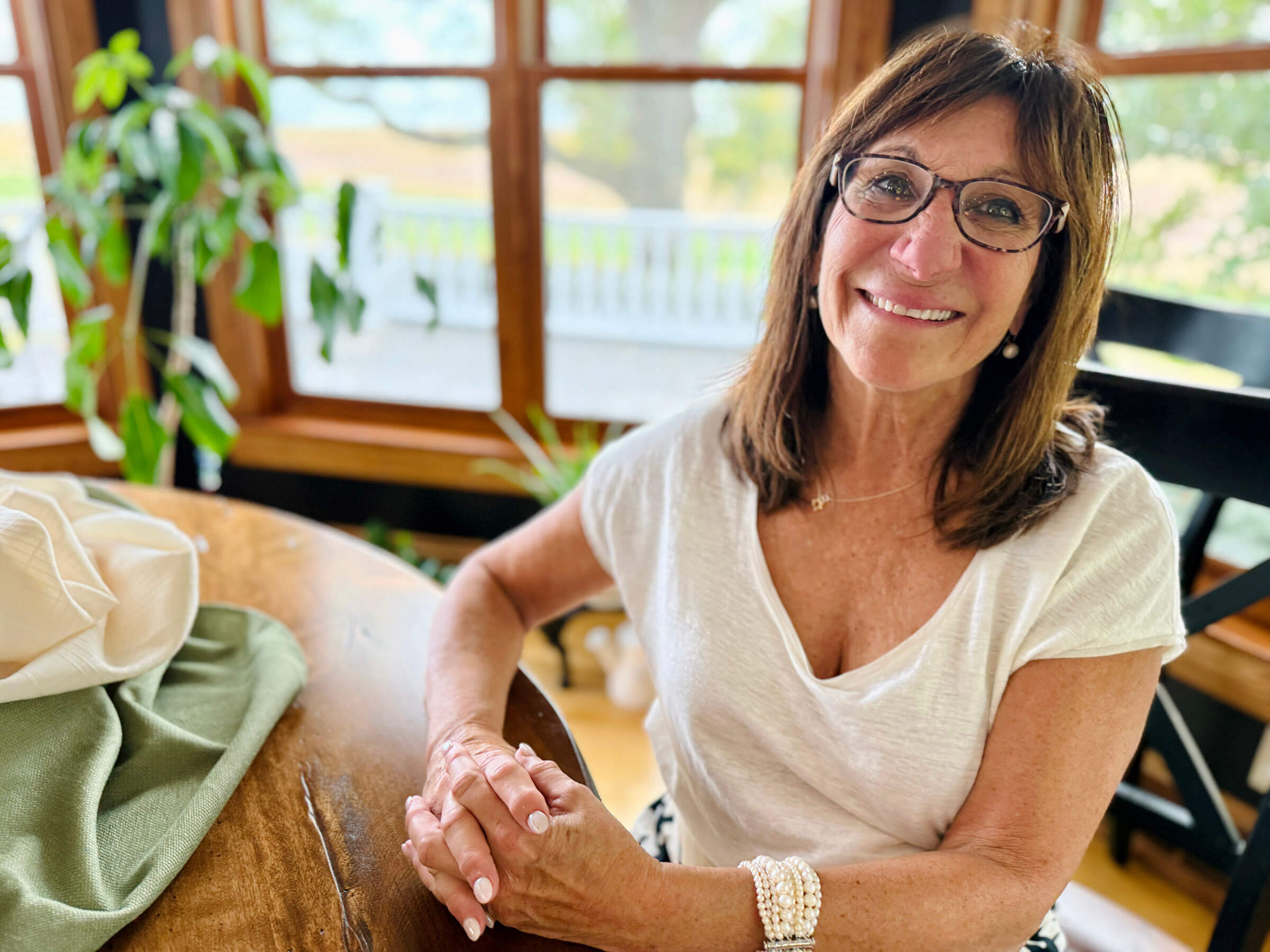
Her grandfather was taken to Dachau on Kristallnacht, lined up before a Nazi guard who pointed a gun and pulled the trigger on an empty chamber. He was able to escape with a few other men, thanks to a commandant he served under in World War I. The family fled on one of the last ships from Rotterdam. “The ship before theirs was bombed,” Margo said.
They rebuilt their lives in Wisconsin: her grandparents in a paper factory and department store; her parents later opening a bakery. Now, in rural Illinois, Margo keeps those stories alive — kneading resilience into every meal she prepares.
By the time she married Dave Jakobs in 1983 and moved to Sterling, two hours west of Chicago, the town’s Jewish community was already shrinking. Temple Sholom had once thrived, its sanctuary filled by families drawn to the promise of a postwar Midwest. But when the Northwestern Steel and Wire plant closed, so did the shops and synagogue it sustained.

“It made Sterling so vibrant in the 1940s and ’50s,” Margo said. “But as the mill closed, people moved away. It’s just sad.”
When she joined the congregation, she and Dave were among the few young Jewish couples left. “We had picnics and potlucks,” she said, smiling.
Earlier this year, Temple Sholom sold its building to a church. Members packed away the Torahs and yahrzeit plaques and began meeting in a tent on the Jakobs’ farm. When word spread that they planned to build again, on a two-and-a-half-acre cornfield in the middle of town, something unexpected happened: other synagogues that were closing began sending their remnants. Prayer books and pews, windows and wine goblets, all to be replanted here.
“We’re humbled,” Margo said. “People are entrusting us with what’s precious, with their stories.”
She wanted to be clear, though, that the project isn’t just about her family. It’s about Temple Sholom and all the congregants who have kept it going. “It takes a village,” she said, wiping her hands on a towel.
In that village is Scott Selmon, the congregation’s treasurer, who has quietly kept Temple Sholom alive for decades — paying the bills, leading services when no rabbi could make it, and making sure the lights stayed on long enough for the Jakobs’ dream to take hold.
He doesn’t see it as their project alone. “It’s all of ours,” he told me. “We just happen to have good people willing to lead the way.”
Selmon spoke of Nik’s grandfather, who became a pillar of the Jewish community in Sterling. “Norbert taught us what it meant to belong somewhere,” Scott said. “To show up for each other, to make this town home.”
People carried in casseroles for Rosh Hashanah and a neighbor dropped off a basket of apples from her orchard. Selmon watched quietly. “That’s what this is,” he said. “Community. You tend it, you keep it alive.”
Standing next to Selmon was Bill Sotelo, 79, who spent three decades as a machinist at the mill. He grew up in Mexico, was raised Roman Catholic, but had always felt a pull toward Judaism. In the 1980s, he started attending Temple Sholom and volunteered whenever something needed fixing. “I helped run the water line to the bathrooms and the kitchen,” he recalled.
Sotelo and his wife, Teresa, eventually converted. Bill celebrated his bar mitzvah at the shul when he was 68. “I did a DNA test recently,” he told me with a grin, “and it turns out I’m 8% East European Jew.”
Once, this village had been vast. Downtown Sterling bustled — clothing shops, newsstands, scrap yards, law offices — many owned by Jewish families who helped build the town’s economy. The steel mill by the river powered the synagogues and storefronts across the Sauk Valley — in Sterling, Rock Falls, Dixon, Morrison, even tiny Mount Carroll and Milledgeville.
Now the mill sits quiet, but Sterling is trying to grow again: a redevelopment project, a new hotel, a sports park, green trails along the river. “Sterling’s been reinventing itself ever since the mill closed,” former Mayor Skip Lee told me. “What the Jakobs are doing — taking something old and giving it new life — fits right into that story.”
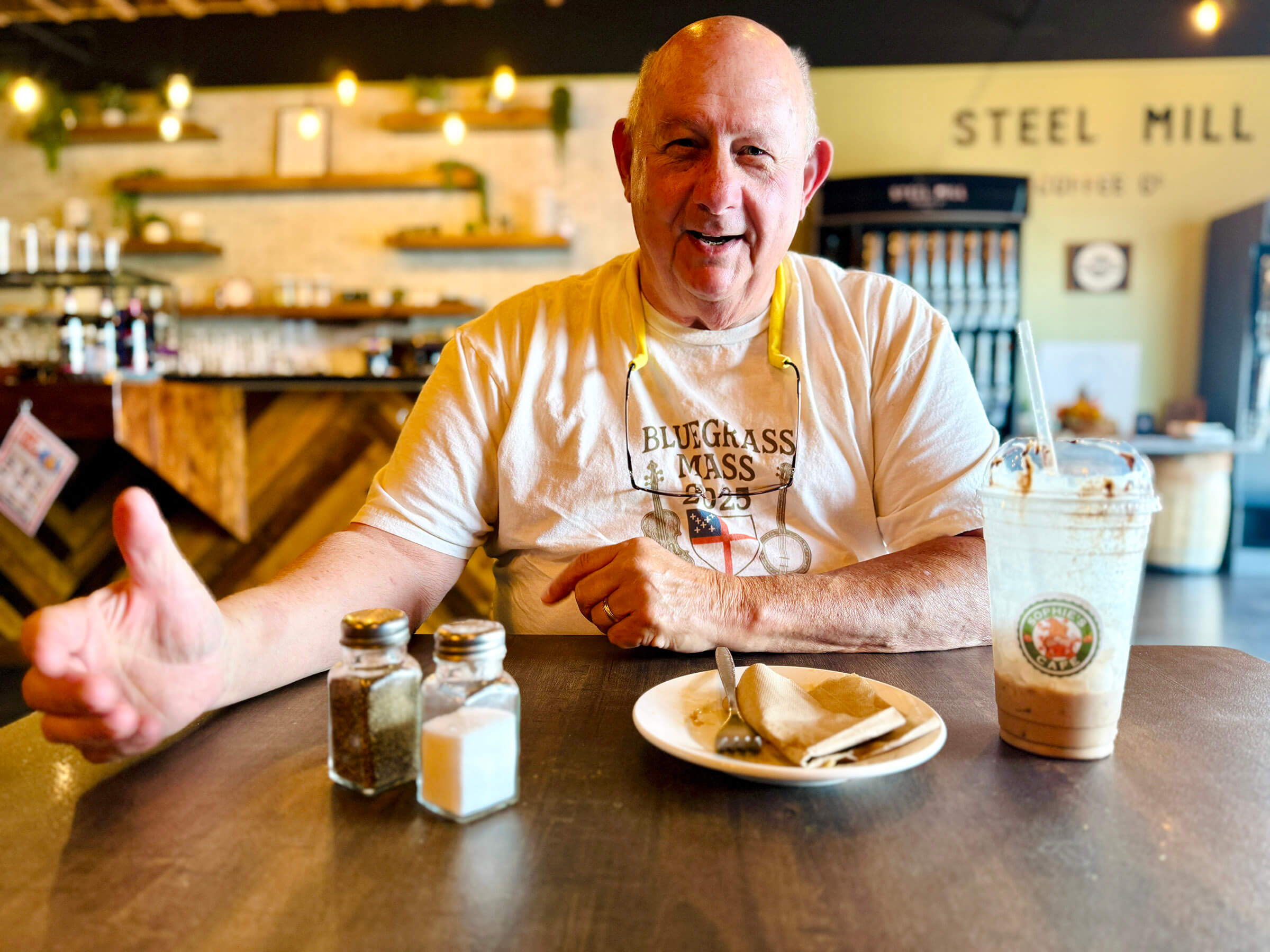
The Jews scattered across the Sauk Valley are rooting for Sterling — for this family, this field, this synagogue — to succeed.
Margo opened the oven to check dessert: a peach crisp warming beside an apple-bourbon cake. The smell of cinnamon and butter filled the kitchen, a small sweetness before the holiday began.
A tent that became a temple
The September light was fading, the fields turning the color of old straw. Out on the lawn beside the house, Nik and his brothers, Alex and Ricky, worked in rhythm, raising a canvas tent where the Rosh Hashanah service would be held. Metal poles lay scattered in the grass like the ribs of something waiting to take shape.
“It’d be easier if we had a temple,” someone joked.
In the distance, a combine droned through the corn, a harvest of another kind unfolding just beyond the prayer site. Nik carried folding chairs from the basement. Alex unspooled an extension cord from the garage to power the lamps and string lights. When they tamped the final stakes into the soil, the tent stood ready — not planted, exactly, but rooted for a day.
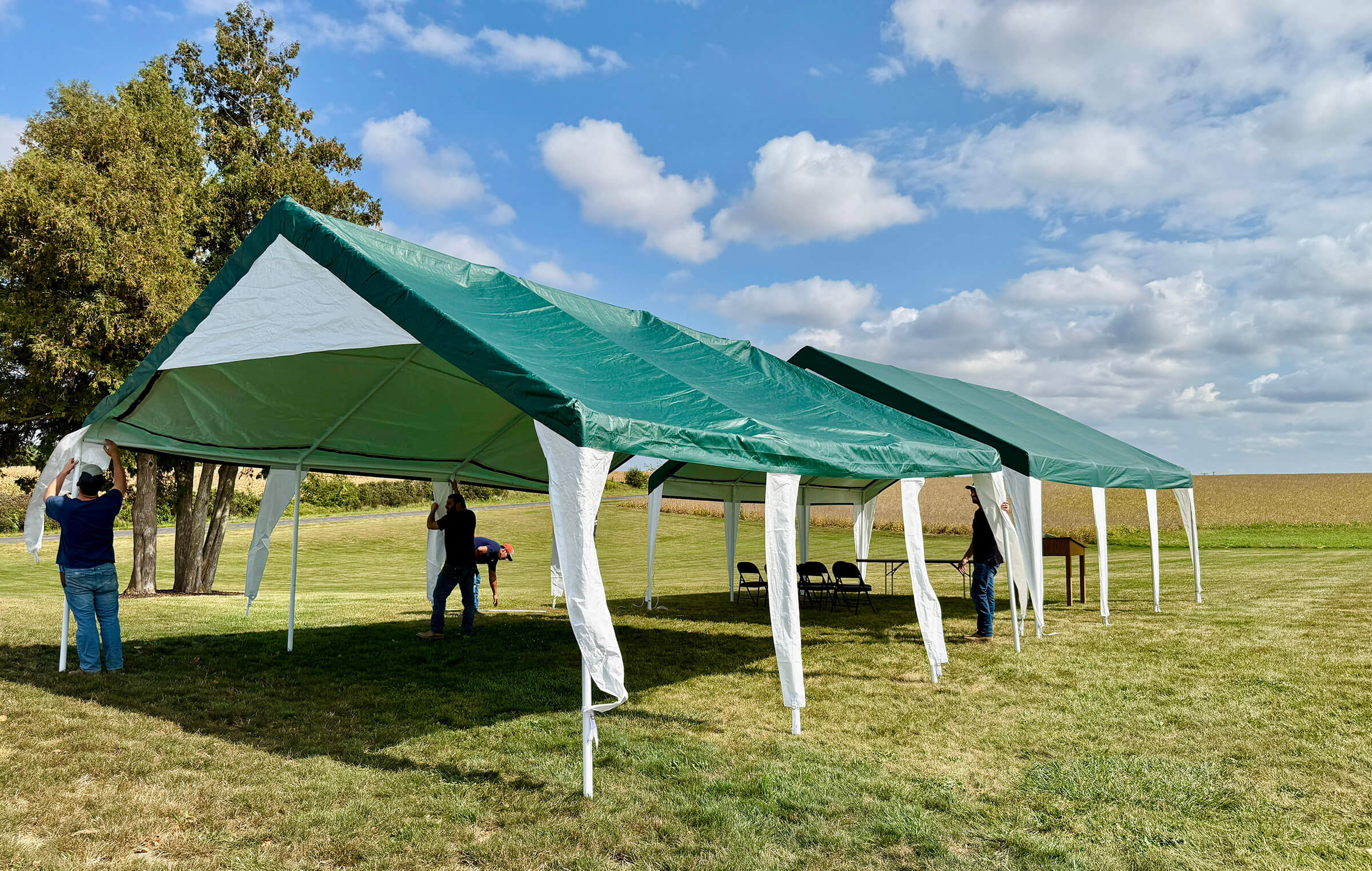
By morning, the field had turned into a sanctuary. Nearly 50 people gathered beneath the sloped roof, the air still and expectant after weeks without rain. Some women wore sundresses and cowboy boots; others went barefoot, their toes brushing the grass. They faced east, toward Jerusalem, toward renewal.
At the front, three Torahs rested on a table covered with a white cloth embroidered decades ago by Nik’s grandmother, Edith, while she hid from the Nazis — her childhood handiwork carried through war, exile, and soil.
Cantor Lori Schwaber, who has helped lead High Holiday services in Sterling for three decades, stood beside Hannah, Nik’s cousin, her prayer shawl pale pink in the morning sun. Their melodies carried across the field.
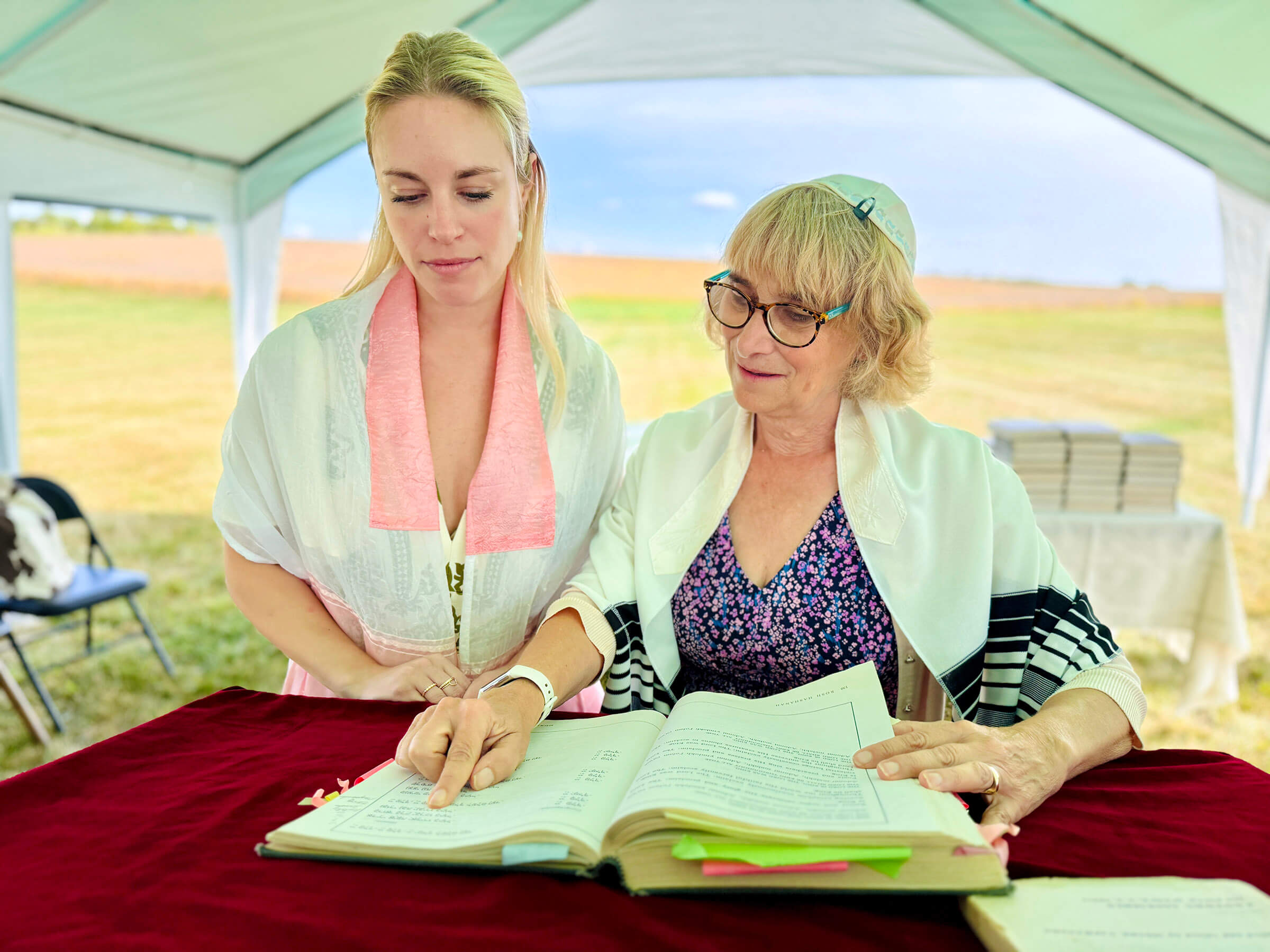
When it came time for the haftarah, Hannah chanted from the Book of Samuel, the story of another Hannah who prayed for a child and was answered with life. The promise echoed here: Even in barren soil, something new can take root. This was a harvest whose yield measured not in bushels, but in belonging.
Then Taylor, Nik’s eldest, stepped forward to read the same passage in English. It was a rehearsal for the bat mitzvah her family plans to hold in the new synagogue. The rabbi from Pennsylvania, whose congregation donated its stained glass and ark, has already promised to officiate a service that weekend.
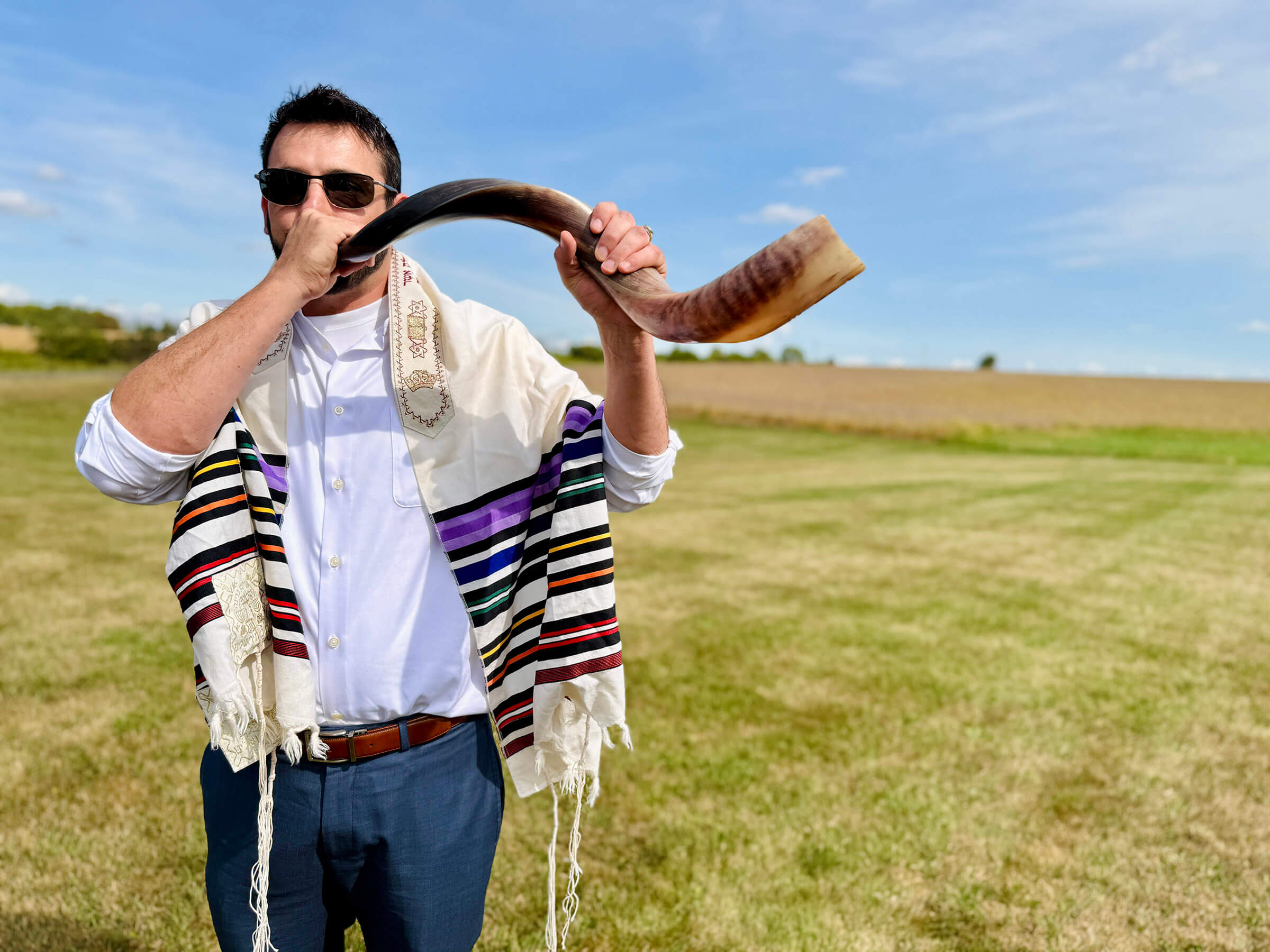
As the service ended, Nik’s four daughters called out the shofar blasts: Tekiah. Shevarim. Teruah. Tekiah Gedolah. Each shout met by their father’s ram’s horn, its note low and unbroken, bending through the air until it joined the wind.
The synagogue and the soil
In a storage area tucked away on the farm sit the rescued pieces from Temple B’nai Israel — the century-old synagogue in White Oak, Pennsylvania, whose sacred objects Nik salvaged.
The space was quiet, almost reverent — a warehouse of waiting. Along one wall, stained-glass windows lay boxed and labeled, their blues and ambers dulled by dust, their light waiting to be released. A pair of rabbi’s chairs stood sentinel beside the bimah, their arms worn smooth by generations. At the far end, Nik lifted a heavy blanket to reveal the ark — twin lions perched on top, their wooden paws folded in patience.
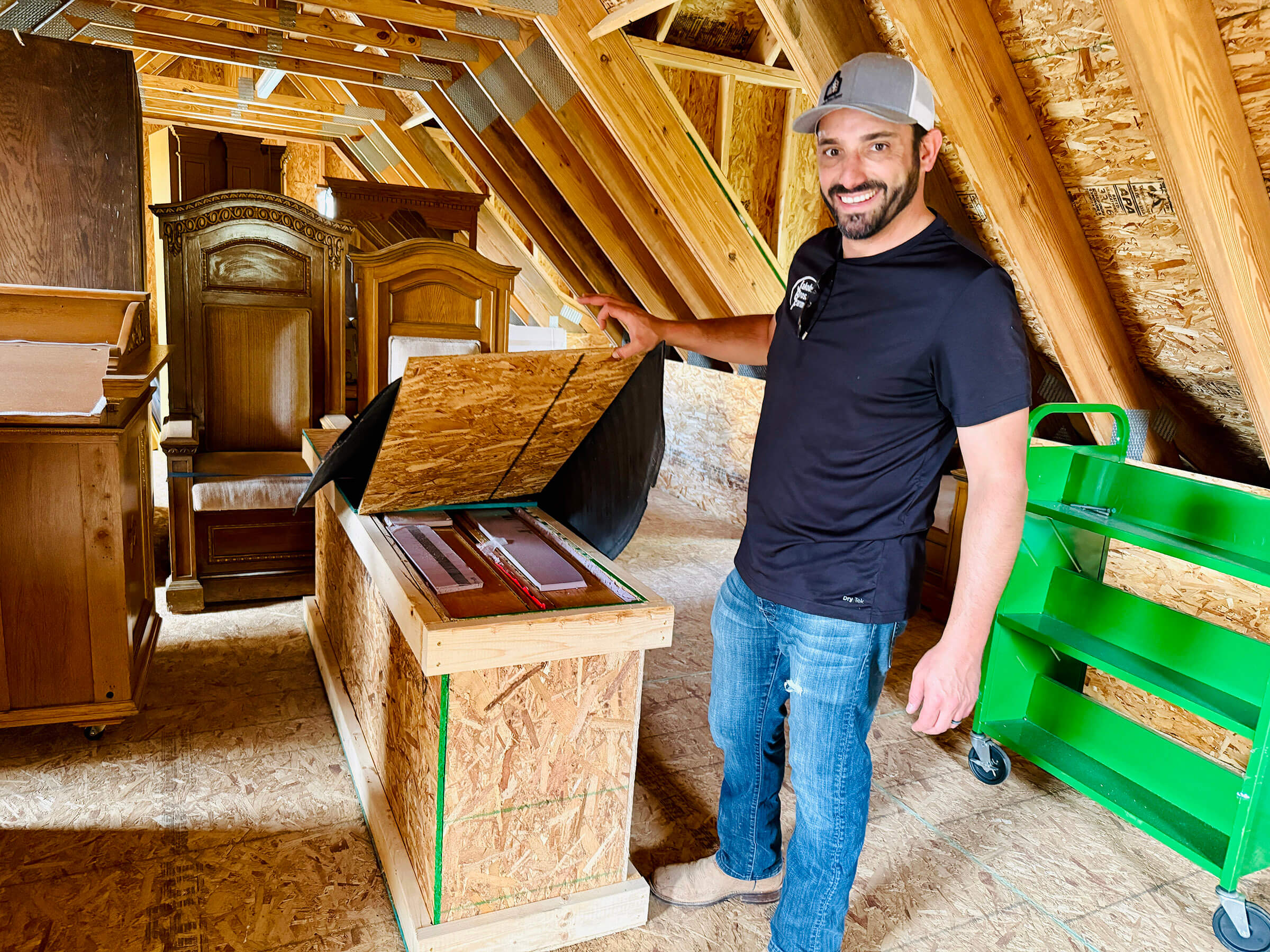
“This is what we’re saving,” Nik said softly. For a man who measures life in acres and seasons, this was another kind of harvest.
Around the objects sat more fragments of American Jewry: twelve stone tablets engraved with the tribes of Israel, salvaged from another synagogue — Beth Israel in Washington, Pennsylvania — beside the yahrzeit plaques from Sterling’s own Temple Sholom. Legacy upon legacy, boxed but not buried. A reliquary of Jewish endurance.
He was done storing the past like seed. It was time to see what would grow.
In the center of town, there’s the cornfield where the new synagogue will rise, beside New Life Lutheran Church. A farmer from the congregation had sold them the land: steeple on one side, shul on the other. The name felt like a promise.
On the hood of his truck, Nik spread the blueprints, the paper snapping in the wind. A sanctuary lined with stained glass from White Oak. Beside it, a museum to tell the story of Jewish life in small-town America — and the people who refused to let that story end.
One area will honor the Jewish merchants and families who once filled the Sauk Valley towns. Another will recreate the room where a Christian family hid Nik’s grandmother and her relatives during the Holocaust — her childhood spent in whispers, her prayers muffled beneath a pillow.
He paused, tracing calloused fingers along the edge of the paper. “It won’t be dark,” he said. “People will walk through and understand what it means to come out of hiding.”

Since the Forward first published Nik’s story about the synagogue in a cornfield, envelopes have arrived at the farm, postmarked from towns Nik had never heard of — some with checks for $18, others with offers of sacred objects from shuttered shuls across the country. One rabbi wrote to donate his congregation’s bimah chairs; Nik plans to use them as seating in the museum, each marked with a small plaque naming where it came from.
Margo told me she still dreams of Torah crowns, the silver rimonim that once shimmered atop scrolls in sanctuaries now gone. Each new package feels like a quiet affirmation, a widening circle of faith.
The Jakobs family and the small but mighty Sterling Jewish community are not trying to save Judaism. They’re proving it can still take root here, in open country.
Hope, here, isn’t an idea. It’s a practice, the daily work of planting what you may never see bloom.
Stretching before us, the field was bare, the soil raked smooth and waiting. Nik stood in silence, listening for the faintest stir of something beginning, the sound of a harvest yet to come.
The post This Jewish farmer is harvesting corn — and planting a synagogue — in the Illinois prairie appeared first on The Forward.
Uncategorized
Congressional Hopeful Michael Blake Seeks to Erase AIPAC Support, Misleads on Past Trips to Israel

Former New York State Assemblyman Michael Blake is running for US Congress in the Democratic primary in New York’s 15th Congressional District. Photo: Screenshot
Michael Blake, a progressive Democrat running for US Congress in New York City, appeared to have recently made misleading statements about the nature of his previous trips to Israel and relationship with AIPAC, the country’s foremost pro-Israel lobbying group.
In Instagram comments, Blake characterized one of his visits to Israel as being done in his capacity as a reverend. Blake visited Israel in 2014 with the Jewish Community Relations Council (JCRC) and in 2017 with the AIPAC-affiliated American Israel Education Foundation.
“I attended a trip and spoke at previous events about my faith as an ordained reverend and about the Black & Jewish relationship but haven’t been involved in years,” he posted when asked to clarify his ties to AIPAC, which seeks to foster bipartisan support for the US-Israel alliance.
Blake, a former New York state assemblyman, is running an insurgent left-wing campaign to unseat incumbent US Democratic Rep. Ritchie Torres, a staunch supporter of Israel, in the state’s 15th congressional district.
Regarding previous support from AIPAC, Blake said, “Donations would have been minimal in the past.”

Social media screenshot
However, Blake’s social media comments contradict previous documentation about the nature of his trip to Israel and relationship with AIPAC. Although Blake asserted that he visited Israel with an AIPAC-linked group as a reverend, reports indicate that he attended AIPAC events through 2019 and only became ordained as a reverend following his 2020 Democratic primary defeat to Torres.
“The Bronx Democrat then gave up his Assembly seat to fall to Ritchie Torres in a 2020 congressional race. Since then, he’s run his public affairs firm, backed Maya Wiley’s 2021 run for mayor, and got ordained as a reverend,” Politico reported in 2024 in an article on Blake considering a bid at the time for New York City mayor.
Contrary to Blake’s assertions that he only participated with AIPAC as a reverend, the politician participated in multiple AIPAC events, including its annual policy conference in 2017 while serving as vice chairman of the Democratic National Committee (DNC). Skeptics have suggested that Blake invoked religion to minimize progressive blowback over his connections to AIPAC.
Last year, the New York Post first reported that Blake deleted several past social media posts touting his attendance at AIPAC events.
Since announcing his campaign to unseat Torres, Blake has lurched farther left on the Israeli-Palestinian conflict in an apparent attempt to court progressive voters. Blake has issued blistering statements condemning Israel of committing a so-called “genocide” in Gaza and vowed to vote against any military aid to the Jewish state.
“I am ready to fight for you and lower your cost of living while Ritchie fights for a Genocide. I will focus on Affordable Housing and Books as Ritchie will only focus on AIPAC and Bibi,” Blake posted on X in a statement last year announcing his candidacy, referencing Israel Prime Minister Benjamin Netanyahu.
In May 2025, however, during his failed campaign for mayor, Blake walked back his accusations of “genocide” against Israel, claiming that he regretted using the term to characterize the war in Gaza.
“It was wrong language to use,” Blake said, referencing his October 2023 post which accused Israel of committing genocide in Gaza. He apparently again reversed his stance when launching his congressional bid in New York’s 15th district.
Despite his efforts, Blake’s previous trips to Israel and history of praising the Jewish state have elicited skepticism among left-wing voters in New York City. Progressive critics have pointed to his 2017 speech at the annual AIPAC conference in which he lavished praise on Israel. In 2020, while speaking with Jewish Insider, he compared his experience as an African American to the struggles of Jewish people in Israel.
As the relationship between the Democratic Party and Israel continues to deteriorate following the breakout of the Israel-Hamas war, liberal politicians have continued to recalibrate their approach to Middle Eastern geopolitics. Many ambitious Democratic candidates have staked out positions on Israel more aligned with the far-left, progressive flank of the party, accusing the Jewish state of “genocide” and “ethnic cleansing” while vowing to oppose any arms sales to Jerusalem.
Despite his aggressive overtures to progressives, Blake’s campaign to unseat Torres still remains a longshot. The 15th district encompasses Riverdale, a heavily Jewish and affluent community and hub of pro-Israel activism. Polling suggests that Torres maintains heavy levels of support in his district, placing him among the most popular politicians in the state of New York.
Blake’s campaign did not respond to a request for comment for this story.
Uncategorized
National support group for interfaith Jewish families guts staff amid funding crisis
(JTA) — A national nonprofit that supports interfaith Jewish families has slashed its workforce after facing an unanticipated budget shortfall.
18Doors announced on March 31 that it had “significantly” reduced its staff due to budget constraints. In fact, about two-thirds of the staff were laid off the week before the announcement, board member Laurie Beijen told the Jewish Telegraphic Agency.
The nonprofit had 15 staff members last August, according to an archived version of its website. This week, it lists four employees, nearly all in the C-suite.
CEO Mike Wise has stepped down, and 18Doors is now being led by Ellen Frank, the chief operating officer, and Adam Pollack, the chief program officer, the organization said.
Among those no longer at 18Doors are employees responsible for fundraising, creating digital content about interfaith inclusion and running a referral service to connect interfaith families and clergy. That service, which the organization says reached 2,000 families a year, remains operational, Beijen said, but “to a lesser degree.”
She said the budget crunch was complex and had come as a surprise. She cited in particular the squeeze felt by nonprofits like 18Doors in recent years as foundations and donors shifted their giving priorities toward Israel and fighting antisemitism.
“We were kind of caught off guard by the severity of our funding issues,” Beijen said. “It’s a myriad of causes that are sort of short, medium and long term, and we ended up just getting caught in this storm.”
Jodi Bromberg stepped down as CEO in 2024 after helming the organization for a decade, including during its 2020 rebrand from InterfaithFamily. The organization hired a search firm to find her replacement and a consulting firm to help draw up a strategic plan, which Beijen said it had been “on the cusp” of announcing before instead sharply contracting.
A delayed annual gift also scrambled budget planning, Beijen said, with a gap of just a few months sending the organization into a financial crisis. 18Doors declined to identify the donor or the size of the gift.
The nonprofit has raised $2 to 3 million a year in recent years and spent all of that or more, according to its filings with the IRS. Its significant donors have included the Marcus Foundation and Combined Jewish Philanthropies, the Jewish federation in Boston, where 18Doors is based. The Marcus Foundation and CJP did not respond to requests for comment.
In a statement emailed to the 18Doors community and posted on social media last week, the nonprofit wrote, “The Board has since secured necessary funding to stabilize the organization in the short term.”
Jewish philanthropic giving has changed since the Hamas attack on Israel on Oct. 7, 2023, with many donors choosing to focus on pro-Israel giving and causes that address antisemitism.
In December, the Shabbat dinner nonprofit OneTable laid off a quarter of its staff, citing donors’ funding priorities. The group is adapting its programming to include more Israel content.
At the recent Jewish Funders Network international conference, speakers, funders and philanthropy executives put a heavy emphasis on giving toward Israel and antisemitism-related issues, according to video and recaps of the conference.
Activists and educators in other areas say that while Israel and antisemitism are important issues, other causes are being left behind.
Founded in 2001, 18Doors says its mission is to encourage mixed-heritage families to engage in Jewish life, while encouraging Jewish communities and clergy to become more welcoming and inclusive.
18Doors’ vision of inclusion for interfaith families has grown closer to reality in the decades since its launch. In 2001, a Pew survey found that half of Jews who married in the previous 10 years had married non-Jews. Two decades later, in 2021, it found that the rate for marriages in the last decade had risen to 61%. Most children of the couples were being raised Jewish, the survey found, with participation in synagogue life and Jewish institutions common.
Two major seminaries recently began admitting students who are in relationships with people who are not Jewish, saying that they wanted to ordain rabbis who match the communities they serve. And in December, while continuing to prohibit intermarriages performed by its rabbis, leaders of the Conservative Movement formally apologized for decades of discouraging intermarriage between Jews and non-Jews and vowed to create new opportunities for inclusion in Conservative synagogues.
But advocates for interfaith families say much more needs to be done.
“The idea that being warm and welcoming is sufficient is false. There’s much more to learn and to do,” said Keren McGinity, an interfaith educator and scholar. “18Doors is important because they are part of the work that gets done, including training clergy.”
McGinity has her own experience with layoffs in the interfaith inclusion space. She was the interfaith specialist at the United Synagogue of Conservative Judaism before her position was eliminated last year.
She said she is optimistic that 18Doors’ financial crunch will be temporary — but she said she believed the Jewish philanthropic landscape needs to change nonetheless.
“What concerns me is that there should be more funding channeled towards engaging interfaith couples and families,” McGinity said.
Though no other institution has quite the national reach that 18Doors has, other organizations addressing some aspects of interfaith family life include the children’s Jewish literacy program PJ Library; Embark at Mem Global, a program for interfaith and mixed-heritage couples in their 20s and 30s; and Honeymoon Israel, which provides trips to Israel for “young couples of all backgrounds.”
Beijen said 18Doors is aiming to preserve its flagship 18-month clergy program, the Rukin Rabbinic Fellowship, which provides training for spiritual leaders who work with interfaith families.
Bromberg, the group’s former CEO, says 18Doors serves families like hers: Her wife is Catholic and they have children together. Now a consultant helping other nonprofits, she said the cuts at 18Doors signify both a crushing loss and a pressing question.
“These are long time, long-tenured staff. The Jewish community as a whole will lose the institutional knowledge and the relationships that it’s had through 18Doors, through the laying off of those staff,” she said.
Bromberg added, “The question it leaves in the minds of families like mine is: Whose priority are mixed-heritage and interfaith families in Jewish life?”
The post National support group for interfaith Jewish families guts staff amid funding crisis appeared first on The Forward.
Uncategorized
Jewish groups condemn Trump’s threat that a ‘whole civilization will die’ in Iran
(JTA) — Jewish groups were among those criticizing President Donald Trump and accusing him of using genocidal rhetoric on Tuesday after Trump posted online that “a whole civilization will die tonight” if Iran does not reopen the Strait of Hormuz.
“A whole civilization will die tonight, never to be brought back again,” wrote Trump in a post on Truth Social. “I don’t want that to happen, but it probably will. However, now that we have Complete and Total Regime Change, where different, smarter, and less radicalized minds prevail, maybe something revolutionarily wonderful can happen, WHO KNOWS?”
The president’s comments came hours before his 8 p.m. deadline for Iran on Tuesday to reach a deal to reopen the Strait of Hormuz, and were met by swift condemnation by a group of Senate Democrats, including Minority Leader Chuck Schumer.
“We speak today with one voice and one purpose: to condemn President Trump’s threat to extinguish an entire civilization,” Schumer wrote in a joint statement. “This is not strength. Intentionally destroying the power, water or basic infrastructure upon which tens of millions of civilians depend to punish the very civilians who suffer at the hands of the Iranian regime would constitute a war crime, a betrayal of the values this nation was founded on and a moral failure.”
Amy Spitalnick, the CEO of the Jewish Council for Public Affairs, condemned the president’s remarks, saying in a statement that there were “simply no words to describe the danger of a U.S. president openly threatening to erase an entire civilization.” She alluded to Jews’ history of facing genocidal leaders in her comments.
“Make no mistake: the president’s threats are deeply reprehensible to us as Jews and as Americans, and must be condemned by all leaders – regardless of their stance on the war with Iran,” Spitalnick said. “We know what it means when leaders call for communities and populations to be wiped out.”
Spitalnick was not the only Jewish leader to weigh in. Jeremy Ben-Ami, the president of the liberal pro-Israel lobby J Street, said in a statement that the group was “appalled by President Trump’s heinous remarks.”
“This language – a threat to carry out war crimes – is a searing violation of Jewish and American values, certainly will not lead to the de-escalation we desperately need and is a terrifying example of the senseless violence that has characterized Trump’s leadership,” Ben-Ami said, calling on Congress and the Cabinet to “do everything in their power to restrain and remove him.”
Other progressive Jewish groups and leaders accused Trump of promoting genocide, including Bend the Arc: Jewish Action, which wrote in a post on Instagram, “This is not strength. This is not safety. This is a call for genocide.”
Timothy Snyder, a historian of the Holocaust, also leveled the accusation against the president in a Substack post published on Tuesday titled “The president speaks genocide.”
“To bomb a bridge or a dam or a power plant or a desalinization facility, very likely a war crime in any event, could very well have a different legal significance, a genocidal one, if it takes place after the expression of genocidal intent by the commander and head of state,” Snyder wrote.
For some Jews, the president’s looming deadline for Iran carried added significance as it came during the final days of Passover — and as Iran continued to barrage Israel with missiles.
“Tonight, I pray that the Pharaohs who insist on our demise recognize the harm that they may bring on themselves,” Rabbi Arie Hasit, associate dean of the Schechter Rabbinical Seminary in Israel, wrote on Facebook. “That they recognize that Iran can put aside its insistence that Israel must be destroyed and that they can make the necessary steps to end this war.”
“And I pray that if they are overcome by Pharaoh, that no leader try to play the part of God,” Hasit continued. “That in the name of my future, we do not wipe out any civilization. That we understand that even the worst of enemies does not justify the use of the fiercest of our power.”
The post Jewish groups condemn Trump’s threat that a ‘whole civilization will die’ in Iran appeared first on The Forward.