



Uncategorized
Toronto Police Allow Anti-Israel Protests Outside Synagogue, Other Jewish Sites

Illustrative: Hundreds of anti-Israel protesters, primarily university students, rally at Toronto’s Nathan Phillips Square on Oct. 28, 2023. Photo by Sayed Najafizada/NurPhoto
Protesters in Toronto this past weekend demonized the Jewish state through provocations such as chanting accusations of terrorism outside of a synagogue and destroying an effigy of Israeli Prime Minister Benjamin Netanyahu with a noose around his neck.
Israel’s consul general in Toronto, Idit Shamir, blasted Toronto police, charging they had failed to follow a recent pledge to prevent demonstrations outside of Jewish institutions.
“One week ago, Toronto Police banned pro-Palestinian protests at Bathurst and Sheppard, the heart of Toronto’s suburban Jewish community, after two years of documented harassment and antisemitic displays targeting the people who live, pray, and send their children to school there,” Shamir wrote on X. “Today, one week later, police escorted a pro-Palestinian protest through that same intersection.”
Shamir described how the anti-Israel advocates marched “past Darchei Noam Synagogue. Past the Toronto Heschel School. Past the L’Chaim Seniors Residence. Masked demonstrators chanted that Zionists are racists and terrorists.” He added that “small groups broke off onto side streets to reach Jewish residents more directly. No arrests. The ban held exactly as long as the gap between demonstrations.”
In making his statement, Shamir shared a video posting from lawyer Caryma Sa’d, a journalist and self-described satirist running a “Protest Mania” website whose footage vividly documented the events. The video features a man saying to Toronto police, “You gotta start enforcing the law. I don’t know who gives you your mandate, but start enforcing the law.”
Concluding his statement, Shamir wrote: “In Hebrew, there is a word for this: hefker. הפקר Ownerless. Abandoned. Beyond protection. Every generation of Jews has known a city where that word became real. I did not expect Toronto to be mine.”
In analyzing the event, the Combat Antisemitism Movement said that “Toronto Police have not explained why the march proceeded along this route. The gap between policy and enforcement remains clear — and so do the questions about whether Jewish residents are being protected in practice.”
In further videos shared by Sa’d, demonstrators and pro-Israel counter-protestors exchanged profane insults on Sunday with accusations of “Rape supporters!” and vulgarities like “Dirty c—t! F—k you, f—king losers!” A video of activists on Saturday shows one man who calls a yellow-jacketed police officer a “dumb f—k.”
The Canadian Antisemitism Education Foundation (CAEF) stated that “Toronto Police would not tolerate a white supremacist parade up and down Jane St. between Finch and Steeles. So why are Toronto’s Jews required to tolerate a hate parade in the part of the city where we make our homes and community?”
Toronto’s law enforcement defended the decision to sanction the protestors’ route. “Officers ensured the group did not enter residential streets, and no arrests were made,” a police spokesperson said.
The spokesperson explained that the ban “does not apply to lawful demonstrations at the main intersection and along major roadways. Demonstrations have taken place at this intersection for several years. They can be tiring, disruptive, and distressing – but that does not make them illegal. Demonstrations are protected under Canadian law, and enforcement action is taken when there are reasonable grounds to believe a criminal offence has occurred.”
Another report of a Toronto protest over the weekend said that demonstrators burned Israeli and American flags. One individual took an effigy of a noosed Netanyahu and spit on its head before stomping the symbol of Israel’s leader.
According to Israel National News, demonstrators proclaimed, “We will sacrifice our souls and our blood for Al-Aqsa and Palestine.” Other chants asserted that “resistance is justified when a people lives under occupation” and declared that “the only solution is intifada.”
According to A Dictionary of Modern Written Arabic, the word “intifada” translates as “to be shaken off, be dusted off; to shake; to shudder, shiver, tremble; to shake off from oneself; to wake up, come to consciousness.”
Since the 1980s, the term came to refer to two distinct efforts by Palestinian terrorists to murder Israelis and destroy the Jewish state, with the first period starting in 1987 and the second in 2000. Anti-Israel activists today now regularly demand that supporters of the Palestinians seek to “globalize the intifada,” meaning engage in violence and terrorist acts everywhere. In an interview with cable host Al Sharpton on Sept. 7, then-New York City mayoral candidate Zohran Mamdani said he would “discourage” use of the phrase. He had previously refused.
Mirroring trends around the planet, Canada has seen a surge in recent years of antisemitic hate crimes, pro-terror advocacy, and vulgar street demonstrations with Toronto as the epicenter.
On March 10, Toronto Police Deputy Chief Frank Barredo said that according to witnesses, two men drove up to the US consulate in a white SUV and fired a handgun at the building before fleeing in the vehicle.
Royal Canadian Mounted Police Chief Superintendent Chris Leather announced an increased security presence at the US and Israeli consulates in response, saying at a press conference that “these consulates deserve a heightened amount of vigilance and security at this time in the hopes that we can bring the temperature down in the coming days and weeks.” Vandals in Toronto have previously shot bullets at a Jewish-owned restaurant and at a local synagogue.
B’nai Brith has documented the rise of antisemitism in Canada, with the organization’s 2024 audit finding a 7.4 percent increase from 2023, reaching 6,219 for the highest total ever recorded since tracking began in 1982.
On Sept. 21, 2025, Canada joined with its Anglosphere allies the United Kingdom and Australia in choosing to recognize a Palestinian state.
Canadian Prime Minister Mark Carney asserted at the time that “this in no way legitimizes terrorism, nor is it any reward for it.”
Uncategorized
Alleging conflicts, California judge boots Jewish DA from trying Stanford pro-Palestinian protesters
(JTA) — This story originally appeared in J. The Jewish News of Northern California.
Jewish groups in the Bay Area are protesting a judge’s removal of a local Jewish district attorney from a case involving pro-Palestinian protesters accused of vandalizing Stanford University’s president’s office.
The district attorney, Jeff Rosen, was disqualified from retrying a felony case against five protesters after the judge ruled that Rosen had crossed a legal line when suggesting in a campaign message that the protest was antisemitic.
“Rosen is allowed to take a strong stance against crime in the community, against antisemitism. But caution and care need to be taken when utilizing active litigation in campaign communication,” Judge Kelley Paul said from the bench.
The judge said Rosen had erred when publicly labeling the incident antisemitic when it was not charged as a hate crime.
“This case is not a hate crime,” Paul said. “The characterization of the prosecution as a fight against antisemitism runs afoul of case law.”
In an email to J. The Jewish News of Northern California, Rosen’s office wrote that while it “disagrees with the judge’s ruling, we respect it.”
In a joint statement, the Jewish Community Relations Council Bay Area and Jewish Silicon Valley wrote that they are “deeply troubled” by Paul’s decision and that the case “must proceed.”
“This decision uniquely targets minority prosecutors, suggesting they are incapable of pursuing justice in cases perceived to be impacting their own communities,” the statement says, adding that it “risks reinforcing longstanding antisemitic prejudices and invites future defendants to weaponize a prosecutor’s identity against them.”
The five protesters face felony vandalism and conspiracy counts stemming from a June 2024 protest in which 13 people broke into Stanford’s executive offices and caused an estimated $300,000 in damages. A jury deadlocked in February, splitting 9-3 on the vandalism count and 8-4 on conspiracy. Rosen quickly announced his plan to retry them.
The disqualification motion was filed by deputy public defender Avi Singh, who argued that Rosen had compromised his office’s neutrality by featuring the prosecution on a campaign fundraising page titled “DA Rosen Fighting Anti-Semitism,” alongside a donation button.
Singh argued that the fundraising campaign falsely implied that the defendants were antisemitic. None was charged with a hate crime.
Rosen, who has spoken publicly about his commitment to fighting antisemitism and supporting Israel, has denied any conflict of interest.
In her decision, Paul pointed to Rosen’s remarks in a March 2025 speech he gave for the San Jose Hillel, about a month before his office filed charges against the protesters. A video of the speech is linked on the “Fighting Anti-Semitism” page on his campaign website.
In the speech, Rosen equated antisemitism and “anti-Americanism,” a phrase that Deputy District Attorney Robert Baker also used to describe the conduct of the protesters during the trial’s closing arguments. Paul ruled that the similarities in the language disqualified the entire DA’s office from the case, not just Rosen.
In their own statement, the local Jewish groups suggested Rosen was being disqualified because he is Jewish.
“Generations of American Jews in positions of public trust have all too often been treated as suspect or inherently conflicted,” JCRC Bay Area and Jewish Silicon Valley said. “This decision risks reinforcing longstanding antisemitic prejudices and invites future defendants to weaponize a prosecutor’s identity against them, casting any public opposition to hate as grounds for disqualification.”
Rosen’s challenger in his June primary election, former prosecutor Daniel Chung, has turned the ruling into a campaign video. Chung called Rosen’s pursuit of the Stanford case “overzealous” and “a waste of time and money.”
“This is a humiliating loss for DA Rosen and his entire office,” Chung said in an Instagram video. “For years, millions of dollars have been spent trying to prosecute Stanford student protesters with felony charges.” Rosen’s actions, Chung said, “jeopardized the due process of the defendants” and “exemplifies the undermining of integrity, competence and compassion under DA Rosen for the last 16 years.”
The ruling hands the case to California’s attorney general, which will decide whether to retry the defendants — German Gonzalez, Maya Burke, Taylor McCann, Hunter Taylor-Black and Amy Zhai — or drop the charges.
The post Alleging conflicts, California judge boots Jewish DA from trying Stanford pro-Palestinian protesters appeared first on The Forward.
Uncategorized
Iran’s Deepening Water Crisis Threatens 35 Million as Economy Buckles Under US Pressure, Mounting Domestic Strain
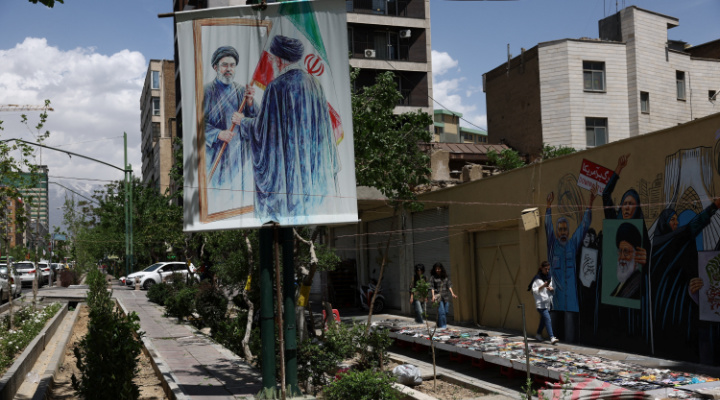
People walk on a street near a mural featuring an image of the late Supreme Leader of Iran, Ayatollah Ali Khamenei, in Tehran, Iran, May 6, 2026. Photo: Majid Asgaripour/WANA (West Asia News Agency) via REUTERS
As talks with the United States over a possible deal to end the war remain uncertain, Iran’s economy is under mounting strain, with prolonged water shortages, pressure on energy infrastructure, and slowing industrial output deepening what authorities describe as an “economic war.”
With Iran entering the summer months amid a deepening water and electricity crisis, government officials estimate that around 35 million people will face water shortages, intensifying concerns over deteriorating living conditions, mounting economic strain, and daily hardship across the country.
On Monday, Issa Bozorgzadeh, a spokesman for the country’s water industry, reported that rainfall has fallen “below normal” levels across 11 provinces, warning that Tehran is among the worst affected as it enters its sixth consecutive year of drought.
Now, Iranian authorities are urging citizens to cut consumption and adopt stricter usage habits, pointing to deep structural failures in the water and power sectors as public frustration rises over supply disruptions, mismanagement, and declining living standards.
Officials have also announced planned summer power outages, warning that the deepening energy crisis could lead to factory shutdowns, reduced industrial output, rising unemployment, and higher prices.
On Sunday, Arash Najafi, head of the Energy Commission of Iran’s Chamber of Commerce, noted that household, commercial, and office blackouts are likely to continue daily throughout the summer, while the industrial sector will continue to be targeted for power cuts” or “will continue to bear the brunt of power cuts.
Given the damage to several petrochemical facilities in Israeli and US strikes and their reliance on electricity from the national grid, Najafi said most available power would now be directed toward keeping these complexes operational around the clock.
“The Islamic Republic will be forced to impose electricity consumption restrictions for about 120 days, and given the lack of effective means for people to significantly reduce usage, this will result in widespread blackouts,” the Iranian official said in a statement.
Amid growing public frustration over the ongoing crisis, Majid Doustali, a member of Iran’s parliamentary planning and budget committee, called on citizens to cut back on electricity, water, and fuel consumption as part of the country’s resistance efforts in what he described as an “economic war.”
“Every effort by the public to save resources represents a direct challenge to the enemy’s economic conspiracy,” Doustali said.
Even as the crisis continues to weigh heavily on the Iranian people, a nationwide internet blackout remains in place, having exceeded 1,728 hours as of Monday, after authorities imposed the shutdown more than two months ago, effectively isolating millions of Iranians from independent reporting on the war and access to global news.
Across much of the country, unstable internet forces many people to rely on illegal black-market virtual private networks (VPNs) — tools that bypass government censorship — to stay connected beyond Iran’s borders, with access costing millions, and users risking imprisonment and national security charges.
According to a CNN estimate, Iranians have spent roughly $1.8 billion on internet access over the past two months.
Soaring costs and crumbling infrastructure have also forced businesses to cut jobs on a massive scale, leaving many workers unemployed and intensifying social and economic pressures across the country, The New York Times reported.
Dozens of major companies have reportedly laid off hundreds of employees across multiple industries, with the industrial sector alone potentially putting up to 3.5 million workers at risk, as the country’s economy reels from the impact of a US naval blockade on Iranian ports that began in mid-April.
The US blockade has prevented the regime from exporting energy through the Strait of Hormuz — a critical global energy chokepoint through which about one-fifth of the world’s oil supply passes.
With companies sharply reducing or freezing production amid shutdowns and mass layoffs, the private sector downturn is further threatening the regime by reducing tax revenues, which the government has come to rely on heavily amid mounting sanctions and trade restrictions.
Iran’s new supreme leader, Ayatollah Mojtaba Khamenei, has attempted to contain the fallout by urging companies to avoid layoffs “to the extent possible.”
But the regime’s internet shutdown alone has cost businesses and companies an estimated $80 million in daily losses, The New York Times reported.
As the Iranian currency continues to plunge and inflation peaks near 60 percent, senior official Gholamhossein Mohammadi said the war has already cost around one million jobs, alongside “the direct and indirect unemployment of two million people.”
Meanwhile, Iran’s energy sector is also under severe strain, with exports falling sharply, storage capacity nearing its limits, and infrastructure under growing pressure.
According to data from commodity analytics firm Kpler, Iran could exhaust its oil storage capacity within 25 to 30 days if the crisis continues, prompting cuts in output at several oil fields to ease pressure.
Amid an export collapse exceeding 70 percent, the government now faces a critical decision between shutting wells to manage storage constraints or risking long-term damage to key oil fields.
Even though Kpler’s report estimates Tehran may not feel the full revenue hit for another three to four months due to payment delays and pre-existing sales flows, the regime is expected to face a heavy blow, with losses potentially reaching $200–250 million per day.
With domestic tensions rising and the internal economic crisis worsening, Iranian officials are increasingly wary that renewed protests could erupt in the coming days, further destabilizing an already volatile situation.
Uncategorized
Sen. Cory Booker Reaffirms Commitment To Maintaining Israel’s ‘Qualitative Military Edge,’ Criticizes ‘Reckless War’ In Iran

April 12, 2026, New York, New York, United States: (NEW) 2026 NAN Convention. April 11, 2026, New York, New York, USA: U.S. Senator Cory Booker speaks during Day 4 of the National Action Network (NAN) 35th Anniversary Convention at Sheraton New York Times Square Hotel on April 11, 2026 in New York City. (Credit: M10s / TheNews2)(Foto: M10S/Thenews2/Zumapress) (Credit Image: © M10s/TheNEWS2 via ZUMA Press Wire)
Sen. Cory Booker (D-NJ) defended his continued support for Israel in a recent interview while distancing himself from what he described as a “reckless war,” underscoring the increasingly delicate balancing act facing pro-Israel Democrats amid mounting political pressure from the party’s progressive wing.
In an interview with the media outlet RealClearPolitics, Booker emphasized that his opposition was not directed at Israel itself, but rather at policies he believes risk further destabilizing the Middle East and weakening long-term regional security.
“Let’s be clear, I’m opposed to a reckless war that has made the United States and Israel less safe, as well as our other Arab allies. I will not support arms from the United States or any of our allies, including Israel, in a context of a war that is endangering our national security and Israel’s. I continue to support our US military being the strongest in the world,” Booker said.
The comments come as divisions within the Democratic Party over Israel have intensified following over two years of conflict in Gaza and escalating tensions involving Iran-backed militant groups across the region. While a growing faction of Democrats has pushed for stricter conditions on military aid to Israel, Booker sought to position himself as firmly supportive of the US-Israel alliance even as he voiced concern about the conduct and trajectory of the conflict.
Booker, however, emphasized that he still supports helping Israel maintain its military advantage over its neighbors in the Middle East, a position which analysts argue helps bolster American geopolitical interests in the region.
“I continue to support Israel having a qualitative military edge, the ability to defend themselves, and offer deterrents. But in the context of this war, I will not support more military armaments to conduct what I think is a disaster that’s endangering American lives, Israeli lives, and as we see in the UAE and Saudi Arabia, our regional allies as well.”
Booker, long viewed as one of the Senate’s more traditionally pro-Israel Democrats, has historically backed military assistance to the Jewish state and has frequently spoken about the importance of Israel as America’s closest democratic ally in the Middle East. His latest remarks appeared aimed at reassuring pro-Israel voters and donors wary of the party’s leftward shift on the issue.
However, Booker raised eyebrows recently when he joined a record number of Democratic senators to vote in favor of Sen. Bernie Sanders’ (D-VT) resolution against sending more arms to Israel, raising questions among some pro-Israel observers about his position on Israel.
Of the 47 Senate Democrats, 40 voted in favor of blocking sales of bulldozers and 36 voted in favor of blocking transfers of so-called “dumb” bombs.
The failed votes represent the largest show of opposition to military aid for Israel within the party in recent memory. While previous efforts spearheaded by Sanders drew support from a smaller bloc, this vote saw roughly 80 percent of Senate Democrats vote against transferring aid to the Jewish state, signaling a seismic shift in the dynamic between the Democratic Party and Israel.
Booker’s framing may reflect a broader strategy among mainstream Democrats: separating criticism of specific military operations from opposition to Israel’s existence or security needs.
Supporters of Israel argue that distinction is increasingly important as anti-Israel rhetoric grows more common in some activist circles following Hamas’ October 7 attacks and the subsequent war in Gaza. A growing number of Democratic officials and ambitious progressive candidates have accused the Jewish state of committing “genocide” in Gaza. Israeli officials have repeatedly argued that military operations are necessary to dismantle Hamas and prevent future attacks against Israeli civilians.
Booker’s comments may signal an effort to preserve bipartisan support for Israel at a time when polling shows younger Democratic voters becoming more critical of the Israeli government. At the same time, pro-Israel advocates have warned that weakening US backing could embolden Iran and its regional proxies, including Hamas and Hezbollah.
The senator did not indicate support for ending military cooperation with Israel altogether, instead emphasizing that American leadership should focus on both protecting Israeli security and preventing a wider regional war.