



Uncategorized
Tucker Carlson’s Huckabee Interview: Confidence Without Comprehension

Tucker Carlson speaks on first day of AmericaFest 2025 at the Phoenix Convention Center in Phoenix, Arizona, Dec. 18, 2025. Photo: Charles-McClintock Wilson/ZUMA Press Wire via Reuters Connect
When Tucker Carlson announced he would be interviewing US Ambassador to Israel Mike Huckabee, it was clear this would not be a friendly exchange. Carlson, who appears to be funded by Qatar, a state that openly backs Hamas, has positioned himself as one of Israel’s fiercest critics in American media.
What followed was not the exposé Carlson likely imagined.
It was a two-hour display of confident ignorance.
Yet much of the media coverage focused on a single distorted headline: Carlson’s suggestion that biblical scripture implies Israel seeks to “take over the Middle East.”
That became the story.
It was also the least revealing part of the interview.
What went largely unreported was not Huckabee’s answers, but Carlson’s performance: his theological confusion, historical sloppiness, conspiratorial insinuations, and failure to grapple with facts that contradicted his narrative.
A Disaster From Start to Finish
Carlson opened the interview with a monologue that appeared designed to rehabilitate his own credibility.
He repeated claims that he had been “detained” at Ben Gurion Airport when leaving Israel after recording the interview, suggesting it was unsafe for him to travel to Jerusalem. He implied he felt endangered after Prime Minister Benjamin Netanyahu allegedly called him a “Nazi.”
That was among the first of his distortions. There is no verified record of Netanyahu making such a statement.
Footage from the airport shows Carlson in the VIP lounge, posing for photos and interacting amicably with staff.
He claimed he was “detained,” that security “took passports,” and his producer was “hauled into a side room.”
Footage from Ben Gurion’s VIP lounge shows Tucker Carlson hugging staff and posing for photos.
This pattern — reframing routine events as persecution –serves a rhetorical purpose. It casts Carlson as a dissident truth-teller under siege. It does not withstand scrutiny.
Huckabee directly confronted Carlson over his earlier interview with Aguilar, a former Gaza Humanitarian Foundation aid worker who claimed he witnessed Israeli soldiers kill a young boy in Gaza.
As Huckabee pointed out, that account was later proven false when the boy was discovered alive.
Huckabee stated that he personally helped coordinate the child’s evacuation from Gaza, working with four countries to secretly extract the boy and his mother less than a week after the alleged “murder.” The operation had to remain covert, he said, because Hamas would have killed the child to validate Aguilar’s narrative.
And yet Carlson still entertained the claim as plausible, naturally failing to acknowledge his own role in broadcasting this fiction to millions.
For a commentator who brands himself as a skeptic of mainstream media narratives, the absence of self-scrutiny was striking.
Bethlehem and Basic Geography
Carlson cited Bethlehem – the birthplace of Christianity – as evidence that Christians are being driven out of the West Bank by Israel.
Bethlehem has been under Palestinian Authority control since 1995. Israel does not govern it, and there has been no Jewish community there for decades.
If the Christian population has declined, the obvious question is: under whose governance?
Huckabee raised precisely that point.
Carlson did not engage.
1/
The media’s takeaway from Tucker Carlson’s interview with Ambassador @GovMikeHuckabee?A distorted headline about Israel “taking over the Middle East.”
That wasn’t the story…
The story was Tucker Carlson self-immolating for over two hours.
Watch the clip.
Then let’s… pic.twitter.com/e5AvpTMGW6
— HonestReporting (@HonestReporting) February 21, 2026

Theology as Geopolitical Caricature
Carlson invoked God’s promise to Abraham – “from the river of Egypt (Nile) to the Euphrates” – and suggested that this covenant implies contemporary Israeli expansionism across sovereign Middle Eastern states.
This is a categorical error.
The Abrahamic covenant is a theological concept, not a modern policy platform. No Israeli government has articulated a program to annex the Middle East based on Genesis.
By collapsing ancient scripture into a present-day territorial blueprint, Carlson substituted provocation for analysis.
Huckabee attempted to correct the framing.
Carlson appeared uninterested.
Ancestry as Legitimacy Test
In one of the interview’s most jarring moments, Carlson questioned Netanyahu’s right to live in Israel on the basis of ancestry.
“Netanyahu’s family is from Poland,” Carlson said. “There’s no evidence his ancestors ever lived here. On what basis does he have a right to be here?”
Huckabee responded bluntly: “I’m totally unable to process what you’re saying.”
The exchange spoke for itself.
Framed as a critique of one politician, the logic extended further – implying that Jewish belonging in Israel requires genealogical proof acceptable to Carlson.
It was delivered not tentatively, but with certainty.
And then there was the subject of Qatar.
Carlson appeared surprised when Huckabee noted that Christians in Qatar are overwhelmingly migrant workers confined to a restricted church compound, with no Christian citizens and limited public expression of faith.
By contrast, Israel has approximately 184,000 Christian citizens, hundreds of churches, open Easter processions, and church bells ringing weekly.
Carlson initially leaned on a cursory reading of Wikipedia before conceding he did not know the details.
For someone positioning himself as a defender of Christianity in the Middle East, all while seemingly receiving funding from the Qatari state, the disconnect was difficult to ignore.
Conspiracy, Recycled
Carlson floated additional insinuations and conspiracy, including the absurd claim that the United States went to war in Iraq after September 11 because of Israel.
This trope, that Jewish or Israeli influence dragged America into war, has circulated for decades across ideological extremes.
Reducing complex American strategic decisions, Congressional votes, and post-9/11 security policy to “Israel made us do it” is not serious analysis. Yet here it was, presented as such by a former Fox News host watched by millions.
By the end of nearly three hours, a pattern had emerged.
Carlson repeatedly blurred theology into policy, questioned Jewish historical continuity, recycled war-blame insinuations, dismissed counter-evidence, and spoke authoritatively on subjects he appeared not to have mastered.
And he did so with confidence.
That is what much of the media missed.
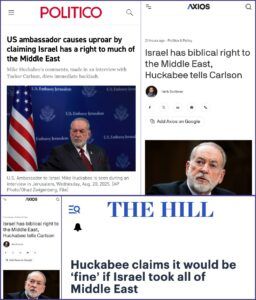
The story was not Huckabee’s answer to a distorted Biblical question.
It was watching a prominent commentator unravel under the weight of his own thinly sourced claims.
Criticism of Israeli policy is legitimate. Debate over strategy is healthy.
But when interrogation gives way to insinuation, and skepticism morphs into selective credulity, the result is not fearless journalism.
It is confidence without comprehension.
And it was watched by nearly two million viewers in under 24 hours.
The author is a contributor to HonestReporting, a Jerusalem-based media watchdog with a focus on antisemitism and anti-Israel bias — where a version of this article first appeared.
Uncategorized
Piers Morgan is what’s wrong with media coverage of the Israeli-Palestinian conflict — and I can’t stop watching him
Piers Morgan’s online debate about Nicholas Kristof’s New York Times op-ed containing allegations of Israeli dog rape was loud, chaotic and unenlightening — and I couldn’t stop watching it.
That’s a problem. Morgan’s format is a trap. On his YouTube talk show, Piers Morgan Uncensored, he pits people holding intransigent, often extreme positions against each other, goads them to yell at one another across Zoom, and positions himself as the voice of reason in the middle. It’s hateporn — addictive, and not reflective of reality.
And yet Piers Morgan Uncensored and many similar YouTube- and social-media based news programs are where people increasingly get their information and engage with controversial issues like the Israeli-Palestinian conflict.
These programs rack up views by persuading viewers there is no middle ground, no moderate position, no alternative to conflict. And their strategy is working.
The Kristof episode, which racked up 340,000 views in a day, is titled, “Torture Does NOT Work!” — all Morgan show names have one word in all caps and end in an exclamation point.
It begins with people shouting. “You are not a journalist!” Ana Kasparian, a commentator on another YouTube show, shouts at podcaster and online anchor Emily Schrader — before Morgan comes on to introduce the segment.
He quickly recaps the lurid details from Kristof’s New York Times oped, “The Silence That meets the Rape of Palestinians,” and a newly issued nearly-300 page Israeli report on Hamas sexual violence.
“As far as I’m concerned, the only cause is basic human decency,” Morgan says in his cool British accent, “If your first instinct about either report is to look for ways to smear them, you might have run out of that yourself.”
Yet the six deeply partisan guests spend the next 45 minutes smearing the reports, and each other.
Morgan’s introductory call for human decency is not a plea, it’s a ploy. He plays the mature voice of reason standing between the extremist pro-Israelis and the pro-Palestinians — not to persuade them to come to a moderate position, but rather to exploit the most virulent voices in order to generate clicks, while still claiming the cover of journalism. This approach causes real harm by giving extremists a megaphone, and a degree of exposure that all but guarantees that people actually trying to build a better future go unheard.
A recipe for drama
Morgan repeats this formula over and again. In an episode entitled, “Netanyahu CONNED Trump!” Dave Smith, a sidekick to Joe Rogan, accuses Israel of dragging the United States into the Iran war. In “I’m SICK of it!” commentator Megyn Kelly launches into a similar attack on Israel.
Morgan has had long interviews with white supremacist and proud antisemite Nick Fuentes (“What a crock of S***!”). In “STAND for Dead Soldiers!” Morgan hosted four Israelis at the extreme ends of the political spectrum and watched them fight when one refused to stand as a siren sounded to honor Israel’s fallen soldiers.
Not extreme or dramatic enough? How about the time Morgan hosted Crackhead Barney, a Black pro-Palestinian street activist, to explain why she harasses celebrities to get them to say, “Free Palestine.”
“I’m truly shocked/disgusted that @piersmorgan would have this nutjob & clearly unwell person to go on his show and even remotely try to talk about Palestine or the war,” wrote the Gazan-born activist Ahmed Fouad Alkhatib.
Alkhatib is a moderate Palestinian who works for a peaceful solution to the conflict. He has, unsurprisingly, not been on Piers Morgan Uncensored.
Instead, Morgan’s choice of guests is calculated for maximum friction, a function of an attention economy that monetizes the time people like me spend watching the fights.
From ‘Animal House’ to Piers Morgan
Luring viewers this way isn’t exactly new. President Ronald Reagan called The McLaughlin Group, a current affairs program that ran on public television for 34 years beginning in 1982, “the political equivalent of Animal House”— more drunken frat house than graduate seminar. McLaughlin begat Crossfire, a CNN political debate program hosted by a younger Tucker Carlson that Jon Stewart once compared to pro-wrestling.
In 2025, Morgan, who came up in British tabloids before a long stint at CNN, moved away from traditional broadcast TV and went all in on social media and his YouTube channel.
His success on that platform is part of a larger shift in media from major institutions to independent personalities, and from actual news — the dutiful and expensive process of finding out and relaying what’s actually happening in the world — to opinion that spins itself as reporting, which is far cheaper and more entertaining.
That shift has come as audiences have moved from loyalty to long established institutions to following enterprising, independent personalities. The podcaster Joe Rogan has 20.9 million subscribers; Carlson has 5.6 million; Morgan’s show has 4.42 million subscribers and over 1.36 billion total views.
In other words, Morgan is not some guy some people watch now. He is what people will be watching in the future.
A bias toward extremes
That prospect should alarm us. Morgan’s shows rarely feature people working toward compromise or reconciliation. A Piers Morgan Uncensored discussion spotlighting the many civil society groups in Israel working toward coexistence? A show where he sits down with Arab and Jewish Israelis who share a vision for a common future? A segment that highlights the actual, albeit rare, instances of cooperation?
Pipe dreams. All that is also happening in Israel and the West Bank — but Piers Morgan Uncensored effectively censors it.
Compare that to Jon Stewart, who on The Daily Show last month conducted a long interview with the Palestinian and Israeli co-authors of The Future Is Peace, a book that calls for moving beyond violence and stalemate to a shared future. Same approach — a streaming interview on a hot-button topic, with an eye toward entertainment — but radically different editorial choices.
That episode garnered a mere 400,000 views. Morgan’s comparative millions of eyeballs may, in his mind, justify his guttersweeping approach to international conflict. And in his defense — and mine, for watching — it’s never boring. He can be a thoughtful and provocative interviewer, and his not-ready-for-primetime, self-created show allows him, when he so chooses, to platform voices that more mainstream venues overlook, like former Israeli Speaker of the Knesset and longtime peace activist Avrum Burg.
Alas, he stuck the erudite former statesman with a diehard evangelical and a firebreathing American Jewish conservative pundit. That episode is called, “A SHAME on Judaism!”
Whatever this is, it’s not journalism. But it is the future.
The post Piers Morgan is what’s wrong with media coverage of the Israeli-Palestinian conflict — and I can’t stop watching him appeared first on The Forward.
Uncategorized
Rashida Tlaib Introduces Resolution ‘Recognizing Ongoing Nakba’

US Rep. Rashida Tlaib (D-MI) addresses attendees as she takes part in a protest calling for a ceasefire in Gaza outside the US Capitol, in Washington, DC, US, Oct. 18, 2023. Photo: REUTERS/Leah Millis
US Rep. Rashida Tlaib (D-MI) on Thursday reintroduced a congressional resolution recognizing the 78th anniversary of what she described as the “ongoing nakba,” using the Arabic term for “catastrophe” deployed by Palestinians and anti-Israel activists to refer to the establishment of the modern state of Israel in 1948.
The resolution, introduced on the anniversary of Israel’s independence, accuses the Jewish state of carrying out “ethnic cleansing,” “apartheid,” and “genocide” against Palestinians, language that many pro-Israel lawmakers in Congress and advocacy groups strongly reject as inflammatory and inaccurate. The measure also calls for renewed US support for the United Nations Relief and Works Agency for Palestine Refugees in the Near East (UNRWA), an agency that has faced mounting scrutiny from Israel and several Western governments over allegations that employees participated in or supported Hamas’s Oct. 7, 2023, massacre across southern Israel.
In a statement announcing the resolution, Tlaib argued that the so-called nakba “did not end” with the Arab-Israeli war in 1948 and continues today through Israeli military operations and settlement expansion.
“War criminal Netanyahu and his cabinet have repeatedly threatened to ethnically cleanse the entire Palestinian population in Gaza, annex the land, and permanently occupy it. Today, they are extending these same threats towards southern Lebanon,” she said, referring to Israel Prime Minister Benjamin Netanyahu and military operations against US-designated terrorist groups Hamas and Hezbollah. “As we mark the 78th anniversary of the Nakba, we honor all of those killed since the ethnic cleansing of Palestine began and all those who have been forced from their homes and violently displaced from their land.”
Activists often invoke the term “nakba” when discussing the displacement of some 750,000 Palestinian Arabs following Israel’s War of Independence, many of whom left the nascent state for varied reasons, including that they were encouraged by Arab leaders to flee their homes to make way for the invading Arab armies. At the same time, about 850,000 Jews were forced to flee or expelled from Middle Eastern and North African countries in the 20th century, primarily in the aftermath of Israel’s declaring independence.
Tlaib’s resolution is co-sponsored by several prominent progressive Democrats, including Reps. Alexandria Ocasio-Cortez (NY), Ilhan Omar (MN), Ayanna Pressley (MA), and Summer Lee (PA).
The move is likely to draw fierce criticism from pro-Israel lawmakers and Jewish organizations, many of whom argue the resolution ignores the historical context surrounding Israel’s founding and the 1948 war. Israel accepted the United Nations partition plan in 1947 to create two states, one Jewish and one Arab, while neighboring Arab states rejected it and launched a military invasion after Israel declared independence.
The resolution also calls for a so-called Palestinian “right of return,” a demand insisting that potentially millions of descendants of Palestinian refugees should be able to return to the land of Israel, a step that, according to proponents, would result in the abolition of the world’s only Jewish state.
“This immense trauma, including the loss of their loved ones and connections to the communities they grew up in, needs to be repaired. True peace must be built on justice and the inalienable right of return for Palestinian refugees,” Tlaib said in her statement.
While refugees are generally defined as those who flee a country out of credible fear of persecution, UNRWA uniquely defines Palestinian refugees to include all descendants of those who left the land, regardless of where they were born.
Tlaib, the only Palestinian American member of the US Congress, has emerged as one of Israel’s loudest critics on Capitol Hill, repeatedly accusing the Jewish state of genocide and drawing rebuke from fellow lawmakers.
Uncategorized
Toronto Sees 50% Drop in 2025 Hate Crimes, Yet 82% of Religiously Motivated Attacks Target Jews

A member of law enforcement personnel works at the scene outside the US Consulate after shots were fired, in Toronto, Ontario, Canada, March 10, 2026. Picture taken with a mobile phone. Photo: REUTERS/Kyaw Soe Oo
Even as Toronto recorded an overall decline in reported hate crimes last year, newly released data shows the city’s Jewish community continued to face disproportionately high levels of targeted antisemitism and violence amid an increasingly concerning social climate.
On Thursday, Toronto Police released its annual hate crime statistical report, showing that Jews accounted for 82 percent of all religiously motivated hate crimes in 2025, compared to 14 percent targeting Muslims.
Even though the Jewish community makes up less than 3 percent of Toronto’s population, officials now warn that Jewish residents are 14 times more likely than other residents to be targeted in a hate incident.
With 81 anti-Jewish hate crimes recorded, Jews and Israelis were the targets of 35 percent of all reported hate incidents in the city.
Despite a 50 percent overall decline in reported hate crimes, from 443 in 2024 to 231 in 2025, Toronto has seen a 40 percent increase in such incidents so far this year compared with the same period last year.
Toronto Police Chief Myron Demkiw noted that, even with the overall decline, the Jewish community continued to be the primary target of hate-motivated offenses.
“We are steadfast in our commitment to confronting hate in all its forms and making it easier for people to come forward and report incidents of hate,” Demkiw said in a press release.
Because police-reported hate crime data only includes incidents that come to the attention of authorities and are later confirmed or suspected to be hate-driven, official figures likely underestimate the true scale of such incidents.
Over the past two years, Toronto authorities have expanded law enforcement capacity and resources to investigate hate crimes by establishing a Counter-Terrorism Security Unit and increasing specialized training for officers, while also strengthening Holocaust education initiatives and introducing digital literacy programs for youth aimed at countering online radicalization.
Centre for Israel and Jewish Affairs Vice President Michelle Stock called the latest statistics “deeply alarming,” warning of a broader reality of hostility that Jewish families across the city are confronting on a daily basis.
“Toronto prides itself on being a city where people of all backgrounds can live openly, safely and without fear. Those values are undermined when any community no longer feels secure expressing its identity in public,” Stock said in a statement.
“From synagogues to schools to public displays of Jewish identity, blatant attacks against the Jewish community are becoming more frequent and more brazen,” she continued. “Jewish Canadians are being targeted simply for who they are. No one should have to think twice about wearing a kippah, attending synagogue, sending their children to Jewish schools or participating openly in Jewish life.”
The city’s figures reflect a broader nationwide rise in antisemitism and anti-Israel hostility, with the Jewish advocacy group B’nai Brith Canada reporting a record high in anti-Jewish hate crimes in 2025 for the second consecutive year, documenting 6,800 such cases across the country.
According to the latest report, antisemitic incidents nationwide increased by 9.3 percent last year, surpassing the previous record total of 6,219 set in 2024.
With an average of 18.6 incidents per day, this figure represents a 145.6 percent increase from 2022, before the Hamas-led invasion of and massacre across southern Israel on Oct. 7, 2023.
Early 2026 data already indicate the country is now on track to see its most violent year against the Jewish community in recent memory, with more violent antisemitic attacks recorded so far this year than during all of 2025, B’nai Brith Canada reported.
In total, 11 violent antisemitic incidents have already been recorded across the country since January, surpassing the 10 violent cases documented during all of last year
“These brazen attacks on Jewish Canadians are a sign of a crisis of antisemitism that has spiraled out of control,” Simon Wolle, chief executive officer of B’nai Brith Canada, said in a statement.
“Violence such as this, which has escalated from targeting synagogues to targeting Jewish people directly, does not occur in a vacuum. It is what happens when governments fail to act despite mounting evidence that antisemitism is becoming more normalized and dangerous,” Wolle continued.
Last week, a group of Jewish worshippers standing outside the Congregation Chasidei Bobov synagogue in Montreal was targeted in a drive-by shooting, leaving one person with minor injuries.
A week earlier, three visibly Jewish residents were targeted in a separate antisemitic attack when suspects opened fire with a gel-pellet gun, causing minor injuries.