


Uncategorized
UC San Diego ‘Guardian’ Journalist Unfairly Attacks Study Abroad Program in Israel

The San Diego skyline. Photo: Wikimedia Commons
Following the announcement of the UC San Diego study abroad program in Israel and Jordan this winter, some students — including UCSD Guardian senior staff writer Jaechan Preston Lee — expressed outrage at the Anthropology department’s decision to host the trip.
The critical article that Lee published in the university paper last month parades misinformation as truth, and exacerbates the already fragile climate on campus.
His article conveys Israel as a militaristic, vengeful, malevolent, and hateful state. And his argument promotes exclusion and discourages students from gaining a comprehensive understanding of perspectives they may not agree with.
Accepting Lee’s call to cancel the trip would undermine our school’s commitment to academic freedom, further demonize pro-Israel and Jewish community members, and allow his deeply distorted worldview to continue bullying its way into wider acceptance.
On Oct. 5, the UCSD Anthropology Department sent an email to all undergraduate students offering the opportunity to learn about the region’s “ancient and recent past” by “meeting people of very different religious and ethnic backgrounds.”
Two weeks later, Lee argued that the trip is “unethical and reckless” because it is “a form of American and Israeli soft power influence on the West’s perception of land rights and indigeneity in the Middle East.” He justifies his position in a number of ways, all of which collapse under even modest scrutiny.
First, it’s important to address his false claims. The characterization of Israel as an “apartheid state” and the current conflict with the Palestinians as a “genocide” are easily disproven.
Palestinian Arab citizens of Israel enjoy full and equal rights. They serve in every single level of society — from the Supreme Court and Knesset to all levels of civil life — and policies regarding the disputed territories are either temporary or a response to constant terror threats.
The genocide accusation is equally false. First, there was no intention to commit genocide — which is legally and morally required for the term to ever apply. Israel was fighting a war of self defense after the Oct. 7 massacre. Second, any arguments about population decline in Gaza cannot be proven — because the death tolls released by the Hamas-run Gaza Health Ministry have been falsified and also debunked.
The genocide accusation is also a complete insult to populations that have undergone an actual genocide — since no “genocide” in history has included protective actions such as leaflet distribution to encourage evacuation, nor has it ended immediately after hostages were released. Israel had the fire power to kill hundreds of thousands, if not a million Gazans. If genocide were Israel’s true aim, why were none of these capabilities ever used?
What’s more, all of the sources that Lee offers have faced widespread criticism for being incredibly dishonest and systemically biased against Israel for decades.
The UN report Lee hyperlinks was co-written by a rapporteur who is so antisemitic that she is being sanctioned by the US government. Lee also cites Hamas-allied Qatari state media Al Jazeera to suggest that Israel attacked its neighboring countries unprovoked, without mention of Hezbollah in Lebanon, the Houthis in Yemen, or jihadist activity in Syria.
Lee’s work follows a pattern in biased discourse where the lie of Israel’s unique evil is repeated until nobody questions if it’s true. Regardless of intent, Lee has become a mouthpiece for the propaganda that he claims to oppose.
One revealing argument targets Israel’s archaeological work, which Lee portrays as a means for the state to exert control over disputed land. By acknowledging Jewish artifacts beneath the soil, he implicitly affirms the deep historical Jewish roots in the region, yet dismisses that history as irrelevant to Jewish claims to the land. He also overlooks concerns that, under full Palestinian control, many of these sites and artifacts would risk neglect or destruction. The very existence of this debate underscores the importance of students seeing Israel’s archaeological realities firsthand.
Lee also fails to mention that the trip will include excursions in Jordan. The program is clearly designed to provide a balanced regional perspective rather than promote any single narrative.
At its core, the article is an excuse to attack Israel and isolate Zionist students. To deprive students of the opportunity to visit Israel is to attack our community’s freedom of choice and academic strength.
If the mere exposure to opposing perspectives derails your cause, perhaps it isn’t an honest one.
The campus culture at UCSD has been divisive and exclusionary towards Jews and Israelis since Oct. 7, 2023. Harmful narratives shut out anyone whose experiences do not align, and Lee’s piece will likely contribute to this trend.
By hosting this trip, the Anthropology Department takes a step toward changing that. It demonstrates a commitment to fostering global citizens and critical thinkers who inform their opinions through conversations with real people rather than 60-second videos on TikTok feeds.
I hope that the trip’s participants will show our campus what it means to engage rather than alienate. Maybe they will open the door for a generation of students who choose curiosity over banishment, and have the courage to see one another as people, not as sides of a centuries-old geopolitical conflict.
Uncategorized
Argentina designates Iran’s Revolutionary Guard a terrorist organization
(JTA) — Argentina announced on Tuesday that it had designated Iran’s Islamic Revolutionary Guard Corps as a terrorist organization, a move that was quickly praised by Israeli Foreign Minister Gideon Saar.
The move stems from Argentina’s decades-long investigations into the 1992 bombing of the Israeli Embassy in Buenos Aires, which killed 29 and injured more than 200, and the 1994 attack on the AMIA Jewish center, which left 85 dead and 300 injured in what remains the deadliest terrorist attack on Argentine soil.
In a statement, President Javier Milei’s office described the attacks as “two of the most serious terrorist attacks in history, carried out in the 1990s by the IRGC’s operational arm in the region, the organization Hezbollah.”
With Tuesday’s decision, the Argentine government will now include the IRGC in the Public Registry of Persons and Entities Linked to Acts of Terrorism and its Financing, triggering financial sanctions and operational restrictions intended to curb its ability to operate in the country and safeguard Argentina’s financial system from illicit use.
The announcement by Milei, who has stood out as one of Israel’s staunchest international supporters, comes months after his office also designated the Quds Force, the foreign arm of the IRGC, as a terrorist organization in January. In recent years, Argentina has also designated Hamas and Hezbollah as terror groups.
Saar praised the move in a post on X Wednesday, writing that the designation “places Argentina, under [Milei’s] leadership, at the forefront of the free world in the fight against the Iranian regime of terror and its proxies.”
“With this decision, President Milei – one of the greatest leaders of our generation – has once again demonstrated moral clarity and an unwavering commitment to the values of freedom and the fight against its enemies,” Saar wrote.
Last month, just days into the ongoing U.S.-Israel war with Iran, Argentina issued an arrest warrant for Ahmad Vahidi, who was appointed as the head of the IRGC after its previous leader was killed in the first wave of U.S.-Israeli strikes.
Vahidi is currently the highest-ranking Iranian figure accused by the Argentine judiciary. An arrest warrant for him was first issued in 2006 in connection with the AMIA case.
This article originally appeared on JTA.org.
The post Argentina designates Iran’s Revolutionary Guard a terrorist organization appeared first on The Forward.
Uncategorized
This isn’t Barbra Streisand’s ‘Yentl’ — it isn’t I.B. Singer’s either
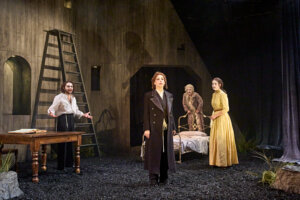
There’s an FAQ on the website of the London theater where the Kadimah Yiddish Theatre of Melbourne’s production of Yentl is running through April 16. The very first item reads:
Is this a stage version of the 1983 musical film starring Barbara Streisand?
No — the London production of Yentl is a play. It is a new adaptation of Isaac Bashevis Singer’s 1962 short story,“ Yentl the Yeshiva Boy“ — just like the Streisand film was at the time.
This explanation does more than relieve box office staff of the tedious duty of informing Mrs. Lipschitz and Mrs. Rosenblatt from the sisterhood that no, they shouldn’t come expecting to sing along to “Papa, Can You Hear Me.” It argues that this theatrical “reimagining” (to use Kadimah’s own term) of Yentl is no less authentically Singerian than the musical. It also hints at how Kadimah prevailed, against considerable odds, in adapting a story whose rights Streisand still owns and fiercely guards.
As Gary Abrahams, Kadimah’s executive director and the director of the production, recently told the Jewish Telegraph, Singer’s estate gave him their approval on the condition that it be a Yiddish language, non-musical production. The London transplant, which comes on the heels of earlier stagings in Melbourne and Sydney, is enjoying a six-week run at the Marylebone Theatre, which is housed inside of an anthroposophical center. Both the limited duration of the run and the Off West End venue were critical to securing the Singer estate’s approval.
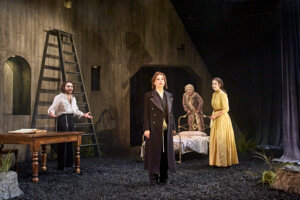
Kadimah’s production, a bilingual Yiddish-English chamber piece that has gained a certain notoriety for featuring male and female nudity, is the latest chapter in the long and unruly afterlife of Singer’s deceptively simple tale.
In “Yentl the Yeshiva Boy,” which first appeared, in English translation, in Commentary in September 1962, a rabbi’s daughter, shut out from the Talmud learning reserved for men, cuts her hair, dons male clothing, changes her name to Anshel, finds a chavrusa, the heartbroken Avigdor, and enters a yeshiva. But Singer’s tale is considerably stranger than both that simple summary and Streisand’s popular version suggest.
Yentl is not simply a tale of female exclusion and feminist defiance. It is also a story of impersonation, erotic confusion, spiritual hunger and metaphysical trespass. Yentl does not cross one line and stop there. Once she begins living as Anshel, all the categories meant to keep life orderly — male and female, study and desire, law and transgression — begin to blur.
That instability may explain why Yentl has proved so durable. Before Streisand made it famous on screen, Singer had already adapted it for the stage in the mid-1970s together with Leah Napolin. The show opened at the Brooklyn Academy of Music in 1974 and transferred to Broadway the next year, with Tovah Feldshuh in the title role.
“As a play it is altogether too anecdotal,” wrote Clive Barnes in the 1974 Times review. “The storyline wanders on and on like a river through a landscape, but the landscape happens to be worth looking at.” Napolin, who died in 2018 (and who claimed that Singer didn’t write a single word of the script) suggested that the second wave feminism of the time made the story and its themes feel relevant to contemporary audiences.
“This dark little gender-bending tale had an impact on many people who identified, as I did, with the heroine’s struggle to reinvent herself, to redefine herself,” Napolin once told an interviewer.
Half a century later, Kadimah’s Yentl leans heavily, and not always successfully, into our contemporary discourse about sex and gender. The story reemerges in a markedly — and overtly — queerer form than in previous versions.
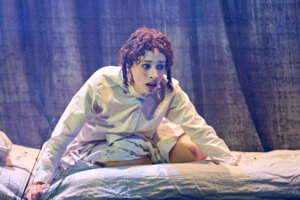
Streisand’s film absorbed the title character so completely into her own star persona that for many people Yentl is now synonymous with Babs, not Singer. Her approach is expansive where Singer is compressed, ardent where he is dry-eyed, and schmaltzy where he is severe. Streisand gave the story glamor, emotional clarity and uplift. It also tilted the material away from Singer’s sharper ambiguities and toward the all-American theme of becoming oneself. The film, which Streisand also directed, produced and co-wrote, even ends with Yentl aboard a ship bound for America! (In Singer, Yentl simply ups and vanishes, an ending that has been interpreted as a reference to the legend of the Wandering Jew).
Yet Streisand’s victory over the material came with at an expense. As Linda Besner notes in an essay on Singer and Streisand and published in the Canadian arts review Arcade, the film’s feminist reclamation of Yentl also trims away some of the story’s deepest instability. Singer’s Yentl tells Avigdor, “I’m neither one nor the other,” and the story allows a degree of erotic and ontological confusion that the film flattens into a drama of self-realization.
Kadimah’s production, adapted by Abrahams, Elise Esther Hearst and Galit Klas, starts from dissatisfaction with that inheritance. Hearst has said the team wanted to get back to the story’s darker, more transgressive roots. In an interview with The Times of London, Abrahams said he had been struck by how unlike the movie Singer’s story really was, and described the original as a work about spirituality, identity, gender, sexuality, as well as plain old sex.
Those ambitions are evident from the outset. This is not a shy Yentl. It foregrounds the body, goes hard on the story’s sexual unease and sharpens its queer implications. Amy Hack is alluringly androgynous in the title role, both attracted by and attractive to Avigdor and Hodes (Genevieve Kingsford in a very stiff performance), Avigdor’s erstwhile fiancée, who Yentl marries in bad faith. As in the film, she casts a prurient gaze at the bathing Avigdor (Ashley Margolis bares all onstage, one-upping Mandy Patinkin, whose naked tush is one of the film’s most memorable sights). Singer’s story can accommodate plenty of sexual discomfort and frustration, but Abrahams’ production lays it on too thick. Did he really need to make Avigdor a mikveh peeper?
The production also never settles on a convincing tone and register. The one-set production, with its vaguely Expressionist look, goes for too much shtetl schlock. The acting keeps sliding between modes without enough control to make the shifts meaningful: naturalistic for a few minutes, then suddenly pitched into something like Yiddish melodrama. Additionally, there isn’t any discernible logic to why certain passages are spoken in English while others are in Yiddish (with subtitles projected onto the set). The result is less daring than uncertain. No performance fully steadies the evening, although Evelyn Krape comes the closest. As the spectral “Figure,” she hovers, narrates, inhabits minor roles and hangs over the proceedings like a comic dybbuk. The device of a spectral conferencier does not entirely cohere, but Krape — hammy in a grotesque-vulgar-goofy way — almost pulls it off.
Kadimah’s production was lauded in Melbourne and Sydney but has met with a very different reception in London, which is, of course, a no-nonsense theater town. Despite the tepid and sometimes outright negative reviews (“Even with nude scenes, this is a schlep,” The Times of London’s critic wrote), the Thursday evening performance I attended was nearly full. And, the mostly grey-haired audience members, several of whom I recognized, from a nearby kosher deli where I wolfed down a pastrami sandwich before the show, were enthusiastic. A Yiddish Yentl in London now is enough of an event to draw not only the usual suspects but the theatrically adventurous — and, no doubt, some Streisand fans who should know to check their expectations at the door.
Kadimah Yiddish Theater, which recently passed its centenary, is, by some counts, Australia’s oldest theater company. This Yentl might well be the biggest hit they’ve had in their long history. Despite its shortcomings — and there any many, both in concept and execution — the production shows that the company understands the need to strive for more than nostalgia and sentimentality, à la Streisand, and to be a little impious and even impish.
Today’s most interesting Yiddish theater (and also film, to an extent) inscribes itself within tradition while treating that heritage as unstable, literate and vulgar. That is what makes the Yiddish work of another Australian director, Barrie Kosky, so refreshing and bracingly alive.
Earlier this season, Kosky directed K., a “Talmudic vaudeville” inspired by Kafka’s “The Trial” at the Berliner Ensemble. In interviews, Kosky has spoke of the polyglot, code-switching, cross-dressing Yiddish theater that formed part of Kafka’s world. His haunting and unsettling production moves between German, Hebrew and Yiddish (including a gorgeous translation of Schumann’s Dicherliebe into mamaloschen) and injects intellectual seriousness with showbiz energy.
There’s another reason I bring up Kosky, a prolific, influential, and deeply Jewish theater and opera director. In summer 2027, he will present a fresh musical version of Yentl at the Fisher Center for the Arts at Bard College, created together with Lisa Kron (the Tony-winning writer and lyricist of Broadway’s Fun Home) and Adam Benzwi, one of the director’s regular musical collaborators in Berlin. According to Bard’s announcement, Benzwi’s score will draw on American and European Yiddish theater, music hall and Hasidic choral traditions. That sounds less like an attempt to strip Yentl back to some pristine original than like an effort to push through the whole layered history of the piece and make something gloriously heterodox.
By this point Yentl exists not as a single work. Singer gave it severity, mischief and danger. Streisand gave it melody and yearning. Kadimah has tried, admirably if unsuccessful, to restore taboo, Yiddish abrasion and folkloric unease, sometimes vividly, sometimes crudely. Kosky may prove better placed than most to let those elements collide without trying to reconcile them too neatly.
The post This isn’t Barbra Streisand’s ‘Yentl’ — it isn’t I.B. Singer’s either appeared first on The Forward.
Uncategorized
Oct. 7 changed Howard Jacobson. But his new novel is as defiant as ever.
Howard Jacobson is a rarity in British public life: vocally, unabashedly Jewish.
Jews have made fine contributions to British society, of course, but typically they haven’t done so with their Jewishness front and center, preferring to stow it away in the service of a vaguely-defined Britishness that still sees outward expressions of ethnic or religious identity as verging on indecorous.
For British Jews remain a tiny minority, just 400,000 or so in total. With nothing like the profile of, say, American Jewry, most Brits continue to view the British-Jewish community as little more than a small, faith-based group.
Yet Jacobson’s funny and discursive fiction has probed the relationship between Britain and its Jews so successfully that it’s earned him the nickname the ‘British Philip Roth’. (Jacobson has said he’d rather be known as the ‘Jewish Jane Austen’.) Often, he’s been the lone British representative of a kind of Jewishness organized not around superstition and routine, but humor and creativity — in short, the secular, cultural model. In 2010, his novel The Finkler Question, about, loosely, a non-Jew so fed up of being mistaken for a Jew that he decides to carry out a sweeping survey of Jewish identity, won the Man Booker prize.
Since Oct. 7, Jacobson has made no secret of both his anguish at the Hamas-led Oct. 7 attacks and his anger at what he sees as the excesses of the pro-Palestinian coalition. He has come out especially forcefully against some of the rhetoric at the London demonstrations that have been the centerpiece of the UK’s anti-Zionist movement. (A couple of his op-eds and interviews were perhaps more controversial than he had intended; in one piece for the Guardian, for example, Jacobson suggested that continued coverage of dead Palestinian children was a new form of ‘blood libel’ against Jews.)
His latest novel, Howl, gives vent to these same frustrations while adding the usual Jacobsonian literary flourishes: a prickly and well-read male Jewish protagonist; a long-suffering, non-Jewish spouse; frequent references to Jewish history; fizzing dialogue; and a darkly comic tone.
Howl — the title is a nod to the Allen Ginsberg poem — charts the descent into madness of Ferdinand Draxler, a Jewish headmaster at a primary school in leafy, diverse north London, who quickly unravels in the face of growing anti-Israel sentiment after Oct. 7. Though Ferdinand is certain that anti-Zionism is antisemitism repackaged, most everyone around him disagrees, including his colleagues, his wife and his brother, who after decades living in Israel as an Orthodox Jew has returned to England newly secular and left-wing. Most galling of all is the conduct of Ferdinand’s Oxford-educated daughter, Zoe: she’s become a regular attendee at pro-Palestinian demonstrations, and is on one occasion caught on live TV tearing down posters featuring photos of Israeli hostages.
As Ferdinand casts about for explanations — is it the universities? Identity politics? A lack of Holocaust education? Plain old Jew-hatred? — his behavior grows ever more erratic, and his ordered, rather British existence crumbles.
I spoke with Jacobson about the re-emergence, to his mind, of an ancient hatred after Oct. 7; the importance of Zionism as an idea; whether he and Ferdinand Draxler are kindred spirits; and why British Jews are typically happy with what he described as “self-abridgment.” The following conversation has been edited for length and clarity.
You said in an interview with The New Yorker last year, and I’m paraphrasing slightly, that when people denied that children were killed and women were raped on Oct. 7, that made you a different kind of person. So in what ways does this altered person, so to speak, show up in Ferdinand?
I certainly was a different person. The world changed the day after, and in many ways, it’s remained that different world now. A world in which people rejoiced in the pain and the suffering and the murder and the rape of other people, was not one I knew. I knew people didn’t like Jews much, but the degree to which they didn’t like Jews, the degree of it I only learned that day. Call me naive, but I didn’t know it was as bad as that. So that day was the new day.
I knew I had to write about it, because otherwise I would have gone mad. But I was in such a rage that the novel I started to write was a kind of madness. So I had to find a character who was a bit more lost, a bit less angry, a bit more confused, even more surprised than I was, and sweeter than me — a kinder, nicer me. One that still had to be astonished by what had happened, maybe even more astonished than me, but somehow or other in the way one could write about him, funnier about it, or gentler about it. That was how I felt I had to go.
Ferdinand repeatedly criticizes the reductive-ness, to his mind, of the protests. Their lack of nuance baffles him. At the same time, his beliefs are rigid and unbending. What would acceptable protest against the war look like for Ferdinand? And is the reader supposed to conclude that there are two, almost competing kinds of madness, Ferdinand on the one hand, the protests on the other, and that something more middle-of-the-road is impossible today?
The protests are madder. That has to be said. The protests are more mad because they are not perturbed or changed at all by any glimmer of light or any glimmer of argument with themselves. Ferdinand is. He’s battered as the novel goes on.
But he’s not happy with himself. And maybe the marchers aren’t happy with themselves. I tried very hard, the more I wrote this book, and the more time goes by, not to argue about the rights and the wrongs of war, because the rights and wrongs of war are, more often than not, evenly spread. And the minute you start defending one side, you look pretty foolish, because in a war the other side is rarely kind, the other side is rarely magnanimous. I don’t think there are any heroes in this war.
Still, why does Ferdinand never so much as attempt to get to grips with his daughter’s beliefs, much less those of the protest movement at large?
Let’s put that down as a failure of his, if you like, and it is a novel, and the character is allowed to have failings. It might be that I, as the novelist, have a greater failing than him in that I didn’t nudge him enough. I nudged him a bit: I had his wife try to encourage him to think about Zoe more, and she [his wife] introduces him to an Italian academic at one point, who says, ‘Never mind the rights and wrongs of it, you’re not making it any better calling them antisemites all the time, that’s going to do no good.’
But he can’t do anything about that because all he hears from their mouths is antisemitic gibberish. This is the problem for my kind of educated hero. Once you hear the gibberish, you can’t get past it. I found sympathy very hard to find for the protesters, and I’m afraid my hero suffers for being so close to me at that moment. So I’ll give you that.
‘Mutti,’ Ferdinand’s Holocaust-survivor mother, has, it turns out, embellished some of her experiences as a prisoner at Bergen-Belsen — notably in her best-selling memoir. What informed how you decided to depict Mutti?
I’ve met one or two female survivors, and they’re who I thought about when I was writing Mutti. Because whenever I’ve met a Holocaust survivor, I’ve wanted to fall in love with them. To feel swallowed up in pity for them. But bad experiences don’t necessarily make a good person. I didn’t want to make a bad person, but I wanted to make somebody who was not just a quivering heap, who does what real people do, and that is she embellishes a bit, lies a bit, she forgets a bit. I wanted a little bit of murkiness around it. I didn’t want anybody to be just a hero or a heroine of anything — on any side.
One of Howl’s more interesting contrasts is Ferdinand’s impassioned defense of Israel on the one hand, and his never having set foot there on the other. What was the rationale for creating a passionate defender of the Jewish State who’d never been there?
I wanted the idea. I wanted him to sort of be naive. I wanted his Zionism to be inexperienced, because I wanted it to be a love of the idea. So much of Zionism is an idea, and it’s very cruel when an idea has to be tested against actuality, because actuality is a swine like that.
Actuality will kill many of an idea, and I wanted him to have a kind of purity about it, an innocence about it, which doesn’t mean he’s right about it. And that’s what his brother laughs at and destroys. So I think I would have ruined it had Ferdinand gone to Israel. But I was very pleased when I came up with the idea, quite late in the novel, to have the brother come back.
Midway through the novel, there’s the following summary of British Jewry: “There’s an air of self-abridgement about them, as though being Jewish were a serious accident that had befallen them and about which they would rather not talk.” Why has Britain produced this kind of Jewishness?
The way we were brought up, we were few in number, and though we did not go around in terror we did go around with the consciousness of keeping a low profile. My father, who actually was not capable of keeping a low profile, because he was an old-fashioned Ukrainian, he was out of Dostoevsky, but he always said to the family, ‘schtum, you stay schtum.’
That was how we were brought up. Don’t make a noise. Don’t run around the streets waving flags. Keep it quiet. I think Philip Roth came over at one point and kind of looked around at English Jews and said, ‘This is the worst, most undistinguished, least forceful bunch of Jews I’ve ever met.’ [It’s worth noting that Roth had a long and often tumultuous relationship with English, Jewish actress Claire Bloom.]
We are still very, very quiet, and even, dare I say it, compared to the American Jews, I think quite Philistine. Because to make art, however quiet the art, is to put yourself forward. It’s to color yourself on the canvas. It’s to announce yourself on the page. “Look, we are here.” You can’t write a Jewish novel and not announce yourself on the page.
And it wasn’t just my dad who thought, schtum, schtum, it’s still British Jews today. Most of the Jews I went to school with went on to become doctors, went on to become lawyers. And they chose those safe careers not just because they were lucrative — and you can make the usual jokes — but because they didn’t need to declare themselves as Jewish within them. Very few went where I went. Almost nobody.
Ferdinand is fairly pessimistic about British Jewry’s future. Do you share this view? How will the current tumult, for lack of a better word, shape us?
I think it will make us less quiescent. I think it will make us realize we really do have to stand on our own feet. A lot of Jews I know have gone to Israel. But I have a feeling that, in the long-term, just as Trump has taught the Europeans that NATO has to defend itself, that Jews will feel they’ve got to defend themselves, and maybe Israel can’t help them. Israel never offered to come over with tanks. But maybe the idea of Israel as a bolt hole, that’s gone.
And how do you want this novel to be remembered?
I hope that my own contribution is the laughter. My contribution in this novel is not the truth I tell about Zionism and the rest of it. That’s not it. It’s the comedy. And I think I can say that some people have loved, or are loving, the book, and it’s the jokes. It’s that strength of mind that says even the worst things that are visited upon us, we will find a way of making funny.
Funny is a big and complex thing, a little word for a very complex thing. Comedy is understanding, it’s grasping, it’s an intellectual act as well as everything else. And that’s what we’ll do. We’ll become even better intellectuals, and let them do their worst.
The post Oct. 7 changed Howard Jacobson. But his new novel is as defiant as ever. appeared first on The Forward.