


Uncategorized
UC San Diego ‘Guardian’ Journalist Unfairly Attacks Study Abroad Program in Israel

The San Diego skyline. Photo: Wikimedia Commons
Following the announcement of the UC San Diego study abroad program in Israel and Jordan this winter, some students — including UCSD Guardian senior staff writer Jaechan Preston Lee — expressed outrage at the Anthropology department’s decision to host the trip.
The critical article that Lee published in the university paper last month parades misinformation as truth, and exacerbates the already fragile climate on campus.
His article conveys Israel as a militaristic, vengeful, malevolent, and hateful state. And his argument promotes exclusion and discourages students from gaining a comprehensive understanding of perspectives they may not agree with.
Accepting Lee’s call to cancel the trip would undermine our school’s commitment to academic freedom, further demonize pro-Israel and Jewish community members, and allow his deeply distorted worldview to continue bullying its way into wider acceptance.
On Oct. 5, the UCSD Anthropology Department sent an email to all undergraduate students offering the opportunity to learn about the region’s “ancient and recent past” by “meeting people of very different religious and ethnic backgrounds.”
Two weeks later, Lee argued that the trip is “unethical and reckless” because it is “a form of American and Israeli soft power influence on the West’s perception of land rights and indigeneity in the Middle East.” He justifies his position in a number of ways, all of which collapse under even modest scrutiny.
First, it’s important to address his false claims. The characterization of Israel as an “apartheid state” and the current conflict with the Palestinians as a “genocide” are easily disproven.
Palestinian Arab citizens of Israel enjoy full and equal rights. They serve in every single level of society — from the Supreme Court and Knesset to all levels of civil life — and policies regarding the disputed territories are either temporary or a response to constant terror threats.
The genocide accusation is equally false. First, there was no intention to commit genocide — which is legally and morally required for the term to ever apply. Israel was fighting a war of self defense after the Oct. 7 massacre. Second, any arguments about population decline in Gaza cannot be proven — because the death tolls released by the Hamas-run Gaza Health Ministry have been falsified and also debunked.
The genocide accusation is also a complete insult to populations that have undergone an actual genocide — since no “genocide” in history has included protective actions such as leaflet distribution to encourage evacuation, nor has it ended immediately after hostages were released. Israel had the fire power to kill hundreds of thousands, if not a million Gazans. If genocide were Israel’s true aim, why were none of these capabilities ever used?
What’s more, all of the sources that Lee offers have faced widespread criticism for being incredibly dishonest and systemically biased against Israel for decades.
The UN report Lee hyperlinks was co-written by a rapporteur who is so antisemitic that she is being sanctioned by the US government. Lee also cites Hamas-allied Qatari state media Al Jazeera to suggest that Israel attacked its neighboring countries unprovoked, without mention of Hezbollah in Lebanon, the Houthis in Yemen, or jihadist activity in Syria.
Lee’s work follows a pattern in biased discourse where the lie of Israel’s unique evil is repeated until nobody questions if it’s true. Regardless of intent, Lee has become a mouthpiece for the propaganda that he claims to oppose.
One revealing argument targets Israel’s archaeological work, which Lee portrays as a means for the state to exert control over disputed land. By acknowledging Jewish artifacts beneath the soil, he implicitly affirms the deep historical Jewish roots in the region, yet dismisses that history as irrelevant to Jewish claims to the land. He also overlooks concerns that, under full Palestinian control, many of these sites and artifacts would risk neglect or destruction. The very existence of this debate underscores the importance of students seeing Israel’s archaeological realities firsthand.
Lee also fails to mention that the trip will include excursions in Jordan. The program is clearly designed to provide a balanced regional perspective rather than promote any single narrative.
At its core, the article is an excuse to attack Israel and isolate Zionist students. To deprive students of the opportunity to visit Israel is to attack our community’s freedom of choice and academic strength.
If the mere exposure to opposing perspectives derails your cause, perhaps it isn’t an honest one.
The campus culture at UCSD has been divisive and exclusionary towards Jews and Israelis since Oct. 7, 2023. Harmful narratives shut out anyone whose experiences do not align, and Lee’s piece will likely contribute to this trend.
By hosting this trip, the Anthropology Department takes a step toward changing that. It demonstrates a commitment to fostering global citizens and critical thinkers who inform their opinions through conversations with real people rather than 60-second videos on TikTok feeds.
I hope that the trip’s participants will show our campus what it means to engage rather than alienate. Maybe they will open the door for a generation of students who choose curiosity over banishment, and have the courage to see one another as people, not as sides of a centuries-old geopolitical conflict.
Uncategorized
This deli serves ham and calls itself Jewish. New Jersey says it’s not kosher.
The Kibitz Room in Cherry Hill, New Jersey, just outside of Philadelphia, serves shrimp salad. It also has a ham sandwich, and its doors are open on Saturdays.
So the people who run it were surprised this month when a state investigator walked in carrying a notice saying a deli with a “Jewish cheesesteak” on the menu needs to tell customers, in writing, that it isn’t kosher.
The backstory and fallout involve a brisket-boosting talk radio host, a rock-and-roll dive bar in Los Angeles, a historian known as Dr. Pastrami, a famous rye bread ad, and a question Jewish diners have been fighting over for the better part of a century: Can a deli be Jewish if it isn’t kosher?
Here’s the beef. The New Jersey Division of Consumer Affairs, which, yes, has a kosher fraud enforcement unit, sent an investigator to the Kibitz Room with a simple message. If you call yourself a Jewish deli, state consumer-fraud rules say you also have to post a sign, or otherwise let customers know, that your food isn’t under kosher supervision. The state isn’t accusing the deli of passing itself off as kosher, and it isn’t banning the word “Jewish.” It just wants a disclaimer next to it.
Neil Parish, 62, who runs the Kibitz Room with his son, Brandon, wasn’t having it. He told the investigator, “You’re not going to come in here and dictate to me the verbiage that I’m going to put on my menu,” he said in an interview with the Forward.
Parish grew up working in delis, first as a dishwasher at 14, and then he was slicing meat by 16. Apart from a six-year stretch in a job with health insurance (“I wasn’t cut out for that,” he says), he’s been in delis ever since.
Which is why the notice struck him as absurd. In Parish’s telling, no observant customer has ever mistaken the Kibitz Room for a kosher deli.
The state is proposing a $1,000 penalty and wants a sign that’s visible to customers saying the deli isn’t kosher. For Parish, it’s the principle, and what he calls government overreach. He says he told the investigator, “I’ll see you in court. I hope the Supreme Court,” adding that “we’re taking this thing to the end. Period. I’m not stopping.”
The fraud squad
New Jersey’s kosher unit spends most of its time on businesses that say they’re kosher.
The biggest cases involve packaging. In 2014, ShopRite’s supplier cooperative agreed to pay a $35,000 penalty for putting a kosher symbol on private-label coffee bags without the certifying agency’s approval. The state leaves the definition of kosher to rabbis. Its job is to check that sellers are telling the truth.
Delis that call themselves Jewish without claiming to be kosher are a smaller slice of the caseload, but not an unheard-of one.
The spark seems to have been lit on Sept. 14, when NJ.com published “New Jersey’s 15 best Jewish delis, ranked for 2026.” The Kibitz Room came in eighth.
Shortly after, the state investigator walked into Radin’s Delicatessen, a mile down the road and ranked No. 7, to see whether it was passing itself off as kosher.
Radin’s owner is Russ Cowan, a fourth-generation deli man, and the original owner of the Cherry Hill Kibitz Room, which he opened in 2001. He was happy to schmooze with the inspector. “Jewish does not mean kosher, and kosher style does not mean kosher,” he said in an interview with the Forward. “But for me personally, I avoid saying either because I don’t want to confuse a customer that might think we are kosher.” His shop sells bacon, ham and cheeseburgers.
When people ask what line of work he’s in, he replies, “the corned beef and pastrami business.” He had replicas made of the neon signs from his family’s old Brooklyn delis, and he says he took the word “kosher” off them.
Rabbi Chaim Dovid Zwiebel, executive vice president of the Orthodox advocacy group Agudath Israel of America, has been watching these fights for more than 20 years. His group supported New York’s kosher fraud law back when it was battling for survival in court. He argues kosher claims should be policed like any other: “From a perspective of consumer fraud,” he said, “the fact that we happen to be speaking about religious items shouldn’t make a difference.”
He isn’t bothered by what New Jersey is asking of the Kibitz Room. “The least you can do is put the disclaimer,” he said, referring to a sign saying the deli isn’t under kosher supervision, posted where customers can see it.
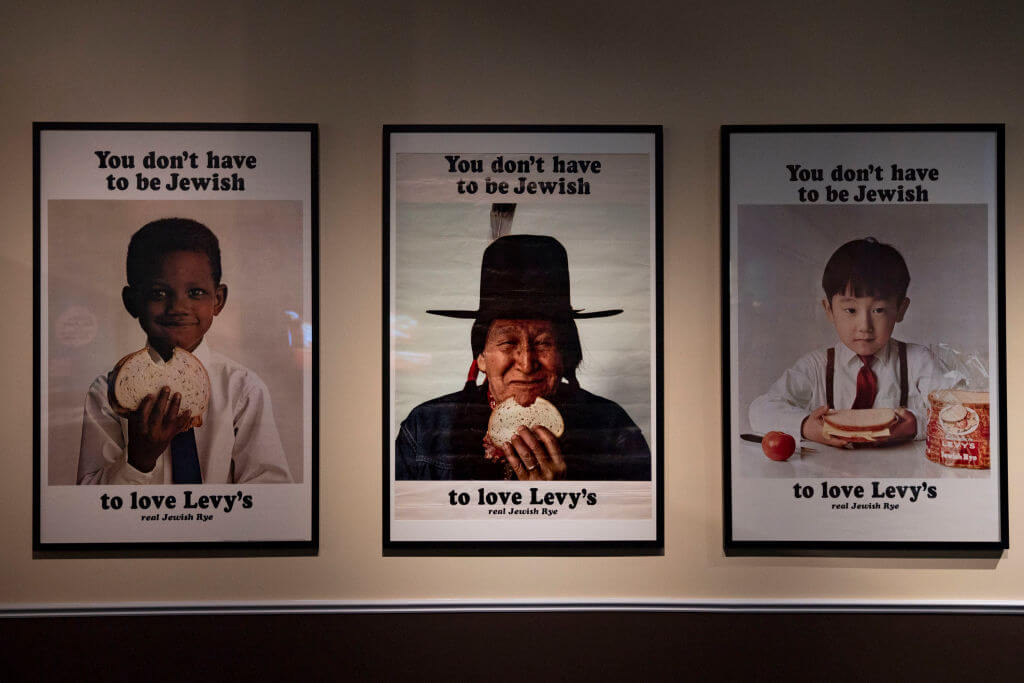
But he sees another problem. The word “Jewish,” Zwiebel says, “kind of implies there are certain foods which are reserved exclusively for Jews.” The current controversy reminds him of an iconic ad campaign, he says.
Starting in 1961, subway posters around New York showed an Italian grandmother, a Black child, an Asian kid and a Native American man, each enjoying a sandwich on Levy’s Real Jewish Rye, with the tagline: “You don’t have to be Jewish to love Levy’s.” The Brooklyn bakery had been losing customers as Jewish families moved to the suburbs. The campaign made Levy’s the top-selling rye in the city.

But Zwiebel takes umbrage with the larger concept. “Forget about the misleading nature that a phrase of ‘kosher style’ might be,” he says. “Jewish style is not so much misleading; it’s just deeply offensive.”
Offensive to whom, and why, depends on who you ask. And whether a deli can call itself Jewish without being kosher has been a fight for a long time.
‘A secular synagogue’
Ask people who’ve spent their careers thinking about Jewish delis what they make of the New Jersey news, and the first response is surprise.
To Jeffrey Yoskowitz — host of the podcast Meet Me at the Deli and co-founder of Gefilteria, which reimagines Eastern European Jewish cooking — the notice “clearly comes from a place of ignorance or not understanding.”
To understand the fight, start with how the Jewish deli began. In the 1880s, a wave of Jewish immigrants from Eastern Europe began arriving on the Lower East Side. They borrowed the format of the German delicatessen to sell the foods they’d left behind. Pastrami came from Romanian Jews. But hot pastrami on rye, says Yoskowitz, “is an entirely American innovation.”
Then the deli became a place to sit. Yoskowitz says it turned into what’s sometimes called a “secular synagogue,” where immigrants could feel Jewish, speak Yiddish and become American at the same time.
Kosher was part of the story, never all of it. In 1915, New York amended its false-labeling law to punish fraud in the sale of kosher meat, but that didn’t solve the problem. According to “I’ll Have What She’s Having,” a traveling deli exhibit, an estimated 40 percent of the meat sold as kosher in New York in 1925 wasn’t. Meanwhile, delis multiplied. By the early 1930s, the city had roughly 5,000 of them.
Lara Rabinovitch, who was a co-curator of the exhibit, isn’t sure the question can be answered. To really answer it, she says, “you have to get to the question of what is a deli, what is Jewish? What do those two words even mean?”
Rabinovitch has a PhD in Jewish food history from New York University. Back in grad school, her husband got tired of her long academic answers about her work and told her to “just say you have a PhD in pastrami.” The nickname stuck. She’s now Dr. Pastrami, and has a Substack newsletter.
The only part of the story that really troubles Rabinovitch is “whether the deli pays explicit homage to its namesake, the original Kibitz Room attached to Canter’s Deli” in Los Angeles. Missing that, she said, “would be a shanda.”
That Kibitz Room is a legend. It opened in 1961 as a cocktail lounge next to the dining room at Canter’s Deli. It has a full bar and a small stage, with live music or comedy most nights that often turns into a jam session by midnight. Everyone from Joni Mitchell to members of Guns N’ Roses and the Red Hot Chili Peppers has passed through. (Cowan, who founded the Cherry Hill Kibitz Room, says he was inspired by the Kibitz Rooms at Canter’s and at Attman’s in Baltimore.)

David Sax, author of Save the Deli, has been in the middle of this argument for years. He heard it constantly after his book came out, he says: deeply kosher people insisting a deli can only be Jewish if it’s kosher, and everyone else saying it’s Jewish if it serves kosher-style food.
“The same fight, the same battle, has been going on for the better part of a century,” he says. Can a deli be Jewish without being kosher? “Yeah, 100 percent.” Ban the non-kosher ones, he says, and you lose Katz’s, Carnegie, Canter’s and Langer’s, “almost every single famous and well-known Jewish deli” in the U.S.
“Does it make it less Jewish? Sure, if that’s your definition of Jewish,” Sax says. “But how do you define Jew? Who is a Jew?”
Brisket boosterism
By the second week of October, the notice to the Kibitz Room had found its way onto New Jersey 101.5, the statewide talk radio station, where host Bill Spadea spent most of his show pontificating about it.
Spadea grew up in Cherry Hill. Friday nights meant pizza from a shopping center in the Woodcrest neighborhood, next to a Jewish deli where his dad ordered the chicken livers and chopped egg. He admitted on the air that he had never been to the Kibitz Room. He wanted his listeners to go anyway. “Get them sold out today,” he said. Then, in case that was too vague, he added: Buy the brisket.
His theory of the case was that nobody was fooled. “No consumer was harmed in the creation of a kosher-style Kibitz menu item,” he argued. No observant diner, he figured, would see pastrami with Swiss and think they were in a kosher kitchen. A listener texted in that Little Caesars isn’t Italian food, it’s Italian-style.
Parish agreed with that logic. “When I go into an Italian restaurant, it doesn’t say ‘not authentic Italian American,’” he says.
What really got to him was the adjective. “You want a Jew to change his menu to not use the word Jewish,” Parish says. (The state isn’t asking the Kibitz Room to drop the word. It wants a disclaimer next to it.)
Parish says he is not planning to pay the penalty and that “a very powerful Washington D.C. law firm” will represent him at a hearing scheduled in the coming weeks.
To Parish, the notice didn’t arrive in a vacuum. He says it landed at a moment when Jews feel under threat, around the world but “especially in this country and in my community.” He says he has customers in Cherry Hill who have taken the mezuzahs off their doors “because they’re scared.” His daughter and son-in-law live on the Upper East Side, and the stories he hears from them about rising antisemitism in New York City are worse, he says.
So when the state investigator — who is Jewish — showed up to talk about his menu, Parish says he lost his temper. Echoing a quote from Israeli Prime Minister Menachem Begin, Parish says, “I’m not the trembling Jew. I’m not going to take this anymore.”
Which may explain the Kibitz Room’s Instagram bio, which now reads: “Not kosher. Still Jewish.”
The post This deli serves ham and calls itself Jewish. New Jersey says it’s not kosher. appeared first on The Forward.
Uncategorized
AIPAC to halt direct campaign contributions and candidate endorsements
(JTA) — The American Israel Political Affairs Committee has announced that it will no longer make direct campaign contributions or endorse candidates, instead focusing on mobilizing individual donors.
The pro-Israel lobby disclosed the change in a letter to its members on Wednesday, as first reported by Jewish Insider. The letter stated that the lobby would still operate its super PAC, the United Democracy Project, which was launched alongside AIPAC’s PAC in 2021, ahead of the 2022 midterms.
The strategy shift occurred in an increasingly tense environment in which AIPAC has become a boogeyman among many progressive politicians – particularly among members of the Democratic Socialists of America in their Democratic congressional campaigns.
“We will prioritize increasing direct, organized contributions from individual Americans to candidates – expanding upon our current efforts – and maximizing the emerging political fundraising tools,” the AIPAC letter stated.
“Endorsements, direct PAC contributions, and earmarking will no longer be part of our approach so we can expand individual giving and utilize new tools to help our friends win,” the lobby added.
The letter detailed the lobby’s accomplishments in this political cycle, saying it helped 290 pro-Israel candidates secure election wins nationwide and prevented 29 “detractors” from winning.
Looking ahead, the letter noted that “the 2028 cycle will demand an even stronger commitment by our activists to pro-Israel politics.” As a result, the lobby said it would be important to adopt new fundraising strategies and ensure that individual member contributions are being used as effectively as possible.
“Our mission and strategy remain the same,” AIPAC spokesperson Deryn Sousa told the Jewish Telegraphic Agency in a statement.
“Our goal is to build support for the U.S.-Israel relationship,” Sousa added. “AIPAC members gave more than $90 million directly to candidates this cycle, and that organized, direct giving from our members will continue and increase.”
This article originally appeared on JTA.org.
The post AIPAC to halt direct campaign contributions and candidate endorsements appeared first on The Forward.
Uncategorized
The missing ‘peace’ in Israel’s election campaign
(JTA) — JERUSALEM – There’s a short video clip that’s been circulating on Israeli social media channels in recent days showing a massive crowd of jubilant young Israelis at a music festival singing along on repeat to “The Song of Peace.”
The scene, using an anthem forever associated with assassinated prime minister Yitzhak Rabin and the peace momentum that surrounded him in the 1990s, feels ironic today. As Israelis prepare to vote on Oct. 27, peace – the idea at the heart of the song and that was once at the heart of the political debate in Israel – is strikingly absent this time around.
More than three years of war have reshaped the country, but few candidates are offering a vision for relations with the Palestinians, let alone a path toward resolving the conflict.
Meanwhile, rising settler violence in the West Bank and mounting international pressure to resolve the decades-old intractable conflict with a two-state solution are making the costs of that political silence increasingly difficult to ignore.
“Objectively, this is just not the main issue in this election,” Prof. Gideon Rahat, a political scientist at Hebrew University of Jerusalem, told the Jewish Telegraphic Agency in a recent interview.
In contrast to the years leading up to Rabin’s assassination in 1995 – and even those that followed – the divisions in this election have little to do with the question of peace with the Palestinians.
Rather, said Rahat, they are more about the fundamentals, the future character of the state and security. For the past four years, the government under Prime Minister Benjamin Netanyahu has sought to overhaul the country’s judiciary, while a burgeoning ultra-Orthodox population has avoided compulsory military service even though Israel has been fighting a relentless war on seven different fronts.
And while there has been an attempt by Netanyahu’s ruling Likud party to frame the debate as one between right-wing and left-wing, pro-and-anti-Palestinian statehood, Rahat said this was misleading.
Most of the parties making up the opposition – those seeking to oust Netanyahu and the current government – are a mix of center-right and right-wing parties. Only one Jewish party in the bloc, the Democrats, appears open to addressing the Palestinian issue.
Rahat pointed out that Hamas’s attack on Israeli civilian communities in southern Israel and at a music festival had served to harden even those who previously thought a peaceful solution with the Palestinians might be possible.
Surveys published in recent years had already shown that support for a Palestinian state, or even a process to reach some kind of solution, had been steadily decreasing even before Oct. 7.
According to Tel Aviv University’s Peace Index, which has published regular data on Israeli attitudes toward peace with the Palestinians since the first Oslo Accords were signed in September 1993, in July this year only 29% of the Jewish public in Israel now supports any form of negotiations with the Palestinian Authority, the Palestinian leadership governing the Palestinians in the West Bank.
Broken down into right-wing vs. left-wing voters, the divisions on the issue of the peace process still appear to be sharp, with only 7% of those who identify as right-wing saying they support negotiations, compared to 83% of those on the left. Yet this is somewhat misleading as overall, the percentage of people who identify with views traditionally associated with Israel’s peace camp and the left has been steadily shrinking.
Following a historic low turnout for the two traditional left-wing parties, Labor and Meretz, during the last election in 2022, the two factions joined forces to form The Democrats, now headed by former IDF general Yair Golan. And while the Democrats believe in pursuing separation from the Palestinians through a diplomatic and regional process, Golan has refrained from talking about the position throughout the election campaign.
Additionally, former prime minister Yair Lapid, who heads the center-left Yesh Atid Party and has stated in the past that he supports a two-state solution for Israelis and Palestinians, has cooled on the idea.
He has teamed up with former prime minister Naftali Bennett, who is emphatically against the concept of two democratic states side by side, and is saying that the Hamas attack had postponed the possibility of Palestinian statehood at least for now.
“I don’t think the idea is dead. I think it will be delayed significantly because we need to find ways to secure the safety of our people,” Lapid reportedly said in an interview to a London-based Saudi Arabian newspaper in December 2023.
On the issue of settlements in the West Bank, recent surveys show that the majority of Israeli Jews support the concept. A poll published by the Israel Democracy Institute this month shows that around 55% of Israeli Jews support the policies of various governments to allow, and even encourage, the establishment of settlements. Only 32% think that settlement expansion was not correct, the research found.
While the question of peace with the Palestinians — and the possibility of a nation-state for them in Gaza or the West Bank, which many Israelis refer to by its biblical name of Judea and Samaria — is not being discussed on the political level, violent events in that contested area are becoming increasingly hard to ignore.
On Friday, Heidi Levine, a photojournalist with The Washington Post, was brutally attacked by masked settlers, as shown in video footage. And on Saturday, a group of European diplomats said they were similarly attacked. Both incidents took place as Palestinian farmers harvested their olive crop.
An influential rabbi associated with far-right Israeli Minister of National Security Itamar Ben-Gvir had issued an edict that Jews were permitted to attack Palestinians and take their olives to “demonstrate our ownership of the land.”
Palestinians, Rabbi Dov Lior, the former chief rabbi of Kiryat Arba wrote in a decree, had “stolen land in their hands,” and really it belongs to Jews.
The phenomenon of Israeli settlers attacking Palestinians is not new, but, according to human rights organizations and the United Nations, it has increased in frequency since Oct. 7. Ben-Gvir, who oversees the Israel Police has struggled, along with the military, to maintain law and order.
The violence has resulted in multiple deaths. Several governments imposed sanctions on individuals and organizations linked to settler violence. Netanyahu continues to insist that it is only a handful of disorderly youths who are responsible for the disorder.
The increasing violence has drawn condemnation from Netanyahu’s rivals and even some who support him.
Gadi Eisenkot, the former military chief, whose party Yashar leads the opposition bloc, described the attacks, in a post on X, as “Jewish terrorism, under the auspices of the Israeli government.”
He said it was “burning away the little legitimacy the state of Israel still possesses.”
Avigdor Liberman, a former defense minister under Netanyahu who is now running as part of the opposition bloc, also criticized the violence, saying it was “wiping out Israel’s last bastions of support in the United States and around the world.”
“Bibi is putting out statements in English, but the defense minister, and the national security minister are doing nothing to stop this madness,” Liberman wrote on X, referring to Netanyahu by his nickname.
“In the end, the damage is first and foremost to the State of Israel and the settlement enterprise. This just proves that Bibi doesn’t care about the country — he only cares about staying in power,” he wrote.
Israeli journalist Amit Segal, known for being pro-Netanyahu, wrote on X that the violence had caused great damage to Israel’s standing among its greatest friends.
Ilana Shpaizman, a senior lecturer in the department of political studies at Bar-Ilan University, said that the flare-up in violence was putting the Palestinian issue back in the spotlight in Israel and beyond.
“For many years or even decades Israeli policy in the West Bank was carried out quietly … It wasn’t like people didn’t know what was going on, but they tried to promote it as quietly as possible to maintain legitimacy to the settlement project,” she said, adding, “When we look at what has happened over the last couple of days, not only has the international community condemned it, but also Israeli politicians.
“People are starting to realize that this government’s support in the West Bank has become very dangerous,” Shpaizman said.
It’s not just Netanyahu, she said – the so-called “change” government that was in office between 2021 and 2022 also failed to address the Palestinian issue.
Shpaizman said that Netanyahu was known for being indecisive and reluctant to address the Palestinian issue, and Bennett and Lapid’s slogan was about addressing the only issues that could be solved and leaving the tougher question of peace with the Palestinians to a later time when other, domestic rifts were resolved.
But, she said, the Palestinian issue is the most explosive issue and one that “cannot be ignored for a long period of time.”
Rahat said the rising tensions in the West Bank and the increasing international pressure, which will likely rise if Netanyahu’s government retains power, could end up forcing a solution, or at least putting the Palestinian issue back on the agenda.
This article originally appeared on JTA.org.
The post The missing ‘peace’ in Israel’s election campaign appeared first on The Forward.
