


Uncategorized
What is flydubai and will it continue to link Israel and the Emirates?
(JTA) — TEL AVIV – The apparent hijacking attempt aboard flydubai Flight 1073 has put a spotlight on the Emirati airline, which has become a main air link connecting Israelis to the rest of the world.
The incident could also test the relationship between Israel and one of the airlines that has come to symbolize the ties forged by the 2020 Abraham Accords, in which the United Arab Emirates was one of a small number of Arab countries that recognized Israel.
Flydubai, a Dubai government-owned airline, began operating in 2009 and launched regular flights to Israel in 2020, shortly after the UAE and Israel established diplomatic relations.
When war broke out in Israel in October 2023, many foreign airlines suspended flights to the country for extended periods. Flydubai and other UAE airlines continued operating flights to and from Israel through much of the conflict, providing an important connection for Israelis seeking to travel abroad at a time when international air service to the country was severely reduced.
The airline has also become an important hub for Israelis traveling beyond the UAE itself. Through Dubai, passengers can connect to destinations across Asia, Africa and other regions. The airline operates dozens of flights between Tel Aviv and Dubai each week.
According to Ben Gurion Airport data for August, flydubai carried roughly 90,000 passengers during the month. Since the beginning of 2026, more than 420,000 passengers have flown with the airline to or from Ben Gurion, accounting for roughly 4% of the airport’s international passenger traffic and placing it third among international airlines operating at the airport by passenger volume.
The incident aboard Flight 1073 could now put that relationship under scrutiny.
Israel’s Transportation Minister Miri Regev has reportedly asked Prime Minister Benjamin Netanyahu to immediately suspend flydubai flights to Israel until the circumstances of Wednesday’s incident are clarified, according to Israeli news outlet Ynet.
Regev said flydubai had violated the countries’ aviation agreement, which she described as requiring pilots operating flights to Israel to be citizens of countries with which Israel maintains diplomatic relations. Israeli and international media have reported that the co-pilot who instigated the incident was an Omani national.
Former Israeli Ambassador to the UAE Amir Hayek pushed back against calls to suspend the flights, however. In a post on X, Hayek wrote that flydubai and Etihad were the only two airlines in the world that continued flying to Israel “even during the most difficult times,” and argued that the UAE and the airline should be allowed to fully investigate what happened rather than face action based on speculation.
“I trust them,” he wrote.
The episode comes as Flydubai continues to expand its global network. The airline said this month that it was operating an average of 2,200 flights a week and serving more than 125 destinations in 56 countries. Its partnership with the major airline Emirates gives passengers access to a combined network of more than 214 unique destinations in more than 100 countries, with more than 4,600 possible connections through Dubai.
This article originally appeared on JTA.org.
The post What is flydubai and will it continue to link Israel and the Emirates? appeared first on The Forward.
Uncategorized
In this Florida district, politicians battle over who most loves Israel
(JTA) — BOCA RATON, Fla. — Rep. Jared Moskowitz said that he is “proud to be known as the most pro-Israel Jewish Democrat in Congress” during a synagogue event in one of the country’s most Jewish congressional districts on Tuesday evening.
The comment came during a one-hour candidates’ forum featuring Moskowitz and his Republican challenger, Scott Singer — both Jewish and both wearing kippahs — that largely centered on Israel and got testy at moments.
Moskowitz said he is “proud to have AIPAC’s endorsement” at a moment when the popularity of Israel and the pro-Israel lobbying group AIPAC has plummeted among Democratic voters amid Israel’s military campaign in Gaza and the war with Iran.
But the crowd at the Reform synagogue Congregation B’nai Israel in Boca Raton was, like Florida’s 25th Congressional District itself, split across party lines, and staunchly pro-Israel.
“This isn’t New York, this isn’t Boston — this is South Florida,” attendee Edward Kone told the Jewish Telegraphic Agency.
Moskowitz had soundly defeated democratic socialist challenger Oliver Larkin, a sharp Israel critic, in August. As Democrats look to take control of the House of Representatives, Florida’s recently redrawn 25th Congressional District — which would have favored Trump by 9 percentage points in 2024 but backed Joe Biden in 2020 under its new boundaries — is being closely watched ahead of the Nov. 3 midterm elections.
Despite some tense moments between Moskowitz and Singer, who was Boca Raton’s mayor until earlier this year, the two politicians have been largely aligned on the issue of Israel.
Both have condemned accusations that Israel has committed genocide against Palestinians in Gaza. They each oppose any effort to condition or cut off U.S. military aid to Israel. Both supported Israel’s strikes on Iranian facilities in 2025, though Moskowitz has since called for the U.S. to end its war with Iran.
Moskowitz referenced his and Singer’s shared pro-Israel viewpoints on Tuesday during the forum moderated by South Florida Sun Sentinel journalist Anthony Man.
“This is exactly why nothing gets done in Washington. This is exactly why nothing is functioning: Because literally two people who agree on 99% of this stuff want to take this 1% and try to ram it down people’s throats,” Moskowitz said.
Singer, however, made a point of emphasizing where the two candidates differ on Israel. He criticized Moskowitz for voting for the March 2026 war powers resolution in response to the Trump administration ordering strikes on Iran without congressional authorization. While Moskowitz has called for the administration to end the war, Singer argued that the threat of Iran must be thoroughly dealt with. “We have to ensure victory here,” he said.
For siblings Edward and Susan Kone, both Jewish Republican voters who attended the forum, Moskowitz’s record on Israel does not stack up against Singer’s positions. They, too, criticized Moskowitz for voting to end the Iran war, and for his 2023 vote to keep Minnesota Rep. Ilhan Omar on the Foreign Affairs Committee.
“I’m America first, but Israel is extremely important to me. And on Israel, Jared Moskowitz just doesn’t add up,” Edward Kone said. Omar is among a number of pro-Palestinian Democrats whom Republicans say are leading the party’s left-wing flank in turning it against Israel..
Singer himself blasted Moskowitz for his vote against removing Omar, and tied Moskowitz to the left flank of the Democratic Party.
“The strategy is adjective, verb, Ilhan Omar, I got it. Let’s move onto the next topic,” Moskowitz responded, drawing some groans from the audience.
Others in the room had voted for Moskowitz in previous elections, and said they were likely to do so again, at least in part because of his Israel stance.
“He has a good track record with Israel, and as an American Jew I appreciate that,” said Peter Davidson, an independent who is a member of Congregation B’nai Israel.
Moskowitz pointed to his endorsement from AIPAC and Singer’s lack of an endorsement from Rep. Randy Fine, a fellow Jewish Republican from Florida, as evidence that he is seen as satisfyingly pro-Israel across parts of the political spectrum. He also pointed to a post on X by Jeff Miller, an RJC board member, who wrote that he has “zero interest in tearing down one of the few Democrats left willing to stand unapologetically with America and Israel.”
“They’re staying out,” Moskowitz said. “They’re specifically saying, ‘We’re not going to oppose Jared Moskowitz because of his record fighting antisemitism and fighting for the State of Israel.’”
Singer has the endorsement of the RJC as well as Trump. He admitted during the forum that he had reached out to Fine for an endorsement and was rejected.
Earlier this year, Singer downplayed anti-Israel trends on the right as “a few fringe commentators” who are out of step with Trump. Moskowitz challenged him to name three of those figures: Tucker Carlson, Candace Owens and Florida gubernatorial candidate James Fishback.
Singer named all three and said “I gladly, shamelessly condemn” them, but countered that Democrats are voting in anti-Israel voices while Republicans cast theirs aside.
Man also asked Singer about President Donald Trump’s use of the term “Shylock” on Monday, a term that references a character from the play “The Merchant of Venice” which is rooted in an antisemitic trope.
“I think that’s an ill-advised term,” Singer said, before pivoting to praise of Trump and urging the audience to focus on what the president has done for Israel rather than his choice of words..
“‘Merchant of Venice’ happens to be my favorite Shakespeare play. That term has multiple meanings. But let’s look at the real record beyond an offhand comment: No president has been better for the State of Israel than President Trump,” Singer said, drawing applause.
As for the upcoming Israeli elections — which Trump recently weighed in on — Singer told reporters after the event that he was too busy with his own race to make endorsements and does not have a preferred candidate.
“To be candid, I have some awareness of it, but I’m not following it intently,” he said.
Singer’s attacks on Tuesday often focused on Moskowitz’s Democratic Party, which he says will drown out the congressman’s pro-Israel views as it takes its cues from its left-wing flank. He pointed to Moskowitz’s quote from last month, when he said that pro-Israel voices are being “ostracized” in the party.
“It’s great that he says these things, but he’s also voted to empower Ilhan Omar twice,” Singer said. “He’s tried to go along to get along with the Squad, and it’s not working.”
But for some in the crowd, that attack didn’t quite land.
Davidson, an independent, said he is “not a great fan” of the Democratic Party. But for him, Moskowitz is an exception.
“He’s more of an independent thinker,” Davidson said. “Crosses a lot of party lines.”
This article originally appeared on JTA.org.
The post In this Florida district, politicians battle over who most loves Israel appeared first on The Forward.
Uncategorized
Brad Lander detained by Israeli police in the West Bank while helping Palestinians harvest; dozens of rabbis and activists arrested

Dozens of Israeli and international activists, including U.S. congressional candidate Brad Lander, were detained by Israeli authorities in the occupied West Bank on Wednesday morning while accompanying Palestinian farmers harvesting olives. After Landers was released, the Israeli activists were later placed under arrest, and the foreign citizens were reported to be awaiting interrogation.
The delegation was hours into their work when they were told they were unlawfully inside a closed military zone, according to Anton Goodman, acting CEO of Rabbis for Human Rights. Authorities detained the group even after he agreed they would leave immediately, he said.
Goodman told the Forward that 42 Israeli members of his delegation and another 28 foreign citizens were being held at the police station in nearby Beitar Illit.

“Those of us with Israeli citizenship are being detained outside of the police station,” Goodman said by phone while he was detained. “The foreign passport holders have been separated from us, and I have been told by a senior security officer that they will be interrogated by Army personnel.”
Shorty after speaking to Goodman, Tamar Glezerman, an activist from New York who holds Israeli citizenship, informed the Forward that the detainment had been converted to arrests “because you cannot detain people for more than three hours.” Glezerman also said the foreign citizens had been taken to a military base for interrogation.
According to Goodman, the delegation was helping Palestinians who have faced severe restrictions on access to their land since Oct. 7, 2023, when authorities informed the group that the area had been declared a closed military zone.
“There is no possible way we could have known that this morning,” Goodman said. “And even so, I told them we would respect the decision and leave immediately.
“But that was not good enough for them,” he continued. “I was informed that the entire group was being detained for ‘identification purposes.’”
At the time of the interview, Goodman said, only Lander had been released. The others remained detained, including a Palestinian woman whose family owned the olive grove where the harvest took place. Lander, a progressive Democrat running for Congress this year, has been vocal in his criticism of both settler violence and Israel’s actions in Gaza.
Rabbi Jill Jacobs, CEO of T’ruah: The Rabbinic Call for Human Rights, also confirmed that she and dozens of other Americans, along with Canadian and British citizens, had been detained, their passports confiscated. They were being taken by bus to the same police station, she said at the time.
“There is a Jewish principle of accompaniment of those in danger,” Jacobs told the Forward. “We were living that out, in contrast to the settlers who justify stealing olives and carrying out violent acts contrary to Jewish law.”
Despite the uncertainty over what would happen to her delegation, Jacobs said they remained in good spirits.
“We are currently on the bus saying divrei Torah and singing niggunim and religious songs,” she said, referring to Torah teachings and wordless melodies.
“It is a sad comment on the current state of Jewish affairs that they are arresting rabbis picking olives, and not the settlers who steal them, poison trees, and violently attack human beings,” Jacobs added.
The detentions follow an especially brutal week in an already escalating wave of settler violence in the West Bank. On Friday, settlers severely beat Washington Post photojournalist Heidi Levine while she covered the olive harvest in Abu Falah, leaving her with fractured vertebrae and a broken rib. The following day, settlers attacked a delegation of European diplomats and other visitors near Taybeh. Palestinian residents have also faced repeated assaults, with dozens reported injured, several seriously.
Goodman called the mass detention “insane,” criticizing both its scale and the deployment of security forces against volunteers.
“This is the largest mass detainment we have ever seen,” he said. “But it’s not just that. All across the West Bank we have seen a complete deterioration of the rule of law as settler terrorists rampage through Palestinian villages with little consequence or deterrent. Now you have a completely peaceful delegation who are only here to help with the olive harvest and 100 security personnel are dispatched to detain them?
“What a complete and utter waste of public resources.”
The post Brad Lander detained by Israeli police in the West Bank while helping Palestinians harvest; dozens of rabbis and activists arrested appeared first on The Forward.
Uncategorized
Christiane Amanpour exits CNN with a legacy shaped by the debate over Israel
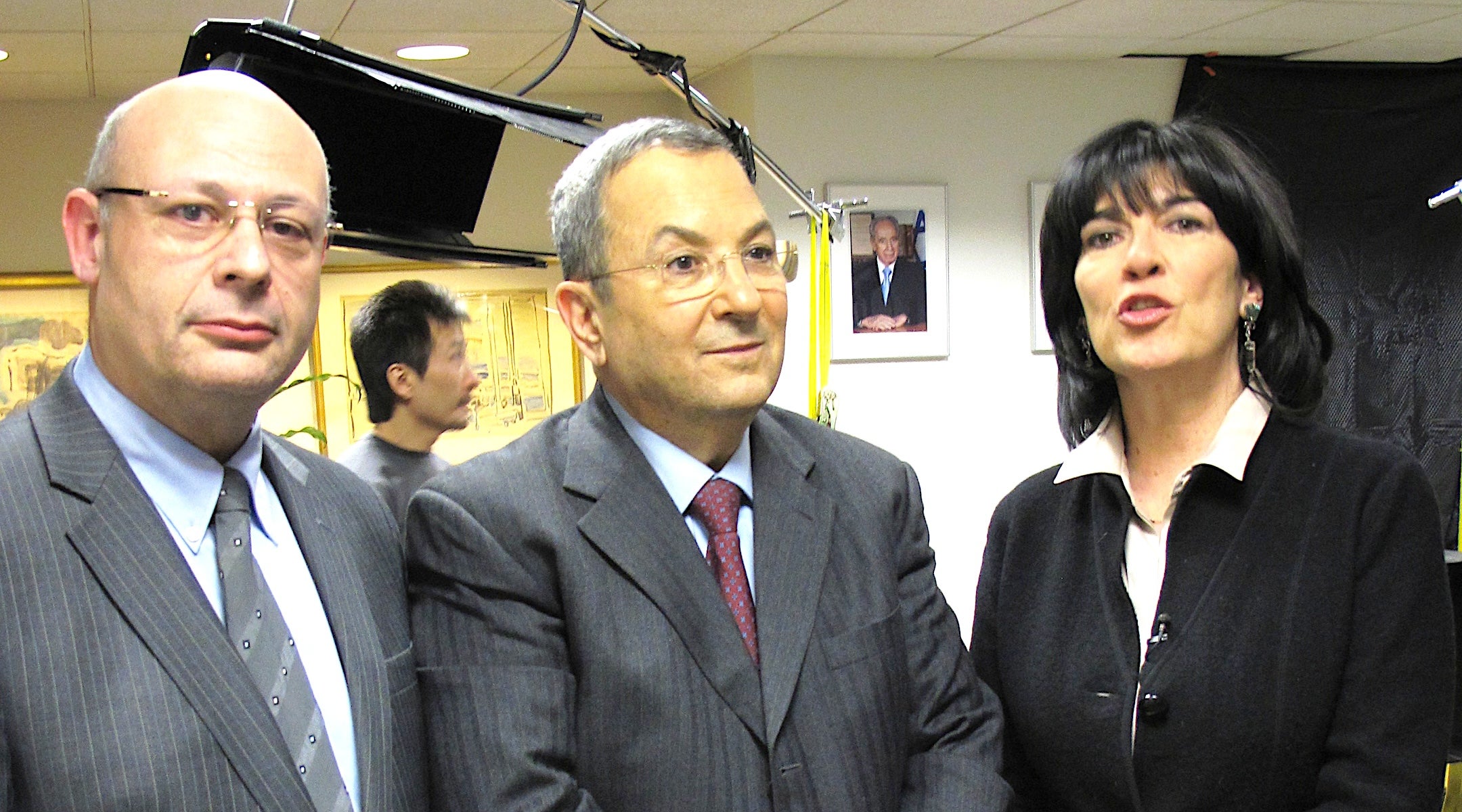
(JTA) — Christiane Amanpour, CNN’s chief international anchor, is leaving the network after 43 years, closing a chapter in a career that made her one of television journalism’s most celebrated war correspondents — and one of its most controversial figures among Jewish and pro-Israel viewers.
For many viewers, Amanpour’s legacy is that of a fearless correspondent who brought the human costs of war into American living rooms, from the first Gulf War to Bosnia, Rwanda and Ukraine.
But her coverage of Israel and the Palestinians has long drawn sharp criticism from some Jewish viewers, who accused her of giving insufficient weight to Israeli security concerns, mischaracterizing events and disproportionately presenting Israeli religious nationalism in an especially unflattering light.
Amanpour, 68, announced Monday that she will wind down her daily CNN International program early next year, conclude its weekly successor in May and leave the network in June 2027. Her PBS program, “Amanpour & Company,” will end at the close of this year. However, she will continue her podcast, “The Ex Files,” with her ex-husband, Jamie Rubin, a former State Department official.
Amanpour did not give a specific reason for her departure, which comes as CNN enters a new era under Paramount Skydance ownership.
“Always be truthful, not neutral,” Amanpour wrote in her farewell message, summing up a philosophy that has animated her reporting — and helped make her a polarizing figure.
Amanpour’s admirers would argue that the same qualities that make her coverage uncomfortable for some Jewish viewers — skepticism toward official accounts, attention to civilian suffering and willingness to challenge powerful governments — are essential to journalism.
When the National Press Foundation honored her in 2025 with its Sol Taishoff Award for Excellence in Broadcast Journalism, its judges called her “a gold standard for international broadcast journalism” and praised her tough questioning of world leaders. The Committee to Protect Journalists, which honored her in 2016, likewise celebrated her commitment to press freedom.
Amanpour, who was raised in Iran and England by her Iranian Muslim father and British Roman Catholic mother, joined CNN in 1983 as a desk assistant and rose through the ranks to become one of its most prominent correspondents. Her reporting from the Bosnian war in the 1990s helped establish her reputation for confronting officials and challenging the language governments use to justify military action.
Some of the sharpest criticism of her work came in 2007, when Amanpour hosted “God’s Jewish Warriors,” the opening installment of a three-part CNN documentary series examining the role of religion in politics and conflict.
Andrea Levin, president of the Committee for Accuracy in Middle East Reporting and Analysis, or CAMERA, condemned the program as a biased portrayal of Jewish religious life and Israeli settlers. A 2010 Jewish Telegraphic Agency commentary revisited the controversy, with Ron Kampeas noting that “the only explicitly religious people she interviewed were ultranationalist settlers,” and that Amanpour ignored religious Jews who opposed the settlements.
Kampeas also said the program’s treatment of the pro-Israel lobby in Washington exaggerated the power of groups like AIPAC and downplayed the shared strategic and moral imperatives that drove the U.S.-Israel alliance.
“God’s Jewish Warriors” became Exhibit A in the case against Amanpour’s work. Legitimate criticism of Israeli policy, her detractors asserted, was framed in a way that left Jewish viewers feeling that Jewish religious identity, political advocacy or national aspirations were inherently suspect.
Reporting from Lebanon during the 2006 war between Israel and Hezbollah, Amanpour was part of a CNN team whose work rekindled a longstanding debate over how journalists should cover conflicts in which a state military fights an armed group embedded in civilian areas.
Even as Amanpour at times acknowledged the difficulty of covering such “asymmetrical warfare,” Israeli officials and supporters argued at the time that images of destruction and civilian suffering in Lebanon obscured Hezbollah’s role in initiating and sustaining the conflict. Those objections anticipated similar complaints, aimed at CNN and other outlets, over coverage of Israel’s devastating war in Gaza after the Hamas attacks of Oct. 7, 2023.
Critics have continued to document what they see as a pattern. CAMERA has maintained a collection of complaints about Amanpour’s reporting, while HonestReporting, another pro-Israel media-monitoring organization, has accused her of repeated anti-Israel distortions.
Although both organizations have a clear advocacy perspective, they often provide specific examples of errors, and often extract corrections.
One example came in April 2023, when Amanpour described the killing of Israeli Lucy Dee and her daughters Maia and Rina in a Hamas-linked West Bank terrorist attack as a “shootout.” The women were driving on a highway when Palestinian gunmen opened fire on their vehicle. Amanpour subsequently apologized on air for her inaccurate characterization.
In 2024, Amanpour also drew criticism for a social media post about Marwan Barghouti, the imprisoned Palestinian political leader convicted by an Israeli court of involvement in deadly attacks. “To many Israelis, he’s a terrorist. To many Palestinians, he’s their Mandela,” she wrote.
The comparison accurately captured Barghouti’s sharply different reputations among Israelis and Palestinians, but critics argued that it risked reducing the gravity of the attacks for which he was convicted.
Complaints about CNN’s Gaza coverage gained a striking new dimension in February 2024, when Amanpour reportedly joined CNN colleagues in accusing the network of a pro-Israel bias in its coverage of the Israel-Hamas war.

According to reporting by The Intercept and The Guardian, journalists at an internal CNN meeting raised concerns that the network’s editorial procedures were favoring official Israeli narratives and making it harder to convey Palestinian perspectives. CNN’s process required coverage of the conflict to pass through its Jerusalem bureau; Amanpour was heard on tape saying that the process led to “changing copy, double standards, and all the rest.”
At the same time, some pro-Israel viewers saw CNN and Amanpour as too willing to accept Palestinian claims and too quick to foreground Gaza’s devastation.
In response to the reports, CNN defended its coverage of the conflict. “We remain absolutely committed to reporting all sides of this immensely challenging, complex and emotive story,” it said in a statement. “We absolutely reject the notion that any of our journalists treat Israeli officials differently to other officials.”
Amanpour again apologized on air in October 2025 for having said that surviving Israeli hostages released from Hamas captivity were “probably being treated better than the average Gazan, because they are the pawns and the chips that Hamas had.” Following backlash from political figures and organizations, Amanpour retracted the statement, calling her remarks “insensitive and wrong.”
Last month, in a rare long-form interview about her career with the podcaster Sam Fragoso, Amanpour discussed CNN’s coverage of the Gaza war. In the immediate aftermath of the Oct. 7 attacks, she said, the network was “practically wall to wall with horrendous stories from the victims in Israel. I mean, just horrendous.”
But as Israel’s military response ground on, “the story flipped,” she said. “As the destruction of Gaza took place and the bodies piled up, most particularly the women and the children, the tone of the coverage reflected the reality.” At the February 2024 meeting with CNN executives, she said, her colleagues expressed frustration that the network took too long to cover the Palestinian side.
In the same interview, Amanpour also walked back an apology she made in 2020 — not about CNN’s Mideast coverage, but for a commentary on the 82nd anniversary of the Kristallnacht attacks. In that segment, she juxtaposed the Nazis’ anti-Jewish pogrom with what she called President Donald Trump’s “attacks on history, facts, knowledge and truth.” After Jewish groups, including the American Jewish Committee, complained that she had “instrumentalized” the Holocaust with a faulty comparison, Amanpour said on air that she regretted any pain her statement may have caused.
Speaking last month with Fragoso, Amanpour said that she stands by her assertion that Kristallnacht demonstrated how quickly “democratic values can slowly slip away.” She also suggested that her employers had bowed to outside pressure and instructed her to apologize.
“There were people, you know, in various communities in regard of this,” she said, referring to her critics, “who decided that I need to be slapped around and pull[ed] down a peg. But I think that’s just because some people are afraid of the truth.”
Amanpour’s departure comes at a moment of uncertainty about CNN’s future under its new corporate owner. Paramount Skydance’s $110 billion merger with Warner Bros. Discovery, CNN’s parent company, has raised concerns among journalists about political influence and editorial independence, particularly given new owner David Ellison’s ties to Trump and the changes he has overseen at CBS News.
Amanpour herself expressed concern in May about what she called an “ideological realignment” at CBS News under its new leadership. “So clearly, obviously, I’m concerned,” she said, speaking at an investigative journalism conference in London. “I would like to think that we would have the very basic, which is editorial independence. I’m hoping for that. I know many of us at CNN are incredibly — including leadership — are very, very committed to that, clearly.”
For some Jewish and pro-Israel observers, however, the same changes have raised hopes that CNN’s coverage of Israel might become more favorable. Bari Weiss, who became CBS News editor in chief after Paramount acquired her strongly pro-Israel publication, The Free Press, has long argued that mainstream news organizations have mishandled Israel and antisemitism.
Amanpour didn’t mention the merger in her announcement. But she noted how her background shaped her perspective.
“Because of my upbringing — I’m half-Iranian and half-British — I’ve had the great privilege of being able to see the world from two very distinct perspectives,” she said. “I’ve always spoken out about the need to bridge gaps. I know we can live in a world that’s not 100% tribalized.”
This article originally appeared on JTA.org.
The post Christiane Amanpour exits CNN with a legacy shaped by the debate over Israel appeared first on The Forward.
