


Uncategorized
When Famine Vanished: How the Media Repeated a Claim, and Never Reckoned With Its Collapse

Trucks carrying humanitarian aid and fuel line up at the crossing into the Gaza Strip at the Rafah border on the Egypt side, amid a ceasefire between Israel and Hamas in Gaza, in Rafah, Egypt, October 17, 2025. Photo: REUTERS/Stringer
CNN delivered the update quietly and inaccurately, with much less gravity than it once used to amplify the warning.
“Gaza no longer in famine,” read a CNN post, citing a UN-backed hunger monitor.
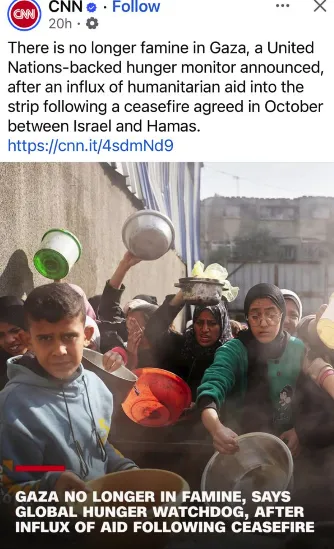
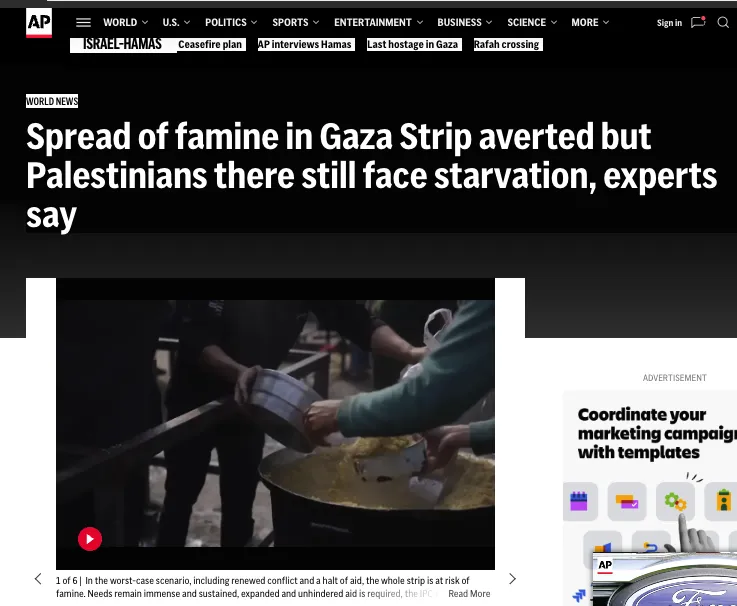
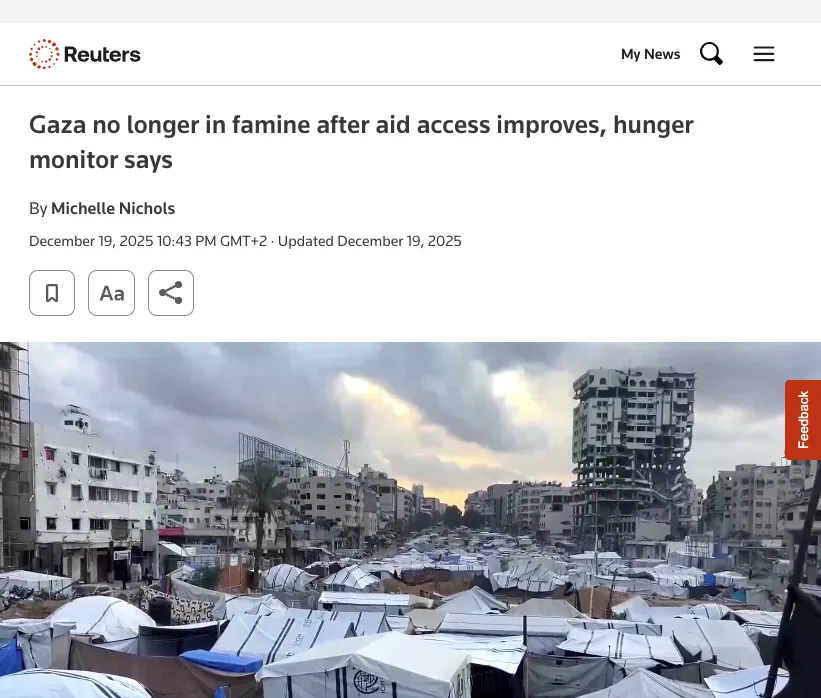
Reuters and the Associated Press followed with similar headlines.
What is striking is not that the unreliable IPC, which has been criticized in the past for faulty methodology, revised its assessment.
What’s really upsetting is that much of the press treated the reversal as a weather update, not as a reckoning.
Only months earlier, these same institutions helped cement a very different narrative.
In late July 2025, UN agencies issued a high-profile warning that key indicators in Gaza exceeded famine thresholds, citing IPC data and describing hundreds of thousands facing famine-like conditions. The IPC alert itself stated that famine thresholds had been reached for food consumption in most of Gaza and for acute malnutrition in Gaza City.
In August 2025, the Food and Agriculture Organization of the United Nations (FAO) announced that famine was confirmed for the first time in Gaza, again anchored to IPC assessments.
Those claims ricocheted through global media coverage with little visible skepticism about methodology, access constraints, or incentives baked into a wartime information environment.
The result was a widely accepted narrative that Israel was causing famine, a narrative that shaped diplomatic pressure and public outrage long before the data could be stress tested.
Now the IPC’s latest assessment says no area has ever been in famine, attributing improvements to increased humanitarian and commercial food deliveries after the ceasefire, while warning that the situation remains fragile and could deteriorate again if access is disrupted or fighting resumes.
IPC’s latest fraudulent Gaza report implies 1,700+ starvation deaths this December 2025—even TODAY we should see 57 such deaths! But even Hamas reports only 475 total starvation deaths for the ENTIRE WAR. The math exposes how detached from reality all these models are. 1/ pic.twitter.com/wOvIohWTt2
— Aizenberg (@Aizenberg55) December 19, 2025
The AP at least gestured to the whiplash, noting that months earlier, the IPC said famine was occurring in Gaza City and was likely to spread without a ceasefire and an end to restrictions.
Reuters likewise framed the change as a shift from earlier IPC findings, while stressing continued emergency-level needs. But what was largely missing was the one ingredient journalism owes the public when an apocalyptic claim collapses or is materially revised: responsibility.
No media outlet interrogated the underlying assumptions when famine warnings were treated as settled fact. None explained what changed in the inputs and thresholds. None revisited the earlier certainty with the same prominence as the original alarm.
This matters because narratives do not stay on paper.
In the United States, the ADL has reported that anger at Israel during the war has been a driving force behind antisemitism, underscoring how the information ecosystem around Gaza can translate into real-world hostility toward Jews. When famine claims are amplified uncritically, they do not just inform. They inflame.
The new UN-backed update does not erase Gaza’s suffering, and it does not vindicate anyone’s politics. It does, however, expose a core media failure: outsourcing verification to a single authoritative label, and then moving on when the label changes.
If famine was once a front-page certainty, the correction cannot be a footnote.
The author is a contributor to HonestReporting, a Jerusalem-based media watchdog with a focus on antisemitism and anti-Israel bias — where a version of this article first appeared.
Uncategorized
VIDEO: A Hasid gives us a tour of Morocco in Yiddish
דער ירושלימער יוטוב־שטערן וועלוול קירשנבוים האָט לעצטנס אַרויסגעשטעלט אַ ווידעאָ אויף ייִדיש פֿון אַ פּרעכטיקן וויזיט, וואָס ער האָט געמאַכט אין מאַראָקאָ. עס באַגלייט אים זײַן חבֿר אַבֿרהם פּרץ.
אינעם ווידעאָ זעט מען ווי קירשנבוים דאַוונט שחרית מיט די אָרטיקע ייִדן און באַזוכט אַ גוט אָפּגעהיטענעם בית־עולם, וווּ עס ליגן באַערדיקט גרויסע צדיקים ווי למשל הרבֿ חיים בן עתר (1696–1743), באַקאַנט ווי דער „אור החיים“. „מענטשן מיינען, אַז נאָר אין אייראָפּע זענען דאָ קבֿרים פֿון צדיקים!“ זאָגט קירשנבוים.
מיר זעען אַ גרויסע, שיינע שיל מיט אַ פֿײַנער אַרכיטעקטור אין קאַזאַבלאַנקאַ; דעם גרויסן אַראַבישן שוק, וווּ קירשנבוים קויפֿט זיך אײַן מלבושים פּונקט ווי די מאַראָקאַנער גייען אָנגעטאָן. ער באַוווּנדערט אויך די שיינע טיי־גלעזער און טשײַניקן, וואָס מע פֿאַרקויפֿט דאָרט, און באַקענט זיך מיט אַ ייִדישן סוחר וואָס האַנדלט מיט זילבער און גאָלד, פּונקט אַזוי ווי זײַן טאַטע און זיידע האָבן געטאָן פֿאַר דור־דורות.
The post VIDEO: A Hasid gives us a tour of Morocco in Yiddish appeared first on The Forward.
Uncategorized
Conservative and Christian movies are coming for Hollywood
A star-studded new movie set in a Soviet prison is coming out in November. James Franco and Rob Lowe anchor the cast of Confession, playing a brutal prison guard and an imprisoned dissident professor, and a disheveled Nick Nolte appears as a fellow prisoner.
These actors were once huge gets, and their names could convey legitimacy to a project. Nolte and Franco both have received Academy Award nominations. Lowe was a member of the Brat Pack, and was a regular on The West Wing.
Confession, written by Ben Shapiro and produced by the rightwing tabloid-esque news site The Daily Wire, is not the expected fare for actors with that kind of name recognition; Shapiro’s screenwriting aspirations have been the target of ridicule for years.
Nevertheless, this isn’t the only Daily Wire production getting big names; Danny Trejo signed onto a pro-ICE movie about Minneapolis in the aftermath of the Renee Good shooting, and Jonathan Majors led Run, Fight, Hide: Infidels earlier this year.
Each one of these actors has been, in some way, canceled or in career doldrums so may have been more open to working with The Daily Wire. And some have claimed that they did not know who Shapiro was, or what his politics were; Trejo’s son, Gilbert, said his 82-year-old father did not endorse ICE and was misled about the movie before he signed his contract.
Movie studios have struggled through the pandemic and the streaming era, both of which have tanked box office receipts, leaving the field open for movies from offbeat production studios. In addition to The Daily Wire, there has been a whole ream of Christian movies attempting to shift the stereotype of bible movies — that they’re preachy, low-budget straight-to-TV affairs with cardboard acting — to something more prestigious, or at least profitable.
The Christian company Angel Studios has been placing screenings of the half philo-semitic, half-antisemitic Jesus TV series The Chosen in movie theaters across the country, produced the right-wing hit The Sound of Freedom and is pumping out faith-based movies like the animated King of Kings Christmas story and David, a kiddie movie about the biblical king. Recently, Pinnacle Peak Pictures, another faith-based production company, premiered Daniel and the Fiery Furnace, another bible movie that was notable enough to merit a review in The New York Times. (Though admittedly it wasn’t a particularly positive one.)
For decades, Hollywood, and the media industry at large, has been associated with liberalism, progressive politics and diversity. (This is part of why conservative conspiracy theorists often insist that Jews control the media.) Even when conservatives are in power, satirical movies have poked fun at the ruling class — Team America: World Police spoofed George W. Bush’s foreign policy, while M*A*S*H critiqued Richard Nixon. During the current Trump administration, we’ve seen One Battle After Another lambasting immigration policies and rising white nationalism, Eddington on misinformation and populism, and The Apprentice depicting Trump directly.
But a rising number of higher-budget, bigger releases from the right wing, whether The Daily Wire’s conservative political parables or the Christian fables, are bringing a new kind of messaging — about the importance of God and country, about gender roles, about about the centrality of Jesus to the U.S. — to the American movie-going public.
This is no accident. A group of powerful conservative Christians, many of whom worked on Project 2025, are proponents of the Seven Mountains Mandate, a blueprint for Christian nationalism that instructs Christians to gain influence and control over the “seven mountains” of society — which include media, entertainment and the arts. The Mandate is part of the New Apostolic Reformation, a decentralized evangelical movement embraced by millions of Americans.
Jeremy Boreing, the director of many Daily Wire movies — though he has since left the company — said on a podcast hosted by businessman Patrick Bet-David that “It had always been part of our strategy to move into making culture, not just criticizing culture” as a way of proving that “there is a future where conservatives aren’t losing. There’s a future where we have political power and cultural power.”
Cultural power, of course, requires more than just a lot of movies; they have to be well-done, or at least appear to be. Previous Daily Wire productions, as well as other right-wing, MAGA movie ventures, have been hacky. Lady Ballers, about an unsuccessful men’s basketball team pretending to be women so they can dominate the league, was an unsubtle, unfunny and ultimately unwatchable spoof of transgender athletes. And even plenty of higher-budget attempts, like Daniel and the Fiery Furnace, can still fall victim to wooden acting and writing.
But now, with the financial success of movies like The Sound of Freedom and biblical parables like The Chosen, bigger stars are being drawn to projects like the Daily Wire’s lineup of pro-ICE, anti-immigration and anti-LGBTQ movies. With those bigger stars may come new audiences who might not have watched a Christian movie or Daily Wire project otherwise. And where there is money and viewers, mainstream Hollywood will go, too, no matter how progressive people expect the industry to be. We’ve already gotten a biblical epic from Amazon Prime, with The House of David, and there are likely to be many more to come.
After all, it wasn’t so long ago, after all, that Cecil DeMille’s The Ten Commandments was the biggest movie in town.
The post Conservative and Christian movies are coming for Hollywood appeared first on The Forward.
Uncategorized
‘Heil’ Mary? New Atlanta Falcons logo inspires Nazi comparisons
If there was something off about the logo the Atlanta Falcons unveiled on social media Wednesday, whoever runs their accounts did, uh, not see it.
Behind the black falcon graphic that began appearing on the football team’s helmets in the 1960s was a new background — a flag of red, tan, black and white vertical stripes. To thousands of people who responded to the logo, it looked distinctly German — in a 1930s kind of way.
“The Atlanta Falcons are preparing to invade Poland,” one fan wrote.
A day after its posting, the new profile picture had unleashed a deluge of Nazi memes in the 4,000-plus replies on X. One picture swapped in the logo for Nazi flags in the background of a historical photo of a Hitler rally. Another edited the Falcon claw to look like a Nazi salute.
Others depicted Hitler in a Falcons cap, references to Inglourious Basterds and the Battle of the Bulge and a World War II joke invoking a blown lead in Super Bowl LI.
“Falcons were up 28-3 at Dunkirk,” that tweet read.
The Falcons’ snafu enters a small but growing catalogue of Reich-coded brand mixups. Who can forget the German national soccer team’s ‘44’ soccer jerseys? There was also the swastika-emblazoned Hallmark gift wrap; the accidental Hitler mugs; and (for my money) the worst of the bunch, Zara’s concentration camp uniform shirt.
All of those have been addressed; so far, the Falcons’ has not. We’ve reached out to them for comment.
The post ‘Heil’ Mary? New Atlanta Falcons logo inspires Nazi comparisons appeared first on The Forward.
